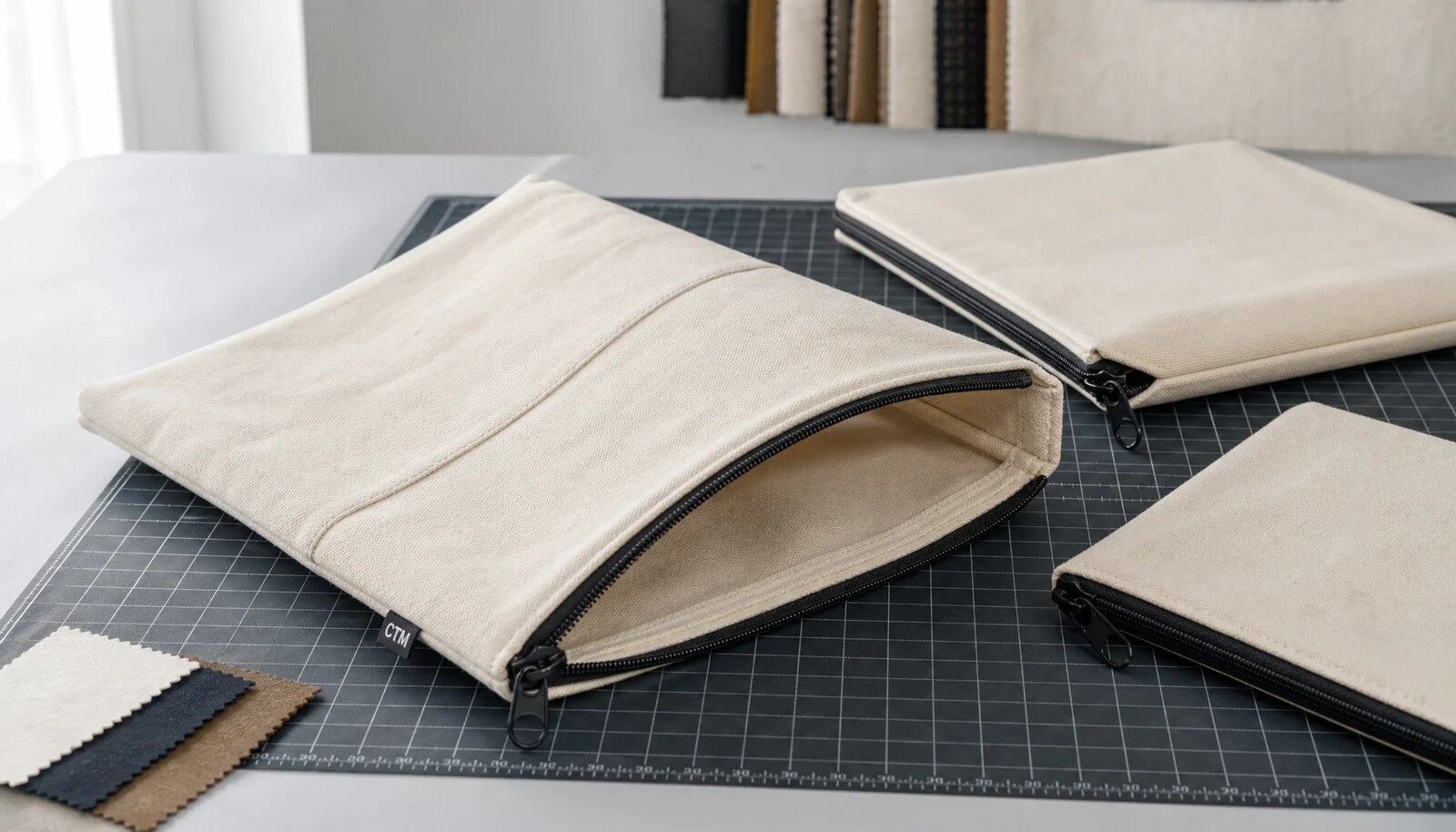
Start With the Craft Fair Use Case, Not the Product Name
A canvas zipper portfolio sounds simple until the order is split across vendor check-in desks, sponsor packs, maker workshops, resale tables, and registration kits. The same product photo can represent several different specifications. A flat pouch for two forms can be light, low cost, and easy to ship. A kit that holds booth maps, coupons, badges, postcards, catalogs, and a pen needs more clearance, stronger zipper-end sewing, and better loading performance. A resale portfolio sold at a craft fair booth needs cleaner stitching, controlled print placement, and packing that looks intentional.
Before sending an RFQ, write a short use-case statement. Who receives the portfolio? What goes inside? Will it be used once, handled for a full season, or sold as a branded accessory? Will your team pre-pack it before the event, or will the end user fill it at the booth? Those answers shape the canvas weight, size, zipper construction, decoration method, and inspection checklist.
This step also makes quote comparisons fair. One supplier may price a 10 oz flat canvas pouch with a basic zipper. Another may assume a 12 oz portfolio with reinforced zipper ends and individual sleeves. Both can call the item a canvas zipper portfolio, but they are not quoting the same product. Procurement teams save time when the use case is clear enough that the factory does not need to guess.
The load is the detail that matters most. Count the paper sheets, measure catalog thickness, include sponsor cards and badges, and note any hard objects such as pens, scissors, rulers, jewelry cards, swatches, or small tools. Then test the sample with that exact stack. Many zipper and corner issues do not show up when the portfolio is empty; they appear when staff load pieces quickly at a registration table or when customers handle them repeatedly at a booth.
- For vendor check-in kits, list booth maps, badges, coupons, sponsor cards, instructions, and any inserts packed before the event.
- For resale portfolios, treat zipper feel, print opacity, label placement, stitching cleanliness, barcode position, and individual packaging as product features.
- For sponsor giveaways, keep the construction straightforward and protect calendar time for logo color, placement, and approval.
- For workshop supply pouches, test pens, scissors, ruler edges, or tools for pressure points that may require a gusset or heavier canvas.
- For multi-event programs, consider one base construction that accepts different artwork versions without changing size, zipper, or packing.
Specify Canvas Weight, Finish, and Shade Control Precisely
Canvas weight drives cost, appearance, sewing difficulty, and lead time. For many wholesale canvas zipper portfolios for craft fairs, 12 oz cotton canvas is a practical baseline. It is typically around 380-410 GSM, gives better body than lightweight promotional canvas, and still sews cleanly around zipper edges. It works well for vendor document holders, registration packs, sponsor kits, and general branded portfolios.
A 10 oz canvas can be suitable when the goal is a lower-cost giveaway and the contents are light. It will usually feel softer, wrinkle more easily, and show insert shapes more than a 12 oz material. That may be acceptable for a one-event handout, but it may not satisfy a buyer planning retail resale or repeated seasonal use.
Heavier canvas, such as 14 oz or 16 oz, can create a more premium hand feel. It may be appropriate for maker resale items, workshop kits, or portfolios that will be opened and refilled many times. Still, heavier is not automatically better. Thick canvas increases sewing bulk, corner thickness, needle and thread requirements, carton weight, freight cost, and dimensional variation. It may also need stronger zipper-end reinforcement and a wider size tolerance.
Finish and color deserve the same level of clarity. Natural unbleached canvas is often simpler to source than custom dyed fabric, but shade variation, cotton flecks, and slubs are more visible. Bleached canvas gives a cleaner print background but can show handling marks. Washed or pre-shrunk canvas can improve hand feel and reduce shrinkage, yet it can add processing time and make size control harder. Dyed canvas may require lab dips, shade approval, and higher MOQ.
Do not approve a bulk order based only on the phrase cotton canvas. Ask for oz, GSM, fiber composition, finish, shade reference, and whether production fabric will match the approved sample lot. If several craft fair logos are produced in one program, ask whether all versions can be cut from the same fabric lot or whether shade variation will be controlled by an agreed standard.
- Use 12 oz cotton canvas at about 380-410 GSM as a balanced starting point for most craft fair portfolio programs.
- Use 10 oz when budget is the priority and the buyer accepts a softer, less structured product.
- Use 14-16 oz when premium hand feel, repeated use, or heavier insert loads justify higher cost and freight weight.
- Request oz, GSM, fiber composition, finish, approved swatch, sample-lot reference, and production-lot control in the RFQ.
- For dyed canvas, add time for lab dip or shade approval and ask MOQ by color before committing to an event delivery schedule.
Define Finished Size, Internal Space, and Tolerance
Size problems usually begin with loose wording. A supplier may read A4 size as paper size, external product size, or simply a general category. For B2B purchasing, that is not precise enough. State the finished external width, finished external height, gusset depth if any, zipper location, minimum usable internal space, minimum usable zipper opening, and measurement tolerance. Put those values into the purchase order, not only in an email thread.
A portfolio must be larger than the paper it carries. Seam allowance, zipper tape, zipper stops, binding, corner stitching, and the insertion angle all reduce usable space. For light document use, buyers often add about 10-15 mm of clearance beyond the paper size. Catalogs, stacked postcards, sample cards, folded inserts, or pre-packed kits need more. The only reliable confirmation is a physical sample loaded with the real contents.
Tolerance should be realistic for the build. A simple flat portfolio in standard canvas can often target ±5 mm on width and height. Gusseted styles, washed fabric, heavy 14-16 oz canvas, thick binding, or L-shaped zippers may need ±7-10 mm. Print placement is commonly controlled at ±3-5 mm on flat panels, but artwork near seams, zipper tape, gusset folds, or binding may require a wider approved tolerance.
Do not focus only on the outside dimensions. For event kits, minimum internal usable space matters more. Ask the supplier to confirm the internal width and height after sewing. Also ask for the usable zipper opening. A zipper may run nearly the full edge in a product photo, yet stops, seam allowance, and reinforcement can reduce the true opening length.
- Write dimensions as finished external width × height × gusset depth, then state the tolerance for each measurement.
- Define minimum internal usable space and minimum usable zipper opening after sewing.
- Add 10-15 mm clearance for light document use and more for catalogs, sample cards, pens, tools, or bundled event kits.
- Choose a flat profile for lower carton volume and freight efficiency; add a gusset only when the load requires depth.
- Measure and photograph the approved sample with the real insert stack before releasing bulk production.
Treat the Zipper as a Functional Component
The zipper is the main moving part of the portfolio. It should not be quoted as generic trim. For most wholesale canvas zipper portfolios used in craft fair programs, a No. 5 nylon coil zipper is a practical choice. It is flexible, smooth in frequent use, and suitable for fabric portfolios when sewn correctly. A No. 3 zipper can feel too light for repeated handling, while a larger or molded zipper may add stiffness unless the design needs it.
Every quote should identify zipper size, tape material, tape color, slider type, puller shape, puller finish, opening direction, usable opening length, and end treatment. If the design uses natural canvas with black zipper tape, wavy sewing and crooked stitch lines will be easy to see. If the zipper tape must match dyed canvas, ask whether stock tape is available or whether custom dyeing changes MOQ and timing. Custom pullers should be treated as a separate development item with tooling, sample approval, MOQ, and lead time.
Zipper ends are a common weak point. At a registration desk, users pull quickly, load at an angle, and may overfill the portfolio. The end stops and corner seams take the stress. Reinforcement stitching or bar tacks are recommended at zipper ends, especially for gusseted designs, heavier canvas, and thicker insert loads. A portfolio can pass a basic visual inspection and still fail in real use if the zipper ends are weak.
Approval should include both empty and loaded testing. Open and close the sample when empty, then repeat with the intended contents inside. Watch for catching, skipped coil, wavy tape, loose slider movement, sharp exposed ends, weak stops, and puller plating or molding defects. Put zipper function into the inspection checklist as a major quality point, not a minor finishing detail.
- Specify a No. 5 nylon coil zipper unless the product brief requires a different zipper type.
- Confirm tape color, slider color, puller shape, puller finish, opening direction, usable opening length, and end reinforcement.
- Use loaded zipper testing because tight contents can reveal stress that an empty sample hides.
- Require clean zipper-end sewing with no exposed sharp ends, weak stops, loose stitches, or uneven corner bulk.
- For custom zipper colors or pullers, ask for separate MOQ, sample timing, production lead time, and surcharge.
Control Printing, Labels, and Artwork Approval
Branding is often why buyers order canvas zipper portfolios in the first place. That makes artwork a schedule driver, not a cosmetic afterthought. Screen printing is usually the most practical method for one to three solid colors on cotton canvas. It suits event logos, sponsor marks, marketplace names, workshop branding, and simple resale graphics. The limitation is the canvas texture. Fine type, small sponsor logos, thin lines, and reversed lettering may not reproduce as sharply as they do on paper or coated synthetic material.
Heat transfer can work for gradients, many colors, or artwork that is difficult to screen print. The tradeoff is surface feel. A large transfer can feel smoother, glossier, or more film-like than the fabric around it. That may be fine for a promotional giveaway, but it may not fit a handmade or craft-oriented retail product. Digital printing may be possible for complex artwork or smaller runs, but the supplier should confirm opacity, durability, color behavior, and capacity on the exact canvas selected.
Labels can simplify repeat programs. A woven side label, cotton label, or patch keeps the base brand consistent while the front panel changes by fair, sponsor, or season. Labels still require artwork approval, MOQ, and lead time, so they should not be added after the schedule is already tight. For resale, confirm hangtag attachment, barcode sticker position, country-of-origin labeling, and any retailer-specific packing rules before the packing sample is approved.
Digital mockups help with layout, but they are not production proof. Final approval should come from a printed swatch or pre-production sample on the approved canvas. Pantone references are helpful, but ink on natural cotton canvas may not match a coated-paper chip exactly. Specify print area, print dimensions, placement measured from seams, artwork file format, number of colors, print method, curing expectation, and placement tolerance.
- Use screen print for simple one- to three-color logos where repeatability and cost control matter.
- Use heat transfer only after approving surface feel, edge quality, flexibility, and appearance on the actual canvas.
- Avoid placing detailed artwork across zipper seams, gusset folds, heavy stitching, or high-compression points.
- Provide vector artwork, print dimensions, Pantone targets, placement from seams, and acceptable placement tolerance.
- Quote labels, hangtags, barcodes, and retail sleeves separately so decoration and packing costs are visible.
Make MOQ and Quote Comparisons SKU-Based
MOQ is more than a number to negotiate. It reflects how the supplier buys fabric, schedules cutting, sets up printing, sources zipper tape, orders labels, and organizes packing. A standard natural canvas portfolio with a simple one-color print may be possible at 500-1,000 pieces with some suppliers, depending on stock materials and production timing. MOQ usually rises when the order includes dyed canvas, custom zipper color, custom puller, woven labels, several artwork versions, retail packaging, or split shipments.
Ask for MOQ by variable, not only by total quantity. A 2,000-piece order divided into four logos, two canvas colors, two zipper colors, and two packing formats is not one simple lot. It creates separate print setups, material control, sorting, carton marking, inspection steps, and sometimes different lead times. A supplier may accept the total order but add surcharges because each SKU is effectively smaller.
Use a structured RFQ table so every supplier quotes the same item. Include finished size, canvas GSM, zipper specification, print method, print colors, label type, packing method, pieces per carton, sample fee, setup fee, MOQ, price breaks, production lead time, payment terms, and trade term. A low unit price can be misleading if it excludes screen charges, label tooling, barcode labeling, special packing, inspection, or carton marking.
Landed cost should be part of the comparison. A heavier canvas or gusset may add only a modest product cost, yet increase carton size, gross weight, and freight. A cheaper fabric may reduce unit price but create a weak hand feel or more complaints. For B2B buyers supplying craft fair programs, the strongest quote is usually the one that makes assumptions visible and keeps delivery risk under control.
- Request MOQ by fabric color, zipper color, artwork version, label version, packing method, and destination.
- Separate unit price from sample fee, print setup, label tooling, packing surcharge, inspection cost, and freight estimate.
- Ask which specification changes trigger a new price, new MOQ, or new production lead time.
- Compare carton dimensions and gross weight because freight can change the true cost ranking.
- Use one master RFQ form so every supplier answers the same fields in the same order.
Build Lead Time Backward From the Required In-Hand Date
Craft fair dates do not wait for production delays. Plan from the required in-hand date, not from the supplier's estimated ship date. In-hand means the goods have arrived where your team can use them, with time left for receiving, quantity check, internal inspection, event allocation, document insertion, relabeling if needed, and transport to the venue or distributor. If portfolios arrive the day before setup, there is almost no recovery window.
A realistic timeline includes RFQ clarification, material confirmation, plain sample, sample transit, sample review, revision if needed, printed pre-production sample, artwork approval, material booking, cutting, printing, sewing, trimming, internal QC, final inspection, packing, export handover, freight, customs, domestic delivery, and buyer receiving. For many standard custom canvas zipper portfolio orders, bulk production after full approval may take around 35-50 days. Sampling can add one to three weeks before production, and freight can range from several days by air to several weeks by sea depending on route and service level.
Be clear about when the production clock starts. Deposit alone is not enough if artwork is still changing, barcode data is missing, packing is undecided, or the pre-production sample has not been approved. The factory may reserve capacity after deposit, but bulk cutting and printing should wait until size, canvas, zipper, artwork, label, packing, and material availability are confirmed. Starting too early can save a few days but create bigger delays if material or artwork must be reworked.
Buffers should match the customization level. Dyed fabric, custom zipper tape, woven labels, multiple sponsor logos, retail packaging, and split shipments all add approval and sorting risk. If the schedule tightens, simplify the product: natural canvas, stock zipper colors, one print method, fewer artwork versions, standard flat packing, and clear carton marks.
- Set the required in-hand date and work backward through freight, receiving, allocation, kit assembly, inspection, production, and sampling.
- Protect time for quantity check, event sorting, document insertion, and delivery to the venue.
- Start the bulk production clock after deposit, final artwork, approved sample, confirmed packing, barcode data, and material availability.
- Add buffer for dyed fabric, custom zipper, woven labels, multiple artwork versions, retail packaging, or split shipments.
- For urgent orders, reduce variables by using stock materials, simple screen print, and standard packing.
Use Sampling as a Risk-Control Process
Sampling should do more than create a nice photo for approval. A strong path has two decision gates. The first is a plain fit sample, which proves construction before decoration slows the process. It should confirm finished size, internal usable space, zipper position, minimum opening, gusset depth, seam structure, corner bulk, label position, and loading capacity. Load it with the exact craft fair contents and check whether the zipper closes without forcing the corners.
The second gate is the printed pre-production sample. This sample should use the intended canvas, correct zipper color, final artwork size, selected print method, label, and packing presentation. It becomes the reference for bulk production. Avoid approving a first-time portfolio from photos only. Fabric weight, zipper feel, print hand, corner stiffness, shade, and loaded function cannot be judged reliably on screen.
Compressed timelines sometimes require staged approvals. A buyer may approve construction from a physical plain sample while reviewing print color on a separate printed swatch. If a full printed portfolio cannot be couriered before the production deadline, record exactly which elements are approved and which are accepted with risk. That is far safer than treating a digital mockup as proof that production is ready.
Approved samples should be measured, photographed, and written into the specification. Record width, height, gusset, zipper opening, print position, label position, and packing method. Keep one approved sample with the buyer and ask the factory to keep a sealed duplicate. Final inspection should compare bulk goods to the approved reference sample, not only to a digital rendering.
- Approve a plain fit sample before bulk cutting, especially for new sizes, gussets, or heavy canvas.
- Load the sample with real event contents and test the zipper repeatedly.
- Approve a printed pre-production sample for artwork placement, color, opacity, hand feel, zipper color, label, and workmanship.
- Record measured sample dimensions and accepted tolerances in the purchase order or spec sheet.
- Keep duplicate approved samples with the buyer and factory for production control and final inspection.
Plan Packing, Cartons, and Event Distribution Early
Packing is part of the product specification. It should not be left until the factory is ready to ship. Canvas zipper portfolios can be packed flat, but too much compression can bend corners, crease panels, mark prints, or distort zipper edges. Individual polybags protect against moisture and handling marks. Paper bands or recyclable sleeves may better support sustainability goals or retail presentation. Bulk packing can reduce cost, but it may create sorting problems when goods are split across several fairs, booths, or destinations.
Choose packing based on what happens after delivery. If cartons go to a distributor warehouse, SKU labels, carton marks, barcode accuracy, and clean counts may matter more than individual presentation. If the portfolios go directly into registration kits, inner pack quantities should match the assembly workflow. If the item is sold at a booth, retail sleeves, hangtags, barcode labels, or clean individual packaging may be required. Each choice affects unit cost, labor, carton volume, and lead time.
Carton planning should protect the goods without creating handling problems. Too many pieces per carton can make cartons heavy for warehouse or event staff. Too few pieces can increase freight volume and receiving labor. A practical gross weight target is often around 15-18 kg where possible, but buyers should follow their own warehouse and carrier rules. Cartons should protect corners, keep printed panels from rubbing, and avoid tight compression that creates deep fold lines.
Carton marks reduce allocation mistakes. Each carton should show purchase order number, SKU, artwork version, fabric color, zipper color if relevant, quantity, carton number, and destination or event allocation. If barcodes or retail labels are required, provide data early and request a scanned label proof before bulk labeling. Clear marks are especially important when several craft fair logos ship together.
- Choose individual polybag, paper band, recyclable sleeve, hangtag, barcode label, or bulk pack before final quote approval.
- Define pieces per inner pack, pieces per export carton, carton gross weight limit, packing direction, and moisture protection.
- Avoid direct pressure on printed panels and prevent over-compression during export packing.
- Require carton marks that match the purchase order, SKU list, artwork version, color, and event allocation plan.
- Ask for carton dimensions and gross weight before final freight comparison or air-versus-sea decisions.
Set QC Thresholds Before Production Starts
Quality control should focus on failures that matter in real craft fair use. The most important issues are wrong size, tight loading, zipper catching, wavy zipper tape, weak zipper-end reinforcement, open seams, print misalignment, fabric stains, shade variation, loose internal threads, incorrect labels, and packing damage. Define these before production so the factory, procurement team, and any third-party inspector use the same acceptance logic.
Many buyers use general AQL inspection, but a generic bag checklist is not enough for a branded zipper portfolio. A broken zipper, wrong artwork, wrong size outside tolerance, open seam, missing label, or severe stain near the logo should be treated as major or critical because it affects function, identity, or sellability. Minor natural flecks on unbleached canvas may be acceptable if they match the approved standard. Oil marks, under-cured ink, repeated zipper catching, and crooked print should not be dismissed as normal variation.
Inspection is stronger when it happens at more than one point. Fabric should be checked before printing for stains, holes, heavy slubs, shade panels, and weaving defects. In-line sewing checks can catch zipper waviness, corner bulk, loose thread, and open seams before the full order is complete. Final inspection should review finished and packed goods because cartons can create corner bending, print transfer, moisture problems, or compression marks that are not visible on loose pieces from the sewing line.
Functional testing should include loaded use. Inspectors should place a defined insert stack, or the actual intended contents, into a sample of portfolios and then open and close the zipper. They should check inside thread trimming so documents, stickers, sample cards, and catalogs do not snag. For resale programs, inspectors should also verify barcode accuracy, hangtag placement, sleeve condition, carton count, and carton marks.
- Classify broken zipper, wrong artwork, wrong size, open seam, severe stain, and major print misalignment as major or critical defects.
- Define acceptable natural canvas features, such as minor flecks or small slubs, before final inspection.
- Inspect zipper function empty and loaded, with attention to catching, skipped coil, wavy tape, and weak end reinforcement.
- Check print placement, opacity, curing, dry rub performance, pinholes, bleeding, cracking, and color consistency against the approved sample.
- Review packed cartons for correct count, dry condition, protected corners, readable marks, correct barcodes, and no over-compression damage.
Specification comparison for buyers
| Procurement decision | Recommended specification | Best fit for craft fair programs | Buyer risk to verify before PO |
|---|---|---|---|
| Body canvas | 12 oz cotton canvas, typically about 380-410 GSM; confirm 100% cotton or cotton blend, weave, finish, shade, and whether fabric is pre-shrunk, washed, bleached, dyed, or natural | Vendor document portfolios, registration packs, sponsor kits, flat sample holders, maker resale pouches | Suppliers may quote 10 oz or mixed-weight canvas to reduce price; require oz, GSM, fiber content, approved swatch, shade lot control, and finished piece weight if hand feel matters |
| Budget vs premium fabric route | 10 oz canvas for low-cost giveaways; 12 oz for balanced bulk programs; 14-16 oz for premium resale or heavier repeated use | Budget route fits one-event handouts; premium route fits retail merchandise, workshop kits, and repeated booth use | Heavier fabric increases sewing bulk, needle size, corner thickness, carton weight, and freight cost; lighter fabric may wrinkle, collapse, or telegraph insert shapes |
| Finished portfolio size | Specify finished external width and height, minimum internal usable space, zipper opening, and tolerance; do not use only A4 or US letter wording | Paperwork, order forms, postcards, stickers, pattern sheets, flat sample cards, catalogs | Paper size is not product size; seams, zipper tape, stops, gusset folds, binding, and insertion angle reduce usable capacity |
| Typical size tolerance | Flat styles: target ±5 mm on width and height when construction is simple; gusseted or heavy-canvas styles may need ±7-10 mm; print placement commonly ±3-5 mm | Wholesale orders where receiving teams need predictable packing and event kit assembly | Over-tight tolerances can increase rejects and cost; loose tolerances can cause tight document fit, artwork drift, or inconsistent retail appearance |
| Gusset depth | Flat construction for papers and stickers; 20-40 mm bottom gusset for thicker event kits, light tools, or bundled resale items | Flat portfolios ship efficiently; gussets support maker kits, catalogs, and multi-item bundles | Gussets add pattern complexity, seam intersections, measurement variation, carton volume, and sample revision risk |
| Zipper construction | No. 5 nylon coil zipper with stable tape, smooth slider, defined tape color, puller style, opening direction, and reinforced zipper ends | Frequent opening at registration desks, booth counters, workshop tables, and kit assembly lines | Long zippers can wave if sewn under tension; confirm usable opening length, end stops, reinforcement stitches, slider finish, and loaded zipper performance |
| Print method | Screen print for 1-3 solid colors; heat transfer for gradients or many colors; woven/cotton label for repeat base styles; approve on actual canvas | Event logos, sponsor marks, marketplace resale graphics, workshop branding | Canvas texture affects fine details; require print area, Pantone targets, placement tolerance, curing standard, rub check, and pre-production sample |
| MOQ planning | Often 500-1,000 pcs for standard natural canvas and simple print; higher MOQ for dyed fabric, custom zipper tape, custom puller, woven label, or multiple packing formats | Importers, distributors, event organizers, and brands consolidating craft fair SKUs | Total quantity can hide small production lots; ask MOQ and price by fabric color, zipper color, artwork, label, packing method, and destination |
| Sampling path | Plain fit sample for construction, then printed pre-production sample for final approval before bulk cutting or full production release | New sizes, gusseted portfolios, retail programs, multi-logo event orders | Skipping fit approval can cause tight loading, zipper-end distortion, incorrect clearance, or artwork placement problems after bulk fabric is cut |
Buyer checklist before sampling
- Define the portfolio's commercial role: document holder, vendor kit, registration pack, resale pouch, sponsor giveaway, workshop supply pouch, flat merchandise bundle, or multi-event branded SKU.
- List the exact load to be inserted: paper size, number of sheets, catalog thickness, postcards, stickers, badges, pens, pattern cards, jewelry cards, sample swatches, or small tools.
- State finished external width, height, gusset depth, minimum internal usable space, usable zipper opening, zipper location, and measurement tolerance instead of relying on terms such as A4, letter, or standard size.
- Specify canvas in both oz and GSM, fiber composition, weave if known, natural or dyed shade, washed or unwashed finish, shrinkage expectation, and whether natural flecks or slubs are acceptable.
- Confirm zipper size, tape material, tape color, slider type, puller shape, puller finish, opening direction, end treatment, and reinforcement at zipper stops and corners.
- Provide production artwork in vector format when possible, with print dimensions, Pantone or brand color references, placement measured from seams, number of colors, method preference, and whether artwork may cross folds or seams.
- Break quantity down by SKU, fabric color, zipper color, artwork version, label version, packing style, carton mark requirement, and delivery destination rather than quoting only the total order quantity.
- Request a plain fit sample for construction approval and a printed pre-production sample for artwork, canvas shade, print hand feel, zipper color, label placement, and final workmanship approval.
- Set sample approval criteria: loaded fit, zipper smoothness, finished dimensions, print alignment, fabric shade, seam strength, zipper-end reinforcement, inside thread trimming, label placement, and packing presentation.
- Define acceptable and unacceptable defects before production, including stains, oil marks, holes, severe slubs, shade variation, print pinholes, under-curing, zipper catching, wavy tape, loose threads, open seams, incorrect labels, and carton damage.
Factory quote questions to send
- What exact canvas will be used, including oz, GSM, fiber composition, weave type if known, finish, natural or dyed shade, and whether the bulk fabric will match the approved sample lot?
- Can you provide a fabric swatch or material card from the intended production stock before sampling, and how will shade variation be controlled across bulk cutting and multiple artwork versions?
- Is the quoted size the finished external size after sewing, and what tolerance do you support for width, height, gusset depth, zipper opening, and print placement?
- What minimum internal usable space will remain after seam allowance, zipper tape, binding, gusset folds, corner stitching, and zipper stops are completed?
- Which zipper size, tape material, tape color, slider type, puller style, puller finish, opening direction, and zipper-end reinforcement are included in the price?
- Which print method is included, how many colors are quoted, what maximum print area is included, and what changes trigger a screen charge, transfer setup, digital print surcharge, or artwork reset fee?
- Can you print on the approved canvas and provide a real printed swatch or pre-production sample for color, opacity, edge clarity, ink hand feel, dry rub, and curing review?
- What is the MOQ and price break by fabric color, zipper color, artwork version, label version, packing method, and shipment destination?
- How many calendar days are required for plain sample, printed sample, sample revision, material booking, cutting, printing, sewing, trimming, inspection, packing, and export handover?
- Does the production lead time start after deposit only, or after deposit, final artwork, approved sample, confirmed packing details, approved labels/barcodes, and material availability are all complete?
Quality-control points to confirm
- Finished size tolerance should be agreed before cutting. For simple flat portfolios, ±5 mm on width and height is often workable; gusseted styles, washed fabric, or 14-16 oz canvas may require ±7-10 mm depending on construction.
- Canvas GSM and hand feel should match the approved swatch. Bulk fabric substitution after sample approval should require written buyer approval, especially when the portfolio is sold as a retail craft fair accessory.
- Fabric inspection before printing should check stains, oil marks, holes, heavy slubs, weaving flaws, shade panels, dust contamination, crease lines, and excessive natural cotton flecks outside the approved standard.
- Zipper inspection should include smooth opening and closing across the full usable length, no skipped coil, no broken teeth, no wavy tape, no sharp exposed ends, no loose slider, and no puller plating or molding defects.
- Loaded zipper testing should be performed with the intended insert stack or a defined test stack because a zipper that works empty may catch, bow, or stress the corner seams when filled.
- Print placement should stay within the approved tolerance, commonly ±3-5 mm for flat panels; artwork near seams, zipper tape, gusset folds, or edge binding may need a wider approved tolerance.
- Ink should pass a dry rub check and show no obvious cracking, pinholes, smearing, under-curing, heavy bleeding into canvas texture, weak opacity, or inconsistent color between panels and production lots.
- Seams, bar tacks, and reinforcement stitches should be secure at zipper ends, corners, side seams, label points, gusset folds, and any area pulled during loading or repeated opening.
- Inside thread trimming should be controlled so documents, stickers, sample cards, catalogs, or retail inserts do not catch on loose threads when inserted or removed.
- Labels, hangtags, barcode stickers, polybags, paper bands, and carton marks should match the purchase order, SKU list, artwork version, event allocation plan, and destination routing.