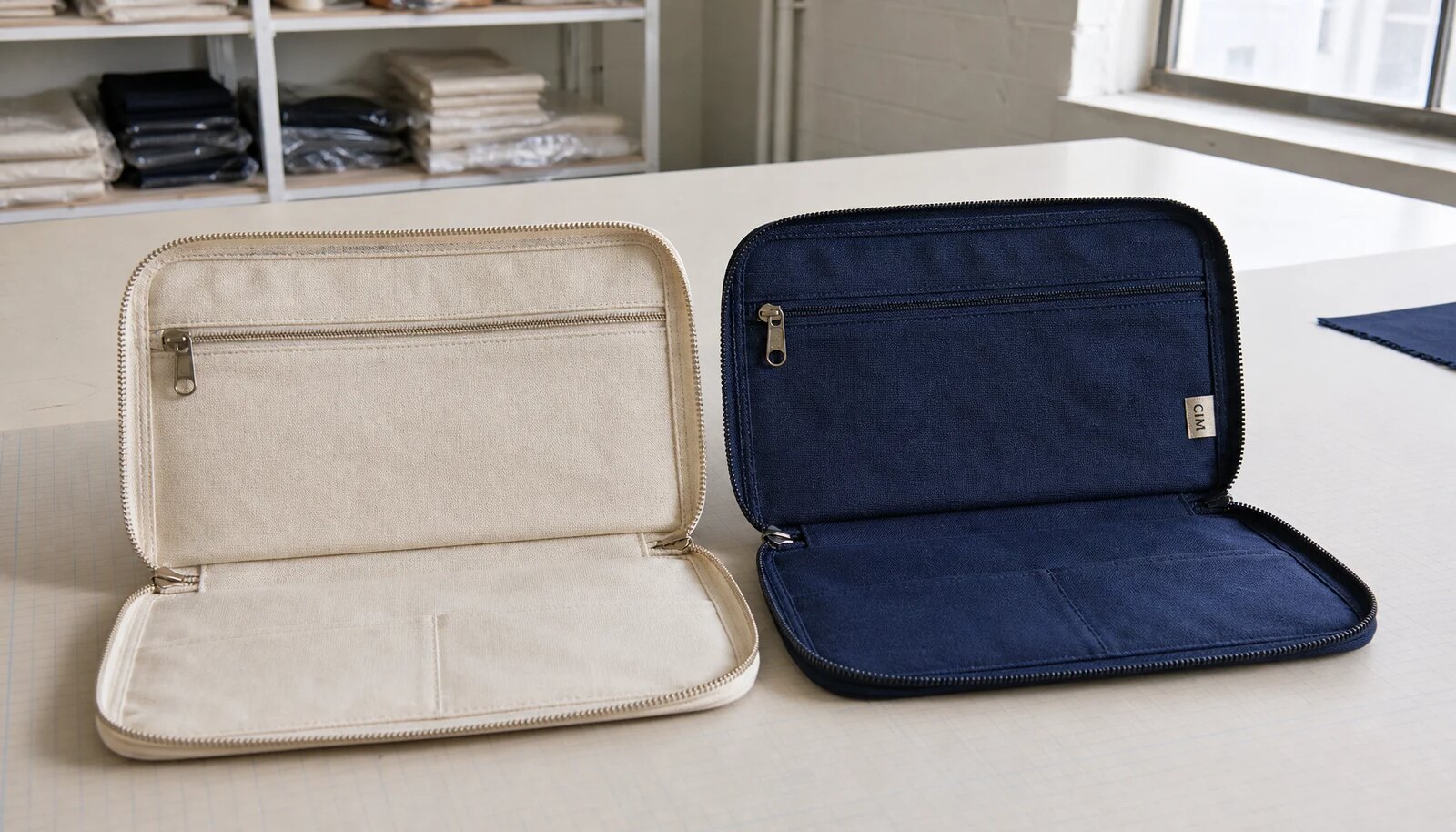
Start With The Use Case, Not The Fabric
A canvas zipper portfolio for corporate gifting is not just a document pouch with a logo. The right build depends on what the recipient will actually carry: printed handouts, onboarding paperwork, a tablet and charger, or a client presentation pack that needs to look polished the moment it leaves the carton. If the item is only meant to hold paper, you can keep the structure light and spend on print quality. If it needs to hold a device or move through travel, the seam strength, zipper grade, and lining matter more than the visual surface.
Buyers usually lose money when they start with a price target instead of a use case. A portfolio that looks acceptable in a sample photo can feel flimsy in hand if the canvas is too light, the zipper is undersized, or the interior lacks reinforcement. The better RFQ starts with size, contents, and presentation: A4 or US letter fit, internal pocket count, whether the item is slim or gusseted, and whether it must arrive gift-ready or only bulk packed. Once that is fixed, the rest of the spec becomes a controlled discussion instead of a guessing exercise.
- Define the contents first: paper only, paper plus tablet accessories, or a full executive kit.
- Choose slim or gusseted construction based on what must fit, not on what looks premium in a photo.
- Treat the zipper portfolio as a branded functional item, not a soft good with decorative printing only.
Choose Canvas Weight, Lining, and Structure Together
For wholesale canvas zipper portfolios, fabric weight drives both hand feel and quote quality. A standard program often sits around 10 to 12 oz canvas, roughly 340 to 400 GSM, which gives enough body for a clean silhouette without making the piece too heavy. If the buyer wants a more premium executive feel, 14 oz canvas, about 475 to 500 GSM, gives better structure and a more substantial hand. Light 8 to 10 oz fabric can still work for simple document sleeves, but it starts to feel soft once the zipper and trim are added.
Canvas weight alone does not finish the job. The interior lining, interfacing, and seam construction decide whether the portfolio holds its shape or collapses in transit. A simple promotional run may use unlined canvas, but that should be a deliberate choice. For higher-value gifting, a 210D polyester lining or similar internal layer reduces snagging and makes the item look cleaner when opened. If the portfolio needs a real body, a thin board, EVA insert, or firm interfacing can help, but too much reinforcement makes packing bulky and raises freight cost.
- Use 10 to 12 oz canvas for most corporate gifting programs that need balance rather than luxury stiffness.
- Move to 14 oz canvas when the portfolio must look premium and keep a sharp shape on a desk or in transit.
- Do not add structure blindly; every insert changes carton count, freight volume, and closing behavior at the zipper.
Match The Branding Method To The Surface
The print method should follow the artwork, not the other way around. A one-color or two-color logo on natural canvas usually belongs in screen print because it keeps the cost controlled and the visual sharp. If the design has gradients, small type, or multiple shades, heat transfer or digital transfer can work, but you need to test rub resistance and edge sharpness on the actual fabric. Embroidery looks premium on a small mark, but on a zipper portfolio it can distort the panel if the canvas is light or the logo is too large.
For corporate gifting, the branding surface often matters as much as the logo itself. Some buyers want the mark centered and visible; others want a quieter side label, woven patch, or debossed PU badge that feels more like a retail accessory. The safe way to decide is to compare visual load and production risk. Large prints can cover imperfect canvas, but they also show registration errors more easily. A small woven label or sewn patch usually survives repeated handling better than a heavily inked area, especially when the portfolio will be inserted and removed from bags.
- Screen print is the default for solid logos with controlled cost and repeatability.
- Heat transfer is useful for complex art, but it needs a real rub and peel test on the final fabric.
- Woven labels or sewn patches are strong options when the buyer wants a subtle, premium look without large ink coverage.
Source Route And MOQ Logic Change The Whole Quote
The supplier route matters as much as the product spec. A direct factory is usually the best option when you want control over fabric, stitching, print, and packing in one place. That route is strongest for standard corporate gifting volumes, especially when the item is simple and the buyer wants to avoid quote drift. Trading companies can still be useful when a program includes multiple items or when the buyer needs one coordination point, but they add another layer between you and the actual line that cuts and sews the product.
MOQ is not just a sales number. It is usually driven by how many fabric colors the factory must set up, whether the zipper tape is stock or custom, whether the print method needs screens or plates, and whether the canvas is already in warehouse stock. A 300-piece order with one logo and one color can be perfectly viable if the factory has the right base fabric. The same order becomes expensive if the buyer wants three colors, a custom lining, and special pullers. That is why the RFQ should separate base item, branding, and packaging so the factory can show the real cost of each choice.
- Direct factory is the cleanest route for process control and lower quote noise.
- Trading companies are better for multi-item programs, but they must prove who actually makes the portfolio.
- MOQ usually moves on fabric color, zipper setup, and branding method, not just on total piece count.
Read Quotes Like A Production Spec, Not A Price Tag
A useful quote for wholesale canvas zipper portfolios should be more than a single unit price. It should tell you what canvas weight is included, whether the zipper is a stock item or custom-ordered, how the logo is applied, what packing is included, and what happens at each volume tier. If one supplier gives a low ex-factory number but excludes screen setup, carton printing, or individual polybags, the quote is not really cheaper. It is just incomplete. The buyer has to normalize the quotes before comparing them.
The cleanest way to compare landed cost is to break the offer into production, packing, and shipping layers. Production covers canvas, zipper, lining, trim, stitching, and print. Packing covers tissue, polybag, insert cards, master cartons, and carton markings. Shipping covers inland movement, export handling, freight mode, duty, and any destination delivery charge. Once the line items are visible, you can see where a factory is genuinely efficient and where it is hiding cost in a separate charge. That matters most when the buyer is trying to compare a direct factory against a trading company or against a regional decorator.
- Ask for quote tiers at 300, 500, 1,000, and 3,000 pieces so you can see the real price curve.
- Separate unit price from tooling, screen setup, sample charge, and carton cost.
- Normalize every quote to the same packing and shipping assumption before comparing suppliers.
Set Sample Approval Rules Before Mass Production
The sample stage is where most portfolio programs are won or lost. A good pre-production sample should use the final canvas, final zipper, final print method, final lining, and final carton spec. A loose fabric swatch or a semi-finished sample is not enough for a corporate gifting order, because small construction choices change the feel of the product more than buyers expect. The zipper should open smoothly, the logo should sit in the final position, and the portfolio should close flat without warping at the seam line.
Sampling needs a pass-fail standard, not just a visual approval. Set a measurement sheet with finished length, width, gusset depth if used, zipper length, artwork position, and any pocket dimensions. Then include simple function checks: repeated zipper cycles, seam stress at the corners, and a visual rub test on the printed area. If the buyer plans a high-value gift program, also check how the portfolio looks after being packed, opened, and reinserted into the carton. That is where weak interfacing and poor fold memory often show up first.
- Approve the full bill of materials, not just the outer appearance.
- Use a measurement sheet so the factory cannot drift on size during bulk production.
- Test the portfolio as a gift item, not only as a sewn sample on a table.
Packing Should Match The Gift Program, Not Just Freight
Many buyers optimize for carton count and forget the unboxing moment. For corporate gifting, the portfolio often arrives as part of a branded package, so the packing spec has to support presentation as well as transport. If the item will be distributed directly to employees or clients, individual polybags, tissue wrap, and a clean insert card may be justified. If it is going to a distributor or a pack-out center, bulk packing can save cost and reduce waste. The right choice depends on where the final handling happens, not on what looks premium in isolation.
Carton design should protect the shape of the portfolio and keep the logo surface clean. Overfilled cartons crush the zipper edge and mark the canvas; underfilled cartons waste freight space and allow movement damage. Ask for outer carton dimensions, carton weight, and carton marks before you approve bulk. For export orders, the factory should also define how many units fit per carton without forcing the product. If the portfolio includes a board insert or a rigid pocket, carton loading becomes more sensitive and should be checked in the sample pack-out, not after production starts.
- Choose gift-ready packing only when the final recipient will see the package immediately.
- Keep carton loading stable enough that the zipper edge does not deform in transit.
- Verify carton dimensions early because packing changes can affect freight cost more than the fabric choice.
Control Lead Time With One Approval Calendar
Lead time on a canvas zipper portfolio is usually less about sewing speed and more about how many decisions move after quoting. If the buyer changes the artwork after sample approval, swaps zipper color, or upgrades the canvas weight, the schedule resets. That is why a simple approval calendar matters. The factory should know the date for artwork lock, sample sign-off, material purchase, bulk start, packing approval, and ship-ready inspection. Once those dates are in writing, the buyer can see where the real schedule risk sits.
Typical production windows vary with customization, but the pattern is predictable. Stock canvas and standard zipper builds move faster than fully custom trim packages. New tooling, special colors, or yarn-dyed fabric slow the process. Importers should always leave buffer time for rework, carton printing corrections, and shipment booking. A good rule is to protect the last ten percent of the schedule with no design change at all. That is the point where the factory is cutting, sewing, and packing, and a minor change can still cost a full week.
- Lock artwork, material, and zipper color before the sample is approved.
- Build schedule buffer for packing corrections and final inspection fixes.
- Treat late design changes as costed change orders, not casual tweaks.
Choose The Build By Buyer Profile, Not By Habit
Different buyers should not source the same portfolio spec. A procurement team buying employee welcome kits usually wants a stable quote, decent canvas weight, and standard branding with low risk. A brand owner running executive gifts may accept a higher MOQ if the portfolio feels more premium and more aligned to the brand. A distributor or retail buyer often cares most about repeatability, carton efficiency, and whether the factory can hold the same spec across multiple reorders. The wrong build usually comes from copying last year’s sample without checking whether the use case changed.
The best decision is usually the simplest one that still protects the brand. For a broad corporate gifting program, a 10 to 12 oz canvas portfolio with a clean screen print, standard zipper, and practical lining is often enough. For a premium client drop, step up to heavier canvas, stronger structure, and a small woven label or patch instead of a large inked surface. For ESG-led programs, choose a recycled blend or a documented recycled content option, but insist on proof that the fabric and print both work together. The key is to spend where the recipient will feel it and avoid spending where it only inflates the freight bill.
- Use a stable, midweight spec for most corporate gifting programs.
- Reserve premium structure for high-visibility client or executive drops.
- Tie the material story to the actual buyer objective: cost control, brand feel, or sustainability reporting.
Specification comparison for buyers
| Spec decision | Recommended option | When it fits | Buyer risk to check |
|---|---|---|---|
| Direct factory, stock canvas base + custom logo | Best balance of price, control, and lead time for 300 to 2,000 pcs | Conference gifts, onboarding kits, and simple brand programs with one size and one or two logo colors | Confirm the real GSM, whether print is in-house, and whether the same factory controls sewing and packing |
| Direct factory, fully custom trim package | Use when the portfolio is part of a premium brand story and must feel unique | Executive gifting, client retention kits, and projects that need custom lining, pullers, or pocket layout | Watch tooling cost, sample rounds, and longer lead time if every component is custom |
| Trading company, multi-factory sourcing | Good for mixed programs where one supplier coordinates several product types | Bundles that include portfolios plus notebooks, pouches, or tech items under one PO | Require factory identity, process photos, and clear accountability for print, sewing, and carton quality |
| Regional decorator or domestic assembler | Practical for urgent events and smaller drops | Rush deliveries, local distribution, and short-run corporate events under tight deadlines | Unit price is usually higher, and stock canvas options may be limited or inconsistent |
| Stock-lot canvas with standard zipper | Lowest-friction route for repeat promo orders when color flexibility is limited | Repeat programs where the buyer can accept available fabric shades and standard trims | Check shade variation, inventory continuity, and whether the exact lot will still be available for reorders |
| Recycled or blended canvas program | Use when ESG messaging matters and the buyer needs a material story | Sustainability-led gifts, retail brand programs, and procurement teams with content reporting needs | Verify fiber composition, finish, print adhesion, and whether the recycled claim is supported on the actual spec sheet |
| Premium executive build with structure | Choose a heavier canvas, lining, and insert when perceived value matters more than unit cost | Board packs, premium client gifts, and portfolios that must hold documents, tablet accessories, or thin folders neatly | Do not overbuild it with excessive board or bulky reinforcements that make the item stiff and hard to pack |
| Split-source program, sample from one factory and backup from another | Useful for large or multi-region programs that need supply continuity | Annual gifting calendars, multi-country rollouts, and buyers who want a fallback source | Lock the spec tightly so both factories build to the same measurements, zipper grade, and print placement |
Buyer checklist before sampling
- Confirm the target document size, internal pocket layout, and whether the portfolio must hold A4, US letter, or a tablet sleeve.
- Lock the canvas weight in GSM or oz, plus whether the fabric should be raw, pre-shrunk, washed, or lightly coated.
- Choose the branding method before sampling so the factory can quote the right screen count, embroidery setup, or patch cost.
- Specify the zipper grade, puller style, and whether the zipper tape should match the main fabric or contrast on purpose.
- Ask for a pre-production sample that includes the final fabric, stitching, print, zipper, lining, and carton spec, not just a loose swatch.
- Request quote tiers at several quantities so you can see where the price drops and where the MOQ breakpoints really sit.
- Define packing clearly: individual polybag, tissue wrap, insert card, master carton count, and outer carton mark format.
- Get the approval calendar in writing so print sign-off, sample sign-off, and bulk production release do not move the lead time.
Factory quote questions to send
- What exact canvas GSM, weave, and finish are you quoting, and is that the same material that will be used in bulk production?
- Which zipper grade are you using, who supplies it, and how many open-close cycles should it pass before shipment?
- Is the logo print, embroidery, or woven label done in-house, and what are the setup charges for screens, plates, or patches?
- What is the MOQ per color, per size, and per branding method, and where do the breakpoints change the unit price?
- Can you quote the same item at 300, 500, 1,000, and 3,000 pcs so we can compare the cost curve?
- What sample type is included in the price, what is charged separately, and which approvals are required before bulk starts?
- What packing spec is included in the quote, including polybag type, carton count, carton dimensions, and carton markings?
- What is the production lead time after sample approval, and what events reset the schedule, such as logo changes or material substitutions?
Quality-control points to confirm
- Canvas weight should match the approved spec within the factory tolerance you agree upfront, not just a verbal description of heavy or medium canvas.
- Finished dimensions should stay within a practical tolerance of plus or minus 5 mm for flat portfolios unless the buyer specifies a tighter fit.
- Zipper movement should be smooth, with no catching, wave, or exposed teeth gaps after repeated open-close checks.
- Stitching should be even and dense enough for the fabric weight, with no skipped stitches, loose thread tails, or weak bar-tack points at stress areas.
- Logo placement should stay within the approved artwork position, with no obvious color shift, blur, or rub-off on handled surfaces.
- Lining, pockets, and inserts should sit flat without puckering, twisting, or visible glue marks if the design uses laminated parts.
- Packing should match the carton count and color assortment exactly, with no mixed sizes or mislabeled cartons in the export pack.
- The pre-production sample should be signed off against the final bill of materials so the bulk run cannot quietly substitute fabric, zipper, or trim.