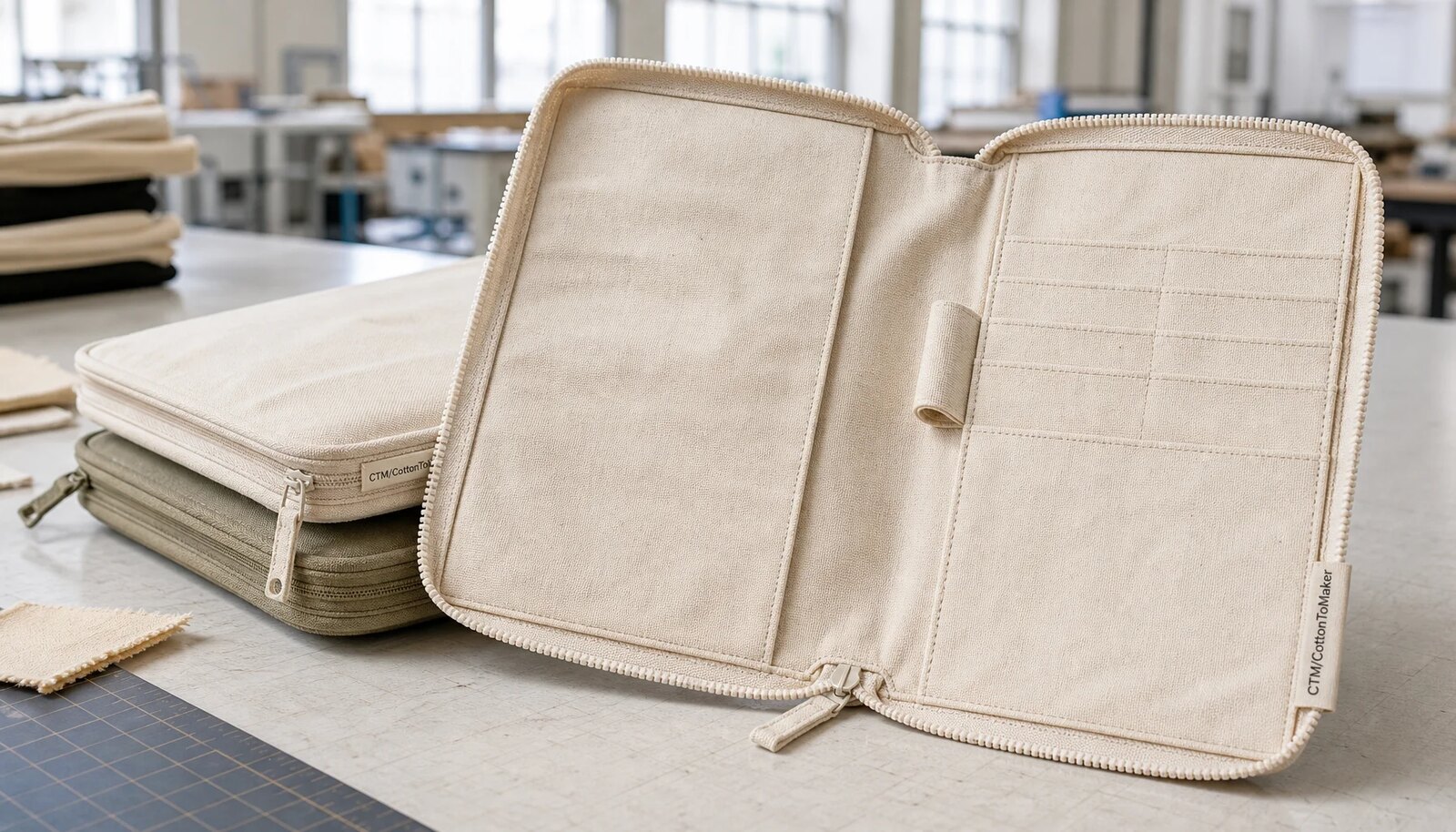
Define the Buying Job First
Wholesale canvas zipper portfolios for event planners are often ordered as branded accessories, but procurement should treat them as working business bags. The item may carry contracts, venue layouts, floor plans, speaker notes, badge sheets, receipts, pens, business cards, rooming lists, and sometimes a slim tablet. Those contents affect size, zipper strength, pocket layout, reinforcement, and packing. A portfolio used by internal event staff for a season should not be specified the same way as a one-day attendee giveaway.
The first sourcing risk is terminology. One supplier may interpret canvas zipper portfolio as a flat zip pouch with a logo. Another may quote a padfolio-style organizer with document sleeves, pen loops, card pockets, lining, and reinforced corners. Both suppliers may be honest, but their prices will not be comparable. A B2B buyer needs to name the product type, intended channel, document format, expected load, and acceptable finish level before asking for a price.
Use case also changes compliance detail. A retail-ready SKU may require barcode labels, fiber-content review, country-of-origin marking, carton labels, and receiving rules. A client welcome kit may need individual presentation packing and stricter cosmetic checks. An internal staff tool may need stronger zipper and pocket durability, while a simple conference handout may prioritize cost and fixed delivery date. The supplier compliance checklist should start with the business job, not with a photo alone.
- Name the channel: staff use, attendee giveaway, VIP gift, welcome kit, retail SKU, or repeat corporate program.
- Confirm document format: A4, Letter, legal-size sheets, custom agenda booklets, folded venue maps, badge sheets, or mixed paperwork.
- Define expected load: paper only, paper plus notebook, paper plus stationery, or paper plus slim tablet.
- Decide whether the portfolio needs gusset depth, document sleeves, pen loops, card slots, wrist strap, carry handle, or tablet pocket.
- Set the buying priority in writing: lowest workable cost, premium appearance, reorder consistency, retail compliance, or fixed event-date delivery.
Turn the Idea Into a Measurement Sheet
A strong RFQ turns a product idea into a measurement sheet. The sheet does not need to be complicated, but it should remove assumptions. Include finished outside dimensions, usable pocket dimensions, fabric composition, fabric weight, zipper specification, lining, pocket layout, reinforcement points, logo method, packing method, carton rules, and shipment term. If a supplier must guess any of these items, the quote is only a rough estimate.
Finished size should be more specific than A4 or Letter. Paper needs clearance. A document sleeve needs seam allowance. A zipper curve can reduce usable space at the corners. A notebook or event agenda may be thicker than loose paper. Buyers should request outside dimensions and usable inside dimensions, measured from seam to seam or opening to bottom edge. For a gusseted version, define both empty depth and usable loaded depth if the design expands.
Use one main specification and one controlled alternate. The main specification should reflect the product the buyer actually wants. The alternate can be a deliberate cost-down version, such as stock canvas color instead of custom dyed fabric, one-color screen print instead of embroidery, no lining instead of lined interior, or bulk packing instead of individual polybags. This keeps price comparison clean while still giving procurement room to manage budget.
- Write dimensions in mm or inches, and state where measurements are taken: outside edge, seam edge, pocket opening, or zipper opening.
- Common sewn-goods tolerance for simple portfolios may be plus or minus 5 mm on width and height; use tighter limits only when fit requires it.
- Specify usable document sleeve dimensions separately from outside portfolio dimensions.
- Define gusset depth, zipper opening length, pocket depth, card slot opening, pen loop width, and tablet sleeve clearance.
- List body fabric, lining, interlining, binding tape, thread, zipper, puller, label, patch, and reinforcement materials.
- Lock packing assumptions before quoting: bulk pack, individual polybag, tissue, insert board, barcode, hangtag, carton count, and carton weight limit.
Specify Canvas Without Vague Labels
Canvas descriptions such as premium, heavy duty, natural, or durable are not enough for procurement. Buyers should specify composition, weight, weave, finish, color standard, and shrinkage expectation. For many standard event-planner portfolios, 12 oz cotton canvas, roughly about 340 gsm depending on supplier conversion and construction, is a practical starting point. It usually gives enough body for handling and logo printing without making corners too bulky. A heavier 14 oz canvas, roughly about 400 gsm, can add structure but may increase cost, sewing difficulty, and zipper distortion if the pattern is not adjusted.
Cotton canvas, cotton-poly canvas, recycled PET canvas-look fabric, coated canvas, and polyester canvas-look fabric should not be treated as interchangeable. Cotton canvas has a familiar texture and accepts many print methods, but color shade, shrinkage, and surface slubs can vary. Polyester canvas-look fabric may be more consistent or water resistant, but it changes the product story and compliance profile. Recycled-content materials require documentation tied to the actual fabric lot if the buyer plans to make that claim.
Lining and interlining need a reason. A lining can hide seams and help papers slide smoothly. Interlining can stiffen the front panel or stabilize a logo zone. Extra layers also add cost, weight, sewing complexity, and possible wrinkling. Ask suppliers to explain what each layer does and whether a cost-down version removes function or only changes perceived finish.
- Use measurable fabric terms: composition, gsm or ounce weight, weave, surface finish, backing, coating, and color reference.
- Ask whether the canvas is pre-shrunk, washed, dyed-to-order, stock dyed, coated, laminated, or cut with shrinkage allowance.
- Request swatches for body fabric, lining, zipper tape, binding tape, thread, labels, patches, and print or embroidery trials.
- State whether natural slubs and shade variation are acceptable, and define the approved visual standard with a signed swatch.
- Treat recycled-content claims, organic claims, and fiber-content statements as compliance items that require evidence.
- Do not approve substitution from cotton canvas to polyester canvas-look fabric unless the quote and product description are revised.
Control Zipper Construction
The zipper is the component the user touches most, and it is often where low-cost portfolios fail first. A #5 nylon coil zipper is commonly practical for document portfolios because it runs smoothly around curved corners, keeps weight moderate, and is easier to sew into fabric bags than many metal zippers. A #8 zipper may be useful for a larger or heavier organizer, but it can look bulky on a slim portfolio. Metal zippers can add a premium look, yet they require closer attention to weight, snagging, corrosion resistance, and corner construction.
The RFQ should name zipper type, gauge, tape width, tape color, slider material, slider finish, puller style, opening direction, and whether the puller is plain or branded. Zipper tape color should be treated as a trim specification, not as a factory guess. If the buyer wants a matching beige tape, contrast black tape, custom color, metal puller, cord puller, or logo puller, each choice can affect MOQ, lead time, and cost.
Function testing should be concrete. Instead of asking whether the zipper is good quality, ask how the factory checks it. For normal promotional use, buyers can require inspectors to open and close the zipper 10 to 20 cycles on each checked sample unit, including corners and thick seam areas. For repeat staff-use programs, a buyer may set a higher internal cycle requirement or request third-party testing. The important point is that zipper failure is treated as a major defect because it makes the portfolio unusable.
- Specify zipper type and gauge, such as #5 nylon coil, #8 nylon coil, resin tooth, or metal tooth if appropriate.
- State tape width, tape color, slider finish, puller shape, pull direction, and whether a custom puller mold is required.
- Check zipper length against usable opening, not only outside portfolio size.
- Require smooth operation at corners, zipper ends, thick binding, and gusset transition areas.
- Treat tooth separation, broken teeth, slider looseness, severe snagging, missing puller, or reversed opening direction as major defects.
- Ask whether replacement zippers and sliders come from the same approved trim source throughout production.
Design Pockets Around Real Event Contents
Interior layout should be tested with the actual items the event team expects to carry. A pocket that fits one sheet of blank paper may not fit a printed agenda with tabs, a spiral planner, a badge sheet, or a folded venue layout. Card slots that look neat in a sample photo may be too tight once business cards are inserted. Pen loops may fit a slim pen but not a marker used at registration desks. Procurement should define both the pocket count and the usable dimensions.
Document sleeves need special attention. If the sleeve is too shallow, papers fall out. If it is too tight, papers crease at the corners. If the zipper curve cuts into the document space, the portfolio may technically measure correctly while still failing in use. Specify pocket opening direction, pocket depth, seam allowance, and whether the sleeve should hold a specific number of sheets or a notebook thickness.
Reinforcement should be placed where load and movement happen. Common stress points include pocket corners, document sleeve openings, zipper ends, handle joins, wrist strap anchors, gusset corners, and the top edge of organizer panels. Reinforcement may be bartacks, backstitching, binding, hidden patches, or extra seam allowance. A general request for reinforced stitching is weaker than a marked construction note.
- Use real inserts during sample approval: agenda, contract packet, badge sheet, folded map, pens, business cards, notebook, and tablet if required.
- Measure usable pocket depth and width after sewing, not just pattern size before assembly.
- Confirm card slot opening, pen loop diameter, elastic length, notebook pocket depth, and tablet sleeve clearance.
- Check whether the portfolio closes naturally when loaded to the expected working capacity.
- Specify bartacks or backstitching at pocket corners, zipper ends, strap anchors, handle joins, and gusset transitions.
- Reject pockets that are missing, reversed, too narrow for intended contents, loosely stitched, or positioned differently from the approved sample.
Make Branding Inspection-Ready
Branding is one of the easiest places for quotes to diverge. Screen printing, embroidery, woven labels, heat transfer, printed patches, debossed PU patches, leather patches, and custom zipper pullers all carry different setup costs, minimums, tolerances, and durability risks. A supplier compliance checklist should state the preferred method and ask for alternatives as separate line items rather than letting each supplier choose a different method.
For canvas portfolios, screen printing is often efficient for simple one-color or two-color logos on a flat panel. Embroidery can create a more textured look but may lose small text clarity on coarse canvas. Woven labels can keep fine details consistent, though label attachment and alignment must be inspected. Heat transfers may hold detailed artwork, but the buyer must confirm compatibility with the canvas surface and handling expectations. Patches can work well when the front panel is not ideal for direct printing, but patch material, edge finish, and attachment method must be specified.
Logo placement should be measured. Terms such as centered, front lower right, or near zipper are not precise enough for bulk production. Provide an artwork box with distance from top edge, side edge, pocket seam, zipper seam, or center line. A practical placement tolerance is often plus or minus 3 mm to 5 mm, depending on method and construction. If the order is retail-facing, photographed, or part of a premium client kit, tighter cosmetic review may be justified.
- Provide vector artwork, Pantone or brand color references, logo size, placement coordinates, and approved artwork proof.
- State decoration method and backup method as separate quote options with setup fees and lead times.
- Approve decoration on the same bulk-intended fabric color, not only on a white paper proof or unrelated sample fabric.
- Define failures clearly: off-center logo, wrong color, ink bleed, print cracking, transfer lift, embroidery thread pull, crooked label, patch edge lift, or adhesive mark.
- Ask whether print screens, embroidery digitizing, heat-transfer films, woven labels, and custom pullers are one-time costs or repeated charges.
- Confirm whether decoration happens before sewing, after sewing, or at an outside vendor, because this changes risk and repair options.
Check Supplier Evidence and Compliance
Supplier compliance is not proved by sales language. Procurement should collect order-specific evidence: material swatches, trim cards, factory identity, process ownership, sample records, inspection reports, production photos, pack-out photos, and documentation tied to the purchase order. The strongest evidence connects the approved sample to the bulk production lot.
Start with who will actually make the order. A direct factory, trading company, specialized workshop, and sourcing agent can all be valid partners, but the buyer needs to know which party controls cutting, printing, sewing, inspection, packing, labeling, and corrections. Outsourcing is common for printing, embroidery, zipper pullers, woven labels, and retail packaging. The risk is not outsourcing itself; the risk is an unclear approval path when defects appear.
Documentation must match the item. A test report for a different tote bag, fabric, or year does not automatically support this portfolio. If the destination market or buyer requires restricted-substance review, fiber-content labeling, recycled-content evidence, packaging declarations, or country-of-origin review, the documents should apply to the actual canvas, lining, zipper tape, slider, puller, thread, label, patch, ink, adhesive, and packaging materials used in the order.
- Confirm supplier identity, factory address, production factory name, and whether inspection access is allowed.
- Ask for trim cards showing approved fabric, lining, zipper, slider, puller, binding, thread, label, patch, and packaging materials.
- Require written approval before any fabric, zipper, logo method, pocket layout, or packing substitution.
- Request first-piece photos before full bulk sewing, especially for new patterns or new suppliers.
- Collect in-line or mid-production photos when the order has a fixed event date, complex logo, or tight document-fit requirement.
- Tie compliance statements and test reports to the actual SKU, production materials, destination market, and purchase order.
Compare Quotes by What Is Included
A low unit price is only useful when the quote includes the same product. Suppliers can reduce cost by using lighter canvas, smaller zipper gauge, fewer pockets, no lining, thinner binding, lower carton strength, simpler logo method, or bulk packing. These can be acceptable cost-down choices when disclosed, but they are dangerous when hidden inside a single all-in number.
Ask suppliers to quote against the same specification and provide line-item visibility. At minimum, identify product unit price, sample charge, decoration setup, custom puller or label costs, packaging costs, carton costs, inland freight, export documentation, inspection support, and shipment term. For B2B procurement, the comparison should include landed cost and operational cost, not only FOB or EXW unit price. A slightly higher unit price may be cheaper overall if it prevents relabeling, repacking, rush inspection, or missed receiving requirements.
MOQ should be broken down by component. A supplier may advertise 300 or 500 pieces, but that number may apply only to stock canvas, standard zipper tape, and one print color. Custom-dyed canvas, special zipper tape, metal pullers, woven labels, embroidery, retail insert cards, and barcode labels can each carry their own minimums. Ask for MOQ by finished item, body color, zipper color, decoration method, print color count, puller, label, and packaging style.
- Compare only quotes based on the same size, fabric weight, zipper, pockets, lining, logo method, packing, carton count, and shipment term.
- Ask for separate pricing for material, zipper, lining, interlining, reinforcement, decoration, labor, packaging, cartons, setup, samples, and freight-related items.
- Clarify whether screen charges, embroidery digitizing, puller molds, label setup, sample fees, and courier fees are one-time or repeated.
- Request MOQ by body color, zipper color, print color count, logo position, custom puller, woven label, retail insert, and packaging format.
- Ask whether sample fees are credited back after bulk order placement and under what conditions.
- Confirm Incoterms, currency, payment terms, production lead time, inspection window, and shipment-ready date in the quote.
Use Samples as Production Controls
Sampling should prove production readiness, not only appearance. A reference sample shows general style. A prototype tests layout and dimensions. A pre-production sample should lock the actual order, including canvas, zipper, lining, thread, pockets, reinforcement, decoration, labels, and packing. Procurement should not approve a bulk order based only on a photo of a similar product unless the risk is deliberately accepted.
Sample review should include measurement, loading, handling, and packing. Measure outside dimensions, usable document sleeve dimensions, pocket openings, zipper opening length, logo placement, and gusset depth. Load the sample with the actual event materials. Open and close the zipper repeatedly. Place it flat on a desk. Check whether papers slide in smoothly, whether the zipper catches at corners, whether the puller is comfortable, and whether the front panel warps when filled.
Sample comments must become written production instructions. Avoid vague feedback such as improve zipper or make pocket bigger. State the exact change: increase document pocket opening from 215 mm to 225 mm, move logo 10 mm higher, change zipper tape to black, add bartack at both sleeve corners, or reduce pen loop width. Ask whether each change affects price, MOQ, sample timing, or bulk lead time. Once approved, the pre-production sample should become the golden sample for production and inspection.
- Label sample stages clearly: reference sample, prototype, pre-production sample, golden sample, and shipping sample if needed.
- Require the pre-production sample to use bulk-intended materials and trims, unless every deviation is written and approved.
- Create a measurement chart for outside size, pocket size, zipper opening, logo placement, gusset, and handle or strap placement.
- Photograph approved construction details such as zipper ends, pocket corners, bartacks, label placement, lining, and packing.
- Keep one approved physical sample with the buyer or QA team and one with the factory production team when possible.
- Do not release bulk cutting until sample comments, price changes, artwork proof, and packing requirements are closed.
Set Product-Specific QC Limits
Quality control should define pass and fail conditions before bulk production starts. For canvas zipper portfolios, critical or major defects include zipper failure, open seams, missing reinforcement, wrong material, wrong pocket layout, dimensions that prevent document fit, incorrect logo, severe stains, strong odor, and packing that damages the product. Minor defects may include small thread tails, slight removable chalk marks, or tiny cosmetic variations within the approved standard.
Many buyers use AQL sampling as a reference, but AQL alone is not a checklist. The inspection must be specific to zipper portfolios. Inspectors should measure dimensions, load sample inserts, open and close zippers, inspect pocket usability, verify reinforcement, check decoration placement, review fabric cleanliness, and confirm packing accuracy. The buyer should identify which defects are major before inspection so shipment decisions are not negotiated under delivery pressure.
First-piece review is one of the most valuable controls. Before the factory completes bulk sewing, the buyer or inspector reviews early finished units against the golden sample. This can catch wrong zipper tape, off-position logo, missing bartacks, incorrect pocket depth, or wrong label placement while correction is still possible. Final inspection then confirms that the approved standard continued across the production run and that carton markings match the packing list.
- Set dimensional tolerances, such as plus or minus 5 mm for width and height unless the document-fit requirement needs tighter control.
- Set logo placement tolerance, often plus or minus 3 mm to 5 mm depending on method and buyer standard.
- Classify zipper splitting, severe snagging, open seam, missing pocket, wrong material, wrong logo, severe stain, or unusable packing as major defects.
- Check zipper operation on inspected units with repeated open-close cycles through corners and thick seam areas.
- Measure usable pocket dimensions with the intended insert format, not only with a ruler on the closed product.
- Inspect reinforcement at zipper ends, pocket corners, document sleeve openings, handle joins, wrist strap anchors, and gusset transitions.
- Verify shade consistency across cartons and lots against the approved swatch or golden sample.
- Confirm carton count, carton label, SKU, PO number, color, country of origin, barcode, batch code, and final pack-out photos before release.
Specification comparison for buyers
| Supplier option | What to verify | Commercial advantage | Buyer risk to control |
|---|---|---|---|
| Direct sewing factory | zipper source record, production-line zipper test photos, approved trim card, cutting marker photos, and final open-carton count | Better sample-to-bulk control and faster production feedback | May be weaker on export paperwork or branded packing unless checked early |
| Trading company | Factory name, production photos, trim-source proof, and who owns QC decisions | Can coordinate small mixed orders and extra services | Markup can hide real factory capability and slow defect decisions |
| Specialized bag workshop | zipper gauge, zipper tape width, puller finish, binding tape, corner reinforcement, seam allowance, and document-size tolerance | More practical for detailed construction, trims, and repeat programs | Capacity may be limited during peak seasons |
| Low-price general supplier | 300D-600D polyester, 10-12 oz canvas, or recycled PET with backing stiffness matched to document weight | Useful for simple promotional runs with loose specs | Material downgrades, weak packing, and vague inspection scope can erase savings |
| Retail-ready supplier | flat packing, insert board if needed, SKU bundles, carton weight limit, moisture protection, and barcode visibility | Can handle labels, SKU separation, carton marks, and receiving rules | Higher unit cost must be compared against reduced warehouse work |
| Compliance-focused supplier | Fabric records, labeling review, test plan, and production traceability | Safer for retail programs and repeat brand orders | Documentation claims need evidence, not only sales language |
| Local sample room plus bulk factory | Signed sample, bulk factory handoff, first-piece photos, and deviation owner | Good for complex branding before large production | Sample room quality may not match bulk line unless handoff is controlled |
Buyer checklist before sampling
- Define the order channel before pricing: internal staff tool, attendee giveaway, VIP gift, retail SKU, client welcome kit, or repeat corporate program.
- Lock finished outside dimensions and usable inside dimensions for A4, Letter, agenda booklet, contract packet, badge sheet, notebook, or slim tablet use.
- Specify whether the item is a flat document portfolio, gusseted organizer, padfolio-style case, or zippered business bag with internal compartments.
- State canvas composition, weight, weave, finish, color standard, shrinkage expectation, and whether substitution to polyester canvas-look fabric is allowed.
- Define zipper type, gauge, tape width, tape color, slider material, puller style, opening direction, and open-close test requirement.
- Confirm pocket count, pocket depth, card slot size, pen loop width, document sleeve opening, seam allowance, lining, and interlining.
- Specify decoration method, artwork file type, Pantone or brand color, print size, placement coordinates, placement tolerance, and cosmetic rejection limits.
- Ask all suppliers to quote against the same packing, carton quantity, carton weight limit, inspection level, and shipment term.
- Request line-item pricing for material, zipper, lining, reinforcement, decoration, labor, packaging, carton, setup, sample, testing, inland freight, and export documents.
- Verify which party cuts, decorates, sews, inspects, packs, labels, and stores the finished goods before shipment.
Factory quote questions to send
- What exact fabric composition, ounce weight or gsm, weave, finish, color standard, and shrinkage control are included in this quote?
- Is the body fabric cotton canvas, cotton-poly canvas, recycled PET canvas-look fabric, coated canvas, or another textile, and will you provide a dated swatch card?
- What finished outside dimensions and usable pocket dimensions are quoted, and what tolerance do you apply to width, height, gusset, pocket opening, and zipper opening?
- Which zipper type, gauge, tape width, slider material, puller style, puller finish, and tape color are included, and is the zipper stock or custom ordered?
- What zipper function check do you perform during production and final inspection, including the number of open-close cycles checked per inspected unit?
- Is the logo screen printed, embroidered, heat transferred, woven, debossed on a patch, printed on a patch, or applied as a label, and what setup charge applies?
- What placement tolerance do you apply for the logo, label, patch, puller mark, barcode label, and country-of-origin label?
- What is the MOQ by body color, zipper color, logo position, print color count, custom puller, label, lining, and packaging style?
- What is included in the unit price: fabric, zipper, lining, interlining, binding, thread, reinforcement, decoration, labor, polybag, insert board, carton, and master label?
- Which production steps are in-house and which are outsourced, including printing, embroidery, label making, zipper puller making, inspection, packing, and carton labeling?
Quality-control points to confirm
- Finished outside dimensions should stay within the agreed tolerance, commonly plus or minus 5 mm for width and height on simple sewn portfolios unless the buyer specifies tighter limits.
- Usable document sleeves should fit the intended A4, Letter, agenda, or contract packet without forcing paper corners into seams or zipper curves.
- Gusset depth, pocket width, card slot size, pen loop width, and tablet sleeve dimensions should match the approved sample and written measurement chart.
- Zippers should open and close smoothly across the full track, including corners and thick seam areas, with no tooth separation, slider looseness, tape waviness, broken teeth, or snagging.
- A practical zipper check should include repeated open-close operation on inspected units; buyers can require 10 to 20 cycles per checked unit for normal promotional use, or a higher internal standard for repeat staff tools.
- Logo placement should remain within the approved artwork box, often plus or minus 3 mm to 5 mm depending on print method, panel construction, and buyer requirement.
- Decoration should match the approved color standard as closely as the method allows and should not crack, peel, bleed, distort, lift, or leave adhesive marks after basic handling checks.
- Stitching should be straight and secure, with no skipped stitches, open seams, loose thread bundles, needle cuts, exposed raw edges, or visibly uneven topstitching on front panels.
- Bartacks, backstitching, or reinforcement patches should be present at zipper ends, handle joins, wrist strap anchors, pocket corners, document sleeve openings, and gusset transitions where specified.
- Canvas color, weave texture, and surface finish should match the approved bulk standard closely enough that mixed cartons are not visibly different in the same delivery.