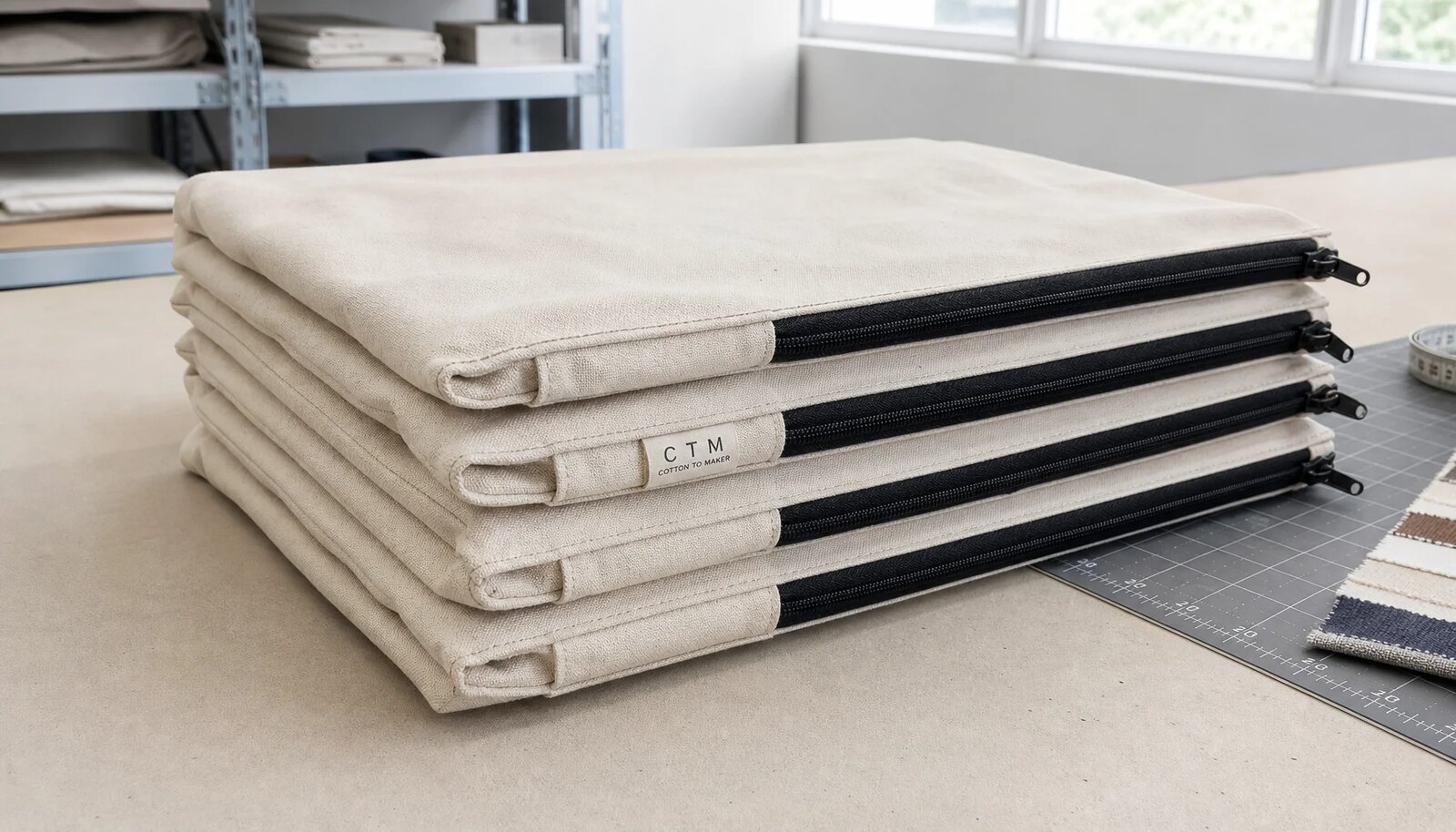
Start carton planning before unit price comparison
Canvas zipper portfolios are practical B2B products: lookbook sleeves, swatch folders, sales-kit organizers, training packs, conference document holders, and retail accessories. They look simple in a product image, but the landed cost is shaped by folded thickness, zipper hardware, packing method, carton size, gross weight, and receiving requirements.
For procurement teams, a unit quote without carton data is incomplete. The same 34 x 25 cm portfolio can ship very differently as 12 oz unlined canvas, 14 oz lined canvas, or a retail-ready unit with barcode, belly band, insert, and protected puller. Those differences affect freight cube, container planning, warehouse labor, pallet configuration, and 3PL receiving fees.
Ask for product price and packout assumptions in the first RFQ. Do not wait until production is finished to learn that the carton count changed. Early carton planning also supports lower-waste packaging because the buyer can choose only the protection needed for the distribution route.
- Request pieces per carton, carton L x W x H, net weight, gross weight, total cartons, estimated CBM, carton marks, and pallet assumptions with the quote.
- Plan from folded packed thickness, not only the outside dimensions on a sketch.
- Ask how zipper pullers are oriented so hardware does not create stack lean, pressure marks, or print abrasion.
- Compare suppliers only after fabric, zipper, branding, packaging, incoterm, and destination are aligned.
Define the portfolio job before building the spec
The best specification starts with the contents. A portfolio for seasonal line sheets does not need the same opening strength as a swatch pouch used daily by sales teams. A catalog holder needs enough clearance so document corners do not scrape the zipper teeth. A retail accessory may need cleaner unit presentation and barcode control than an internal training pack.
Write dimensions around the actual contents: A4, US letter, catalogs, fabric cards, folded garments, trim cards, or printed inserts. Define closed size, usable internal size, zipper opening, gusset depth, lining, pockets, padding, and whether the product must lie flat in a carton, fit a kit box, hang on a display, or meet a retailer shelf requirement.
Tolerances should be clear and tied to function. For many flat canvas portfolios, plus or minus 5 mm for finished length and width is a reasonable starting point, but logo placement, zipper opening, pocket placement, label position, and folded thickness may need separate limits. A tight logo tolerance may be easy on a woven label and harder on screen printing over textured canvas.
- State the contents and required clearance instead of requesting a generic canvas portfolio.
- Show all pockets, dividers, labels, pen loops, handles, padding, linings, and zipper path on a measured sketch.
- Define seam allowance, stitch density target, bartack or reinforcement points, and opening direction.
- Keep a reference sample or approved drawing with the purchase order and inspection file.
Specify canvas with measurable sourcing language
Canvas should be quoted by measurable details, not by a generic name. Ask for gsm, ounce weight, weave, fiber composition, color standard, finish, shrinkage expectation, and shade tolerance. A 12 oz canvas is often around 340 gsm, 14 oz around 400 gsm, and 16 oz around 450 gsm, but conversions vary by supplier and finishing. Require both gsm and ounce weight on the quote and approve a swatch from the quoted material.
A 12 oz canvas can suit cost-sensitive programs, internal documents, or high-volume giveaways where freight cube matters. A 14 oz canvas is often a practical middle option for a structured hand feel without excessive bulk. A 16 oz canvas can feel more premium but may reduce pieces per carton, increase gross weight, require stronger needles, and create thicker seams at zipper ends.
Natural canvas character must be separated from defects. Seed flecks, small slubs, and shade variation may be acceptable for a natural look if approved in advance. Holes, oil marks, mildew odor, severe stains, obvious shade bands, and dirty handling marks should be treated as defects. If the product is sold or marketed with a sustainability claim, define what proof is required before the claim appears on packaging or product pages.
- Use gsm as the main comparison point and ounce weight as supporting information.
- Approve a fabric swatch before final PO release and keep it for inspection.
- Ask whether fabric is stock or custom, because color, finish, and certification needs can change MOQ and lead time.
- Write acceptable natural canvas variation into the standard so QC is not decided subjectively.
Be careful with eco claims and documentation scope
Eco apparel brands often want canvas portfolios to match broader material values, but procurement language must be precise. Terms such as organic, recycled, undyed, natural, low-impact, biodegradable, or plastic-free should not be used unless the supplier can provide documents that support the exact claim and scope. A fabric certificate is not always the same as finished-product certification.
Ask whether documentation covers the fiber, fabric mill, dyeing process, finished portfolio factory, packaging, or transaction. Some claims may require chain-of-custody documents, transaction certificates, test reports, or supplier declarations. Others may only be appropriate as internal sourcing notes rather than customer-facing claims. If the brand plans to print a claim on a hang tag, belly band, website, or carton, review it with the brand’s compliance process before bulk production.
Packaging claims need the same discipline. Recycled-content polybags, paper sleeves, FSC-labeled paper, compostable bags, and plastic-free packaging all have different documentation requirements and practical limits. A low-waste packout is valuable, but it should still protect goods from dirt, moisture, ink transfer, and barcode failure.
- Request documents before approving claim language, not after goods are packed.
- Confirm whether certification applies to raw material, fabric, finished product, packaging, or the specific transaction.
- Avoid unsupported wording such as 100% eco-friendly or fully sustainable.
- Keep claim documents with the PO, artwork approval, and packaging approval for reorder consistency.
Choose zipper details for function, not only appearance
The zipper is one of the highest-risk components because it affects daily use, edge shape, sewing quality, and carton stacking. Nylon coil zippers are common for flat document portfolios because they are flexible, light, and smooth. A #5 nylon coil zipper is a frequent option when buyers want a stronger feel; smaller gauges may suit lighter sleeves.
Metal or molded plastic zippers may fit a brand look, but they need extra review. Metal pullers can create pressure points inside cartons or mark printed panels if stacks are compressed. Molded teeth can be bulkier than coil. Custom pullers should be quoted with tooling cost, MOQ, finish process, lead time, and replacement plan for defective hardware.
The RFQ should define zipper type, gauge, tape color, slider, puller shape, puller finish, opening direction, end stops, and reinforcement. During sampling, open and close the zipper fully, especially at corners and endpoints. A zipper that works on one sample can still fail in bulk if sewing tension, seam allowance, or puller orientation changes.
- Avoid vague wording such as premium zipper or high-quality zipper.
- Confirm whether zipper tape color matching affects MOQ or lead time.
- Inspect zipper function after sewing and again after a packing trial.
- Keep pullers away from printed panels, or protect the print with approved interleaving.
Build an RFQ that prevents false savings
A low unit price can hide missing specifications. One supplier may quote 12 oz unlined canvas with a basic zipper and no inner packing. Another may quote 14 oz canvas with lining, #5 zipper, screen print, barcode sticker, and retail carton marks. Both may call the item a canvas zipper portfolio, but they are not comparable products.
A procurement-ready RFQ includes size, tolerances, canvas, zipper, seam construction, branding, packaging, carton plan, inspection requirement, incoterm, destination, and quantity by SKU. It should also state whether variants share the same fabric, zipper, label, artwork, barcode, and carton mark. If variants require different materials or labels, MOQ and lead time can change quickly.
Separate recurring and one-time costs. Screen setup, strike-offs, mold charges, custom labels, sample fees, barcode labeling, belly bands, cartons, palletization, and inspection support should be visible. This makes reorders easier to forecast and prevents late additions after price approval.
- Attach artwork files, placement diagrams, Pantone or color references, and label files.
- Request MOQ by fabric color, zipper color, label, print design, barcode, inner packing, and carton mark.
- Standardize incoterm and destination before comparing offers.
- Ask suppliers to list quote exclusions so late charges are visible before sampling.
Approve samples for fit, artwork, zipper, and packout
A pre-production sample should represent the bulk order: fabric weight, zipper gauge, thread, label, artwork method, lining, folded thickness, and packing direction. If substitute fabric or temporary zipper hardware is used, label it as a development sample. Do not approve final carton quantity or product claims from a sample made with non-bulk materials.
Sample review should include measurements and use testing. Check length, width, zipper opening, pocket size, logo placement, label placement, seam allowance, folded thickness, and whether intended documents slide in without forcing corners into the zipper. Open and close the zipper repeatedly and check whether the portfolio lies flat or twists along the zipper line.
Packout approval is part of sample approval. Ask for photos of the proposed stack direction, zipper-puller orientation, inner protection, open loaded carton, closed carton, carton mark, and weighed carton. A small trial can reveal pressure points, print rubbing, overcompression, carton bulge, or barcode placement problems before mass packing begins.
- Approve bulk-intended materials before mass production starts.
- Record every sample deviation and confirm whether it will be corrected in bulk.
- Measure folded thickness because it drives carton count and compression risk.
- Keep packout photos as inspection references for the factory and third-party inspector.
Compare carton options with trial-confirmed numbers
Carton figures should be treated as planning examples until confirmed by a factory packing trial. Finished size, canvas weight, seam bulk, lining, zipper puller, artwork method, packaging, and carton board strength all change the result. Use early estimates to compare scenarios, then update the landed-cost model after the supplier packs and weighs a trial carton.
For example, a flat 34 x 25 cm portfolio in 12 oz unlined canvas may be estimated at around 80 pieces in a 48 x 36 x 32 cm carton, or about 0.055 CBM per carton. For 1,000 pieces, that is roughly 13 cartons and about 0.72 CBM before pallet, rounding, or routing adjustments. A heavier 14 oz version with firmer seams and interleaving might pack closer to 60 pieces in a 52 x 38 x 36 cm carton, or about 0.071 CBM per carton. For 1,000 pieces, that becomes roughly 17 cartons and about 1.21 CBM.
The heavier option may still be correct if the product needs structure and durability. The point is to make the freight and handling impact visible before approval. Flat stack versus individual packing can create a similar shift. Retail-ready packaging may reduce pieces per carton but improve barcode control, while internal sales-kit shipments may be better with clean stacks and minimal inner packing.
- Label all early packout numbers as estimates until a trial carton is measured and weighed.
- Calculate CBM as carton length x width x height x carton count using consistent units.
- Review gross weight per carton against warehouse handling limits and carrier requirements.
- Ask for at least two packout options when packaging, freight, and sustainability priorities compete.
Reduce packaging without losing receiving control
Minimal packaging is a good target, but wholesale cartons still need to arrive clean, dry, countable, and scannable. Separate packaging into three jobs: transit protection, retail presentation, and warehouse identification. A shipment for internal use may need only a clean stack, carton liner, and clear carton mark. A retail or 3PL shipment may require barcode labels, unit sleeves, insert cards, or account-specific carton marks.
Lower-waste options include no individual bag, paper interleaving only at printed areas, a paper belly band, a carton liner, or recycled-content polybags where individual protection is necessary. Each option should be tested for rubbing, lint, moisture behavior, barcode adhesion, and ink transfer. Paper can still damage presentation if it abrades a dark print or dents corners.
Natural cotton canvas can absorb odor and moisture, so storage and routing matter. Cartons should be packed from dry goods, kept off damp floors, and sealed only when ready. Desiccant may be useful on some routes, but it should be specified by type and quantity rather than added casually.
- Quote minimum-protection and retail-ready packouts separately.
- Define barcode, hang tag, insert, belly band, sleeve, carton liner, and desiccant needs by SKU.
- Check whether packaging materials rub ink, leave fibers on canvas, or reduce barcode readability.
- Document approved packaging so substitutions do not happen during bulk packing.
Inspect product quality and cartons as separate control points
Quality control should be tied to the approved sample, measurement sheet, artwork guide, purchase order, and packout photos. Broad phrases such as good workmanship are hard to enforce. Define likely critical, major, and minor defects before inspection. Sharp hardware edges, mold, wrong material, broken zipper, open seam, severe stain, incorrect barcode, and wrong carton packing should not be treated as small issues.
Product inspection should cover fabric shade, hand feel, measurements, seam quality, zipper function, label placement, print quality, and folded thickness. Textured canvas can show small print pinholes more than smooth fabric, so approve a strike-off or sample standard before bulk. Inspectors should measure from the same reference edges shown in the tech pack.
Carton inspection is a separate checkpoint. Verify pieces per carton, SKU separation, carton number, carton mark, carton size, net weight, gross weight, inner packing, loading direction, compression, and barcode readability. Take photos of open cartons before sealing and sealed cartons after marking. Receiving delays often come from carton errors even when the product itself is acceptable.
- Use AQL sampling if your company requires it and define inspection levels before booking.
- Measure product size, logo placement, zipper opening, pocket placement, and folded thickness.
- Classify zipper failures, wrong materials, severe stains, mold odor, and wrong packing as high-priority defects.
- Keep inspection reports and defect photos in the reorder file.
Specification comparison for buyers
| Packout option | Example pieces/carton | Example carton size | Approx. gross weight | Approx. CBM/carton |
|---|---|---|---|---|
| Flat stack, no individual bag | 80 pcs | 48 x 36 x 32 cm | 15-18 kg | 0.055 CBM |
| Flat stack with paper interleaving at print area | 70 pcs | 50 x 38 x 34 cm | 15-18 kg | 0.065 CBM |
| Individual recycled polybag or paper sleeve | 50 pcs | 52 x 40 x 38 cm | 13-17 kg | 0.079 CBM |
| Retail-ready unit with belly band, barcode, and insert | 40 pcs | 54 x 42 x 40 cm | 12-16 kg | 0.091 CBM |
| Heavier 14-16 oz canvas with lining or gusset | 35-45 pcs | 56 x 44 x 42 cm | 16-21 kg | 0.104 CBM |
| Custom puller or hardware protected with interleaving | 45-60 pcs | 54 x 40 x 38 cm | 14-19 kg | 0.082 CBM |
| Pallet-friendly carton for warehouse handling limit | 45-55 pcs | 50 x 40 x 35 cm | 12-16 kg | 0.070 CBM |
| Low-compression pack for dark print or coated canvas | 35-45 pcs | 56 x 42 x 36 cm | 11-16 kg | 0.085 CBM |
Buyer checklist before sampling
- Confirm the intended job: document sleeve, lookbook holder, swatch pouch, training pack, conference portfolio, retail accessory, or sales-kit organizer.
- Specify closed size, usable internal size, zipper opening, gusset depth if any, lining, padding, pocket layout, folded thickness, and required fit for A4, US letter, catalogs, fabric cards, or apparel swatches.
- Set written tolerances for finished length and width, logo placement, pocket placement, zipper opening, label position, and packed thickness. Do not use one tolerance for every feature.
- Lock canvas by gsm, ounce weight, weave, fiber composition, color standard, finish, shrinkage expectation, shade tolerance, and documentation required for organic, recycled, undyed, or other material claims.
- Define zipper type, gauge, tape color, slider, puller, puller finish, end stops, opening direction, and reinforcement at zipper ends or other stress points.
- Provide artwork files with actual logo size, print method, color reference, placement measured from fixed edges, registration tolerance, and SKU-level artwork differences.
- List every packing and labeling requirement: belly band, individual bag or sleeve, insert card, hang tag, barcode, desiccant, master carton label, carton mark, carton number format, and pallet label if required.
- Ask for carton assumptions before sampling: pieces per carton, stack direction, zipper-puller orientation, allowed compression, carton board strength if specified, net weight, gross weight, and estimated total CBM.
- Require a pre-production sample using bulk-intended materials and final branding, plus photographed trial packout before mass packing starts.
- Keep the approved sample, measurement sheet, fabric swatch, artwork approval, packing photos, inspection criteria, and eco-claim documents together for reorder control.
Factory quote questions to send
- What finished closed size, usable internal size, zipper opening, gusset depth, folded thickness, and dimensional tolerance are included in this quote?
- What canvas gsm, ounce weight, weave, fiber composition, finish, color standard, shrinkage expectation, and shade tolerance are you quoting?
- Is the canvas stock dyed, custom dyed, greige, washed, undyed, bleached, recycled-content, organic-content, or conventional cotton, and what documents can you provide if requested?
- If an organic, recycled, undyed, or low-impact claim is requested, does your documentation cover the fabric only, the finished product, the transaction, or only a supplier declaration?
- Which zipper type and gauge are included, such as nylon coil #5, and what tape color, slider, puller, puller finish, opening direction, and end stops are included?
- Are canvas, zipper, label, thread, lining, and packaging components stock items or made to order, and what MOQ applies to each component?
- Is printing done in-house or outsourced, and what are the setup charges by color, screen, design, logo size, strike-off, or artwork revision?
- What artwork placement tolerance can you hold in bulk, and from which product edges will placement be measured?
- Does MOQ change by fabric color, zipper color, label type, print design, barcode, inner packing, carton mark, or retailer version?
- What sample fee is required, what materials will be used for the sample, what deviations from bulk should we expect, and is the fee deductible from the order?
Quality-control points to confirm
- Fabric weight, hand feel, shade, and finish should match the approved swatch within agreed tolerance; no unapproved fabric substitutions or mixed lots should be used in one SKU.
- Canvas panels should be commercially clean, with no holes, oil marks, mildew odor, severe stains, sharp creases, major weaving defects, or visible shade bands on primary areas.
- Finished measurements should remain within approved tolerance for length, width, zipper opening, gusset if any, pocket placement, logo placement, label position, seam allowance, and folded thickness.
- Stitching should be consistent, with no skipped stitches, broken threads, loose backstitching, open seams, needle damage, heavy puckering, or weak reinforcement at zipper ends and stress points.
- The portfolio should lie flat enough for the approved packout; twisting, zipper waviness, uneven corners, and stack-height inconsistency should be classified before inspection.
- Zipper travel should be tested end to end, with no snagging, jamming, broken teeth, detached stops, loose sliders, rough pullers, missing sliders, sharp edges, or weak end-stop construction.
- Zipper tape, puller finish, thread color, lining color, label type, label placement, barcode, and hardware finish should match the approved sample and purchase order.
- Artwork should be measured from agreed reference edges after the portfolio is closed; print or label placement should not drift outside approved tolerance.
- Print quality should show acceptable coverage on textured canvas, with no major pinholes, cracking, bleeding, ghosting, misregistration, ink transfer, scorch marks, or heavy ink buildup on fold lines.
- Carton inspection should verify pieces per carton, SKU separation, carton marks, carton dimensions, net weight, gross weight, loading direction, inner packing, compression, moisture protection, and barcode readability.