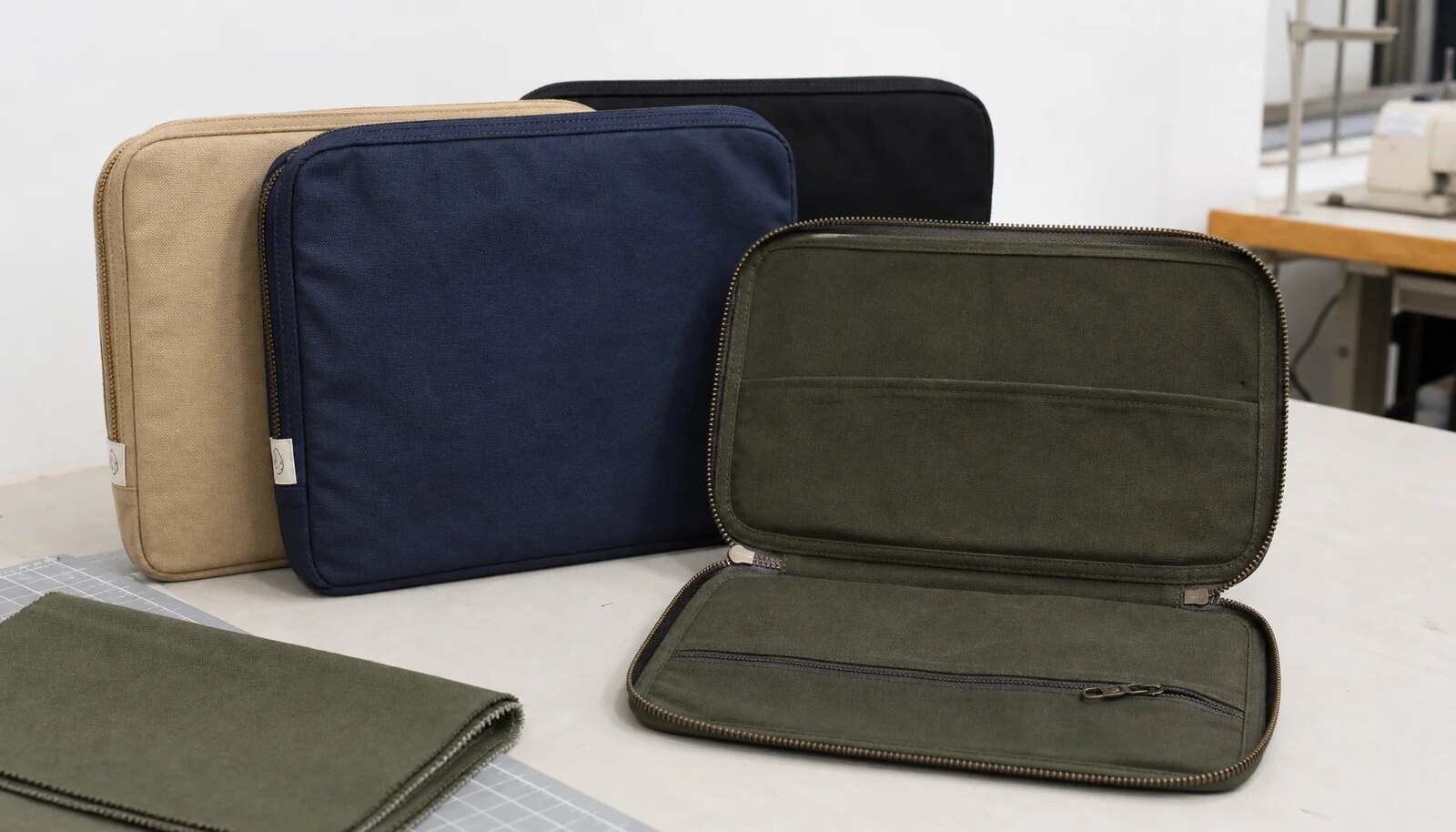
Start with the job this portfolio must do
Wholesale canvas zipper portfolios look straightforward from a distance: a flat canvas body, a zipper, a logo, and perhaps a sleeve or pocket inside. In sourcing, that simplicity can be misleading. A short RFQ that says canvas zipper portfolio with logo invites every supplier to fill in the blanks differently. One quote may assume 10 oz cotton canvas and a stock zipper. Another may include 14 oz cotton-poly canvas, lining, a woven label, and reinforced zipper ends. The unit prices will sit in the same spreadsheet, but they will not describe the same product.
For an eco apparel brand, the portfolio is rarely just a giveaway. It may hold wholesale line sheets, lookbooks, price lists, sample cards, retail onboarding papers, showroom notes, or collaboration documents. The person using it may be a buyer, distributor, sales rep, merchandiser, or press contact. The product should protect contents, open smoothly, feel consistent with the brand, and support responsible material language without stretching the claim.
A stronger RFQ begins with the use case, then turns that use case into measurable requirements. Finished size, usable internal size, opening width, canvas GSM, fiber composition, color standard, zipper details, logo method, packing, samples, and QC points should all appear before buyers compare prices. This keeps the buying process calm. It also gives the factory fewer places to guess.
- Name the use case in the first line of the RFQ: line-sheet holder, retailer folder, event portfolio, tablet sleeve, sample-card carrier, or sales kit.
- Send every supplier the same base specification so price differences reflect real cost differences.
- Ask each factory to identify what is excluded, such as testing, special packing, barcode labels, inspection, custom trim, sample freight, or carton marking.
- Separate must-have features from optional upgrades so procurement can adjust cost without changing the whole product brief.
Define size, clearance, and contents before materials
The right canvas weight and zipper choice depend on what the portfolio must carry. A slim pouch for a few sheets can stay flat, light, and efficient. A retailer onboarding kit with lookbooks, order forms, swatch cards, and a tablet needs more clearance and stronger stress control. Before requesting quotes, build the actual contents stack. Measure it. Then add the handling clearance needed for easy insertion and closing.
Do not rely only on outside dimensions. Outside size affects appearance, packing, carton planning, and freight volume. Usable inside size decides whether the product works. A4 paper is 210 x 297 mm, while US Letter is 216 x 279 mm. A portfolio intended for international sales teams may need to fit both formats, plus a margin. Zipper tape, lining, binding, turned seams, seam allowance, and corner bulk can steal several millimeters from each edge.
Opening width is another common miss. A document can fit inside the body and still be annoying to insert if the zipper opening is too short or tight at the corners. If the zipper runs around two or three sides, the portfolio will open wider, but the corner construction becomes more demanding. If the zipper is only across one edge, the product may look cleaner and cost less, but capacity is less forgiving.
Gussets should earn their place. A gusseted construction carries thicker stacks, yet it adds pattern complexity, sewing time, carton volume, and shape-control risk. For flat documents, a flat construction often looks sharper and inspects more consistently. For sample kits or multi-piece sales packs, a controlled gusset may be worth the added cost.
- Specify finished outside size, minimum usable inside size, and zipper opening width in millimeters or inches.
- List the target contents: A4, US Letter, tablet model, catalog size, swatch-card dimensions, or document stack thickness.
- State whether the portfolio must close smoothly when fully loaded, not only when empty.
- Ask the sample maker to test fit real contents during development and record the result with photos and measurements.
Specify canvas with numbers, not adjectives
Canvas is a material family, not a finished specification. For many wholesale canvas zipper portfolios, 12 oz to 16 oz canvas, roughly 340 to 450 GSM depending on weave and finish, is a practical range. A 12 oz canvas can be suitable for lighter document pouches and cost-sensitive programs. A 14 oz canvas often gives a good balance of structure, printability, sewing efficiency, and freight weight. A 16 oz canvas can feel more substantial, but it increases corner bulk, needle stress, and the chance of visible tension around zipper seams.
Use both ounces and GSM when possible. Some suppliers quote ounces per square yard; others work in grams per square meter. Conversion can be affected by fabric convention, weave, and finishing, so the approved swatch matters more than the number alone. Agree the GSM tolerance before the purchase order is released. A practical target may be around +/-5% when the mill and supplier can support it, but buyers should confirm what is realistic for the specific fabric.
Fiber composition should be written as a percentage. Conventional cotton, organic cotton, recycled cotton blend, and cotton-poly blend can all appear in canvas portfolios, but they behave differently. Cotton-poly blends may improve stability and cost control. Organic cotton may align better with apparel brand positioning. Recycled cotton blends can bring shade, hand-feel, and strength considerations depending on source and blend ratio. The phrase eco canvas is not enough for procurement, compliance, or repeat orders.
Finishing also matters. Brushed, washed, dyed, undyed, coated, or stiffened canvas will not sew or print the same way. If shrinkage is relevant, ask whether the material is pre-shrunk and how final dimensions are controlled. If odor, stiffness, or surface texture matter to the brand, include those points in sample review rather than discovering them during bulk inspection.
- Write canvas weight as both oz and GSM, then attach or reference the approved physical swatch.
- Request fiber composition by percentage, such as 100% cotton or a stated cotton/recycled cotton blend.
- Confirm whether weave, finish, washing, coating, or shrinkage control affects finished dimensions and hand feel.
- Avoid unsupported phrases such as heavy duty, premium, sustainable, or eco canvas unless the supplier ties them to measurable material details.
Control sustainability language and color approvals
Eco apparel buyers often care deeply about material claims, and that care needs precise documentation. A canvas zipper portfolio may use cotton canvas but still include nylon coil, polyester zipper tape, synthetic thread, metal puller, ink, labels, and packing materials. That is normal for many functional business bags. The risk comes when product copy implies more than the component evidence supports.
Ask which component the claim covers. Organic may describe the fabric only. Recycled may apply to a cotton blend, a lining, a label, or packaging. Natural may mean undyed canvas, but it does not automatically mean chemical-free, certified, or fully biodegradable. Certification scope can differ as well: a supplier may have certified fabric availability, a certified mill relationship, or documentation tied to a specific transaction. Procurement should know what can be provided, when it can be provided, and whether MOQ affects access to that documentation.
Color approval deserves equal discipline. Natural canvas can include flecks, seed marks, slubs, and undertone variation. Many eco apparel brands like that character, but it must be approved as part of the standard. If the brand expects a smooth, uniform surface, natural canvas may disappoint unless the factory sorts material carefully or uses a different fabric. Custom dye can improve brand color alignment, but it adds lab dips, dye-lot MOQ, shade tolerance discussions, and reorder risk.
Digital mockups are useful for layout, not color approval. Screen color, office lighting, and photo exposure can all mislead the buyer. Use supplier stock cards, physical swatches, or lab dips. If the portfolio must match apparel collection colors, packaging colors, or retailer fixture standards, record the approved color reference and viewing conditions.
- Ask whether organic, recycled, undyed, natural, low-impact, or similar claims cover fabric, trims, packaging, or the full finished product.
- Request documentation scope before writing product copy, retailer submissions, or packaging language.
- Approve natural flecks, slubs, seed marks, and lot-to-lot shade movement before bulk production.
- For dyed canvas, confirm lab dip timing, dye-lot MOQ, shade tolerance, and how reorder color drift will be managed.
Treat the zipper as a working component
The zipper is the part users touch every time. It should not be reduced to black zipper or matching zipper in the RFQ. For canvas zipper portfolios, nylon coil zippers are often practical because they are flexible, smooth, and cost-effective. For slim document portfolios, #5 coil is common. Larger portfolios, thicker stacks, or multi-side openings may need a different zipper size after sampling.
A proper zipper specification includes type, coil size, tape width, tape color, slider type, puller shape, puller material, finish, zipper length, zipper route, end stops, and reinforcement. Custom pullers should be treated as separate development items, not casual trim changes. They may require tooling, MOQ, extra approval time, and closer inspection for finish consistency or sharp edges.
Zipper quality should be tested with contents inside. An empty sample may zip perfectly while a loaded one drags at the corner or bows along the edge. During sample review, insert the intended line sheets, cards, tablet, or kit contents. Open and close the zipper repeatedly. Feel for rough travel, tight spots, loose slider action, tape waviness, tooth skipping, or snagging at reinforced corners.
Ends and corners deserve special attention because stress concentrates there. The factory may use bartacks, backstitching, folded zipper tape, fabric stops, binding, or another construction. The chosen method should appear in the pre-production sample and in the QC checklist. If the design uses a zipper around two or three sides, corner smoothness and stitching alignment become even more important.
- Specify zipper type, coil size, tape width, tape color, slider, puller, finish, length, route, and end-stop treatment.
- Test the zipper repeatedly with the intended contents inside the portfolio.
- Inspect zipper tape stitching for straightness, even tension, no twisting, no missed catch, and no puckering.
- Ask for close-up photos or a physical construction sample if the factory proposes an unfamiliar zipper-end method.
Select branding that suits textured canvas
Branding on canvas should be chosen for the artwork, the surface, the expected handling, and the price target. Screen printing is often efficient for simple logos, solid marks, and clean typography. It can look strong on canvas, but texture may soften edges, close tiny gaps, or reduce fine detail. Very small type, thin reversed lines, and gradients should be tested before approval.
Woven labels are a good fit when the brand wants a quieter sewn identity. They feel closer to apparel trim than promotional decoration, which can suit eco apparel brands well. Specify label material, fold type, size, ground color, thread colors, stitch placement, and whether the stitching will show inside the portfolio. A small side label may be understated; a front label may carry more brand visibility but needs tighter placement control.
Embroidery can add perceived value, but it is not automatically better. Dense stitches can pucker canvas, expose backing, leave needle marks, or distort the panel. Heat transfers can reproduce fine detail, but buyers should test adhesion, edge lift, gloss, and hand feel on the actual canvas. Patches add another material and sewing step, so they need their own size, placement, edge, and durability approval.
Placement is not just a design question. A logo too close to a zipper line, seam allowance, pocket, or curved corner may shift visually after sewing. Give the factory vector artwork, final logo size, color references, and measurements from fixed edges or center lines. Agree a realistic placement tolerance, often +/-3 mm to +/-5 mm depending on method, fixture control, and product size.
- Use screen print for simple artwork, clean typography, and efficient repeat orders.
- Use woven labels for subtle sewn branding and an apparel-adjacent finish.
- Use embroidery only after checking puckering, backing, stitch density, and panel distortion.
- Approve logo strike-offs on the actual canvas, not only on a smooth substitute fabric.
Compare quotes by total scope
A low unit price is not useful if it leaves out required work. Major cost drivers include canvas GSM, fiber composition, zipper grade, lining, binding, pockets, logo method, sewing complexity, packing, cartons, samples, testing, inspection, and freight assumptions. If one supplier includes individual recycled polybags and barcode labels while another assumes loose bulk packing, the prices are not comparable.
Ask suppliers to quote the same base specification, then list optional upgrades separately. This makes tradeoffs visible. A woven label may add a setup cost plus a small unit cost. A lined interior may affect labor more than material. A heavier canvas may improve hand feel but raise sewing time and carton weight. Custom-dyed canvas may give a better brand match while adding MOQ, lab dips, and lead time.
Price breaks should be requested at realistic decision points. For many custom programs, 500, 1,000, and 3,000 pieces per style, color, or artwork version are useful checkpoints. If the brand wants several colors, sizes, or logo versions, confirm whether MOQ applies to total program volume or each variant. This single answer can change the assortment plan.
Landed cost should be reviewed before final approval. A slightly higher unit price may be acceptable if packing is cleaner, carton volume is lower, or the supplier can hold tighter inspection standards. The reverse is also true: a cheaper product can become expensive if it causes sample rounds, rework, rush freight, or retailer rejection.
- Request line-item visibility for fabric, zipper, sewing, logo, packing, cartons, samples, testing, and inspection where possible.
- Ask for price breaks at 500, 1,000, and 3,000 pcs per style, size, color, zipper color, and artwork version.
- Confirm whether pricing is based on stock canvas and standard zipper colors or custom materials.
- Compare packing method, carton quantity, carton dimensions, gross weight, and barcode requirements before choosing a supplier.
Plan MOQ, variants, and lead time with care
MOQ is not only a negotiation number. It is tied to fabric purchasing, dye-lot size, zipper sourcing, logo setup, cutting efficiency, and sewing-line planning. Very low MOQ can be useful for a pilot, but it often relies on stock canvas, standard zipper colors, simple logo application, and fewer construction choices. That may be the right commercial decision. It simply needs to be visible.
For custom wholesale canvas zipper portfolios, 500 to 1,000 pieces per style or color is often a practical planning range for first runs, with better economics commonly appearing at higher volumes such as 3,000 pieces. The actual MOQ depends on whether the canvas is stock or custom, whether the zipper is standard or custom, whether the lining is special, and whether the supplier already makes similar zipper business bags.
Variants can make a first order feel exciting and make production harder. Multiple canvas colors, zipper colors, lining colors, logo versions, and sizes can split the order into small runs. That affects material allocation, shade tracking, logo setup, carton separation, and inspection. For a first wholesale launch, fewer variants with tighter execution often serve the brand better than a wide assortment with thin quantities.
Lead time should be broken into stages: material sourcing, lab dip if needed, logo strike-off, sample production, sample approval, bulk material purchase, cutting, logo application, sewing, final inspection, packing, and export handover. Reorder lead time matters too. A first run using stock fabric may move quickly, while a reorder in a custom color may require a new material lot and fresh approval.
- Ask whether MOQ applies per total order, style, size, canvas color, zipper color, lining color, or artwork version.
- Keep first-order variants limited unless the supplier can clearly track each lot and SKU.
- Confirm which components drive MOQ: fabric, zipper, puller, label, lining, packing, or logo setup.
- Ask for both first-order lead time and reorder lead time before committing to a retailer program.
Use sampling to remove uncertainty
Sampling is where assumptions become visible. A strong path may include material swatch, lab dip for custom dye, logo strike-off, construction sample, fit sample, and final pre-production sample. Not every order needs every stage, but any order with new canvas, new color, new zipper, new logo method, new interior layout, or special packing should have a real pre-production sample before bulk cutting.
Review the sample as a working product, not as a photo object. Measure the finished outside size, usable inside size, zipper opening width, pocket position, logo placement, and stitch quality. Insert the actual documents, lookbook, tablet, swatch cards, or sales-kit contents. Open and close the zipper repeatedly. Check whether the canvas wrinkles attractively or collapses, whether corners pinch, whether the puller is comfortable, and whether branding remains readable after handling.
The pre-production sample should use actual bulk materials wherever possible. If the sample uses substitute canvas, a temporary zipper, reference logo method, or non-final packing, mark that exception clearly. Buyers should not let a reference sample become the silent bulk standard. Once the final sample is approved, keep one sealed approval sample and one working measurement sample for inspection and internal alignment.
Approval notes should be specific. Instead of writing approved with comments, list the comments: logo move 5 mm down, zipper puller finish to be matte nickel, inside sleeve depth confirmed at 220 mm, loose threads not acceptable, natural flecks accepted as swatch standard. Clear notes protect both buyer and supplier.
- Approve material and logo strike-offs before relying on a complete product sample.
- Measure usable capacity with intended contents, not only with an empty portfolio.
- Label substitute materials or temporary trims as reference only in writing.
- Keep an approved sealed sample for final inspection comparison and repeat-order reference.
Build QC into production, packing, and shipment release
Quality control should be agreed before cutting starts. For canvas zipper portfolios, inspection should cover incoming material, cutting, logo application, sewing, final product review, and packing. Incoming checks confirm GSM, color, odor, stains, surface defects, and any approved natural variation. Cutting checks protect size consistency. Logo checks catch print, embroidery, label, or patch problems before panels become finished goods.
Sewing inspection should focus on the points that affect daily use: zipper alignment, straight tape stitching, secure ends, seam tension, stitch density, skipped stitches, corner bulk, raw edges, pocket placement, lining attachment, loose threads, and label position. A portfolio can look acceptable in a quick image and still fail when it is loaded or zipped under tension.
Final inspection should combine measurement, function, appearance, and carton verification. Measure outside size, usable inside size, and zipper opening width separately. Test zipper function with repeated open-close cycles. Review logo placement against the approved tolerance. Check that the product can hold the intended contents and close cleanly. If AQL inspection is used, define defects in plain product language so the inspector knows what matters.
Critical defects may include unsafe sharp parts, severe contamination, mold, or wrong product identity. Major defects may include broken zipper, wrong logo, wrong size outside tolerance, unusable interior capacity, missing pocket, severe stain, open seam, or incorrect material. Minor defects may include small loose threads, slight removable marks, or tiny print imperfections within agreed limits. Packing QC should verify SKU separation, carton marks, carton count, barcode labels, gross weight, packing material, and random carton contents.
Packing is part of the product experience. Many eco apparel brands want recycled polybags, paper bands, tissue, belly bands, or reduced-plastic packing. Whatever the requirement, it must be written into the PO and checked before shipment release. Portfolios should not arrive with scuffed faces, zipper-pull dents, moisture odor, mixed color lots, or crushed corners.
- Check canvas GSM, color, odor, stains, and visible defects before cutting.
- Inspect logo application before sewing so rejected panels do not become finished goods.
- Test zipper smoothness, end reinforcement, and tape stitching on finished pieces.
- Measure external size, usable internal size, and opening width during final inspection.
- Verify packing method, carton marks, labels, SKU separation, count, and gross weight before shipment release.
Specification comparison for buyers
| Buying decision | Procurement-ready specification | Best-fit order situation | Quality or cost risk to control |
|---|---|---|---|
| Finished size and capacity | State outside size, minimum usable inside size, zipper opening width, and target contents such as A4, Letter, lookbook, tablet, swatch cards, or 10-15 mm document stack | Sales kits, showroom folders, onboarding packs, retailer handover kits, event document portfolios | A portfolio can meet outside dimensions but fail usable capacity because zipper tape, lining, seam allowance, and corner bulk reduce the internal space |
| Canvas weight | 12 oz to 16 oz canvas, usually about 340-450 GSM depending on weave and finish; agree a tolerance such as +/-5% GSM when feasible | Structured document pouches for eco apparel brands that need better hand feel than light promotional cotton bags | Vague terms like heavy canvas hide large differences; too-light fabric collapses, too-heavy fabric increases sewing bulk, needle damage risk, and freight weight |
| Canvas composition | Declare fiber content by percentage: conventional cotton, organic cotton, recycled cotton blend, cotton-poly blend, or other blend; identify certification scope if claimed | Brands aligning product copy, packaging language, sustainability reporting, or retailer compliance files | Do not accept eco canvas as a material spec; unsupported claims can create compliance and brand-risk issues |
| Color standard | Approve physical swatch, lab dip, or stock color card; define shade tolerance and whether natural flecks, slubs, and seed marks are acceptable | Natural, undyed, or custom-dyed canvas programs tied to apparel collection colors or brand packaging | Natural canvas varies by lot; custom dye adds MOQ and lead time; screen colors are not reliable approval standards |
| Zipper specification | Nylon coil zipper, commonly #5 for slim portfolios; state tape width, tape color, slider type, puller material, puller finish, end stops, zipper length, and reinforcement method | Most flat document portfolios where smooth operation, cost control, and flexible sewing are important | Underspecified zippers can drag, split, wave, snag at corners, or arrive with a puller finish that does not match brand standards |
| Construction | Flat or gusseted; lined or unlined; bound or turned seams; pocket, sleeve, pen loop, card slot, divider, label location, and seam finish documented | Orders carrying documents, line sheets, tablets, price cards, samples, or retailer materials | Interior features change pattern, labor minutes, usable space, inspection points, and carton volume; they are not minor add-ons |
| Logo method | Screen print, woven label, embroidery, heat transfer, or patch selected after artwork review; specify size, color, placement, and tolerance, often +/-3 mm to +/-5 mm depending on method and design | Eco apparel brands balancing clean branding, durability, unit price, and repeat-order consistency | Canvas texture can blur fine print; embroidery can pucker; transfer may feel glossy; labels need material, fold, stitch, and placement approval |
| MOQ and price breaks | Quote 500, 1,000, and 3,000 pcs per style, size, canvas color, zipper color, and artwork version; separate stock-material and custom-material scenarios | First wholesale launch, seasonal sales kit, retailer program, distributor replenishment, or repeat branded accessory | Low MOQ may rely on stock canvas, standard zipper colors, simplified logo, or higher setup charges; compare the same customization level |
| Sampling path | Material swatch, lab dip if dyed, logo strike-off, fit sample, and final pre-production sample using actual bulk materials where possible | Any order with new canvas, new color, new zipper, new logo placement, new interior layout, or new packing requirement | Digital mockups and substitute-material samples are reference tools, not bulk approval standards |
Buyer checklist before sampling
- Define the commercial use before quoting: document pouch, wholesale line-sheet holder, lookbook kit, retailer onboarding pack, tablet sleeve, event portfolio, or sample-card carrier.
- Measure the intended contents as a real stack and specify required clearance; include paper standard such as A4 210 x 297 mm or US Letter 216 x 279 mm.
- Lock finished external size, minimum usable internal size, zipper opening width, and whether the portfolio must close cleanly with contents inside.
- Specify canvas weight in oz and GSM, fiber composition by percentage, weave or finish if relevant, and acceptable GSM tolerance such as +/-5% where the supplier can control it.
- Confirm whether material claims such as organic, recycled, undyed, natural, or low-impact apply to the fabric only, the full product, a trim, or only packaging.
- Approve color by physical swatch, lab dip, or supplier stock card; define whether natural cotton flecks, slubs, seed marks, and lot-to-lot shade movement are acceptable.
- Choose zipper type, coil size, tape width, tape color, slider style, puller shape, puller material, finish, zipper length, end-stop treatment, and corner reinforcement.
- Clarify construction: flat or gusseted, lined or unlined, bound or turned edge, internal sleeve, card slot, pen loop, divider, label, and seam allowance.
- Provide vector artwork with logo dimensions, Pantone or thread colors, print or stitch location, and allowable placement tolerance from fixed edges or center lines.
- Request price breaks at 500, 1,000, and 3,000 pcs per style, color, size, zipper color, and artwork version, not only total program volume.
Factory quote questions to send
- What exact canvas are you quoting: oz, GSM, fiber composition by percentage, weave or yarn details if available, fabric width, finishing, shrinkage allowance, and expected GSM tolerance?
- Is the canvas stock fabric or custom sourced/custom dyed, and what MOQ, lab dip timing, shade tolerance, reorder risk, and lead time apply to each option?
- If the material is described as organic, recycled, undyed, natural, sustainable, or eco, what documentation can you provide and which component does it cover?
- What finished outside size, usable inside size, and zipper opening width are included in the quote, and what production tolerance do you recommend?
- Which zipper specification is included: nylon coil or other type, coil size, tape width, tape color, slider type, puller material, finish, end stops, zipper route, and zipper length?
- How will zipper ends and corners be reinforced, and can you provide close-up photos or a construction sample from similar portfolio production?
- What construction are you quoting: flat, gusseted, lined, unlined, bound edge, turned edge, internal sleeve, pocket, pen loop, card slot, divider, or woven side label?
- How many logo colors are included, what logo method is quoted, and what setup costs apply for screens, woven labels, embroidery digitizing, patches, or heat transfers?
- What logo placement tolerance can you hold in bulk, and how will placement be controlled near zipper stitching, seam allowance, pockets, and curved corners?
- What MOQ applies per style, size, canvas color, zipper color, lining color, and artwork version, and what are the price breaks at 500, 1,000, and 3,000 pcs?
Quality-control points to confirm
- Canvas GSM should be checked against the approved swatch or material specification, with a written tolerance agreed before purchase order release.
- Fiber content and any claimed certification or recycled/organic documentation should be verified against the quoted component scope, not assumed to cover the full finished product.
- Fabric color should match the approved physical standard under consistent light; natural flecks, slubs, seed marks, and shade variation should be accepted only if approved in the sample.
- Finished outside size, minimum usable inside size, and zipper opening width should be measured separately because thick seams, lining, zipper tape, and turned corners reduce functional capacity.
- Zipper should open and close smoothly for repeated cycles without snagging, tooth skipping, slider looseness, end-stop failure, tape waviness, or rough pull action.
- Zipper tape stitching should be straight and parallel to the edge, with no twisting, puckering, missed catch, or uneven topstitch visible on the front face.
- Zipper ends and high-stress corners should be reinforced with the approved bartack, backstitch, folded tape, binding, or fabric stop construction.
- Stitch density should be consistent across long seams, corners, pockets, lining, labels, and zipper tape, with no skipped stitches, broken threads, raw seam exposure, or loose thread tails.
- Print or logo placement should match the approved measurement from edges, zipper line, seam allowance, and center point within the agreed tolerance, commonly +/-3 mm to +/-5 mm depending on design.
- Screen print should be checked for coverage, registration, cracking, smudging, ink buildup, pinholes, excessive hand-feel change, and loss of fine detail on textured canvas.