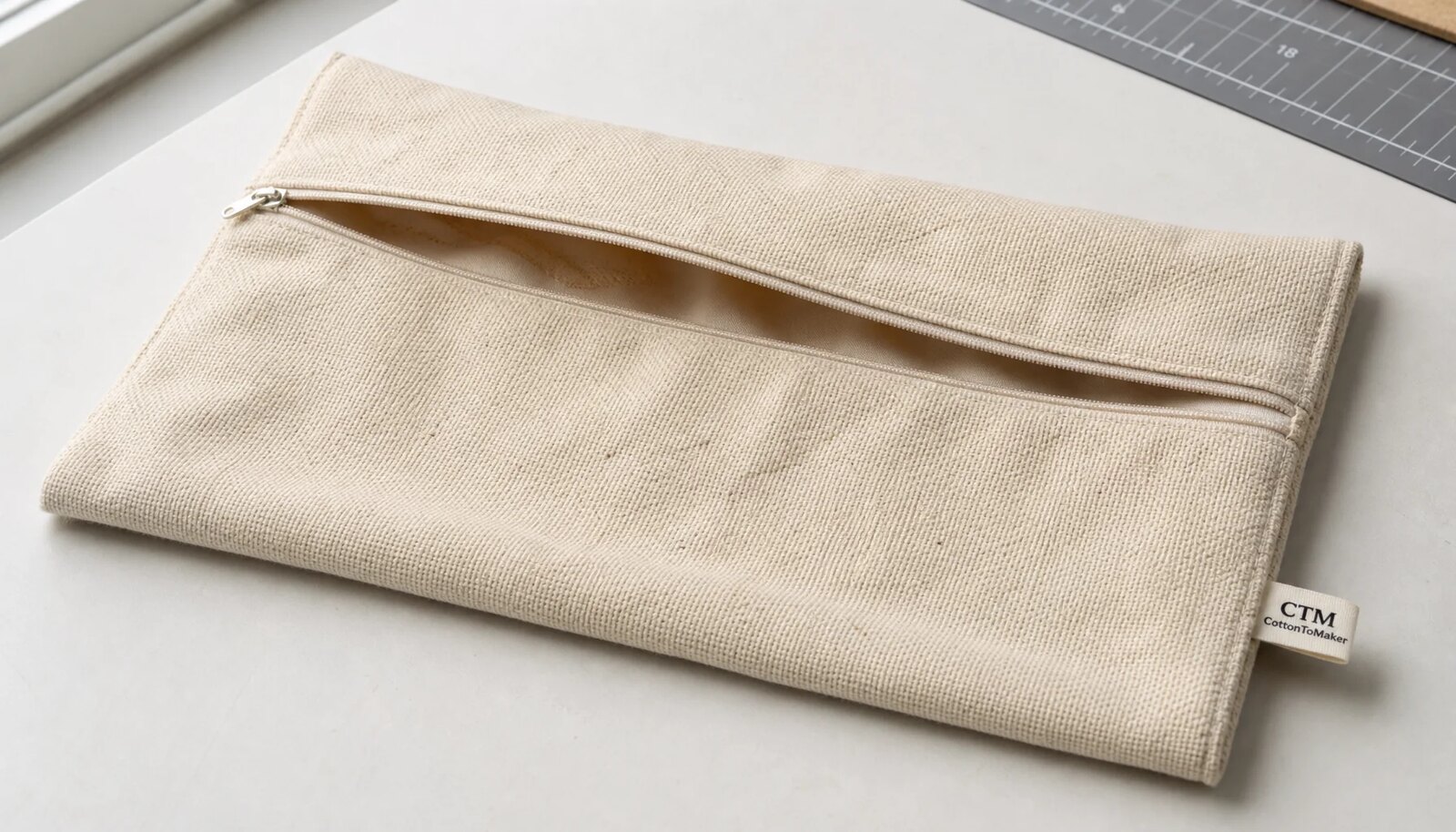
Start with the buying risk
Canvas zipper portfolios look simple in a catalog, which makes them easy to under-specify. A buyer may approve a clean photo and later receive bulk goods with dragging zippers, weak corners, crooked logo placement, or pockets too shallow to use. For a corporate gifting program, the portfolio is not just a logo surface. It carries documents, welcome materials, sales collateral, or event kits before the recipient ever handles it.
The useful question is not whether the mockup looks attractive. It is whether the construction matches the load, delivery route, and brand expectation. Risk rises when orders involve several offices, multiple logo versions, warehouse kitting, fixed event dates, or inserts added after delivery. A small weakness in one sample can become a repeated complaint across a bulk order.
Procurement control starts with a written specification before price comparison. Define the canvas, zipper, seams, reinforcement, decoration, tolerances, packing, and inspection method. The supplier should not have to guess whether the buyer expects 12 oz or 16 oz canvas, a basic zipper or a specified slider, bulk packing or individually protected units.
- Treat the portfolio as a working branded item, not only a gift wrap.
- Use one written specification for all suppliers before comparing prices.
- Test the sample loaded, zipped, packed, and measured.
- Make the approved sample and spec sheet the production reference.
Define the load first
A strong RFQ begins with what the portfolio must carry. A conference handout may hold an agenda, pen, and a few sheets. An onboarding kit may hold a notebook, welcome booklet, badge, card, contract folder, and tablet sleeve. A dealer program may need the portfolio to protect printed materials through storage and courier delivery. Each scenario changes the size, canvas weight, zipper quality, pocket depth, reinforcement, and packing method.
Estimate both dimensions and weight. Define whether the product must fit A4, US letter, legal paper, presentation folders, catalogs, or a tablet inside a sleeve. A tablet sleeve, spiral notebook, or insert box can add enough thickness to strain a tight zipper opening. If the portfolio will be placed into a larger mailer, confirm the outer size after loading, not only when empty.
Load affects where the product fails. A brochure stack creates pressure along one edge. A pen loop adds a concentrated stress point. A zipper pull can dent the front panel if it faces the logo during carton stacking. These details are not overengineering; they are the normal path from a good sample to a disappointing delivery.
- List intended contents, dimensions, and target loaded weight in the RFQ.
- State whether the item will be handed out, mailed, warehoused, couriered, or kitted.
- Use real contents or a weight-and-thickness substitute during sample testing.
- Check document clearance with the zipper closed, not only with the portfolio open.
Specify canvas clearly
Canvas weight drives structure, hand feel, sewing difficulty, and price. For many corporate gifting portfolios, 14-16 oz cotton canvas, roughly 475-542 GSM, is a practical starting range. It usually feels more substantial than light promotional canvas while remaining manageable at zipper seams and corners. A 12 oz canvas can work for lighter programs. Heavier canvas can feel premium, but only if the factory can sew clean corners and control bulk.
Avoid vague fabric descriptions such as thick canvas or premium cotton. Ask for oz and GSM, plus a tolerance the supplier can realistically hold. Around +/-5% may be a useful starting discussion for fabric weight, but the supplier should confirm its actual control method. If the order needs a consistent appearance, ask whether one fabric lot can cover the full quantity and whether pockets, gussets, and binding use the same material.
Finish matters. Natural canvas, dyed canvas, washed canvas, and controlled-shrink canvas can behave differently during cutting, sewing, and decoration. A loose weave may look authentic but reduce fine logo detail. A tighter weave can improve print edges but change the hand feel. If the product must fit a document standard or carton exactly, ask how shrinkage and panel skew are controlled.
Color should be approved physically. Natural cotton shade can vary by lot, and dyed cotton may shift between batches. The approved sample should represent the accepted shade range, or the buyer should approve a fabric swatch before the production sample.
- Specify canvas in oz and GSM, with an agreed tolerance.
- Confirm natural, dyed, washed, pre-shrunk, or treated finish.
- Define whether body, pocket, gusset, lining, and binding materials are identical.
- Approve fabric shade and texture before bulk cutting.
Make the zipper a real spec
The zipper is the part recipients use most, and it is a common failure point. For document-style canvas portfolios, a #5 nylon coil zipper is often a suitable starting point because it is flexible and smooth for soft textile construction. That does not mean every #5 zipper performs the same. Tape quality, slider fit, puller shape, stop construction, and sewing alignment all matter.
A useful zipper specification includes type, size, tape color, slider finish, puller shape, lock or non-lock function if relevant, and top and bottom stop method. If the zipper turns corners, the factory should confirm the path is not too tight for smooth travel. If seam allowance sits too close to the coil, the slider may catch even when the zipper itself is acceptable.
Test the zipper under load. Opening and closing an empty sample proves little. Load the sample with intended contents or a realistic substitute, then cycle it repeatedly. For sourcing comparison, 50-100 loaded open-close cycles can expose many obvious issues. The exact count should match program risk, but pass/fail conditions should be written: no slider failure, no coil separation, no tape pullout, no stop failure, and no repeated snagging.
- Define zipper size, coil type, tape, slider, puller, lock function, color, and stops.
- Inspect zipper ends, corners, tape waviness, and seam interference.
- Test movement with the intended load inside the portfolio.
- Use written pass/fail criteria instead of zipper feels okay.
Engineer stress points
Canvas is durable, but the finished portfolio is only as strong as its seams. Stress concentrates at zipper ends, lower corners, pocket openings, handle tabs if any, pen loops, and places where the user pulls the item open. A flat panel of 16 oz canvas can look strong while a pocket opening fails because its seam end was not reinforced.
For main construction, lockstitch is typical, with stitch density adjusted to fabric thickness, thread, needle, and seam layering. A range such as 7-9 stitches per inch is a practical starting point for many canvas portfolios, not a universal rule. Too few stitches can look loose and weaken the seam. Too many can perforate heavy canvas or create puckering.
Reinforcement can include bar-tacks, box stitches, back-tacks, binding, folded seam allowances, or patches depending on the design. Procurement does not need to dictate every sewing technique if the factory has a proven method, but it should require reinforcement by location. A marked photo or pattern note gives inspectors something concrete to verify.
Pockets should be functional, not decorative afterthoughts. Define opening width, depth, placement, and intended contents. Test a card pocket, pen loop, or slip pocket with the actual item. If a pocket is too shallow, too tight, or too close to the zipper, recipients will notice immediately.
- Require reinforcement at zipper ends, lower corners, pocket openings, and tabs or loops.
- Approve stitch density and puckering against the production sample.
- Ask the supplier to mark reinforcement points on a photo or drawing.
- Test pockets through repeated insertion and removal.
Use a sample durability checklist
A practical durability checklist should be simple enough for procurement, the factory, and an inspector to repeat. It does not need to be a laboratory protocol for every order, but it should identify the sample, test contents, cycle count, measurement points, observations, and pass/fail criteria. Before-and-after photos are useful because they reduce subjective debate.
Start with dimensions. Measure width, height, gusset or thickness, zipper opening length, pocket opening width, pocket depth, and logo placement while the portfolio is empty, flat, and zipped. For straightforward flat portfolios, buyers often discuss finished size tolerance around +/-5 mm. For thicker, gusseted, washed, or structured builds, +/-8 mm may be more realistic. The supplier should confirm what it can hold.
Then test loaded use. Place intended contents inside and open and close the zipper repeatedly. Watch the slider at corners, stops, and seam intersections. Hold the portfolio as a recipient would, lift it from the edge, insert and remove documents, use pockets, and inspect whether seams shift or corners distort. If there is lining, check that it does not catch in the zipper.
Finish with surface and packing checks. Rub the decoration with a clean dry cloth using a consistent number of passes and compare with the approved standard. For higher-risk inks or transfers, ask whether wet rub or tape adhesion checks are suitable. Pack the sample as proposed for bulk and check for pressure marks, scuffs, bent corners, and zipper-pull impressions.
- Measure size, pocket dimensions, zipper opening, and logo placement first.
- Load the sample with real contents or a realistic substitute.
- Cycle the zipper and inspect stress points after handling.
- Rub-test decoration on final canvas and check packing pressure marks.
- Record photos, measurements, defects, and required corrections.
Write an RFQ that compares like with like
A weak RFQ makes unit prices misleading. One supplier may quote 12 oz canvas, a basic zipper, no lining, no reinforcement detail, and bulk cartons. Another may quote 16 oz canvas, reinforced zipper ends, a woven label, individual polybags, and export cartons. Both may call the item a canvas zipper portfolio, but they are not quoting the same product.
The RFQ should include finished size and tolerance, fabric weight and finish, color, zipper specification, lining requirement, pocket layout, reinforcement locations, stitch expectations, decoration method, logo size and placement, packing format, carton marks, sample requirements, inspection expectations, and lead time. It should also state the use case and intended contents so the supplier understands the reason behind the specification.
Cost inclusions should be explicit. Ask whether unit price includes artwork setup, screen charges, label development, sample fee, sample freight, hangtags, insert cards, individual polybags, tissue, carton marks, export cartons, and documentation. If the order has multiple logo versions or delivery points, ask how that affects MOQ, sorting, carton labels, and inspection time.
Leave room for factory recommendations, but capture them in writing. A capable factory may suggest a small size increase for document clearance, a different zipper puller, a deeper pocket, or a packing orientation that avoids dents. Those changes should be reflected in the final quote and sample comments.
- Send every supplier the same spec sheet and load case.
- Ask for line-by-line confirmation of fabric, zipper, reinforcement, decoration, packing, and lead time.
- Separate included costs from optional or excluded charges.
- Require suppliers to identify any spec item they cannot meet before sampling.
Approve production-intent samples
A showroom sample is helpful for early style screening, but it should not be the final approval reference for a custom corporate gifting order. The approval sample should use production-intent canvas, zipper, thread, reinforcement, lining if any, decoration, labels, and packing. If substitute materials are used, record exactly what is different and request a revised sample when the difference affects performance or appearance.
Review the sample in sequence. First measure it against the spec. Then load it and run the handling checklist. Finally inspect decoration and packing. This order matters because a portfolio can look good in a flat photo but fail when filled, zipped, or packed. Some issues require redesign; others only require a tolerance correction or sewing adjustment.
Artwork approval on canvas should be physical. Digital mockups do not show ink absorption, weave texture, embroidery pull, label bulk, or shade interaction. A Pantone reference can guide color, but the buyer should approve the result on actual canvas. For critical branding, request a strike-off before full production sample approval.
Once approved, the sample becomes a control tool. Keep one signed physical sample where possible, supported by photos, measurements, artwork files, and packing photos. Bulk inspection should compare goods against that package. If the factory proposes a material or process change after approval, require written approval and a new sample or strike-off when the change is material.
- Use showroom samples for style screening only.
- Approve a production-intent sample before bulk cutting or printing.
- Measure, load, handle, inspect, and pack the sample before signoff.
- Keep the approved sample package available for inspection.
Control logo durability and placement
Decoration carries brand value and technical risk. Screen print, heat transfer, embroidery, woven labels, and patches behave differently on canvas. A 1-2 color screen print is often repeatable for flat panels. A woven label can be durable and understated. Heat transfer may hold fine detail, but it should be checked for edge lift and cracking. Embroidery can look substantial, but it may pucker lighter canvas or distort small text.
Ask the factory for practical artwork limits on the selected canvas. Minimum line thickness, smallest readable text, maximum solid ink area, and recommended logo size depend on fabric texture and ink system. Gradients, tiny legal lines, metallic effects, and large solid ink blocks should be proven on production-intent fabric before bulk decoration.
Placement tolerance should be measurable. Instead of saying centered on front, state the distance from the top seam, zipper edge, side seam, or panel centerline. A tolerance such as +/-3 mm to +/-5 mm may be reasonable for many sewn textile products, depending on panel size and print method, but the supplier should confirm capability. For woven labels, define visible label length, fold style, and direction after sewing.
Check branding after packing, not only after printing. A zipper pull, tight carton, or rough separator can mark the decorated panel. If the item is part of an executive gift, presentation defects may matter as much as basic function.
- Select decoration for clarity, durability, repeatability, and cost control.
- Test decoration on final canvas, not unrelated fabric.
- Define logo placement with measured reference points and tolerance.
- Check rub, cracking, puckering, label security, and packed appearance.
Inspect packing as product quality
Packing can damage a well-made portfolio. Canvas can hold pressure marks, corners can bend, and zipper pulls can dent printed panels when cartons are tight. Approve packing at the same time as the sample. Pack the sample in the proposed polybag, tissue, sleeve, or bulk arrangement, then check for scuffing, odor, trapped moisture, bent corners, and hardware impressions.
Choose packaging based on distribution. Individual polybags can help warehouse handling or direct shipment, but they add material, labor, and moisture risk if goods are packed too soon or stored poorly. Tissue or separators can protect logo areas. Gift sleeves, insert cards, or belly bands can improve presentation but add cost, carton volume, and extra inspection points. For internal events, protected bulk packing may be enough.
Write carton details into the purchase order: pieces per carton, carton dimensions, gross weight, carton strength, packing orientation, carton marks, and mixed-SKU rules. Heavy cartons increase handling damage. Loose cartons allow scuffing. Over-tight cartons crush corners and zipper lines. Multiple logo versions, colors, or delivery addresses require clear labels to prevent sorting mistakes.
Final inspection should classify defects. Critical defects include wrong logo, non-functioning zipper, open seam, unsafe sharp hardware, incorrect size that blocks intended use, or wrong packing that prevents distribution. Major defects include missing reinforcement, visible print defects, crooked zipper, significant stains, shade outside approval, or repeated dimension failure. Minor defects may include small thread tails or slight wrinkles that recover after unpacking.
- Approve packaging by testing it with the actual sample and zipper-pull position.
- Confirm carton quantity, dimensions, gross weight, orientation, and marks before packing starts.
- Define critical, major, and minor defects for final inspection.
- Require inspection photos of measurements, decoration, zipper function, reinforcement, packing, and cartons.
Specification comparison for buyers
| Decision area | Option to compare | Best fit | Procurement risk to verify |
|---|---|---|---|
| Supplier capability | Direct factory or sourcing partner with documented control of fabric, sewing, decoration, packing, and inspection | Repeat corporate gifting programs, multi-location rollouts, and orders where one approved sample must be reproduced consistently | Confirm who buys the canvas and zipper, where decoration is done, what is subcontracted, and who signs the final inspection report. |
| Canvas weight | 12 oz, 14-16 oz, or heavier canvas, specified in both oz and GSM with a realistic tolerance | 12 oz for light handouts; 14-16 oz as a common starting point for premium document portfolios; heavier only when the factory can sew clean zipper corners | Do not accept only words like heavy canvas. Ask for GSM, fabric-lot control, shrinkage handling, and whether pockets and gussets use the same material. |
| Zipper construction | #5 nylon coil zipper as a common starting point, or upgraded zipper based on load and opening shape | Document portfolios, onboarding kits, sales folders, and soft-sided business bags that need flexible zipper movement | Specify tape color, slider finish, puller shape, stops, and loaded zipper testing. A larger zipper does not fix poor sewing or tight corner geometry. |
| Reinforcement method | Bar-tacks, box stitches, back-tacks, binding, or added patches at defined stress points | Orders carrying notebooks, brochures, folders, tablet sleeves, or kitted accessories | Require a marked reinforcement map. Check zipper ends, lower corners, pocket openings, pen loops, handle tabs, and any point the user pulls repeatedly. |
| Branding method | Screen print, woven label, heat transfer, embroidery, or patch tested on final canvas | Screen print for many 1-2 color logos; woven label for subtle durable branding; embroidery only after puckering is checked | Approve decoration on production-intent fabric. Check rub, edge lift, cracking, small text clarity, label security, and placement tolerance. |
| Packing standard | Individual polybag, tissue/separator, gift sleeve, bulk packing, or carton-ready kitting format | Choose based on warehouse handling, direct mail, event distribution, or executive gift presentation | Test pressure marks, zipper-pull dents, scuffing, odor, moisture risk, carton weight, mixed-SKU sorting, and carton marks before bulk packing. |
Buyer checklist before sampling
- Define the business use case: onboarding kit, executive gift, sales presentation kit, conference handout, employee welcome pack, dealer program, or warehouse-kitted mailer.
- List expected contents with dimensions and approximate loaded weight, including documents, notebook, tablet sleeve, brochure stack, pen, card, insert box, or charging accessory.
- Specify finished size and tolerance; state whether the item must fit A4, US letter, legal documents, a 13 inch tablet sleeve, or a pre-sized gift carton.
- State canvas weight in oz and GSM, acceptable tolerance, weave or hand-feel expectation, color, finish, and whether pre-shrunk or controlled-shrink canvas is required.
- Confirm whether body, pockets, gussets, binding, and lining use the same canvas or different materials, and require substitutions to be approved in writing.
- Define zipper type, size, tape color, tape width if relevant, slider material, puller shape, lock function if needed, stop construction, and expected smoothness under load.
- Require reinforcement at zipper ends, lower corners, pocket openings, handle tabs if any, pen loops, and any seam that carries concentrated stress.
- Specify stitch type, stitch density target, thread color, seam allowance, bar-tack or box-stitch locations, thread trimming standard, and acceptable puckering level against the approved sample.
- Choose decoration after testing on final canvas: screen print, woven label, embroidery, heat transfer, leather or cotton patch, or other branding method.
- State artwork size, placement reference points, placement tolerance, color reference, ink count, label dimensions, and acceptable shade variation on the actual canvas color.
Factory quote questions to send
- What exact canvas weight in oz and GSM will be used, what tolerance can you hold, and will body panels, gussets, pockets, and binding use the same fabric?
- Is the canvas stock, made-to-order, dyed-to-order, washed, pre-shrunk, or otherwise finished, and can one fabric lot cover the full bulk quantity?
- What finished size tolerance do you recommend for this construction, and how will width, height, gusset, zipper opening, and pocket size be measured during QC?
- Will the pre-production sample use production-intent fabric, zipper, thread, lining, reinforcement, decoration, labels, and packing, or only similar available materials?
- What zipper size, coil type, tape width, tape color, slider material, puller style, lock function, and top/bottom stop method are included in the quote?
- What zipper-cycle check do you perform internally, is it tested empty or loaded, and what is the pass/fail standard for snagging, tape separation, slider failure, and stop failure?
- Where exactly do you add bar-tacks, box stitches, double stitching, binding, or reinforcement? Please mark these points on a photo, pattern drawing, or sample comments sheet.
- What stitch density, thread type, needle size range, and seam allowance do you recommend for the main seam, zipper seam, pocket opening, and reinforced corners?
- What is the maximum practical logo size, minimum line thickness, and number of print colors you recommend for this canvas surface?
- Can you provide a print strike-off or label sample on the production-intent canvas before the full pre-production sample is approved?
Quality-control points to confirm
- Canvas weight should match the agreed oz/GSM and tolerance; if no lab test is used, the factory should at minimum keep roll labels and internal weight records for the approved material.
- Fabric panels should be free from unapproved shade mismatch, major skew, holes, oil marks, stains, broken yarns, excessive slubs beyond the approved sample, and visible crease marks that do not relax.
- Finished dimensions should stay within the agreed tolerance for width, height, gusset or thickness, zipper opening length, pocket opening width, and pocket depth.
- The portfolio should fit the stated contents without bending documents, overstraining the zipper line, or causing the zipper slider to drag around corners.
- Zipper should run smoothly from end to end while loaded, without catching on seam allowance, lining, loose threads, print thickness, or fabric bulk at corners.
- Zipper tape should be sewn straight and evenly, with no waviness beyond the approved sample, no exposed raw tape ends, no skipped stitches, and no weak top or bottom stops.
- Slider and puller should match the approved finish and shape, with no sharp edges, plating flakes, heavy rattle, rust marks, color mismatch, or rough movement.
- Main seams, zipper seams, lower corners, pocket openings, gussets, and tabs should show no skipped stitches, broken threads, popped stitches, seam slippage, or loose thread tails beyond the trimming standard.
- Bar-tacks, box stitches, or other reinforcements must be present at every agreed stress point and should remain intact after the load, pocket, and zipper handling checks.
- Thread color, stitch density, stitch line straightness, seam allowance, and visible puckering should match the approved production sample within the written tolerance.