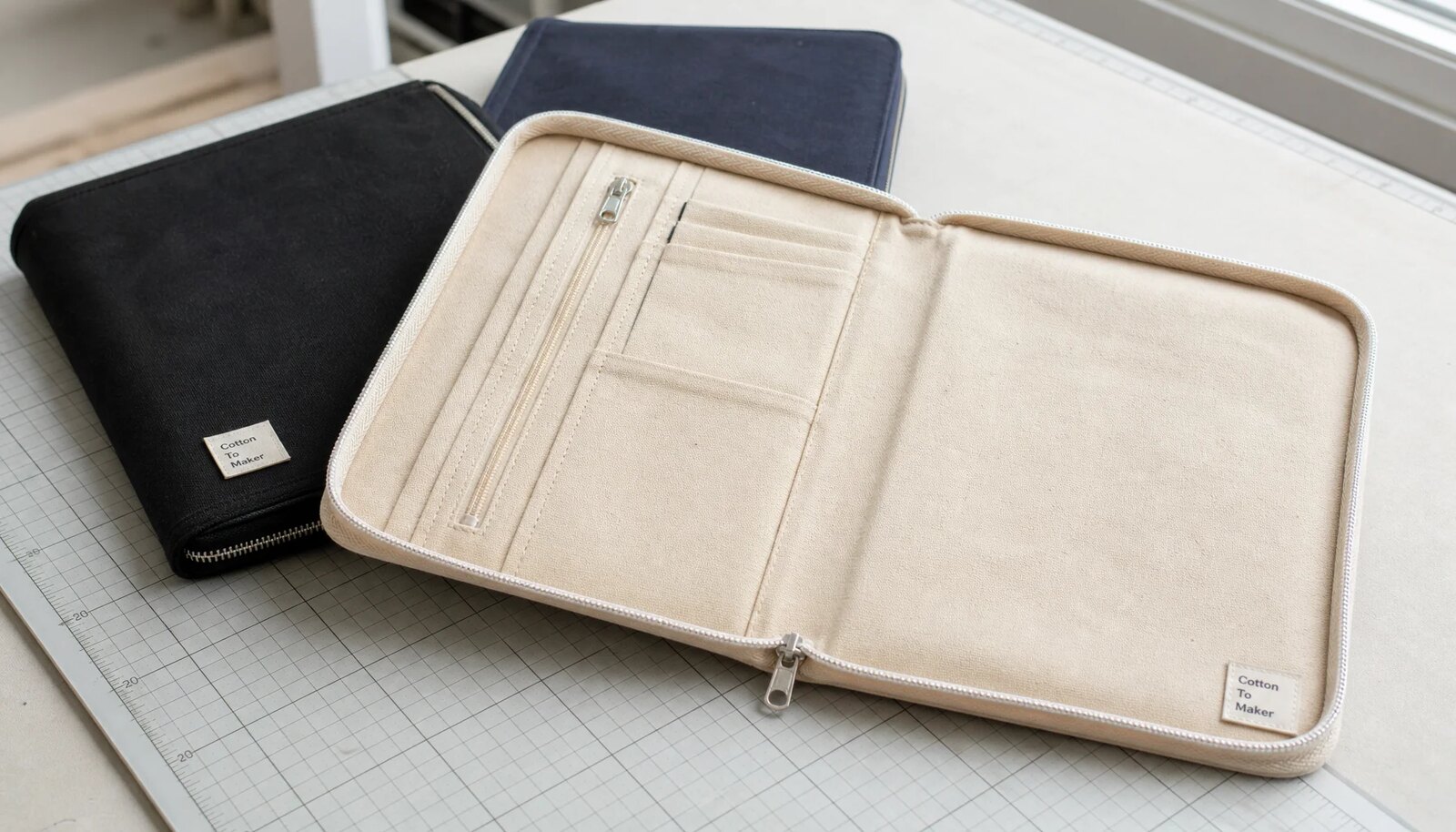
Start With the Use Case, Not the Fabric
For eco apparel brands, a canvas zipper portfolio is usually a presentation tool, not just a generic office folder. It may hold line sheets, fabric swatches, a tablet, shipping documents, or a mix of all four. That means the buying problem is not only visual. It is about how the portfolio opens, how flat it lies on a table, and whether it still looks clean after repeated buyer meetings and sample-room use.
The first RFQ question should be about contents, not decoration. State what the portfolio has to hold, how thick the load will be, and whether the user needs a pen loop, a business-card pocket, or a full internal sleeve. A bag that fits loose paper can fail once a tablet or swatch board is added. If the internal space is wrong, the rest of the spec does not matter.
- Define the user: sales team, merchandiser, distributor, or retail buyer.
- State the contents: paper, swatches, tablet, notebook, or mixed presentation kit.
- Give the target thickness when closed, not just a flat size.
- Say whether the portfolio must stand up, stay flat, or fold into a tote.
Choose a Canvas Weight That Matches the Load
Canvas weight drives the feel, shape retention, and defect risk. As a practical buying range, 8 oz or about 270 GSM is light and flexible, 10 oz or about 340 GSM is the common middle point, and 12 oz or about 400 GSM gives a firmer, more premium hand. For paper-only use, the lighter range can work. For trade show handling, buyer samples, and repeated opening and closing, the heavier range usually looks better and lasts longer.
Construction matters as much as cloth weight. An unlined portfolio is cheaper, but it can look soft, show stitch marks, and wear faster at the zipper line. A simple lining in cotton twill or polyester-cotton helps the interior stay cleaner and improves the glide of the zipper tape. If the portfolio will carry weight, ask for reinforcement at the zipper ends and any handle or corner stress points. Buyers should request the exact GSM, weave style if known, lining type, and whether the canvas is pre-shrunk or washed.
- Use 8 oz for light document use and short-run launch programs.
- Use 10 oz for most wholesale eco apparel programs.
- Use 12 oz when the portfolio needs structure and a premium feel.
- Treat lining and reinforcement as part of the spec, not optional extras.
Decide How the Portfolio Will Be Branded
Branding changes the quote more than many buyers expect. A one-color screen print on the front panel is usually the most efficient bulk option because it spreads setup cost across volume and keeps the hand feel light. If the art is bold and simple, this is often the cleanest result. If the design uses small text, fine lines, or more than one color, the supplier may need a larger mesh screen, more registration control, and a tighter approval process.
For eco apparel brands, the most practical look is often a mix of methods rather than a single large treatment. A printed logo on the front, a woven side label, and a recycled-paper hangtag can look more intentional than trying to embroider everything. Embroidery adds texture and a premium signal, but it can pucker lighter canvas and needs backing. Heat transfer can work for small runs, but it should be tested for rub resistance before bulk. Keep the artwork large enough to survive the fabric weave and the daily handling the portfolio will get.
- One-color screen print: best for bulk and bold logos.
- Woven label or side tab: useful when the front panel should stay minimal.
- Embroidery: best on heavier canvas and premium programs.
- Heat transfer: acceptable for short runs, but not the first choice for heavy handling.
Build the Cost Model Around the Real Price Drivers
The unit price of a canvas zipper portfolio is driven by more than fabric and sewing. Canvas weight, zipper grade, lining, inner pockets, gusset depth, logo method, and pack format all change the labor time and rejection risk. A flat folder with one pocket is efficient. A structured portfolio with a gusset, pen loops, business-card slot, and tablet sleeve creates more sewing operations and a higher chance of variation, so the price should reflect that reality.
MOQ logic is layered, and buyers should treat it that way. The sewn bag may have one minimum, the print process another, and custom trim a third. A factory can often make 500 pieces of the body, but a custom zipper pull, woven label, or special lining may only become economical at 1,000 pieces or more. Ask for pricing at more than one quantity, such as the next breakpoints your team might actually order. The useful comparison is not the cheapest unit price on one quantity. It is the lowest acceptable landed cost after setup, samples, packing, and freight.
- Request separate lines for body, trim, branding, packing, and cartons.
- Ask where the price drops at the next MOQ step.
- Confirm whether artwork color count changes the print setup fee.
- Do not compare one bundled quote against another bundled quote without the breakdown.
Compare Supplier Routes Before You Send RFQs
A buyer often loses time by comparing a direct factory quote against a trading company quote without knowing what each quote really includes. Direct factory sourcing gives stronger control over cutting, sewing, and packing, especially when the spec is stable. A trading company can be useful when the program has multiple trim items, mixed product types, or a need to consolidate different goods in one shipment. A stock blank route is faster, but it limits what the portfolio can be.
The right sourcing route depends on volume, schedule, and how often the spec will change. If the portfolio is part of a repeat wholesale program, a direct OEM factory is usually easier to manage. If the buyer is testing a new range and expects changes after the first run, a domestic short-run supplier or a local decorator may be cheaper in practice because it reduces revision risk. Use the comparison table to decide which route fits the program before you ask for prices.
- Direct factory: best for control and repeatability.
- Trading company: useful when the order includes mixed bag styles or difficult sourcing.
- Stock blank plus local branding: best for launch speed.
- Hybrid routes: useful when body production and final branding need to happen in different places.
Write the RFQ So Quotes Can Be Compared
A good RFQ reads like a controlled spec sheet, not a brand story. It should state finished size, usable internal dimensions, canvas GSM, lining type, zipper size, puller style, pocket layout, logo method, artwork size, and packing standard. If those items are vague, each supplier will fill in the blanks differently, and the resulting quotes will not be comparable. Procurement teams then spend time chasing clarifications instead of evaluating value.
The quote should also separate the hidden cost layers. Ask for the blank portfolio price, branding setup, trim upgrades, sample charges, packing materials, carton spec, export preparation, and the quoted validity period. If the supplier gives only one all-in number, that is not necessarily wrong, but it makes later changes harder to price. For buyer teams, the most useful quote is the one that shows exactly what is included and what is excluded.
- State the artwork file format and exact print dimensions.
- Tell the supplier whether the sample must be approved before bulk cutting.
- Ask for the validity period of the quote and the production start trigger.
- Require a line that states all exclusions in plain language.
Approve Samples Against Measurable Criteria
The first sample should prove fit and construction, not just appearance. A portfolio that looks good empty can still fail if the zipper strains when the intended contents are inserted. Test the sample with the real load: line sheets, a tablet, or swatch cards. Make sure the portfolio closes cleanly, the zipper tracks smoothly, and the internal panels do not buckle. If the product is meant to be opened repeatedly in front of buyers, those details matter more than a perfect photo.
Record sample approval in measurable terms. Measure the finished size, gusset depth, pocket depth, logo placement, and zipper stop position. Then inspect seams, corner turns, thread tails, and fabric slubs. If the factory says a defect needs a pattern change or hidden reinforcement, get that change written into the spec before bulk cutting begins. This is how a buyer avoids the common same-as-sample dispute after the order is in production.
- Test the sample with actual contents, not just paper templates.
- Open and close the zipper several times before approval.
- Compare logo color and position under daylight and store lighting.
- Keep a signed sample record with photos and measurements.
Set Packing and Carton Rules Before Production
Packing affects both damage risk and freight cost, so it should be locked before bulk production starts. A simple polybag can protect the portfolio from dust, but extra inner packaging increases volume and can make the shipment less efficient. For eco apparel buyers, a recycled paper insert or minimal inner wrap may be enough if the product still arrives clean and uncreased. The key is to define the bag size, barcode placement, and whether the portfolio ships flat or folded.
Master carton details matter once the goods reach a warehouse or distribution center. Ask the factory to state pieces per inner carton, inner cartons per master carton, carton dimensions, gross weight, and whether palletization is required. If the portfolio has a rigid insert or thick lining, the carton count may need to drop to avoid crushing the shape. Many quality complaints begin as packing mistakes, not sewing mistakes, so this part should never be left to default factory habits.
- Confirm if the portfolio ships flat or folded.
- Lock barcode and carton mark placement before print approval.
- Keep carton weight within the buyer warehouse handling limit.
- If the product is structured, request a packing method that protects the shape.
Control Lead Time, Reorders, and Landed Cost
Lead time in this category is usually driven by component readiness. Stock canvas may be available quickly, but custom lining, special zipper color, print setup, and sample revisions all add time. Procurement should separate sample lead time, material reservation time, bulk sewing time, and export booking time. If the supplier gives only one delivery date, the schedule risk is hard to manage and the buyer loses the ability to see where delays are actually likely to happen.
The cheapest quote can become the most expensive landed cost if it causes rework, a late shipment, or a messy reorder. For repeat programs, keep the base spec stable and swap only the artwork or label when the brand refreshes. That lowers MOQ pressure and reduces the chance of color drift between batches. The most useful internal file is a stable master spec with one approved sample reference, one packing reference, and one reprint reference for future orders.
- Track lead time by stage, not just by final ship date.
- Hold one approved reference sample from each production run.
- Review freight, duty, and destination handling charges before awarding the PO.
- Keep the base body spec unchanged when only seasonal artwork changes.
Specification comparison for buyers
| Spec decision | Recommended option | When it fits | Buyer risk to check |
|---|---|---|---|
| Direct factory with in-house sewing | Best for 500+ pcs of one stable spec with one logo method | When you need one responsible party for cutting, sewing, and packing | Check hidden MOQ on lining, zipper pull, or woven label |
| Trading company or sourcing agent | Best when you need mixed trims, multiple styles, or combined shipments | When the portfolio is one item in a broader bag program | Ask which factory actually makes the goods and how QC is handled |
| Stock blank portfolio plus local branding | Best for fast launches, events, and short first runs | When fit is standard and only the logo changes | Limitations on pocket layout, zipper color, and finish quality |
| Full custom OEM factory | Best for premium retail programs and repeat wholesale orders | When the buyer needs control over fabric, lining, closure, and packaging | Longer sample cycle and higher risk if artwork is not finalized early |
| Nearshore repeat supplier | Best for rush reorders and lower communication friction | When freight time matters more than the lowest unit cost | May have fewer fabric options and smaller scale price breaks |
| Domestic short-run decorator | Best for 100-300 unit tests or regional drops | When speed and revision flexibility matter most | Usually weak on bulk economics and custom hardware |
| Hybrid offshore body plus local finishing | Best when retail labeling or final branding must happen late | When two-step control is worth the extra handoff | Risk of spec drift between suppliers if sample files are not locked |
| Two-source core and seasonal strategy | Best for brands that want a steady reorder base and an experimental lane | When you need continuity without putting every launch on one MOQ | Keep one master spec sheet to avoid color and measurement drift |
Buyer checklist before sampling
- Define the exact use case: document holder, tablet sleeve, sales sample portfolio, or buyer presentation folder.
- Lock finished size and usable internal dimensions, not only the outer size on the drawing.
- Choose the canvas weight in GSM or oz, plus whether the body is lined or unlined.
- Specify zipper type, puller style, zipper tape color, and any reinforcement at the ends.
- Choose logo method, artwork size, and number of print colors before asking for quotes.
- Set the MOQ target, overrun tolerance, and reorder expectation for the same spec.
- State packing format, barcode position, master carton count, and whether the product ships flat or folded.
- Request a pre-production sample and measure it against the approved spec sheet.
- Ask for a quote broken into body, trim, branding, packing, and export-related line items.
Factory quote questions to send
- What exact canvas GSM or oz weight are you quoting, and is it natural, dyed, or washed canvas?
- What zipper type, zipper size, and puller style are included in the price?
- What is the MOQ for the sewn bag body, the logo process, and any custom trim or lining?
- Can you separate the quote into bag body, branding, packaging, cartons, and sample charges?
- What are the sample stages, and which sample is considered the final approval sample before bulk cutting?
- What overrun or underrun tolerance applies to this order?
- What packing format is included: polybag, insert card, tissue, barcode label, or master carton mark?
- What lead time applies to stock materials versus custom materials or custom-colored trims?
- What inspection standard or acceptance criteria do you use before shipment?
- Can you share recent production photos or a reference sample with the same canvas weight and zipper build?
Quality-control points to confirm
- Finished size must stay within a practical tolerance, typically plus or minus 5 mm on length and width unless the buyer spec says otherwise.
- The zipper must run smoothly through repeated open-close cycles without snagging, teeth mismatch, or puller binding.
- Stitching should be even, with no skipped stitches, broken thread chains, or loose tails longer than 3 mm on visible areas.
- Logo placement should match the approved artwork position and color should hold under daylight and indoor retail lighting.
- Canvas panels should be free of thin spots, broken yarns, oil stains, and visible holes in all front-facing areas.
- Reinforcement at zipper ends, corners, and stress points should be secure, with no puckering or popped stitches.
- Pocket depth, card slots, and any tablet sleeve must remain usable after the portfolio is filled to the intended thickness.
- Packing counts, barcode labels, carton marks, and carton dimensions must match the approved packing sheet exactly.