Start With the Bakery Program
A canvas zipper portfolio is simple only when the use case is simple. For bakery procurement teams, the same product may serve as a wholesale menu folder, distributor welcome pack, franchise opening kit, tasting-note wallet, catering sales tool, or trade show press folder. Each use affects size, pocket layout, branding, packing, and carton handling. A low quote is not useful if menu sheets do not load easily, the zipper catches at a corner, or the carton cube makes the landed cost uncompetitive.
Write the RFQ around the actual handling path. A sales representative who opens the portfolio every day needs smoother zipper performance than a one-time kit folder. A retail gift needs cleaner presentation than an internal order pouch. A distributor allocation program needs carton marks, barcodes, and pack counts that receiving teams can process without repacking.
The long-tail idea behind wholesale canvas zipper portfolios for artisan bakeries shipping carton planning is buyer-led, not SEO-led: specify the product and the carton together. Fabric weight, zipper path, print method, sleeve, pieces per carton, gross weight, and CBM should be reviewed before the PO, not after bulk goods are finished.
- State the final user and handling path: bakery staff, sales rep, distributor, franchisee, or end customer.
- Share the exact insert stack instead of asking for a generic A4 or letter-size pouch.
- Request carton data during quotation so landed cost can be compared early.
- Flag raised trims, metal pullers, embroidery, or paper sleeves early because they change pressure-mark risk.
Define Size, Opening, and Fit
Fit is the first technical checkpoint. A4 paper is 210 x 297 mm, while US letter is about 216 x 279 mm. A portfolio that is only slightly larger than the sheet can still fail because seam allowance, zipper tape, binding, and rounded corners reduce the usable internal area. The drawing should separate outside finished dimensions from usable internal dimensions and zipper opening length.
The zipper opening needs its own measurement. A body can measure correctly while the loading gap is too narrow for a packet of menus or price lists. If bakery staff insert contents once before shipment, a close fit may work. If sales teams refill the portfolio frequently, additional clearance protects the zipper and reduces handling frustration.
Thickness is also part of size control. A single price sheet, a 5 mm order pack, and a 10 mm seasonal catalog bundle should not use the same construction assumptions. Gussets help thicker contents but add sewing points, cube, and inspection complexity. For many bakery document programs, a flat body with one internal pocket is easier to control and pack.
- Define outside size, usable internal size, zipper opening length, pocket depth, loading direction, and tolerance.
- Provide the largest sheet size plus maximum stack thickness in millimeters.
- Approve fit with real inserts or a gauge sheet during sampling.
- Avoid hard tolerances unless the supplier confirms they are realistic for sewn cotton canvas.
Specify Canvas by Evidence
Canvas affects hand feel, sewing performance, print appearance, carton count, and freight weight. A lighter fabric may reduce cost and weight but can wrinkle or feel under-structured. A heavier canvas may look more premium but can create bulky corners, reduce pieces per carton, and raise gross weight. Quote by nominal oz and measured GSM range, because fabric naming can vary by mill and finish.
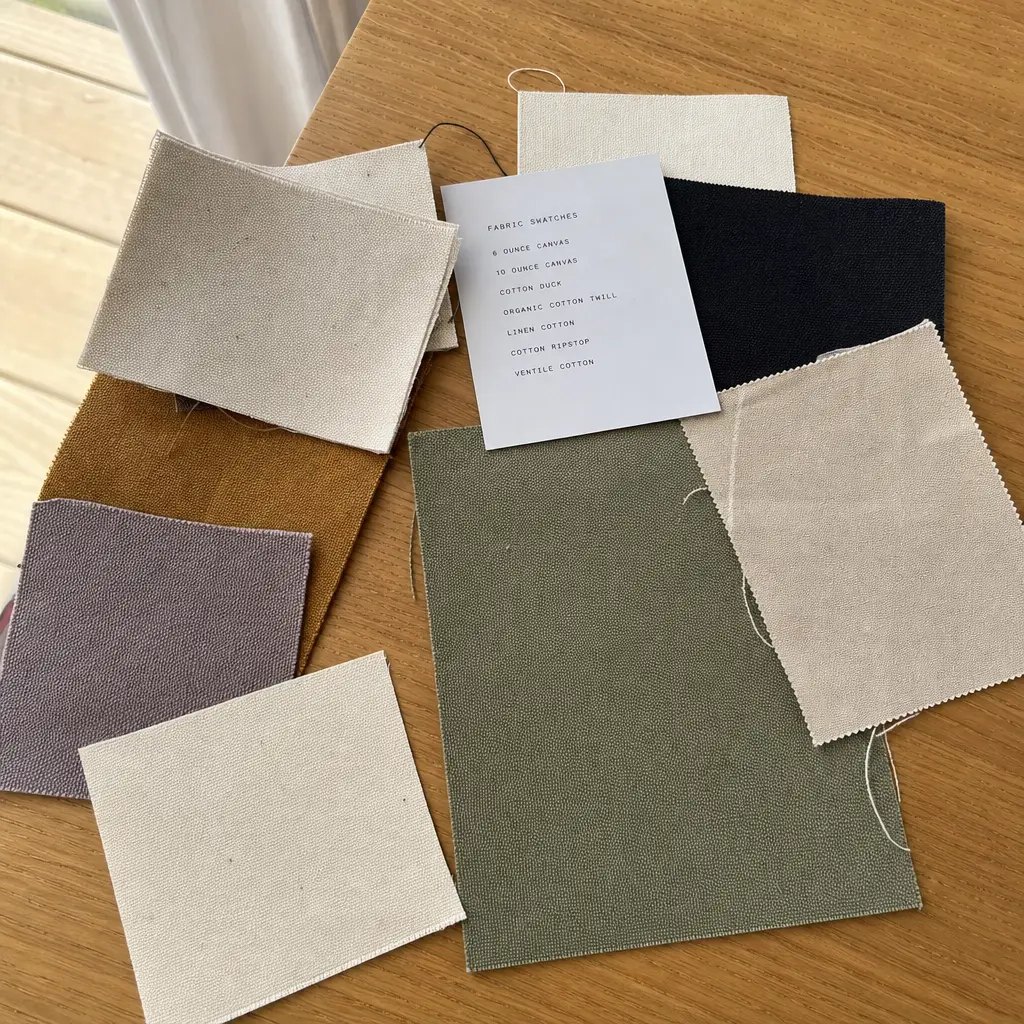
Natural cotton canvas suits artisan bakery branding because it feels warm and tactile. It also needs an agreed surface standard. Seed flecks, minor yarn slubs, and slight shade variation may be acceptable outside the logo area. Oil stains, mold, dirty handling, strong odor, heavy weaving defects, and obvious shade mismatch should be classified as defects. Keep an approved swatch with the order file and inspection documents.
Dyed canvas gives stronger brand control but can raise MOQ and lead time. Cream, black, chocolate, olive, burgundy, or a custom bakery brand color may look polished, yet dye lots can vary between orders. If multiple branches or distributors will display portfolios together, require shade approval before cutting bulk fabric.
- Confirm composition, nominal oz, measured GSM range, finish, shrinkage expectation, and odor standard.
- Clarify whether fabric is stock, dyed to order, washed, pre-shrunk, or specially finished.
- Define acceptable natural flecks and slubs so normal canvas character does not become a dispute.
- Check heavier canvas for zipper smoothness, corner bulk, carton count, and gross weight before approval.
Control Zipper and Construction
The zipper is the main functional component. For canvas document portfolios, a No. 5 nylon coil zipper is usually a strong starting point because it is flexible, relatively flat, and easier to sew into cotton canvas than heavy metal teeth. A metal slider or puller can improve perceived value, but its shape must be tested in the carton layout because hard edges can mark neighboring units under compression.
Zipper path changes both usability and defect risk. A top-opening style is simple and cost-efficient. A two-side zipper gives better access but introduces corner turns where catching, puckering, tape twisting, and weak end stops are more likely. Approval photos should show zipper ends, corner turns, inner seam finish, side profile, and puller position, not only the front logo view.
Interior finishing should match the channel. Bound seams look cleaner and reduce loose threads. Overlocked seams can lower cost but may feel less premium when the portfolio is opened. Full lining hides construction but adds material, labor, thickness, and more inspection points.
- Specify zipper size, coil or metal teeth, tape color, slider finish, puller style, zipper path, and end-stop method.
- Use close-up sample photos for zipper corners, end stops, seam binding, pocket stitching, and side thickness.
- Cycle sampled zippers at least five times across the full path, including corner turns.
- Reject sharp puller edges, weak puller attachment, wavy zipper tape, missing stops, or catching sliders.
Keep Branding Inspectable
Screen printing is normally the cleanest method for simple bakery logos, solid typography, wheat icons, badges, and one- to three-color marks. It keeps the portfolio surface flat for stacking and avoids raised pressure points in cartons. The artwork file should include vector artwork, Pantone references, print size, position from fixed edges, orientation, and registration tolerance.
Canvas is not paper. Fine serif type, reversed letters, pale ink, flour-dust textures, and hand-drawn pastry lines can lose detail on natural weave. A digital mockup is useful for layout, but approval should come from a strike-off on the approved canvas at the actual print size.
Transfer printing can fit gradients or full-color illustrations, but check film edge, hand feel, rubbing, and pressure marks. Embroidery can work for a small premium accent, yet it may cause puckering, backing visibility, higher stack height, and carton dents. For many bakery programs, a clean screen print plus a small woven side label gives strong branding with fewer logistics issues.
- Quote screen print first when the logo is simple and the carton plan needs a flat surface.
- Use transfer print only when artwork requires gradients or full-color reproduction.
- Keep print away from zipper teeth, seam bulk, corner curves, and puller pressure zones.
- Retain one approved strike-off at the factory and one buyer-held reference for inspection and reorders.
Compare MOQ and Quote Options
MOQ is usually controlled by materials and trims, not by the portfolio shape alone. Stock natural canvas, standard zipper tape, common sliders, one-color screen print, and simple sleeves may support a lower starting quantity. Custom dyed fabric, custom zipper tape, branded pullers, special lining, printed paper sleeves, or unique woven labels can raise MOQ because upstream suppliers have their own minimums.
Ask for clear options instead of one blended price. Option A might use stock canvas, standard zipper, one flat pocket, screen print, and standard packing. Option B can add dyed fabric, custom puller, lining, special label, or printed sleeve. This lets procurement see which feature changes cost, MOQ, lead time, carton count, or QC complexity.
FOB unit price is only one part of the buying decision. Heavier fabric, lining, embroidery, retail sleeves, and high print coverage can reduce pieces per carton and increase freight cube. If portfolios are allocated to stores, franchisees, or distributor kits, agree overage, replacement units, and carton labeling before placing the PO.
- Separate cost drivers: canvas weight, lining, zipper grade, print colors, pocket count, binding, label, sleeve, and carton spec.
- Separate MOQ drivers: dye lot, zipper tape color, custom puller, woven label, printed sleeve, and factory setup.
- Request two or three quote options rather than one blended price.
- Compare unit price with carton CBM, gross weight, pieces per carton, and damage-prevention packing.
Use a Staged Sample Plan
A single finished sample is not enough for a new canvas zipper portfolio if the order has custom size, print, or packing. Better control comes from separating material, structure, print, and packing approvals. Start with a swatch or trim card showing canvas, zipper tape, slider, puller, label, sleeve material, and lining if used.
The blank structure sample confirms size, fit, seam finish, zipper path, pocket layout, stiffness, and hand feel before branding distracts from construction issues. The print strike-off should then be made on the approved canvas or intended bulk fabric. This is where buyers check color, ink opacity, edge sharpness, artwork scale, registration, and whether small bakery details survive the fabric texture.
The pre-production sample should combine approved materials and workmanship before bulk cutting. For carton-sensitive designs, request a packed sample or pilot carton layout. This reveals whether sleeves fit, pullers create dents, paper wraps scuff, goods shift, or cartons become too heavy.
- Material approval: canvas swatch, zipper tape, slider, puller, label, lining, sleeve, and carton reference where possible.
- Blank sample: confirms fit, zipper function, pocket depth, seam finish, stiffness, and construction.
- Print strike-off: confirms color, opacity, edge quality, artwork scale, registration, and hand feel.
- Packed sample: confirms sleeve, folding direction, carton count, carton mark, pressure points, and gross weight estimate.
Plan Cartons With Numbers
Carton planning should happen before bulk production because construction choices change packing density. A flat unlined portfolio may stack efficiently. A lined, bound, embroidered, gusseted, or heavy-puller version can create air gaps and pressure points. Ask suppliers to quote carton dimensions in centimeters, pieces per carton, net weight, gross weight, carton CBM, and total shipment CBM at the order quantity.
Use a simple CBM check in the quote review. If one carton is 55 x 38 x 32 cm, carton CBM is 0.55 x 0.38 x 0.32 = 0.0669 CBM. At 40 pieces per carton, 1,000 pieces need 25 cartons and about 1.67 CBM before pallet allowance. If a thicker construction lowers the pack to 30 pieces per carton with the same carton size, the same 1,000 pieces need 34 cartons and about 2.27 CBM. That difference can outweigh a small unit-price saving.
Dimensional weight can also change the freight decision. Couriers and air freight often compare actual gross weight with dimensional weight based on carton size and a carrier divisor. For example, a 55 x 38 x 32 cm carton equals 66,880 cubic centimeters. With a 5,000 divisor, dimensional weight is about 13.4 kg. If the actual gross weight is 10 kg, freight may be charged at 13.4 kg. Confirm the divisor with the forwarder because it varies by service.
The best carton is not the highest forced count. Overpacked cartons can create zipper dents, puller marks, bent corners, and sleeve damage. Underpacked cartons allow movement, abrasion, and carton collapse. The approved pack should hold goods firmly without compressing raised areas. If the buyer has manual handling rules, state the maximum carton gross weight in the PO.
- Confirm pieces per carton, carton size, net weight, gross weight, carton CBM, and total shipment CBM before PO.
- Compare actual gross weight with dimensional weight for courier or air shipments.
- Use interleaving, alternate orientation, or puller protection when raised trims create pressure points.
- Approve carton marks, barcode labels, PO numbers, item codes, carton numbering, and country-of-origin marking.
Write QC and AQL Terms
Quality control should be written into the PO because canvas zipper portfolios have visible and functional failure points. Typical risks include stains, odor, mold, crooked logos, zipper waviness, open seams, loose threads, distorted corners, sleeve scuffing, and incorrect carton marks. Since the item carries bakery branding into buyer meetings, presentation defects can have direct commercial impact.
Use an inspection plan that matches order value and risk. Many softgoods buyers reference ANSI/ASQ Z1.4 or ISO 2859-1 sampling methods, with AQL levels agreed before production. The buyer may set critical defects as not acceptable, major defects at a stricter limit, and minor defects at a wider limit. The exact AQL should be agreed in writing rather than assumed by the supplier.
Measurement inspection should cover outside width and height, usable internal size, zipper opening length, pocket dimensions, and logo position. Internal fit should be checked with the buyer’s document stack or a gauge sheet. Functional inspection should test zipper operation, puller attachment, seam security, pocket stitching, and sharp trim across sampled units.
Packing inspection closes the loop. Verify sleeve type, pieces per carton, carton dimensions, carton gross weight, carton marks, barcode placement, and product movement inside cartons. Random cartons should be opened to check compression marks, puller dents, sleeve tearing, dust transfer, moisture exposure, and whether cartons can be resealed after inspection.
- Critical defects: mold, severe contamination, wrong item, wrong artwork, zipper failure, unsafe sharp trim, or missing essential component.
- Major defects: size beyond tolerance, crooked logo, open seam, broken stitch, severe puckering, visible stain, wrong pocket, or wrong packing count.
- Minor defects: small loose thread, slight slub variation, or small shade variation within the approved fabric standard.
- Shipment evidence: measurement sheet, zipper test notes, print comparison photos, packed carton photos, gross weight record, and final inspection report.
Control Lead Time and Reorders
Bakery portfolio orders are often tied to seasonal menus, wholesale campaigns, franchise openings, trade shows, distributor meetings, retail gifts, or catering promotions. Schedule risk is rarely sewing time alone. Delays can come from incomplete artwork, missing Pantone references, fabric sourcing, dye approval, zipper color confirmation, strike-off revision, sample courier transit, inspection booking, export documents, and freight availability.
The RFQ should define when lead time starts. Some suppliers mean after deposit; others mean after artwork approval, material approval, print strike-off approval, or pre-production sample approval. A practical timeline should show sample timing, approval deadlines, material purchase, production window, inspection date, packing date, freight handover, and required arrival date.
Specification complexity should match the deadline. Stock natural canvas, standard zipper colors, simple screen print, and standard sleeves usually move faster than custom dye, custom zipper tape, branded pullers, full lining, and printed sleeves. If the launch date is fixed, a clean standard portfolio that arrives on time may be more valuable than a complex trim package that misses the campaign.
For reorders, keep the approved sample set, artwork files, Pantone references, fabric swatch, zipper trim card, carton data, and inspection report. If the first order used stock fabric, confirm whether the supplier can reserve or re-source the same material, or whether future orders require shade approval again.
- Define lead time start point: deposit, artwork approval, material approval, strike-off approval, or PP sample approval.
- Add buffer for sample courier time, buyer review, production scheduling, inspection, packing, and freight booking.
- Use stock materials when the bakery launch date is more important than custom trim.
- Keep the approved sample file for repeat orders, including fabric, print, trim, carton, and inspection criteria.
Specification comparison for buyers
| Spec decision | Recommended option | When it fits | Buyer risk to check |
|---|---|---|---|
| Canvas body fabric | Quote by nominal oz plus measured GSM range, composition, finish, and shade tolerance | Bakery welcome packs, wholesale catalogs, sales portfolios, franchise opening kits, and document presentation | Oz and GSM vary by mill and finish; confirm test method, shrinkage expectation, odor standard, shade lot, and accepted natural flecks |
| Finished portfolio size | Use A4-plus or US-letter-plus dimensions with outside size, usable internal size, zipper opening, and pocket depth listed separately | Menus, order sheets, ingredient cards, distributor price lists, tasting notes, and flat inserts | Outside size can pass while the loading opening fails because seams, zipper tape, binding, and corner radius reduce usable space |
| Size tolerance | Use supplier-confirmed sewn tolerance, such as plus or minus 5 mm for outside dimensions only when feasible | Cotton canvas sewing where practical consistency matters more than molded-product precision | Unrealistic tolerance increases rejection risk; vague tolerance creates inspection disputes and unclear AQL classification |
| Zipper type | Specify No. 5 nylon coil zipper with tape color, slider finish, puller shape, zipper path, and end-stop construction | Flexible document portfolios opened repeatedly in sales meetings, bakery counters, trade shows, and distributor visits | Low-grade coil can wave or catch; hard pullers can dent adjacent units if carton layout is not pressure-tested |
| Print method | Screen print for simple one- to three-color logos; transfer print only for gradients, illustrations, or full-color artwork | Flat branding on natural, black, dyed, or cream canvas without creating carton pressure points | Fine serif text, pale ink, and textured graphics need a strike-off on production fabric, not only a digital proof |
| Inner construction | One flat document pocket with bound or clean-finished seams; avoid foam unless contents require padding | Slim, inspectable zipper business bags for paperwork and launch kits | Lining, foam, gussets, and extra pockets increase stack height, CBM, inspection points, and pressure-mark risk |
| Packing method | Individual paper sleeve, recycled polybag, or approved plastic-free wrap validated in a pilot carton | Clean delivery, barcode receiving, distributor allocation, and retail-ready handling | Paper reduces plastic but protects less against moisture; polybags protect better but may conflict with packaging policy |
| MOQ logic | Confirm MOQ by the exact fabric, trim, print, label, sleeve, and carton combination | Stock canvas and standard zipper programs differ from custom dye, branded puller, or printed sleeve programs | Very low MOQ may depend on stock lots, simplified packing, limited replacements, or wider shade variation |
| Carton planning | Confirm pieces per carton, carton dimensions, net weight, gross weight, CBM, carton marks, pallet needs, and test expectations before PO | Sea freight, air, courier dimensional weight, warehouse receiving, distributor routing, and landed-cost comparison | Unit price alone hides carton cube, carton strength, compression marks, puller dents, dimensional weight, and receiving delays |
Buyer checklist before sampling
- Define the commercial use: wholesale order folder, tasting kit, retail gift, sales rep portfolio, franchise opening pack, distributor welcome kit, or trade show press folder.
- List intended contents by size and thickness: menu sheets, A4 or US letter documents, catalogs, ingredient cards, coupons, loyalty cards, flat samples, or brochures.
- Specify finished outside size, usable internal size, zipper opening length, pocket size, loading direction, and measurement tolerance.
- Confirm canvas composition, nominal oz, measured GSM range, color, finish, shrinkage expectation, odor requirement, and acceptable natural slubs or shade variation.
- Define zipper details: size, coil or metal type, tape color, slider finish, puller design, zipper path, and end-stop method.
- Attach vector artwork with Pantone references, print size, print position from fixed edges, orientation, registration tolerance, and no-print zones near seams or zipper teeth.
- Decide whether the portfolio must look premium for retail presentation or mainly protect documents in distributor shipping; this affects lining, label, trim, and packing choices.
- Request sample photos of zipper ends, corner turning, inside seam binding, pocket stitching, label position, print strike-off, side profile thickness, and packed carton layout.
- Set inspection terms before PO, including AQL level, defect classification, measurement tolerances, zipper function checks, print comparison method, and carton checks.
- Set carton requirements before PO: pieces per carton, maximum gross weight, carton dimensions, total CBM, carton board strength, barcode, PO number, and carton mark format.
Factory quote questions to send
- What exact canvas composition, nominal oz, measured GSM range, finish, and color are included, and is the material stock, dyed to order, washed, pre-shrunk, or specially finished?
- What finished outside size, usable internal size, zipper opening length, pocket size, and measurement tolerance will you guarantee after sewing, pressing, and packing?
- Which zipper is quoted: size, coil type, tape width, tape color, slider material, slider finish, puller style, zipper path, and end-stop construction?
- Which print method is quoted, how many colors are included, what ink or transfer type is used, and will the strike-off be made on approved production canvas?
- What MOQ applies to this exact combination of fabric color, zipper color, print method, inner pocket, seam finish, label, sleeve, and export carton requirement?
- How many pieces fit per export carton, and what are the estimated carton dimensions, net weight, gross weight, carton CBM, and total shipment CBM at the quoted quantity?
- Can you quote two packing options, such as paper sleeve versus recycled polybag, and show the effect on cost, carton count, moisture protection, scuff risk, and CBM?
- What sample stages are included: material swatch, blank structure sample, print strike-off, pre-production sample, and packed carton sample?
- What production lead time starts after which milestone: deposit, artwork confirmation, material approval, zipper approval, print strike-off approval, or PP sample approval?
- What inspection plan do you support, including AQL level, defect classification, measurement sheet, zipper cycling notes, print comparison photos, packed carton photos, gross weight records, and final inspection report?
Quality-control points to confirm
- Finished outside size should follow the PO tolerance and approved sample; for flat cotton canvas portfolios, plus or minus 5 mm should be used only if the supplier confirms sewing feasibility.
- Usable internal size must be checked with the buyer’s actual document stack or a gauge sheet, not only by outside seam-to-seam dimensions.
- Logo placement should be measured from fixed edges, with a defined tolerance such as plus or minus 3 mm to 5 mm depending on artwork, print method, and fabric movement.
- Zipper should open and close smoothly across the full path for sampled units, with at least five manual cycles and no catching at corners, missing teeth, tape twisting, or weak end stops.
- Print color should be compared against the approved strike-off or Pantone reference under consistent light; phone photos alone are not enough for final approval.
- Canvas surface should be free from oil stains, mold, heavy weaving defects, unacceptable dye shade variation, strong chemical odor, and visible dirt inside packing.
- Corner stitching must be secure, with no open seams, skipped stitches, loose threads, distorted zipper ends, or sharp puller edges that can cut sleeves or mark adjacent portfolios.
- Stitch density should match the approved sample and supplier-confirmed construction; if a numeric target is used, define count method and acceptable variation.
- Carton packing should match approved count, folding direction, sleeve type, carton mark, barcode label, gross weight limit, and carton board strength.
- Random carton checks should include edge abrasion, compression marks, puller pressure marks, carton bulging, product shifting, moisture exposure, and whether cartons can be resealed after inspection.