Buying Problem and Product Scope
Wholesale canvas zipper portfolios for artisan bakeries are a small but important sourcing category. The buyer is usually not asking for a fashion accessory; they need a flat, reusable document case that can carry wholesale price sheets, tasting menus, franchise training pages, event handouts, and brand presentation inserts. The product has to look polished enough to represent a bakery brand, but it also has to be durable, repeatable, and easy to quote in bulk. That combination is what makes the procurement brief matter. If the spec is vague, the supplier can produce something that photographs well but fails when staff actually load documents into it.
This product sits in the Zipper Business Bags category, so the cost drivers are different from tote bags or soft cases. Panel size, zipper length, seam allowance, print area, pocket layout, and carton flatness all affect the finished price. For artisan bakeries, the portfolio often travels between store managers, wholesale buyers, caterers, franchise partners, and trade show staff. A strong RFQ should therefore describe the use case, the document stack, the brand image, and the expected handling frequency. That gives the factory a realistic basis for pricing instead of a decorative mockup.
- Typical uses: sales kit, wholesale menu folder, franchise document pouch, event handout, or distributor presentation pack.
- Category fit: flat zippered document portfolio, not a messenger bag, tote, or drawstring pouch.
- Primary buying risk: under-specified construction that looks fine in a quote but fails during loading, zipping, or packing.
What to Lock Before Quoting
Before you ask for pricing, lock the few variables that drive the whole build. The first is the document stack: what it contains, how thick it is, and whether the portfolio must accept quick loading or a tighter retail presentation. The second is the brand program: one bakery logo, multiple branch logos, seasonal artwork, or a generic house design. The third is the delivery channel: internal staff use, distributor handoff, or retail resale. Those decisions change the required finish, packing method, and acceptable tolerance.
The RFQ should also call out the commercial rules, not just the dimensions. Give the supplier your target quantity tiers, the delivery date window, the destination country, and the payment terms you expect to use. If you need a landed-cost comparison, ask for the same quote terms from every vendor: same fabric, same zipper, same print method, same pack count, same carton plan, and same incoterm. That is the only way to compare bids without accidentally comparing different products.
- Define the exact insert stack and its thickness before asking for a quote.
- State whether the portfolio is for internal use, distributor use, or retail sale.
- Ask for pricing at the same incoterm and the same packing count across all suppliers.
- Separate one-time setup charges from recurring unit cost.
Size, Pattern, and Insert Fit
The first specification should be the largest insert and how it will be loaded. A4 and US letter are not interchangeable once fabric thickness, seam allowance, zipper tape, and sewing tolerance are added. If the bakery inserts laminated menus, sample cards, folded brochures, or thick price sheets, the buyer should define the actual stack height and the shape of the corners, not just the paper size. A tight paper fit can become too hard to use after the factory cuts and stitches the panels.
A practical sourcing method is to send a physical dummy pack. Put the real document stack together, measure its thickness, and mark the loading direction. For most flat zipper portfolios, 10-15 mm of internal clearance around the insert stack is safer than a paper-tight fit. Buyers should also decide whether the zipper runs on three sides, only the top edge, or around a partial gusset. Three-sided opening improves usability for thicker packs but adds sewing time and more corner reinforcement. In the RFQ, ask the factory to confirm the cut size, the sewn size, and the seam allowance separately so no one confuses the flat pattern with the finished item.
- Measure the finished requirement from the actual document stack, not only from paper size names.
- Specify both external finished size and internal usable opening size.
- Test the real documents in a sample before approving the final cutting pattern.
- Ask the factory to state the sewn seam allowance and the corner turning radius in the sample confirmation.
Canvas Weight, Finish, and Stitch Construction
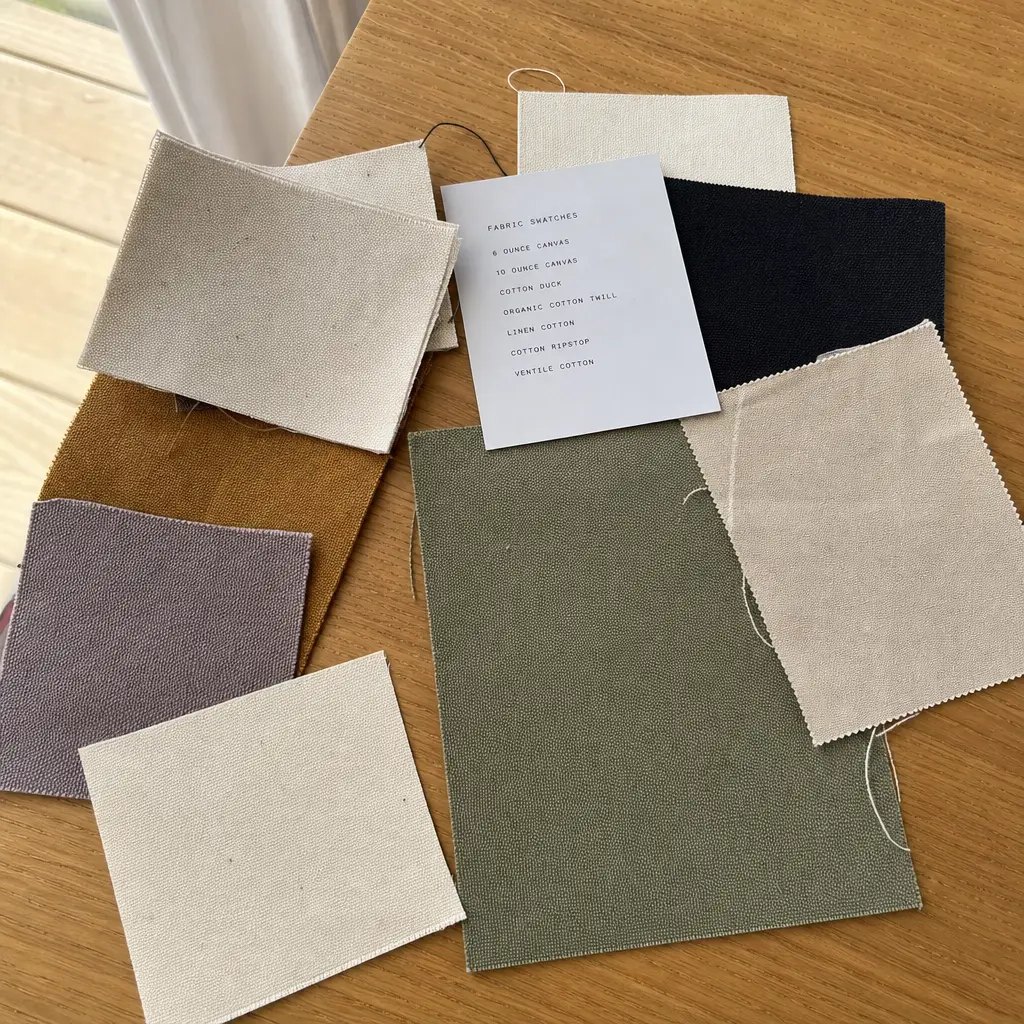
Canvas weight drives structure, print behavior, and freight cost. For most bakery procurement programs, 12 oz cotton canvas, roughly 380-420 GSM, is the most balanced option. It feels substantial in hand, holds its shape better than lighter cloth, and still stitches cleanly around zipper corners. A lighter 8 oz or 10 oz canvas can reduce unit cost, but the portfolio may look limp or wrinkle easily after repeated handling. A heavier 14 oz or 16 oz version can feel premium, but it increases needle wear, carton weight, and bulk at the corners.
Finish matters just as much as weight. Natural canvas is a common choice for artisan bakeries because it matches the look of flour, grain, and craft packaging, but it also comes with visible cotton flecks, subtle shade variation, and occasional slubs. If the logo needs a cleaner background, buyers can request bleached canvas, washed canvas, or dyed stock, but those options often raise MOQ and extend lead time. The RFQ should state whether seed marks, slubs, and tonal variation are acceptable outside the logo zone and whether the supplier should provide a clean front-panel grading standard. Also ask for stitch density, binding method, and reinforcement at the zipper corners so the portfolio does not distort after the first few uses.
- Commercial baseline: 12 oz canvas for a balance of structure, cost, and print performance.
- Premium option: 14 oz canvas when the portfolio needs a heavier retail feel.
- Ask for: oz weight, GSM range, finish type, shrinkage expectation, and shade tolerance.
- Confirm the seam allowance, binding method, and corner reinforcement before sample approval.
Zipper, Puller, and Reinforcement Details
The zipper is the most-used functional part of the portfolio, so it should be specified as carefully as the fabric. A No.5 nylon coil zipper is usually the safest bulk choice because it bends smoothly around corners, keeps cost controlled, and is less likely to mark the canvas than a stiff metal option. Metal zippers can look premium, but they add weight and can make tight turns feel less smooth if the sewing line is not precise. If the bag is intended for daily store handling or repeated sales calls, smooth operation matters more than a decorative zipper profile.
Puller and reinforcement choices should also be written into the spec. A standard painted slider may be enough for giveaway packs, while a metal pull, cord loop, or leather-look tab can support a more premium bakery presentation set. If the buyer wants a branded puller, treat it as a separate development item with its own tooling and lead time. The supplier should also confirm end stops, zipper tape color, bar tacks, and corner reinforcement so the zipper does not drift, buckle, or snag after repeated use. On sample approval, ask for a simple cycle test, such as 20-30 open-close passes, to catch slider drag or corner binding before production starts.
- Recommended default: No.5 nylon coil zipper with a smooth auto-lock slider and secured end stops.
- Ask the factory to test the zipper across the full track, not only the first few centimeters.
- Separate pricing for custom pullers, metal teeth, contrast zipper tape, and branded hardware.
- Confirm the zipper path length, corner radius, and reinforcement method before sample approval.
Branding, Print Method, and Label Strategy
For bakery branding, the print method should match the artwork, not the other way around. Screen printing is usually the strongest bulk option for simple one-color or two-color logos because it gives predictable cost and good opacity on canvas. Heat transfer can handle fine details, gradients, or multicolor graphics, but it may feel less natural on rougher fabric and should be tested for edge adhesion. Embroidery can work for a small premium logo, but large stitched areas can stiffen the panel and distort the lay of the portfolio.
The artwork file should include vector art, Pantone references, final logo size, clear space, and print placement measured from the top edge and side seam. Bakery artwork often uses script fonts, wheat motifs, line drawings, or flour-dust textures. Those details can fill in or break apart on coarse canvas, especially if the print line is too fine. As a working rule, avoid hairline text and ultra-thin strokes on natural canvas, and ask the supplier to confirm the minimum printable line width they can hold. Buyers should also decide whether a woven side label, heat-transfer size mark, or printed care label is needed. That decision affects both cost and how polished the finished piece looks at handover.
- Best bulk route: screen print for solid logos and simple bakery marks.
- Use heat transfer only when the design truly needs fine multicolor detail.
- Keep embroidery limited to small marks so the panel does not become stiff.
- Specify print position, Pantone target, minimum line width, and acceptable shift tolerance.
Bulk Pricing Plan and MOQ Logic
A workable bulk pricing plan separates fixed costs from variable costs. Fabric, zipper, sewing, printing, labels, packing, and cartons move with quantity. Screen setup, custom puller tooling, label plates, and sample development are usually fixed or semi-fixed. If the buyer only looks at unit price, the quote can appear cheap while setup fees and excluded services make the program expensive. The buyer should therefore ask for a complete price build that shows what is included at each quantity tier and which items recur on every reorder.
MOQ is also not one number. The base MOQ may be low for natural canvas with a standard zipper and one logo, but it can rise if the program adds dyed canvas, custom zipper tape, woven labels, multiple branch logos, or special packing. The right way to compare quotes is to request the same spec at two or three realistic volumes, such as a pilot run, a replenishment run, and a larger seasonal order. That lets procurement see where pricing drops, where setup is being spread, and where the factory is hiding cost in tooling or rework assumptions.
- Request separate line items for fabric, zipper, sewing, print, label, packing, carton, and sample fees.
- Compare the same specification at multiple order quantities, not just one target volume.
- Ask what changes MOQ: fabric color, zipper color, print count, custom puller, or packing method.
- Make sure the quote clearly states whether screens, tooling, and export documents are included.
Supplier Route Comparison and RFQ Normalization
A direct factory is usually the better choice when the portfolio is the main item and the buyer needs repeatability. The factory can control cutting patterns, sewing tolerances, zipper sourcing, print approval, and carton marks. That matters because small details, such as zipper end reinforcement and pocket opening width, affect the user experience more than the first quotation sheet suggests. A direct relationship also makes corrective action easier if the supplier must replace a zipper, redo a print, or adjust the pocket placement after sampling.
A trading company can still be useful when the bakery brand is buying a broader program that includes aprons, tote bags, paper packaging, and other promotional items. The tradeoff is visibility. The buyer should ask who actually sews the portfolio, who owns the QC checklist, who approves rework, and whether the same factory will handle repeats. To normalize quotes, request photos of the material swatch, zipper component, print sample, production line, and a finished item from a similar construction. That creates a fairer comparison than reading only a single unit price.
- Direct factory advantage: stronger construction control and clearer sampling accountability.
- Trading company advantage: easier consolidation when the portfolio is only one item in a mixed shipment.
- Ask for evidence: material swatches, zipper references, print samples, carton plan, and QC checklist.
- Confirm who owns rework if the inspection finds a defect.
Sampling, Approval, and Pre-Production Checks
Sampling should move in stages. A blank sample confirms size, handfeel, zipper path, and pocket function. A printed sample confirms logo size, color, placement, and ink behavior on the chosen canvas. A pre-production sample confirms the full combination: approved fabric, zipper, print, label, packing method, and carton plan. If the order has multiple bakery branches or seasonal artwork, the sample set should also show how the versions will be sorted and identified in the carton marks.
Approval should happen on the actual working use, not only on a clean tabletop photo. Insert the real bakery materials, zip the portfolio several times, and check whether the corners catch or the document stack shifts. If the bag must be presented in a retail setting, check the front panel for dust, print rub, and zipper pull marks after the item sits under light compression. One signed sample should stay with the factory and one with the buyer so the inspection standard is visible to both sides. If possible, get the factory to mark the approved sample date, version, and material references so the production file is traceable later.
- Blank sample: verifies structure, size, zipper route, and pocket fit.
- Printed sample: verifies color, opacity, line sharpness, and placement.
- Pre-production sample: verifies final trims, packing, carton count, and workmanship standard.
- Do not start bulk cutting until all trims and artwork are approved in writing.
Packing, Cartons, and Distribution Readiness
Flat canvas zipper portfolios still need careful packing. Natural canvas attracts dust, folded corners show quickly, and zipper pulls can press marks into the fabric surface if the item is packed too tightly. The right individual pack depends on the channel. Retail programs may need a clean polybag or kraft sleeve with barcode labels, while distributor programs may prefer less plastic and a simpler counting method. The buyer should tell the factory whether the item is for shelf presentation, staff distribution, or bulk warehouse delivery.
Carton planning affects both damage and landed cost. Flat portfolios often ship by volume more than by weight, so the carton dimensions matter as much as the piece price. Request carton size, pieces per carton, gross weight, net weight, total CBM, and the number of cartons for the order. A well-planned carton stack keeps the portfolios flat, aligns zipper pulls away from pressure points, and avoids crushed corners during transit. As a practical packing target, ask the factory to keep cartons well filled without compressing the products, and confirm that outer marks, barcode labels, and carton counts match the purchase order.
- Standard packing: one piece per recyclable polybag or kraft sleeve, flat packed in export cartons.
- Request carton data before final approval: size, pieces per carton, gross weight, net weight, and total CBM.
- Ask whether carton marks, barcode stickers, and retail labels are included in the price.
- Avoid hard pressure from zipper pulls against the printed front panel during carton stacking.
Specification comparison for buyers
| Spec decision | Recommended option | When it fits | Buyer risk to check |
|---|---|---|---|
| Fabric body weight | 12 oz cotton canvas, about 380-420 GSM, with pre-shrink or wash-test confirmation if the portfolio will be handled daily | Best balance for wholesale bakery sales kits, wholesale menus, distributor packets, and staff handouts | Lighter canvas can look limp and wrinkle quickly; heavier canvas raises freight and makes zipper corners bulky |
| Finished size | Size the portfolio to the largest insert plus 10-15 mm usable clearance, then confirm seam allowance and zipper path with the factory pattern | Works for A4 or US letter documents, laminated menus, certificate sheets, and folded price lists | Paper-sized specs can become too tight once seams, zipper tape, and corner turning are added |
| Zipper construction | No.5 nylon coil zipper with a smooth auto-lock slider, secured end stops, and bar-tacked ends | Good for daily store use, branch training packs, and distributor folders that are opened often | Cheap sliders snag at corners; ask for a cycle test on the pre-production sample |
| Print method | Screen print for one- or two-color logos; heat transfer only when artwork genuinely needs fine multicolor detail; embroidery only for small premium marks | Screen print usually gives the best unit cost and the most reliable result on natural canvas | Fine script and thin lines can fill in on coarse canvas; approve minimum line width before production |
| Inner layout | One flat document pocket plus an optional card slot, with no unnecessary stitched compartments | Works for menus, order sheets, loyalty inserts, and bakery sales collateral | Too many pockets increase sewing time, distort the front panel, and create loose fit variance |
| MOQ structure | Quote MOQ by fabric, zipper, print version, label type, and packing style instead of one blended MOQ | Useful when buyers need multiple branch logos or seasonal artwork under one program | A low blended MOQ can hide setup fees, sorting charges, or additional color restrictions |
| Packing method | One piece in a recyclable polybag or kraft sleeve, then flat stack in export cartons | Protects canvas from dust and keeps portfolios flat for retail or distributor delivery | Overfilled cartons crush corners; underfilled cartons increase movement and dimensional freight cost |
| Supplier route | Direct factory for custom canvas zipper portfolios; trading company only when consolidating unrelated bakery items | Direct factory gives better control over canvas lot, zipper quality, print approval, and carton marking | A low quote from a trader may hide subcontracted sewing, weaker QC, or unclear rework responsibility |
Buyer checklist before sampling
- Define the finished portfolio size from the largest insert and the actual stack thickness, not only from the A4 or letter label.
- State whether the documents are loose sheets, laminated menus, folded brochures, or a mixed stack, because that changes the usable opening and clearance needed.
- Specify fabric weight in ounces and approximate GSM, plus the finish type, shade range, and whether pre-shrink or wash testing is required.
- State the zipper size, zipper type, slider finish, puller shape, tape color, end-stop method, and whether branded hardware is needed.
- Send artwork in vector format with Pantone references, minimum line width, print area, print placement, and acceptable placement tolerance.
- Separate quote lines for body fabric, zipper, print, label, pocketing, individual packing, export carton, sample fees, and any tooling or screen charges.
- Approve a blank sample first, then a printed pre-production sample made with the final canvas, zipper, trims, pocket layout, and packing method.
- Set measurable QC points for finished size, zipper function, seam strength, print position, stains, odor, and carton condition.
- Request carton dimensions, gross weight, net weight, pieces per carton, and estimated CBM before confirming landed cost.
- Confirm whether repeat orders can reuse the same cutting pattern, print screen, and approved trim references without redesign charges.
Factory quote questions to send
- What fabric weight and GSM are included in the quoted price, and is the canvas greige, bleached, dyed, washed, or otherwise finished?
- Is the zipper No.5 or another size, nylon coil or metal, and what slider and puller options are included without surcharge?
- What is the MOQ for one logo, one fabric color, one zipper color, one label type, and one packing method?
- Can multiple bakery branch logos share one bulk order, and how will screen charges, sorting, carton labels, and rework be handled?
- What print method do you recommend for this artwork on canvas, and what minimum line width or color limit should we follow?
- What finished-size tolerance, print-position tolerance, and zipper-function standard will your QC team use?
- How many days are needed for a blank sample, printed sample, pre-production sample, bulk production, and final inspection booking?
- What are the carton dimensions, pieces per carton, gross weight, net weight, and total CBM for the quoted quantity?
- Which costs are excluded from the unit price, such as sample freight, screen charge, tooling, export documents, or inland trucking?
- If inspection finds zipper failure, stains, wrong print position, or carton damage, what rework method and timeline can the factory support?
Quality-control points to confirm
- Finished width and height should stay within the agreed tolerance, commonly plus or minus 5 mm for sewn canvas goods.
- The usable opening should fit the approved document stack without forcing the corners or scuffing the inserts during loading.
- The zipper should open and close smoothly across the full track without skipped teeth, weak end stops, or slider drag.
- Zipper tape should lie flat and straight, with no twisting, waviness, or puckering at the corners.
- Print placement should remain within the approved tolerance from the top edge and side seam, not judged only by visual centering.
- For simple spot prints, a placement tolerance of plus or minus 3 mm is a practical target unless the factory can hold tighter control on the chosen panel.
- Print color should match the signed approval sample closely enough to avoid a visible shift in brand tone under normal light.
- Canvas panels should be free from oil marks, mildew odor, heavy slubs in the logo area, and obvious shade difference within one carton.
- Seams, binding, zipper ends, and pocket corners should pass pull checks without loose stitching, skipped stitches, or raw-edge exposure.
- Inner pockets should fit the intended insert size after sewing, not only on the paper pattern.