Procurement Goal
Canvas zipper portfolios are often sourced for skincare launch kits, retail buyer presentations, spa consultant packs, salon training folders, and gift-with-purchase programs. The product looks simple, but procurement mistakes usually come from incomplete specification: a factory quotes a flat fabric pouch while the brand expects a structured reusable portfolio that can carry catalogs, sachets, treatment menus, and sample cartons without creasing.
The goal is to buy a portfolio that protects brand presentation and arrives in a carton plan the receiving team can handle. That means the RFQ should define materials, loading, zipper construction, logo execution, packing, carton dimensions, gross weight, and QC checks before price comparison. For wholesale canvas zipper portfolios for skincare brands, shipping carton planning is not a separate logistics task. It affects the unit price, freight cost, damage risk, warehouse handling, and final unboxing condition.
- Start carton planning during quotation, not after bulk production.
- Quote the portfolio with the real contents loaded, especially if samples or mini cartons are included.
- Compare delivered usable cost, not only factory unit price.
- Treat packing method, carton marks, and carton strength as part of the product specification.
Size and Fit
A4, letter, and custom catalog sizes are common starting points, but the final dimensions should be built from the contents. A flat document portfolio may only need a small allowance around a treatment menu, price sheet, or retail presentation deck. A launch kit with sachets, sheet masks, sample cards, mini tubes, or small cartons may need a slim gusset. A box gusset can improve capacity but changes the zipper path, side panel tension, and carton cube.
Fit testing should be done with the largest and thickest expected insert set. The buyer should check whether the portfolio closes easily, whether the zipper pulls around the corner without force, and whether the loaded item still lies acceptably flat. If the contents will be inserted by a 3PL or regional sales team, the opening should be practical for repeated packing, not just attractive in a sample photo.
- Flat format: best for catalogs, contracts, training sheets, treatment menus, and consultation cards.
- Slim gusset: useful for sachets, masks, sample cards, and light promotional sets.
- Box gusset: suitable for mini cartons or tubes, but it needs stronger structure and more carton volume.
- Measurement rule: confirm tolerance from an approved sample; plus or minus 5 mm may be workable for many sewn flat portfolios but is not automatic.
Canvas Selection
Fabric weight is a major quote driver. A lighter 10 oz canvas may work for a short-term promotional folder, but it can wrinkle around the zipper and feel less structured. A 12 oz to 14 oz cotton canvas is often a practical range for skincare portfolios that need a natural hand feel with enough body for repeated handling. Heavier canvas can feel more premium, but it can also increase sewing difficulty, needle marks, carton gross weight, and air freight cost.
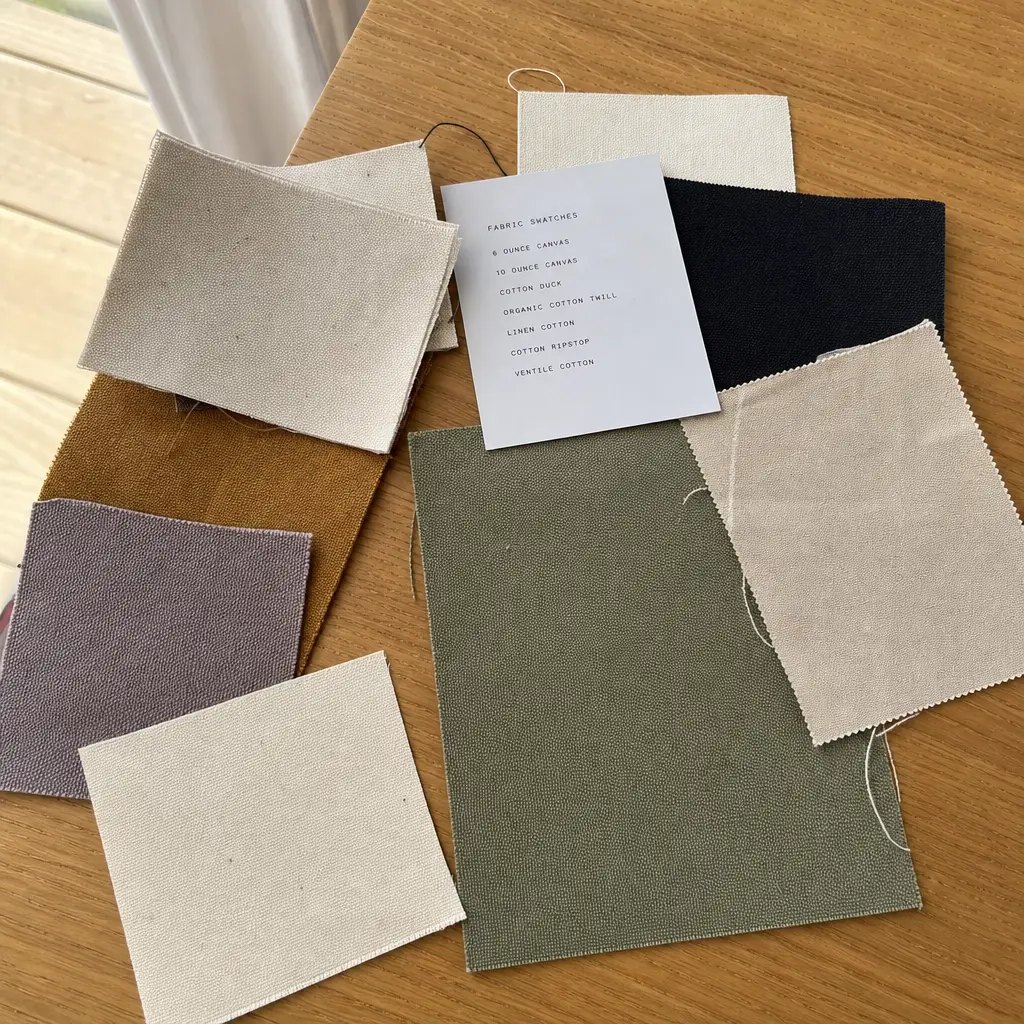
Natural canvas should be approved as a fabric, not judged like coated paper or plastic. Cotton seed flecks, yarn slubs, and shade variation may appear unless the buyer specifies a bleached, dyed, or higher-grade fabric. If the portfolio will carry white skincare cartons, foil boxes, or uncoated printed cards, check fiber transfer and rubbing. Binding or lining may be worth the added thickness if the interior must stay cleaner.
- Ask for oz and approximate GSM, then approve the actual swatch.
- Confirm whether the canvas is stock, custom dyed, washed, bleached, organic, or recycled-content cotton.
- Define acceptable seed marks, slubs, shade range, and surface cleanliness.
- Test the chosen canvas after sewing and packing because structure changes once zipper, binding, and logo are added.
Zipper Build
The zipper is the part users interact with first. A No. 5 nylon coil zipper is commonly practical for bulk canvas portfolios because it is relatively smooth, lighter than many metal options, and more forgiving on curves. Brass-look zipper teeth or a metal puller may better match a premium skincare position, but decoration should not outrank function. A stiff zipper, weak puller, or poor corner turn can make a well-branded portfolio feel cheap.
The stress points are usually the zipper start, stop, and corners. That is where users pull harder when the portfolio is loaded. Reinforced stitching, bartacks, clean end tabs, and proper zipper tape alignment matter more than a quick visual inspection suggests. The approved sample should be opened and closed repeatedly while loaded with the intended inserts, not only tested empty on a desk.
- Default to a zipper size and grade appropriate for the finished dimensions, not the lowest available cost.
- Match zipper tape color to canvas or brand direction, then test for staining on light fabric.
- Check puller edges so they do not scratch printed cartons or catch tissue.
- Run repeated open-close cycles on the loaded sample before approving production.
Branding Method
Skincare brands often want understated branding, but the production method must match the artwork. Single-color screen printing is efficient for simple logos, campaign names, and clean line art on canvas. Fine serif typography, pale ink, small claims, and tight spacing may lose contrast on natural fabric. A strike-off on the actual canvas is more reliable than a digital mockup or Pantone callout alone.
Woven labels, cotton labels, patches, and embroidery create a more reusable feel. They also add thickness and may create pressure points in a packed carton. Embroidery can pucker lighter canvas if backing and tension are not controlled. Heat transfer can deliver sharp detail, but some brands prefer the feel of ink, woven trim, or a stitched label for natural packaging programs. The RFQ should fix logo size, placement, color reference, and allowed movement from the edge or seam.
- Screen print: efficient for clean one-color or two-color artwork.
- Woven label: good for subtle branding on spa, clinic, and retail buyer kits.
- Embroidery: test on the chosen fabric weight and inspect for puckering.
- Patch: confirm material, colorfastness, attachment method, and stacking impact.
- Approval: require a physical strike-off and keep a signed reference sample.
MOQ and Cost Drivers
MOQ is not one universal number for canvas zipper portfolios. It changes with fabric availability, zipper color, logo method, label type, lining, packing material, and carton requirements. A low MOQ may be possible with stock natural canvas, stock zipper tape, a standard puller, and one-color printing. Custom dyed canvas, custom zipper tape, printed lining, woven labels, and retail packaging can each raise the efficient production quantity.
Procurement teams should ask suppliers to identify the component that drives the MOQ. This avoids false comparisons where one quote uses stock materials and another includes custom components. For a channel test, it may be sensible to use stock canvas and invest in better logo execution or packing protection. For a national rollout, a higher MOQ may be justified if it stabilizes shade, zipper color, label supply, carton size, and repeat order consistency.
- Low MOQ path: stock fabric, stock zipper, standard puller, screen print, simple carton packing.
- Mid-range path: selected fabric weight, custom label, controlled zipper color, SKU carton marks.
- High customization path: custom dyed canvas, printed lining, custom puller, retail sleeve, barcode labeling.
- Quote rule: compare the same specification, quantity, packing method, and incoterm before negotiating unit price.
Carton Planning
Carton planning should begin once the sample structure is close to final. Canvas portfolios can be packed flat, lightly folded, interleaved, paper banded, individually bagged, or bulk stacked. For document-size skincare portfolios, flat packing usually protects the logo panel and avoids permanent fold lines. The tradeoff is carton cube. Folding may reduce volume, but it can create crease marks across the print and pressure at the zipper.
Pieces per carton should be treated as an estimate until the approved sample is packed. Many flat portfolios may land in a 25 to 50 pieces per carton range, but the right number depends on finished size, canvas GSM, gusset depth, zipper bulk, lining, logo method, and inner protection. Too many pieces can compress the bottom layers; too few pieces can increase carton count, handling labor, and warehouse fees. The supplier should provide carton length, width, height, net weight, gross weight, board strength, and packing photos before shipment.
- Flat packing: protects presentation but increases carton footprint.
- Light folding: can reduce cube but needs crease testing on the logo and zipper area.
- Interleaving: helps prevent print transfer and zipper impressions.
- Individual bags: improve cleanliness but add cost, plastic use, and carton volume.
- Carton marks: confirm SKU, PO, quantity, gross weight, carton number, destination, and barcode requirements.
Quote Comparison
A useful quote should show more than a unit price. The buyer needs finished dimensions, fabric grade, zipper specification, logo method, MOQ, sample cost, packing method, carton data, lead time, payment terms, and incoterm. Two suppliers can quote the same product name while one includes 14 oz canvas, reinforced zipper ends, interleaving, and carton marks, and the other includes lighter canvas, bulk packing, and a basic zipper. The lower unit price may become expensive after freight, damage, or repacking.
Landed cost should include carton cube and receiving workload. A 20-piece carton may protect presentation but creates more cartons to unload, label, and store. A 50-piece carton may reduce handling but become heavy or compress the lower pieces. The best choice depends on order size, shipment mode, 3PL limits, carton weight rules, and the value of the skincare program. Ask for carton data in the first quote round, then update it after the pre-production sample is approved.
- Compare EXW, FOB, CIF, and DDP only when the service scope is clearly defined.
- Separate sample fees, print setup, label setup, special packing, inspection, and testing costs.
- Ask whether the price assumes stock materials or custom production.
- Use one quote matrix with columns for materials, zipper, logo, MOQ, packing, carton cube, lead time, and incoterm.
- Do not approve the cheapest quote until the carton plan and QC scope are visible.
Sampling and QC
Sampling should move from material decisions to a complete production reference. Start with fabric swatches and zipper options if the brand has a specific natural tone, hand feel, or hardware finish. Then make a fit sample with the intended contents. After that, approve the logo strike-off on the actual fabric. The pre-production sample should combine final fabric, zipper, logo, lining or binding, sewing, and packing method. Approving each item separately can hide problems, such as print placement shifting after seam allowance is finalized.
The approval record should include photos, measurements, material references, artwork version, logo placement, loading test notes, and packing direction. QC should check dimensions, zipper function, print adhesion, odor, stains, loose threads, interior cleanliness, shade range, and carton condition. If the portfolios ship directly to retail partners, distributors, or 3PLs, inspection should also verify carton marks, piece counts, barcode labels, and packing list accuracy.
- Swatch approval: canvas weight, shade, surface, lining, zipper tape, label material.
- Fit sample: loaded with real skincare inserts and sample products.
- Logo strike-off: actual print, label, patch, embroidery, or transfer on approved fabric.
- Pre-production sample: final construction and final packing direction.
- Retention sample: one kept by the buyer and one kept by the factory for inspection reference.
Lead Time and Shipping
Lead time depends on material availability and approval speed. Stock fabric and standard zipper components can move faster than custom dyed canvas, custom zipper tape, special pullers, printed lining, or retail sleeves. Artwork revisions can hold production even when fabric is ready. The purchase order should state when production lead time starts: deposit receipt, artwork approval, material approval, material arrival, or pre-production sample approval.
Shipping planning should use carton data from the approved sample stage. Sea freight is sensitive to cubic meters and LCL minimums. Air freight is sensitive to chargeable weight, so heavy canvas or low carton density can change cost quickly. Retailers, Amazon programs, distributors, and 3PLs may also have carton size, carton weight, label placement, and pallet rules. Sending those rules after production can force repacking, which adds cost and can damage the portfolio finish.
- Build schedule around the latest approval, not only the PO date.
- Lock artwork, logo placement, and color references before material cutting where possible.
- Proof barcode labels, carton marks, warning labels, and SKU labels before packing starts.
- Share 3PL or retailer receiving rules early, including carton weight limits.
- Reconfirm final carton dimensions and gross weight before booking freight.
Specification comparison for buyers
| Spec decision | Typical option to quote | When it fits | Carton and freight impact | Buyer risk to check |
|---|---|---|---|---|
| Outer fabric weight | 10 oz, 12 oz, 14 oz, or heavier canvas; confirm actual GSM by swatch | 10 oz can suit short promotional folders; 12 oz to 14 oz is often a practical range for structured skincare document kits; heavier canvas may fit premium reuse programs | Heavier canvas increases gross weight and stack height; very light canvas may compress unevenly and crease in cartons | Do not treat any ounce range as universal. Test the approved sample with the intended contents, packing method, and shipment route |
| Lining construction | Unlined canvas with bound seams, or 150D/210D recycled polyester lining | Unlined supports a natural look and lower cost; lining helps inserts slide in and reduces exposed seam contact | Lining adds thickness and may reduce pieces per carton; unlined construction may allow tighter packing | Check lint, dye transfer, seam roughness, and whether white skincare cartons pick up fibers or marks |
| Zipper type | No. 5 nylon coil zipper with metal puller, or brass-look zipper for a premium finish | Nylon coil is smooth and lighter for bulk orders; brass-look hardware can support spa, clinic, or prestige positioning | Large pullers and metal teeth can increase pressure marks when stacked; zipper curves affect carton compression | Confirm zipper travel under load, corner smoothness, puller strength, and tape colorfastness before bulk approval |
| Portfolio format | Flat A4/letter format, slim gusset, or box gusset based on loaded contents | Flat works for catalogs and treatment menus; gusseted formats work for sachets, masks, mini tubes, or sample cartons | Gussets increase carton cube and can lower pieces per carton; boxy shapes may need larger cartons or dividers | A clean empty sample is not enough. Approve the portfolio while loaded with the real skincare inserts |
| Logo method | Single-color screen print, woven label, embroidery, patch, or heat transfer | Screen print is efficient for simple logos; woven labels and patches feel more reusable; embroidery suits heavier canvas | Raised labels, embroidery, and patches create stacking pressure points; print needs interleaving if ink can rub | Require a strike-off on actual fabric, with placement tolerance and color standard stated in the PO |
| Reinforcement | Bound edges plus reinforced zipper ends, bartacks, or zipper end tabs | Useful for portfolios handled by sales reps, retail buyers, trainers, and beauty consultants | Reinforcement adds small thickness at stress points but can reduce repair and rejection risk | Inspect zipper starts, stops, and corners because failure often appears after loading, not during a quick visual review |
| Carton packing | Flat packed with tissue, paper interleaving, paper bands, or individual bags depending on policy | Flat packing protects document-size panels and logo presentation; interleaving helps reduce print transfer | Typical carton quantity may fall around 25 to 50 pieces for many flat portfolios, but final count depends on size, GSM, gusset, and packing method | Ask for carton dimensions, net weight, gross weight, board strength, and a packing photo before shipment |
| MOQ logic | Stock fabric and zipper for lower MOQ; custom dyed fabric, custom zipper tape, labels, or retail packaging for higher MOQ | Good for separating test orders from full rollout orders without changing the product name | Low MOQ may use less efficient cartons or available material widths; high MOQ may improve shade control and carton consistency | Ask which component drives MOQ so quotes are compared on the same customization level |
| Inspection standard | AQL final inspection with function, measurement, odor, print, and carton checks | Needed when goods ship directly to distributors, 3PLs, retailers, or regional sales teams | Inspection should include packed-carton condition, not only loose product checks | Visual pass alone is weak. Include zipper cycles, print rub, size check, carton marks, and 24-hour compression review where practical |
Buyer checklist before sampling
- Define the exact use: retail buyer document kit, skincare launch press kit, spa consultant folder, salon training pack, sales rep organizer, or gift-with-purchase pouch.
- List every item going inside the portfolio, including catalogs, treatment menus, sample cards, sachets, masks, mini tubes, jars, cartons, barcode cards, and instruction sheets.
- Confirm finished size from the loaded contents, not from a flat artwork mockup. Include height, width, stack thickness, and zipper opening direction.
- Specify canvas weight in oz plus approximate GSM, canvas color, fabric finish, shrinkage expectation, and whether the fabric is natural, bleached, dyed, washed, organic, or recycled-content cotton.
- Choose zipper size, zipper tape material, tape color, puller shape, puller finish, and whether the zipper must turn around corners or a gusset.
- State logo method, artwork size, color reference, placement tolerance, approval stage, and whether the logo surface needs interleaving during packing.
- Decide whether the interior will be unlined, bound, or lined. Check lint, loose threads, seam bulk, and contact marks against the actual skincare packaging.
- Request carton dimensions, pieces per carton, net weight, gross weight, carton board strength, carton marks, pallet recommendation, and loading direction before issuing the PO.
- Require one pre-production sample showing final fabric, zipper, logo, lining or binding, packing direction, inner protection, and carton packing method where possible.
- Define QC acceptance criteria for stains, yarn contamination, shade variation, loose threads, zipper drag, print smudging, odor, size tolerance, and carton damage.
Factory quote questions to send
- What canvas weight are you quoting in oz and approximate GSM, and will you provide a swatch for buyer approval?
- Is the fabric stock, custom dyed, washed, bleached, organic, or otherwise certified, and which documents can be supplied if certification is required?
- What finished size tolerance are you offering after sewing, and does the quotation include any fabric pre-treatment or shrinkage control?
- Which zipper size, tape material, puller material, puller finish, and zipper grade are included in the price?
- Can the zipper operate smoothly when the portfolio is loaded with the buyer's intended skincare inserts and samples?
- Which logo method is quoted, how many colors are included, and what is the setup fee or strike-off cost?
- What is the MOQ for the exact specification, and which component creates the MOQ: fabric, zipper, puller, label, lining, logo, carton, or packing material?
- How many pieces per export carton are planned, and what are the estimated carton dimensions, net weight, gross weight, and carton board strength?
- Will the portfolios be flat packed, lightly folded, interleaved, individually bagged, paper banded, bulk packed, or packed by SKU?
- What sample stages are included: swatch, logo strike-off, fit sample, pre-production sample, retention sample, and carton packing sample?
Quality-control points to confirm
- Finished size tolerance is often planned around plus or minus 5 mm for flat sewn portfolios, but the actual tolerance should be confirmed with the supplier and tightened if inserts or cartons fit closely.
- Canvas weight should be checked against the approved swatch. A lighter substitution can change structure, opacity, print appearance, and compression behavior in the carton.
- Fabric shade and surface character need a defined approval range, especially for natural canvas where seed specks, slubs, and minor variation may be normal unless restricted.
- Zipper must open and close across the full path without skipped teeth, fabric catching, puller bending, or corner distortion when the portfolio is loaded.
- Zipper ends, puller attachment, bartacks, and end tabs should be inspected as stress points, not treated as decorative details.
- Print adhesion should be checked by dry rub and light scratch after curing. Ink should not transfer to tissue, paper bands, or adjacent portfolios during packing.
- Logo placement should be measured from a fixed edge, zipper line, or seam, with a stated tolerance rather than visual judgment only.
- Interior seams, binding, lining, and thread trimming should be checked so paper inserts, sachets, and skincare cartons do not catch or collect lint.
- Odor should be reviewed before packing because canvas, ink, zipper plating, polybags, and cartons can absorb or trap smell during storage.
- Packed cartons should be checked for bulging, zipper impression marks, panel creasing, weak tape, crushed corners, and piece count accuracy.