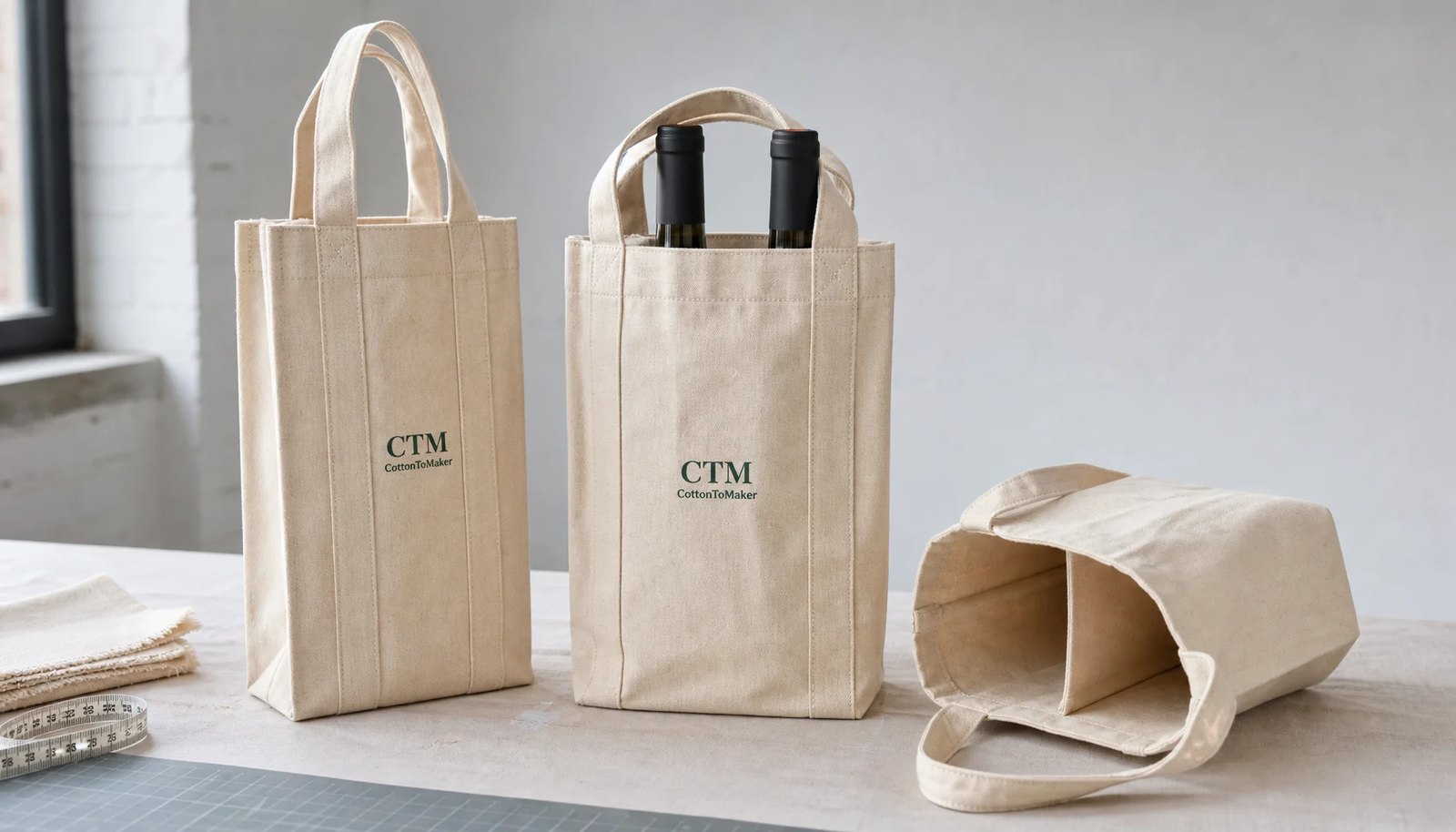
The RFQ Problem Bookstore Buyers Need to Solve
Wholesale canvas wine carriers look simple, but they create several RFQ traps for university bookstore buyers. The carrier must hold glass bottles safely, present licensed artwork cleanly, fit retail shelf handling, and still land at a price that works for seasonal promotions, alumni weekends, fundraising events, and campus gift assortments. If the RFQ only says canvas wine bag with logo, suppliers will quote different fabrics, different structures, and different reinforcement levels.
The most useful RFQ narrows the product before pricing starts. A buyer should state the bottle count, finished size, canvas weight, handle construction, divider requirement, logo method, packing rules, and inspection expectations. This lets importers and retail buyers compare quotes on the same product instead of comparing a thin promotional bag against a stronger retail-grade carrier.
- Use the RFQ to control structure first, then negotiate price.
- Separate bookstore retail use from event giveaway use because the load and presentation requirements are different.
- Avoid accepting a quote that does not mention fabric weight, handle reinforcement, print process, and packing count.
- Treat artwork licensing review as part of the production schedule, not an afterthought.
Choose the Carrier Format Before Discussing Price
The first decision is whether the program needs a one-bottle carrier, a two-bottle carrier, or a mixed assortment. One-bottle carriers are lower cost, easier to pack, and suitable for tasting events or single-bottle gift purchases. Two-bottle carriers feel more substantial at retail and work well for alumni gift bundles, bookstore holiday tables, and campus-branded local wine collaborations.
For a two-bottle version, the divider is not a cosmetic detail. A sewn divider protects bottles from hitting each other and helps the bag stand properly when loaded. If the divider is too low or too narrow, customers will notice bottle movement immediately. For RFQ purposes, include the intended bottle type, such as standard 750 ml wine bottle, and request that the factory checks the fit with an equivalent bottle during sampling.
- One-bottle style: lower unit cost, smaller carton cube, easier retail replenishment.
- Two-bottle style: higher perceived value, better for gift sets, requires stronger divider construction.
- Tall bottle styles: require adjusted height and handle position to avoid unstable carrying.
- Wide bottle styles: require wider gusset and divider planning, not only a taller front panel.
Specify Canvas Weight in Real Production Terms
Canvas should be specified by weight, not by a general fabric description. For bookstore retail wine carriers, 10 oz to 12 oz cotton canvas, roughly 280 to 340 GSM, is usually a practical starting point. It gives enough body for shelf presentation without pushing the product into an unnecessarily heavy freight category. For premium alumni gifts, 14 oz to 16 oz canvas can be appropriate, but the buyer should expect higher sewing cost, heavier cartons, and a more rigid hand feel.
Natural canvas, dyed canvas, and bleached canvas behave differently in production. Natural canvas has a campus-friendly, reusable look, but it may show slubs, seed specks, and color variation. Dyed canvas can match a school color more closely, but custom dyeing affects MOQ and lead time. Bleached canvas gives a cleaner print surface, yet it can make stains and handling marks more visible. The RFQ should state which fabric appearance is acceptable before the supplier chooses the cheapest available roll.
- Budget retail carrier: 10 oz canvas when bottle weight and usage are moderate.
- Standard bookstore carrier: 12 oz canvas for stronger hand feel and cleaner shelf presence.
- Premium gift carrier: 14 oz or heavier only when the landed cost supports the retail price.
- Fabric tolerance: request the factory's normal GSM tolerance and keep an approved swatch for inspection.
Print Method and Licensed Artwork Control
Most university bookstore wine carriers use simple logos, mascots, department marks, or alumni slogans. Screen printing is usually the best choice for solid one-color or two-color artwork on canvas because it is durable, economical, and readable on textured fabric. Heat transfer can help with small multicolor graphics, gradients, or artwork that cannot be separated cleanly, but it may change the hand feel and can look too promotional if the film edge is visible.
Licensed university artwork requires a tighter approval path than ordinary promotional graphics. The RFQ should require vector files, Pantone references, print size, print location, and approval of a strike-off on the same canvas weight used for bulk. A paper proof is not enough because canvas texture changes line sharpness and ink coverage. For bookstore buyers, the safest approval package includes artwork layout, fabric swatch, print strike-off, and one finished pre-production sample.
- Screen print works best for bold marks, block lettering, and single-color school logos.
- Heat transfer may fit complex color artwork but needs wash, rub, and edge-lift review.
- Embroidery is possible for premium gifts but increases cost and may distort lighter canvas.
- Woven side labels are useful when the main panel must stay clean or licensing limits artwork size.
MOQ Logic and Cost Drivers in the Quote
MOQ is not only a factory preference. It is affected by fabric buying, cutting efficiency, print setup, artwork count, labor line planning, and packing requirements. A natural stock canvas bag with one-color screen print can usually support a lower MOQ than a custom dyed canvas bag with multiple artwork versions. When a supplier quotes a very low MOQ, the buyer should check whether the price is based on stock fabric, simplified construction, digital transfer printing, or combined production with another order.
A useful RFQ asks for price breaks rather than one price. Buyers should request 500, 1,000, 2,000, and 5,000 pieces per artwork or per total order, depending on the program. This makes the cost curve visible. If the price drops mainly after 1,000 pieces, print setup and cutting efficiency may be the driver. If the price drops mainly after 3,000 or 5,000 pieces, fabric purchasing or production line planning may be the driver.
- Fabric cost changes with weight, color, certification requirements, and roll availability.
- Labor cost changes with divider complexity, handle reinforcement, seams, and trimming requirements.
- Print cost changes with color count, print area, curing time, and artwork versions.
- Packing cost changes with hangtags, barcodes, individual bags, carton labeling, and retail sorting.
Build an RFQ That Produces Comparable Quotes
A strong RFQ should remove guesswork from the supplier's costing sheet. Instead of requesting a general quote for wholesale canvas wine carriers for university bookstores, provide a structured specification. Include finished dimensions, bottle capacity, gusset, fabric weight, color, handle material, reinforcement method, divider construction, print method, artwork count, packing method, target inspection level, and requested trade term.
The quote should separate the main cost elements where possible. Importers and distributors need to see whether a supplier is cheaper because of real efficiency or because something was omitted. A quote that lists the assumed fabric weight, print colors, sample cost, carton packing, lead time, and validity is much easier to compare than a single unit price. If the buyer will place repeat orders, also request reorder pricing and whether fabric and screens can be held for future production.
- State quantity by design, not only total annual quantity.
- List all artwork versions and whether each version needs a separate carton label or barcode.
- Define Incoterms such as EXW, FOB, CIF, DDP, or courier delivery before comparing prices.
- Require the supplier to identify exclusions, including testing, hangtags, barcode labels, and special packing.
Sample Approval Should Prove More Than Appearance
The sample process should confirm the bag's structure, not only the logo position. A blank size sample can be useful early because it verifies bottle fit, handle drop, divider height, and shelf posture before print screens are made. After that, a print strike-off should confirm ink color, coverage, line detail, and curing on the actual canvas texture. The final pre-production sample should combine bulk fabric, real stitching, approved print, and proposed packing fold.
For university bookstore programs, sample review often involves procurement, licensing, merchandising, and sometimes a campus partner. That can slow approval if the supplier sends an incomplete sample. The RFQ should define which samples are needed and who pays for them, but it should also define approval criteria. A sample can look good in a photo while still failing bottle fit, divider position, or handle strength. Written acceptance criteria prevent subjective approvals that later cause shipment disputes.
- Fit approval: test with the intended bottle type and confirm the top opening is not too tight.
- Load approval: carry loaded samples by the handle and inspect handle attachment after stress.
- Print approval: review color under neutral light and rub the print after full curing.
- Packing approval: fold the sample as packed and check whether creases cross the logo.
Quality Thresholds for Glass-Bottle Carrying Use
A wine carrier has a different risk profile from a flat tote. It may carry glass, liquid, and extra retail items, so seam strength and handle reinforcement matter. The most important inspection areas are handle attachment, bottom seam, divider seam, side seam alignment, and fabric defects near the printed logo. Buyers should not rely on a general visual inspection alone; the inspection checklist should include practical loading and handling checks.
A reasonable acceptance approach is to define critical, major, and minor defects before production starts. A detached handle, open bottom seam, missing divider, wrong artwork, strong chemical odor, or severe stain should be critical or major depending on the buyer's standard. Minor thread ends or small natural canvas slubs may be acceptable if they are outside the logo area and do not affect retail presentation. The approved sample should be used as the reference, but written tolerances are still needed.
- Size tolerance: control width, height, gusset, handle drop, and divider height against the approved sample.
- Strength check: load the carrier with equivalent bottle weight and hold or lift repeatedly as agreed.
- Print check: reject wrong color, poor registration, pinholes in logo areas, and under-cured ink.
- Odor check: air out samples and bulk goods; strong chemical smell is not acceptable for bookstore retail shelves.
Packing Plan for Bookstore Receiving and Distribution
Packing affects landed cost and bookstore receiving efficiency. Canvas wine carriers are usually flat packed, often 50 to 100 pieces per carton depending on fabric weight, handle bulk, and whether each piece has a hangtag or barcode. Heavy 14 oz or 16 oz canvas reduces the safe carton count. Overpacking can create deep creases, crushed handles, and carton failures during export handling.
For campus bookstores with multiple store locations or event distribution, carton labeling can be as important as the product itself. The RFQ should specify SKU, artwork version, quantity per carton, carton number, purchase order number, and barcode rules. If individual polybags are restricted by the buyer's sustainability policy, state that early. A factory can use paper bands, tissue separation, or master carton organization instead, but those choices affect labor cost and packing speed.
- Set a carton gross weight limit that warehouse teams can handle safely.
- Avoid folding through the printed logo if the ink film is heavy or the logo area is large.
- Use inner separation when dark dyed canvas may rub against light print or labels.
- Request carton dimensions for freight quoting before purchase order confirmation.
Lead Time Risks and Schedule Buffers
Lead time for canvas wine carriers depends on fabric availability, sample approvals, artwork revisions, print setup, sewing capacity, inspection, packing, and shipping. A stock natural canvas program with one-color print can move faster than a custom dyed program with several licensed artwork versions. However, university bookstore calendars create their own pressure points: graduation, homecoming, holiday retail, alumni events, and new student orientation all have fixed dates.
The safest schedule separates decision gates. Artwork approval should happen before screens are made. The print strike-off should be approved before bulk printing. The pre-production sample should be approved before cutting all fabric if the structure is new. If the buyer compresses these gates, the order may still ship on time, but the risk moves into production. Late logo changes, delayed licensing approval, and unclear packing labels are common causes of avoidable delay.
- Reserve time for licensed artwork review before sampling begins.
- Add buffer for custom dyed fabric because shade approval and dye lot control take time.
- Do not book final retail events based only on an unapproved sample timeline.
- For repeat orders, confirm whether the factory can reuse approved patterns, screens, and packing files.
Specification comparison for buyers
| Spec decision | Recommended option | When it fits | Buyer risk to check |
|---|---|---|---|
| Fabric weight for bookstore retail | 10 oz to 12 oz cotton canvas, around 280 to 340 GSM | Good balance for one-bottle and two-bottle carriers sold as reusable campus merchandise | Thin fabric can collapse on shelf and show bottle edges; request actual GSM tolerance and finished sample weight |
| Premium alumni or donor gift version | 14 oz to 16 oz canvas, around 400 to 500 GSM, with reinforced stress points | Fits higher perceived value programs where the carrier is part of a gift set | Heavier canvas increases sewing difficulty, carton weight, and freight cost; confirm handle seam strength |
| Bottle capacity | One-bottle carrier for tasting events; two-bottle carrier for retail and gift bundles | One-bottle styles reduce unit cost; two-bottle styles usually have stronger campus store resale value | Incorrect divider height can let bottles knock together; approve divider width and stitch placement |
| Logo application | Screen print for bold bookstore marks; heat transfer only for small multicolor artwork | Screen print is durable and cost-effective on canvas when artwork has solid colors | Heavy ink on coarse canvas can crack or skip; require strike-off approval on production fabric |
| Handle construction | Self-fabric handles with cross-stitch or bar-tack reinforcement | Best for reusable carriers that may hold glass bottles and additional merchandise | Decorative handles without reinforcement may pass visual review but fail load testing |
| Inside structure | Sewn center divider for two-bottle styles, no loose removable insert | Suitable for campus stores where products are handled by staff and customers repeatedly | Loose inserts get lost and complicate packing; define divider seam allowance and bottom attachment |
| MOQ planning | Start RFQ at 500 to 1,000 pieces per artwork, then compare price breaks at 2,000 and 5,000 | Helps buyers see whether setup cost, fabric cutting, or print minimums are driving the quote | A low MOQ may hide higher unit cost, thinner fabric substitution, or longer sampling lead time |
| Packing method | Flat packed by style, 50 to 100 pieces per export carton depending on canvas weight | Keeps carton cube efficient and protects print faces when interleaved or folded consistently | Overpacked cartons can crush handles and create permanent creases; define carton weight limit |
Buyer checklist before sampling
- Define one-bottle or two-bottle capacity, finished size, gusset, divider construction, and handle drop before requesting prices.
- Specify canvas weight in oz and GSM, not only the word canvas, and state whether natural, dyed, or bleached fabric is required.
- Send vector artwork, Pantone references, logo placement, maximum print area, and licensed trademark approval requirements.
- Request price breaks by quantity, artwork count, fabric weight, print method, packing method, and shipping term.
- Approve a pre-production sample made with bulk fabric, bulk handle construction, and actual print process before mass production.
- Set load test, seam strength, colorfastness, print adhesion, odor, and carton drop expectations in the purchase order.
- Confirm carton dimensions, carton gross weight, inner polybag policy, barcode labeling, and campus bookstore distribution needs.
- Build schedule buffer for artwork licensing approval, strike-off review, peak-season sewing capacity, and vessel or courier transit.
Factory quote questions to send
- What canvas weight and GSM are included in this quote, and what tolerance will apply in bulk production?
- Is the quoted fabric stock canvas or custom dyed canvas, and how does that affect MOQ and lead time?
- What finished size, gusset, divider height, and handle drop are assumed in the quotation?
- Which print method is quoted, how many colors are included, and what is the maximum printable area on the finished bag?
- Are reinforcement stitches, bar tacks, or cross-stitches included at handle attachment points?
- What sample types are available: blank size sample, print strike-off, pre-production sample, and sealed production sample?
- What price breaks can you provide at 500, 1,000, 2,000, and 5,000 pieces per design?
- What packing plan is quoted, including pieces per carton, carton dimensions, gross weight, and barcode or hangtag handling?
- What inspection standard do you recommend for glass-bottle carrying use, and what load test can be performed before shipment?
- Which quote elements change if the bookstore requires recycled cotton, organic cotton, or licensed university compliance documentation?
Quality-control points to confirm
- Finished size tolerance should be controlled before packing, especially width, gusset depth, divider position, and handle drop.
- Fabric weight should be verified against the approved swatch and bulk roll record, not judged only by hand feel.
- Handle attachment points should pass a practical load test using filled bottles or equivalent weight for a defined hold time.
- Divider seams should be straight, fully caught at the base, and positioned so bottles do not rub directly during normal carrying.
- Print adhesion should be tested by rub, tape pull, and light fold testing after the ink is fully cured.
- Natural canvas should be checked for stains, oil marks, weaving defects, strong odor, and excessive slubs near the logo area.
- Cartons should meet the approved packing count, carton strength, gross weight limit, and label placement required by the buyer.