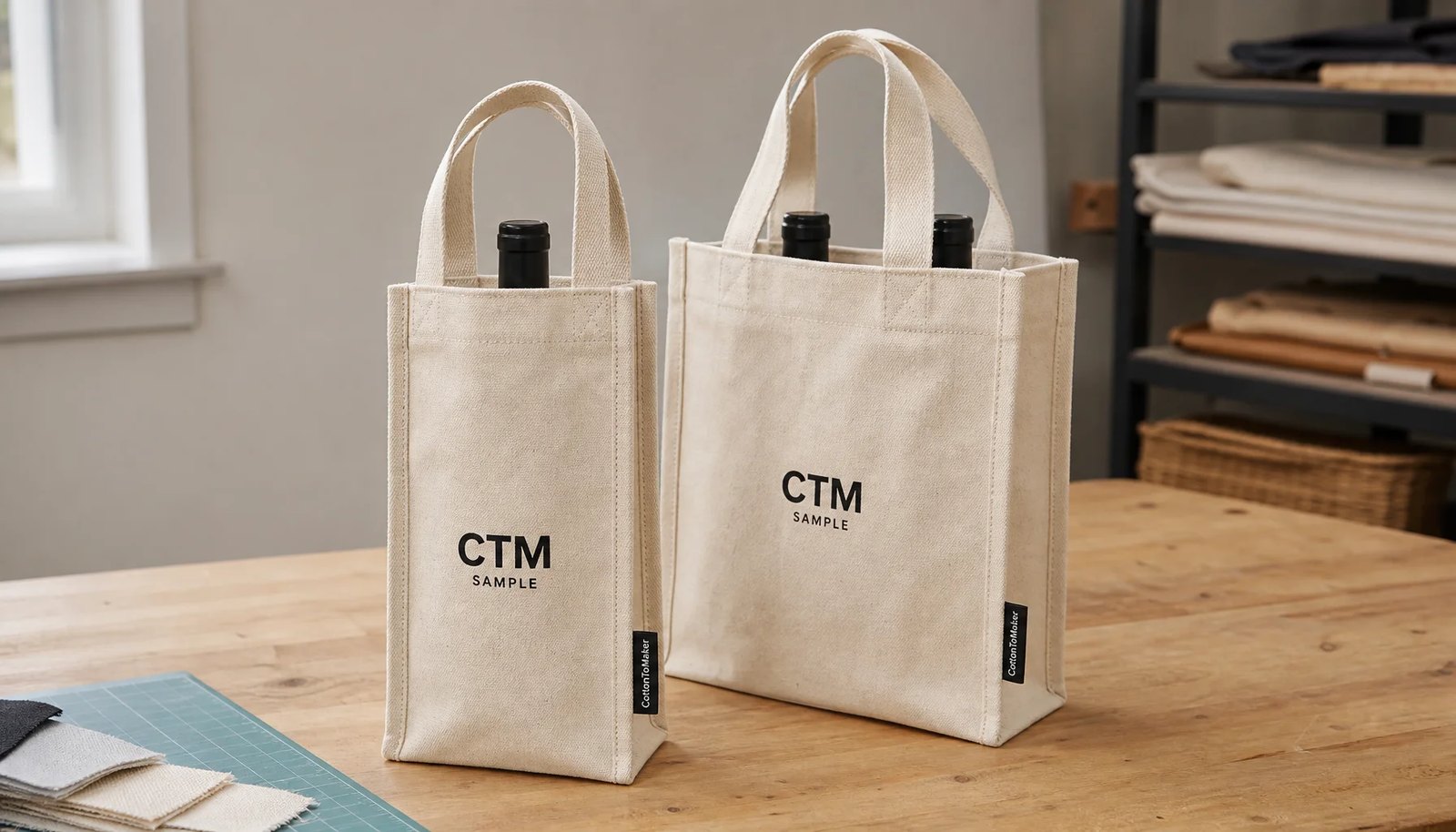
Start With the Use Case
Wholesale canvas wine carriers for trade show exhibitors should be specified around how the bag will actually be used at the event. A carrier handed out empty at a booth can be lighter, flatter, and packed more tightly. A carrier given with a full bottle inside needs stronger handles, better base control, and more careful carton planning. A carrier sold through a retail channel needs cleaner finishing, hangtag planning, barcode labeling, and stronger shelf presentation.
The common purchasing mistake is treating all wine carriers as the same small tote. They are not. A 750 ml bottle concentrates weight in a narrow footprint, and the bag must handle vertical load, side pressure, and movement through crowds. Before requesting wholesale pricing, lock the usage scenario, bottle type, and whether the carrier is a giveaway, VIP gift, distributor kit, or retail item.
- Empty event handout: prioritize low carton volume, clean logo print, and fast booth distribution.
- Bottle-loaded gift: prioritize handle strength, divider construction, carton protection, and receiving instructions.
- Retail resale item: prioritize finished appearance, consistent sizing, labeling, and shelf-ready packing.
- Distributor sample kit: prioritize repeat handling, thicker canvas, stronger seams, and practical bottle fit.
Choose Canvas Weight Correctly
For most trade show wine carriers, 10 oz to 12 oz cotton canvas is the practical range. In GSM terms, this often sits around 340 to 410 GSM depending on construction and finishing. It gives enough body for the carrier to stand reasonably well while still folding flat for export packing. Natural canvas in this range also gives a good print surface for simple logos, event marks, and sponsor branding.
Going heavier is not always better. A 14 oz canvas can look more premium, but it increases material cost, sewing difficulty, carton weight, and sometimes folding marks. A lighter canvas may save money but can twist around the bottle, especially if the base and gusset are not engineered well. When comparing quotes, make suppliers state the actual fabric weight and tolerance, because vague terms like heavy canvas or premium cotton are not purchasing specifications.
- 8 oz canvas: acceptable only for very light promotional use or empty handout programs.
- 10 oz canvas: cost-efficient for single-bottle carriers and moderate-volume exhibitor gifts.
- 12 oz canvas: stronger hand feel and better structure for premium trade show presentation.
- 14 oz canvas: useful for retail or luxury programs but can raise freight and labor cost.
Match the Structure to the Bottle
A wine carrier must be designed around bottle dimensions, not only around the phrase standard wine bottle. Bordeaux, Burgundy, Champagne, and spirits bottles can vary in shoulder width, height, and base diameter. If the buyer sends only a photo of the bottle, the factory may build around a common 750 ml wine bottle and miss a wider Champagne shape or taller spirits bottle.
For one-bottle carriers, the critical points are inner width, gusset, base stability, and handle drop. For two-bottle carriers, the divider is the decision point. A simple center divider may be enough for empty bottle presentation, but when bottles are loaded before distribution, the divider should be stitched securely so glass does not hit glass during handling. This small construction detail can decide whether the product feels reliable or becomes a claims issue.
- Send bottle height, base diameter, widest shoulder diameter, and loaded weight.
- Define whether the carrier must stand upright when empty, when loaded, or both.
- For two-bottle bags, specify whether the divider reaches the base and is fixed into the side seams.
- Allow enough top clearance so the handle is comfortable and the bottle neck does not distort the opening.
Control Print Before It Controls the Order
Most canvas wine carriers for trade show exhibitors use screen printing because it handles solid logos, one-color branding, and medium to large runs efficiently. Screen print also sits well on natural or dyed canvas when the artwork is not too fine. The buyer should provide vector artwork, Pantone references, print size, print position, number of colors, and whether the print appears on one side or both sides.
Heat transfer may be useful for lower MOQs, gradients, or multi-color event graphics, but the finish must be tested on textured canvas. Embroidery can look premium on heavier canvas, but it is usually better for small marks than large front-panel artwork because it can pucker the fabric and raise cost. Digital printing can work for certain designs, but the buyer should verify color saturation, wash or rub resistance, and how the print looks on natural canvas texture.
- Use screen print for bold logos, sponsor marks, and simple event branding.
- Use heat transfer for small runs with many colors, but test edge adhesion and hand feel.
- Use embroidery for small premium logos, not for large detailed art across the bottle area.
- Avoid very fine text under 5 mm height unless the factory confirms print clarity on actual canvas.
Understand MOQ Logic
MOQ is not only a quantity number. It comes from fabric purchasing, cutting efficiency, print setup, sewing line changeover, color changes, and packing labor. A supplier may accept a low total quantity if the fabric is stock natural canvas and the logo is one-color screen print. The same quantity can become difficult if the order needs custom dyed fabric, several logo versions, multiple print colors, or separate packing by event location.
For trade show buyers, the cleanest negotiation is to separate what must be customized from what can stay standard. Keep the base carrier size, canvas weight, and fabric color consistent when possible, then divide the branding by print version. This gives the factory a realistic path to combine cutting and sewing while only changing screens or print runs. It also gives procurement a better way to compare suppliers instead of chasing the lowest headline MOQ.
- Lower MOQ is easier with natural canvas, standard size, and one-color logo.
- Custom dyed canvas usually requires higher MOQ because fabric must be dyed or specially sourced.
- Multiple logos can be efficient if the bag body is identical and only printing changes.
- Separate MOQs may apply per fabric color, per size, per logo, and per packing method.
Compare Quotes on Real Cost Drivers
A proper quote for wholesale canvas wine carriers should not be judged only by unit price. Two suppliers may quote the same bag description while using different GSM, handle stitching, divider structure, carton quantity, and sample inclusion. One quote may include screen setup and export carton labeling; another may add those later. For a trade show deadline, missing cost details often become rush charges or compromises in quality.
Build a comparison sheet that includes bag specification, sample cost, setup cost, packing method, carton dimensions, inspection options, and lead time assumptions. If you are importing, also compare freight impact. A carrier packed at 100 pieces per carton may look cheaper than one packed at 50 pieces, but if the carton becomes too heavy or the bags are crushed, the receiving cost and damage risk can offset the savings.
- Unit cost: confirm whether it includes material, sewing, print, standard packing, and carton labeling.
- Setup cost: include screen charge, logo plate, transfer setup, or embroidery digitizing if applicable.
- Sample cost: separate development sample, pre-production sample, and courier cost.
- Freight cost: compare carton CBM, gross weight, pieces per carton, and pallet requirements.
- Risk cost: include inspection, replacement margin, and late-order contingency.
Approve Samples Like a Production Buyer
A sample should prove the actual production route, not only show the general shape. For a canvas wine carrier, the pre-production sample should use the actual canvas weight, actual fabric color, actual logo method, actual handle reinforcement, and actual divider structure. If the supplier sends a sample in substitute fabric, it may be useful for shape review, but it should not be treated as final approval for bulk production.
Approval comments should be measurable. Instead of writing logo too low or handle too short, mark the exact placement and dimension. Keep one sealed sample at the factory and one with the buyer or inspection team. During bulk inspection, finished goods should be compared against the approved sample for fabric hand feel, print color, stitch pattern, handle length, gusset, and packing.
- Measure finished width, height, gusset, handle length, and print position on the sample.
- Load the sample with the intended bottle and carry it for a practical handling test.
- Review print under normal lighting and check whether canvas texture breaks small artwork.
- Photograph approved details such as handle stitch, divider seam, base construction, and carton packing.
- Issue written approval with any corrections before bulk material is cut.
Set QC Thresholds Early
Quality control for wine carriers should focus on load-bearing points, appearance points, and packing accuracy. Handle attachment is the highest-risk area because a full bottle places concentrated stress on a small stitched zone. The second risk is print quality, especially when event logos must be clean for sponsor visibility. The third risk is divider or base misalignment, which can make the bag lean, twist, or fail to protect the bottle.
The purchase order should define tolerances that an inspector can use. This avoids arguments after production is finished. For example, finished dimensions can be allowed within plus or minus 5 mm to 10 mm depending on the area, print placement within a defined range, and no major defects such as open seams, broken stitches, obvious print smears, or incorrect logo color. For loaded use, a simple static load test and handle pull test should be written into the inspection plan.
- Critical defects: open seams, handle detachment, wrong logo, wrong fabric color, unsafe divider failure.
- Major defects: visible print smudge, skipped stitches, large size deviation, crooked handle, exposed raw edge.
- Minor defects: small loose thread, slight natural slub variation, minor folding crease within agreed standard.
- Inspection sampling should include pieces from different cartons, not only top-layer samples.
- The inspector should test both empty appearance and loaded carrying performance.
Plan Packing Around Freight and Booth Handling
Packing is a commercial decision, not an afterthought. Flat-packed canvas wine carriers usually reduce carton volume and freight cost. However, if the carrier has a stiff divider, reinforced base, or premium retail presentation, the packing method must protect the shape. Folding too tightly can create deep creases across the print panel, especially on heavier canvas or dark dyed fabric.
Trade show exhibitors also need receiving control. Cartons may be shipped to a warehouse, booth builder, hotel, distributor office, or show site. Carton labels should identify the event, SKU, logo version, quantity, and carton number. If multiple booth locations or sales teams receive different logo versions, carton-level separation matters more than saving a few cents on packing labor.
- Flat pack for most empty handout programs and standard wholesale shipments.
- Individual polybag only when required for retail, dust protection, or distribution control.
- Avoid overpacking cartons if heavy canvas causes compression marks on printed panels.
- Use clear carton marks for mixed logo versions, event locations, or sales territories.
- Request carton dimensions and gross weight before final freight comparison.
Protect the Trade Show Schedule
Trade show orders fail when buyers count only bulk production days. A realistic schedule includes artwork cleanup, quotation, sample making, sample shipping, approval revisions, material booking, printing, sewing, final inspection, carton packing, export booking, customs clearance, domestic delivery, and booth receiving. A small wine carrier order can still miss a show if artwork changes or the buyer approves a substitute sample too late.
The safest workflow is to freeze the specification before sample approval and freeze artwork before screen making. If the event date is fixed, work backward from the booth receiving date, not the factory ship date. Allow extra time for inspection and replacement if the carrier will be loaded with bottles or used for VIP gifting. A rushed order may still be possible, but the buyer should simplify the spec: stock fabric, one-color print, standard size, and straightforward packing.
- Artwork preparation: allow time for vector file cleanup and Pantone confirmation.
- Sampling: include factory sample time plus courier transit and buyer review.
- Material booking: custom dyed canvas or special trims require more buffer.
- Production: printing and curing must happen before sewing or final packing, depending on design.
- Final delivery: plan around show-site receiving windows and warehouse appointment rules.
Specification comparison for buyers
| Spec decision | Recommended option | When it fits | Buyer risk to check |
|---|---|---|---|
| Canvas weight | 10 oz to 12 oz cotton canvas for most trade show wine gifts; 14 oz only for premium retail use | Good balance of structure, print surface, carton weight, and booth handling | Too light may collapse around the bottle; too heavy raises freight and can make folding marks more visible |
| Bottle capacity | Single-bottle carrier for sampling campaigns; two-bottle carrier with divider for premium gifts | Single-bottle bags reduce cost and are easier to pack; two-bottle bags carry higher perceived value | Two-bottle carriers need a stitched or padded divider, otherwise glass contact can cause breakage claims |
| Handle construction | Self-fabric handles with box-stitch or cross-stitch reinforcement | Best for repeated trade show carrying and simple production control | Cheap bartack-only handles may pass a photo review but fail under full bottle weight |
| Print method | Screen print for solid logos; heat transfer for multi-color small runs; embroidery only for small logo areas on heavier canvas | Matches most exhibitor branding where logo clarity matters more than photo detail | Thick ink on textured canvas can crack if curing is rushed; fine lines may fill in on coarse fabric |
| Internal protection | Canvas divider or padded insert for two-bottle styles; no divider needed for single-bottle styles if carton packing is correct | Useful when the carrier is given with bottles already loaded | A loose divider adds labor but may not protect glass unless it is secured at the bottom and sides |
| MOQ logic | Negotiate by fabric color, size, and print setup instead of only total quantity | Allows mixed logo versions or event locations without creating new fabric dye lots | Suppliers may quote a low MOQ but apply separate screen, color change, or cutting charges later |
| Packing format | Flat-packed carriers in export cartons; bottle-loaded gift packing only when clearly specified | Flat packing keeps volume and breakage risk lower for most exhibitors | Unspecified packing can change carton size, freight class, handling labor, and warehouse receiving costs |
| Sample approval | Pre-production sample using actual canvas GSM, handle reinforcement, print color, and packing method | Best for branded exhibitors who need predictable booth presentation | A photo sample or substitute fabric sample may hide shrinkage, hand feel, color, and load-bearing problems |
Buyer checklist before sampling
- Define whether the wine carrier is for empty handout, bottle-loaded gift, retail resale, or distributor sales kit use.
- State bottle type and dimensions, including 750 ml Bordeaux, Burgundy, Champagne, spirits bottle, or mixed bottle range.
- Choose single-bottle, two-bottle, or multi-bottle structure before requesting price, because cutting, divider labor, and carton volume change significantly.
- Specify canvas weight in oz or GSM, not only words such as heavy duty or premium.
- Confirm fabric color standard using Pantone, dyed canvas reference, or approved lab dip if the color is not natural canvas.
- Send logo artwork in vector format and define print size, placement, number of colors, and whether printing is on one side or both sides.
- Define handle length and reinforcement method, especially if the bag must carry a full glass bottle during a crowded trade show.
- Require a pre-production sample made with actual material, actual print method, and actual handle stitching.
- Set acceptance criteria for print registration, logo color tolerance, seam allowance, stitch density, loose threads, and load test.
- Clarify whether bags ship flat, folded, individually polybagged, with tissue, with hangtag, or pre-packed with bottle inserts.
Factory quote questions to send
- What canvas weight and yarn construction are included in this quote, and can you provide the GSM tolerance?
- Is the quoted fabric greige, natural, bleached, dyed, recycled cotton blend, or conventional cotton canvas?
- Does the price include screen setup, color matching, logo placement, and one pre-production sample?
- What MOQ applies per size, per fabric color, per logo version, and per print color?
- For two-bottle carriers, is the divider stitched into the base and side seam, or is it a loose insert?
- What handle reinforcement is included: bartack, box-stitch, cross-stitch, or reinforced patch?
- What maximum recommended loaded weight has the factory tested for this style?
- How many pieces are packed per export carton, and what are the carton dimensions and gross weight?
- Can the supplier provide production photos showing fabric cutting, printing, stitching, and final packing for the approved order?
- What is the sample lead time, bulk production lead time after sample approval, and latest date for artwork freeze to meet the trade show?
Quality-control points to confirm
- Canvas GSM within agreed tolerance, commonly plus or minus 5 percent unless a tighter range is written into the PO.
- Finished bag dimensions within agreed tolerance, commonly plus or minus 5 mm for width and gusset and plus or minus 10 mm for height.
- Handle length and attachment position consistent across cartons so the bag hangs evenly when loaded.
- Handle attachment passes a practical load test using the intended bottle weight plus margin.
- Stitching is straight enough for retail presentation, with no skipped stitches, broken threads, open seams, or loose divider panels.
- Print color matches approved standard under consistent lighting and does not show visible pinholes, smudging, cracking, or misregistration.
- Ink or transfer is cured properly and passes a simple rub test before packing.
- Divider and base alignment keep bottles upright without forcing the carrier out of shape.
- Cartons are strong enough for export handling and labeled with SKU, logo version, quantity, gross weight, and carton number.
- Random finished goods inspection includes loaded visual check, flatness check, packing count, and comparison against the sealed pre-production sample.