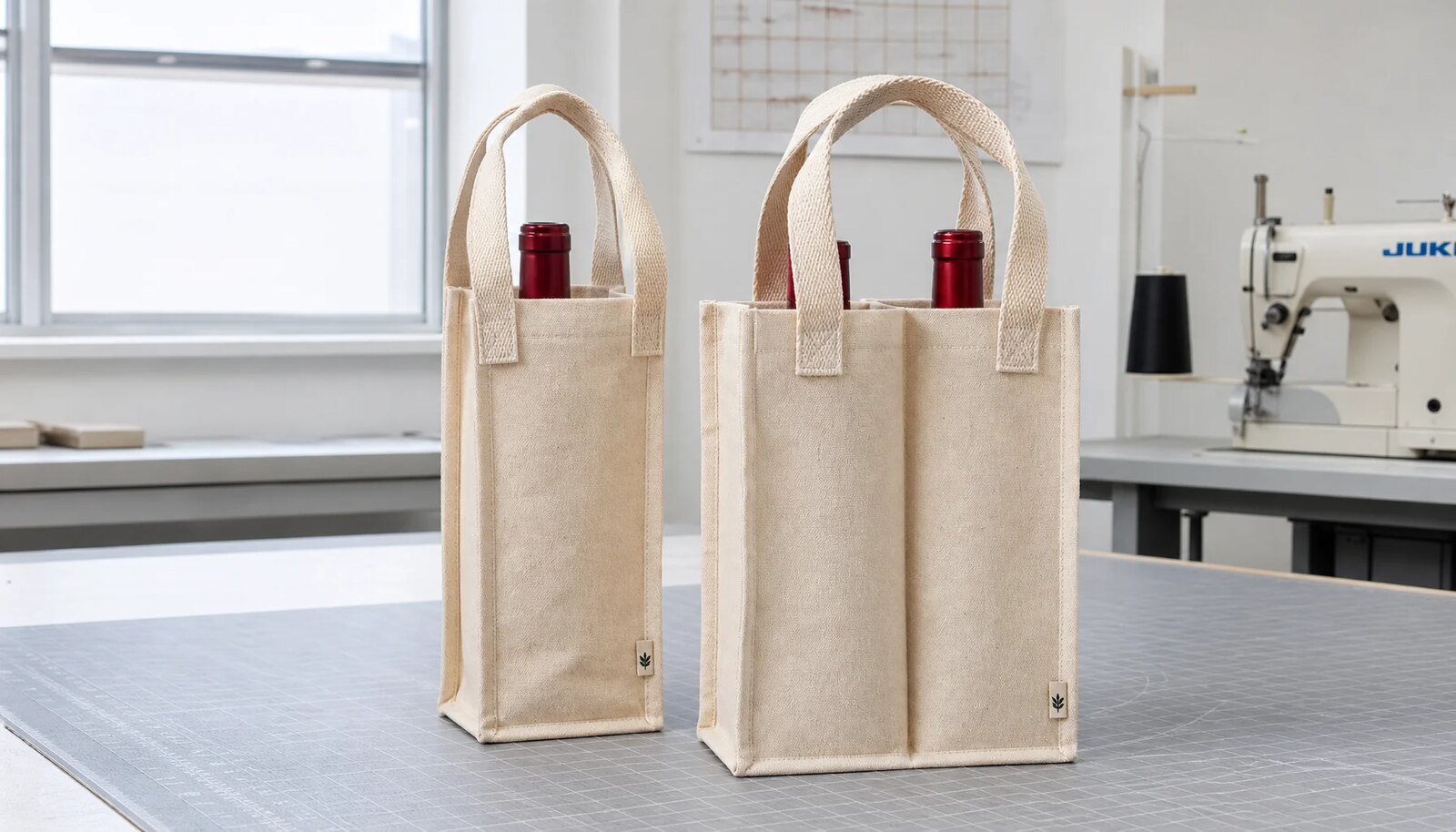
Define the selling route first
Canvas wine carriers look simple in a product photo, but the right buying specification depends on where the carrier is used. A farmers market vendor may need compact cartons that fit in a van, fast bottle insertion at checkout, and carriers that can be stored under a table without crushing the print. A winery shop may care more about resale presentation, barcode labels, and single-SKU carton discipline. A distributor or 3PL may prioritize carton marks, gross weight, and pallet stackability.
Begin the brief with the operating route instead of the artwork. State whether the carrier is a giveaway, resale item, tasting-room add-on, gift-pack component, or reusable vendor supply. Then identify the receiving point: importer warehouse, 3PL, distributor, retail location, winery, event operator, or direct-to-vendor delivery. The same bag may need a different pack plan for each route.
This early detail keeps quotes comparable. If one factory assumes a flat single-bottle sleeve and another assumes a semi-assembled two-bottle carrier with a sewn divider, the unit prices will not mean much. Buyers sourcing wholesale canvas wine carriers for farmers market vendors should connect product design and shipping carton planning before the first quote is issued.
- Name the use case: giveaway, resale carrier, wine club insert, event kit, or market vendor supply.
- State where cartons are received and whether that location has carton weight or dimension rules.
- Identify how the carrier is stored: flat in cartons, hung on display, nested on shelves, or packed into vendor vehicles.
- Decide whether freight efficiency, presentation, or fast receiving is the primary constraint.
Turn bottle fit into measurements
Bottle fit is the first technical control point. A generic 750 ml reference is not always enough because wine bottles vary in height, shoulder shape, diameter, glass weight, and label thickness. Sparkling bottles and heavy Burgundy-style bottles may need more width or gusset depth than a standard Bordeaux bottle. If the fit is too tight, the vendor may fight the bag at checkout, scuff bottle labels, or distort the decoration panel.
Use finished dimensions rather than pattern dimensions. The RFQ should state finished body height, body width, gusset depth, top opening, bottom shape, handle drop, divider height, and divider position. If fabric is washed, dyed, or heavily pressed, ask whether shrinkage has already been built into those finished dimensions. For two-bottle carriers, divider height and bottle clearance should be measured because a low divider can let bottles hit each other during normal carrying.
A measurement sheet makes sample approval cleaner. For common sewn canvas goods, buyers often use a tolerance such as +/-5 mm for body width, height, gusset, and handle drop, with tighter control on logo placement when the decoration is small. The exact tolerance should be agreed before bulk production, not debated after inspection. Ask the supplier to return the RFQ table with its proposed production tolerances so the buyer, factory, and inspector are using the same reference.
- Provide bottle height, maximum diameter, shoulder profile, expected filled weight, and label area.
- Measure top opening as well as body width, since the opening controls checkout speed.
- For two-bottle formats, state whether bottles may touch or must remain separated.
- Approve the sample against a measurement sheet, not only against a product photo.
Choose construction and material together
Canvas weight should match the carrier structure. An 8 oz canvas, roughly 270 gsm, can work for a simple promotional sleeve where the goal is low cost and efficient carton packing. A 10 oz canvas, roughly 340 gsm, is often a balanced option for reusable wine carriers because it gives more body while still folding reasonably well. A 12 oz canvas, roughly 400 gsm, feels more substantial, but it increases material cost, sewing resistance, and carton volume.
Finish matters as much as weight. Raw natural canvas has the market-friendly look many buyers want, but the approved sample should set the acceptable range for shade, slubs, seed flecks, and handfeel. Washed canvas can feel softer but may wrinkle more in cartons. Dyed canvas supports brand color, yet buyers should check shade consistency and crocking risk. Lined construction improves inside finish and perceived value, but it adds labor and makes the carrier bulkier.
Do not use fabric weight as a substitute for engineering. A lighter canvas may perform well if the carrier has a proper gusset, reinforced handle, and good seam allowance. A heavier canvas can still fail if the handle is attached only to a weak hem or if the divider pulls against a single stitch line. The approved spec should combine fabric, finish, handle, divider, bottom shape, decoration, and carton method into one product definition.
- Use 8 oz canvas for simple sleeves and cost-sensitive promotional orders.
- Use 10 oz canvas for balanced reusable market, winery, and event programs.
- Use 12 oz canvas when premium handfeel or stronger shape retention justifies lower carton density.
- Request fabric weight tolerance and clarify whether GSM is checked before or after finishing.
Engineer handles, dividers, and load points
Wine carriers usually fail at concentrated stress points: handle anchors, top hems, divider seams, side seams, and bottom corners. A filled bottle creates a focused load when the customer lifts, twists, swings, or sets the carrier down. The RFQ should define handle material, width, drop length, stitch type, reinforcement, thread, and attachment point. A vague phrase like reinforced handle is not enough for production control.
Self-fabric handles give a clean matching look, but they need enough stitch area and reinforcement for repeated lifting. Cotton webbing can improve grip and strength predictability, though it changes the visual style. Bar tacks, box stitches, cross stitches, and reinforced top hems should appear on the approved sample and in bulk photos. For heavier two-bottle carriers, ask whether the handle is stitched into the body seam or only sewn to the top hem.
Dividers need the same precision. A sewn divider is stable, but it adds sewing minutes and can create fold pressure inside the carton. A removable insert may help with packing, but it can shift, detach, or be lost. A bottom board helps the carrier stand upright, yet it may require semi-assembled packing and moisture protection. During sample review, load the carrier with the correct bottle weight and check lift, balance, bottle movement, seam strain, and handle comfort.
- Treat handle failure, divider detachment, and open load-bearing seams as critical or major defects.
- Require close-up photos of handle anchors from both inside and outside the carrier.
- Define divider material, height, attachment method, and required bottle clearance.
- Ask for a simple lift check during inspection, such as holding loaded carriers for an agreed time without seam opening.
Select decoration for real handling
Decoration must survive folding, rubbing, storage, and repeated use. Screen print is often the practical choice for wholesale canvas wine carriers because it scales well, keeps cost predictable, and works for simple logos. It performs best on a flat panel with enough clearance from seams, gussets, fold lines, handle anchors, and divider pressure areas. For multi-color printing, the quote should identify screen charges, underbase needs, registration tolerance, and color standard.
Embroidery, woven labels, patches, heat transfers, and hangtags each solve a different problem. Embroidery can look premium but may cause puckering, backing bulk, or stiffness on a narrow bag. Woven side labels are durable and consistent for repeat programs. Patches can fit a craft retail look, but edge lift and placement must be inspected. Heat transfers can handle fine artwork, yet adhesion should be tested on the exact canvas finish.
Approve decoration on the finished carrier and again after folding. A logo that looks centered on a loose sample may sit on a hard crease once packed, or it may be partly hidden by the handle. Measure logo position from stable reference points such as the top edge, side seam, and bottom seam. For multi-vendor farmers market programs, keep the decoration zone consistent across SKUs so different logos do not force different carton counts or inspection rules.
- Keep artwork away from fold lines, seam ridges, handle anchors, divider pressure, and bottom corners.
- Confirm setup charges for screens, digitizing, woven labels, patches, and hangtags separately from unit price.
- Check print curing, rub resistance, color target, registration, and appearance after carton folding.
- For repeat orders, keep an approved logo placement sheet with measurements and photos.
Build an RFQ buyers can compare
A useful RFQ makes every supplier price the same carrier. Include bottle profile, finished dimensions, fabric weight, finish, color, construction, handle, divider, decoration, sample requirement, carton target, incoterm, delivery point, and inspection expectations. Without those details, suppliers may all quote a canvas wine carrier while making different assumptions about material, sewing time, packing density, and carton strength.
Ask suppliers to separate fixed costs from unit costs. Fixed costs may include sampling, print screens, embroidery digitizing, woven label setup, patch tooling, custom carton development, or testing. Unit costs include fabric, cutting, sewing, reinforcement, inserts, decoration labor, inner packing, master cartons, and export packing. This split helps buyers see whether a design change actually saves money or simply moves cost into a different line.
The quote should also include MOQ, price breaks, lead time, payment term, quote validity, incoterm, carton dimensions, pieces per carton, net weight, gross weight, carton marks, overrun tolerance, underrun tolerance, and available inspection support. Price breaks should be requested at matched quantities, such as 500, 1,000, 3,000, and 5,000 pieces, using the same specification. A low unit price is not useful if it excludes the handle reinforcement, carton grade, or packing method shown on the sample.
- Ask which input controls MOQ: fabric, dye lot, decoration, labels, cartons, or sewing efficiency.
- Require carton data in the first quote, not after the purchase order is released.
- Request base, balanced, and premium construction options when the target cost is still uncertain.
- Compare landed cost using the same incoterm, carton count, pack method, and inspection assumption.
Approve sample and carton pack together
Sample approval should cover the product and the pack method. A sales sample can confirm the general look, but the pre-production sample should match bulk production exactly: fabric, finish, thread, handle, divider, decoration, fold method, inner packing, and master carton plan. That approved sample becomes the reference for inspection, claims, and repeat orders.
Test the pre-production sample with the real bottle or an approved dummy. Check insertion speed, standing behavior, divider movement, handle comfort, balance, seam strain, and bottle removal. Measure finished dimensions against the approved sheet. Then fold or nest the carrier exactly as the factory plans to pack it. Look for print cracking, print transfer, hard creases, handle bulk, divider distortion, wrinkles, odor, or pressure marks after short-term compression.
Ask for documentation before bulk release. Useful records include a measurement sheet, product photos from front and back, close-ups of handle anchors and divider seams, decoration placement photos with a ruler, folded-pack photos, carton layout photos, carton marks, carton size, and gross weight. For larger or stricter programs, request any available carton drop, compression, or stacking evidence. The goal is not paperwork for its own sake; it is to make the factory prove that the approved carrier can travel in the approved carton.
- Approve the pre-production sample only when product, decoration, and packing match the order.
- Use practical tolerances for sample approval, such as +/-5 mm on key sewn dimensions unless the design needs tighter control.
- Review the carrier after folding and carton compression, not only when freshly pressed.
- Keep approved photos and measurement sheets available for final inspection.
Set carton and pallet rules early
Carton planning belongs in the purchase order. The master carton spec should include pack form, pieces per carton, outer dimensions, board grade, net weight, gross weight, closure method, carton marks, and inner packaging. If goods are going to a warehouse or 3PL, ask for its carton limits before confirming the PO. Many buyers set a preferred gross weight under 15 kg for easier handling and a hard limit around 20 kg unless their warehouse allows more.
Flat packing usually gives the best freight efficiency, but the fold must not damage the carrier. Semi-assembled packing protects sewn dividers, board inserts, embroidery, and premium shapes, but it increases volume. Fully formed packing can make sense for retail-ready presentation, but it is inefficient for basic wholesale shipping. The carton format should follow product structure, receiving rules, and landed cost, not factory habit.
Pallet planning matters once volume increases. Ask for cartons per pallet, pallet height, stack pattern, and whether lower cartons can handle the load without crushing. If the order includes several colors, winery logos, or vendor versions, require one SKU per carton whenever possible. Mixed-SKU cartons should be used only by written approval, with inner labels and packing list detail that the receiving site can handle.
- Define the pack format: flat, semi-assembled, nested, fully formed, bundled, individually packed, or retail inner packed.
- Set target and maximum gross weight, carton dimensions, pack count, board grade, closure method, and carton marks.
- Confirm whether tissue, polybags, belly bands, inserts, or inner cartons are included in price.
- Request pallet quantity, pallet height, stackability notes, and mixed-SKU rules before shipment.
Inspect to the approved standard
Quality control should be written before production starts. Critical defects may include handle failure, open load-bearing seams, mold, sharp insert edges, unsafe contamination, wrong product identity, or mixed SKUs that make the shipment unusable. Major defects may include wrong fabric weight, severe stains, loose dividers, off-center decoration, incorrect dimensions, skipped stitches at stress points, carton count mismatch, wrong carton marks, or decoration that cracks after approved folding. Minor defects may include small loose threads, light wrinkles, or slight shade variation within the approved standard.
For many general sewn-bag orders, buyers use a final random inspection with AQL 2.5 for major defects and AQL 4.0 for minor defects, while treating critical defects as not acceptable. The exact level depends on brand risk, order size, destination, and buyer policy. Even when no formal AQL is used, the inspection brief should define how many units are checked, which measurements are recorded, how bottle fit is tested, and what evidence is required for pass or fail.
Packing inspection protects the warehouse side of the order. Sample cartons from different pallet positions, count units, verify carton marks, check barcode and PO data, confirm gross weight, inspect tape closure, and compare the packing list to physical cartons. Natural canvas should also be checked for odor, dampness, oil marks, dirt, heavy slubs, and shade variation outside the approved range. A good inspection treats the carrier and carton as one deliverable.
- Define critical, major, and minor defects in the PO or inspection brief.
- Use the approved sample, measurement sheet, and packing photos as inspection references.
- Check bottle fit, handle strength, divider attachment, seams, decoration, odor, and fabric condition.
- Verify carton count, dimensions, gross weight, SKU, barcode, PO number, country-of-origin marks, and packing list accuracy.
Specification comparison for buyers
| Carrier and packing choice | Best-fit specification | When to use it | Procurement risk to control |
|---|---|---|---|
| Single-bottle flat sleeve | 8-10 oz canvas, simple side seams, one-color print, folded on approved line | High-volume giveaways, tasting-room add-ons, farmers market handouts, simple retail bag programs | Tight bottle fit, print cracking on fold, weak top hem, and carton overpacking |
| Single-bottle gusseted carrier | 10 oz canvas, side or bottom gusset, reinforced handle, controlled top opening | Reusable market carrier where bottles must insert quickly and stand more cleanly | Gusset depth can vary after sewing; set finished tolerance and test with actual bottle |
| Two-bottle sewn-divider carrier | 10-12 oz canvas, center divider stitched into body or bottom, reinforced handle anchors | Farmers market vendors, winery clubs, gift sets, and event bundles carrying two 750 ml bottles | Divider pressure can distort folding, reduce carton count, or let bottles knock if too low |
| Carrier with board insert | Canvas body plus bottom board or stiffener, usually semi-assembled pack | Premium presentation, better standing shape, heavier bottles, or retail display needs | Board edges, moisture exposure, and carton compression must be inspected |
| Lined carrier | Outer canvas plus cotton or nonwoven lining, reinforced seams, careful turn-and-press | Gift programs, premium winery retail, or designs where inside finish matters | Higher sewing minutes and bulkier packing; confirm landed cost and gross weight |
| Screen-printed flat pack | Logo placed away from folds, seams, divider pressure, and handle anchors | Simple logos, repeat wholesale SKUs, and cost-controlled programs | Require cured print, rub check, color target, and folded-sample approval |
| Embroidered or patch carrier | Decoration backed or sewn cleanly, positioned away from stress seams | Premium small runs, winery shop resale, and brand-focused gift carriers | Backing bulk, puckering, needle damage, and inconsistent placement can affect appearance |
| High-density master carton | Agreed fold method, consistent piece count, target gross weight under warehouse limit | Price-sensitive orders where freight efficiency matters | Overpacking can cause wrinkles, print transfer, seam pressure, and receiving complaints |
| Lower-count protective carton | Fewer units per carton, inner bundle or divider protection, stronger board if needed | Two-bottle carriers, inserts, embroidery, retail-ready programs, or strict handling rules | Freight cost rises; model unit landed cost rather than comparing ex-factory price only |
Buyer checklist before sampling
- Confirm the bottle profile before pricing: standard 750 ml, tall 750 ml, sparkling bottle, heavy glass, boxed bottle, or two-bottle format.
- State finished dimensions for body height, body width, gusset depth, top opening, handle drop, divider height, divider position, and bottom shape.
- Specify canvas weight in GSM or ounces and identify the finish: raw, washed, dyed, brushed, lined, water-repellent, or untreated natural canvas.
- Set practical sample tolerances, such as +/-5 mm on key finished dimensions and an agreed fabric weight tolerance before bulk production.
- Define construction clearly: flat sleeve, side gusset, bottom gusset, sewn divider, removable insert, board insert, lining, snap, drawstring, open top, or retail-ready format.
- Select decoration before RFQ: screen print, heat transfer, embroidery, woven label, patch, hangtag, or side label.
- Keep artwork away from fold lines, handle stress points, divider pressure zones, bottom corners, and heavy seam transitions.
- Choose the pack form: flat, semi-assembled, nested, fully formed, individually polybagged, bundled, belly-banded, or retail inner packed.
- Set carton limits for pieces per carton, target gross weight, maximum gross weight, outer dimensions, carton grade, pallet height, and carton marks.
- Ask for a pre-production sample using exact fabric, thread, handle, divider, logo placement, fold method, and carton packing.
Factory quote questions to send
- What canvas GSM or ounce weight is included, what finish is priced, and what tolerance do you allow on bulk fabric weight?
- Are finished dimensions measured before or after washing, dyeing, sewing, pressing, and packing, and what tolerance will you accept at inspection?
- Which bottle profile did you use for fit confirmation, and can you test against our supplied bottle, bottle drawing, or approved bottle dummy?
- How is the handle attached: self-fabric, cotton webbing, reinforced top hem, bar tack, box stitch, cross stitch, or sewn into the body seam?
- What handle pull or load test do you recommend for this construction, and how many seconds or cycles can be checked during QC?
- For two-bottle carriers, is the divider sewn, inserted, removable, or bonded, and how does that choice affect folding, carton count, and bottle separation?
- How many decoration colors are included, and what setup fees apply for screens, embroidery digitizing, woven labels, patches, hangtags, or heat transfers?
- Can you quote 500, 1,000, 3,000, and 5,000 pieces using the same fabric, construction, decoration, carton grade, and packing assumptions?
- What is the proposed pack form, pieces per carton, carton size, board grade, net weight, gross weight, closure method, and carton mark layout?
- Can you provide a pre-production measurement sheet plus photos of handle anchors, divider seams, print placement, folded profile, and master carton packing?
Quality-control points to confirm
- Fabric weight should match the approved GSM or ounce standard within agreed tolerance, with bulk fabric aligned to the approved weave, finish, handfeel, and shade range.
- Finished dimensions should be checked for body height, width, gusset depth, top opening, handle drop, divider height, divider position, and packed fold profile.
- Bottle fit should be tested with the actual bottle profile, including shoulder shape, label thickness, bottle diameter, height, and expected bottle weight.
- Handle attachment must resist lift and twist load; inspect stitch count, bar tacks, reinforcement, loose ends, and whether the handle is anchored into the body panel or only the hem.
- Divider or insert construction should hold bottles upright without excessive wobble, collapse, edge exposure, tearing, or detachment under normal handling.
- Print or decoration should stay centered, cured, and intact after folding, rubbing, and carton compression; check cracking, transfer, registration, stitch puckering, and color match.
- Seams should have even allowance with no skipped stitches, open corners, puckering, needle cuts, loose threads, or stress-point weakness.
- Natural canvas should be checked for oil marks, stains, dampness, odor, heavy slubs, shade variation, mildew risk, and contamination before packing.
- Carton count, carton dimensions, gross weight, barcode, SKU, PO number, and country-of-origin marks should match the packing list exactly.
- Cartons should be strong enough for the route; inspect board grade, tape closure, edge crush, internal movement, strap marks, pallet stack condition, and whether lower cartons are being crushed.