Start proofing from the bottle, not the artwork
Wholesale canvas wine carriers for craft fairs look simple until the first sample is loaded with a real glass bottle. The most common sourcing mistake is starting with a logo layout while the bottle profile remains undefined. A 750 ml Bordeaux bottle, Burgundy bottle, Champagne bottle, and slim dessert bottle do not sit the same way in a carrier. Shoulder height, base diameter, and total bottle height affect the visible print area, bottom gusset, divider pressure, and handle balance.
For craft fairs, the carrier must perform in a crowded selling environment. A customer may buy a bottle, walk for two hours, place the carrier on a vendor table, and then carry it again. If the carrier leans, if the bottle shoulder pushes the front panel outward, or if the logo disappears into a fold, the problem is not cosmetic only. It affects perceived quality and can lead to complaints from retailers, wineries, and distributors.
- Nominate the bottle profile before the supplier makes the cutting pattern.
- Provide bottle diameter, height, shoulder shape, and filled weight if available.
- Require sample photos with the bottle inserted, carrier standing upright, and handles lifted.
- For mixed-bottle retail use, size the carrier for the largest realistic bottle, then evaluate how smaller bottles sit.
Choose canvas weight by structure, print result, and freight impact
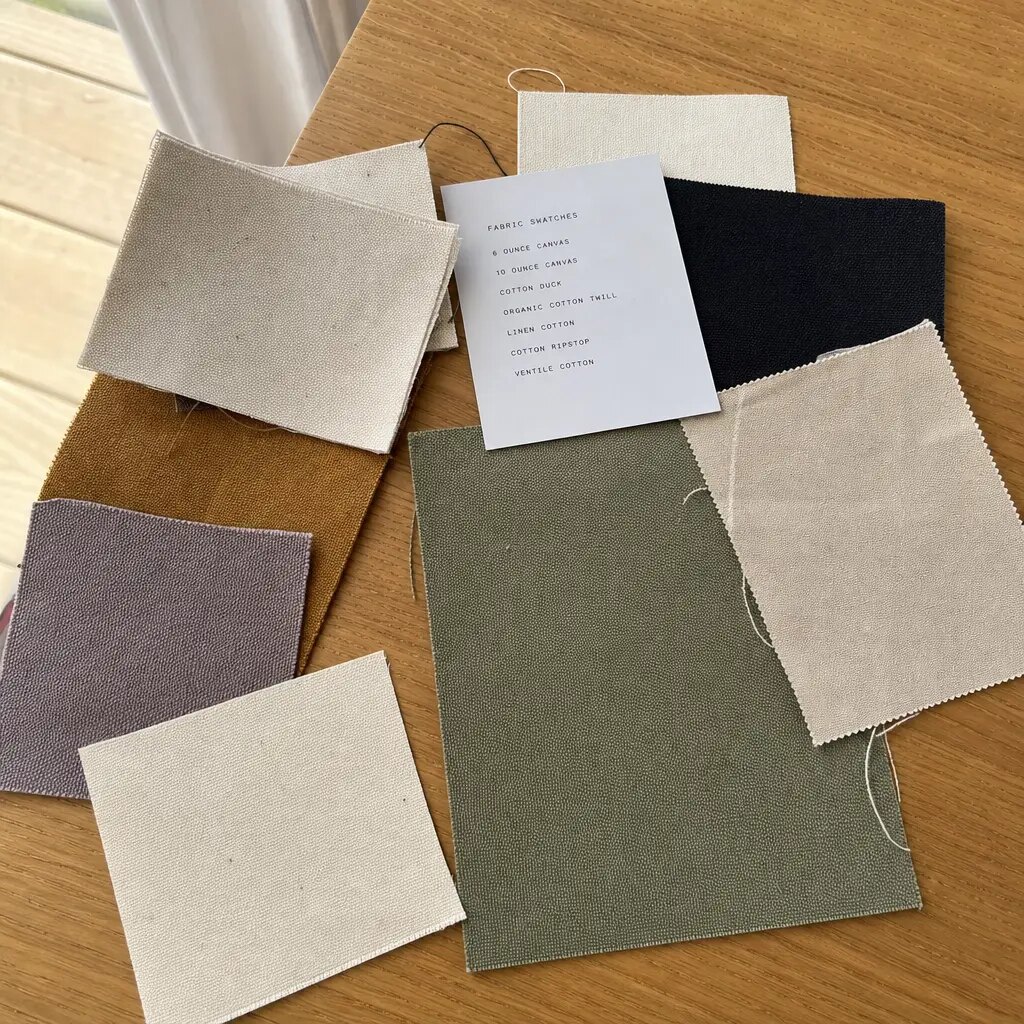
For printed wine carriers, 10 oz to 12 oz cotton canvas is often the practical working range. In GSM terms, this commonly falls around 280 to 340 GSM depending on yarn, weave, and finishing. It has enough body to support one or two bottles and enough surface stability for screen printing. Lighter 6 oz to 8 oz canvas can work for very low-cost promotions, but the bag may wrinkle around the bottle and show less crisp print edges.
Heavier canvas is not automatically better. A 14 oz or heavier canvas gives a premium handfeel, but it increases material cost, carton weight, and sewing difficulty. Thick seams around the gusset and handle reinforcement can create bulky points that do not press flat. If the buyer needs high-end retail resale, heavier canvas may be justified. If the requirement is a craft-fair giveaway with a logo, midweight canvas usually gives a better cost-to-performance balance.
- Use GSM or oz, not vague terms such as heavy canvas or premium cotton.
- Clarify whether quoted weight is before or after dyeing, washing, or coating.
- Natural canvas normally shows cotton specks and slubs; this should be accepted or rejected during sample approval.
- Dyed canvas improves brand color matching but adds shade-control and lead-time risk.
Build the print proof around canvas limitations
Canvas is a textured fabric, not a coated paper surface. Ink sits on yarns and drops into the weave valleys. This matters when a brand wants thin serif text, detailed illustrations, QR codes, small event dates, or multiple spot colors. A digital mockup can make these details look perfect, but the production print may lose sharpness. The proofing step should prove what the fabric and print method can actually hold.
Screen printing is usually the safest method for solid winery logos, event marks, and one to three color designs. Heat transfer can help when the order has many colors or the MOQ is low, but the buyer should evaluate handfeel, edge adhesion, and whether the transfer changes the natural look of the canvas. Digital printing may be useful for gradients or artwork-heavy souvenir designs, yet it needs more careful color approval because natural canvas affects brightness.
- Set minimum text height before proofing; very small legal lines often fail on rough canvas.
- For QR codes, test scan performance on the actual printed sample, not only on the artwork file.
- Keep print away from thick seams, gusset folds, and handle attachment points.
- Use Pantone references as targets, but approve a physical strike-off because natural cotton changes color appearance.
Control logo placement with loaded-bag measurements
A print layout measured on a flat panel does not always look centered after the bottle is inserted. The front panel curves slightly, the bottom gusset opens, and the handle tension can pull the top edge inward. This is why proofing should include both flat measurement and loaded appearance. For a craft-fair carrier, the logo is usually viewed while the bag is standing on a booth table or being carried at waist height.
A practical RFQ should define the print position from stable reference points. Instead of saying center logo on front, state the print width, print height, distance from top edge, and distance from side seams. If the bag has a bottom gusset, keep the lower edge of the print above the fold line. If the carrier has a divider, check that the divider seam does not create a visible ridge through the print panel.
- Common print position tolerance is plus or minus 3 mm to 5 mm, but large logos on loose canvas may need realistic flexibility.
- For two-bottle carriers, verify logo alignment when both compartments are filled.
- Avoid wrapping artwork around side seams unless the factory has a proven sewing and print sequence for that design.
- If the logo must align with a woven side label or hangtag, approve both together in the pre-production sample.
Understand MOQ logic before comparing supplier quotes
MOQ on canvas wine carriers is not only about the number of sewn bags. It is also driven by fabric purchase quantity, dye lot, cutting efficiency, print setup, screen making, label production, and packing style. A quote for 1,000 pieces of one natural canvas carrier with one black logo is not equal to a quote for 1,000 pieces split across five logos, two bag sizes, and three print colors.
Procurement teams should force the quote to separate shared components from design-specific costs. Blank bag production may share the same fabric and cutting table, but each logo can require its own screen, transfer setup, strike-off, and packing segregation. If those costs are hidden in one unit price, the buyer cannot compare suppliers fairly or understand the cost impact when the marketing team adds another craft-fair design.
- Request MOQ by blank carrier style, by fabric color, and by print design.
- Separate screen or transfer setup charges from running print cost.
- Clarify whether the supplier can combine multiple logos in one production batch without increasing defect risk.
- For distributors, require carton separation by logo version to avoid relabeling work after arrival.
Use samples to approve production behavior, not just appearance
A pre-production sample should answer practical questions: does the carrier fit the bottle, does the print hold enough detail, does the handle feel secure, and does the packed unit arrive without deep creases? A beautiful flat sample that was hand-cut or specially pressed is not enough. The buyer should know whether the sample was made using the intended bulk fabric, bulk thread, bulk print process, and planned sewing construction.
For time-sensitive craft-fair orders, sampling discipline prevents expensive late changes. If the first sample shows that the logo is too low or the canvas is too soft, it is cheaper to revise before bulk fabric is cut. Approving with comments can be risky unless the factory understands which comments are mandatory. Mark revisions clearly as approve, approve with required correction, or reject and resample.
- Approve fabric handfeel, shade, print color, print position, stitching, handle drop, and loaded-bottle fit as separate items.
- Keep one signed sample with the buyer and one with the factory for production reference.
- Photograph the approved sample with a ruler at print position and finished dimensions.
- Do not allow bulk cutting to start until artwork size, placement, and bottle fit are locked.
Set stitching and strength criteria for glass-bottle use
Wine carriers carry fragile, heavy products, so stitching quality deserves more attention than many buyers give it. The stress points are the handle attachment, side seam near the top opening, bottom gusset corners, and divider seam if the bag holds two bottles. A weak seam may pass visual inspection when flat but fail when a customer walks through a fair with a full bottle.
The RFQ should define handle material and reinforcement. Self-fabric handles match the bag body and look natural, while cotton webbing handles can offer stronger and more consistent load performance. Box-stitch, cross-stitch, or bartack reinforcement can be used depending on style and equipment. The important point is to make the reinforcement visible in the sample and repeatable in production.
- Define handle width and handle drop, not only total handle length.
- Specify stitch density, thread color, and reinforcement type at handle ends.
- Use a practical loaded pull test based on the intended bottle weight and carrying use.
- Reject open seams, skipped stitches, broken thread, needle cuts, and untrimmed thread tails beyond the agreed limit.
Plan packing so printed panels are protected and SKUs stay separated
Canvas wine carriers are often flat packed to reduce freight volume, but aggressive compression can create creases across the print. Some creases relax after unpacking; others remain visible, especially on thicker ink deposits or heat-transfer graphics. If the carriers will be sold at a craft fair or packed with bottles by a winery, the unpacking condition matters.
Packing also controls operational errors. A distributor may receive several print versions for different fairs, winery partners, or retail accounts. Mixed cartons without clear marks cause sorting labor and shipment mistakes. Each carton should show carrier style, fabric color, print design, quantity, purchase order, and destination if the buyer is allocating stock to multiple event sites.
- Use inner bundles of 25 or 50 pieces when the buyer needs easy warehouse counting.
- Limit carton gross weight to a practical handling range agreed with the importer or warehouse.
- Avoid folding directly through the main printed logo when possible.
- Request a packing photo before shipment showing bundle method, carton mark, and carton fill.
Protect the schedule with artwork and proofing milestones
Craft-fair orders usually have a fixed event date, so late proof changes can create more risk than a small unit-cost difference. A realistic schedule starts with final artwork, fabric availability, print proof, pre-production sample, bulk cutting, printing, sewing, inspection, packing, and export. The sequence can vary depending on whether the factory prints before sewing or prints on finished bags, but each step has a dependency.
Buyers should avoid placing a bulk order while artwork is still being revised by the marketing team. Changing a logo after screens are made or after fabric panels are printed can create scrap, delay, and arguments over who pays. If the order includes multiple brand owners or retailers, set an internal artwork lock date before the supplier's production lock date.
- Treat artwork approval and sample approval as separate milestones.
- Build buffer for courier transit of samples, especially when several departments must sign off.
- Confirm whether the factory's quoted lead time begins after deposit, artwork approval, sample approval, or material arrival.
- For repeat orders, verify whether the old screen, print file, and fabric shade are still available.
Compare landed cost using the same quote structure
A low unit price can become expensive if it excludes print setup, inner packing, carton strength, labels, inspection, or realistic freight volume. For canvas wine carriers, landed cost is affected by fabric weight, bag size, number of print colors, carton cube, and how many SKUs are split across the order. Procurement teams should compare quotes line by line instead of judging only the first unit price.
A useful quote format separates the blank carrier, decoration, accessories, packing, sampling, tooling or screens, and shipping basis. This allows the buyer to run scenarios. For example, reducing from a three-color print to a one-color print may save setup and running cost. Switching from 14 oz to 12 oz canvas may lower material and freight cost while keeping adequate structure. Combining logo versions may help sewing efficiency but may not reduce print setup cost.
- Compare quotes using the same incoterm, such as EXW, FOB, CIF, or DDP, not mixed terms.
- Request estimated carton dimensions and gross weight before freight is booked.
- Separate one-time charges from repeat-order unit costs.
- Include inspection cost and any retailer labeling cost in the landed-cost comparison.
Specification comparison for buyers
| Spec decision | Recommended option | When it fits | Buyer risk to check |
|---|---|---|---|
| Fabric weight for craft-fair handling | 10 oz to 12 oz cotton canvas, roughly 280 to 340 GSM after normal finishing | Good for reusable wine carriers sold or gifted at markets, tasting rooms, and seasonal fairs | Very light 6 oz to 8 oz canvas can collapse around the bottle and show print-through; heavy 14 oz canvas increases freight and may need stronger needles and slower sewing |
| Bottle format | Single-bottle carrier for low-cost giveaways; two-bottle carrier with divider for retail sets | Single-bottle bags suit winery sampling and promotional bundles; two-bottle bags work for gift packs and higher perceived value | Do not approve only flat measurements; test with the actual bottle diameter and shoulder height used by the buyer |
| Printing method | Screen print for solid logos; heat transfer for multicolor small runs; digital print only when artwork needs gradients | Screen print is usually the most stable choice for craft-fair volume and repeat artwork | Canvas texture reduces fine-line sharpness; proof small text, QR codes, thin outlines, and color trapping before bulk cutting |
| Logo placement | Front-center print with safe margin from side seams and bottom gusset | Best for clear brand visibility on a standing carrier at a booth or retail shelf | Artwork placed too low may fold into the gusset; artwork too wide can distort when the carrier is filled |
| Handle construction | Self-fabric or cotton webbing handles with reinforced cross-stitch or box-stitch | Needed when customers carry 750 ml glass bottles around a crowded fair | Weak handle stitching is a bigger failure risk than fabric tearing; define stitch density and pull-test method |
| MOQ logic | One print design per MOQ tier, with shared blank fabric only if carrier size and fabric color are identical | Useful when buyers need several winery logos or seasonal fair designs | Combining SKUs without separating print setups can hide real cost; each logo color and screen usually changes the price |
| Packing method | Flat packed in export cartons with inner bundles of 25 or 50 pieces and a carton mark showing SKU, print version, and quantity | Efficient for distributors shipping to multiple craft-fair locations or sales reps | Over-compression can crease printed panels; unmarked mixed cartons create allocation errors during fair setup |
| Proof approval standard | Pre-production sample with signed artwork layout, color target, bottle-fit photo, and packing sample | Appropriate before bulk production where logo accuracy and shelf appearance matter | Approving only a digital mockup is not enough; fabric color, ink absorption, and seam position must be physically verified |
Buyer checklist before sampling
- Define bottle type before quoting: 750 ml Bordeaux, Burgundy, Champagne, slim dessert bottle, or mixed bottle assortment.
- State whether the carrier is for giveaway, retail resale, winery gift pack, distributor promotion, or event merchandise.
- Specify fabric construction: cotton canvas weight in oz or GSM, natural or dyed color, washed or unwashed finish, and acceptable shade tolerance.
- Provide finished size with tolerance, including width, height, bottom gusset, divider size if any, and handle drop.
- Send vector artwork with Pantone references, print size, placement from seams, and minimum acceptable text height.
- Decide whether print approval will use lab dip, strike-off, pre-production sample, or shipment sample only.
- Require the supplier to test the actual bottle fit and send photos of the loaded carrier standing upright and being held by the handles.
- Define stitch requirements: seam type, stitch density, reinforcement point, thread color, and loose-thread allowance.
- Set packing rules by SKU and print version, including inner bundle quantity, polybag preference, carton mark, carton weight limit, and carton dimensions.
- Request a quote that separates blank bag cost, print setup, print running cost, sample charge, packing cost, and freight basis.
Factory quote questions to send
- What canvas weight and GSM are you quoting, and is the weight measured before or after dyeing, washing, or finishing?
- Is the quoted fabric greige, natural, bleached, dyed, or washed canvas, and what shade tolerance will be used for repeat orders?
- Which print method is included in the price, how many colors are included, and what is the setup cost for each screen, plate, or transfer design?
- Can you print a strike-off on the same bulk canvas before cutting the order, and how long does that add to the schedule?
- What finished-size tolerance do you use for this wine carrier after sewing and pressing?
- What bottle size was used for your fit test, and can you test with the buyer's actual bottle dimensions?
- What handle material, handle width, reinforcement stitch, and pull-test standard are included in the quote?
- How is the MOQ calculated if the order has multiple logos, multiple fabric colors, or both single-bottle and two-bottle styles?
- What is the standard packing unit per inner bundle and export carton, and what are the expected carton dimensions and gross weight?
- What are the sample lead time, bulk lead time after sample approval, and latest date for final artwork lock to meet the craft-fair date?
Quality-control points to confirm
- Finished carrier must fit the nominated bottle type without forcing the seams or causing the base to tilt.
- Print position tolerance should be agreed in millimeters, commonly plus or minus 3 mm to 5 mm depending on artwork size and fabric movement.
- Print color must be compared against an approved strike-off or Pantone target under consistent light, allowing for canvas absorption.
- Small text, QR codes, registration marks, and thin lines should remain readable after printing on textured canvas.
- Handle attachment must withstand a practical loaded-bottle pull test without popped stitches, seam tearing, or visible thread stress.
- Bottom gusset and side seams should hold shape when the filled carrier stands on a flat surface.
- Stitch density should be consistent, with no skipped stitches, open seams, needle cuts, or loose thread tails beyond agreed allowance.
- Fabric shade, slub level, and surface contamination should match the approved sample range.
- Cartons must not exceed the buyer's handling weight limit, and printed panels should not be sharply creased by over-tight packing.
- Carton marks must separate SKU, print design, bottle format, quantity, and destination where the buyer ships to multiple craft-fair sites.