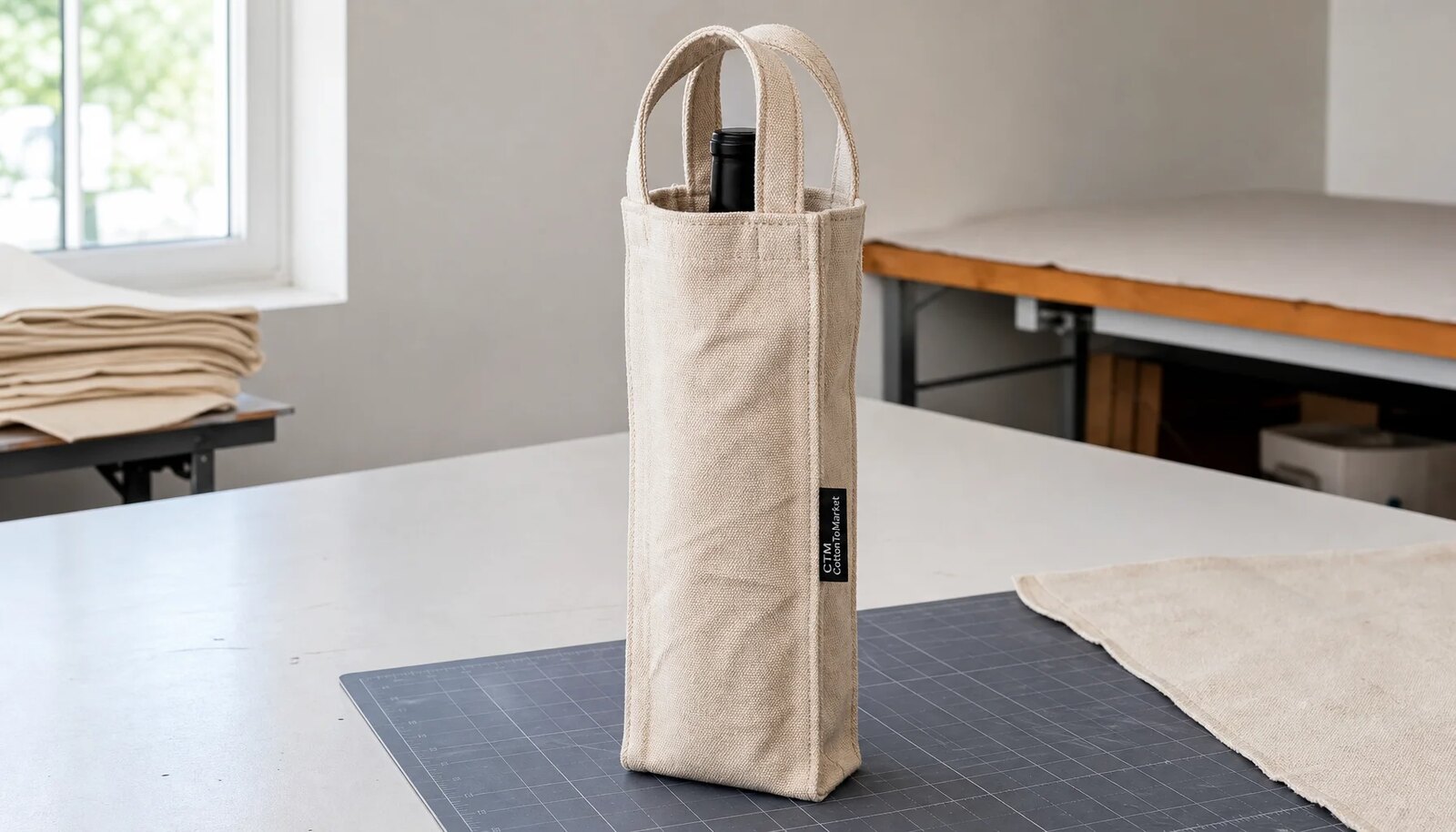
Why print proofing matters on canvas wine carriers
Wholesale canvas wine carriers look straightforward because the product is small: a fabric sleeve, a handle, a print, and a bottle. In procurement terms, that simplicity is deceptive. The carrier is a sewn item, a printed item, a packing item, and often a customer-facing brand touchpoint at the same time. A proof that only checks whether the logo appears in the right general area does not protect the buyer from weak ink opacity, crooked seams, handle stress, carton scuffing, or a carrier that twists once the bottle is inserted.
For eco apparel brands, wine carriers often sit next to apparel packaging, tote bags, gift bags, and retail accessories. The buyer may expect the same quiet, natural look as a cotton tote, but wine carriers carry more concentrated weight and have less flat print area. The fabric has to handle load, the handle has to feel stable, and the print has to remain legible over texture. A small defect can become obvious because the logo is usually the focal point of the product.
The proofing process should answer four questions before bulk production starts: does the construction fit the bottle, does the fabric support the intended brand finish, can the print method hold the artwork on the actual canvas, and will the packing protect the print until it reaches stores or fulfillment. If the answer to any of those questions is assumed rather than proven, the order is exposed.
- Treat the carrier as a constructed product, not only a decorated blank.
- Approve fabric, sewing, print, and packing as separate checkpoints.
- Use the proof to test real-world loading, not just flat-table appearance.
- Keep proof approvals written, measured, dated, and tied to the artwork version.
Start with the commercial use and bottle format
The right spec starts with how the carrier will be used. A gift-with-purchase program may prioritize cost, fast packing, and clean one-color branding. A retail wine set may need heavier canvas, a divider, hangtag, barcode, and shelf-ready carton labeling. A corporate gift or apparel-brand collaboration may need a more premium handfeel, tighter print control, and stronger presentation. These use cases can all look similar in a product photo, but they should not be quoted as the same item.
Bottle format is the next non-negotiable input. A standard 750 ml wine bottle, a tall sparkling bottle, a wider Burgundy-style bottle, and a bottle already wrapped in tissue can all change the internal clearance. Two-bottle carriers add more complexity because the divider must protect the bottles without eating so much space that insertion becomes awkward. If the supplier only works from outside dimensions, the buyer can end up with a carrier that measures correctly on paper but feels tight or distorted in use.
Procurement teams should send either the physical bottle sample or a dimensioned drawing that includes height, base diameter, widest shoulder point, and any gift wrapping thickness. If the carrier will be used across several bottle types, specify the largest one and ask the factory to confirm whether the smaller bottles will sit acceptably. This is also the moment to decide whether the product needs to stand upright when loaded, fold flat for packing, or hang cleanly from the handle for retail display.
- Define the channel before the construction: retail, gifting, ecommerce, hospitality, or event allocation.
- Send the actual bottle or a dimensioned bottle reference before sampling.
- For two-bottle carriers, approve divider width, divider height, and insertion clearance.
- Confirm whether the carrier must stand upright, fold flat, or hang for display.
Lock the base spec before artwork approval
Artwork should not be approved until the base carrier spec is stable. Canvas weight, weave density, panel size, gusset depth, base style, and handle construction all affect how a logo lands. A print area that looks generous on a flat drawing may shrink visually once seam allowance, bottom gusset, and bottle curvature are considered. If the buyer approves artwork first and changes the carrier later, the proofing sequence has to restart.
For wholesale canvas wine carriers, a practical commercial range is often 12 oz to 16 oz canvas, roughly 400 to 540 gsm depending on the mill, weave, and finishing. A 12 oz to 14 oz canvas can work for promotional or cost-sensitive programs, while 16 oz canvas usually creates a sturdier and more premium feel. The heavier fabric is not automatically better, however. It can increase unit cost, bulk weight, and sewing difficulty. It also requires stronger stitch control at the handle and base because the product feels more substantial and buyers notice construction flaws more quickly.
Construction details should be written into the spec rather than handled as factory assumptions. Define finished width, finished height, gusset depth, bottom shape, seam allowance, handle length, handle width, stitch type, reinforcement, divider, closure, label, and hangtag position. If the brand wants a natural eco look, specify whether raw cotton flecks are acceptable or whether fabric shade needs to be cleaner and more uniform. Natural canvas variation can be attractive, but it still needs boundaries for bulk acceptance.
- Set canvas weight and fabric shade before print strike-off.
- Define finished dimensions and internal bottle clearance separately.
- Write down gusset, base, handle, divider, closure, label, and hangtag requirements.
- Clarify whether natural cotton flecks are acceptable or a cleaner canvas shade is required.
Choose a sourcing route that matches the order risk
The best sourcing route depends on order complexity, timeline, repeat potential, and internal bandwidth. Factory-direct OEM is usually strongest when the buyer needs a custom carrier, a controlled canvas weight, a specific print finish, and repeatable packing. It gives procurement more direct visibility into how the product is made, but it also requires the buyer to manage specs carefully and compare quotes with discipline.
A trading company or sourcing agent can be useful when a brand is buying several cotton packaging items at once or does not have time to coordinate multiple factories. The risk is that quality responsibility can become blurred. If a print defect appears, the buyer needs to know whether the agent, sewing factory, or print shop is accountable. The quote should identify what is included, what is outsourced, and how defects are handled before the purchase order is placed.
Domestic decoration on imported blank carriers can solve urgent needs, especially for event deadlines or small replenishment. It is less suitable when the carrier construction needs to match a custom prior order. Blank carriers may vary in canvas shade, seam position, handle placement, and available print area. If the brand wants continuity across programs, domestic printing should still use a physical blank approval and a decorated sample before rollout.
The cheapest unit price is often the quote with the most missing information. A serious quote should state the material, construction, artwork assumptions, setup charges, sample charges, packing method, carton details, lead time, delivery term, and defect remedy. If one supplier is vague and another is specific, the comparison is not truly apples to apples.
- Use factory-direct OEM for repeatable custom programs with controlled proofing.
- Use an agent when coordination matters, but assign quality responsibility clearly.
- Use domestic decoration for speed only after approving the blank carrier.
- Compare quote completeness before comparing unit price.
Prepare artwork the print shop can actually hold
Canvas is not a smooth paper surface. The weave can break up fine lines, soften type edges, and absorb ink differently across natural fiber variation. Artwork that looks sharp in a PDF can fill in or feather once printed. The safest file package includes vector artwork, outlined fonts, Pantone references, final print size, placement measurements, and notes on which details are critical to preserve.
Most wholesale canvas wine carriers for eco apparel brands use one-color or two-color screen printing because it is commercially practical and suits simple brand marks. It can produce a clean, durable look when the artwork is prepared for fabric. Complex gradients, tiny reversed type, thin script marks, fine crosshatching, and tight multi-color registration should be challenged early. If those details are brand-critical, the buyer should ask the supplier to flag risk and prove the result with a strike-off before any bulk commitment.
Artwork should be placed from physical references, not just centered visually. Measure from the top opening, side seam, bottom seam, gusset fold, or handle stitch line. Keep clear space away from seams and heavy fold areas because printing over uneven surfaces increases distortion. If the print will appear on both sides, confirm whether both sides use the same placement tolerance and whether the second side adds another setup cost.
Color approval also needs discipline. Pantone targets are useful, but natural canvas shifts perceived color. White ink can look warm or dull on unbleached fabric, black ink can soften at the edge, and muted brand colors can lose contrast. The strike-off should show the real canvas shade and final ink system, not a theoretical match on coated paper.
- Send AI, EPS, or print-ready PDF with fonts outlined.
- State final logo size in millimeters and placement from physical seams or edges.
- Avoid hairline rules, tiny reversed type, and gradients unless proven on the same fabric.
- Approve color on the actual canvas shade, not only from a screen or paper swatch.
Use a proofing sequence that catches real defects
A reliable proofing sequence has stages. The digital proof confirms layout, artwork version, print size, and approximate placement. The fabric strike-off confirms ink color, opacity, edge quality, registration, and cure behavior on the actual canvas or an approved substitute. The sewn pre-production sample confirms that the print and construction work together after cutting, sewing, folding, and loading.
Skipping stages often moves risk into bulk production. A digital mockup can make a print look centered on a perfectly flat panel, but a real carrier has seams, gussets, handle attachments, and fabric tension. A loose strike-off can show color but not whether the print sits too close to a seam after sewing. A pre-production sample made from the wrong fabric lot can approve a look that bulk cannot repeat. Each sample has a job, and procurement should not treat them as interchangeable.
The approval should be measured, not emotional. Check logo size, placement tolerance, color target, opacity, line clarity, seam behavior, handle comfort, bottle fit, and packing fold. Photograph the sample from the front, side, inside, and loaded position. Label the approved sample with supplier name, date, purchase order, artwork version, fabric weight, and any allowed exceptions. Keep one golden sample sealed for final inspection and send clear written approval notes to the factory.
If the sample fails, state the correction precisely. Instead of saying the logo looks too low, say move the logo up 15 mm from the current position and keep the lower edge at least 35 mm above the bottom seam. Instead of saying the print is weak, state whether opacity, ink color, or edge sharpness is the issue. Clear corrections shorten the sample loop and reduce the chance of a second mismatched proof.
- Use digital proof for layout, strike-off for print, and pre-production sample for full product approval.
- Measure placement and print size instead of relying on visual comments.
- Test the sample empty, loaded, folded, and packed.
- Seal and label one golden sample for production and inspection reference.
Set QC standards around the real failure points
Quality control for canvas wine carriers should focus on how the product performs in use. A carrier may look acceptable flat but fail once a bottle is inside. The front panel can pull out of square, the base can sag, the handle can twist, and the logo can appear off-center under load. Inspection should include loaded-bag checks, not only flat-table checks.
The main construction risks are skipped stitches, open seams, weak handle reinforcement, uneven gussets, frayed internal edges, crooked dividers, and inconsistent finished dimensions. These are not minor issues when the product carries glass. Buyers do not need to invent complicated lab tests for every order, but they should require the factory to check the load-bearing points and reject obvious structural defects before packing.
Print inspection should cover placement, color, edge clarity, opacity, registration, curing, and transfer. Ink that is not fully cured can offset onto the next carrier, especially when products are stacked or pressed in cartons. A light rub test after the agreed curing time is a practical factory-floor check. For two-color artwork, registration should be checked at multiple points because canvas stretch and panel handling can shift alignment.
Defect classification should be agreed before production. Major defects may include wrong artwork, wrong print color, severe misplacement, ink transfer, open seam, weak handle, wrong dimensions that affect bottle fit, wrong SKU, and incorrect carton count. Minor defects may include small loose threads or slight natural cotton flecks within an approved range. The important point is that the factory and buyer share the same definition before the order is finished.
- Inspect the carrier loaded with the intended bottle, not only empty.
- Treat handle failure, open seams, wrong artwork, ink transfer, and wrong carton labels as major defects.
- Define acceptable natural fabric variation before bulk cutting.
- Ask for first-batch photos or inspection notes before the factory completes all packing.
Pack for retail receiving, ecommerce, and freight reality
Packing is part of the product experience and part of the landed cost. A well-printed canvas carrier can be damaged by tight nesting, rough carton movement, moisture, or pressure during transit. If the print face rubs against another carrier, the order can arrive with scuffed ink even though the printing itself was acceptable when it left the print table.
Flat packing is common because it keeps cartons efficient and simplifies counting. The buyer should specify whether the print face is protected with tissue, kraft paper, or another agreed material. Eco apparel brands often want to reduce plastic, which is reasonable, but plastic removal should not mean print protection disappears. The packing method has to balance sustainability goals with the practical need to prevent abrasion, moisture exposure, and warehouse handling damage.
Carton details should be confirmed before production, not improvised after sewing. Agree inner pack quantity, master carton quantity, carton dimensions, gross weight, carton strength, carton marks, purchase order number, SKU, artwork version, and carton sequence. If the order contains multiple designs, carton labeling becomes a quality-control issue as much as a logistics issue. Mixed cartons can create receiving errors, wrong allocations, and extra labor at the buyer's warehouse.
For retail programs, barcode placement, hangtag attachment, and visible labeling should be approved on the pre-production sample. For ecommerce programs, the carrier may need to arrive in a condition suitable for direct packing into customer orders. For ocean freight, the buyer should consider humidity protection, carton compression, pallet stability, and whether long storage could increase the risk of odor or moisture damage.
- Specify print-face protection instead of leaving nesting to factory habit.
- Confirm carton quantity, dimensions, marks, and gross weight before bulk packing.
- For mixed artwork orders, require SKU and artwork version on carton labels.
- Align packing with the channel: retail receiving, ecommerce fulfillment, gifting, or warehouse allocation.
Understand MOQ, lead time, and cost drivers
MOQ is not just a number the factory chooses casually. It is shaped by fabric sourcing, cutting efficiency, printing setup, sewing line changeover, packing labor, carton ordering, and inspection time. A simple one-color single-bottle carrier in a standard canvas may be easier to run at a lower quantity. A two-bottle carrier with divider, two-side print, woven label, hangtag, and special packing requires more setup and tighter coordination, so the true economic minimum rises.
Cost drivers should be separated so the buyer can see what is changing. Canvas weight, fabric type, print color count, print size, two-side decoration, divider construction, handle reinforcement, labels, hangtags, inserts, individual packing, carton strength, and freight method all move the final cost. A supplier who only gives one blended unit price may be convenient, but it makes value engineering harder. Procurement teams should ask for line items or at least clear notes showing which features are included.
Lead time should also be broken into stages: artwork review, strike-off, pre-production sample, buyer approval, bulk fabric preparation, cutting, printing, curing, sewing, finishing, packing, inspection, and shipment. When a factory says the order takes 30 days, ask whether that starts after artwork approval, after sample approval, or after deposit. Many schedule misses begin because the buyer and supplier are counting from different starting points.
If the sample is rejected, the schedule needs a recovery rule. Ask how long a revised strike-off takes, whether bulk fabric will wait until approval, and whether the factory can protect the production slot. Rushing from a failed sample into bulk is rarely worth the risk for a customer-facing product.
- Ask for MOQ by exact construction, print method, and packing format.
- Separate setup, sample, label, packing, and freight costs where possible.
- Count lead time from approval milestones, not from the first inquiry.
- Plan time for revised proofing if color, placement, or construction misses.
Compare supplier quotes on total landed cost
Unit price is useful, but it is not enough for supplier selection. A low ex-factory price can become expensive after setup charges, sample courier fees, inner protection, stronger cartons, inland freight, inspection, export costs, and international freight are added. Canvas products also have meaningful carton volume and weight, especially when heavier fabric or protective packing is used. The lowest unit price may not create the lowest landed cost.
To compare quotes fairly, normalize the specification. Every supplier should quote the same canvas weight, finished size, handle construction, divider requirement, print method, print size, color count, label, packing method, carton count, delivery term, and target quantity. If one quote uses 12 oz canvas and another uses 16 oz canvas, the difference may be material quality rather than supplier efficiency. If one includes tissue protection and another does not, the cheaper option may be leaving a problem for receiving.
The buyer should also compare the supplier's willingness to document proofing and remedies. A quote that includes a physical strike-off, pre-production sample, first-batch check, and written defect policy may carry a slightly higher visible cost but reduce production uncertainty. That does not mean choosing the highest quote. It means choosing the quote where the cost, spec, and accountability are clear.
For apparel brands managing margin across accessories, landed cost should be reviewed alongside brand fit. A carrier that looks too flimsy next to premium apparel packaging can weaken the perceived value of the set. A carrier that is overbuilt for a one-time event may waste budget. The best quote fits the channel, not just the spreadsheet.
- Normalize material, print, construction, packing, and delivery term before comparing prices.
- Include setup, samples, courier, carton, inspection, and freight assumptions in landed cost.
- Check whether the quote includes proofing steps and defect remedies.
- Choose the spec that fits the channel rather than automatically upgrading or downgrading.
Specification comparison for buyers
| Procurement decision | Recommended option | When it fits | Buyer risk to check |
|---|---|---|---|
| Sourcing route | Factory-direct OEM with approved fabric, strike-off, and pre-production sample | Repeat programs, retail gift sets, apparel brand collaborations, and buyers who need control over material, construction, and packing | The first quote may omit sample courier, screen setup, carton marking, inner protection, or inspection costs |
| Sourcing route | Trading company or sourcing agent coordinating the factory and print shop | Mixed SKU projects, limited internal sourcing bandwidth, or buyers consolidating several cotton bag styles | The quote can hide which party owns print consistency, sewing quality, defect replacement, and production schedule recovery |
| Sourcing route | Domestic decorator printing imported blank carriers | Urgent short runs, local event gifting, or replenishment when custom sewing lead time is too long | Blank carrier quality, canvas shade, seam location, and print area may not match a prior factory-direct order |
| Canvas weight | 12 oz to 14 oz canvas, roughly 400 to 475 gsm depending on weave | Promotional carriers, seasonal gift-with-purchase programs, or cost-sensitive allocations with moderate bottle weight | Too-light fabric can sag, twist at the base, and make screen print edges look uneven on the woven surface |
| Canvas weight | 16 oz canvas, roughly 540 gsm, with reinforced seams and handle attachment | Retail-ready carriers, premium wine sets, corporate gifts, and eco apparel brands using the carrier as a reusable brand object | Heavier canvas raises cost and bulk carton weight; weak stitching becomes more obvious when the body fabric is upgraded |
| Construction | Single-bottle carrier with reinforced handle and boxed or gusseted base | Most brand gifting and simple retail wine-bag programs | If the base is not defined, the loaded bottle can distort the front print panel |
| Construction | Two-bottle carrier with divider and stronger bottom structure | Gift bundles, retail sets, and hospitality programs requiring separation between bottles | Divider material, seam bulk, and bottle shoulder clearance can change usable internal dimensions |
| Print method | One-color or two-color screen print with physical strike-off on the actual canvas shade | Most wholesale canvas wine carriers for eco apparel brands with clean logos and repeatable artwork | Fine text, reversed type, thin rules, and tight registration need approval on fabric, not only on a PDF |
| Print method | Embroidery or woven label for small brand marks, used selectively | Premium, low-detail marks where texture and perceived durability matter more than large graphic coverage | Embroidery can pucker canvas, add cost, and reduce legibility at small sizes; labels need placement and color approval |
Buyer checklist before sampling
- Confirm the commercial use first: gift-with-purchase, retail resale, corporate gifting, hospitality, ecommerce bundle, or apparel-brand collaboration.
- Lock the bottle format before sizing: single bottle, two bottle, tall sparkling bottle, standard 750 ml wine bottle, or custom bottle supplied by the buyer.
- Set internal dimensions around the actual bottle sample, including shoulder width, base diameter, height, and whether tissue wrapping or gift packaging adds bulk.
- Choose canvas weight before artwork approval, because GSM, weave density, and canvas shade all affect print opacity, edge sharpness, structure, and carton weight.
- Specify construction details in writing: gusset depth, base style, divider, handle length, handle width, seam allowance, reinforcement stitch, closure, label, hangtag, or insert.
- Define the print area using seam and edge references, not only visual placement; include logo size in millimeters and distance from top, side, and bottom seams.
- Send vector artwork with outlined fonts, Pantone references, minimum line weight, clear-space rules, and a note on whether small type may be simplified for production.
- Require a physical strike-off on the same or formally approved substitute canvas shade before authorizing bulk printing.
- Approve a sewn pre-production sample after the strike-off, then test print placement again with the intended bottle inserted.
- Set written acceptance tolerances for logo position, color variation, registration, ink coverage, print edge quality, and any known limitations caused by canvas texture.
Factory quote questions to send
- What exact canvas weight, weave type, yarn count if available, fabric shade, and shrinkage allowance are included in this quote?
- Is the quoted price for natural cotton canvas, recycled cotton blend, organic cotton, or another material, and what documentation can you provide if sustainability claims are needed?
- Are the finished dimensions measured flat or loaded, and what tolerance do you hold on width, height, gusset, handle length, and divider placement?
- Is the price based on one-side or two-side printing, how many colors are included, and are screen, plate, or setup charges listed separately?
- Which print method do you recommend for this artwork on this canvas weight, and what artwork details are at risk of filling in, breaking, or losing registration?
- Will you provide a physical strike-off on the same canvas shade before bulk production, and what happens if the strike-off is rejected?
- Will the pre-production sample be sewn from the same fabric lot intended for bulk, or will you disclose and approve a substitute lot before cutting?
- What is the MOQ for this exact construction and artwork, and how does it change if we add a divider, lining, zipper, closure, woven label, hangtag, or special packing?
- What packing format is included in the quote, including individual protection, inner pack quantity, master carton quantity, carton dimensions, gross weight, and carton marks?
- What is your standard lead time for strike-off, pre-production sample, bulk cutting, printing, sewing, packing, and final inspection after approval?
Quality-control points to confirm
- Bulk canvas weight, weave appearance, shade, and handfeel should match the approved sample, with no obvious downgrade, oil stain, mildew odor, or inconsistent dye lot across cartons.
- Finished dimensions should stay within the agreed tolerance, including width, height, gusset depth, handle drop, divider location, and base shape after the carrier is loaded.
- Logo placement should remain within the written tolerance from seams and edges, and it should still look centered when the intended bottle is inserted.
- Print color should match the approved strike-off within the agreed tolerance, with no muddy edges, weak opacity, pinholes, streaking, ghosting, bleeding, or uncontrolled ink spread.
- Registration should be checked on every color version, especially where two-color artwork uses small gaps, outlines, reversed text, or centered lockups.
- Ink cure should resist light rub testing after the agreed curing time, with no chalking, cracking, tackiness, offsetting, or transfer onto adjacent carriers in the carton.
- Main seams, side seams, bottom seams, divider seams, and handle attachments should show consistent stitch length with no skipped stitches, broken threads, open seams, or frayed stress points.
- The loaded carrier should stand, hang, and carry as intended, without twisting, leaning heavily to one side, exposing raw internal seams, or pulling the print panel out of shape.
- Bottle fit should be tested with the actual bottle model or agreed reference bottle, including insertion, removal, handle clearance, and divider clearance for two-bottle carriers.
- Woven labels, hangtags, barcodes, and retail labels should be placed according to the approved sample and should not cover the printed artwork or interfere with packing.