Start with the retail job
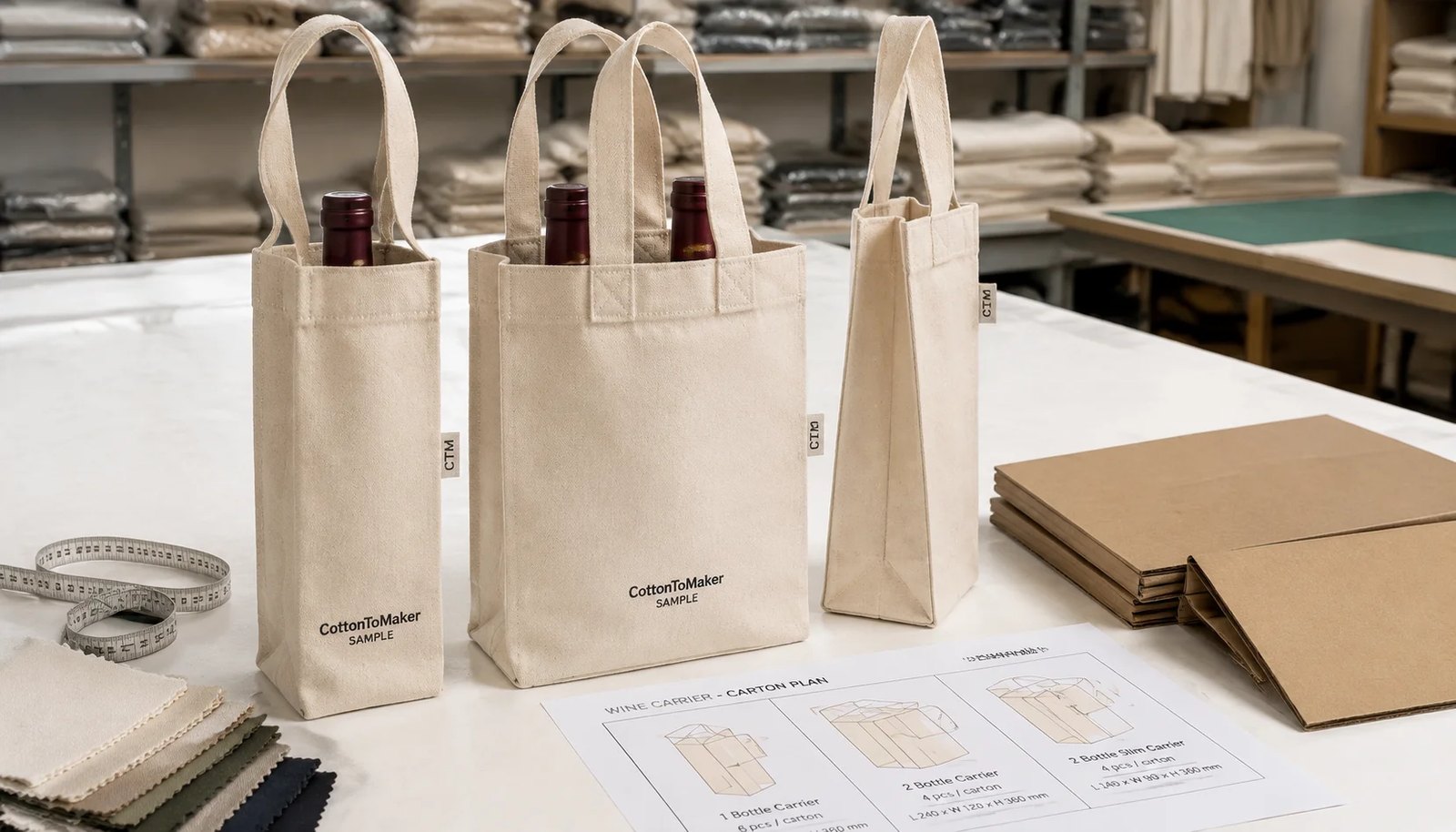
Natural grocers buy canvas wine carriers for a practical retail role: support wine merchandising, give customers a reusable gift carrier, and move cleanly through the retailer's distribution network. The bag is not fully specified until the buyer knows how it will be sewn, printed, folded, counted, cartoned, labeled, inspected, and received.
A useful RFQ connects the bag specification and carton packing plan from the first quote round. If those are separated, supplier comparisons become unreliable. One factory can quote a low unit price while assuming a carton count that fails after the printed bag is folded. Another supplier can look more expensive but include stronger board, realistic carton weight, and better receiving data.
The commercial target is usable landed cost. Piece price matters, but so do carton cube, gross weight, damage risk, relabeling risk, inspection readiness, and whether the cartons match the buyer's routing guide. For wholesale canvas wine carriers for natural grocers, the most reliable quote is the one that proves both the product and the packing method.
- Treat the bag and carton as one buying specification.
- Ask for packed-carton data, not only loose bag dimensions.
- Compare CBM per 1,000 units alongside unit price.
- Validate limits against the retailer routing guide, importer, carrier, and DC rules.
Choose canvas by function
Canvas GSM affects feel, bottle support, print result, folded thickness, carton count, and freight cube. For many single-bottle programs, buyers evaluate 280-340 GSM cotton canvas. The lower end can work for lighter promotional carriers when seams and handles are reinforced. The higher end gives a more structured, giftable hand feel, especially when the carrier is displayed near wine rather than distributed only at checkout.
Two-bottle carriers, divider styles, and premium gift programs usually need a heavier test range, such as 340-400 GSM. This is a development range, not a universal rule. Heavier fabric can improve presence, but it also changes folding behavior, carton density, sewing time, and gross weight. If a supplier recommends moving above 400 GSM, ask what performance issue it solves and how it affects cube and MOQ.
Fabric claims need documentation. Natural unbleached canvas has shade variation. Bleached canvas gives a cleaner print ground. Dyed canvas adds lab-dip approval and fabric-lot control. Organic cotton, recycled cotton, or other claim-based materials should be supported by appropriate transaction documents or certificates before the claim appears on packaging, product pages, or retailer setup forms.
- Single-bottle target range: 280-340 GSM, confirmed by bottle and load test.
- Structured or two-bottle target range: 340-400 GSM, confirmed by sampling and packing tests.
- Ask for GSM tolerance and bulk roll measurement method.
- Approve printing on production fabric, not only on a digital mockup.
Specify construction clearly
A canvas wine carrier depends on small construction choices. Finished width, height, and gusset depth should match the bottle format. A standard 750 ml wine bottle, a wider sparkling bottle, and a bottle wrapped in tissue do not need the same body. Oversizing feels cautious during development, but it wastes fabric, weakens shelf presentation, and adds bulk inside cartons.
For single-bottle styles, decide whether the bag is flat, bottom-gusseted, or boxed at the base. A bottom gusset improves standing ability and presentation, but it must fold consistently for packing. For two-bottle styles, the divider must remain centered when loaded; a divider that looks acceptable when empty can twist once bottles are inserted.
Handle construction is the main functional risk. The quote should state handle material, width, drop, attachment area, stitch pattern, and reinforcement. Self-fabric handles give a cohesive look. Cotton webbing can offer flatter handling and consistent strength. Reinforcement should be priced into the base construction, not treated as an optional upgrade after the first sample fails.
- List width, height, gusset, handle width, handle drop, divider, seam style, and label details in the RFQ.
- Set dimensional tolerances before sampling, such as plus or minus 5 mm for major body dimensions when appropriate.
- Use real bottles or buyer-approved gauges during sample review and inspection.
- Confirm reinforcement stitching, hang tags, care labels, and barcode labels in the quoted unit cost.
Match decoration to canvas
Screen printing is a practical default for grocery-volume canvas wine carriers because it is cost-effective, repeatable, and suitable for restrained brand artwork. Natural grocer programs usually work best with one or two ink colors, moderate coverage, and clear artwork that accepts the texture of canvas. Water-based ink can give a softer hand feel, but the ink system should be confirmed through a strike-off on the actual fabric.
Canvas is textured, and natural fabric is not perfectly uniform. Fine text, small certification icons, thin lines, and large solid blocks need careful review. Large print areas can stiffen the panel and change how the bag folds into the carton. That matters when the carton packing plan depends on a fixed count and clean stack.
Other decoration methods can work, including woven labels, embroidery, transfer print, and sewn patches. Each changes cost, MOQ, lead time, and folding behavior. For routine replenishment, simple decoration usually gives the best balance of brand presentation, production control, and carton reliability.
- Quote 1-2 color screen print first, then price decoration upgrades separately.
- Specify Pantone target, ink type, print size, placement, and tolerance.
- Review strike-offs on production fabric and after folding.
- Check printed samples for cracking, rub transfer, opacity, edge sharpness, and panel distortion.
Build MOQ around one body
The cleanest sourcing structure is one base bag body with several artwork versions. The factory can keep cutting, sewing, quality checks, and packing stable while the buyer supports regional programs, holiday wine sets, or private-label messages. This reduces the chance that each artwork version becomes a different product with a different carton count.
Changing body size is more disruptive than changing artwork. A new gusset, handle length, divider, fabric color, or construction method can require revised patterns, separate sewing instructions, new sample approval, and another carton test. If variety is important, first vary print color, logo, woven label, or hang tag before multiplying bag constructions.
MOQ should be requested at three levels: fabric MOQ, base body MOQ, and artwork split MOQ. Stock natural canvas can support lower quantities than custom-dyed fabric or certified material. Custom webbing, specialty labels, or unique hang tags can also create separate minimums.
- Ask for total MOQ and minimum split per artwork.
- Keep one fabric, one handle, and one carton plan where possible.
- Separate stock fabric pricing from custom-dyed or certified material pricing.
- Require each artwork version to follow the same carton count unless approved otherwise.
Calculate carton plans
A carton plan should be calculated from packed dimensions, not guessed from the finished bag size. Confirm the folded bag thickness and bundle layout, pack the target quantity into a trial carton, measure outer carton length, width, and height in meters, then multiply length x width x height x number of cartons. To compare suppliers, convert the result into CBM per 1,000 pieces.
For example, if 80 pieces are packed in a 0.52 x 0.42 x 0.40 m carton, the carton cube is 0.08736 CBM. One thousand pieces require 12.5 cartons, so the estimated cube is about 1.09 CBM per 1,000 pieces if the dimensions and count hold. If bulk folding forces a larger carton, the calculation changes immediately.
Planning ranges help start the discussion. Many buyers prefer soft-goods cartons around 10-14 kg for manual handling, and some retail distribution centers cap the longest carton side near 55-60 cm. Final limits must come from the retailer routing guide, freight mode, pallet pattern, carrier rules, and buyer logistics team.
For larger orders, ask suppliers for two plans: a cube-efficient plan and a DC-handling plan. The cube-efficient plan maximizes pieces per carton. The DC-handling plan caps dimensions and weight. The best choice depends on route, receiving rules, board strength, and damage risk.
- Request pieces per carton, outer dimensions, net weight, gross weight, and CBM per 1,000 units.
- Ask for carton board spec, flute type, edge-crush or bursting strength, and sealing method.
- Confirm whether inner bundles use polybags, paper bands, master liners, or no plastic.
- Freeze carton count before bulk carton ordering.
Set carton strength and labels
Carton strength should be specified before production cartons are purchased. For canvas wine carriers, the product is soft, but cartons can still fail from compression, poor sealing, loose bundles, or rough DC handling. Ask the supplier to recommend board grade based on gross weight, route, pallet height, container loading, and whether cartons will be handled individually at receiving.
A buyer-ready carton specification should include flute type, liner requirement, bursting strength or edge-crush test value, carton style, sealing method, and any strapping or corner protection. For many soft-goods export cartons, a double-wall carton may be justified when the route involves long ocean transit, high pallet stacks, or repeated manual handling. A lighter carton may be acceptable for smaller air shipments if the routing guide permits it.
Labels and marks are part of the packing plan, not an afterthought. Carton labels should match the retailer's required fields: PO number, SKU, artwork version, color or material, quantity, country of origin if required, carton number, gross weight, net weight, dimensions, and barcode or SSCC label when applicable.
- Approve carton board grade before mass packing.
- Place labels on the required side and keep them scannable after pallet wrapping.
- Keep one artwork version per carton unless mixed cartons are approved.
- Confirm carton numbering format before the packing list is issued.
Approve samples in sequence
Sample approval should move from function to appearance to packing. A blank construction sample verifies bottle fit, body shape, gusset behavior, divider usability, handle comfort, and reinforcement. This is the easiest stage for correcting sewing details because print setup has not yet been committed.
The printed pre-production sample validates artwork scale, ink opacity, color, edge sharpness, and placement. It should use production fabric or the closest approved material. If the front panel has a large logo, fold the printed sample in the approved packing orientation and check whether the print creases, rubs, or transfers.
The packed-carton sample confirms the commercial packing plan. It should show fold orientation, pieces per bundle, bundles per carton, final count, carton dimensions, gross weight, carton marks, label location, board grade, and sealing method. For first orders, this sample prevents more problems than another loose bag sample because it tests the product as it will actually ship.
- Blank sample: approve size, bottle fit, gusset, divider, handle drop, and reinforcement.
- Print sample: approve color, ink, placement, opacity, and folding effect.
- Packed-carton sample: approve count, dimensions, weight, marks, labels, board strength, and sealing.
- Tie every approval to a dated specification or version number.
Use measurable QC
General inspection language is not enough for a product that carries glass bottles. The inspection plan should define sampling standard, AQL levels, defect classes, measurement points, functional testing, print checks, and packing checks. ANSI/ASQ Z1.4 or ISO 2859-1 sampling can be used, but the purchase order or inspection booking should state the exact plan and AQL levels.
The load test should be written in operational terms. Use the intended filled bottle weight plus a buyer-approved margin, such as 1.25-1.5 times expected load. Hold or suspend the loaded bag for 60 minutes, then perform 10 controlled lift cycles by the handle. Pass criteria should include no handle detachment, no seam rupture, no divider tear, no fabric split, and no stitch movement beyond the agreed tolerance, such as 2 mm at the reinforced handle seam.
Print QC should compare production units with the approved strike-off for color range, opacity, edge quality, rub resistance, cracking, and placement. Natural canvas shade should be reviewed by lot so panels do not look mismatched after sewing. Packing QC should verify carton count, bundle count, carton dimensions, gross weight, board grade, shipping marks, and barcode placement.
Carton testing should match the route. A face, edge, and corner drop check from a buyer-approved height can reveal weak cartons, poor sealing, or excessive product movement. Acceptance should require no burst carton, no contamination, no count loss, and no functional damage to the bags.
- Classify defects as critical, major, and minor before inspection.
- Measure GSM, finished size, handle drop, print placement, carton dimensions, and carton weight.
- Test production units, not only development samples.
- Pull packed cartons from bulk for count, label, and drop checks.
Compare quotes by landed cost
A strong quote comparison has one line for the bag and one line for the carton plan. Include unit price, MOQ, artwork split, fabric type, GSM tolerance, print method, setup charges, label costs, sample fees, inspection charges, production lead time, pieces per carton, carton dimensions, gross weight, CBM per 1,000 units, carton board grade, and sample stages included.
This format makes weak quotes visible. A supplier that cannot provide packed-carton dimensions may still be capable, but its freight numbers are incomplete until a packed sample proves them. A supplier with a higher unit price may still be the better buying choice if its carton count, board strength, QC plan, and routing-guide compliance reduce handling risk.
The search phrase wholesale canvas wine carriers for natural grocers carton packing plan describes the real procurement issue: the item is not just a bag. It is a retail-ready soft-goods product that must carry a bottle, present the brand cleanly, and move through cartons, pallets, freight, and receiving systems without avoidable rework.
- Compare CBM per 1,000 pieces, not only pieces per carton.
- Add setup, labels, inner packing, cartons, samples, inspection, and freight assumptions to the cost view.
- Flag quotes based on estimated carton dimensions until a packed sample is approved.
- Score supplier risk by evidence: samples, carton board spec, drop-test plan, pallet pattern, and routing-guide readiness.
Specification comparison for buyers
| Carton plan scenario | Typical pieces per carton | Example outer carton size | Example gross weight | Cube per 1,000 pcs |
|---|---|---|---|---|
| Light single-bottle carrier, 280-300 GSM, flat packed | 100 pcs | 50 x 40 x 38 cm | 9-11 kg | About 0.76 CBM |
| Structured single-bottle carrier, 320-340 GSM, bottom gusset | 80 pcs | 52 x 42 x 40 cm | 10-13 kg | About 1.09 CBM |
| Two-bottle divider carrier, 340-380 GSM | 50-60 pcs | 55 x 45 x 42 cm | 11-14 kg | About 1.73-2.08 CBM |
| DC handling priority plan, capped carton size and weight | 60-80 pcs | 60 x 40 x 40 cm maximum planning box | 10-14 kg target range | About 1.20-1.60 CBM |
| Ocean cube priority plan, higher carton fill | 100-120 pcs where fold allows | 55 x 45 x 45 cm | 13-17 kg, if routing guide permits | About 0.93-1.11 CBM |
| Pallet efficiency plan for grocery DC routing | 80 pcs | 48 x 40 x 42 cm to suit common pallet layers | 10-13 kg | About 1.01 CBM |
| Plastic-reduction inner pack plan | 80 pcs | 52 x 42 x 42 cm with paper bands or master liner | 10-13 kg | About 1.15 CBM |
| Mixed artwork carton restriction plan | 60 pcs | 50 x 40 x 36 cm for cleaner SKU separation | 7-9 kg | About 1.20 CBM |
Buyer checklist before sampling
- Define the bottle format before quoting: standard 750 ml wine bottle, wider sparkling bottle, two-bottle divider, or mixed-use carrier.
- Specify fabric by construction and weight, such as 280-340 GSM cotton canvas for many single-bottle programs or 340-400 GSM for structured and two-bottle styles, subject to test results.
- State whether the fabric is natural unbleached cotton, bleached cotton, dyed cotton, organic cotton, recycled blend, or conventional cotton because shade, cost, MOQ, and claim support change.
- Lock finished dimensions with tolerances: width, height, gusset depth, divider width if used, handle width, handle drop, and seam allowance.
- Require handle reinforcement in the base quote, such as box-X stitching or an approved equivalent, with stitch density and placement expectations.
- Define print method, print size, print colors, artwork placement, Pantone target, ink type, and acceptable print-position tolerance.
- Ask for MOQ by base body and by artwork split so regional or seasonal prints do not multiply sewing setups unnecessarily.
- Set inner packing rules: pieces per bundle, polybag or plastic-free preference, bundle orientation, barcode label need, mixed-SKU rules, and moisture-control requirements.
- Set carton targets before sampling: pieces per carton, maximum outer dimensions, gross weight range, board grade, shipping marks, pallet pattern, and retailer routing guide fields.
- Request a blank sample, print strike-off or printed pre-production sample, and packed-carton sample for first orders or revised styles.
Factory quote questions to send
- What exact fabric is quoted: cotton canvas, recycled cotton blend, cotton-poly blend, organic cotton, or another material, and what GSM tolerance will you guarantee in bulk?
- Is the price based on natural unbleached canvas, bleached canvas, dyed canvas, or stock fabric, and how does each option change MOQ, shade control, and lead time?
- For the intended bottle weight, what handle reinforcement do you recommend, and can you test it on production-size samples?
- Does the quoted construction include bottom gusset, boxed bottom, internal divider, side seams, seam binding, label sewing, and box-X handle reinforcement?
- What finished-size tolerances can you hold for width, height, gusset depth, handle drop, and divider placement after bulk sewing and pressing?
- Which print method is included, what is the maximum print area, how many colors are included, and what artwork features increase risk on natural canvas?
- Can you provide two carton plans: one optimized for freight cube and one capped for retail DC handling, with pieces per carton, carton dimensions, gross weight, and CBM?
- What carton board grade, flute type, bursting or edge-crush strength, liner specification, and sealing method do you recommend for this route?
- Can you provide a drop-test plan or reference standard, such as ISTA-style face, edge, and corner drops adjusted to carton weight and buyer requirements?
- What is the MOQ for one base body with multiple print artworks, and what is the minimum split per artwork?
Quality-control points to confirm
- Use a written inspection plan, such as ANSI/ASQ Z1.4 or ISO 2859-1 sampling, with buyer-approved AQL levels such as Critical 0, Major 2.5, Minor 4.0 unless the retailer manual requires different limits.
- Measure fabric GSM from bulk roll samples, not only early swatches; record actual readings and agreed tolerance before cutting.
- Check finished dimensions against approved tolerance, especially height, width, gusset depth, divider placement, and handle drop because these affect bottle fit and carton count.
- Run a defined load test on finished production bags: use the intended filled bottle weight plus a buyer-approved safety margin, such as 1.25-1.5 times expected load; suspend or carry for 60 minutes; then complete 10 controlled lift cycles.
- Pass/fail for the load test should be written: no handle detachment, no body seam rupture, no divider tear, no fabric split, no skipped stitch opening, and stitch movement not exceeding the agreed tolerance, such as 2 mm at the reinforced handle seam.
- Inspect handle reinforcement for stitch density, skipped stitches, loose thread ends, stitch backtracking, and correct box-X or approved reinforcement placement.
- Verify print quality against the approved strike-off: color range, edge sharpness, opacity, cracking, rub resistance after folding, and placement tolerance such as plus or minus 3 mm if agreed.
- Check natural canvas shade consistency by lot and panel; define acceptable shade variation before mixed cartons are packed.
- Inspect divider bags with real bottles or bottle gauges so both compartments remain usable and the divider does not twist the body.
- Confirm carton count at three levels: pieces per bundle, bundles per carton, and total pieces per carton; reconcile with packing list and shipping marks.