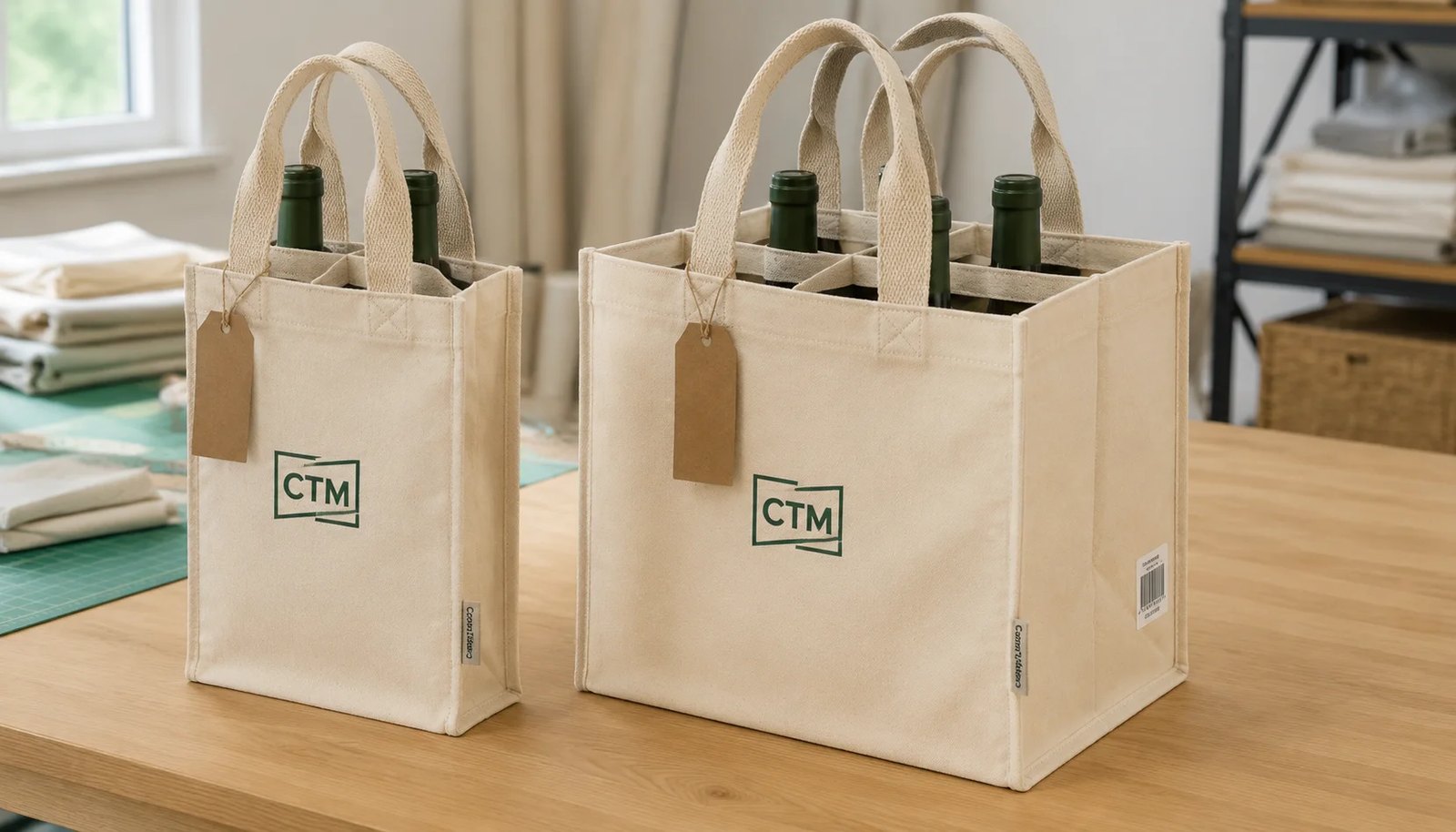
Start with the natural grocer use case, not a generic wine bag
Wholesale canvas wine carriers for natural grocers have a different job than basic promotional totes. They sit near wine, cheese, floral, checkout, gift baskets, or seasonal displays; they may be sold as a reusable accessory; and they must support a brand message around responsible shopping without creating packaging waste or breakage complaints. The first buying decision should be the role of the carrier, not the fabric color.
A checkout add-on needs fast loading, visible pricing, and a scannable barcode. A wine club carrier needs stronger handles and a more giftable finish. A holiday retail SKU may require a hangtag, country-of-origin label, and shelf-ready folded presentation. A giveaway at a tasting event can be simpler, but it still needs safe separation between bottles. Writing this use case into the RFQ helps factories quote the right construction instead of guessing from a photo.
- Define whether the carrier is a retail SKU, giveaway, loyalty reward, gift accessory, or club-pack component.
- Identify where it will be displayed: peg hook, shelf tray, basket, checkout counter, wine aisle, or bundled with bottles.
- State whether the bag must stand upright when empty, fold flat for replenishment, or hang from a tag.
- List any natural, organic, plastic-reduction, or private-label compliance language that must be avoided or approved.
Bottle fit drives the pattern and divider dimensions
The safest specification begins with bottle size. Standard 750 ml wine bottles are often around 74-78 mm in diameter, but natural grocers commonly sell more than traditional Bordeaux and Burgundy shapes. Sparkling wine, cider, kombucha, gourmet vinegar, olive oil, and specialty beverages can be wider or taller. If the same carrier may be sold across these categories, the largest target bottle should control the pocket size.
Flat bag dimensions alone are not enough. A carrier can measure correctly and still be difficult to load because the divider seam consumes usable space, the gusset is too narrow, or the bottle shoulders catch at the top opening. Ask the supplier to confirm usable pocket width after sewing, not only panel width before sewing. During sample review, load the actual bottles that store staff expect customers to carry.
- Provide maximum bottle diameter and height in millimeters, not only the phrase 750 ml bottle.
- For 2-bottle carriers, confirm each pocket width after divider stitching.
- For 4-bottle carriers, check the cross-divider intersection and whether all four pockets load easily.
- If oversized bottles are included, decide whether to enlarge every pocket or create a separate SKU.
- Reject samples where bottles must be forced into the pockets or lean hard against one another.
Choose canvas weight for durability, shelf feel, and carton efficiency
For most natural grocery programs, 10 oz to 12 oz cotton canvas, roughly 280-340 GSM, is the practical range. It gives enough structure for glass bottles while still folding efficiently into export cartons. Lighter 6 oz or 8 oz cotton may look acceptable in online photos, but it can sag around bottles, telegraph stress at the handle base, and feel too promotional for a paid retail SKU.
Heavier 14 oz or 16 oz canvas can make sense for premium gifting, but it increases sewing difficulty, carton cube, and sometimes freight cost. Natural unbleached canvas is popular because it has a less processed look, yet shade variation is normal. If the retailer has a strict brand color environment, approve a shade range or request bleached canvas. Recycled or organic cotton should be quoted separately because availability, documentation, handfeel, and strength can differ.
- Everyday 2-bottle option: 10 oz canvas when foldability and cost control matter.
- Stronger 4-bottle option: 12 oz canvas with reinforced handles and secure dividers.
- Premium gift option: 14 oz canvas only when added structure justifies higher cube and cost.
- Ask for fabric GSM, oz weight, composition, and shade reference on every quote.
- Do not treat recycled, organic, bleached, and natural conventional canvas as interchangeable without sample approval.
Divider construction is the main difference between a tote and a wine carrier
The divider is where many low quotes save money. A loose insert, short center strip, or divider that is attached only at the top may reduce sewing time, but it may not stop bottles from knocking together. For grocery retail, stitched dividers are usually the safer default because the product is handled by staff, moved through carts and checkout lanes, and carried by customers who may not treat it gently.
A 2-bottle carrier should keep bottles in separate channels without making loading difficult. A 4-bottle carrier needs a stable cross-divider or panel system that reaches low enough to control bottle movement. Ask for inside photos, not only front-view beauty shots. If the supplier proposes a cheaper divider, require the sample to pass the same loaded carry test before accepting the cost reduction.
- Prefer stitched dividers for paid retail sale and repeat customer use.
- Use loose inserts only when the program is clearly promotional and lower durability is acceptable.
- For natural grocer shelves, confirm dividers recover shape after flat packing.
- Check that divider seams do not reduce pocket width below the largest approved bottle.
- Include the divider type in the product name on the quote sheet to avoid later substitution.
Handles must be engineered for loaded glass
A four-bottle carrier can exceed 5 kg when loaded with liquid and glass, so the handle is a load-bearing component. The quote should describe handle material, width, drop, seam allowance, thread, and reinforcement. Self-fabric handles match the body and look natural; cotton webbing handles may offer cleaner strength and easier repeatability. Either can work if the attachment is built correctly.
Handle drop affects shopper comfort and shelf appearance. Too short can feel cramped, especially with four bottles. Too long may let the load swing or cause the carrier to sit awkwardly in a display. Approve the handle while the sample is loaded, not empty. The strongest-looking sample is not useful if it tilts, digs into the hand, or pulls away from the panel after repeated lifts.
- Require box-X stitching, bar tacks, or reinforced patches at handle attachment points.
- Confirm handle width and drop in centimeters after sewing.
- For 4-bottle and 6-bottle designs, test with filled bottles or equivalent weight plus safety margin.
- Check that the loaded carrier hangs level and does not twist at the handle base.
- Reject narrow seam allowance, skipped stitches, loose thread tails, or handle ends placed too close to panel edges.
Branding, print, and retail compliance need early decisions
Water-based screen printing is often the best match for natural canvas wine carriers with one to three solid colors. It has a softer hand than heavy plastisol and suits natural grocery branding. The limitation is detail: canvas texture can soften fine lines, tiny reversed text, and small certification-style icons. If the logo includes compliance marks, ingredient-related language, or organic claims, confirm who is responsible for approving that artwork before production.
Retail-ready details are just as important as the main logo. If the carrier is sold as a SKU, it may need a hangtag, UPC, barcode sticker, price label area, country-of-origin statement, and possibly private-label brand language. If the grocer prefers plastic-free packaging, the hangtag and tying method should be planned before the sample. Do not wait until production packing to decide where the barcode goes.
- Provide vector artwork, Pantone references, print size, placement, and minimum text height.
- Approve a print strike-off on the actual production canvas shade.
- Keep claims such as organic, compostable, plastic-free, recycled, or fair trade out of artwork unless documentation supports them.
- Confirm barcode position, scan readability, hangtag material, hangtag hole, and attachment method.
- Use woven labels or small hangtags when the brand wants a quieter natural look than a large front print.
MOQ, replenishment, and artwork splits affect the real unit cost
MOQ is shaped by fabric availability, cutting efficiency, print setup, label ordering, carton marking, and sewing-line changeover. A factory may offer a lower MOQ for natural stock canvas with one-color print, but require more units for custom dyed fabric, organic cotton, special webbing, multiple hangtags, or several barcode versions. Buyers should ask for MOQ by size, fabric, artwork, and retail label version.
Natural grocers often test a carrier in selected stores before broader rollout. That can work, but the replenishment plan should be discussed before the first order. If a small pilot uses one construction and the next order changes bottle size, label placement, or print method, the buyer loses the value of the approved spec. For repeat programs, lock the base pattern and update only artwork or hangtag seasonally when possible.
- Ask for MOQ per size, per fabric color, per artwork, per barcode, and per hangtag version.
- Separate blank carrier MOQ from printed carrier MOQ if later replenishment may use the same base bag.
- Consolidate store logos where possible to reduce screen setup and handling cost.
- Request reorder lead time, not only first-order lead time.
- Consider keeping approved blank stock if seasonal printing changes frequently and the supplier can manage inventory responsibly.
Compare quotes using full commercial and logistics data
A useful quote should show the complete product and packing basis: fabric GSM, dimensions, divider type, handle reinforcement, print method, number of colors, hangtag or barcode cost, pieces per carton, carton dimensions, gross weight, sample fee, inspection responsibility, lead time, and trade term. Without these fields, the lowest unit price may simply be a weaker product or an incomplete export quote.
Trade terms matter. EXW may exclude inland handling, export paperwork, and port delivery. FOB is easier to compare for importers because it usually includes delivery to the named port, but destination freight, duty, customs, and local delivery still remain outside the unit price. Carton cube also matters: a structured carrier may cost only slightly more to make but ship fewer units per carton, increasing landed cost and DC storage pressure.
- Compare EXW with EXW, FOB with FOB, and landed estimates with the same assumptions.
- Request sample fee, sample lead time, and whether the fee is refundable against bulk order.
- Ask who pays for failed inspection rework and reinspection.
- Record carton dimensions, gross weight, pieces per carton, and estimated CBM before issuing the PO.
- Separate product cost, decoration cost, retail labeling cost, packing cost, and freight assumptions in the quote sheet.
Packing should match natural grocer expectations and DC handling
Many natural grocers prefer reduced-plastic or plastic-free packaging, but the product still has to arrive clean, dry, and retail-ready. Individual polybags protect against moisture and handling marks but may conflict with packaging goals and add labor. Bulk packing with paper bands, kraft dividers, carton liners, or controlled bundles may be better when carriers go directly to store displays, provided moisture risk is managed.
The fold method deserves approval. Sharp folds across the logo can crease ink; uneven compression can deform dividers; loose cartons can create abrasion and wrinkles. If the carrier is a retail SKU, the packed shape should support quick shelf setup. If it hangs on a peg, the hangtag must remain visible and unbent. If it sits in a basket, bundles should be easy for staff to open without cutting the product.
- Choose individual polybag, paper band, carton liner, or bulk bundle based on retail and sustainability priorities.
- Approve fold direction, bundle count, carton orientation, and maximum carton weight.
- Keep printed faces protected if ink transfer or abrasion is possible.
- Confirm carton marks: SKU, PO, quantity, country of origin, gross weight, carton number, and routing labels.
- For DC programs, ask whether palletization, ASN labels, or retailer-specific carton labels are required.
QC and lead time planning should be part of the purchase order
Quality control is easier when test methods are written before production. The approved sample should become the reference for fabric shade, print placement, divider structure, stitching, packing, and retail labels. The final inspection should not only count cartons; it should load bottles, check handle strength, scan barcodes, measure dimensions, rub the print, and review carton cube against the quote.
Lead time risk often appears before sewing begins. Artwork correction, fabric booking, strike-off approval, hangtag printing, barcode verification, pre-production sampling, and inspection scheduling can delay the order. For seasonal wine events or holiday promotions, set the latest sample approval date and work backward from the required DC arrival date. Repeat orders move faster when the pattern, print method, labels, and carton marks remain unchanged.
- Use a written AQL plan or the buyer’s inspection standard before production starts.
- Include load testing, print rub testing, barcode scanning, and packing review in final inspection.
- Freeze dimensions before cutting and freeze artwork before screen making or digital setup.
- Book inspection before cartons are sealed for shipment.
- Build reorder calendars around production lead time, transit time, customs, DC appointments, and store set dates.
Specification comparison for buyers
| Quote field | Recommended buying standard | Why it matters for natural grocers | Buyer risk to check |
|---|---|---|---|
| Fabric weight | 10 oz to 12 oz cotton canvas, roughly 280-340 GSM, with approved shade range | Balances durability, natural appearance, retail shelf feel, and carton efficiency | A quote that says only cotton canvas may hide 6 oz or 8 oz fabric that sags under bottles |
| Bottle capacity | 2-bottle or 4-bottle format with tested pocket dimensions | Works for checkout add-ons, wine club bundles, holiday gifting, and tasting events | Pocket width must match the largest bottle sold, including sparkling wine, cider, olive oil, or specialty beverages |
| Divider construction | Stitched divider panels secured into side and bottom seams where possible | Prevents glass-to-glass contact during checkout, store handling, and customer transport | Loose inserts reduce cost but can shift, collapse, or be removed before the customer uses the carrier |
| Handle reinforcement | Self-fabric or cotton webbing handles with box-X, bar tack, or reinforced patch | Loaded bags can exceed 5 kg for four bottles, so handles are a safety and return-prevention item | Single straight stitching or narrow seam allowance can fail even if the empty sample looks acceptable |
| Print and branding | Water-based screen print for simple logos; woven label or hangtag for subtle natural branding | Supports organic, natural, and plastic-reduction positioning without overdecorating the product | Fine reversed text, compliance icons, and small claims can blur on textured canvas |
| Retail-ready elements | Hangtag hole, UPC or barcode placement, SKU sticker area, country-of-origin marking, and display fold method | Allows the carrier to be sold as a grocery SKU, gift accessory, or promotional add-on | A beautiful carrier can still fail receiving if barcode, carton marks, or shelf presentation are missing |
| Packing method | Flat pack or controlled half-fold with plastic-free or reduced-plastic protection when feasible | Natural grocers often prefer less plastic while still needing clean product for shelves | Over-tight folds can crease ink and deform dividers; no moisture plan can cause staining in transit |
| Commercial terms | Quote EXW, FOB, or landed basis clearly, including sample fee, mold/setup fees, and inspection responsibility | Makes supplier comparisons fair across importers, distributors, and direct retail buyers | A low EXW unit price may exclude export cartons, local handling, documentation, freight, duty, and inspection |
| Carton cube impact | Show pieces per carton, carton dimensions, gross weight, and estimated CBM | Affects ocean freight, pallet count, DC storage, store back-room space, and replenishment cost | A heavier structured carrier may look cheaper per unit but ship fewer pieces per carton |
Buyer checklist before sampling
- Define the carrier job: retail SKU, checkout add-on, wine club bundle, event giveaway, gift packaging, or reusable loyalty item.
- State bottle count and target bottle dimensions, including maximum diameter and height for standard wine, sparkling wine, cider, olive oil, or specialty bottles.
- Specify fabric in oz and GSM, natural or bleached shade, recycled or organic cotton requirement if applicable, and acceptable shade variation.
- Confirm finished dimensions after sewing tolerance: total width, height, gusset, pocket width, pocket depth, divider height, and handle drop.
- Choose divider type: stitched internal dividers, removable insert, padded separator, or simple sleeve, and define the acceptable bottle-contact standard.
- Set handle requirements: width, material, drop length, reinforcement method, stitch pattern, thread quality, and expected loaded weight.
- Provide vector artwork with Pantone references, print size, placement, and any restrictions on brand claims, organic language, or certification marks.
- Decide retail presentation: folded flat, standing display, peg-hole hangtag, shelf tray, clip strip, or bulk basket near wine and checkout.
- Confirm barcode, UPC, SKU sticker, hangtag, country-of-origin label, and master carton marking requirements before sampling.
- State packing preference, including plastic-free or reduced-plastic options, inner carton liner, moisture protection, bundle count, and carton weight limit.
Factory quote questions to send
- What fabric weight will you use in both oz and GSM, and is it stock fabric, made-to-order fabric, recycled cotton, organic cotton, or conventional cotton?
- What are the finished dimensions for total width, height, gusset, handle drop, divider height, and each bottle pocket after sewing?
- What maximum bottle diameter and loaded weight is this pattern designed for, and can you send photos with real bottles loaded?
- How is the divider constructed, and is it secured into the bottom seam, side seams, top edge, or only inserted loosely?
- What stitch density, thread type, seam allowance, and reinforcement method are used at the handle attachment points?
- Which print method is included, how many colors are included, what is the maximum print area, and is a strike-off on production fabric included?
- Can you support hangtags, UPC labels, barcode stickers, woven labels, or country-of-origin labels, and what are their MOQs and application costs?
- Is the quoted sample made with the same fabric, print, divider, handle, label, and packing method as bulk production?
- What is the MOQ per size, per fabric color, per artwork, per hangtag version, and per barcode or SKU version?
- What are the trade terms: EXW, FOB port, CIF, DDP, or another basis, and what is excluded from the unit price?
Quality-control points to confirm
- Fabric weight tolerance should be agreed in writing, commonly plus or minus 5% against the approved production sample.
- Finished dimensions should use a written tolerance, such as plus or minus 0.5 cm for small pocket panels and plus or minus 1 cm for total bag width or height.
- Each bottle pocket should accept the approved maximum bottle size without forcing the bottle through the divider seam or distorting the carrier.
- Handle load testing should use the agreed bottle count plus a safety margin; for example, suspend the loaded carrier with equivalent weight for 30 minutes and then lift-cycle it 20 times, with no seam tearing, handle slippage, or broken reinforcement stitches.
- For four-bottle carriers, test at least the actual expected loaded weight of four filled 750 ml bottles, and agree whether heavier sparkling bottles require a higher test weight.
- Handle attachment must show the approved box-X, bar tack, or patch construction with no skipped stitches, loose thread nests, broken thread, or visibly uneven tension.
- Divider alignment should allow smooth loading and unloading; dividers should not twist, detach, or collapse after folding and unpacking.
- Print placement should match the approved sample within the agreed tolerance, commonly plus or minus 0.5 cm to 1 cm depending on panel size.
- Print rub testing should include dry rubbing and light damp rubbing on the printed area, such as 20 back-and-forth strokes with a white cotton cloth, with no unacceptable ink transfer or smearing.
- Screen print color should be checked under consistent lighting because natural canvas shade can make ink appear warmer, duller, or less saturated.