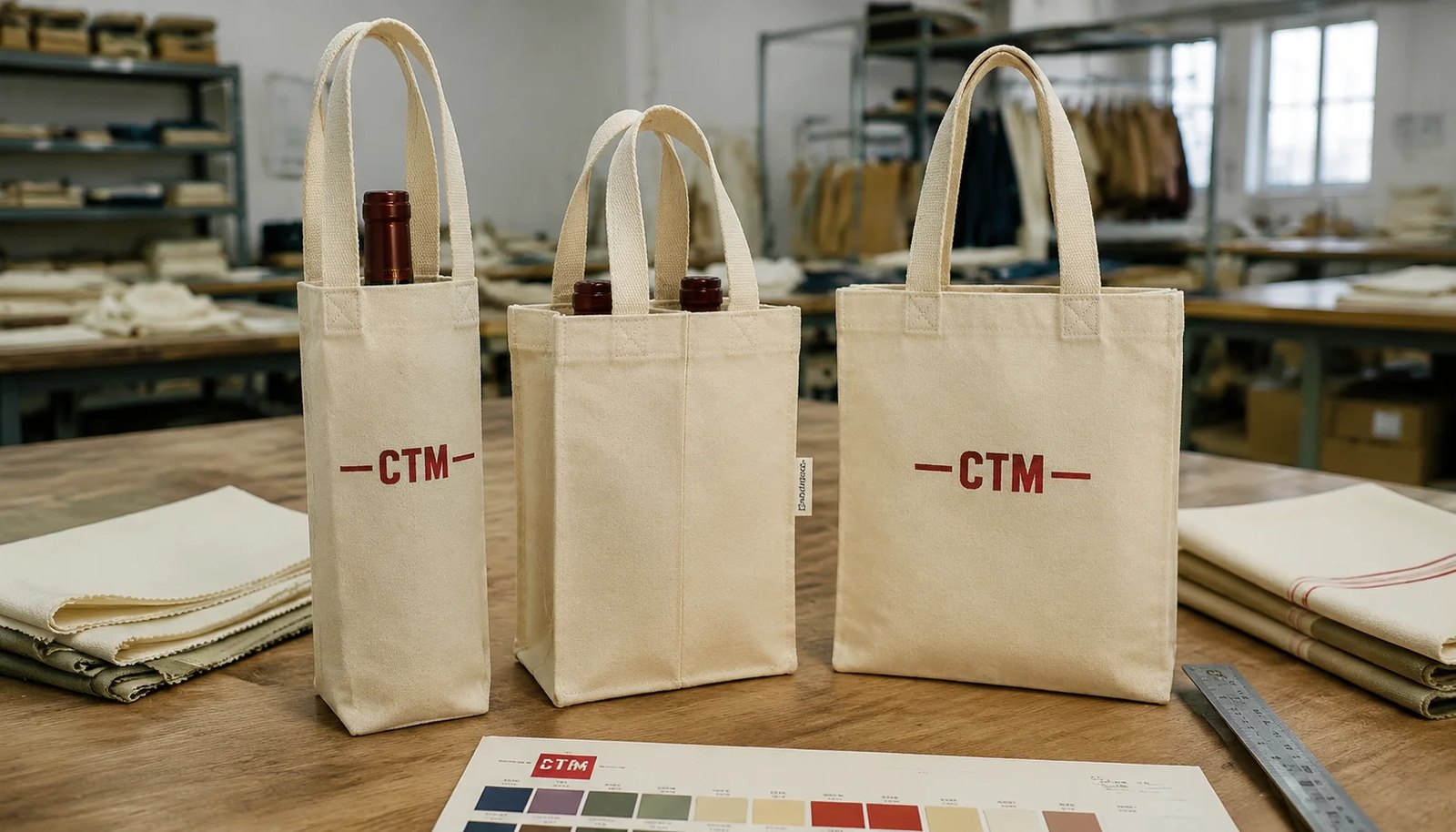
Why logo placement is the main buying issue on canvas wine carriers
For natural grocers, the wine carrier is usually doing two jobs at once: carrying glass safely and presenting a private-label or store logo clearly on shelf, near checkout, or during gifting. Buyers often spend most of the RFQ on fabric and size, then leave logo placement as a vague note like "front center print." That is where quote differences and sample failures start. On a wine bag, the printable area is smaller than on a grocery tote, and bottle shape pushes against the front panel once filled. If the artwork sits in the wrong zone, it can look straight on an empty sample but become distorted in actual retail use.
The practical problem is that logo placement cannot be separated from structure. Top hem depth, side gusset width, bottle neck opening, handle insertion point, and divider construction all reduce usable print area. A supplier who prices a large artwork on the assumption of a flat front panel may later shrink the print or move it upward during sampling. The better buying approach is to define a protected logo zone tied to the finished dimensions of the bag, then make print method and panel layout follow that decision.
- Main visibility zones: front center panel, lower front panel, side gusset, woven side label, or inside neck label
- Most reliable wholesale choice: front panel print plus a small side label if brand traceability matters
- Most common mistake: approving artwork on an empty lay-flat image without testing with an actual 750 ml bottle inserted
Start with bottle fit and panel geometry before discussing artwork
A wine carrier that fits a standard 750 ml Bordeaux bottle may not fit a wider Burgundy bottle or sparkling wine bottle cleanly. That changes how much the front panel bulges and where the logo sits visually. Procurement teams should lock the product use case first: one bottle gift bag, reusable store carrier, or two-bottle promotional pack. A narrow single-bottle style can tolerate a larger centered logo because the front panel stays more stable. A two-bottle divider bag often has a wider face but more stress at the center, so artwork needs to stay away from the internal divider stitch line and lower bottle pressure points.
Use finished dimensions, not nominal marketing sizes. A useful RFQ includes bottle type, bottle diameter range, and whether the bag should hold one oversized bottle. For example, if the opening is too tight, users force the bottle in and wrinkle the print near the neck. If the base is too narrow, the bag tips in display and the logo no longer reads cleanly. Good factories can propose dimensions, but the buyer should define function first so quotes do not hide different assumptions.
- Typical single-bottle body width: about 12 to 15 cm depending on seam allowance and fabric thickness
- Typical gusset depth: about 8 to 10 cm for stable standing shape
- For two-bottle carriers, request divider material and attachment method, not only outer size
- If stores sell sparkling bottles, mention shoulder diameter because it affects neck opening and panel tension
Choose canvas weight for print quality, structure, and freight balance
Canvas weight is not only a durability decision. It changes print appearance, fold memory, seam bulk, and freight cost. For most natural grocer wine carriers, 10 oz to 12 oz canvas, roughly 280 to 340 GSM, is the practical middle ground. It supports bottle weight, gives enough body for shelf presentation, and still prints cleanly on a flat front panel. Lighter 8 oz material can work for short-term promotional use, but the logo tends to wrinkle more once a bottle is inserted. Heavier 14 oz and above can feel premium, yet the bag becomes stiffer, the seam area gets bulkier, and export carton weight climbs quickly.
Natural canvas is often preferred because it aligns with organic and low-plastic brand positioning. However, it is not a perfectly uniform white printing surface. Flecks, yarn variation, and slight lot-to-lot tone changes are normal. Buyers who need exact pale ink shades should note whether they accept base fabric variation or require bleached fabric. That choice affects both visual outcome and quote level. In many cases, a darker, simpler logo on natural canvas delivers better consistency than trying to force very delicate color reproduction.
- Budget promo use: 8 oz to 10 oz, only when bottle fit is narrow and print is simple
- Mainstream reusable grocery wine bag: 10 oz to 12 oz
- Premium gift style or structured bottle pair bag: 12 oz to 14 oz if freight allows
- State GSM tolerance expectation in quote review; a practical commercial tolerance may be around plus or minus 5 percent depending on fabric source
Best logo zones on wine carriers and where print usually fails
On a wine carrier, the safest logo area is usually centered on the front panel, roughly 40 to 60 mm below the top hem and clear of both side seams. That keeps the artwork visible while avoiding top-edge distortion and lower-panel bottle bulge. If the bag has a deep gusset, the visible front face shrinks once filled, so a logo that looked balanced on the cutting pattern can wrap visually toward the sides in use. For natural grocers, simple logos, short slogans, or one icon mark generally hold up better than wide horizontal artwork.
Print failure tends to happen in four zones: too close to the top hem, too close to the side seam, too low on the bottle belly area, or crossing a gusset fold. A supplier may accept a large file and technically print it, but the resulting bag will not present well at retail. If your brand system requires both a logo and a legal line such as website or campaign text, move the secondary message to a side label or inside hem tape rather than forcing all content on the front face.
- Protected no-print zone near top hem: keep enough clearance for stitching and fabric curl
- Protected no-print zone near side seams: avoid art loss and seam pull
- For gusset print, use small marks only; large gusset graphics are hard to keep consistent across batches
- If using woven label branding, define label position and fold type so it does not compete with the front print
Pick the print method based on logo shape, volume, and canvas color
Screen printing remains the most practical method for wholesale canvas wine carriers. It handles simple one-color and two-color logos well, has stable opacity on natural canvas, and usually produces the lowest unit cost once quantities move into real wholesale range. It is also easier to repeat between orders if the factory keeps screens or digital references. For natural grocers, most logos are simple enough that screen print is the default recommendation unless the artwork has fine gradients, photographic detail, or very small variable runs.
Heat transfer and digital methods can solve small-volume artwork complexity, but they bring tradeoffs. Transfers can feel less integrated with the canvas, especially on fold lines. Digital printing may look sharp on strike-offs yet shift in tone depending on fabric absorbency and base cloth shade. If the logo is dark green, black, brick red, or one spot color, screen print is usually the cleanest path. If the bag color is dyed rather than natural, ask how the factory will maintain logo contrast and whether a white underbase is needed, since that changes hand feel and cost.
- Screen print best for: 500+ pcs, simple logo, strong repeatability, lower per-unit cost
- Heat transfer best for: low MOQ trials, detailed small artwork, not ideal for heavy fold zones
- Digital print best for: multi-color art, but request wash/rub and shade consistency evidence
- Always review print strike-off on the actual canvas, not only on paper or substitute cloth
MOQ logic and why logo placement can change your quote
Buyers often expect MOQ to be driven only by bag construction, but decoration setup plays a major role. A blank single-bottle canvas bag may be easy to produce at a moderate minimum, while a custom-printed version with a precise centered artwork and Pantone match can push the economical MOQ higher. Factories need to recover screen setup, fabric sourcing, labor planning, and wastage. If you split a purchase into too many logos, store names, or seasonal colorways, the nominal bag MOQ may no longer be the real cost driver.
Logo position itself can affect cost if it reduces sewing efficiency or adds quality control time. For example, a front print positioned very close to the top hem may require more manual alignment attention during printing. A side-gusset print can be slower than a flat-front print because the panel is less stable. Procurement teams comparing quotes should normalize the same artwork size, same print colors, same placement tolerance, and same packing basis. Without that, one supplier may seem cheaper simply because they assumed a smaller or less controlled decoration spec.
- Economical MOQ often starts around 500 to 1000 pcs per design for screen printed wine bags
- Mixed sizes or mixed artworks usually increase effective cost more than mixed handle colors
- If testing two logo placements, quote them as separate sample scenarios before committing mass production
- Request setup line items separately so future repeat orders can be priced more accurately
Sample approval should prove position, not just appearance
A visually nice sample is not enough. For wine carriers, the approval sample should prove three things at the same time: bottle fit, logo position under load, and production consistency feasibility. Many buyers approve a neatly stuffed photo sample and later receive bulk goods where the print drifts a few millimeters higher or lower. On a large tote that may be acceptable. On a narrow wine bag, that drift is obvious. The pre-production sample should therefore include measured placement coordinates from top hem and side seam, plus photos of the bag both empty and filled with the intended bottle type.
If the logo is central to brand presentation, insist that the pre-production sample uses the actual fabric weight, actual print method, and actual handle construction. A counter sample made from similar cotton or from digital print only is useful for artwork review but not for final approval. For two-bottle styles, ask for a loaded sample with both bottles inserted and standing. This reveals whether the front panel remains flat enough for the logo to read correctly.
- Useful sample stages: blank fit sample, printed counter sample, pre-production sample, shipment retention sample
- Measure logo placement from fixed reference points, not from bag edges that may vary after turning and pressing
- Request photos of empty, filled, side profile, and top opening views
- If base fabric is natural, approve an acceptable shade range, not one exact photographic tone
QC thresholds that matter more than generic inspection language
A generic AQL statement does not tell a factory what will damage your retail presentation. For logo-driven wine carriers, the reject criteria should focus on visible print position, print cure, seam quality around load points, and shape retention after packing. A print that is a few millimeters off-center may be a major issue if the front panel is narrow. A tiny yarn slub on natural canvas may be commercially acceptable. Buyers get better outcomes when they distinguish cosmetic tolerances from structural failures and from true retail presentation defects.
Set QC around use conditions. The bag should be inspected both flat and with a bottle inserted. This catches lower-panel distortion, opening symmetry, and handle pull direction. If the bag includes a divider, check that bottles do not touch through the divider under normal carrying pressure. Print should survive dry rubbing and not transfer onto adjacent bags in carton compression. These are the points that reduce store complaints and distributor returns.
- Critical defects: wrong size causing bottle fit failure, missing reinforcement, divider not secured, severe print misplacement
- Major defects: visible print skew, color mismatch outside approved tolerance, handle misalignment, seam puckering on front panel
- Minor defects: slight natural flecks or small weave irregularities that do not affect branding or strength
- Use filled-bag visual review for final approval because the bottle changes front-panel presentation
Packing decisions influence print condition and landed cost
Wine carriers are simple products, but packing choices affect both arrival quality and total landed cost. Bulk packing in export cartons is usually the best route for natural grocer programs because it keeps unit cost lower and avoids unnecessary retail-style packaging. However, screen-printed canvas faces can block or mark if stacked too tightly before the ink is fully cured or if cartons are over-compressed. A small inner separator or looser bundling may save claims later, especially on dark, large, or freshly printed logos.
Carton planning also matters for warehouse handling. A very dense pack lowers freight per unit but may create hard handle creases and make the bags look tired when opened in store. If the retailer plans to hang or bin-display the bags directly after import, it can be worth paying slightly more for a packing format that reduces recovery time. Quote review should include carton dimensions, pcs per carton, gross weight, and whether bags are packed flat, folded once, or nested with inserts.
- Typical commercial route: bulk packed, flat folded, export carton with shipping marks and item label
- Use inner poly only if required by market or if print blocking risk is proven; otherwise it adds cost and plastic content
- Avoid overfilling cartons with heavy 12 oz to 14 oz bags because compression lines become difficult to steam out
- Ask for carton drop and compression suitability if bags will pass through distributor hubs before retail delivery
Lead-time risks and how to compare quotes on a real schedule basis
Lead time on custom canvas wine carriers is usually driven by fabric readiness, print scheduling, and sample approval speed rather than sewing alone. Natural canvas using common greige stock may move faster than custom-dyed canvas. But if the logo placement is sensitive and requires two rounds of printed samples, the calendar can extend quickly. Buyers should separate the timeline into sample development, material prep, print setup, bulk sewing, final inspection, and export booking. A single headline lead-time number is not enough to compare suppliers fairly.
When reviewing quotes, identify which assumptions sit behind the promised production window. Some factories quote from artwork approval; others quote from deposit and Pantone confirmation; others quote from receipt of approved pre-production sample. If one supplier includes fresh weaving or dyeing and another assumes stock fabric, the dates are not comparable. For seasonal grocery promotions tied to holiday wine sales, a one-week schedule error can leave inventory arriving after the key selling window.
- Stock natural canvas can shorten material lead time if weight and width are common
- Custom dyed shades and custom woven labels add extra steps that should be listed separately
- If the logo uses multiple screens, print setup and alignment time should be visible in the production plan
- Require milestone dates for sample approval, bulk start, inspection readiness, and cargo handover
Specification comparison for buyers
| Spec decision | Recommended option | When it fits | Buyer risk to check |
|---|---|---|---|
| Base fabric weight | 10 oz to 12 oz canvas, about 280 to 340 GSM | Best balance for grocery retail: holds one or two wine bottles without looking too thin or becoming too expensive | Below 8 oz can sag around bottle shoulders; above 14 oz raises freight and may reduce print smoothness on seam-heavy panels |
| Bag construction | Single-bottle flat gusset or 2-bottle center-divider style | Use single-bottle for promo or seasonal displays; use divider style when retail buyers want giftability and less bottle collision | Divider must be stitched into base seam, not only top tacked, or bottles can knock together in transit |
| Front logo position | Centered 40 to 60 mm below top hem, staying clear of side seams and gusset fold | Works for most shelf display and keeps the logo visible when the bag is filled | If logo sits too high, top hem distortion affects print; too low and bottle bulge can warp the artwork |
| Print method | Screen print for simple 1 to 3 color logos; heat transfer only for small runs or detailed artwork | Screen print is usually most stable on canvas and gives lower unit cost at wholesale volumes | Heat transfer can crack on fold lines and may lift after repeated friction; digital options may vary lot to lot on natural canvas tone |
| Natural vs dyed canvas | Natural canvas for earthy grocery branding, dyed black or olive only when logo contrast requires it | Natural grocers often prefer unbleached appearance and sustainability positioning | Natural canvas can show cotton seed flecks and slight base shade variation, which affects exact color matching of pale inks |
| Handle specification | Self-fabric handles with X-box reinforcement, 25 to 30 mm width | Suitable for one or two glass bottles carried by hand from store to home | Short handles stitched too close to bottle opening can pull inward and block bottle insertion |
| MOQ by print setup | 500 to 1000 pcs per design per colorway for efficient screen print pricing | Good for chain rollout, distributor stock, or private-label promotions | Low MOQ orders may force mixed print methods, higher setup allocation, or fabric substitution if mills do not support small cuts |
| Retail packing route | Bulk packed in export carton with optional inner poly only by market requirement | Keeps landed cost lower for grocery programs where bags are floor-loaded or displayed in bins | Too-tight carton compression can create hard print blocking, handle creasing, and longer recovery time at store level |
Buyer checklist before sampling
- Define whether the bag is for one 750 ml bottle, two 750 ml bottles, or mixed bottle sizes such as sparkling wine with larger shoulder diameter.
- State fabric target in both oz and GSM, for example 10 oz canvas about 280 GSM, to reduce quote gaps between suppliers.
- Specify finished size with gusset depth, handle drop, and whether a bottom board or center divider is required.
- Provide logo artwork with exact print size in mm and approved Pantone references, plus tolerance for natural canvas shade variation.
- Identify the display condition: empty hanging display, stacked flat, or sold with bottle inserted, because this affects the best logo position.
- Note whether print can cross a seam or must stay on a flat panel only; many failed samples happen because artwork is placed over gusset folds.
- Clarify packaging route: bulk carton, bundle pack, barcode sticker, retail belly band, or e-commerce repack after import.
- Set acceptance criteria for print registration, seam allowance, handle strength, odor, needle marks, and carton drop condition.
- Request a pre-production sample using actual fabric and actual print method, not only a digital mockup or substitute cloth sample.
- Break the quote into bag cost, print setup, sample charge, carton spec, and any compliance or test fee line items.
Factory quote questions to send
- What canvas weight are you quoting in GSM and oz, and what is the fabric weave composition and tolerance per batch?
- Is the logo price based on screen print, heat transfer, or digital print, and how many colors are included in the quoted unit rate?
- What is the maximum printable area on the front panel after deducting top hem, side seam, and gusset distortion zones?
- Can you provide the exact distance from top hem to logo top edge and from side seam to artwork edge on the pre-production sample?
- For a two-bottle carrier, how is the center divider fixed into the bottom seam, and what stitch density are you using on the load points?
- What is the MOQ by size, color, and artwork, and does mixing natural and dyed canvas change the MOQ or lead time?
- What carton dimensions, packed quantity, and gross weight are assumed in the quote, and do you recommend inner poly bags for print protection?
- What sample stages do you offer: blank fit sample, printed counter sample, pre-production sample, and shipment sample?
- What production lead time is based on fabric greige stock and what lead time is based on fresh dyeing or weaving?
- What defects are considered rejectable at final inspection for print skew, color deviation, seam puckering, and handle alignment?
Quality-control points to confirm
- Measure finished width, height, and gusset on filled and unfilled bags; excessive shrink or panel skew changes logo position.
- Check logo placement against approved artwork coordinates, not by eye; practical tolerance is often within plus or minus 3 mm for simple layouts.
- Rub-test the print on dry and slightly damp white cloth to detect poor ink cure or unstable pigment on natural canvas.
- Inspect whether artwork lands on flat fabric or creeps into side seam, top hem, or gusset break when the bag is loaded with a bottle.
- Verify stitch density and back-tacking at handle joints and divider seams; weak reinforcement is a common failure point in bottle bags.
- Test fit with actual bottle diameters, including one larger sparkling bottle if stores carry mixed assortments.
- Review inside cleanliness for loose threads, raw edge exposure, and needle oil marks that can transfer to labels or tissue wrapping.
- Open at least one carton from top, middle, and bottom layers to inspect print blocking, compression marks, and handle deformation after packing.