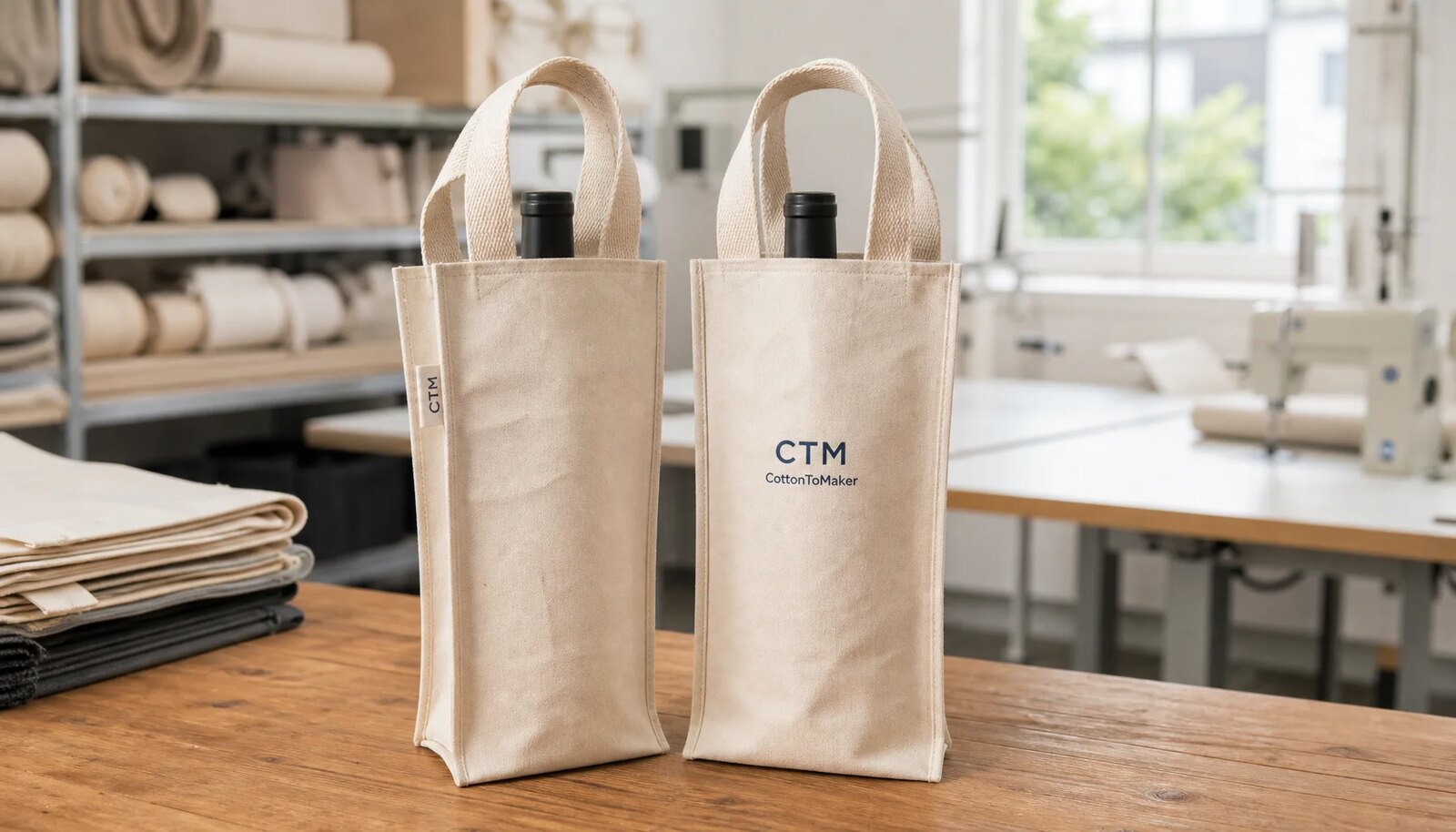
Logo placement is where the bag earns its keep
For event planners, a canvas wine carrier has to do more than hold a bottle. It may sit on a sponsor table, wait in a hotel room, move through a gala checkout line, or appear in guest photos long after the event crew has packed up. When the logo sits in the right place, the carrier feels intentional: useful, clean, and tied to the event identity. When the mark is too low, too wide, or too close to a seam, the same bag can look like a generic giveaway with decoration added at the last minute.
The procurement catch is simple: a wine carrier is not a flat tote. The print field is narrow, the bottle creates a curved face, and the upper opening can pull inward when someone lifts the handles. A divider seam, top fold, binding, or handle reinforcement can also change how much of the front panel is truly visible. That is why a digital proof alone is not enough. The logo should be approved on a filled sample, viewed from the angles the event team will actually use.
For many orders, the safest placement is the upper front panel, centered with clear space from the top edge, side seams, and handle stitching. It reads well when the carrier is standing and when it is carried at waist height. Lower front placement can work for a quiet design, but it may be hidden by a table edge, gift tag, or the guest's hand. A woven side label or small patch can feel more premium up close, yet it will not deliver the same sponsor visibility across a room. The right answer depends on the brief, not on decoration habit.
- Review placement with the intended bottle inserted, not only on an empty bag.
- Check readability at arm's length, on a table, and in ordinary event photos.
- Keep the logo away from seams, top folds, divider stitching, and handle reinforcement.
- Use subtle side branding only when the event brief values restraint over distance visibility.
Specify fabric before debating the logo
Fabric weight sets the stage for nearly every other decision. A 10 oz canvas, often around 280-300 gsm, can be sensible for budget programs, short-use giveaways, or local events where the bags will not be handled heavily. It usually helps unit price and carton weight. The tradeoff is presentation: lighter canvas can wrinkle faster, reveal more of the bottle silhouette, and give the print a less stable surface.
A 12 oz canvas, commonly around 340-380 gsm, is the practical center for many wholesale canvas wine carriers for event planners. It has enough body to support a filled bottle, usually gives the printer a better surface, and still remains manageable for sewing and packing. It also feels substantial without turning the carrier into a bulky object that drives up carton volume. When buyers do not have a strong reason to go lighter or heavier, 12 oz is often the more controlled starting point.
Heavier canvas, such as 14 oz or above, can suit premium hospitality gifting, winery programs, and executive events. Treat that upgrade as a full specification change, not a vague quality boost. Thick fabric creates seam bulk, can show needle marks more clearly, may require different print pressure, and can hold fold creases during shipment. A heavy carrier that arrives with a hard line through the logo is not an upgrade in practice.
Bottle fit belongs in the same conversation. The phrase 750 ml does not tell the whole story because Bordeaux, Burgundy, Champagne, and specialty bottles vary in diameter, shoulder shape, and height. If the event uses a specific wine or beverage, send the supplier the bottle dimensions or a physical sample. The bottle profile changes the curve of the front panel, the tension on the seams, and the flat space left for decoration.
- Use 12 oz canvas when the goal is balanced structure, print quality, and wholesale practicality.
- Specify finished dimensions, gusset or base depth, divider width, and handle drop.
- Confirm the exact bottle type before finalizing logo size and position.
- Ask whether fabric weight is measured before or after washing, dyeing, or finishing.
Build a usable panel map
A strong logo placement guide starts with a panel map that reflects the finished carrier, not the flat cut piece. The drawing should show finished front width, finished height, side seams, top fold, handle attachment points, divider stitching, base fold, label positions, and any trim. The usable logo field sits inside those boundaries. This matters because the cut fabric may look generous while the finished visible area becomes much tighter once seams and bottle curve are involved.
Placement should be measured from physical reference points. A note that says centered on front panel sounds clear, but it leaves room for disagreement when the product is inspected. Better instructions state the logo width, logo height, distance from finished top edge to logo top, and alignment to the vertical centerline. If side labels or patches are used, define label size, distance from top, distance from side seam, fold direction, thread color, and whether the label is flat or folded into the seam.
Artwork may need editing before it belongs on a wine carrier. A narrow panel is unforgiving. Long horizontal logos can crowd the seams; tall artwork may distort over the bottle curve; tiny taglines and detailed seals can disappear into the canvas texture. Event buyers often get cleaner results by using a simplified wordmark, a stacked logo version, or one sponsor mark with generous clear space. If the brand team insists on small text, make the sample prove it at production size.
It also helps to decide which logo needs to perform. Some events want the host brand visible in photos. Others need sponsor recognition on tables. A winery collaboration may want the winery mark to feel quiet and product-adjacent. Those are different placement problems. Name the priority before the supplier makes the sample, and the placement conversation becomes much less subjective.
- Ask for a finished panel map, including seams and handle reinforcement.
- Define logo size and placement with measurable reference points.
- Remove tiny text unless it remains legible on the actual sample.
- Match placement to the event priority: host brand, sponsor visibility, or premium gift cue.
Match decoration to artwork and volume
Screen printing is the workhorse for wholesale canvas wine carriers because it suits solid artwork, repeat orders, and medium to larger quantities. One-color and two-color logos on natural canvas are usually straightforward when the artwork is clean. Still, buyers should ask for the details that affect the finished look: ink opacity, curing, registration tolerance, and how the factory controls pressure on textured fabric. A sample on the final canvas matters more than a bright digital proof.
Dark canvas needs extra care. A light logo may require an underbase so the color does not sink visually into the fabric. Too little underbase can make the mark dull or patchy; too much can make it feel heavy and raised. Fine lines are also more exposed on coarse canvas, where the weave can break up edges. If the artwork includes small sponsor names, thin rules, or a detailed emblem, include those elements on the sample instead of approving a simplified test mark.
Heat transfer can be useful for short runs, gradients, or full-color artwork that is not economical to screen print. The risk is hand feel. Transfers can look glossy or sit on top of natural canvas in a way that does not match the rest of the bag. The buyer should check edges, adhesion, rub resistance, and whether stacked bags mark each other during shipping. A transfer that looks sharp on day one but scuffs in the carton is not suitable for event distribution.
Embroidery, woven labels, and stitched patches are better for tactile, premium branding. Embroidery can pucker a narrow panel if the design is dense or placed near seams. Woven labels and patches add steps for tooling, color approval, sewing, and trimming. Those steps are manageable when the schedule allows them and the MOQ supports them. They should be quoted separately so the buyer can see the true cost of the premium finish.
- Choose screen print for clean solid-color artwork and repeatable event programs.
- Test an underbase when printing light colors on dark canvas.
- Use heat transfer only after checking edge feel, gloss, adhesion, and carton rub.
- Quote woven labels, patches, and embroidery with their own MOQ, setup, and lead time.
Control MOQ and version creep early
MOQ is rarely just about sewing a certain number of bags. It can be affected by fabric purchasing, cutting efficiency, print screens, label weaving, patch production, custom packing, carton sourcing, and the number of artwork versions. A quote that starts at 500 pieces can change quickly when the buyer adds two sponsor versions, a second logo color, a custom hangtag, and separate carton labels.
The cleanest procurement path is one canvas color, one body construction, one decoration method, one placement, and one packing style. That does not mean the event has to look plain. Variable sponsor information can often move to a bottle neck card, insert, tag, belly band, or event collateral. Keep the carrier itself tied to the most stable brand element, especially if there is any chance of a reorder.
Setup costs should be visible. Screen charges, artwork cleanup, color matching, patch sampling, label tooling, revised samples, and packing mockups are not imaginary costs; they either appear as line items or hide inside the unit price. Clear setup charges make supplier comparison easier. They also help buyers understand which costs can be reused for a repeat order and which costs return every time artwork changes.
Variation also adds inspection risk. If three placements are packed in similar cartons, the warehouse team can mix them. If multiple sponsor prints run on the same fabric, one version may be approved while another drifts. For event-date orders, simple version control protects both schedule and presentation. Label each version clearly on the PO, artwork sheet, sample tag, carton mark, and inspection checklist.
- Treat each logo color, placement, label, patch, and pack style as a separate cost driver.
- Separate setup charges from unit cost in the quote.
- Use tags or inserts for variable sponsor content when possible.
- Require clear version naming on samples, cartons, and inspection documents.
Approve samples like production evidence
A paper proof is a layout tool. It is not approval of the product. The real approval sample should use the final canvas weight, final fabric color, final decoration method, final logo size, final handle construction, and the intended bottle fit. If the carrier body is custom, approve the blank structure first. Once the body is stable, approve the decorated preproduction sample. That sequence keeps buyers from chasing logo placement while dimensions are still changing.
Review the decorated sample in real conditions. Put the intended bottle inside. Add the hangtag, insert, tissue, or neck card if those items will be used. Place the carrier on a table and view it from standing height. Carry it by the handles and see whether the opening collapses into the logo. If the bags will be used for room drops, check whether they still look presentable after being unpacked quickly by staff.
Approval notes should be measurable. Record logo width and height, distance from finished top edge to logo top, centerline alignment, acceptable vertical and horizontal tolerance, fabric shade reference, print color reference, and any allowed variation. Photos help, but measurements settle disputes. The approved sample should be kept as a control piece, and the supplier should keep its own matching sample at the factory.
Color deserves its own review. Natural cotton canvas can vary by lot, and ink on woven fabric will not look exactly like ink on coated paper. If brand color is critical, provide Pantone references or a physical color standard, then approve the match on fabric. The sample approval should state whether a close commercial match on canvas is acceptable and whether minor fabric shade variation is allowed across the bulk order.
- Approve custom blank construction before decorated sampling.
- Review the sample with the actual bottle and event add-ons.
- Record measurements, tolerances, color references, and sample date.
- Keep the approved sample for inspection, payment release, and reorders.
Write QC standards before bulk starts
Quality control becomes easier when acceptance standards are set before mass production. For canvas wine carriers, the main checkpoints are fabric weight, fabric shade, logo placement, print quality, sewing strength, handle symmetry, bottle fit, trimming, packing, and carton condition. Each checkpoint should point back to the approved sample and the written specification. Vague wording such as good quality or normal tolerance is not enough when an event date is fixed.
Logo placement needs a practical tolerance. The factory should know how far the print may move horizontally or vertically from the approved position. The tolerance has to allow for fabric and sewing realities, but it should not allow a visibly crooked or low logo to pass. Inspectors should measure from the same points used in sampling: finished top edge, side seam, centerline, or label seam. Filled-bag checks are important because divider tension and bottle curve can make a straight print appear slanted.
Print inspection should look for opacity, edge sharpness, color consistency, curing, bleed, ghosting, pinholes, cracking, scorching, transfer lift, and rub marks. On natural canvas, small pinholes can appear where ink bridges the weave; the question is whether they are acceptable at normal viewing distance. Define that standard before the bulk run, not after the cartons are finished.
Sewing QC matters because a wine bottle is heavy for the size of the bag. Handles should be reinforced, even, and long enough for the intended carry style. Side seams should be closed and straight. The base should not have weak corners where a bottle can press through. On two-bottle carriers, divider seams must be secure and aligned so bottles do not collide or lean. Thread trimming is not cosmetic trivia; loose threads around the top opening are one of the first things guests notice.
Inspection should sample across the run. Early pieces may look right while later pieces drift as operators change, screens wear, or fabric lots shift. A useful inspection plan checks early, middle, and late production, then verifies packed cartons. For time-sensitive events, request production photos at cutting, printing, sewing, final inspection, and packing, even when a third-party inspection is not used.
- Define placement, print, sewing, fit, trimming, and packing tolerances before production.
- Inspect filled carriers as well as flat carriers.
- Sample early, middle, and late production to catch drift.
- Include packed-carton checks in the inspection scope.
Pack for fast setup and clean presentation
Packing can make or undo a good carrier. A bag may be sewn and printed correctly, then arrive with a hard crease through the logo, ink rub on the front panel, crushed handles, or a damp carton. Event teams do not always have time to steam, reshape, or sort hundreds of pieces before doors open. The packing plan should protect the logo and support the setup workflow.
For bulk distribution, folded packing may be acceptable and cost-efficient. Approve the fold. Do not assume the factory's default fold avoids the print area. If a fold line must cross the decorated panel, test whether the crease relaxes after unpacking and whether the event team has time to prepare the bags. Heavier canvas can hold fold lines longer than lighter canvas; transfers can also mark if pressed tightly against neighboring fabric.
For premium gifting, a looser pack, tissue separation, individual bags, or shaped packing may be worth the extra carton volume. The decision should be tied to how the carriers will be used: banquet table display, hotel room drop, sponsor suite gift, retail-style handout, or back-of-house assembly with bottles. Overpacking a simple giveaway wastes labor, but underpacking a premium gift can damage the presentation.
Moisture protection is practical, especially for sea freight, humid storage, or long warehouse holds. Canvas can absorb odor and moisture, and cartons can soften under poor conditions. Ask whether inner liners, desiccants, stronger export cartons, or palletization are appropriate for the route. Also confirm carton labels, units per carton, gross weight, and whether the cartons can be opened and counted quickly by the receiving team.
- Approve the folded or packed sample, not only the loose bag.
- Avoid hard fold lines through the logo when the carton plan allows it.
- Check print rub, handle creasing, moisture control, and carton strength.
- Match packing to the event workflow and available setup labor.
Backsolve the schedule from the event date
Event procurement should start with the in-hands date and work backward. Include local delivery, customs clearance if applicable, freight, final inspection, packing, bulk production, decorated sample approval, blank sample approval, artwork lock, and quote confirmation. A lead time that begins only after production starts hides too much risk. The pre-production stage is often where the schedule slips.
Sampling and bulk production should be listed separately. A standard 12 oz carrier with a one-color screen print can move faster than a custom two-bottle carrier with a divider, woven label, custom insert, and revised artwork. If the logo file is not final, the clock has not really started. Artwork changes after sample approval can affect screen setup, placement, color matching, and the need for another sample.
Peak season and holidays need an early conversation. Fabric supply, sewing capacity, print line availability, port congestion, and local factory holidays can all affect delivery. If the event date is fixed and close, simplify the specification before the order becomes fragile. A standard body with one clear front print may protect the event better than a complex decoration package with no recovery time.
Rush orders require specifics. Ask what can be overlapped and what cannot. A factory may be able to cut blank canvas while artwork is being finalized, but printing usually cannot begin until placement is approved. Packing materials may have their own lead time. Freight upgrades can recover transit days, but they change landed cost. The schedule should name the latest approval date for artwork, sample, production start, final inspection, and shipment.
- Work backward from the event in-hands date.
- Separate artwork lock, sampling, production, inspection, packing, freight, and local delivery.
- Simplify fabric, decoration, or packing when there is no recovery window.
- Ask for the latest approval dates that keep the delivery plan intact.
Compare suppliers on control, not just unit price
A useful supplier comparison uses the same specification across every quote. For wholesale canvas wine carriers, that means canvas weight, GSM tolerance, finished dimensions, handle material, divider construction, logo method, logo size, placement tolerance, packing method, carton count, sample cost, setup charges, production lead time, and incoterm. If those details differ, the buyer is not comparing prices; they are comparing different products.
A direct factory with in-house sewing and printing can offer tighter control for repeatable or quality-sensitive orders. The buyer can discuss fabric, print position, sample corrections, and packing with the team responsible for production. That route is often useful for event agencies, corporate procurement teams, hospitality buyers, and wineries that expect consistent presentation across programs.
A trading company may be useful when the project includes several product categories, such as wine carriers, totes, aprons, napkins, and packaging. The buyer gains coordination, but may have less visibility into the actual production path. That can still work if the quote is transparent. Ask who handles decoration, where final inspection happens, and whether the approved sample is held by the factory making the goods.
Domestic decoration or local sourcing can make sense for small runs, short timelines, or last-mile personalization. The unit price may be higher, and base bag construction may be less customizable, but schedule control can be worth it. For an event planner, the lowest unit cost is not always the best landed decision if the risk is late delivery, weak packing, or a logo that does not match the approved placement.
Landed cost should include freight, duty, inland delivery, setup, packaging, inspection, rework risk, and schedule risk. A quote that clearly includes screens, cartons, final packing, and inspection support may be more useful than a cheaper quote with exclusions. The strongest supplier is the one that can repeat the approved sample at the required quantity and deliver it in event-ready condition.
- Compare quotes using the same canvas, dimensions, logo method, placement, packing, and incoterm.
- Ask which steps are in-house and which are outsourced.
- Include freight, duty, packaging, inspection, and rework risk in landed cost.
- Choose the route that protects the event date and brand presentation.
Specification comparison for buyers
| Spec decision | Recommended option | When it fits | Buyer risk to check |
|---|---|---|---|
| Fabric weight | 12 oz canvas, about 340-380 gsm | Best balance for event gifting, repeat orders, stable bottle shape, and a clean print surface | Confirm actual GSM tolerance, shrinkage allowance, fabric lot consistency, and whether weight is measured before or after finishing |
| Fabric weight | 10 oz canvas, about 280-300 gsm | Budget promo runs, lighter bottles, short-life giveaways, or local events with limited handling | Watch for bottle silhouette showing through, weaker handle stress points, more visible wrinkles after packing, and a softer standing shape |
| Fabric weight | 14 oz canvas or heavier | Premium gifting, corporate hospitality sets, winery programs, or orders where a structured hand feel matters more than lowest freight cost | Check sewing needle marks, fold bulk, carton count, print pressure, and whether thick seams distort the logo field |
| Logo placement | Upper front panel, centered with clear margins from seams and top fold | Best when the logo must be readable in photos, at registration desks, on sponsor tables, or while carried | Require a seam map and approved filled sample so the mark does not drift into the curve, top collapse, or stitch line |
| Logo placement | Lower front panel with smaller logo | Works for minimalist branding or designs with handles, trim, or divider seams near the top | Can be hidden by table edges, gift tags, bottle neck cards, or the user's hand; check visibility from standing distance |
| Logo placement | Side panel, woven side label, or small patch | Premium programs that want a quieter brand cue or a less crowded front face | Visibility drops from a distance, so confirm the event brief accepts a subtler brand read |
| Decoration method | Screen print for one or two solid colors | Most wholesale programs with stable artwork, medium or high volume, and repeat ordering potential | Ask about underbase on dark canvas, ink curing, print tolerance, opacity, and how fine text holds at actual size |
| Decoration method | Woven label or stitched patch | Gift sets, executive events, winery collaborations, and understated sponsor branding | Higher MOQ, extra sewing, possible puckering, separate color approval, and longer lead time for label weaving or patch production |
| Decoration method | Heat transfer for complex small-run artwork | Short runs, gradient artwork, or programs where full-color detail is more important than a natural fabric hand feel | Test adhesion, edge feel, rub resistance, gloss level, and whether the transfer surface looks too synthetic on canvas |
Buyer checklist before sampling
- Lock final logo artwork in vector format, with Pantone or brand color references and a placement drawing showing exact size, position, and clear space.
- Specify canvas weight, acceptable GSM tolerance, fabric color, lining choice, handle material, divider style, bottom support, and finished carrier dimensions.
- Choose one primary logo location and define the measurement point, such as top edge to logo top and centerline to logo center.
- Require a printed preproduction sample on the same fabric, with the same decoration method, same handle construction, same bottle fit, and same packing method intended for bulk.
- Test the approved sample with the actual bottle size, gift insert, hangtag, tissue, neck card, or event collateral that will be used on site.
- Ask the supplier to separate the quote into blank bag cost, decoration cost, setup charges, packaging cost, carton cost, inspection support, and freight basis.
- Confirm carton quantity, folded shape, inner pack method, moisture protection, gross weight, and whether the bags can be unpacked without creasing the logo area.
- Set acceptance windows for logo position, print opacity, color variation, stitch quality, thread trimming, bottle fit, handle pull, and carton condition before mass production starts.
- Request production photos at cutting, printing, sewing, final inspection, and packed carton stages for event-date orders.
- Keep one approved sample and one signed artwork sheet as the control reference for bulk inspection, payment release, and reorder discussions.
Factory quote questions to send
- What is the blank bag price at the target canvas weight, and what changes if the GSM tolerance, lining, divider, handle material, or bottom support changes?
- Is the logo printed, embroidered, woven, patched, or label-applied in-house, and what MOQ applies to each decoration method?
- What is the maximum safe logo size for the chosen panel after seam allowance, bottle curve, handle reinforcement, top fold, and divider stitching are considered?
- Can you show a preproduction sample made on final canvas with an actual 750 ml bottle inserted and the logo measured from fixed reference points?
- What are the setup costs for screens, labels, patches, color matching, sampling, and revised samples if artwork changes after approval?
- What tolerance do you hold for print position, color variation, seam alignment, loose threads, handle length, and finished dimensions?
- How will the bags be folded or packed so the logo area is protected from ink rub, hard creases, moisture, and carton pressure?
- What are the carton dimensions, units per carton, gross weight, net weight, outer carton grade, and palletization recommendation for this order?
- What is included in the unit price, and what is excluded, such as artwork setup, screens, labels, inserts, barcode stickers, inspection, or inland transport?
- What are the sample lead time, bulk lead time, packing lead time, final inspection window, and latest artwork approval date required to meet the event delivery date?
Quality-control points to confirm
- Fabric weight matches the approved sample within the agreed tolerance, and the canvas hand feel is consistent across cut panels and finished bags.
- Logo placement stays within the agreed tolerance and does not drift into seams, folds, handle reinforcement, divider stitching, or the bottle curve.
- Print opacity is even, with no bleed, pinholes, ghosting, cracking, scorching, color shift, transfer lift, or rough transfer edges on the finished fabric.
- Ink or decoration is cured, stitched, or applied securely and passes reasonable dry-rub handling before packing.
- Stitching around handles, side seams, divider seams, and the bottom panel is even, with no skipped stitches, open seams, broken thread, or loose thread clusters.
- Handles are symmetrical, reinforced, and long enough for the intended carry style without pulling the top opening into the logo area.
- The carrier fits the intended bottle size without excessive stretching, twisting, leaning, or bottle slippage through the base or divider.
- Finished dimensions, divider width, and base stability match the approved sample so the filled carrier stands and photographs as intended.
- Carton count, folding method, inner packing, moisture protection, and outer carton strength match the PO and protect the print during transit.
- Final inspection includes representative checks from early, middle, and late production, not only the first finished pieces.