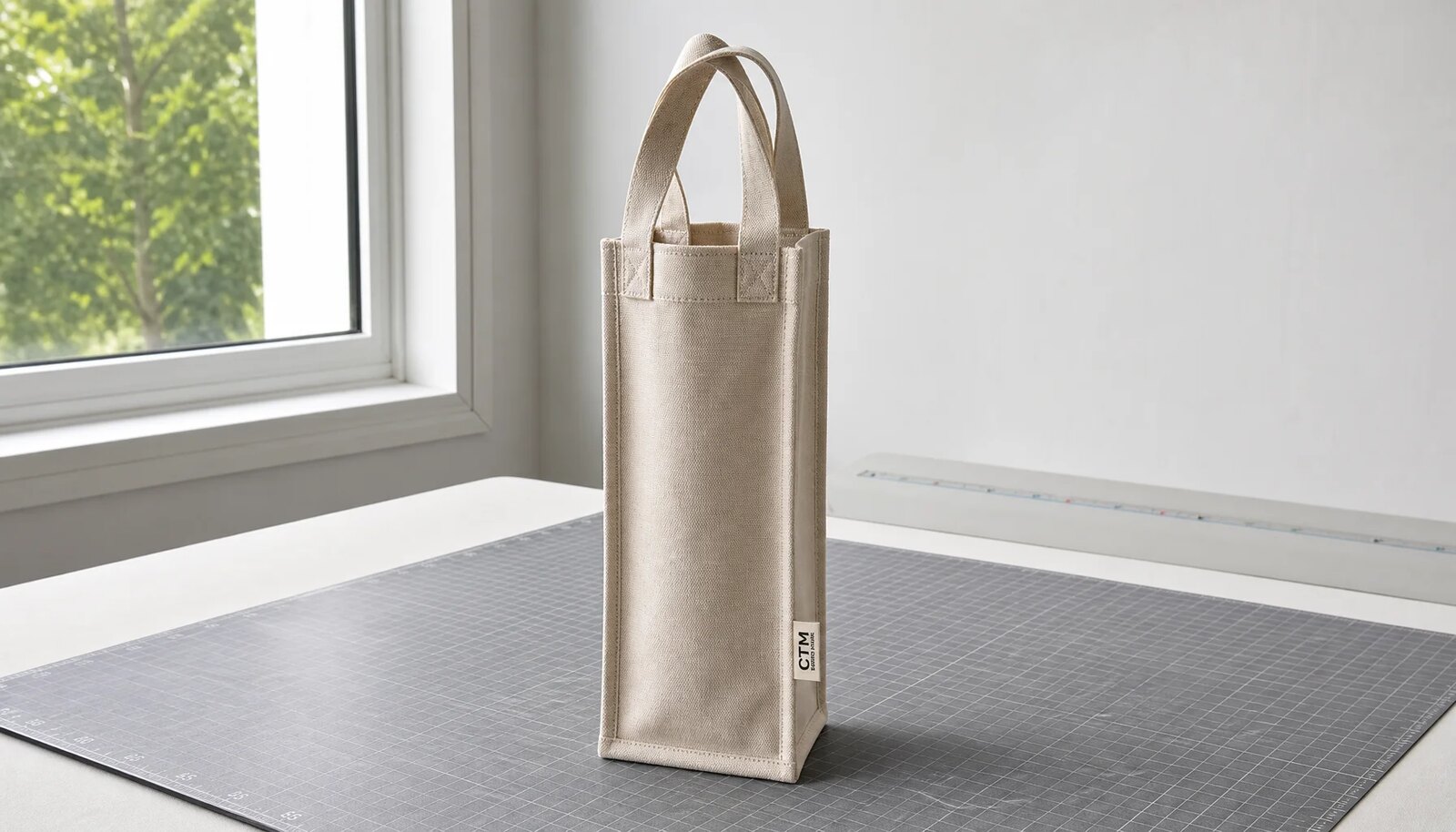
Start With The Bottle And The Store Format
Most sourcing mistakes start with the wrong first question. A hotel retail wine carrier is not a generic tote with a bottle inside. It has to fit the bottle shape sold in the shop, survive transport to the guest room or home, and still look like a product that belongs in a premium retail display. If you skip the bottle dimensions and jump straight to price, the supplier will quote a bag that is either too loose, too stiff, or too flimsy for the actual shelf use.
Define the use case in plain terms before you send the RFQ. A concierge counter gift, minibar add-on, and curated hotel shop item all drive different spec choices. A single-bottle carrier for a 750 ml Bordeaux shape needs different dimensions than a wider Burgundy bottle or a two-bottle set. Once the retail team knows the bottle profile, it becomes much easier to lock the canvas weight, handle construction, and packaging format without later redesign.
- Specify the bottle shape, neck height, and whether the carrier must fit a capsule or foil top.
- State whether the bag is meant for shelf display, checkout add-on, or room-drop gifting.
- Send one physical bottle or a fully dimensioned sample image with your RFQ.
Choose A Fabric Weight That Holds Shape
Canvas weight matters more here than it does in a basic shopping tote. For hotel retail, buyers usually need enough body for the carrier to stand up, hold a printed logo cleanly, and prevent the bottle from leaning through the side panel. A common buying window is 10 oz to 12 oz canvas, or roughly 340 to 420 GSM, depending on finish and weave density. At the lighter end, the carrier can feel economical but may sag. At the heavier end, it feels more structured but can raise cost and make packing tighter.
The right weight depends on the shelf position and brand tier. If the carrier sits near premium wine or gift items, 12 oz canvas with a stable base usually reads better than a soft, loose weave. If the customer is price sensitive and the bag is a simple add-on, a solid 10 oz option can still work if the seams, gusset, and handle attachment are reinforced. The real test is not the swatch alone; it is the full bag loaded with the intended bottle and left upright for display.
- Ask for GSM, yarn count, and whether the fabric is washed or sized after weaving.
- Confirm shrinkage after printing and after a light steam or press treatment.
- Request a filled sample photo with the actual wine bottle, not an empty bag shot.
Compare Supplier Routes Before You Price Out
Not every quote comes from the same type of supplier, and that changes your risk. A direct factory can usually give better control over pattern, stitching, and print placement, but only if it truly owns the line and has a stable sample process. A trading company can be useful for mixed sourcing or lower opening quantities, but then you need to know which factory is actually cutting, sewing, and packing the bags. For hotel retail, that difference matters because the first sample often looks acceptable while the bulk line is quietly shifted to a cheaper source.
When you compare suppliers, do not compare only the unit price. Compare the route to market, the documents they can provide, and how much control they have over fabric lot, print screen, and carton pack. If a seller cannot explain who buys the canvas, who inspects the stitching, and who signs off the pre-shipment photos, you are not buying a controlled production program. You are buying an estimate.
- Prefer a factory when you need custom dimensions, color matching, and repeat orders.
- Use a trading company only if it gives you clear factory disclosure and no sample switching.
- Treat very low quotes as a signal to inspect fabric weight, trim, and packing assumptions.
Read The Quote Line By Line
A proper quote for wholesale canvas wine carriers should separate the product into cost drivers, not hide everything in one number. The main drivers are fabric weight, cutting yield, print setup, handle reinforcement, lining or insert work, and packing. If the supplier gives a single ex-factory price with no breakdown, you cannot tell whether the lower price comes from a thinner canvas, fewer stitches, smaller cartons, or a weaker insert. That is how buyer comparisons become misleading.
MOQ logic should also be tied to setup cost, not treated as a punishment. One color of print on one fabric lot is easier to run than multiple sizes, mixed logos, or different closure types. If your hotel group is testing the market, ask the factory to price the launch version separately from the replenishment version. That lets you protect margin at the first order while keeping a clear path for the second order once the retail response is known.
- Separate fabric, labor, print, insert, trim, packing, and testing in the quote.
- Ask for MOQ by color, by print version, and by carton pack format.
- Request a price ladder so you can see where the unit cost drops at higher volume.
Require A Real Compliance Pack
Hotel retail buyers often need more than a sample that looks nice. They need proof that the bag can be sourced, packed, and shipped under a repeatable process. A practical compliance pack usually includes the material description, fabric composition, print method, carton spec, and test or inspection records that match the actual batch. If your market requires a specific standard, say so in the RFQ. Do not let the supplier substitute a generic report from another style or another month.
The best way to avoid compliance gaps is to tie every document to a production reference. Ask for batch photos, label images, and carton markings before the ship date. If the carrier is meant for a chain hotel, the buyer should also know exactly how the logo will be applied and where the traceability mark sits. Small details matter because the retail team is not only buying a bag. They are buying a product that has to pass internal review, store handling, and replenishment without avoidable exceptions.
- If your market needs a specific standard, name it in the RFQ instead of assuming the factory knows it.
- Match the document set to the exact style number and production batch.
- Ask for pre-shipment images of the finished bags, packing, and master cartons.
Approve Samples Like A Production Buyer
A useful sample process has three stages: prototype, pre-production sample, and golden sample. The first sample tells you whether the dimensions, structure, and logo placement are directionally right. The second sample should use the actual fabric, actual print method, and the same trim that will go into mass production. The golden sample becomes the physical reference for the factory and the buyer team. Without that sequence, teams tend to approve a good-looking hand sample and then discover bulk variations later.
For wine carriers, the sample check should focus on fit and repeatability. Load the real bottle, check the handle drop, confirm the base sits flat, and verify that the bag does not tip when held at arm's length. The print should be checked on the same colored canvas that will be used in the order, because contrast can change the look of the logo dramatically. If the bag includes an insert or divider, test it with the bottle you will actually sell, not a placeholder bottle from the sample room.
- Use the real bottle and the real logo file before sample approval.
- Freeze the approved sample with dated photos and a signed note of what changed.
- Reject sample language that says close enough or similar to approved.
Lock Packing And Retail Presentation
Packing is not an afterthought for hotel retail because the product often goes straight from carton to shelf. The buyer should specify whether each carrier goes into a polybag, whether a barcode label is applied to the bag or inner pack, and how many pieces go into each master carton. If the retailer uses route-specific carton marks or destination labels, those need to be in the artwork set before mass production starts. A strong product can still create receiving problems if the carton count is wrong or the labels are inconsistent.
Retail presentation also includes how the bag feels when the customer opens it. A folded canvas carrier with a clean side label, a stable bottom insert, and a controlled crease pattern will look more premium than a loosely packed bag with random wrinkles. If the product line is for gift shops or minibar upsells, consider whether a simple paper belly band, tissue wrap, or insert card is worth the extra labor. Those small costs matter, but so does the first visual impression on the shelf.
- Define inner packing, carton count, and label placement in the PO.
- Use a barcode and carton mark that match the retailer routing guide.
- Decide whether the bag should arrive folded flat or lightly formed around an insert.
Plan Lead Time Around Print And Fabric Risk
Lead time depends less on the calendar and more on the number of variables you allow to move. If the fabric is in stock, the print is one or two colors, and the packing is simple, a factory can often move much faster than if it needs to source a custom canvas shade or special hardware. The moment you add Pantone matching, lining, extra insert work, or a different closure, the schedule becomes more sensitive to approval delays. The buyer should ask for each step separately: sample time, material reservation time, production time, and packing time.
The safest way to protect a launch date is to build a buffer around sample approval and carton confirmation. Retail teams often approve the product but then delay the artwork, label text, or barcode file, which pushes the whole order back. A clean production plan names the cutoff date for artwork, the date for golden sample signoff, and the shipment window after final inspection. If any of those dates are vague, the supplier will assume more flexibility than your retail launch actually has.
- Ask for a stage-by-stage schedule, not a single promised ship date.
- Reserve extra time for artwork approval, label changes, and carton proofing.
- Keep a backup plan for fabric shade variation or delayed print approval.
Compare Landed Cost, Not Just Unit Price
A low ex-factory quote can still become the most expensive choice once you add freight, carton size, rework, and compliance. A heavier canvas may cost more at source, but if it reduces damage, shelf rejects, and repacking, it can win on landed cost. Likewise, a supplier that quotes a neat per-piece price but hides insert charges or packing labor may appear competitive until the final invoice lands. Buyers should compare the full landed model: unit price, sampling cost, freight, duty or tax, inspection, and expected wastage.
For hotel retail, the decision rule should be simple. Choose the supplier that can prove the spec, match the sample, and deliver the packing standard your store team can receive without extra handling. If two quotes are close, give the edge to the supplier with the clearer document trail and the more stable sample process. That is usually the one that saves time later, especially when replenishment becomes a repeat order and the retail team needs the same carrier to look and feel identical across the chain.
- Build your comparison on landed cost, not only ex-factory price.
- Weight rework, carton damage, and receiving labor in the decision.
- Favor repeatability over a slightly lower first-order number.
Specification comparison for buyers
| Supplier option | What to verify | Commercial advantage | Buyer risk to control |
|---|---|---|---|
| Direct sewing factory | fit-test photos with reference bottle, bottom reinforcement close-up, handle load proof, and final carton photo set | Better sample-to-bulk control and faster production feedback | May be weaker on export paperwork or branded packing unless checked early |
| Trading company | Factory name, production photos, trim-source proof, and who owns QC decisions | Can coordinate small mixed orders and extra services | Markup can hide real factory capability and slow defect decisions |
| Specialized bag workshop | bottle fit, bottom reinforcement, handle or cord strength, divider option, seam allowance, and upright stability | More practical for detailed construction, trims, and repeat programs | Capacity may be limited during peak seasons |
| Low-price general supplier | cotton canvas, jute, felt, nonwoven, or laminated paper sized to bottle diameter, weight, and condensation risk | Useful for simple promotional runs with loose specs | Material downgrades, weak packing, and vague inspection scope can erase savings |
| Retail-ready supplier | upright or flat packing, bottle-protection insert, carton count, moisture control, and retail display orientation | Can handle labels, SKU separation, carton marks, and receiving rules | Higher unit cost must be compared against reduced warehouse work |
| Compliance-focused supplier | Fabric records, labeling review, test plan, and production traceability | Safer for retail programs and repeat brand orders | Documentation claims need evidence, not only sales language |
| Local sample room plus bulk factory | Signed sample, bulk factory handoff, first-piece photos, and deviation owner | Good for complex branding before large production | Sample room quality may not match bulk line unless handoff is controlled |
Buyer checklist before sampling
- Lock the bottle format first: single 750 ml, two-bottle, or mixed bottle shapes.
- Specify canvas weight in GSM and the acceptable hand feel or stiffness range.
- Confirm finished dimensions, gusset depth, and handle drop with a physical bottle sample.
- Define logo placement, print method, Pantone tolerance, and artwork file format.
- Set the reinforcement standard for handles, side seams, and top edge binding.
- Decide whether the carrier needs a divider, bottom insert, or closure hardware.
- Request the full packing plan: polybag, barcode, inner pack, master carton, and carton marks.
- Ask for the compliance documents you need in your market before sampling is approved.
- State the MOQ breakpoints by color, print setup, and fabric lot.
- Agree on sample stages: proto sample, pre-production sample, and golden sample.
Factory quote questions to send
- What is the exact canvas weight in GSM, and is the fabric prewashed, dyed, or bleached?
- What is the finished size tolerance for height, width, gusset, and handle drop?
- Which print method will you use, and what are the setup charges, plate costs, or color limits?
- What is the MOQ by color and by print version, and how does the price change at higher volume?
- What reinforcement is included at the handles, top edge, and bottom panel?
- What packing configuration is included in the quote, and what is charged separately?
- What documents can you provide for compliance, material declaration, and carton verification?
- What is the sample schedule, production lead time, and the earliest ship window after approval?
Quality-control points to confirm
- Finished dimensions must fit the specified bottle with enough clearance to load and remove it without forcing the seams.
- Handle stitching should be even, backtacked, and free from skipped stitches, loose ends, or uneven tension.
- The bag should stand upright with a full bottle and not collapse at the base during shelf display.
- Print registration, color density, and logo placement should match the approved golden sample within the agreed tolerance.
- Fabric should be free from heavy slubs, shade bands, oil marks, and visible weave defects in the retail viewing area.
- Seams and stress points should hold under a practical carry test with the intended bottle weight.
- Carton pack count, barcode label, and master marks must match the purchase order and retail routing labels.
- Polybag, insert, and accessory packing should not scratch, stain, or deform the bag during transit.