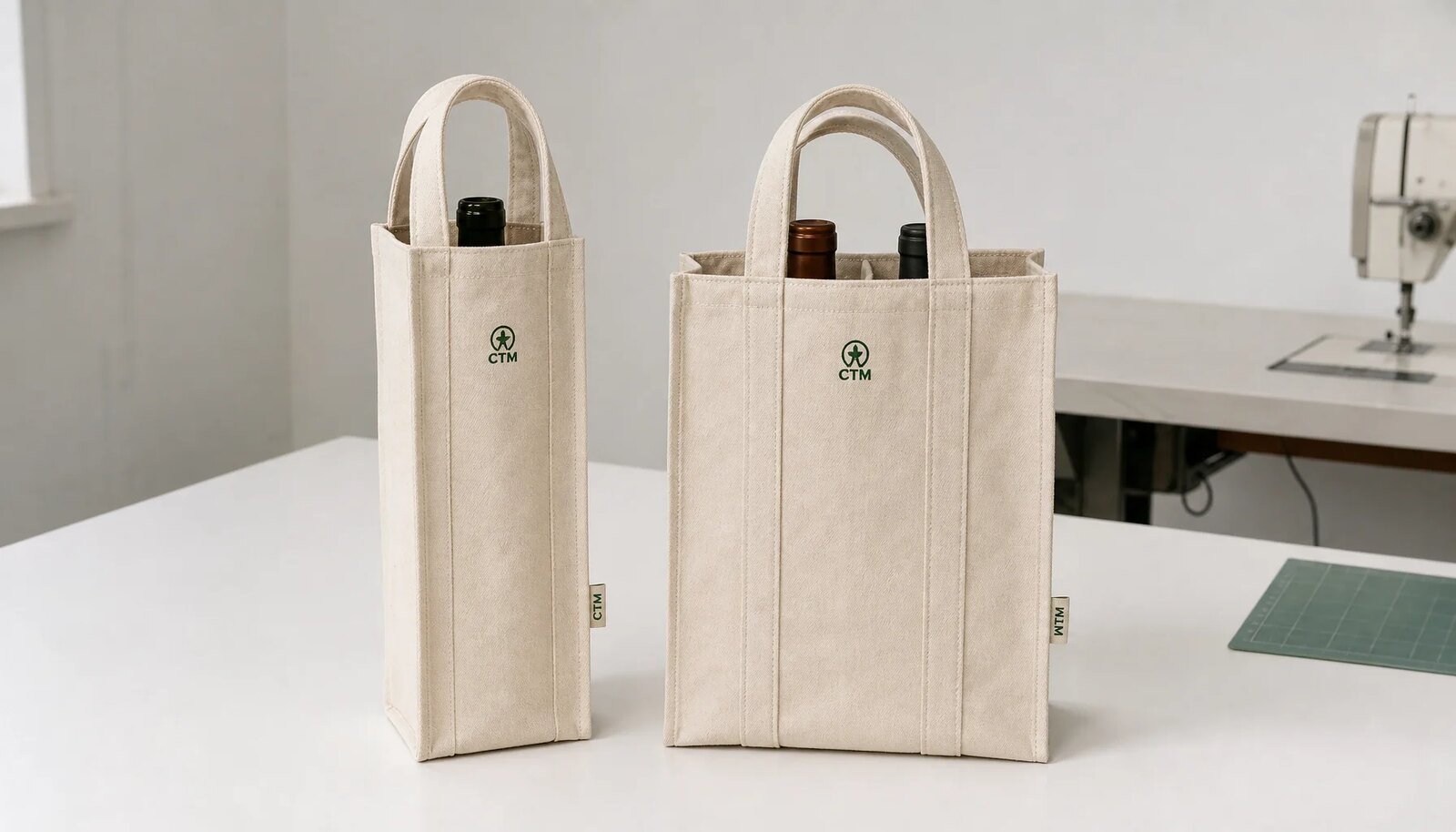
1. Start with the bottle range, not the bag photo
The fastest way to get misleading prices is to ask for “a 750 ml canvas wine bag” without bottle data. A 750 ml Bordeaux bottle, Burgundy bottle, Champagne bottle, olive oil bottle, and spirits bottle can all need different gusset widths, shoulder clearance, and bottom support. For hotel retail, poor fit is visible: labels scrape during insertion, the carrier twists when loaded, or the empty bag looks oversized on the shelf.
Before requesting bulk pricing for canvas wine carriers, document the bottle range. If the carrier is for one house wine, provide exact bottle height, widest body diameter, base diameter, and loaded weight. If the hotel shop carries mixed bottles, quote around the largest bottle and test the sample with it. Two-bottle carriers need an additional check: both bottles must insert easily while the divider still prevents glass-to-glass contact.
Use case also changes the spec. A welcome amenity may travel once from storage to a guest room. A paid retail item must look crisp, scan correctly, carry safely, and support the hotel’s brand positioning. Those products may share artwork, but they should not automatically share canvas weight, handle reinforcement, divider construction, or packing.
- Record maximum bottle height, body diameter, base diameter, shoulder shape, and loaded weight.
- Confirm whether the bottle neck should be visible, partly covered, or mostly covered.
- For Champagne and sparkling wine, check widest base and shoulder clearance instead of assuming a standard gusset.
- For retail display, decide whether the empty carrier must stand upright, hang, fold flat, or ship folded.
- For gifting, decide early whether tissue, ribbon, hangtag, belly band, or card is included in the finished SKU.
2. Convert fabric language into measurable canvas specs
Supplier descriptions such as “heavy canvas,” “premium cotton,” and “eco canvas” are not enough for procurement. Ask for fabric weight in both ounces and GSM, composition, finish, color, and whether the stated weight is before or after finishing. A quote based on 8 oz canvas should not be compared directly with a quote based on 12 oz canvas; the handfeel, structure, sewing behavior, and perceived value will differ.
As a buyer reference, 8 oz canvas is often used for lower-cost promotional bags, 10 oz can suit simple one-bottle hospitality programs, 12 oz is a practical starting point for paid hotel retail, and 16 oz gives a more structured premium feel for two-bottle carriers or heavier bottle formats. Approximate GSM references are about 270 GSM for 8 oz, 340 GSM for 10 oz, 400 GSM for 12 oz, and 540 GSM for 16 oz. Treat these as reference ranges only; actual values depend on yarn, weave, mill practice, and finishing.
Finish affects both look and tolerance. Natural unbleached canvas may include seed flecks, slubs, and shade variation, which can suit a relaxed resort aesthetic if the approval sample defines the acceptable range. Bleached canvas provides a cleaner logo background. Dyed canvas requires lab dip approval and bulk shade control. Washed canvas feels softer but may have more wrinkling and dimension variation. If recycled cotton or organic cotton claims matter, request supporting documents instead of accepting broad “eco-friendly” wording.
- Ask for both oz and GSM on every quote.
- State composition: 100% cotton, cotton/poly, recycled cotton blend, organic cotton, or other.
- Approve acceptable flecks, slubs, and shade variation for natural canvas.
- For dyed fabric, require lab dip or swatch approval before bulk cutting.
- For washed canvas, confirm final measurements after washing.
- Request documentation for any sustainability claim used in hotel retail marketing.
3. Engineer handles, bottom seams, and dividers for loaded use
A wine carrier fails where the weight travels: through the handles, down the side seams, into the bottom, and across the gusset. In a two-bottle carrier, the divider must also keep glass separated while the guest walks. A bag that looks neat while empty can sag or twist once loaded.
Write handle construction into the RFQ. Define handle material, width, total length, finished drop, stitch pattern, and reinforcement. Self-fabric handles can look cohesive, but they need adequate layers and secure seam capture. Cotton webbing is consistent and often comfortable for retail carry. Rope handles can suit gift presentation, but they need reinforced attachment points. For paid retail and two-bottle styles, handle ends should generally use bartack, box stitch, X-box stitch, or another approved reinforcement method rather than plain stitching alone.
Divider construction should be equally specific. A divider attached only near the top can shift and allow bottle contact. A divider anchored into the bottom or side seams gives better separation, although it increases labor. If the carrier must fold flat for shipping or storage, confirm that divider protection and packability are balanced.
- Specify handle width, total length, and finished drop.
- Require reinforced handle stitching for retail-sale products and all two-bottle carriers.
- Confirm whether handles are captured in the top seam, sewn onto the panel, or backed with reinforcement patches.
- For two-bottle carriers, request a divider drawing showing height, width, bottom attachment, and side attachment.
- Check bottom seam and gusset construction for heavier bottle formats.
- Avoid loose threads or sharp internal seam edges that can damage labels or foil.
4. Build a bulk pricing plan around real cost drivers
A useful wholesale pricing comparison separates the details that change cost. Unit price is affected by fabric consumption, canvas weight, cutting yield, sewing minutes, divider complexity, decoration method, packing material, inspection requirements, and shipping terms. When these variables are not fixed, the lowest quote may simply mean lighter fabric, shorter handles, weaker reinforcement, smaller logo size, or loose bulk packing.
Start with one controlled base specification and ask each supplier to quote the same version. Keep body size, GSM, handle, divider, logo method, print area, packing, carton quantity, and Incoterms fixed. Then request price breaks at realistic quantities such as 500, 1,000, 2,500, 5,000, and 10,000 units where applicable. For multi-property hotel programs, ask whether MOQ applies per logo, fabric color, packing version, or delivery destination.
Separate one-time charges from unit price. Screen setup, embroidery digitizing, woven-label setup, patch tooling, barcode setup, and sample fees can affect first-order economics but may not repeat in the same way. Also compare landed cost, not factory unit price alone. Ask for carton dimensions, units per carton, gross weight, net weight, and shipping terms before purchase order release.
- Request price breaks against one fixed spec, not vague alternatives.
- Separate unit price, sample fee, setup charges, packing upcharges, inspection, and freight assumptions.
- Confirm MOQ by style, fabric color, logo design, print color, packing version, and shipment.
- Compare EXW, FOB, DDP, or delivered quotes carefully; they are not interchangeable.
- Ask what is excluded, such as hangtags, barcodes, individual bags, inner cartons, or palletization.
- For multi-property programs, price consolidated cartons and property-specific assortments separately.
5. Match decoration method to brand standard and production limits
Logo decoration determines much of the retail impression. Screen printing is usually efficient for solid one-color or two-color hotel logos on canvas. It works best when the artwork is bold, the print area stays away from seams and gussets, and the ink is properly cured. Fine lines, small serif text, and light ink on natural canvas need sampling because fabric texture can soften detail.
Digital printing can support more complex artwork, although color saturation on cotton may be more muted than expected. Heat transfer offers sharp edges, but edge adhesion, gloss, and handfeel should be checked after folding. Embroidery can look premium, yet dense stitching may distort lighter canvas. Woven labels, side tabs, and patches are useful when the hotel wants a subtler retail product rather than a large front-panel logo.
The RFQ should state artwork file type, decoration method, logo size, placement, number of decorated locations, Pantone target or color reference, and allowed placement tolerance. On narrow wine carrier panels, a logo shift of even several millimeters can look off-center. Approve an actual decorated pre-production sample; a digital mockup is not enough for production control.
- For screen print, provide vector artwork, Pantone targets, print dimensions, and print sides.
- Ask the factory to confirm minimum printable line thickness on the selected canvas.
- For embroidery, review stitch count, backing, puckering, and whether embroidery happens before sewing.
- For heat transfer, test edge lift, cracking, gloss, and handfeel on the actual fabric.
- For patches, confirm material, color, debossing or embossing, stitching, and tooling cost.
- Write print placement tolerance into the PO after the factory confirms capability.
6. Use an RFQ sheet that forces comparable quotes
A short but disciplined RFQ prevents specification drift. If suppliers receive only a product photo and a target quantity, each factory will choose its own canvas, handle, divider, print method, packing, and carton assumptions. The resulting prices may look comparable in a spreadsheet, but they are not pricing the same product.
A practical RFQ should include finished size, bottle range, canvas weight, handle construction, divider design, branding method, packing, order quantity by SKU, destination, Incoterms, sample requirement, and inspection plan. If procurement is deciding between amenity grade and retail grade, request two clearly named options with fixed specifications instead of asking suppliers to “suggest best price.”
Add quote validity and material availability. Cotton canvas pricing, dye lots, and production capacity can change. The quote should state whether the fabric is stock or made to order, how long pricing is valid, and whether the proposed lead time includes sampling, decoration approval, packing, and inspection. This is especially important for hotel openings, wine events, seasonal promotions, and holiday gifting calendars.
- Product format: single-bottle, two-bottle, four-bottle, six-bottle, or custom gift carrier.
- Measurements: width, height, gusset, handle drop, divider spacing, pocket, closure, and tolerance.
- Bottle data: maximum height, diameter, loaded weight, and bottle type family.
- Fabric: canvas oz, GSM, composition, color, finish, documentation, and tolerance.
- Construction: handle material, reinforcement, bottom seam, divider, binding, lining, and closure.
- Decoration: artwork, method, size, colors, location, label or patch details, and placement tolerance.
- Packing: unit packing, hangtag, barcode, inner carton, master carton, shipping marks, and pallet needs.
- Commercials: quantity by SKU, delivery date, Incoterms, destination, payment terms, samples, and inspection.
7. Approve samples under real loading conditions
Do not approve canvas wine carriers from flat photos alone. The product may look good empty while failing the real use case. A gusset can appear neat until the bottle shoulder expands it. A divider can look centered until two filled bottles are inserted. A logo can seem centered on a flat panel but shift visually once the bag is loaded.
Whenever possible, approve a physical pre-production sample made with actual bulk fabric, actual handle construction, actual divider, actual decoration, and proposed retail packing. If remote approval is unavoidable, request measurement photos with a ruler, loaded photos from multiple angles, close-ups of handle reinforcement, inside seams, divider attachment, print edges, and packing. A sample in 12 oz canvas does not approve bulk production in 10 oz canvas.
Use the sample to freeze the production file. Measure finished body size, gusset, handle drop, divider spacing, and print position. Insert and remove the approved bottles several times. Watch for label scuffing, tight neck clearance, divider movement, handle discomfort, bottom sag, seam stress, and whether the packed item matches how hotel staff or guests will receive it.
- Measure the sample and record actual dimensions before approval.
- Load with the intended filled bottle or equivalent test weight.
- Check whether the carrier stands, folds, or hangs as required by the retail display plan.
- Inspect handle ends, bottom seam, divider attachment, and internal seam finishing under load.
- Rub the print lightly with a dry white cloth and slightly damp white cloth to screen for obvious transfer.
- Scan barcode samples if hangtags or barcode labels are part of retail packing.
- Keep one signed sample with the buyer and one with the factory.
8. Write QC standards before production starts
Quality control should be agreed before cutting and sewing, not negotiated after cartons are packed. Standards should cover function, appearance, brand accuracy, packing, and safety. Critical defects may include handle failure, broken load-bearing seams, wrong logo, wrong SKU, mildew odor, or missing divider. Major defects can include severe stains, print smears, open seams, size outside tolerance, wrong packing, or non-scanning barcodes. Minor defects might include small thread ends or natural canvas flecks within the approved range.
Functional testing matters because the carrier holds glass. Use the intended load. A filled 750 ml bottle weighs more than the liquid alone once glass and closure are included, so a real filled bottle or equivalent test weight is more realistic than an empty bottle. For two-bottle carriers, both compartments should be loaded at the same time while inspectors check handle distortion, seam pulling, divider movement, bottle contact, and bottom sag.
Measure across multiple cartons, not just the top carton. A practical starting point, if supplier capability supports it, is plus or minus 0.5 cm for handle drop, divider spacing, and smaller panels, and plus or minus 1.0 cm for larger body height or gusset dimensions. Print position, color, carton count, hangtags, and barcode data should be checked against the approved sample and purchase order.
- Classify critical, major, and minor defects before production.
- Check loaded performance with real bottles or equivalent weights.
- Measure body size, gusset, handle drop, divider spacing, and print placement across cartons.
- Inspect handle reinforcement for skipped stitches, broken threads, and loose ends.
- Check interiors for loose threads or seam edges that can damage bottle labels.
- Verify logo artwork, color, curing, and placement against the approved decorated sample.
- Confirm hangtags, barcode numbers, scan quality, carton quantities, and shipping marks.
9. Plan packing around hotel operations
Packing is part of the product specification. For back-of-house amenity programs, loose bulk packing may be acceptable because staff prepare the presentation. For a hotel boutique, the item may need individual protection, a paper band, hangtag, barcode label, price-label area, and inner cartons for property-level distribution. These choices affect unit cost, carton cube, receiving labor, and shelf readiness.
Individual polybags protect canvas from dust and moisture, but some hotel brands prefer reduced plastic. A recycled paper band or belly band can look more retail-friendly, though it offers less protection in transit. Hangtags can carry barcode and brand information, but their attachment point should not distort handles or front panels. If barcodes are required, test scanning before bulk shipment; low contrast, textured stock, and curved placement can all create scanning issues.
Carton planning affects landed cost because canvas products can be bulky relative to unit value. Heavier canvas, padded dividers, structured handles, and paper bands increase volume. Over-compressing cartons may lower freight cost but can crease printed panels, bend patches, or distort dividers. Ask for master carton dimensions, units per carton, gross weight, net weight, and carton strength before PO approval.
- Use loose bulk pack only when hotel staff handle final presentation.
- Use individual protection when light canvas must arrive clean for retail shelves.
- Consider paper bands or belly bands for lower-plastic retail presentation.
- Confirm hangtag size, string, position, barcode number, and barcode scan quality.
- Request inner cartons if inventory will be split across properties or departments.
- Avoid over-compression that creases logos, bends patches, or crushes dividers.
- Include carton dimensions and gross weight in landed-cost planning.
10. Protect launch timing with early decisions
Lead time is not only sewing time. A realistic schedule includes artwork review, bottle data confirmation, fabric approval, sample making, sample transit, buyer comments, revised sampling if needed, fabric booking, decoration, cutting, sewing, trimming, QC, packing, final inspection, and export handover. Custom dyed canvas, custom webbing, woven labels, patches, embroidery, and retail packaging can become the schedule driver.
Hotel retail launches often have fixed dates: resort openings, wine festivals, holiday gift periods, seasonal promotions, or merchandising resets. Work backward from the in-store date and include freight, customs, domestic distribution, and hotel receiving time. A late bottle change can force pattern revision. A late logo-size change can affect screens, embroidery files, or patch tooling. A late packing change can alter carton count, barcode files, and landed cost.
Separate first-order development from repeat-order production. First orders need more time because the specification is being built and tested. Repeat orders can move faster if the approved sample, fabric spec, artwork, packing file, carton details, and QC report are kept in a production file. Even on repeats, confirm fabric lot, print color, barcode data, and carton plan before release.
- Confirm artwork and bottle dimensions before sample development.
- Approve fabric weight, color, and finish before bulk material booking.
- Freeze pattern, handle drop, divider, and logo placement before cutting.
- Schedule decoration approval early for screen print, embroidery, patch, or woven label.
- Plan inspection before shipment and early enough to correct packing or barcode issues.
- Build buffer for holidays, peak gift season, freight delays, and hotel receiving windows.
- For repeat orders, reuse the production file but recheck fabric lot, print shade, and carton details.
Specification comparison for buyers
| Sourcing decision | Best-fit option | Use case | Buyer risk to control |
|---|---|---|---|
| Bottle sizing | Quote from maximum bottle height, body diameter, base diameter, and loaded weight | Hotel shops carrying mixed wine, Champagne, spirits, or local beverages | A generic 750 ml pattern may not fit wider Burgundy, sparkling, olive oil, or spirits bottles; require a loaded fit test |
| Canvas weight | State oz and GSM, with actual mill spec and tolerance | Comparable supplier quotes and clear retail positioning | Approximate references such as 8 oz/270 GSM, 10 oz/340 GSM, 12 oz/400 GSM, and 16 oz/540 GSM vary by weave and finish |
| Amenity-grade carrier | 8 oz to 10 oz canvas, simple construction, one-color logo | In-room welcome gifts, events, short campaigns, cost-sensitive quantities | More risk of sagging, wrinkling, and lower retail value; test load and handle seams |
| Retail-grade carrier | 12 oz to 16 oz canvas, reinforced handles, clean top edge, stable divider, retail tag or barcode | Paid hotel retail, resort boutiques, wine clubs, premium gift sets | Higher cost; compare only with identical GSM, handle, divider, logo size, and packing |
| Single-bottle format | One gusseted compartment sized to approved bottle | Lobby retail, room-service wine presentation, single-bottle gifts | Too narrow can scuff labels; too wide looks loose and oversized on shelf |
| Two-bottle format | Side-by-side compartments with divider anchored to bottom or side seams | Paired wine sets, resort gifting, higher-ticket merchandise | Loose dividers allow bottle contact; confirm divider height, attachment, and insertion clearance |
| Stock pattern plus logo | Existing factory pattern with controlled branding and packing changes | Faster sampling and replenishment when bottle fit is already proven | Stock samples may not match bulk fabric or stitching; approve the real production specification |
| Fully custom build | Custom size, handle, divider, pocket, lining, closure, label, hangtag, barcode, and carton plan | Multi-property merchandise programs and premium hotel retail collections | Pattern changes affect fabric use, sewing time, MOQ, and carton cube; freeze the spec before final pricing |
| Decoration method | Screen print for bold logos; woven label, embroidery, patch, or side tab for retail styling | Matching brand standard, durability, and price point | Each method has setup cost, color limits, placement tolerance, and sample approval requirements |
Buyer checklist before sampling
- Define the bottle range before quoting: Bordeaux, Burgundy, Champagne/sparkling, spirits, olive oil, or mixed 750 ml assortment, including maximum height and body diameter in millimeters.
- State carrier format: single-bottle, two-bottle, four-bottle, or six-bottle, and whether the divider is sewn-in, removable, padded, or single-layer canvas.
- Specify finished dimensions: width, height, gusset depth, handle drop, divider width, pocket size if any, and permitted measurement tolerance.
- Require canvas weight by both oz and GSM. Ask whether the fabric is greige, unbleached natural, bleached, dyed, washed, recycled cotton, organic cotton, or cotton/poly blend.
- Decide the commercial grade before comparing prices: promotional giveaway, amenity-use, or paid retail merchandise.
- Define handle construction: self-fabric canvas, cotton webbing, rope, reinforced box stitch, bartack, cross-stitch, or binding reinforcement.
- Provide logo artwork with vector file, Pantone target, print size, print position, number of sides, minimum line thickness, and whether the logo crosses seams or gussets.
- Clarify MOQ by style, body fabric color, logo version, print color, packing version, shipping mark, and destination, not only total order quantity.
- Ask for price breaks at realistic quantities such as 500, 1,000, 2,500, 5,000, and 10,000 units where applicable, with setup charges separated from unit cost.
- Require a pre-production sample using the actual bulk fabric weight, actual handle construction, actual divider, actual print method, and proposed retail packing.
Factory quote questions to send
- What is the exact canvas weight in oz and GSM, and what mill tolerance applies to bulk fabric?
- What is the fabric composition: 100% cotton, cotton/poly, recycled cotton blend, organic cotton, or another blend? Can you provide a material spec sheet if needed?
- Is the fabric greige, unbleached natural, bleached, dyed, pigment-dyed, or washed, and will bulk production use the same finish as the sample?
- What bottle dimensions did you use for the pattern, and what maximum height, diameter, and loaded weight has the carrier been checked against?
- Can you quote the same construction in 8 oz, 10 oz, 12 oz, and 16 oz canvas, with GSM stated for each option?
- Is the MOQ calculated per style, fabric color, logo artwork, print color, packing version, or across the total shipment?
- What quantity price breaks can you offer at 500, 1,000, 2,500, 5,000, and 10,000 units, and which charges are one-time setup costs?
- Which decoration method is included in the base quote: screen print, digital print, heat transfer, embroidery, woven label, side tab, leather patch, or PU patch?
- What is the maximum recommended print area without distortion near seams, gussets, handles, or folded edges?
- What print placement tolerance can you hold in bulk production, for example plus or minus 3 mm, 5 mm, or another agreed value?
Quality-control points to confirm
- Fabric weight should match the approved specification within the agreed mill tolerance. If no tighter buyer standard is set, many procurement teams use an approximate plus or minus 5% tolerance for fabric GSM, but any downgrade from approved sample weight should require written buyer approval.
- Finished carrier dimensions should remain within agreed tolerances, commonly plus or minus 0.5 cm for narrow panels, handle drop, and divider spacing, and plus or minus 1.0 cm for larger body height or gusset dimensions, unless the PO states otherwise.
- Bottle fit must be checked with the approved bottle range, including maximum height, maximum diameter, shoulder shape, insertion clearance, label scuffing, divider position, and handle comfort when loaded.
- Loaded performance should be tested with the intended bottle weight. For a single 750 ml wine bottle, use the real filled bottle or equivalent test weight; for two-bottle carriers, test both compartments loaded at the same time.
- Handle attachment should show consistent reinforcement, such as bartack, box stitch, X-box stitch, or reinforced seam capture, with no skipped stitches, broken thread, open seams, or loose handle ends.
- Divider seams should be centered, straight, and secured according to the approved sample. For two-bottle carriers, the divider should prevent glass-to-glass contact during normal hand carrying.
- Stitch density should be consistent with the approved sample, with no long unstitched gaps, needle cuts, severe seam puckering, or loose threads that can catch bottle labels or cork foil.
- Print color should match the signed print sample, Pantone target, or approved color standard under consistent lighting. Bulk print shade should be checked across multiple cartons, not only the top carton.
- Print placement should remain within the approved tolerance and should not drift toward gussets, handle seams, or folded edges in a way that changes the front appearance.
- Print surface must be free from major bleeding, cracking, pinholes, ink smears, ghosting, heavy misregistration, scorching from heat transfer, or adhesive edge lift.