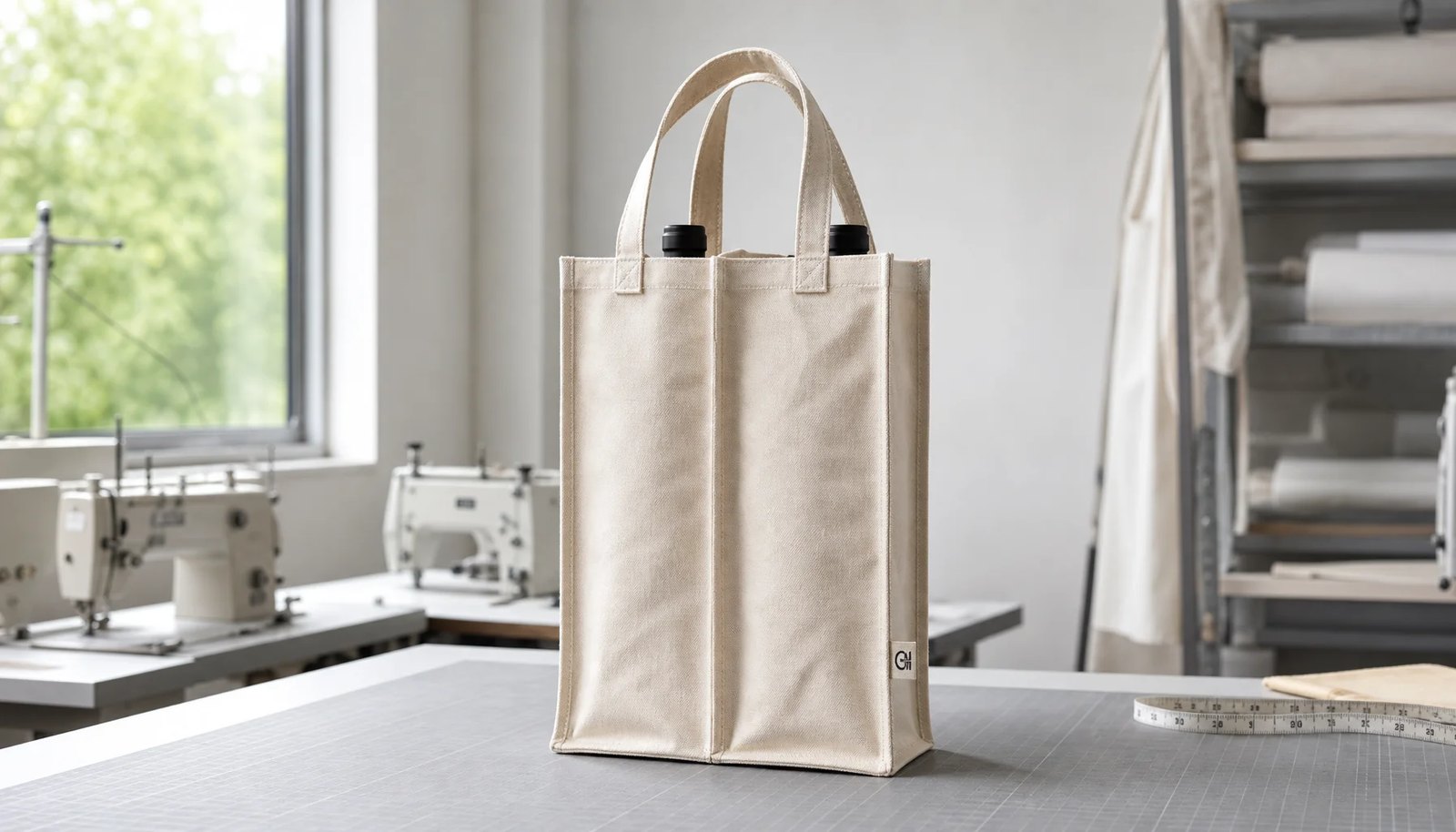
Start With the Bottle, Not the Bag
A wholesale canvas wine carrier looks simple, but trade show buyers do not all need the same product. One program may need a two-bottle gift carrier for VIP meetings, another may need a single-bottle handout that can survive repeated use on the show floor, and another may need a retail-ready item that stays in circulation after the event. If you do not define the use case first, the factory fills in the gaps with its own assumptions, and those assumptions usually show up later as a higher MOQ, a different construction, or a quote that looked good until packing was added.
The cleanest RFQ starts with the bottle profile, the bottle count, the event channel, and the role of the bag in the program. A buyer who states 'two-bottle carrier for 750 ml Bordeaux bottles, natural canvas, one-color logo, bulk packed for warehouse fulfillment' will get quotes that can actually be compared across suppliers. A buyer who only sends a logo file gets several different interpretations of the same product, and none of those quotes negotiates well because the factory does not know which constraints matter most.
- Define the bottle type, especially if it is tall, wide, heavy, or non-standard.
- State whether the carrier is for a one-time handout, repeat trade show use, distributor gifting, or retail resale.
- Lock the role of the bag as gift packaging, carry bag, or sellable product, because each one drives a different quote structure.
- If the bottle is heavier than a standard 750 ml wine bottle, tell the factory the loaded weight target rather than assuming a standard profile.
Choose the Build That Matches the Load
Fabric weight is one of the main cost drivers and one of the easiest places to make a mistake. Around 8 oz canvas, roughly 270 to 340 GSM, can work for lower-cost promotional use or a lighter single bottle, but it can feel soft and may show stress sooner at the handles. Around 10 oz to 12 oz, roughly 340 to 410 GSM, is a better starting point for a more premium look, heavier bottles, or a carrier that needs to be reused after the trade show. Buyers often think they are comparing only fabric, but they are really comparing stiffness, seam stability, decoration surface, and how the bag will look after it has been folded, shipped, and handled all day.
Construction details matter just as much as fabric weight. A carrier for one bottle does not need the same base width or reinforcement as a two-bottle carrier, and a carrier with divider walls needs a different sewing sequence than a simple open sleeve. If you want the quote to stay stable, specify the handle width, handle drop, seam allowance, whether there is a base insert, and whether the divider is sewn in or removable. These details change labor time, cutting yield, and packing efficiency, which is why two bags that look similar on a mood board can land in very different MOQ bands.
- Use 10 to 12 oz canvas for premium event programs, heavier bottles, or repeat use.
- Use 8 to 10 oz canvas only if the bag is a lower-cost promotional item and the load is controlled.
- Ask for reinforcement at handle joins and base seams, not only a stronger fabric spec.
- If the bag will hold more than one bottle, confirm divider placement and the width of each compartment, not just the outside dimensions.
Compare Sourcing Routes Before You Compare Prices
The lowest unit price is not always the lowest-risk route. A direct factory quote usually gives the best control over fabric weight, stitch quality, and packing, which matters when the carrier has to match a brand standard across multiple trade shows. A trading company or sourcing agent can be useful if you need mixed products or help coordinating several factories, but the buyer should understand that the quote often includes an extra layer between the spec and the production floor. That layer can be valuable if the program is complex, but it can also slow down sample feedback and blur responsibility when a detail goes wrong.
Stock programs and local decorators are a different tradeoff. A stock route can get you to market faster and sometimes at a lower initial MOQ, but the fabric, dimensions, and decoration area are usually constrained. Local decoration may help if the event is urgent and you need domestic finishing, but the carrier itself may not match the same fabric weight or construction you would buy from a dedicated factory. The right decision depends on whether the buyer cares most about repeatability, speed, or flexibility. For a multi-show brand program, repeatability usually wins.
- Use direct factory sourcing when the same bag will be reordered or extended into other markets.
- Use a trading company when the order combines different categories and coordination matters more than direct factory control.
- Use a stock route only if the design can accept fixed dimensions and limited branding options.
- Ask who owns production documentation, because the party who owns the tech pack usually controls what gets repeated correctly.
Read the Comparison Table as a Negotiation Map
The table is most useful when it helps you separate what is truly negotiable from what is a hidden cost driver. If the quote looks too high, the first question is not 'Can you reduce the price?' It is 'Which part of the spec is forcing the MOQ and setup time?' A one-color screen print on a standard canvas body is a very different production job from a sewn patch on a custom-dyed two-bottle carrier with retail folding. Buyers who compare those quotes as if they were identical usually end up chasing the cheapest line item and missing the actual constraint.
In practical sourcing terms, compare routes by who controls the sample, who owns the sewing and decoration steps, and how much of the product is standardized. If the factory owns the full process, your changes are easier to implement and your second order is easier to price. If several vendors touch the order, you need more documentation because each vendor will defend its part of the cost. That is why a strong RFQ should state the same basic product goal across suppliers, then allow each supplier to show where it can be cheaper or more flexible.
- Treat the first quote as a production hypothesis, not as a final price.
- Compare sample ownership, production control, and packing control before comparing unit price.
- If a supplier cannot explain the main MOQ driver, the quote is not ready for negotiation.
- Ask whether the quoted fabric is available as a standard stock roll or must be woven or dyed specifically for your order.
Know What Actually Drives MOQ
Factories usually set MOQ from the parts of the order that cannot be shared easily across other jobs: fabric cutting, decoration setup, trim procurement, sewing line changeover, and carton packing. If your bag is standard natural canvas with one simple logo and standard folded packing, the factory has more room to negotiate because the material is already in the market and the setup is light. If you want custom dyed fabric, a special closure, a woven label, and retail packing, the factory has to reserve more labor and inventory, so the MOQ moves up even if the product still looks simple to the buyer.
The best negotiation is not 'lower the MOQ' in isolation. It is 'reduce the number of custom variables that force separate setup.' A buyer can often keep the same bag shape and get a lower MOQ by accepting stock natural canvas, one decoration location, one decoration color, and bulk packing instead of retail-ready inserts. If the factory still needs a higher MOQ, ask whether it can quote a trial run and a repeat run separately. That gives you a path to start smaller without pretending that a highly customized product can be produced at a commodity-level minimum.
- Reduce MOQ by standardizing fabric color, print count, and carton format.
- Keep artwork to one panel and one or two print colors if the objective is to control setup.
- Ask for a trial MOQ and a repeat MOQ when the supplier has not run this exact spec before.
- If the factory says the MOQ is fixed, ask which line item is non-negotiable: fabric, decoration, trim, or packing.
- Use a saved stock canvas color whenever possible; custom dyeing adds both lead time and fabric risk.
Write the RFQ Like a Production Spec
A useful RFQ gives the factory enough detail to price the product without guessing. Include the finished dimensions, construction type, bottle count, handle length, handle drop, seam allowance, decoration position, fabric weight, fabric color, and packing format. If you want the quote to be meaningful, state whether the quoted dimensions should be inside or outside dimensions and whether the measurements are taken flat or filled. That sounds small, but vague measurement language is one of the most common reasons a quote changes after sample approval.
The RFQ should also define what can be standardized. If the factory can use a stock natural canvas body, a standard cotton web handle, and one-color screen print, say so clearly. If you are willing to accept a slight change in carton count or a different fold method to improve throughput, state that too. Buyers often ask for a low MOQ without telling the supplier which parts of the spec are flexible. The result is a quote that looks negotiable on paper but cannot actually be made at the desired price.
- State finished dimensions and, if relevant, seam allowance.
- Specify whether dimensions are measured flat, stitched, or internal usable space.
- Provide vector artwork, Pantone references if used, and a placement diagram.
- Describe any required odor, lint, or surface appearance expectations if the bags are for premium gifting.
- Call out any bottle neck clearance requirement if the carrier will be used with taller bottles.
Specify Branding and Decoration for Trade Show Use
Canvas is forgiving, but the decoration method still changes the quote and the appearance. Screen print is usually the best option for a simple logo, a short brand name, or a clear event message because it is durable and economical at volume. If the artwork has gradients, fine type, or many colors, heat transfer may be easier to start with, but the buyer should test rub resistance and folding behavior before approving it for a wholesale run. A woven label or sewn patch gives a more premium feel, yet it adds sewing steps and can push the MOQ higher because the factory has to coordinate another component.
For trade show exhibitors, the design should be readable from a few meters away, not just good in a product photo. Small text disappears quickly once the carrier is folded, handled, or stacked in a booth. Put the brand mark where it stays visible when the bag is carried, and avoid placing key art right across a fold line or close to heavy seam intersections. If the brand wants a premium presentation, a good compromise is a simple decoration on the main panel with a small woven side label or interior label. That keeps setup manageable while still giving the bag a finished retail feel.
- Use screen print for simple artwork and stable unit cost.
- Use heat transfer only if the artwork needs more detail and you can accept a durability test gate.
- Use a woven or sewn label as a premium accent, not as a substitute for a weak base spec.
- Send vector art and a placement diagram so the supplier is not guessing at scale or position.
- If you need Pantone matching, ask how the supplier will control ink consistency across the run and whether there is an acceptable delta tolerance.
Approve the Sample Against Real Measurements
A sample approval should be a measurement exercise, not a visual preference vote. Measure the finished width, height, base depth, handle length, handle drop, and bottle compartment width against the approved sheet. Put the actual bottle into the sample, not a placeholder bottle, and check whether the carrier still closes or sits flat the way the buyer expects. If the sample was made from substitute fabric or a different closure than the quote, it should not be treated as a production approval, because the bulk run will almost always drift from that reference.
For a first-time program, treat the pre-production sample as the hard gate and reject anything that changes the user experience. That includes sloppy seam ends, off-center decoration, uneven handle length, loose dividers, and poor folding memory. A good sample should also show the packing method that will be used in the bulk order, because a bag that looks correct in a flat sample can still fail when it is folded into a carton, stacked under weight, or opened repeatedly by warehouse staff. The sample has to represent the full production method, not just the visible face of the product.
- Check dimensions, handle geometry, and bottle fit using the actual target bottle.
- Require the sample to use the final fabric, final decoration setup, and final trim.
- Reject any sample that hides production changes behind a visually similar appearance.
- Keep a signed sample or measurement sheet so the bulk order has a fixed reference.
- If the sample is approved with notes, write those notes into the purchase order so they do not disappear during production.
Lock Packing, Cartons, and Freight Terms
Packing choices affect both freight cost and receiving efficiency. A wholesale canvas wine carrier can be bulk packed with a simple polybag and a master carton if it is going to a warehouse, distribution center, or trade show fulfillment team. That route is usually better for margin, because retail-ready folding, inserts, and hang tags increase labor and carton volume. If the product will be sold through retail or ecommerce, then you may need individual polybags, barcode labels, and consistent folding, but those requirements should be written into the quote from day one. Otherwise the supplier may quote a clean bulk pack and later charge for the extra handling needed to turn it into retail inventory.
Carton planning matters more than many buyers expect. A two-bottle canvas carrier can be large enough that carton count changes how much freight space you buy and how easily the warehouse can count stock. Ask for the packed carton size, gross weight, and carton marks before production starts. If the order is going to a trade show advance warehouse, ask whether the cartons should be labeled by show name, SKU, and color so receiving can unload quickly. The wrong carton spec can erase a good product quote very quickly.
- Confirm units per inner pack and units per master carton before cutting starts.
- Request carton size and gross weight in the quote so freight can be estimated correctly.
- Use clear carton marks if the shipment will be split across a warehouse and a show floor.
- If the order is retail-facing, specify folding rules and barcode placement before approval.
- Ask whether the factory can provide a carton packing list by SKU and color so inbound receiving is faster.
Set QC Gates, Reorder Rules, and the Final Negotiation
Quality control should not start at the dock. It should start with the approved sample and the tolerances you accept for the bulk run. For a canvas wine carrier, the important checks are not abstract. They are finished size, handle length, handle drop, seam quality, stitch consistency, bottle fit, decoration placement, decoration cure, carton count, and carton mark accuracy. The buyer should also ask how the supplier will inspect the order: in-line checks during sewing, a final lot check before packing, or a pre-shipment review against the approved reference.
The most useful QC language is specific enough that a line worker or inspector can act on it. 'Good stitching' is too vague. 'No loose threads longer than the agreed allowance, no skipped stitches at the handle joins, and reinforcement applied at the specified stress points' is actionable. The same rule applies to decoration and fit. If the artwork must be centered above the base seam, say so. If the bag must fit a tall bottle without pushing the neck open, say so. The tighter the language, the fewer surprises when the bulk shipment is opened at the warehouse. When you are negotiating MOQ, use the same discipline: reduce custom variables, ask for a repeat-order price, and document exactly what will be repeated next time.
- Use the approved sample as the master reference for size, decoration, and finish.
- Set clear tolerances for finished dimensions, handle drop, and bottle fit.
- Require an agreed check for stitch quality, loose threads, and reinforcement points.
- Ask the supplier how many units are checked at each stage and who signs off the final lot.
- If you use a third-party inspector, give them the sample, the spec sheet, and the acceptable defect list before the factory starts packing.
Specification comparison for buyers
| Spec decision | Recommended option | When it fits | Buyer risk to check |
|---|---|---|---|
| Sourcing route | Direct factory with in-house cutting, sewing, decoration, and sample approval | You need repeat orders, tight control on dimensions, and a lower repeat quote after the first run | Verify who actually cuts fabric, applies decoration, sews the bag, and signs off the pre-production sample |
| Sourcing route | Trading company or sourcing agent | You need mixed-product consolidation, supplier coordination, or support across multiple factories | Check for hidden markups, duplicated communication layers, and slower sample feedback |
| Fabric weight | 10 to 12 oz canvas, about 340 to 410 GSM | Single- or two-bottle carriers that need better body, less sag, and a more premium hand feel | Confirm whether the quoted weight is finished fabric or greige fabric, and ask about shrinkage after washing or steaming |
| Fabric weight | 8 to 10 oz canvas, about 270 to 340 GSM | Lower-cost handouts, lighter bottles, or short-duration event use | Watch for soft walls, handle stress, and logo show-through on darker print |
| Decoration method | 1-color screen print on one panel | Simple logo, clean brand mark, and MOQ control matter more than special effects | Ask about screen charges, color tolerance, curing method, and rub resistance |
| Decoration method | Sewn woven label or patch plus minimal print | You want a more premium retail look or a tighter brand system | Check placement, stitching quality, and whether the added sewing steps change MOQ |
| Carrier format | Single-bottle sleeve with base support | You need a lightweight carrier for handout or lower-cost event use | Confirm bottle height, base support, and whether the neck sits too high |
| Carrier format | Two-bottle carrier with divider and reinforced handles | You need a VIP gift bag or multi-bottle presentation piece | Check divider alignment, handle reinforcement, and loaded weight handling |
| Packing route | Bulk pack with polybag and master carton marks | Wholesale distribution, warehouse receiving, and event fulfillment | Confirm units per carton, folding method, carton compression, and whether labels are visible without opening cartons |
Buyer checklist before sampling
- Lock the bottle count, bottle type, bottle diameter, and carrier dimensions before asking for quotes.
- State whether the carrier is for VIP gifting, trade show handout, distributor incentive, or resale after the event.
- Specify canvas weight in oz or GSM, plus whether the fabric is natural, bleached, dyed, or enzyme-washed.
- Choose one print method and one print location unless there is a strong brand reason to split them.
- State the target MOQ, but also say which details can be standardized to support it.
- Approve a real pre-production sample made from final fabric, trim, decoration, and packing method.
- Confirm carton pack, inner polybag count, carton marks, pallet needs, and any barcode or SKU labeling requirements.
- Ask for separate pricing for sample, bulk unit price, setup, packing, inspection, and freight terms.
- Ask the supplier to quote both stock natural canvas and custom dyed canvas if you are comparing options.
- Set the order timeline against the trade show date and leave buffer for sample corrections and transit delays.
Factory quote questions to send
- What is your MOQ for this exact canvas weight, size, decoration method, and packing spec?
- Is the MOQ driven by fabric purchase, print setup, sewing line changeover, trim procurement, or carton packing?
- Can you quote one price for stock natural canvas and one price for custom dyed canvas?
- Can you quote the same carrier with and without the divider, base insert, or closure so we can compare cost impact?
- What is included in the sample charge, and will it be deducted from the bulk order if the sample is approved?
- What tolerance do you hold on finished dimensions, handle length, handle drop, and decoration placement?
- What seam reinforcement do you use at the handle joins: bar-tacks, X-box stitching, or another method?
- Can you show the proposed carton pack, carton size, gross weight, and carton marks before approval?
- What is the lead time after sample approval, and which items would extend it?
- Which parts of the order are in stock now, and which parts must be purchased after approval?
Quality-control points to confirm
- Finished dimensions should match the approved spec within the agreed tolerance, with no obvious mismatch between sample and bulk.
- Canvas weight should be confirmed on the approved fabric type, not only on a supplier description sheet.
- Handle attachment points should be reinforced with consistent stitching, bar-tacks, or X-box stitching where specified.
- Handle length and handle drop should be consistent from unit to unit so the bag carries level and feels balanced.
- Decoration should be centered, cured, and rub-tested so it does not crack, smear, or lift in handling.
- Bottle compartment width should fit the agreed bottle diameter without excessive squeeze or loose movement.
- Divider, base insert, or closure components should sit straight and remain functional after stuffing and folding.
- Stitch density, seam finish, and thread color should be consistent across the order and match the approved sample.
- Carton count, label data, and carton marks should match the approved packing list and purchase order.
- Outer cartons should protect the product from compression, moisture, and scuffing during freight handling.