Why skincare brands specify canvas wine carriers differently
A wholesale canvas wine carrier for skincare is rarely a generic bottle bag. In procurement terms, it usually sits somewhere between gift packaging, a branded accessory, and a reusable retail item. That creates a different buying standard from simple event totes or low-cost promotional wine sleeves. The bag may carry a glass bottle, but it may also need to hold a boxed serum set, fragrance bundle, holiday duo, or wellness gift pack without collapsing or looking underbuilt.
That difference matters at the RFQ stage. If a supplier assumes a basic one-bottle promo bag while the buyer expects a premium skincare gift carrier, the quote will look attractive but the construction will be too light. Typical failures show up fast: the front panel wrinkles around the product, the bottom rounds out instead of sitting flat, the handles feel narrow in hand, or the logo loses definition on a coarse canvas surface.
Beauty and skincare teams also judge packaging more critically than many promotional buyers do. A carrier used in gifting may be photographed, placed on shelves, included in PR mailers, or sold as part of a bundle. That means fabric texture, seam neatness, print sharpness, and color cleanliness all affect perceived brand value. Procurement therefore needs to define both functional and visual standards before comparing suppliers.
A good starting point is to describe the product role in the order brief. Is this carrier a low-cost add-on at checkout, a premium holiday gift bag, part of a retail set, or secondary packaging for influencer kits? The answer drives fabric weight, handle build, print method, and packing method. Without that context, the factory will optimize for price, not for fit with the skincare brand’s channel and presentation standards.
- Define whether the bag is for retail sale, gift-with-purchase, event use, or internal kit assembly.
- State exactly what goes inside: bottle, rigid carton, mixed set, or a combination of products.
- Clarify whether the bag is customer-facing packaging, transit support, or both.
- Explain where appearance matters most: shelf, e-commerce photo, PR kit, or point-of-sale gifting.
Selecting canvas weight, weave, and surface finish
For most skincare gift programs, 12 oz to 14 oz canvas, roughly 340 to 400 gsm, is the practical starting range. This weight usually gives enough body to support a premium feel without making the bag excessively stiff or difficult to sew cleanly. Lighter 10 oz to 11 oz canvas can work for lower-cost promotions, but it often looks soft once filled, especially when the contents are rigid cartons with visible corners.
Weight alone is not enough, however. Buyers should also ask about weave regularity and surface texture. A smoother canvas face tends to print more cleanly, particularly for minimal beauty logos, fine sans-serif type, or light ink coverage. A heavily slubbed or irregular surface may look natural and artisanal, but it can cause broken edges or uneven opacity in printed branding. If the bag is meant to align with a clean clinical skincare aesthetic, a more even fabric surface is usually easier to approve and repeat.
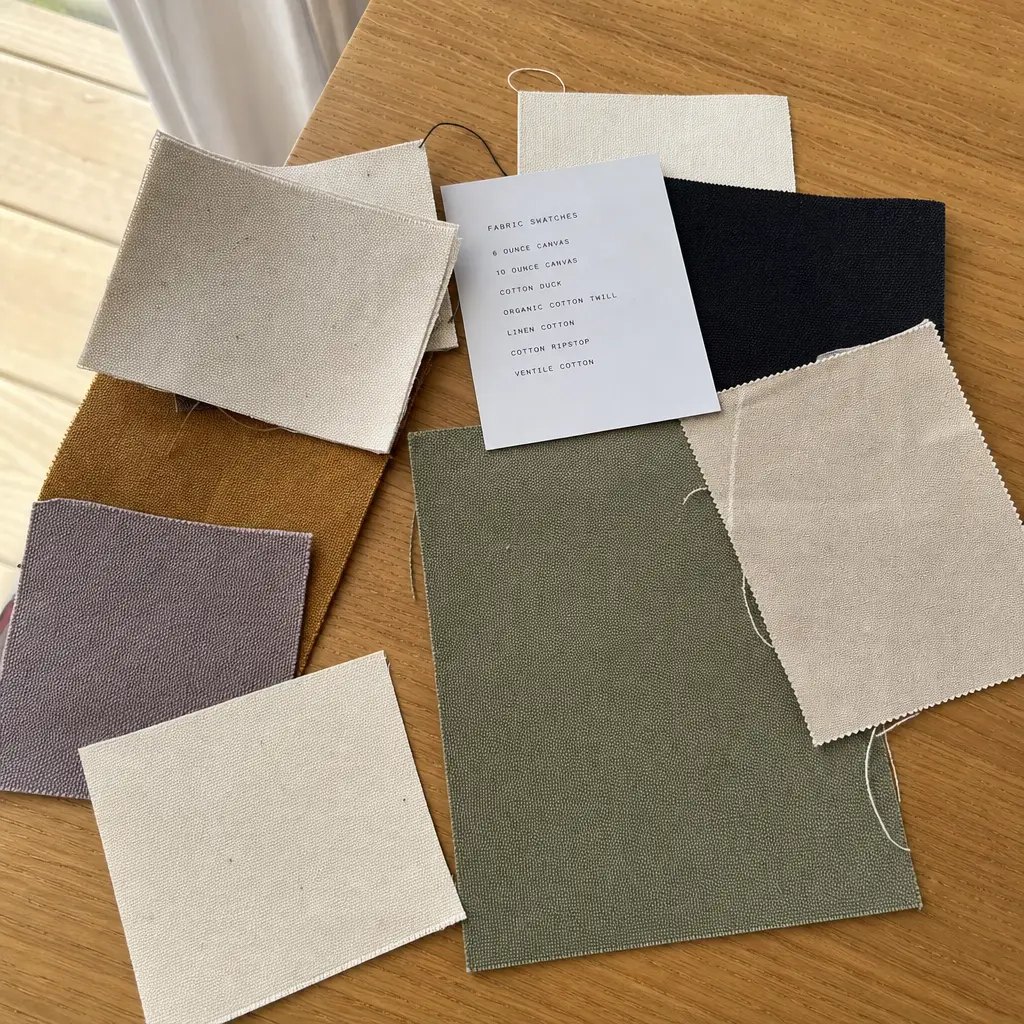
Fabric color and finish also influence both aesthetics and print performance. Natural canvas gives an organic, understated look and works well for earthy or apothecary-style branding. Bleached canvas creates a brighter base and usually helps pastel or precise brand colors read more cleanly. Dyed canvas can be useful when the bag itself is part of a seasonal color story, but dyed goods require clearer shade-control expectations because lot variation is harder to avoid than many buyers expect.
If the bag will be photographed or sold, request that the supplier identify whether the canvas is raw, bleached, washed, or dyed, and whether the fabric is likely to shrink or soften after processing. A washed finish may feel more premium in hand, but it can slightly alter final size and print appearance. For a replenishment program, the safest route is often a stable unwashed or lightly finished canvas with a defined weight and approved shade standard.
- 10 oz to 11 oz canvas suits cost-driven promotions but provides less structure.
- 12 oz to 14 oz canvas is the most reliable range for premium skincare bottle and gift carriers.
- Bleached canvas helps light or precise logo colors show more cleanly.
- Washed or dyed finishes can elevate appearance but need stricter color and size controls.
Construction details that change performance and cost
Many quote gaps come from construction details that are easy to overlook in early sourcing. Two carriers may share the same outer dimensions and fabric weight but perform very differently because of base support, body layering, gusset design, or handle attachment depth. When skincare buyers say a bag should look more premium, what they usually need is not an abstract upgrade. They need clearer decisions on structure.
The bottom construction is one of the first areas to define. A simple sewn base is enough for a light, flexible promotional bag. A bag carrying heavy glass or boxed skincare sets often benefits from a base insert or a better-formed gusset so it stands more squarely when filled. This is especially important if the product will be placed on counters, photographed upright, or used in retail displays. Without bottom support, even decent canvas can look underbuilt.
Body layering is another cost and quality driver. A single-layer bag is common and can work well if the canvas is heavy enough. A double-layer body or added lining improves inside appearance and can reduce show-through from seams or inserts, but it also increases material use, sewing time, and packed thickness. Buyers should not add lining automatically. They should add it when the bag is likely to be opened and examined, when it may rub against printed skincare cartons, or when the brand wants a cleaner internal finish.
Closures and internal features should also be intentional. An open-top carrier is the simplest and lowest-risk option. Snaps, buttons, or small dividers can make sense for premium gifting or multi-item kits, but they introduce more handling steps and more ways for production variance to appear. Any structural addition should be justified by a real packaging need, because each added component changes both quote accuracy and defect exposure.
- Specify base shape and whether a bottom insert is required for flat standing performance.
- State if the body is single-layer or double-layer and whether inside appearance is customer-facing.
- Decide on open top versus snap closure based on presentation, not habit.
- Add dividers only when product stability or separation clearly requires them.
Handle design, comfort, and load expectations
Handles are one of the most visible quality cues on a canvas wine carrier, and they are also one of the first failure points when specifications are weak. For skincare brands, handle design should be treated as a functional requirement, not a decorative afterthought. A bag that carries a glass bottle plus secondary packaging may feel much heavier in use than its size suggests, so the handle width, attachment method, and reinforcement pattern matter directly to customer experience.
Self-fabric handles can create a coordinated look and keep the bag visually minimal. Cotton webbing handles often give better strength and cleaner edge definition, especially on heavier loads. Neither option is automatically better. The right decision depends on the aesthetic direction, target price, and how much weight the filled bag must carry. What buyers should avoid is leaving the decision open in the RFQ. If one supplier quotes thin folded handles and another quotes wider webbing, the prices are no longer comparable.
Handle drop should be specified with the intended carrying style in mind. A short handle may suit countertop gifting and one-hand carry. A slightly longer handle may feel better for events or bundled purchases. Small measurement differences can change the way the bag hangs, the way the front logo is displayed, and the way the bag stacks in cartons. Procurement should therefore approve both total handle length and finished drop, not just a general photo reference.
For QC, ask the factory how the handle is reinforced and whether it runs through the seam or is attached externally. Bar-tacks, boxed stitches, or dense lockstitch reinforcement are common methods. The goal is consistent, repeatable strength without visible sewing distortion. If the bag will carry heavier skincare sets, buyers should ask for a defined pull or load expectation, even if it is verified internally rather than through formal lab testing.
- Lock handle material, width, and length before requesting final quotes.
- Choose self-fabric for a softer integrated look or cotton webbing for a more robust feel.
- Approve handle drop based on real carrying use, not only visual preference.
- Ask for reinforcement details and loading expectations in writing.
Choosing the right branding method for beauty packaging
Branding on a skincare gift carrier usually needs to look cleaner than branding on a general promotional tote. The logo may be small, typography-led, or placed in a precise front-panel position to align with the brand’s packaging system. For that reason, print method selection should begin with the actual artwork, not with the default process a supplier prefers to sell.
Screen printing remains the most common choice for wholesale canvas wine carriers because it is cost-efficient at volume and works well for simple one-color or two-color logos. On the right canvas surface, it gives solid coverage and good repeatability. It is usually the first option to test when the design is bold, uncomplicated, and centered on the front panel. The risk comes when buyers send detailed artwork without defining minimum acceptable sharpness. Fine serif text, thin rules, and very small marks may fill in or break up on textured canvas.
Heat transfer can handle finer detail and more complex art, but it changes the surface feel and may need extra scrutiny for edge lift, cracking, or shine differences. It can be a practical solution for small, crisp beauty logos when screen printing would oversimplify the artwork. Woven labels or sewn patches are also strong options when the brand wants a subtle premium signature rather than a large printed face. For many skincare programs, a small woven side label can feel more elevated and less promotional than a broad front print.
No matter the method, buyers should approve a strike-off, digital placement proof, or physical pre-production sample showing actual scale. The approval should cover print size, panel position, ink or thread color, and any simplification rules. This prevents the common dispute where a factory argues that the artwork was technically unprintable at the requested size, while the buyer expected the design to be preserved exactly.
- Use screen print for simple logos and better unit economics at scale.
- Consider heat transfer when fine detail matters more than hand feel.
- Choose woven labels or patches for restrained, premium branding cues.
- Approve actual-scale artwork output before bulk production begins.
How to build a quote that procurement can actually compare
A usable factory quote must describe the product clearly enough that another supplier could quote the same build. If the quotation only shows a single unit price with a vague product photo, it is not yet a procurement-grade document. The buyer cannot tell whether the price includes heavier fabric, better handles, labels, base support, or cleaner packing. That creates false comparison and almost always leads to cost revision later.
At minimum, the quote should state finished size, canvas weight, fabric color, handle material and dimensions, logo method, number of print colors, lining or insert inclusion, closure type, packing method, MOQ, sample fee, and lead time. If the bag will be ordered in several SKUs, the quotation should separate which costs are fixed and which are variable. For example, the body construction may stay constant while print setup changes by artwork version.
Procurement teams should also ask suppliers to show what is excluded. If polybags, hangtags, barcode stickers, testing, or export carton upgrades are extra, that should appear in the quote early. This matters because packaging accessories and carton decisions can materially change landed cost even when the ex-factory unit price looks stable. A low headline price that excludes routine requirements is not a better quote.
For skincare programs with seasonal launches, request alternate pricing scenarios in one round. Ask for pricing on one-color print versus woven label, unlined versus lined, and one common body across multiple artworks. This gives the team a real decision set instead of forcing repeated requotes. It also helps identify where cost movement is coming from: fabric, labor, print setup, or packing density.
- Request a specification-based quote, not just a photo and piece price.
- Separate fixed costs from SKU-variable costs wherever possible.
- Ask suppliers to list exclusions so hidden add-ons do not appear after approval.
- Compare alternate build options in one quote round to speed decisions.
Sampling and pre-production approval without blind spots
Sample approval should be treated as a verification step, not a branding preview. A canvas wine carrier can look acceptable when empty and still perform poorly in actual use. For skincare brands, the sample needs to be checked with the real product combination it is meant to hold. That may include a bottle, a carton, tissue, an insert card, or a ribboned gift set. Only then can the buyer see whether the base stays flat, the front panel remains smooth, and the handle carries the load comfortably.
Measurements should be taken from the physical sample, not assumed from the tech pack alone. Check body width, height, gusset depth, opening width, handle drop, and logo placement. Then load the sample and reassess how those dimensions behave under use. A bag that technically matches the flat measurement may still distort once filled if the seam allowance, base shape, or insert fit is off.
The pre-production sample is also where inside finishing needs attention. Loose threads, uneven seam allowances, exposed reinforcement, and rough internal edges may not matter on a simple transport bag, but they matter on a beauty gift item that customers will open and inspect. If the bag touches branded skincare cartons, rough internal construction can also scuff packaging. Buyers should therefore photograph the inside, handle attachment, and bottom construction during approval, not just the front logo.
Finally, approval records should be structured. Keep sample photos, measurements, artwork confirmation, and packing notes together. If revisions are required, write them as explicit changes rather than informal comments. Clear documentation reduces the chance that the factory will proceed with an earlier sample version or interpret visual feedback loosely during bulk production.
- Load the sample with actual skincare products before approving structure or fit.
- Measure finished dimensions and reassess appearance after loading.
- Inspect the inside finish, not only the front-facing logo area.
- Record approval with photos, measurements, and written revision notes.
Quality control points that matter before shipment
Bulk inspection for wholesale canvas wine carriers should focus on the issues most likely to affect use, presentation, and repeatability. For skincare brands, that means QC cannot stop at counting pieces and checking whether the logo is present. The inspection plan should address fabric consistency, sewing reliability, clean handling, and packing condition because these are the areas that most often create customer-visible defects.
Start with material confirmation. Inspectors should verify that the canvas weight and shade reasonably match the approved sample or agreed standard. Large differences in fabric body or color can make a replenishment order look inconsistent beside earlier stock. This is especially important when the carrier supports a broader skincare gifting program and needs to align visually across seasons or channels.
Sewing quality should then be checked at stress points and visible panels. Inspect handle attachment, top edge finish, gusset seams, and thread trimming. Look for skipped stitches, seam puckering, uneven handle placement, and loose tails. Even when a bag remains functional, sloppy stitching immediately lowers perceived quality. On customer-facing gift packaging, that is often enough reason for rejection or rework.
Print and cleanliness checks are equally important. Verify that the logo sits in the approved position and that coverage is consistent across the lot. Then inspect for oil marks, dust, mildew odor, transfer stains, or press marks from poor handling. Beauty buyers often underestimate how often soft-goods defects come from contamination rather than sewing. A clean bag is a basic requirement, but it still needs to be specified and verified before the goods are sealed into export cartons.
- Check fabric body and shade against the approved standard before focusing on sewing details.
- Inspect handle attachments and stress points across a meaningful sample size.
- Verify print position, coverage, and surface condition after normal folding and handling.
- Reject for odor, stains, oil transfer, or contamination before packed cartons are accepted.
Packing decisions, carton efficiency, and freight impact
Packing is often treated as an afterthought, but for soft goods it affects both product condition and landed cost. A wholesale canvas wine carrier can usually ship flat, which gives good carton efficiency. However, once buyers add individual polybags, tissue, insert cards, shape supports, or retail-facing presentation requirements, the packed volume can increase quickly. That directly affects freight cost and warehouse handling efficiency.
The correct packing method depends on where value is created. If the bags are going to a fulfillment center for later kit assembly, simple flat bulk packing may be enough. If they are shipping as finished gift items into retail or direct-to-consumer channels, presentation may justify more protective packing. Procurement should tie the packing decision to the downstream process rather than copying a standard approach from another product.
Carton build also matters. Too many pieces per carton can compress handles and front panels, causing visible creases that do not recover well. Too few pieces per carton raise freight cost and increase handling touches. The supplier should state pack count, carton dimensions, gross weight, and whether divider sheets or handle protection are included. This information belongs in the quote because it affects total landed cost, not just factory operations.
For import buyers, carton optimization can be a real savings lever. It is often better to simplify inner packing and protect only the parts that are prone to damage than to overpackage each unit. A procurement team comparing suppliers should therefore review ex-factory price and packing density together. The lower unit price does not help if the carton configuration reduces container efficiency or increases damage risk during transit.
- Choose packing based on downstream use: bulk inbound handling or retail-ready delivery.
- Specify pack count, carton size, gross weight, and handle protection in the quote.
- Avoid carton overcompression that leaves permanent front-panel or handle creasing.
- Compare freight impact alongside unit price when evaluating supplier options.
MOQ strategy, lead time planning, and landed-cost comparison
MOQ should support the real SKU plan, not simply mirror the factory’s easiest production batch. For skincare brands, one program may include several artwork versions, seasonal messages, or bundle variations that all use similar bag construction. In that situation, a common body specification with variable branding is often the most efficient route. It reduces material complexity and makes it easier to hold quality consistent across SKUs.
Very low MOQs are usually possible only with tradeoffs. The unit price rises because cutting, printing, and sewing setup do not scale down well. The supplier may also remove custom elements such as special-dyed canvas, upgraded handles, or better labeling methods to preserve margin. Buyers should therefore compare the real cost of a lower MOQ against the merchandising value of testing more versions. Sometimes a slightly larger run with a simpler shared body spec produces a better total outcome.
Lead time should be broken into stages: sample making, revision cycle, material booking, bulk production, inspection, and shipping document release. This is more useful than a single overall lead-time number because it shows where delay risk actually sits. For example, artwork changes after sample sign-off can disturb the print schedule, while late approval of packing details can hold shipment even after production is complete.
When comparing suppliers, landed cost should include more than ex-factory price. Add sample charges, setup fees, packing extras, freight effect from carton density, and any expected rework risk tied to inconsistent quality. The most economical supplier is the one that can deliver a repeatable specification with acceptable freight efficiency and low approval friction, not necessarily the one that quotes the lowest piece price on the first email.
- Use one approved body spec across multiple skincare SKUs when possible.
- Treat low MOQ offers carefully because price and spec quality usually move together.
- Break lead time into approval, production, inspection, and document stages.
- Compare landed cost, not just ex-factory price, when choosing a factory.
Specification comparison for buyers
| Spec decision | Recommended option | When it fits | Buyer risk to check |
|---|---|---|---|
| Outer fabric weight | 12 oz to 14 oz canvas, or about 340 to 400 gsm | Premium skincare gift sets, retail-ready packaging, and carriers that need to hold shape around boxed or glass products | Too light a body leads to sagging, visible carton corners, lower print opacity, and a softer hand feel than most beauty buyers expect |
| Canvas surface finish | Natural or bleached canvas with a stable, low-slub surface | When brand artwork needs consistent print coverage and a cleaner beauty-oriented presentation | Highly irregular texture can distort fine logos; bleached fabric can vary by lot if whiteness tolerance is not agreed |
| Handle construction | Self-fabric or cotton webbing handles with bar-tack reinforcement at both ends | Reusable gifting programs and any carrier expected to hold heavier bottles, boxed serum sets, or mixed bundles | Thin handles fail first; ask for handle width, attachment depth, stitch density, and pull-test target |
| Internal structure | Single-layer body with base insert, or double-layer body when a more rigid silhouette is required | When you need better bottle stability, flatter bottoms, and a more premium shelf appearance without full foam padding | If no insert or structure is specified, bottles can tilt, the bottom can round out, and front panels may wrinkle in transit |
| Print method | Screen print for simple logos; heat transfer or woven label for fine detail | When the design ranges from one-color branding to small typography or premium labeling needs | Artwork with thin lines or small text can be simplified without approval if the RFQ does not lock print limits |
| Lining option | Unlined for value programs; cotton or lightweight PP lining when abrasion separation or inside finish matters | When the carrier will touch printed skincare cartons, include gift presentation, or be resold as part of a set | Lining changes cost, inside seam appearance, sew time, and packed thickness, so quotes are not comparable unless fixed |
| Closure style | Open top for display; snap or button closure for premium gift packs | When the bag is part of a holiday bundle, influencer kit, or event gift that needs a more complete presentation | Closures add hardware cost and defect risk if placement, finish color, and snap strength are not controlled |
| Supplier route | Direct factory with canvas bag specialization | When you need control over fabric sourcing, sewing details, print approval, and carton packing consistency | Trading companies often hide the actual build spec, making quote comparison and repeat ordering less reliable |
| MOQ approach | Start around 1,000 to 3,000 pcs per color or artwork, with one common body spec across SKUs if possible | When you are testing multiple skincare gift variants but want to preserve price efficiency | Very low MOQ raises unit cost sharply and may remove access to custom fabric, dye lots, or better stitching options |
Buyer checklist before sampling
- Confirm the exact product use case: retail gift-with-purchase, paid add-on, PR kit, holiday bundle, or event packaging.
- Specify finished bag dimensions including width, height, gusset depth, handle drop, opening width, and base shape.
- State the real packed contents by SKU, including bottle size, carton size, unit weight, and total loaded bag weight.
- Define canvas composition, target GSM or oz weight, color, finish, and acceptable fabric weight tolerance.
- Specify whether the bag must stand up when filled, stay flat when empty, or fit inside an outer skincare gift box.
- Lock handle material, width, color, total length, reinforcement method, and minimum load performance expectation.
- Provide vector artwork, print size, print location, Pantone references, and approval rules for small text or fine lines.
- Clarify whether the bag is unlined, lined, padded, includes a base insert, or needs an internal divider.
- Agree on label type, barcode, hangtag, care label, country-of-origin marking, and any retail compliance marking required.
- Request a physical pre-production sample using actual material and print method before bulk approval.
Factory quote questions to send
- What exact canvas composition, fabric weight, weave, and finish are you quoting, and what tolerance do you allow on delivered material?
- Is the quoted price based on single-layer construction, a base insert, lining, internal divider, or any other structure not obvious in the photo?
- What handle material, width, total length, attachment depth, and reinforcement stitch method are included in the unit price?
- Which print method are you recommending for my artwork, and what minimum line thickness or text size can you hold on this canvas surface?
- Does your price include labels, hangtags, snaps, inner packaging, export carton, and carton marks, or are any of those charged separately?
- What is the MOQ per color, per artwork, and per size, and how does pricing change if one order is split across two or three skincare SKUs with the same bag body?
- Can you provide a pre-production sample with the actual fabric, actual logo method, actual handle construction, and the final packing method for approval?
- How many pieces per carton are included in the quote, what are the carton dimensions and gross weight, and how are handles protected during packing?
- What is your standard lead time for sample making, material booking, bulk production, inline inspection, final inspection, and shipping document release after approval?
- What quality checks do you run in-house for fabric weight, color consistency, handle attachment strength, print adhesion, needle damage, stain control, and packed quantity?
Quality-control points to confirm
- Canvas weight should remain within the agreed tolerance, commonly plus or minus 5 to 8 percent of the approved gsm or oz specification.
- Fabric shade should be checked against the approved standard under consistent lighting, especially for bleached, dyed, or brand-matched body colors.
- Cut panels should show straight grain alignment and clean edges so the front print does not twist when the bag is filled.
- Handle attachment must use the approved reinforcement method, typically bar-tack or dense lockstitch, with no skipped stitches, unraveling, or loose thread tails.
- Handle length and drop should be measured across sample points because small variation changes how the bag hangs at retail or in gifting photos.
- Base insert, if specified, must fit flat without buckling, shifting, or visibly telegraphing through the bottom panel.
- Print registration should remain within the agreed tolerance, commonly about 2 mm for simple logos, with no ghosting, pinholes, heavy bleed, or weak coverage.
- Heat-transfer or special-print areas should be checked after fold and rub handling to confirm there is no edge lift, cracking, or surface marking.
- Body dimensions should be measured on a defined inspection sample size for width, height, gusset, and opening consistency after sewing.
- Inside seams should be neat and secure, with no exposed sharp thread ends, oil transfer, or excessive seam puckering that could abrade skincare cartons.