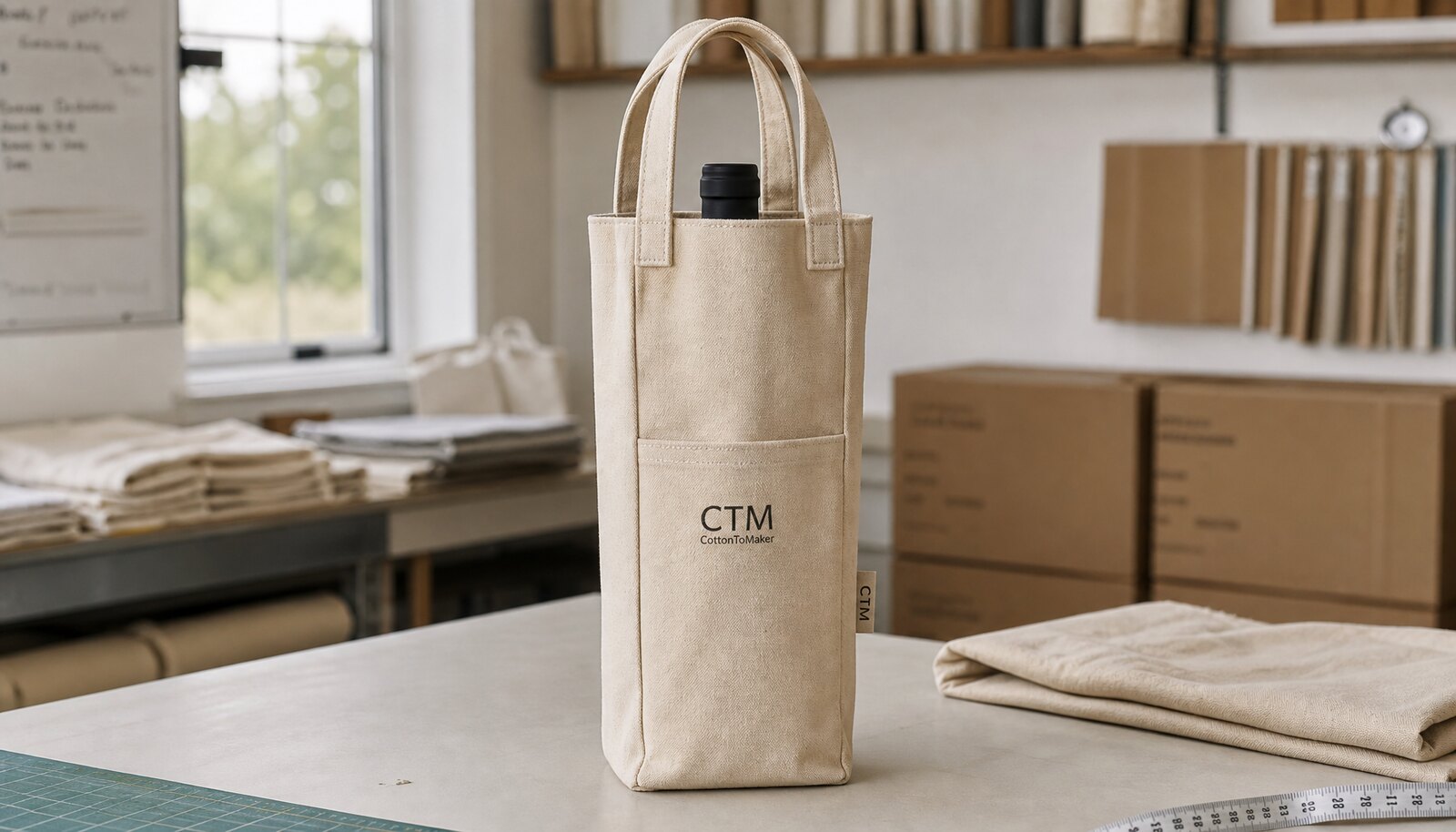
What gift-shop buyers actually need from a canvas wine carrier
Wholesale canvas wine carriers for gift shops are not generic tote bags with a bottle-shaped opening. The product has to do three jobs at once: carry a bottle safely, look polished enough to sit next to premium gifts, and stay inside a margin structure that still works after freight, cartons, and retailer markup. If one of those three breaks, the bag becomes a problem instead of a sales aid.
That is why the buying conversation should start with shelf context, not just dimensions. A gift-shop buyer needs to know whether the carrier will sit near greeting cards, gourmet baskets, holiday sets, or a wine bottle sold on its own. The merchandised environment affects how much structure, print quality, and handle finish the bag needs. A minimalist carrier can work well in a lower-priced shop. A more premium presentation usually needs heavier canvas, cleaner stitching, and a more intentional logo application.
The most common mistake is asking for a quote before the retail role is defined. A supplier can always find a cheaper way to make the bag, but that price may assume lighter fabric, looser sewing, or a packing method that hurts resale condition. When the buyer defines the retail job first, supplier quotes become easier to compare and the packaging plan stops being an afterthought.
There is also a difference between an item that must survive a short trip from shelf to checkout and one that will be used as part of the gift itself. For the first, you can usually keep the build simple. For the second, the outer appearance matters more because the carrier becomes part of the gift presentation. That affects fabric weight, handle finish, logo placement, and even the carton pack, because a bag that arrives creased or crushed no longer supports the shelf story.
- Define the shelf role first: low-ticket add-on, premium bottle presentation, or seasonal gift bundle.
- Use the target bottle type, not a generic bottle, when judging fit and handle stress.
- Treat the carrier as part of the gift presentation, not only as a transport sleeve.
- Ask whether the item is meant for immediate resale display or for secondary packing inside a gift basket.
Spec the body before you spec the logo
For many gift-shop programs, 12 oz canvas is the practical baseline because it gives enough body without pushing the bag into a cost tier that is hard to retail. If the carrier has to feel more premium in the hand, or if the end customer is likely to reuse it, 14 oz canvas is often the better commercial choice. Heavier cloth usually looks more substantial on shelf, but it also changes sewing resistance, fold behavior, and unit cost, so the decision should be intentional rather than automatic.
Fabric weight alone is not enough. Weave consistency, shrinkage allowance, and cut orientation all affect how the finished carrier hangs and how the print looks on the front panel. A bag that is nominally the right weight can still feel thin if the yarn is loose or if the supplier cuts against the stable direction of the fabric. Ask for both the oz and gsm target, then ask what tolerance the factory uses in incoming inspection and during final packing.
Construction should be simple unless the bottle or retail concept justifies more complexity. A single-layer body with a reinforced bottom panel is usually enough for a one-bottle gift carrier. Partial lining makes sense only when the bag needs abrasion control, a cleaner interior presentation, or a premium feel that the customer can notice when the bottle is inserted. Full lining is often unnecessary in this category because it adds labor, increases bulk at the seams, and raises the risk of packing distortion.
If you need a natural look, clarify whether you mean unbleached canvas with visible flecking or a cleaner, more consistent cloth. Buyers sometimes use the same phrase and imagine different textures. The sample should settle that discussion before bulk pricing starts. In practice, the right spec is the one that fits the retail shelf, not the one that sounds best in a short RFQ line.
- Start with 12 oz canvas for standard gift-shop programs, then move up only if the retail position supports the cost.
- Use 14 oz when you want more body, less wrinkling, or a more premium hand-feel.
- Ask for finished dimensions, not only cut size, so the sample matches the actual retail fit.
- Confirm whether the body should look natural, bleached, dyed, or washed, because that changes both appearance and cost.
Handles, seams, and reinforcement are where cheap quotes show up
A canvas wine carrier is carried by the handle and stressed at the seam. That makes reinforcement more important than decorative detail. A supplier may quote a bag that looks identical in the catalog, but the difference between a stable carrier and a weak one is often hidden in the handle attachment, stitch count, and reinforcement length. For procurement buyers, that means the quote must describe the construction method in plain language, not only show a photo.
Self-fabric handles create a clean canvas look and keep the style aligned with a simple gift-shop assortment. Cotton webbing handles are often better when comfort and carry strength matter more than visual minimalism. The right choice depends on how the bag will be used. If the carrier is mostly for a bottle transfer from shelf to checkout to home, a neat self-fabric handle is usually enough. If shoppers will carry the item longer or if the bottle is heavier, webbing is worth quoting. There is no universal winner; the better answer depends on route, load, and shelf position.
Ask the factory how the handle is anchored. Bar-tacks alone may be enough on a light carrier, but many buyers prefer a combination of box stitching and bar-tacks at the stress points. The goal is not to over-engineer the bag. The goal is to make the handle spec explicit so the factory cannot reduce reinforcement quietly while still claiming the bag matches the sample.
A useful quote request should also ask for handle width, handle drop, edge finishing, and the reinforcement length measured from the body. Those details sound small, but they affect comfort, visual balance, and failure risk. A handle that looks fine in a flat sample can sit too high on the shoulder, or too low in the hand, once the bottle is inside. Measured details prevent that mismatch.
- Quote the handle material, width, finish, and attachment method as separate line items.
- Request a measured handle drop so the carrier sits correctly in hand and on shelf hooks.
- Reject any sample that shows seam puckering, twisted handles, or uneven reinforcement on the first pass.
- If the bottle is heavy or the route is rough, move the handle choice toward webbing or stronger reinforcement.
Decoration choices: price, durability, and shelf presentation
For canvas wine carriers in gift shops, decoration is usually where the retail identity lives. Screen printing remains the most practical choice for repeat orders with one-color or simple two-color artwork. It is easier to control on textured canvas than more delicate decoration methods, and it usually holds up better through folding and consumer reuse. If the logo is small, restrained, and meant to feel like a brand stamp rather than a billboard, screen print is usually the cleanest option.
Heat transfer is useful when the artwork is still changing, the run is shorter, or the design uses more colors than a screen setup can justify. The tradeoff is durability. On rough canvas, a transfer can crack, lift, or look plasticky if the cure or pressure is wrong. That is not a theoretical concern. For gift-shop products that may be handled repeatedly, the finish needs to survive being folded, displayed, and carried out of store without looking worn before the consumer even uses it.
Embroidery can look premium, but it needs to be used carefully. It works best on small logos and on panels that have enough body to hold the stitches without pulling. If the logo is too large or the cloth is too light, embroidery can deform the front panel and make the carrier look uneven. Ask for the actual logo size, stitch density, and a photo of the finished sample under normal lighting, not a polished marketing image.
Decoration choice should also reflect how the bag is sold. A simpler one-color mark may be ideal for a store that wants an understated accessory. A richer decoration can make sense if the carrier itself is part of the premium story. Procurement teams should avoid over-decorating just because the supplier can do it. The right method is the one that survives use, stays readable, and keeps the purchase inside budget.
- Screen print is the safest starting point for repeat orders and stable unit cost.
- Heat transfer is better for short runs, but demand a wear-friendly sample before approval.
- Embroidery should be quoted only after the factory confirms the panel can hold the stitch load cleanly.
- Ask for cure method and wash-or-rub expectations if the bag is likely to be reused.
How to read supplier quotes without getting trapped by the headline price
A clean unit price is useful, but it is not enough. For this category, the quote needs to break out material, sewing, decoration, packing, sampling, and carton work so the real cost structure is visible. Two quotes that differ by only a few cents can still produce very different outcomes if one includes polybags, case marks, and carton reinforcement while the other does not. A procurement buyer should compare assumptions before comparing totals.
The direct factory versus trading company question matters because it affects visibility. A direct factory usually gives clearer answers on stitching, material sourcing, and packing labor. That helps when the buyer needs repeatability or wants to lock a packing plan. A trading company can still be useful for smaller or mixed-category programs, but then the buyer must verify that the maker, not just the intermediary, can produce the same spec consistently. The risk is not that trading companies are automatically bad. The risk is that they can be vague when the buyer does not push for the underlying production details.
Before accepting a quote, ask what the supplier has assumed about fabric roll width, print setup, carton size, and pack count. Those assumptions drive the true cost. If one quote assumes a 24-piece carton and another assumes 48 pieces, the freight and damage profile will differ even if the product price looks similar. When the assumptions are written down, the quote becomes an engineering document instead of a sales note.
A better RFQ also asks for exclusions. Does the price include carton artwork, master carton samples, polybags, hangtags, insert cards, or destination handling? What incoterms are quoted, and where does risk transfer? Those answers matter because a low ex-works number can become the most expensive option once origin charges, inland freight, or destination fees are added. The buyer should not need to discover that after the PO is issued.
- Separate product price from setup fees so the real margin impact is visible.
- Ask whether the supplier is quoting direct from factory, via a trading company, or through a consolidated export desk.
- Request the quote in the same structure every time: materials, decoration, sewing, packing, carton, and sample cost.
- Confirm incoterms and excluded charges before comparing suppliers.
MOQ should be read as a production setup decision, not a magic number
MOQ on a canvas wine carrier is rarely driven by the style alone. It is usually driven by color, print setup, and packing configuration. A natural canvas body with one logo version is easier to run than a dyed body with multiple print placements or mixed handle types. That is why the buyer should ask what creates the MOQ instead of focusing only on the final number. The number is a symptom; the setup cost is the cause.
The most useful negotiation question is simple: what would need to change to reduce the MOQ? If the supplier says the minimum falls when you keep one body color, one print screen, and one carton format, that is a constructive answer. If the minimum changes because the factory wants to avoid special handling or because the artwork requires an extra plate, the procurement team can decide whether the commercial tradeoff still works. That is a more practical conversation than pushing for a lower number without knowing what it costs the factory to comply.
For test orders, keep the program narrow. One body color, one logo, one handle spec, one carton pack, and one approved sample path. Multiple versions make the order more expensive in ways that are hard to see at first, especially when the buyer later asks for different art on the same production run. A good first order creates a repeatable baseline for reorder pricing and future retail planning.
There is also a scheduling angle. A higher MOQ may not be the problem if the supplier can commit to clean repeat production and stable carton packs. The real issue is whether the buyer can use the inventory before the season ends. For gift-shop programs, a smaller run that arrives on time is often worth more than a larger run that lands late.
- One body color and one logo version usually produces the cleanest MOQ.
- Each additional logo color or placement can add setup cost and slow approval.
- Mixed handles, dyed fabric, or special inserts usually push the order into a higher minimum band.
- Ask what operational change would reduce the MOQ instead of asking for a number in isolation.
Carton packing plan for wholesale canvas wine carriers for gift shops
Carton packing is where a lot of margin disappears quietly, because the buyer often notices only when goods arrive crushed, scuffed, or oversized for the rack. For wholesale canvas wine carriers for gift shops, the packing plan should protect the bag surface, the handles, and the carton cube at the same time. A flat-packed carrier is usually the best starting point because it reduces freight volume and makes count checks easier. The challenge is to fold the bag in a way that does not crease the logo panel or compress the handle reinforcement.
A practical packing spec should say how each bag is folded, whether printed surfaces are separated by polybag, tissue, or interleaf paper, and how many pieces go into each master carton. The right pack count depends on product thickness and route risk. For thicker 12 oz to 14 oz carriers, 24 pieces per carton can be a reasonable starting point because it keeps the case manageable and reduces compression risk. If the bag folds exceptionally flat, 36 to 48 pieces can work only when the carton size, board strength, total weight, and warehouse handling conditions have been checked together. A bigger count per carton is not a win if it crushes the handles or makes the case hard to lift safely.
Carton dimensions should be designed from the product thickness after folding, not from whatever carton size happens to be available. That sounds obvious, but it is where avoidable damage starts. Ask the supplier to provide the packed carton dimensions, gross weight, and the exact case mark format before production begins. If the order goes to a retail receiving team, include style, color, quantity, and country of origin in the case marks so cartons can be identified without opening them. If the program uses pallets, confirm the layer count and stack height so the carton has the compression strength to survive warehouse life, not just shipment from factory to port.
Board strength should match the route rather than a single generic spec. A carton that performs well on a short domestic move may not be enough for long sea freight, high stacks, or multiple handoffs. Instead of locking on to a single ECT number, ask the supplier to show the actual carton material, size, and filled weight, then align the board grade and closure method to the route. That is a more defensible buying method than repeating a number without context.
- Flat-pack the carrier only if the fold does not crease the logo panel or crush the handle attachment.
- Use tissue or poly separation when printed surfaces can rub during transit.
- Set carton size, carton count, and board strength before bulk production, not after packing starts.
- Confirm pallet pattern and stack height for export orders that will sit in warehouse inventory.
- Keep carton strength tied to route risk and filled weight rather than a fixed rule of thumb.
A side-by-side view of construction, decoration, and carton options
When sourcing this category, it helps to compare options in one place instead of reading supplier quotes line by line. The most useful comparison is not just price; it is the way construction, decoration, and packing interact. A lighter body with a simple print may be cheaper at the factory but worse in retail if it wrinkles or arrives crushed. A heavier body with a stronger carton may cost more up front but reduce defects and rework. That is why side-by-side comparison matters.
The table below is a procurement view, not a design fantasy. It highlights the tradeoffs buyers actually manage when they ask for samples, pack-out photos, and landed-cost estimates. It is also a reminder that the best option depends on route, shelf price, bottle weight, and the retailer’s tolerance for cosmetic variation.
Sample approval should measure fit, not just appearance
A sample that looks good on a table can still be wrong in use. For a wine carrier, the real test is how the bottle enters, sits, and exits the bag. The opening should not be so tight that it fights the bottle, and the body should not twist when the weight is added. If the carrier will sit on shelf as part of a gift set, it also needs to stand cleanly enough to look intentional rather than collapsed. Buyers should test the actual bottle type they plan to sell, not a random substitute from the office.
The sample process should include a simple measurement sheet. Record body width, body height, gusset, handle length, handle drop, print size, and seam location. Then compare those measurements to the approved drawing or supplier photo. A lot of disputes happen because the sample was approved visually, but the production line used a different allowance or a different fold. A measured record gives the buyer something concrete to reference if the bulk order drifts.
Keep a sealed gold sample and a photo record of the approved pack-out. That matters on reorder. Without a physical reference, the same style can come back with a different feel because the factory changed a fabric lot, altered the fold, or switched the print position by a few millimeters. Those changes may sound small, but in a gift-shop environment they are visible enough to matter.
Ask for two rounds of sample information if the first sample is close but not perfect. The first round should answer fit, structure, and decoration placement. The second should confirm the approved corrections before bulk production starts. That small discipline often saves more money than trying to fix everything at the carton stage.
- Use the actual bottle size that will be sold or gifted in the program.
- Measure the bag both flat and loaded, because shape changes under weight.
- Keep one sealed reference sample with the approved packing method attached to the project file.
- If the first sample is off, get the corrections in writing before approving the second sample.
QC needs measurable thresholds, not a general promise of good quality
Quality control for canvas wine carriers should be built around visible retail defects and functional failures. That means the inspection sheet needs severity levels, not vague language like good sewing or nice finish. A buyer does not need perfection in the abstract. The buyer needs a clear pass-fail standard that a third-party inspector, factory QC team, or in-house receiving team can apply the same way every time.
A practical setup is to define critical, major, and minor defects. Critical defects are the ones that make the bag unsellable or unsafe: broken handle, open seam, wrong logo, severe stain, or missing carton quantity. Major defects are issues that will trigger returns or visible complaints, such as print shift outside the tolerance, twisted body shape, weak reinforcement, or carton damage that affects resale. Minor defects are the cosmetic issues that may be acceptable if they stay within the agreed level, such as loose threads, slight shade drift, or tiny ink specks outside the logo area. The point is not to be lenient. The point is to make the standard enforceable.
If a third-party inspection is used, align the AQL target before production starts. Many buyers use AQL 2.5 for major defects and AQL 4.0 for minor defects as a starting point, but the final plan should match the buyer’s risk tolerance, seasonality, and channel. A holiday gift-shop order has less room for rework than a steady replenishment program. That is why the QC threshold should be agreed in writing before the first case is packed.
Acceptance should also include measurement tolerances. Do not leave dimensions in a yes/no format only. State the acceptable variance for body size, handle length, handle drop, and print placement, and define which defects fail immediately regardless of count. For some buyers, a centered logo is more important than a minor shade shift. For others, the carton condition is the top priority because the product is displayed in the box at receiving. The key is to name the priority before the inspection report arrives.
- Critical defects: broken handle, open seam, wrong artwork, heavy stain, missing piece, or unsafe carton condition.
- Major defects: print shift beyond tolerance, twisted body, poor reinforcements, or incorrect case count.
- Minor defects: loose thread, tiny marks, acceptable shade drift, or light cosmetic variation within the approved range.
- Use the approved sample and measurement sheet as the inspection reference, not the catalog photo.
- Set measurement tolerances in writing for body size, handle length, handle drop, and print placement.
Specification comparison for buyers
| Spec decision | Recommended starting point | When it fits | Buyer risk to check |
|---|---|---|---|
| Fabric weight | 12 oz canvas, or about 340 gsm, with a buyer-agreed tolerance of plus/minus 5 percent | Most gift-shop wine carriers where the bag must look sturdy but still price competitively | Too-light cloth can sag, show print strike-through, or lose shape after folding |
| Stitching and reinforcement | Lockstitch construction with a clear seam allowance, plus bar-tacks or box reinforcement at handle stress points | Standard one-bottle carriers where the body is simple and production speed matters | Sparse stitching can open at the seams; over-tight stitching can pucker the canvas and distort the logo panel |
| Handle material | Self-fabric handles for a clean retail look, or cotton webbing when comfort and carry strength matter more | Gift programs where the shopper carries the bottle by hand and sees the bag as part of the gift | Weak handle attachment is a common failure point; confirm handle drop, edge finishing, and reinforcement length |
| Bottom structure | Single-layer body with a reinforced bottom panel, or a partial insert if the bottle base needs extra protection | Everyday gift-shop use where the carrier only needs enough structure to stand and travel safely | A loose insert can slide in transit; an overbuilt base raises cost and can make the bag bulky at retail |
| Decoration method | 1-color screen print for repeat orders; heat transfer only if artwork is changing or multi-color; embroidery only for small premium logos | Brands that want a visible logo without overcomplicating the bag build | Heat transfer can crack on textured canvas; embroidery can pull the fabric if the panel is too light |
| Lining or insert | No full lining unless the carrier needs abrasion control or a premium interior finish | Simple one-bottle gift packaging at accessible price points | Full lining increases labor, adds bulk at the seams, and can push the item out of its target price band |
| Carton board | 5-ply export carton, then confirm carton strength against the actual filled weight and route risk; use a board spec that the supplier can state in writing | Orders that move by sea, sit in warehouse stacks, or are cross-docked through more than one facility | A carton that is strong on paper but weak in compression can crush handles and corners before retail receipt |
| Pack count per carton | Use a pack count that fits the product thickness and carton cube; 24 is often easier for thicker carriers, while 36 to 48 can work only when fold thickness, weight, and carton strength are proven | Programs that need a balance of freight efficiency and low handling damage | Overpacking raises compression risk; underpacking increases freight cost and carton count |
| Supplier route | Direct factory for spec control and repeatability; trading company only when you need category consolidation and can still verify the maker | Procurement teams buying at scale or running seasonal replenishment | A middle layer can hide sewing, carton, or QC assumptions unless the factory data is shown in writing |
Buyer checklist before sampling
- Confirm the finished bag size, bottle fit, gusset depth, handle drop, and target bottle weight before asking for price.
- Specify the fabric in oz and gsm if possible, plus the acceptable shade range for natural or dyed canvas.
- Send vector artwork, logo placement, print size, Pantone references, and whether the logo must stay visible when the bag is filled.
- Ask for a pre-production sample, then a sealed gold sample with measurements and packing photos for reorder control.
- Require carton packing details in the quote: pack count, carton dimensions, board strength, internal separation, case marks, and gross weight.
- Ask how the supplier folds the bag, whether printed surfaces touch, and what protects handles from compression.
- Build a landed-cost sheet that includes unit price, setup fees, sample charges, carton cost, inland freight, and expected air or sea freight.
- Confirm whether barcodes, hangtags, polybags, tissue, or insert cards are included or extra.
- Set inspection criteria in writing for stitching, print position, stain level, dimensions, carton quantity, and packing condition.
- Agree the in-hand date, not only the ship date, for seasonal gift-shop programs.
Factory quote questions to send
- What exact fabric weight, weave count, and shrinkage allowance are you quoting for the body and handles?
- Is the quoted canvas weight a finished target or a source-material estimate, and what tolerance do you allow in production?
- Which decoration method are you pricing, how many colors are included, and what setup fees or curing requirements are separate?
- What stitch density and reinforcement do you use at the handle and side seam, and can you show the seam spec in a sample photo?
- What is the MOQ by body color, print version, and carton configuration, not just by style number?
- Can you show the actual folded dimensions, handle drop, and a measured sample photo with a ruler or taped reference?
- What carton size, carton board spec, and pack count did you assume in the quote, and what changes if we want a different case pack?
- Are printed bags separated by polybag, tissue, or interleaf paper, and how do you prevent print-to-print rubbing?
- What sample charge, plate charge, carton artwork charge, and shipping cost should we expect before bulk approval?
- What is the production lead time after sample approval, what are the key approval gates, and what are the top two reasons this style usually slips schedule?
Quality-control points to confirm
- Fabric weight should match the approved spec within the agreed tolerance, and the buyer should reject cloth that is visibly underweight, too limp, or inconsistent across the lot.
- Seams should be straight and secure, with no open stitches, seam twisting, or obvious needle skip; check the handle area first because that is where failures show up earliest.
- Handle reinforcement should use consistent bar-tacks, box stitching, or another approved pattern, with no loose thread bundles, cut threads left long, or skipped reinforcement at stress points.
- Logo placement should stay inside the approved print window, with a centered appearance when the bag is filled; reject major shift, smearing, pinholes, or color bleed that changes the retail look.
- Color variation should be judged against the sealed gold sample or approved shade standard; define what batch-to-batch drift is acceptable and what requires rework.
- Dimensions should be checked after the bag is folded and after it is opened, because some carriers look correct flat but change shape when the bottle is inserted.
- Carton packing should prevent printed panels from rubbing against each other; reject cartons where the bag arrives scuffed, crushed at the corners, or visibly warped by over-compression.
- Set the acceptable defect rate before inspection starts. Many buyers use AQL 2.5 for major defects and AQL 4.0 for minor defects as a starting point, but the final sample plan should match the buyer’s own QA standard and route risk.
- Critical defects include broken handles, open seams, wrong logo, missing pieces, heavy stains, or carton damage that makes the product unsuitable for resale.
- Major defects include off-center print beyond tolerance, twisted body shape, uneven top edge, poor closure function, or carton count mismatch.