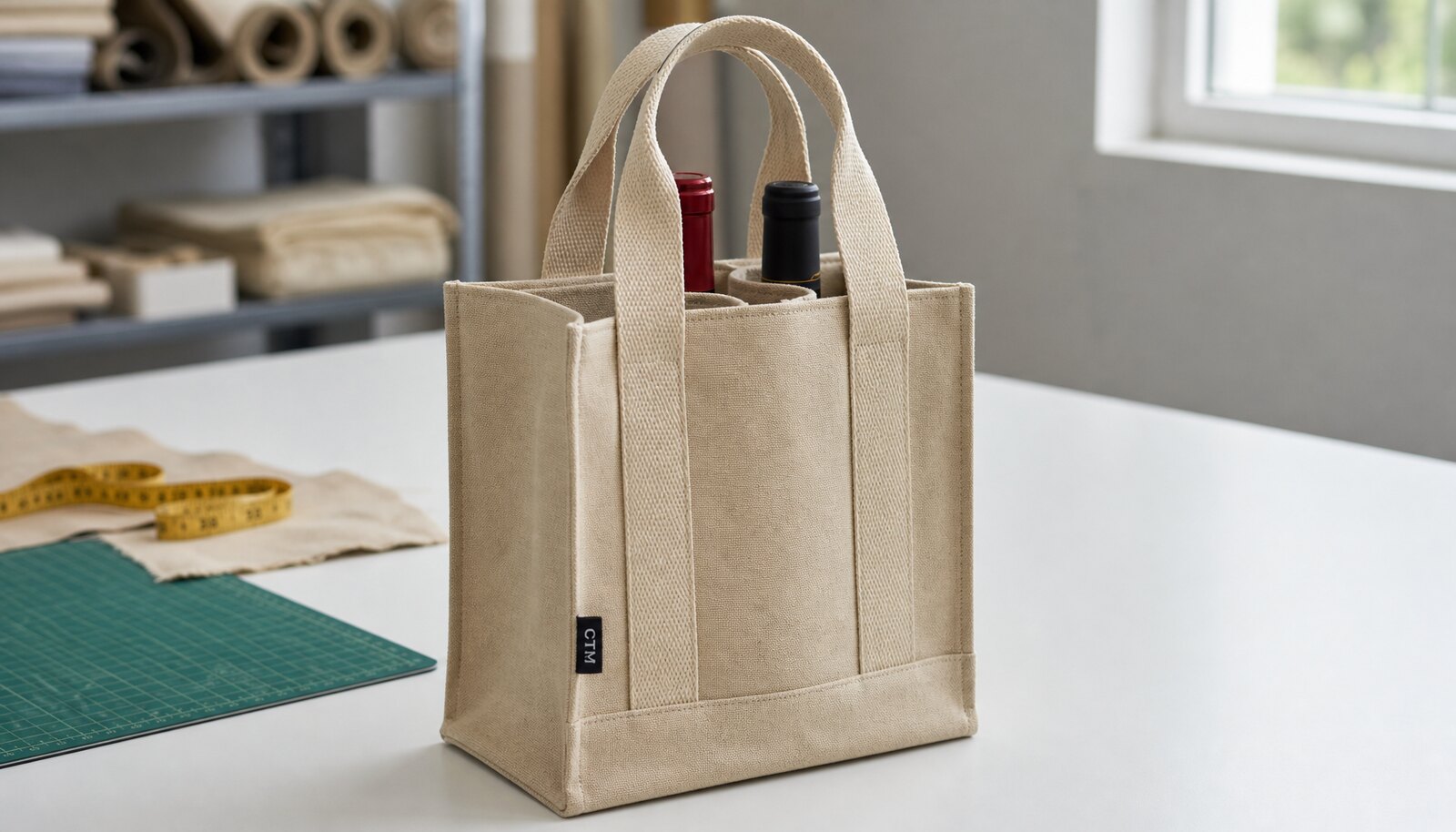
Why a canvas wine carrier RFQ needs more detail than a normal tote bag request
Canvas wine carriers look simple, but the buying risk sits in details that are easy to miss if the RFQ is too short. Gift shops sell these bags as part of the presentation, not just as packaging. The product has to protect the bottle, look neat on shelf, feel sturdy in the customer’s hand, and arrive packed in a way that avoids scuffs, wrinkles, or mixed SKUs. If your inquiry only says “canvas wine bag,” suppliers will quote different constructions and you will not be comparing like for like.
A stronger RFQ does three jobs at once. First, it defines the functional fit: what bottle the carrier must hold and how the handle should perform. Second, it defines the commercial scope: whether the price includes print, label, carton packing, and sample approval. Third, it defines the acceptance standard so the factory knows what will be checked when production is inspected. That is the difference between a shopping inquiry and a procurement brief.
For wholesale buyers, the goal is not to make the RFQ long for the sake of length. It is to make the RFQ specific enough that the supplier can price the same item you intend to receive. The more the order depends on gift presentation, the more the details matter. A retail buyer who wants a reusable premium carrier will tolerate neither vague print wording nor unclear fabric weight. A chain-store program will also expect more traceability, better carton control, and cleaner sample signoff than a one-off promotion.
Start with the bottle fit and end use before you discuss fabric
The first thing a supplier needs to know is the bottle profile. A standard 750 ml wine bottle is not the same as a champagne bottle, a taller imported spirit bottle, or a bottle with a wide shoulder. If the carrier is too tight at the neck or too short at the top, the product becomes annoying at retail and can even damage the bottle finish during repeated insertion and removal. If it is too loose, the bag looks cheap and slouches when displayed.
The RFQ should specify whether the carrier is for one bottle or two, whether it needs a divider, and whether the bag must stand upright. These points affect the pattern, seam layout, base width, and handle placement. They also change the amount of canvas used per unit. A simple flat sleeve is cheaper, but a structured carrier with a gusset or base insert is more shelf-friendly and usually more suitable for gift shops that care about presentation.
It helps to include the actual bottle dimensions if you have them: height, maximum diameter, shoulder width, and neck diameter. Even if the supplier has made similar carriers before, do not assume their reference bottle matches yours. For buyers who work with multiple wineries, spirits brands, or seasonal bottle formats, the safest approach is to name the largest bottle profile the bag must fit and ask the factory to confirm the finished internal clearance in writing.
Fabric choice, finish, and hand feel: where most price differences start
Fabric weight is one of the biggest cost and quality drivers in this category, but it should not be discussed in isolation. A 12 oz canvas can be perfectly acceptable for a low-cost retail item or a promotional pack, while a 14 oz to 16 oz canvas often delivers the more premium look and better shape retention that gift shops expect. The right choice depends on where the carrier will sit in the assortment: entry-level checkout item, mid-tier gift accessory, or premium reusable bag.
Ask for finished fabric weight, not only the nominal base cloth weight. Washing, dyeing, coating, and finishing can change the feel enough that two quotes with the same “canvas” description are not actually comparable. A buyer should also ask whether the fabric is bleached, natural, dyed, pre-washed, or surface-treated, because these choices affect print sharpness, color consistency, and the risk of shrinkage after production. If the bag must remain neat after folding and carton pressure, that matters more than the headline oz number.
Another useful spec is the visual uniformity of the canvas. Some lower-cost fabrics have heavier slub, uneven weave, or patchy dye uptake. That might be acceptable for a rustic gift aesthetic, but not for a polished shelf program. If your retail customer expects a clean premium look, ask the supplier to show fabric photos under neutral light and to confirm whether the bulk lot will be from one dye batch or multiple lots. That gives procurement a better basis for comparing risk as well as price.
Construction choices that change durability and retail appearance
The construction is where a wine carrier stops being “just a pouch” and becomes a reusable gift item. Key decisions include whether the bag has side gussets, a flat or boxed base, a divider for two bottles, and what kind of top edge finishing is used. A clean top hem improves appearance, but a raw or loosely finished edge can fray and make the item look unfinished once it is handled in-store. If the product is sold with a gift bottle, these details become part of the perceived value of the whole bundle.
Handle construction deserves special attention. Cotton webbing handles are common because they are comfortable and easy to reinforce. Self-fabric handles can look more coordinated but may need more stitching and can feel softer under load. The important commercial question is not only what material is used, but how it is attached. Ask for the handle width, attachment length, bar-tack count or dense stitch pattern, and whether the handle has been tested in a loaded carry condition. If the supplier cannot describe that clearly, their process control is probably weak.
Gift shops also care about how the bag behaves on shelf and in the customer’s hand. A carrier that stands upright can merchandise better, but it requires a more controlled base and stitching sequence. A very soft bag may be easier to fold and store, but it can wrinkle easily and look less valuable. This is why the RFQ should include the intended display method: hanging, folded, or standing. That one line helps the factory choose the right pattern and helps procurement avoid a quote that looks good on paper but does not match the retail plan.
Print method, artwork control, and what to specify in the RFQ
For most wholesale canvas wine carriers for gift shops, decoration is a major part of the buying decision. A one-color logo, a simple holiday message, or a short seasonal graphic is usually best suited to screen print. Screen print is often the most stable choice for repeat programs because the setup is straightforward and the cost per piece can remain attractive at volume. However, if the artwork is highly detailed or the run is very short, another method may be more practical.
Heat transfer and digital print have their place, but they should be selected deliberately. They can reduce setup complexity when the order has many artworks, but they can also introduce surface feel changes, cracking risk, or color inconsistency on coarse canvas. If you choose them, ask the supplier for a durability sample on the exact canvas construction you plan to buy. That matters because a print that looks acceptable on one fabric can behave differently on a heavier or more textured cloth.
The RFQ should define the decoration in procurement language, not in marketing language. State the number of colors, the exact print area, the position on the bag, and the color reference if one exists. If the artwork is seasonal or tied to a brand standard, attach a vector file and a Pantone target. Also say whether front and back decoration are both required. Many quote disputes happen because one supplier priced a single-side print while the buyer expected mirrored or dual-side decoration.
MOQ logic: how factories actually set minimums on this item
MOQ on canvas wine carriers is rarely just a simple piece count. In practice, factories are balancing fabric booking, cutting efficiency, print setup, sewing time, and carton packing. That means the same bag can have very different minimums depending on whether the buyer wants natural canvas, dyed fabric, one color, three colors, one SKU, or five seasonal variations. A low headline MOQ may hide the fact that the unit price rises sharply when the order is split across multiple artwork versions.
For procurement, the best way to request MOQ is by production combination. Ask for a minimum by fabric color, print version, and pack format. If the factory offers a flexible MOQ, ask what changes when you move from a blank carrier to a printed one, or from a one-carton sample order to a multi-SKU assortment. This gives you a clearer view of real cost behavior and avoids comparing a single small-run quote to a bulk-program quote.
This is especially important for gift shops that replenish across seasons. If you expect to reorder the same base style with new artwork, it may be better to standardize the base bag and vary only the print. That keeps the sewing setup stable, makes the factory easier to manage, and reduces the risk of leftover inventory. But if your brand uses distinct colorways or premium trims, you should ask the supplier how much the MOQ and setup cost move with each version so you can decide whether the assortment is commercially sensible.
Compare supplier routes with evidence, not assumptions
A factory-direct manufacturer, a trading company, and a sourcing agent can all quote the same canvas wine carrier, but they do not bring the same risk profile. Factory-direct sourcing usually gives the buyer more control over sewing, print, and packing because the production steps sit closer together. That often helps with repeat orders and QC ownership. Trading companies may be easier to work with when you are testing a category or need broader product coordination, but they can also make it harder to see the real process owner if a problem appears.
Do not decide on route by price alone. Ask each supplier to show recent photos of the exact style or a very close style, plus a packing image and a brief process description. You want to know whether the sewing is in-house, whether print is handled internally or outsourced, and who signs off on final inspection. If a supplier cannot clearly explain the stitch pattern, the fabric source, or the packing sequence, they are unlikely to control the final quality tightly enough for a retail gift item.
A useful qualification step is to request the names of the documents they can provide before shipment. A serious supplier should be able to offer a product spec sheet, order confirmation, carton list, and inspection record. For larger orders, ask whether they can support a video review of the pre-production sample and a pre-shipment inspection by the buyer or third party. Those are practical indicators of whether the supplier can support a procurement program instead of only a one-time sale.
A more useful sourcing comparison: the routes, the tradeoffs, and the questions to ask
The table below is more useful than a simple spec list because it helps buyers choose a sourcing route based on order pattern, not just product features. For wholesale canvas wine carriers for gift shops, the wrong supplier type can create avoidable rework. A low-volume seasonal buyer may not need the same factory structure as a chain buyer with repeated replenishment, and a premium brand program should not be evaluated with the same tolerance as a price-led promotional order.
Use this comparison to decide where you need control and where you can accept flexibility. If your assortment changes often, you may value a supplier that can move quickly on artwork. If your business depends on stable reorders, you should favor process control, repeatability, and better documentation even if the quote is not the lowest.
QC thresholds that are specific enough to be useful in procurement
Quality control is where many RFQs stay too general. Saying “good quality” does not help a factory know what to reject or what to correct. For canvas wine carriers, the most common failures are straightforward: wrong size, weak handle anchoring, print misalignment, poor trimming, and cartons that do not match the packed quantity. The way to reduce those risks is to turn each one into a measurable check.
Start with dimensions. Agree the target measurements and the tolerance before production begins. For small fabric items, many buyers use a practical tolerance in the range of +/- 0.3 to 0.5 cm on critical dimensions, but your standard can be tighter if the bottle profile is narrow or the retail presentation is premium. Then define print registration. For simple logos, a small positional variance may be acceptable, but the art must still sit square and clean on the approved panel. If the logo is brand-sensitive, ask the supplier to mark the print placement on the sample and keep that same reference for bulk.
Handle strength is another area where visual inspection is not enough. Ask the factory how they test the attachment points. Even if you do not insist on a laboratory certification, you should want a documented check on the sample and an in-process audit of the stitch pattern. A simple commercial benchmark for a single-bottle carrier is that the handle and seam area should hold a filled 750 ml bottle without the anchor stitches opening or the top edge deforming. If you are ordering a premium product, ask the supplier to document the test load and test duration they use internally so both sides have the same expectation.
For larger orders, use an AQL-based inspection plan instead of a loose pass/fail review. Many buyers start with AQL 2.5 for major defects and 4.0 for minor defects, then tighten the criteria for retail chain programs or brand-sensitive launches. That framework is useful because it separates critical issues, such as the wrong artwork version or a broken handle stitch, from minor cosmetic issues, such as a small fold mark that does not affect use. Most importantly, ask the supplier to record the inspection checkpoints: incoming fabric, sewing line, print check, final packing, and carton count. When those checkpoints are written into the PO or quality agreement, the factory is more likely to manage them seriously.
Sample approval: what the buyer should inspect before releasing bulk
The pre-production sample should be treated as the production standard, not a courtesy item. It should use the final fabric, the final decoration method, the final handle material, and the final label or side tag. If any of those are substituted, the sample can still be useful for shape review, but it should not be used to approve the full production run. This is where many buyers get caught: they approve a neat-looking sample made from substitute cloth and then receive bulk goods that behave differently under stitching or printing.
When you review the sample, inspect it the way a customer will use it. Insert the intended bottle, check the top clearance, test the handle grip, and confirm that the carrier sits as expected when empty and when filled. If the bag is meant to be a gift item, also check whether it folds neatly, whether the print remains readable after handling, and whether the edges look clean under normal store lighting. A good sample should look good not just in a photo but in the hand.
Document the approval. Write down what was accepted, what needs correction, and what the supplier must repeat exactly in bulk. If you need a second sample after revision, label it clearly as revised approval, not as a new idea. That avoids confusion later if the factory says the carton count, label placement, or base shape followed a different version. For branded programs, this documentation is part of the commercial control record, not just a design preference.
Specification comparison for buyers
| Buying option | Best-fit use case | Cost / quality tradeoff | What to ask before you choose |
|---|---|---|---|
| 12 oz canvas with one-color screen print | Entry-level gift shop assortment, promo bundles, lower shelf price point | Lowest fabric cost and simpler production, but the bag may feel softer and show shape variation after packing | Ask for finished GSM, actual print coverage, and whether the bag still stands neatly after folding and carton compression |
| 14 oz to 16 oz canvas with reinforced handles | Core gift shop SKU where presentation and repeat handling matter | Higher unit cost and slightly more carton weight, but better shape retention and a more premium hand feel | Ask for handle anchor stitch pattern, seam allowance, and whether the fabric has been tested on the final bottle size |
| Gusseted carrier with structured base | Retail display programs and premium gifting where shelf presence matters | More sewing steps and higher labor cost, but improved bottle stability and stronger perceived value | Ask for base width, gusset depth, and whether the bag can stand without tipping on a retail shelf |
| Heat transfer or digital print on canvas | Short runs, frequent artwork changes, multicolor seasonal designs | Lower setup flexibility but potentially higher risk of cracking, fading, or surface mismatch on coarse canvas | Ask for wash/rub durability, print edge definition, and a physical sample on the same finished canvas |
| Factory-direct quote with in-house sewing and printing | Buyers who want tighter spec control, better reorder consistency, and clearer QC ownership | Often the best route for repeat programs, though sample discipline matters more and communication may be less flexible than a trader | Ask for process photos, in-house capability evidence, and who signs off on cutting, printing, and final inspection |
| Trading company or sourcing agent | Small programs, mixed product baskets, or buyers needing simpler coordination | Can be easier to manage early, but may hide the actual factory and make defect escalation slower | Ask for the true factory name, quality responsibility split, and whether the same factory will repeat the order on reorder |
Buyer checklist before sampling
- Confirm the bottle profile first: standard 750 ml wine bottle, champagne-style bottle, or taller spirit bottle, because neck height and base width drive the finished pattern.
- Specify finished canvas weight in oz or GSM and state whether you want unwashed, washed, dyed, or finished canvas.
- Define the exact carrier construction: open top, single-compartment, divider for two bottles, gusset depth, base insert, and whether the bag must stand upright on shelf.
- State handle material, width, drop length, reinforcement method, and expected load use case.
- Lock the print spec: print method, number of colors, placement, maximum print area, Pantone references, and whether front and back decoration are both required.
- Ask the supplier to identify whether the quote includes cutting, sewing, printing, labeling, polybagging, carton marks, and export cartons.
- Request a pre-production sample made with the final fabric, final print method, and final label or side tag, not a substitute material.
- Require carton dimensions, inner pack count, gross weight target, and palletization rules if applicable.
- Set acceptance criteria for dimension tolerance, print registration, stitch appearance, and allowed defect types before bulk production starts.
- Ask for compliance documents and factory evidence, especially when the order is for a chain retailer or cross-border shipment.
Factory quote questions to send
- What is the finished fabric weight after finishing, and can you quote the exact cloth specification by lot or construction type?
- Is the price based on a blank bag, printed bag, or fully packed retail unit with label and polybag?
- What is the MOQ by fabric color, print version, and carton configuration, and do mixed SKUs change the minimum or the unit price?
- What handle material is included, what is the stitch pattern at the anchor points, and what pull-force test standard do you use in production?
- What dimensions are guaranteed for the finished bag, and what tolerance do you allow for width, height, base depth, and handle placement?
- Which print method are you using for this artwork, how many setup steps are required, and what happens if the buyer changes one Pantone or one logo line?
- Can you provide photos or video of the actual production line for cutting, sewing, printing, and final packing?
- What documents can you supply with the order, such as material spec sheet, inspection report, carton list, and compliance declarations if requested?
- What is the sample approval process, how long does each step take, and does production start only after written sample signoff?
- If a defect is found in bulk, what is your rework, replacement, or credit process, and who pays for reinspection or reshipment?
Quality-control points to confirm
- Finished dimensions should be checked against the approved spec with a written tolerance, commonly +/- 0.3 to 0.5 cm on key dimensions for small carriers, unless the buyer requires tighter control.
- Handle anchor points should use consistent bar-tack or dense reinforcement stitching, with no skipped stitches, loose ends, or puckering around the seam.
- For single-bottle carriers, perform a load check on the handle and seam area with a filled 750 ml bottle and confirm the bag does not distort at normal carrying weight; for higher-value programs, ask the supplier to document the test method used on your sample.
- Print registration should be checked on the same finished canvas planned for bulk, with visible edges aligned to the approved artwork and no smearing, cracking, or color banding under normal indoor light.
- If the product is sold as a premium gift item, add a visual acceptance rule for trim quality: no visible oil marks, broken threads, misaligned labels, or uneven topstitching in the first inspection sample.
- Use an inspection plan that separates critical, major, and minor defects so both sides know what triggers rejection; for example, a missing handle stitch or wrong artwork version is critical, while a slight fold mark may be minor if it does not affect retail presentation.
- Ask for an AQL-based pre-shipment inspection if the order is large or time-sensitive; many buyers use AQL 2.5 for majors and 4.0 for minors as a commercial starting point, then tighten the standard for chain retail programs.
- Require carton verification at the end of packing: correct SKU, correct quantity, no mixed colors unless approved, correct barcode or outer mark, and no crushed product caused by overfilled cartons.