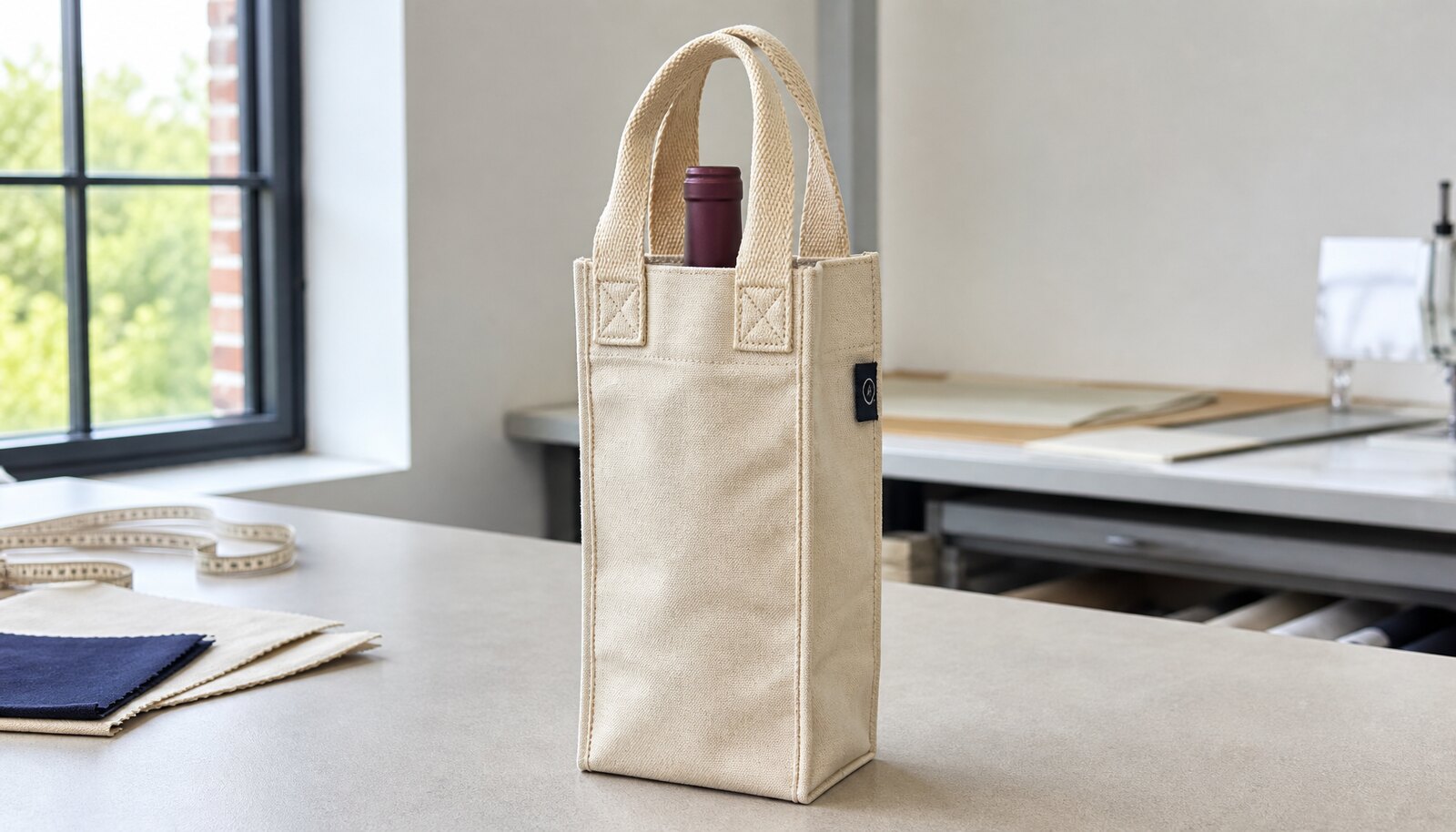
Start with the bottle profile, not the bag
The fastest way to miss MOQ on wholesale canvas wine carriers for gift shops is to request a generic bag before the bottle spec is settled. A gift-shop carrier is not just a pouch. It has to fit the exact bottle family you sell, survive repeated handling on a retail floor, and present cleanly next to candles, glassware, and gift sets. A standard 750 ml Bordeaux bottle, a taller Burgundy bottle, and a square olive-oil bottle have different shoulder shapes, neck heights, and center-of-gravity points. If that is not defined early, the supplier will quote a generic pattern that may look acceptable in a rendering but fail in real packing.
The RFQ should describe the commercial use case in plain terms. If the carrier sits near premium gifts and is expected to hold shelf value, ask for cleaner stitching, a stable base, and a front panel that keeps the logo readable from arm's length. If it is a seasonal add-on near checkout, a lighter build may be acceptable as long as the bottle fits securely and the carrier does not collapse when picked up. Buyers get better pricing when the factory knows whether it can reuse an existing pattern or must create a new one.
For procurement, the bottle profile also determines your acceptable scrap rate and your packaging strategy. A carrier that fits too tightly causes seam stress and higher reject rates. A carrier that is too loose can look cheap on shelf and reduce perceived quality. The best first-order spec is usually one that protects fit first, then optimizes decoration and packing around that fit.
- State the bottle type, volume, and maximum dimensions in the RFQ.
- Specify whether the carrier is for gifting, retail carry, or promotional bundling.
- Include the shelf price target if the factory needs to protect margin with a simpler build.
Use construction choices to set a realistic MOQ band
MOQ is not a single number. It is the result of fabric booking, pattern setup, decoration, trimming, and packing. A factory can often keep MOQ lower when the bag uses a standard body pattern, one canvas color, and one decoration location. The minimum usually rises when you add a custom gusset shape, dyed canvas, a second print location, or a retail pack that requires more labor per unit. For buyers, the practical question is not just "what is your MOQ?" but "what construction do I need to stay inside a target MOQ band?"
A useful planning range for gift-shop programs is as follows. For a stock pattern in natural canvas with one-color print, 300 to 800 pieces is often a realistic starting point. Add dyed canvas and the minimum commonly moves into the 500 to 1,200 piece range because color booking and shade control create extra material risk. Once the design becomes a custom pattern, 800 to 2,000 pieces is a more realistic conversation because the factory must absorb setup and approval work. If you ask for multi-color print plus retail packaging, the practical MOQ can move to 1,000 to 3,000 pieces even when the bag itself is not complicated.
The right way to negotiate is to simplify the SKU before trying to force a low MOQ. Remove unneeded trim, reduce the print area, or switch from custom dyed body fabric to standard natural canvas. This gives you a lower minimum without damaging the bulk order's repeatability. A low MOQ achieved by cutting too many corners usually creates a problem on the second order.
- Natural canvas + stock pattern + one-color print is the easiest path to a lower MOQ.
- Dyed canvas, custom patterning, and multi-color decoration each raise the minimum.
- Ask the supplier to separate pattern setup from fabric booking and decoration setup.
Compare supplier routes by landed cost, not by quoted unit price
A quote that looks low can still be expensive after setup fees, sample charges, carton changes, or freight inefficiency are added. For procurement buyers, the right comparison is landed cost per saleable unit. That means EXW or FOB price plus sampling, packing materials, carton volume, inspection, and the cost of any rework if the first sample misses the mark. A trading company may quote a lower MOQ, but if the price includes extra handling or hidden fees, the landed cost can end up higher than a direct factory order.
Direct factory sourcing usually makes more sense when you expect repeat volume and the build is simple enough to control tightly. You get better visibility into fabric weight, stitch quality, and production scheduling. Trading companies can still be useful when you need mixed product consolidation or sourcing support, but they are rarely the best place to hide specification uncertainty. For a buyer, the key is to compare routes on the same spec and the same packing assumptions.
A carton example makes this concrete. If one supplier packs 50 units into a 58 x 38 x 42 cm carton and another needs 36 units because the bag is bulkier or overpacked with inserts, the lower unit price may disappear in freight. The same logic applies to gross weight. If the quote does not show carton dimensions and pieces per carton, the comparison is incomplete.
- Compare EXW, FOB, and delivered cost on the same carton assumptions.
- Include sample fees, label fees, and inner pack changes in the comparison.
- Treat carton size and gross weight as part of the unit economics.
Choose canvas weight and finish based on shelf price and defect risk
Canvas weight drives feel, structure, print clarity, and cost at the same time. For gift-shop wine carriers, 10 oz to 12 oz is usually the lower-cost entry range. It works for promotional programs and lighter retail use, but the bag can feel soft if the base is not reinforced. 12 oz to 14 oz is the most balanced range for many gift-shop assortments because it gives enough body for a premium look without making the carrier unnecessarily heavy. 16 oz and above creates a stronger, more structured feel, but fabric cost, sewing time, and carton weight rise quickly.
Finish matters almost as much as weight. Natural canvas often gives the cleanest value-to-cost balance, but it can vary by lot in shade and texture. Dyed canvas improves shelf presentation when color is part of the brand story, but buyers need to budget for color matching and dye lot control. Prewashed or softened canvas can improve hand feel, but that can add process cost. Buyers should ask whether the quote assumes bleached, dyed, prewashed, or greige fabric, because those choices affect both minimums and appearance.
The right spec is the one that matches the shelf price. If the product sells at a modest retail price, a heavy build may overconsume margin. If the carrier is part of a premium gift set, a thicker body and cleaner top hem can justify the extra cost. The goal is not the heaviest canvas available. The goal is the most defensible build for the target retail price.
- 10 oz to 12 oz: lower cost, softer hand, acceptable for entry-level gift-shop programs.
- 12 oz to 14 oz: balanced choice for most wholesale canvas wine carriers.
- 16 oz and above: premium look, stronger structure, higher freight and sewing cost.
Treat decoration as a sourcing decision, not a design afterthought
Decoration often drives MOQ as much as the bag structure. One-color screen print on heavy canvas is usually the cheapest and most repeatable option because setup is stable and the result is durable. That is the right starting point for most branded gift-shop carriers. If the artwork has fine lines, gradients, or several colors, you may need a transfer method or a different print process, but that should be a deliberate sourcing choice with a signed sample, not a default factory suggestion.
The key question is how much brand value the decoration actually needs to create. A clean one-color logo on the front panel plus a woven side label often gives enough retail identity without turning the order into a custom art project. If the design needs multiple colors, buyers should ask whether each color requires a separate screen, a separate setup charge, or a longer drying cycle. Those details affect both the quote and the MOQ.
For a procurement team, the right tactic is to narrow decoration scope before negotiating price. Reduce the number of print colors, keep the logo in one location, and avoid wrapping artwork across both sides unless it materially improves shelf conversion. Decoration simplification is one of the most reliable ways to lower price without lowering quality.
- Use screen print for simple logos and repeat runs.
- Reserve transfer or digital methods for artwork that screen print cannot reproduce cleanly.
- Keep the print area fixed so reorders can reuse the same setup and proof.
Use packing and carton math to protect freight budget
Packing is not a minor detail. It changes labor, carton volume, and the number of saleable units you can move per shipment. A bulk-packed carrier is cheaper to pack and often cheaper to ship, but your warehouse or retailer has to handle the final assembly or presentation. An individually polybagged carrier is more retail-ready and better protected, but it adds materials and usually increases carton volume. The right answer depends on whether the product goes straight to the shelf, into a distributor warehouse, or into a kitting operation.
Buyers should insist on carton data before approving a quote. Ask for pieces per carton, carton dimensions, and gross weight. Those numbers let you estimate CBM, compare freight efficiency, and determine whether the carton is strong enough for export handling. A small change in carton size can create a large freight delta over a full order. This is especially important for 16 oz or reinforced builds, where the bag itself may be good but the packaging becomes the cost driver.
A useful rule is to compare cost per saleable unit rather than cost per piece. If a supplier offers a slightly lower unit price but the carton count drops sharply, the shipping cost may erase the saving. For gift shops, the most reliable procurement choice is often the one that balances retail presentation with a compact carton plan.
- Choose between bulk pack, individual polybag, or shelf-ready pack before quote comparison.
- Request carton dimensions and gross weight in the first RFQ round.
- Check whether retail labels, barcode stickers, and hangtags change carton count or carton size.
Write QC tolerances that a factory can actually build to
QC guidance only helps if it can be measured. For canvas wine carriers, the order sheet should define dimensional tolerances, stitch expectations, print placement, and bottle fit. A practical dimension window is usually more useful than an exact size, because sewn textile products naturally vary. For many buyers, plus or minus 0.5 cm is a reasonable tolerance for smaller dimensions and plus or minus 1.0 cm for larger bag dimensions, unless the style or bottle fit requires tighter control. The key is to state the window on the PO and on the approval sample.
The inspection plan should also describe defect thresholds. Loose threads longer than 3 mm, open seam ends, broken bar-tacks, or obvious skipped stitches should be treated as defects, not cosmetic noise. Print misregistration should be measured against the approved artwork position, with a tighter window for centered logo work and a slightly wider one for larger decorative art. If the carrier includes a label, the label should be straight, secure, and not obstruct retail barcodes or care information.
For function, the most important test is bottle fit. The approved bottle should insert without forcing, and the top opening should not distort the side seams. If the product includes a reinforced base, the bag should stand or fold the same way across samples. QC is not about rejecting every minor imperfection. It is about defining the threshold where the product stops meeting the commercial job.
- Specify fabric weight tolerance, commonly plus or minus 5 percent unless negotiated tighter.
- Use a clear measurement window for width, height, gusset, and handle length.
- Define what counts as a defect: broken stitches, open seams, print bleed, label tilt, or failed bottle fit.
Separate sample approval from bulk approval
A sample is only useful if the sample stage is clearly separated from bulk production. The buyer should approve the exact fabric, trim, print method, packing style, and carton spec before the factory starts full production. If the approval sample is made from one fabric and bulk is switched to another, the sample loses most of its value. The approval process needs a named reference sample, a photo record, and a written list of what is locked for the order.
There are usually three useful sample stages. First is a development sample, which confirms the construction and bottle fit. Second is a pre-production sample, which should match the final materials, print, and packing. Third is a sealed approval sample retained by both sides for comparison during production or inspection. If a factory does not want to split those stages, the buyer should be cautious because small unresolved differences tend to show up in the bulk lot.
For higher-confidence orders, ask the supplier to confirm what will change after sample signoff. This can include carton marks, inner pack materials, or minor packaging items. Anything not documented may be changed later to save cost. A strong approval process prevents the most common problem in textile sourcing: the bulk lot is technically close, but commercially different.
- Keep one signed reference sample with date, photo, and measured dimensions.
- Do not approve bulk until final fabric, print, and packaging are all represented in the sample.
- Record any approved deviations so they do not become surprises on reorder.
Negotiate MOQ by trading complexity for repeatability
The cleanest MOQ negotiation is not a price squeeze. It is a trade between complexity and volume. If you need a lower minimum, remove the features that force extra setup. Use one body color instead of mixed colors, one print location instead of two, and standard packing instead of custom retail assembly. When the build is simple, a factory is more willing to accept a smaller order because the chance of waste and rework is lower.
If the brand needs one premium element, keep that element and strip out the ones that do not change sell-through. A woven side label may add more shelf value than an expensive interior finish that no buyer sees. A reinforced base may matter more than a complex two-sided print. The goal is to spend the budget where the shopper notices it and save it where the retailer does not.
For repeat programs, the first order should be treated as a validation run. Ask the supplier to hold the exact approved spec so the reorder is comparable. If the first order sells through, the second order is where buyers can usually negotiate better unit cost or lower setup charges because the factory sees a repeatable SKU instead of a one-off request.
- Simplify the build before asking for a lower MOQ.
- Keep one feature that supports retail value and remove features that do not.
- Use the first order to prove the spec, then negotiate the reorder from a stronger position.
Build the RFQ so quotes are actually comparable
A quote only helps if every supplier is answering the same question. The RFQ should ask for fabric weight, weave, finish, dimensions, bottle fit, decoration method, packing format, carton data, lead time, and sample cost. If one supplier includes a hangtag and another does not, the unit prices cannot be compared fairly. Procurement teams often lose time by comparing incomplete quotes that hide differences in setup, packing, and carton efficiency.
The best RFQ format is a short data sheet with must-have fields and a clear line for optional add-ons. That lets the factory price the core SKU first and then show the cost of extras such as woven labels, barcode stickers, or individual polybags. Buyers can then compare a base model against a slightly upgraded version and decide whether the premium is worth paying. This is more useful than asking for one all-in quote and trying to reverse-engineer the differences.
A disciplined RFQ also shortens the back-and-forth. If the supplier has the bottle dimensions, target MOQ, decoration size, and packing requirement up front, the first quote is usually much closer to reality. That saves time and gives you a better basis for negotiation because the factory cannot later claim that the price assumed a different spec.
- Request base price and add-ons separately.
- Ask for carton size, gross weight, and pieces per carton in the first reply.
- Require the supplier to identify any MOQ driver, such as dyeing, setup, or packing labor.
Specification comparison for buyers
| Sourcing route or build | Typical MOQ band | Expected unit-cost effect | Best use case | Buyer risk to check |
|---|---|---|---|---|
| Stock pattern + standard natural canvas + one-color print | 300-800 pcs | Lowest setup burden; usually the best starting point for first orders | Test program for gift shops, seasonal promotions, or a new SKU launch | Stock availability can mask lot-to-lot variation in shade, hand feel, and dimensions |
| Stock pattern + dyed canvas + one-color print | 500-1,200 pcs | Fabric dyeing usually adds a meaningful premium versus natural canvas | Brand color matters and the program has enough volume to justify color control | Dye lots can vary if lab dips and bulk approval are not locked before production |
| Custom pattern + standard canvas + one-color print | 800-2,000 pcs | Tooling and pattern setup raise the minimum, but repeat orders become more stable | A gift-shop line needs a distinct shape, gusset, or bottle profile fit | Pattern changes can alter bottle fit, handle balance, and carton efficiency |
| Custom pattern + multi-color print + retail packing | 1,000-3,000 pcs | Highest setup burden; landed cost rises unless volume is strong | Chain-store or distributor programs with strict shelf presentation rules | Decoration, labeling, and packout can create multiple approval points and more rework risk |
| Direct factory quote | Usually lower MOQ flexibility if the factory already makes similar bags | Lower landed cost on repeat volume when the spec is simple | Buyers who want control over fabric, stitch quality, and packing details | Requires tighter RFQ discipline and clearer sample approval |
| Trading company quote | Sometimes lower apparent MOQ, but often with higher hidden charges | Can look cheaper or easier on paper, but landed cost may be higher after add-ons | Small buyers who need sourcing support or mixed-category consolidation | Watch for hidden fees on sampling, print prep, carton changes, and inspection handling |
Buyer checklist before sampling
- Bottle profile confirmed in writing: 750 ml standard, Burgundy, or other bottle shape, with maximum height and shoulder width.
- Target MOQ stated by construction type: stock pattern, custom pattern, dyed canvas, or multi-color print.
- Canvas weight defined in oz or GSM, with acceptable tolerance stated on the RFQ.
- Bag dimensions set: width, height, gusset, and handle length, plus the allowed measurement window.
- Print method fixed by artwork complexity, not left to supplier default.
- Packing format defined: bulk packed, polybagged, hangtag, barcode label, or shelf-ready pack.
- Carton count, carton dimensions, and target CBM per case reviewed against freight and warehouse limits.
- Sample approval criteria written for fit, color, stitch quality, print placement, and carton marks.
- Inspection method chosen: AQL level, in-line check, final random inspection, or buyer-appointed third-party inspection.
- Lead time split into sample, material booking, production, and inspection milestones.
Factory quote questions to send
- Is the MOQ based on one color, one print color, one pattern, or one finished SKU?
- What part of the price is fabric, what part is sewing labor, and what part is setup or print prep?
- Can you quote natural canvas and dyed canvas separately so we can compare the landed cost delta?
- What is the exact canvas weight, weave style, and finish included in the quote?
- What are the carton dimensions, gross weight, and pieces per carton for this construction?
- If we change from bulk pack to individual polybagging, what does that add per unit and to carton volume?
- What is the acceptable defect rate for seam failure, print misregistration, and dimension variance?
- How many days are needed after artwork approval, sample signoff, and deposit receipt?
- Can you show a pre-production sample before bulk and identify what will change from the approval sample?
- Are there extra charges for woven labels, side labels, hangtags, barcode stickers, or export cartons?
Quality-control points to confirm
- Canvas weight should match the agreed spec and stay within the stated tolerance band, commonly plus or minus 5 percent unless otherwise negotiated.
- Bag width, height, gusset depth, and handle length should stay within a practical sewing tolerance, typically plus or minus 0.5 cm for small bags and plus or minus 1.0 cm for larger sewn items.
- Handle attachment should use even stitch density, no loose thread ends longer than 3 mm, and secure reinforcement at stress points.
- Bar-tacks or reinforced seam points should be consistent on every sampled unit, with no skipped stitches, broken stitches, or open seam edges.
- Print placement should remain within the approved position window, commonly plus or minus 0.3 cm to 0.5 cm from the reference sample depending on artwork size.
- Ink coverage should not show visible bleeding, heavy pinholes, or severe color shift under normal retail lighting.
- Bottle fit should allow the stated bottle profile to insert and remove without forcing, excessive abrasion, or seam distortion.
- Top opening and side seams should remain flat after loading, with no pulling at the neck or handle base.
- Labels, woven tabs, and barcode stickers should sit straight, be fully adhered or stitched, and not cover required retail information.
- Cartons should match the approved size, count, and gross weight, and should survive normal export handling without collapse or crushing.