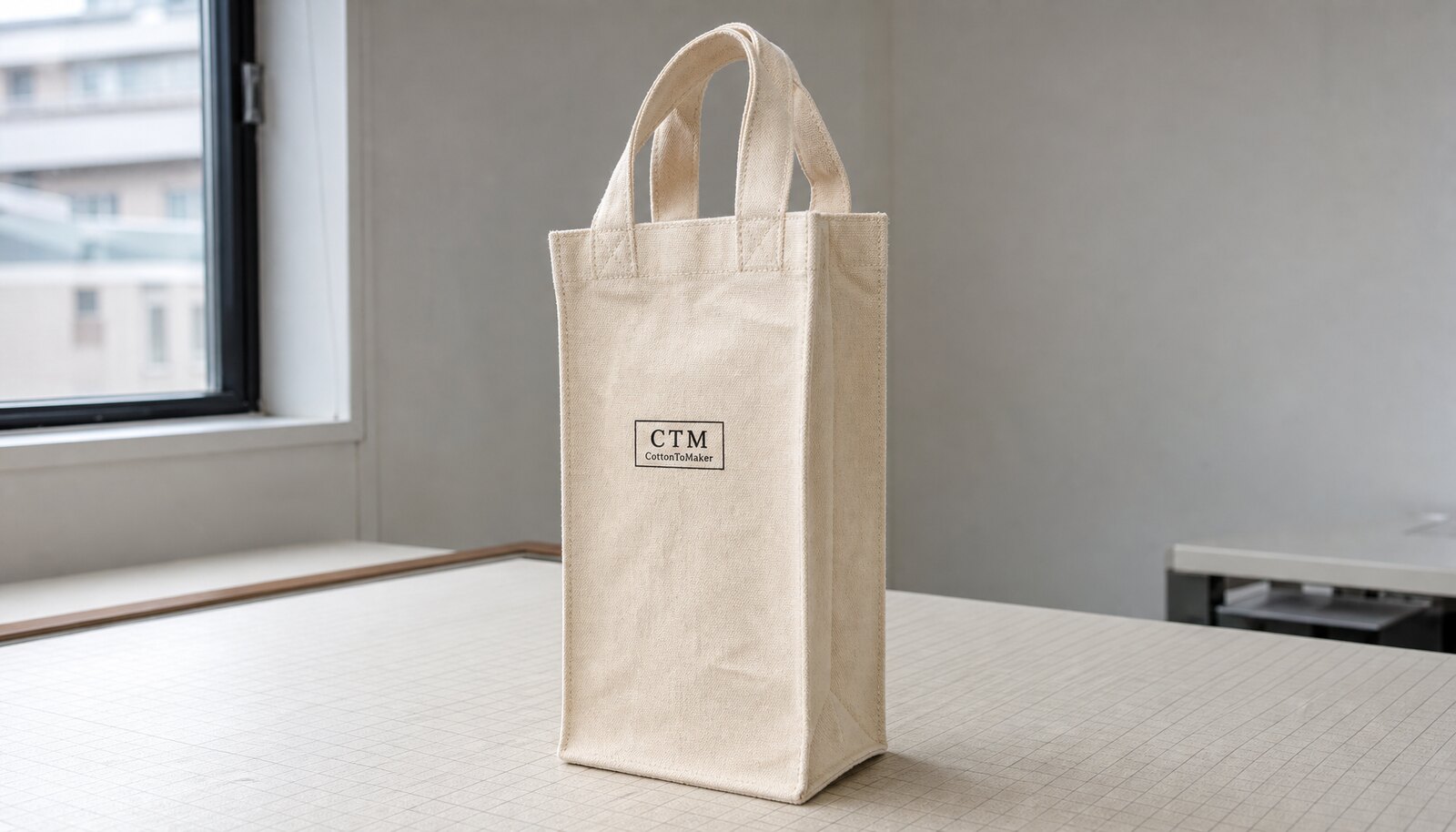
Why logo placement matters more on wine carriers than on tote bags
A canvas wine carrier looks simple, but logo placement changes both the retail impression and the production risk. On a wine bag, the logo sits close to seams, handles, gussets, and often a folded top edge. That means a design that looks fine on a flat proof can end up crooked, partially hidden, or stretched once the carrier is sewn and filled with a bottle. For gift shops, the product has to read clearly at shelf distance, because it is often bought as a last-minute add-on rather than studied in detail.
Buyers should treat the logo location as a structural decision, not just a branding choice. If the print sits too high, it may be interrupted by top binding or handle attachment. If it sits too low, it can disappear behind the bottle body or fold line. The best RFQs include a measured placement drawing, not just a file upload. That lets the factory quote the correct print screen size, sewing sequence, and sample approval method before production starts.
- Front-panel placement usually gives the best shelf visibility.
- Avoid printing across gussets unless the artwork is designed for that seam movement.
- Keep the logo away from bartacks and top binding so it does not distort during sewing.
Choose the right canvas weight before you decide the print size
For wholesale canvas wine carriers for gift shops, the fabric weight drives almost every other decision. A 12 oz canvas can work for a basic reusable carrier, but many gift programs land in the 12 oz to 16 oz range because the bag needs enough body to stand up, hold a bottle without collapsing, and survive repeated retail handling. If you want a more premium feel, a tighter weave and slightly heavier fabric usually improves both the look and the print surface. The tradeoff is cost, carton weight, and freight impact.
GSM and ounce weight need to be stated clearly in the quote request. Some suppliers quote raw fabric weight while others quote finished product weight after coating or washing. That creates comparison problems. If the wine carrier has a lining, base insert, or lamination, the effective hand feel can change even when the label weight looks similar. For gift shops, a carrier that feels too thin often gets rejected by buyers even if it passes basic durability tests.
- 12 oz canvas: lower cost, lighter freight, acceptable for entry-level gift shop programs.
- 14 oz canvas: balanced option for reusable retail presentation and stronger shape retention.
- 16 oz canvas: better body and premium feel, but requires tighter quote control on freight and MOQ.
Logo placement options and what each one does to the quote
Front-center logo placement is the most common option because it gives the clearest retail read. It also keeps the decoration on the flattest part of the bag, which is easier for screen print registration and better for repeat batches. For most buyers, the best starting point is a centered logo with enough blank space around it to avoid seam interference. If the bag has a bottom gusset or vertical seams, the printable area should be defined from the finished sample, not from a flat fabric template alone.
Side-panel or lower-panel placement can work when the brand wants a more subtle look, but the factory must confirm whether the panel stays flat after sewing. Some carriers twist slightly once a bottle is inserted, which makes low-set logos look off-center in retail photos. If the client wants both logo and care text, keep the logo on the main face and move secondary text to the side label or inner tag.
- Front center: strongest shelf branding and easiest quote comparison.
- Upper front panel: good if top fold space is stable and the print area is below the handle stitch line.
- Side panel: useful for subtle branding, but harder to keep visually straight after assembly.
- Woven label or side label: good when the print area is small or the buyer wants a premium sewn finish.
Print method comparison for canvas wine carriers
The print method should match the logo complexity, order size, and expected retail price point. Screen printing is usually the most practical choice for one- or two-color logos on canvas because it stays readable, looks clean on textured fabric, and is economical once the setup is done. It also tends to be more durable than cheap heat transfers if the ink is cured correctly. For buyers comparing quotes, screen print setup cost matters less than the total landed cost across the first and repeat order.
Heat transfer can be useful when the design has more detail or a short run does not justify full screen setup. The risk is feel and wear. A transfer that looks acceptable in the sample room may crack after folding, freight compression, or store handling. Embroidery can look premium, but on a narrow wine carrier it adds cost, thickness, and distortion risk around the logo. Woven labels are good for small branding marks, but they do not replace a full logo if the brand needs shelf recognition.
- Screen print: best balance for standard retail logos and repeat orders.
- Heat transfer: useful for short runs or multi-color details, but requires durability review.
- Embroidery: premium look, but can pucker lightweight canvas and raise unit cost.
- Woven or sewn label: good support branding, not ideal as the only large logo on the front panel.
How MOQ changes when you move the logo or change the artwork
MOQ is not just a factory rule; it is a setup equation. A wine carrier with one logo position, one ink color, and one fabric color is straightforward to produce, so the MOQ can stay relatively low for a factory-direct order. The moment a buyer changes print position, adds another ink color, or asks for special packaging, the plant may need extra screens, more setup time, or separate cutting and sewing batches. That is why a quote for the same style can change quickly when the brand team refines the art late in the process.
If the order is for gift shops, it is usually smarter to lock one core SKU and test demand before adding too many variants. Start with a neutral canvas color and one centered logo. If sell-through is strong, extend into a second logo size or a second color later. Too many options at the first PO often create carton confusion, more sample approval rounds, and higher inventory risk.
- One fabric color + one logo color is the cleanest MOQ structure.
- Every added color usually increases setup and sometimes print minimums.
- Changing only print size can still affect screen cost and sample approval.
- Special packaging can raise MOQ even if the bag itself is unchanged.
Supplier options: direct factory vs trading company vs local decorator
For wholesale canvas wine carriers for gift shops logo placement guide projects, the best sourcing route depends on how sensitive the program is to consistency and packaging. Direct factories usually offer the best control over logo placement, seam details, and carton packing because the people quoting the job also understand production limits. That matters when the logo must sit a specific distance from the top edge or when the buyer wants a sample matched to a display plan. Trading companies can be useful when the buyer needs a broader product mix or prefers one contact for multiple factories, but the quote should clearly show where production happens and who owns the QC responsibility.
Local decorators may seem easier for small quantities, especially if the buyer only needs a short seasonal run. The tradeoff is that local printing often starts from a blank carrier purchased elsewhere, which can create inconsistent fabric weights, higher unit costs, and weaker control over carton packing. If the brand plans repeat orders, a factory route usually gives better repeatability and lower landed cost. For one-off events, local decorating can work, but the buyer still needs a sample signed off on the final carrier, not just the blank bag.
- Direct factory: best for repeat orders, placement control, and packaging consistency.
- Trading company: useful for consolidated sourcing, but verify production ownership and sample traceability.
- Local decorator: faster for very small quantities, but usually less competitive on unit cost and QC consistency.
Sample approval should include the logo on a finished carrier, not a flat proof
A flat artwork proof is not enough for a wine carrier. The approved sample should show the actual bag shape, the exact handle type, the real stitch lines, and the final print location under normal tension. This matters because a logo that looks centered on a flat panel can move once the bag is sewn, folded, or filled with a bottle. Buyers should insist on a pre-production sample that represents the final construction, especially if the carrier includes a gusset, lining, or reinforcement insert.
The sample review should focus on practical retail issues: does the logo sit high enough to be visible in a hanging display, does it avoid seam distortion, and does the print remain sharp on the textured canvas surface. Take the sample out of the box, insert a standard bottle, and check whether the logo is still visible from arm’s length. If the design disappears when the bottle is inside, the placement is too low or too small for gift shop shelf use.
- Approve the exact finished bag, not only an artwork mockup.
- Review logo visibility with a bottle inserted.
- Record the sample as the production reference for placement, thread color, and packing format.
Quote breakdown: where the real cost changes happen
When comparing supplier quotes, the logo itself is only one part of the cost. Fabric weight, print method, reinforcement, handle material, and packing format all move the price. A heavier canvas may increase the bag cost and freight, but if it reduces seam failures or gives the product a better shelf look, it can still be the smarter buy. Buyers should ask for a line-by-line quote so they can see whether a lower price is coming from lighter fabric, simpler stitching, or reduced packing protection.
The most common hidden cost is setup. Screen fees, color separation, sample charges, and carton labeling can be folded into the unit price or shown separately. That makes apples-to-apples comparison difficult. For procurement teams, it is useful to build a landed-cost view that includes sample cost amortized over the first PO, inland carton charges, and the freight effect of each fabric weight. A carrier that is 15% heavier on paper may cost much more after shipping if the order volume is high.
- Compare fabric weight, not just finished unit price.
- Separate print setup, sample fees, and packaging charges from the quoted ex-works price.
- Include freight impact from carton size and bag weight in the landed-cost model.
Packing choices that protect the logo and reduce retail damage
Packing is easy to overlook, but it directly affects whether the logo arrives clean and presentable. Canvas wine carriers can crease if folded too tightly, and printed areas can rub if they are packed without enough surface protection. For gift shop programs, individual polybags are usually the safest baseline, especially if the bags will sit in distribution channels for several weeks. A barcode sticker or style label on each unit also helps retail handling and inventory control.
Master carton design matters as much as inner packing. If the cartons are overpacked, the stack pressure can leave permanent fold marks across the logo area. If they are underpacked, the bags can move around and scuff. Ask the factory to show how many units go into each inner and master carton, and whether dividers or tissue are used to prevent print abrasion. The packing method should match the product’s resale value, not just the factory’s default workflow.
- Use individual polybags when the carrier has a visible front print.
- Avoid over-compression in cartons to protect the logo surface.
- Request carton count, gross weight, and outer carton marks before approval.
Lead time planning for seasonal gift shop orders
Wine carrier orders often get tied to holiday or event calendars, which leaves little room for rework. The biggest schedule risk is late artwork approval. A factory can usually start faster when the buyer sends a clean vector file, confirmed dimensions, and final packing instructions at the same time. If the artwork changes after the sample is approved, the job may need a new screen or a revised sample, which resets the clock and can push shipment past the selling window.
A practical production timeline for a standard canvas wine carrier is usually sample making first, then bulk after approval, then packing and export documents. Buyers should not plan on bulk start before the sample is signed off. If the order is seasonal, build a buffer for fabric sourcing, especially if the buyer wants a specific canvas shade or a special wash finish. Rush orders are possible in some factories, but they tend to raise risk in print alignment and packing accuracy.
- Allow time for sample approval before booking the bulk schedule.
- Keep artwork final before the factory starts screen preparation.
- Seasonal orders need buffer time for fabric sourcing and carton production.
Specification comparison for buyers
| Spec decision | Recommended option | When it fits | Buyer risk to check |
|---|---|---|---|
| Logo placement | Front center, 35-55 mm below top edge, leaving seam and handle clearance | Best for gift shop retail displays and quick brand recognition | Logo can crowd the bottle neck or get hidden by stitching and fold lines |
| Print method | Screen print for simple 1-2 color logos; heat transfer only for short runs or detailed art | Use when the canvas is medium to heavy weight and the logo is not full-color photographic art | Transfer can crack or look plastic; screen print needs proper curing and ink adhesion |
| Canvas weight | 12 oz to 16 oz finished canvas, depending on bottle protection and price target | Gift shops that want a sturdier premium feel and lower seam failure risk | Too light a fabric can collapse around the bottle; too heavy raises freight and unit cost |
| Construction style | Single-bottle carrier with reinforced base and boxed or gusseted bottom | Works for standard wine bottles and higher-end retail presentation | Loose bottom panels can shift bottle weight and cause logo distortion during use |
| Handle spec | Cotton webbing or self-fabric handles with bartack reinforcement | Useful when the carrier is sold as a reusable gift item | Short handles reduce shelf appeal; weak bartacks cause failures in drop testing |
| MOQ route | Factory-direct MOQ with one print color and one fabric color first | Good for first-time orders, seasonal gift programs, or line testing | Mixed specs across too many SKUs can push MOQ up and create dead stock |
| Supplier route | Direct factory or export-focused manufacturer instead of trading-only quote for custom print jobs | Best when logo control, carton packing, and repeatability matter | Trading quotes may look cheaper but can hide print setup, sample, or QC gaps |
| Packing method | Individual polybag with barcode sticker, then inner carton and master carton dividers | Suitable for retail-ready gift shop replenishment and damage control | Loose stacking can crease print areas and create shelf-ready defects |
| Lead time plan | Pre-production sample approval before bulk, then 25-35 days production after art sign-off | Works for standard canvas construction and one decoration method | Artwork changes after sample approval can extend lead time and raise waste |
Buyer checklist before sampling
- Specify bottle size, carrier dimensions, and whether the fit is for standard 750 ml, champagne-style, or tall specialty bottles.
- State canvas weight target in oz or GSM, not just 'heavy duty,' so suppliers quote the same construction.
- Define logo placement with a measured distance from top edge, side seam, and handle stitch line.
- Choose one primary decoration method and one backup method only if the first method cannot meet the art detail.
- Confirm the stitching spec, especially handle bartacks, bottom reinforcement, and seam allowance.
- Request a pre-production sample with the final logo size, exact ink color, and the intended packing format.
- Ask for carton count, master carton dimensions, gross weight, and whether dividers or polybags are included.
- Build a landed-cost comparison that includes sample cost, setup fee, inland carton charges, and freight impact from fabric weight.
Factory quote questions to send
- What canvas weight in oz or GSM are you quoting, and is that finished fabric weight or raw fabric weight?
- Where exactly will the logo sit on the carrier, measured from the top edge, centerline, side seam, and bottom panel?
- Which print method are you proposing for this artwork, and what is the setup charge, color limit, and curing requirement?
- Can you share handle material, handle length, bartack count, and base reinforcement details in the quotation?
- What is your MOQ per color and per logo version, and how does MOQ change if we change only the print size?
- How is the product packed for retail: individual polybag, barcode label, inner carton, master carton, or divider insert?
- What are the sample lead time, bulk lead time, and the earliest date you can start after artwork approval?
- What defects are included in your QC standard for print alignment, thread trimming, stain marks, and seam strength?
Quality-control points to confirm
- Logo placement tolerance: keep print position within ±5 mm of approved sample on the front panel unless the construction forces a different limit.
- Print quality: no ink bleed, pinholes, color smearing, or visible cracking after normal fold handling and a basic rub test.
- Stitching: bartacks at handle joins should be even and secure, with no skipped stitches, loose threads, or seam puckering around the base.
- Fabric consistency: canvas weight should stay within the agreed tolerance and match the approved shade across the production lot.
- Dimension control: carrier width, height, gusset, and handle drop should match the approved spec sheet closely enough to preserve bottle fit and shelf presentation.
- Packing integrity: every unit should be folded consistently, sealed correctly, and packed with the agreed quantity per carton to avoid compression marks.
- Carton labeling: outer cartons should show style code, quantity, color, and destination marks exactly as requested on the PO.
- Final approval: reject bulk if the print area, handle reinforcement, or base structure deviates from the signed sample in a way that affects retail value or usability.