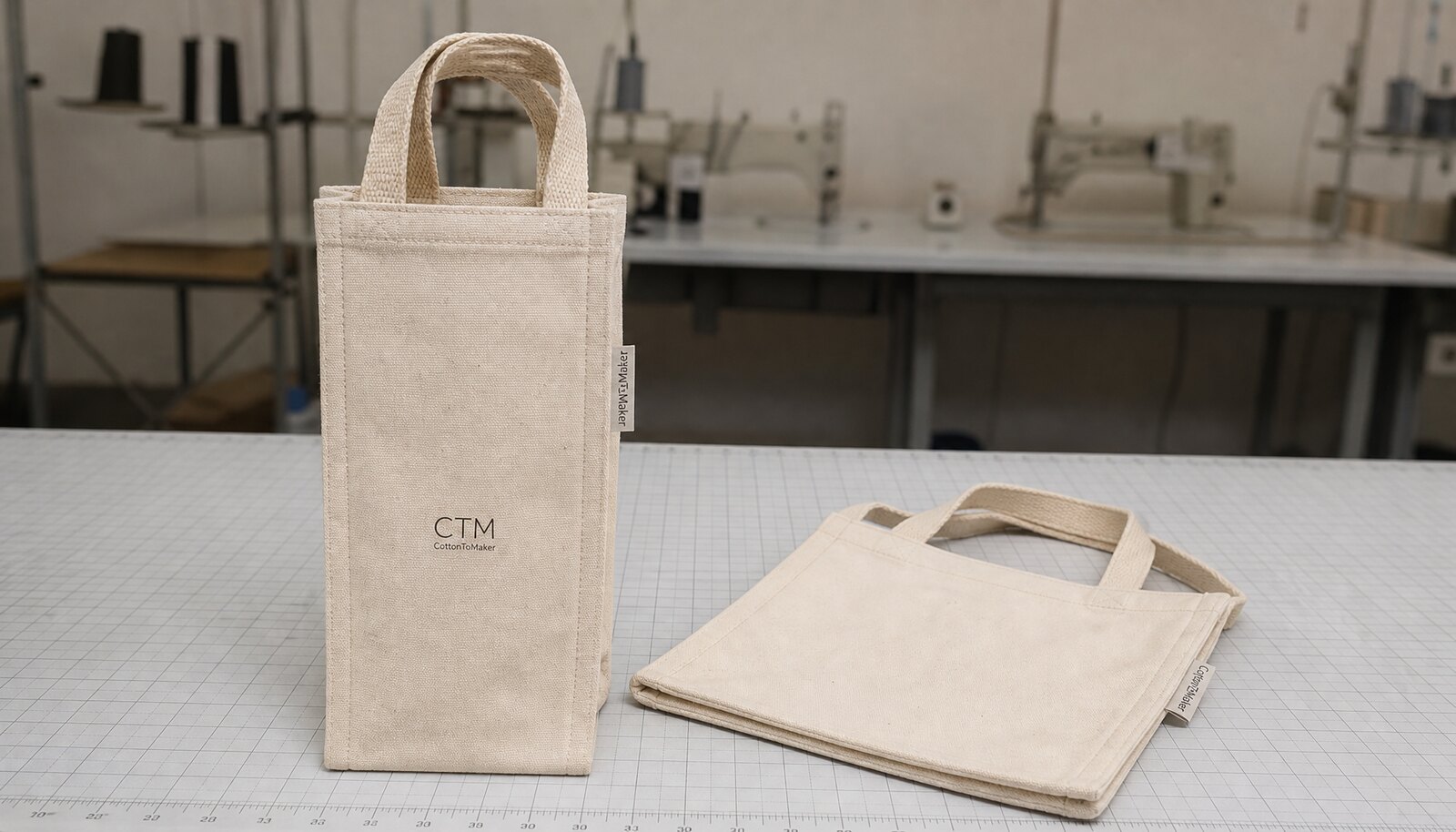
1. What durability means for a gift-shop wine carrier
For a gift shop, durability has a different meaning than it does for a warehouse tote or a promotional bag handed out once at an event. The carrier needs to do three things at the same time: present well on the shelf, hold a bottle safely in customer hands, and survive packing, transit, and repeated handling without looking tired. That combination is why wholesale canvas wine carriers for gift shops should be judged on both structure and appearance.
The common failure modes are usually easy to name once buyers look for them. Handles pull loose after a few carries. The top hem twists and makes the bag look cheap. The printed logo cracks or bleeds on the rough canvas surface. The base loses shape and leans. None of those issues show up in a one-minute product photo, which is why the procurement spec has to define how durability will be tested and what failure looks like.
Gift-shop buyers also need to think about perceived quality. A carrier may technically hold weight but still feel flimsy if the handle is narrow, the canvas collapses when empty, or the seams wander by several millimeters. In retail, those details affect sell-through. If the carrier is part of a bottle-and-gift set, the bag also has to tolerate being opened, closed, carried to the register, and repacked by store staff. That usage pattern is different from a one-time promo bag, so the test plan should reflect it.
A useful way to frame the spec is to separate three layers of durability: fabric durability, construction durability, and pack-out durability. Fabric durability covers the canvas itself and whether it has enough body. Construction durability covers seams, handles, reinforcement, and print adhesion. Pack-out durability covers how the bag behaves once it is folded, bagged, carton-packed, stacked, and shipped. Buyers who check only one of these layers often miss the weak point that later drives returns.
- Retail durability = shelf appearance + carry safety + carton survival.
- A bag that passes visual inspection but fails after repeated folding is not retail-ready.
- Ask the supplier to name the weakest component in the build; their answer often reveals how much they understand the product.
2. Fabric weight, weave, and finish: the first cost lever is also the first failure point
Canvas weight is the most obvious spec, but buyers should not stop at the number. A quote that simply says “canvas” is not procurement-ready. Ask for GSM, ounce weight, fiber content, whether the fabric is natural or bleached, and whether the cloth has been pre-washed or pre-shrunk. Those details affect body, print behavior, sewing yield, and the chance of dimension drift after packing.
For most gift-shop wine carriers, 12 oz to 16 oz cotton canvas is the useful commercial range. Around 340 GSM to 400 GSM works for lighter retail programs, especially if the carrier is mainly a packaging accessory. Around 400 GSM to 510 GSM is more convincing for premium gift items, repeat use, or heavier bottles. The heavier end usually costs more, but not just because of fabric. Sewing takes longer, handling the cut panels is harder, and the bag may need stronger reinforcement to make the extra body worthwhile.
Weave quality matters almost as much as weight. A loosely woven 16 oz cloth can behave worse than a tighter 12 oz fabric if the surface is uneven or the yarn structure is weak. Buyers should ask for a photo of the roll under strong light and, for important programs, a cut swatch that shows the weave density. Natural canvas tends to give a more rustic look and can hide minor imperfections. Bleached canvas can improve logo contrast but may show contamination or shade inconsistency more easily.
Finish matters too. Some suppliers quote a washed or softened finish that feels better in hand but may reduce structural rigidity. Others use raw canvas that looks stronger but can be rougher and more prone to handling marks. The right choice depends on the retail positioning. A premium gift shop usually wants a cleaner feel and better shelf presentation. A more price-sensitive account may accept a rougher finish if the carrier is used mainly as a presentation sleeve.
Do not compare prices without comparing the fabric source. If one supplier quietly switches to a lighter cloth or different weave, the quote may look better but the bag will not perform the same way. A reliable RFQ should name the weight, weave, finish, and acceptable tolerance. If the supplier cannot hold those variables stable, the program will be hard to repeat.
- 340 GSM to 400 GSM: lower-cost retail programs, simple logos, lighter handling.
- 400 GSM to 510 GSM: premium gift shops, stronger shelf presence, repeat use.
- Ask whether the fabric is pre-shrunk or will be cut from raw yardage with no shrink control.
- Request a physical swatch with the approved lot number before bulk cutting.
3. Handle construction and seam design: where most failures begin
For this product, the handle is usually the first place a bag fails. Customers lift from the handle, store staff pull on it during display, and cartons can compress it during shipping. The correct comparison is not just handle material; it is how the handle is attached to the body and how the seam distributes load. A nice-looking handle that is poorly anchored can fail faster than a simpler handle with better reinforcement.
Self-fabric handles work well when the carrier needs a clean, integrated look and the bottle weight is moderate. Webbing handles usually provide better tensile performance and are easier to standardize across production lots. If the bag is intended for a premium gift shop, a webbing handle with reinforcement patches can make the carrier feel more reliable in hand. If the retailer wants a softer, more coordinated look, self-fabric handles may be the better aesthetic choice, but the buyer should insist on stronger seam control.
The attachment method matters more than the handle material alone. Ask whether the factory uses single stitching, double stitching, box stitch, bar-tacks, or stitched reinforcement patches. A bar-tack at the top of the anchor and a second reinforcement line lower down often improves real-world durability. A simple double-stitch without a load-distribution feature may be enough for a light bottle, but it is weak if the bag will be reused frequently or if the bottle has a heavier shoulder or base. Buyers should also ask for the stitch count per inch or per centimeter if the factory can provide it, because that gives a more repeatable view of sewing density than “strong stitching” language.
Seam allowance should be part of the spec, not an afterthought. If the sewing allowance is too narrow, the seam can fray or open when the bag is loaded or folded repeatedly. A practical tolerance should be written in the purchase spec, especially at the top opening, side seams, and base seams. Procurement teams often focus on decorative details and miss this point, yet seam geometry is what decides whether the carrier holds its shape after repeated use.
Failure cases are usually visible in samples if the buyer knows where to look: loose thread tails at the load point, thread breaks near the handle anchor, puckering around a bar-tack, asymmetrical handle placement, or a top hem that twists because the stitch line drifted. These issues are fixable before bulk order, but only if they are documented in the sample approval record.
If the bag will be used with a bottle insert, divider, or inner sleeve, include that in the construction review. An insert can shift the load path and make the handle point more vulnerable if the bag was designed only for an empty fit test. The correct sample test should be performed with the same insert configuration that the retail pack will use.
- Prefer a visible reinforcement method at every load point, not only at the handle end.
- Ask for stitch close-ups at the top hem, handle anchor, and bottom seam.
- Treat seam allowance as a controlled dimension, especially on premium orders.
- If the carrier will be reused, test the handles with repeated lifting, not just a single pull.
4. Compare sourcing routes before comparing unit prices
Procurement buyers often start with price, but for this category the sourcing route can matter more than the number. A direct factory typically offers the best control over fabric, cutting, stitching, and inspection, especially when you need repeat orders and want the same spec next season. The tradeoff is that direct factories usually expect clearer documentation, firmer MOQ, and slower back-and-forth when samples are not approved quickly. A trading company or sourcing agent may be useful when you need mixed categories, smaller orders, or faster coordination across several suppliers, but you should expect some markup and less visibility into the actual production line.
This matters because the same-looking bag can be built very differently depending on the route. A factory that cuts from stock canvas may deliver quickly but have limited shade control. A supplier that offers custom-dyed fabric may achieve a better retail match but need more lead time and higher MOQ. A print-only shop that outsources sewing may be fine for simple runs, but it can be harder to trace who actually controls reinforcement quality. Buyers should ask who handles each step: fabric sourcing, cutting, printing, sewing, inspection, and packing.
The key tradeoff is control versus convenience. If the account is a repeat gift-shop program with stable demand, direct factory sourcing is usually the stronger commercial choice because you can lock the spec and track lot-to-lot consistency. If the order is exploratory, seasonal, or bundled with other SKUs, a trading company can reduce coordination effort. But convenience should not hide risk. Ask for the actual factory name, the factory location, and production photos if you are buying through a middle layer. If a supplier refuses to identify the production source, that is a warning sign for traceability and QC.
Verification without invented assumptions is straightforward. Request a sample with lot identification. Ask for photos of the cutting table, sewing line, and finished pack-out. Ask whether the supplier issues in-line inspection reports or only final photos. If they claim “strict QC,” ask them to show the inspection checklist they actually use. Reliable suppliers can usually answer these questions quickly and specifically. Vague answers are more informative than polished marketing claims.
For many buyers, the best way to compare routes is not to ask “who is cheaper?” but “who can hold the spec most reliably on reorder?” That question is especially important for gift shops, where a seasonal design may be re-bought if it sells well. Repeatability is part of value.
- Direct factory: stronger process control, better for repeat business, clearer spec discipline.
- Trading company: useful for convenience or small mixed orders, but verify who actually manufactures the bag.
- If the supplier cannot name the production site or inspection owner, escalate the risk level.
- Ask for lot traceability on fabric, print ink, and finished cartons before award.
5. Product comparison table: the decision is not just bag style, it is supply risk
A comparison table is most useful when it helps a buyer choose between real commercial options instead of repeating generic advantages. The table below frames the common choices for canvas wine carriers as procurement decisions: material weight, handle build, print method, supplier route, and packing standard. Use it to align quotations before you compare unit price.
The main mistake buyers make is comparing samples that were never built to the same spec. If one supplier used lighter canvas, a different handle fold, or simpler packing, the apparent price gap is not meaningful. The table should therefore be used with a single RFQ sheet and a single sample bottle size.
When you review quotes, look for the hidden cost step: more fabric weight may reduce cartons per pallet; a premium print method may need longer lead time; stronger handles may require slower sewing. Those effects are not defects, but they should be visible in the buying decision.
- Make sure every quote is tied to the same bottle size and the same artwork version.
- Ask for two price points if possible: standard build and upgraded build.
- Do not accept a “good photo” as proof of a durable build.
6. Durability testing checklist with concrete parameters, sample size, and pass/fail criteria
A durability checklist is only useful if it is measurable. For canvas wine carriers, the supplier does not need a certified lab to run a practical pre-production test, but the test should still have defined conditions. Buyers should ask for sample size, load level, cycle count, and the exact failure criteria. If the factory cannot explain those basics, then the test result is not comparable across suppliers.
A workable buyer-side test plan can be built around three questions: does the carrier hold the intended load, do the handles and seams survive repeated use, and does the printed surface stay readable after folding and handling? The following checklist is designed for procurement review, not laboratory certification. It is intended to catch the kinds of failures that create gift-shop complaints.
Suggested sample size for testing: at least 5 units for each style/color combination before approval, with 2 units reserved for destructive checks if the order is large or the design is new. For a new supplier or a premium build, 8 to 10 samples is more defensible because one or two units can hide variation. If the order is large, confirm that the factory is testing units from more than one cutting bundle or fabric roll. Variation across lots is often what causes trouble later.
Suggested test parameters and thresholds:
- Loaded carry test: insert a filled 750 ml wine bottle weighing approximately 1.2 kg to 1.5 kg total system weight including bottle and packaging. Carry for 30 to 50 meters, then repeat 10 cycles. Pass if no handle separation, no seam opening greater than 2 mm, and no visible distortion that prevents shelf presentation.
- Static hang test: suspend a loaded carrier for 15 to 30 minutes. Pass if the handle anchors remain secure, the top hem does not tear, and the seam does not creep more than a few millimeters at the anchor point.
- Stitch pull spot check: manually test the handle anchor and top seam with a controlled hand pull or simple tensile setup on 3 samples. Pass if no skipped stitches, no thread break, and no opening that propagates beyond the intended seam line.
- Fold and reopen test: fold the bag to the expected retail pack shape, leave it folded for 24 hours, then reopen. Pass if the bag recovers its shape reasonably, the print does not crack visibly, and the opening is not permanently twisted.
- Abrasion test: rub the logo area and side seam against a comparable carton edge or coarse cloth for 20 to 30 cycles. Pass if the print remains legible and does not flake, smear, or bleed.
- Drop or carton handling check: pack the approved quantity in the proposed carton and subject at least 1 carton to a practical handling drop sequence from a low height representative of normal shipping handling. Pass if the carton remains intact and the bags do not arrive deformed beyond saleable condition.
For procurement use, it is often enough to define fail points in plain language: handle loosens, stitch opens, print cracks, seam twists, bag no longer sits upright, carton collapses, or bag color varies beyond the accepted shade band. The value of the checklist is not in making the test complicated; it is in making the pass/fail line unarguable.
If a supplier claims higher strength, ask them to show the same test on the actual production spec, not on a different bag or a thicker prototype. If they use bar-tacks in the sample but not in production, the test result should not be accepted. Likewise, if the sample was made from hand-selected fabric, the buyer should ask whether the bulk lot will be matched to that same standard.
For bigger programs, record test results by sample number, fabric roll, and operator if the factory can provide it. That makes it easier to track whether the issue came from sewing variance, fabric variance, or artwork application. In procurement terms, that traceability is worth more than a polished summary statement.
- Use at least 5 samples per style/color; use 8 to 10 for new suppliers or premium programs.
- Record load, cycle count, duration, and visible failure criteria in the approval file.
- Test the exact bottle load and packing configuration that the store will actually use.
- Do not accept a prototype test if production will use weaker reinforcement or a different fabric lot.
7. Sample approval: what to inspect before you release bulk production
The approval sample should be treated as the control specimen for the order. If it passes, the bulk order has a target. If it fails, the factory should revise the construction before cutting production fabric. Buyers who approve based on appearance alone often discover too late that the sample and production are not identical.
Start with dimensions. Measure the finished height, width, gusset or depth, handle drop, and opening width. Do not rely on stated dimensions only; on a tight-fitting wine carrier, even a few millimeters can change whether a standard 750 ml bottle fits smoothly. If the carrier is meant for a broader bottle or a bottle plus gift insert, test that actual configuration. A bottle that has to be forced in during packing will also be awkward for the end customer.
Then inspect the workmanship. Look at seam alignment at all corners and at the top hem. Check whether stitch lines are straight and whether the seam allowance is even. Look at thread trimming and the backside of the handle anchor. Loose tails, uneven back-stitching, and puckering are small defects that often signal deeper inconsistency. If the sample uses embroidery, check the backing and see whether the fabric is buckling around the design.
Print placement deserves the same discipline. A logo that looks centered in a photo may sit too high or too low on the physical bag. Ask the factory to note the allowed print position tolerance and to use a jig or placement guide if repeatability matters. On canvas, slight variation is common, but the buyer should define what “slight” means. A seasonal gift-shop program can tolerate modest hand-variation; a premium retail account usually cannot.
Finally, test the bag as a customer would. Put in the intended bottle, carry it by the handles, set it down on a flat surface, fold it if the retail pack requires folding, and reopen it. Watch for handle roll, body twist, base sag, or print rubbing. If the bag feels awkward in hand, the shelf appearance will not save it. The sample is not approved until it behaves well in use, not just in a photo.
- Measure the physical sample, do not trust the spec sheet alone.
- Check both front and back of the handle anchor and top hem.
- Approve only after a carry test with the actual bottle or insert.
- If the sample changes after revision, rename the sample version and re-approve it formally.
8. Print method, branding quality, and shelf behavior
The print method should match both the artwork and the retail positioning. Screen printing is usually the most practical choice for simple logos, one- or two-color graphics, and medium-to-large orders. It is durable when applied correctly, but rough canvas can distort fine text, thin lines, and delicate type. Heat transfer can be useful for shorter runs or more detailed graphics, but the buyer should test whether the transfer cracks or peels after folding and handling. Embroidery can lift the perceived value, yet it changes cost and may create stiffness or puckering on lighter canvas. A woven label or sewn patch can work well for a premium look when the buyer wants a restrained brand mark instead of a full front-panel print.
For gift shops, branding quality is also a durability issue. The product may be handled many times before purchase, and any print scuffing is highly visible. Ask the supplier how the printed area behaves when rubbed, folded, or packed against another unit. On natural canvas, some ink settling into the weave is normal, but it should not reduce legibility. On bleached canvas, the buyer should watch for uneven ink uptake, because the smoother appearance can also make print errors easier to see.
If the logo includes fine type, small icons, or thin lines, ask the supplier to confirm minimum line thickness and minimum text size they can hold reliably on the actual fabric. A logo that looks crisp on a computer screen may break up on rough canvas. This is where procurement buyers save money by simplifying artwork before production. A simpler logo often prints more cleanly, reduces reject risk, and holds up better after folding.
Ask the supplier to state print position tolerance and color tolerance. If they cannot define those terms, request a physical print reference sample. If color matching matters, especially for brand programs, you may also want to ask whether they match against a Pantone reference or a previous production swatch. The goal is not to demand lab-level precision from a soft goods item; the goal is to keep brand variation within a range the retailer will accept.
A common failure case is a beautiful first sample with a print method that was not realistic for production. Buyers should make sure the approved print method is the one that will actually be used in the bulk run. If the factory proposes a different ink, curing method, or application system after approval, the order should be revalidated before production starts.
- Use screen print for simple, durable, cost-aware branding.
- Test heat transfer or embroidery after folding if the bag will be packed flat.
- Ask for minimum text size and minimum line thickness on rough canvas.
- Require a print position guide for repeat orders.
9. MOQ, cost drivers, and quote comparison without hidden spec drift
MOQ is not just a number. It is the result of fabric availability, cutting setup, print setup, packing labor, and how much variation the supplier is willing to absorb. A buyer who wants a lower MOQ should expect tradeoffs somewhere else: less color control, less custom tooling, or a slightly higher unit cost. That does not mean a lower MOQ is bad; it means the quote has to show where the economics are changing.
To compare quotes properly, ask the supplier to separate the price into components if possible: fabric, sewing, print, label, packing, and carton. This is especially useful when comparing direct factory and trading company offers. If one price includes a hangtag, size sticker, and individual polybag while another does not, the lower quote may only look cheaper. In the same way, heavier canvas can push up the sewing price and reduce carton density, which affects freight even if the ex-works number is still reasonable.
For gift-shop buyers, the most useful commercial question is often: what changes the price most? The answer might be fabric weight, print colors, or closure style. Once that is known, buyers can decide where to spend and where to simplify. If the carrier is a minor add-on to a premium bottle set, a better handle and stronger reinforcement may be worth the upgrade. If it is sold as a low-ticket accessory, a simpler build with reliable basic QC is usually smarter than trying to add premium features everywhere.
Do not let MOQ hide spec drift. Some suppliers quote a low MOQ by quietly using stock fabric, simplified packing, or a standard handle they have already in inventory. That can be acceptable, but only if it is disclosed. If you need a custom color or custom trim, clarify whether the MOQ is tied to fabric dyeing, print setup, or carton allocation. The answer changes what can be negotiated.
A practical comparison method is to ask for two versions from the same supplier: the best-value standard spec and a stronger premium spec. That makes the tradeoff visible. You can then compare not only supplier-to-supplier, but also build-to-build. In procurement, that is usually more useful than comparing one vendor’s cheap sample to another vendor’s upgraded prototype.
- Ask for price by component when possible: fabric, sewing, print, label, packing, carton.
- Separate MOQ by style, color, and logo version.
- Request a second quote for heavier canvas or better reinforcement to see the cost step-up.
- Treat stock-fabric offers as faster but less flexible on shade and reorder consistency.
10. Packing, carton loading, and shipment risk for retail-ready delivery
Packing is where many otherwise decent bag programs lose money. A wine carrier that looks fine at the sewing line can arrive flattened, scuffed, or mixed in the wrong color ratio if carton planning is weak. For gift shops, that matters because staff need quick shelf replenishment and customers expect the carrier to look new when they pick it up. The factory should therefore define not only the unit pack, but also how the carrier is protected inside the carton and how the carton itself survives handling.
Start with the inner pack. Will each carrier go into a polybag, and if so, is there a vent hole to avoid moisture or odor issues? Does each piece need a size sticker, barcode, or retail insert? If the bag is sold in a gift display, a clean insert card can improve presentation, but it also changes pack-out time and may affect carton thickness. The answer should be agreed before bulk, not improvised on the line.
Then control the carton. Ask how many units go into one master carton and whether the carton size has been tested for compression. Overpacked cartons can crush handles, flatten the body, and warp print surfaces. Underpacked cartons may move too much in transit and scuff each other. For this category, the best pack-out is usually the one that preserves shape while remaining efficient enough for palletization. If the product is going to chain stores, label consistency matters too: SKU, color, quantity, gross weight, and carton number should match the packing list exactly.
A practical carton expectation for procurement is simple: the boxes should survive normal warehouse stacking, route handling, and one or more low-height handling drops without opening, bursting, or crushing the product into unsaleable condition. If the route includes long-distance sea freight, moisture resistance and carton edge strength deserve extra attention. Ask the supplier what carton board grade they use and whether they can share a photo of a packed, sealed master carton before shipment. That is a basic but useful control point.
Lead time risk is often packing risk in disguise. If the buyer changes the bag insert, retail tag, barcode, or outer carton mark late in the process, the factory may need to stop, reprint, or re-label. The safest path is to freeze all packaging elements when the sample is approved. The more custom the pack-out, the more likely a schedule slip becomes if approval is delayed by artwork corrections.
- Define inner pack, outer carton, and carton label before production starts.
- Ask for carton compression expectations and a photo of a sealed master carton.
- Do not add tags or inserts after approval unless the factory re-confirms schedule and cost.
- Keep carton quantity aligned with handling weight, not just with order math.
Specification comparison for buyers
| Decision area | Option 1 | Option 2 | Procurement implications | What to verify before award |
|---|---|---|---|---|
| Fabric base | 12 oz / 340 GSM cotton canvas | 16 oz / 510 GSM cotton canvas | 12 oz usually costs less and sews faster; 16 oz improves body, shelf presence, and resistance to seam distortion | Confirm actual GSM or oz, weave density, and whether fabric is bleached, natural, dyed, or pre-washed |
| Handle build | Self-fabric handles | Webbing handles with reinforcement patches | Self-fabric handles can look more integrated; webbing handles usually give better tensile strength and lower stretch | Check handle width, fold method, attachment stitch pattern, and reinforcement area size |
| Reinforcement method | Simple double-stitch only | Double-stitch plus bar-tacks or stitched patches | Double-stitch alone may be fine for light retail use, but bar-tacks are better at load points and repeated carrying | Ask for stitch close-ups and specify where reinforcement must appear |
| Print method | One-color screen print | Heat transfer / embroidery / woven label | Screen print suits simple logo work and scale; embroidery and woven labels add premium feel but can change lead time and unit cost | Verify wash/abrasion resistance, registration tolerance, and whether print survives folding |
| Opening style | Open-top carrier | Drawstring or flap closure | Open-top is simpler and cheaper; closure styles raise perceived gift value but add materials and failure points | Check bottle fit, closure clearance, and whether closure hardware affects throughput |
| Supplier route | Direct factory | Trading company / sourcing agent | Direct factories usually provide better process control and cost transparency; trading companies can help with speed or mixed items but may hide production details | Ask who actually cuts, prints, sews, and inspects the order |
| MOQ profile | Standard stock-fabric run | Custom fabric / custom trim run | Stock runs are easier to place and re-order; custom runs require more setup and often higher MOQ | Separate MOQ by fabric, color, logo version, and packing spec |
| Packaging level | Loose polybag and carton | Polybag + size sticker + insert + master carton spec | Better packing protects shape and reduces miscounts, but adds steps and can affect shipping cube | Request carton count, carton test expectations, and pack-out photos |
| Durability proof | Visual sample only | Visual sample plus defined load, stitch, and carton tests | A good-looking sample alone does not prove retail durability | Require test method, sample size, threshold, and pass/fail criteria in writing |
Buyer checklist before sampling
- Confirm the exact bottle profile before quoting: standard 750 ml Bordeaux/Burgundy shape, wider specialty bottle, or gift set with insert.
- Write the fabric spec in both GSM and ounce weight, and require the supplier to state the base fiber content, weave type, and finish.
- Lock the handle design before sampling: width, length, stitch pattern, fold style, and whether reinforcement patches or bar-tacks are required.
- Specify the print method, artwork size, number of colors, and acceptable variation in print position on rough canvas.
- Define the carton standard: pieces per inner polybag, pieces per carton, carton dimensions, gross weight limit, and whether cartons need edge protection.
- Ask for test evidence on the physical sample, not only on paper: load test, seam inspection, handle pull check, and fold recovery.
- Request one production photo set showing cut panels, stitching, reinforcement points, and packed cartons before mass shipment.
- Compare quotes on a single spec sheet and version number so no supplier can substitute lighter canvas, weaker stitching, or cheaper packing without disclosure.
Factory quote questions to send
- What exact canvas weight are you quoting in GSM and oz, and can you confirm the fabric is the same for sample and bulk?
- Who performs the sewing and inspection: your own factory line or a subcontracted workshop?
- What reinforcement do you use at the handle anchor points, and can you share close-up photos of the stitch pattern?
- Can you state the seam allowance and the tolerance you hold during cutting and sewing?
- Which print method is included in the quoted price, and what changes if we move from one color to two colors?
- What is your MOQ by color, by logo version, and by fabric type?
- What sample lead time do you need, and how many rounds of revision are included before bulk approval?
- What is your standard packing method, and how many units per carton can you ship without crushing the product?
- What durability tests do you run before shipment, and what is your pass/fail threshold for each?
- Can you quote a second option with heavier canvas or upgraded handle reinforcement so we can compare true landed cost?
Quality-control points to confirm
- Canvas weight is checked against the approved spec before cutting, not after the bag is sewn.
- Fabric roll inspection should look for weave inconsistency, slubs, contamination, and shade variation between rolls.
- Cut panel dimensions should stay within the agreed tolerance, especially at the opening, base, and gusset if present.
- Seam allowance should remain consistent and not narrow at corners or load points; for many carriers, a practical target is within ±3 mm of the approved standard unless the construction is unusually complex.
- Handle attachment points should show uniform stitch density and no skipped stitches, thread breaks, or loose knotting.
- Bar-tacks or reinforcement patches, if specified, should be placed exactly at the load point and not drift off position.
- A practical stitch inspection target is no missing stitches in the load seam and no visible seam opening under hand tension.
- Thread trimming should leave no long tails, and loose threads should not hang from the handle anchor or top hem.
- Printed logos should be centered according to the approved artwork placement, with no smearing, cracking, bleeding, or obvious weave distortion.
- If embroidery is used, check density, backing stability, and whether stitches pucker the fabric around the logo.