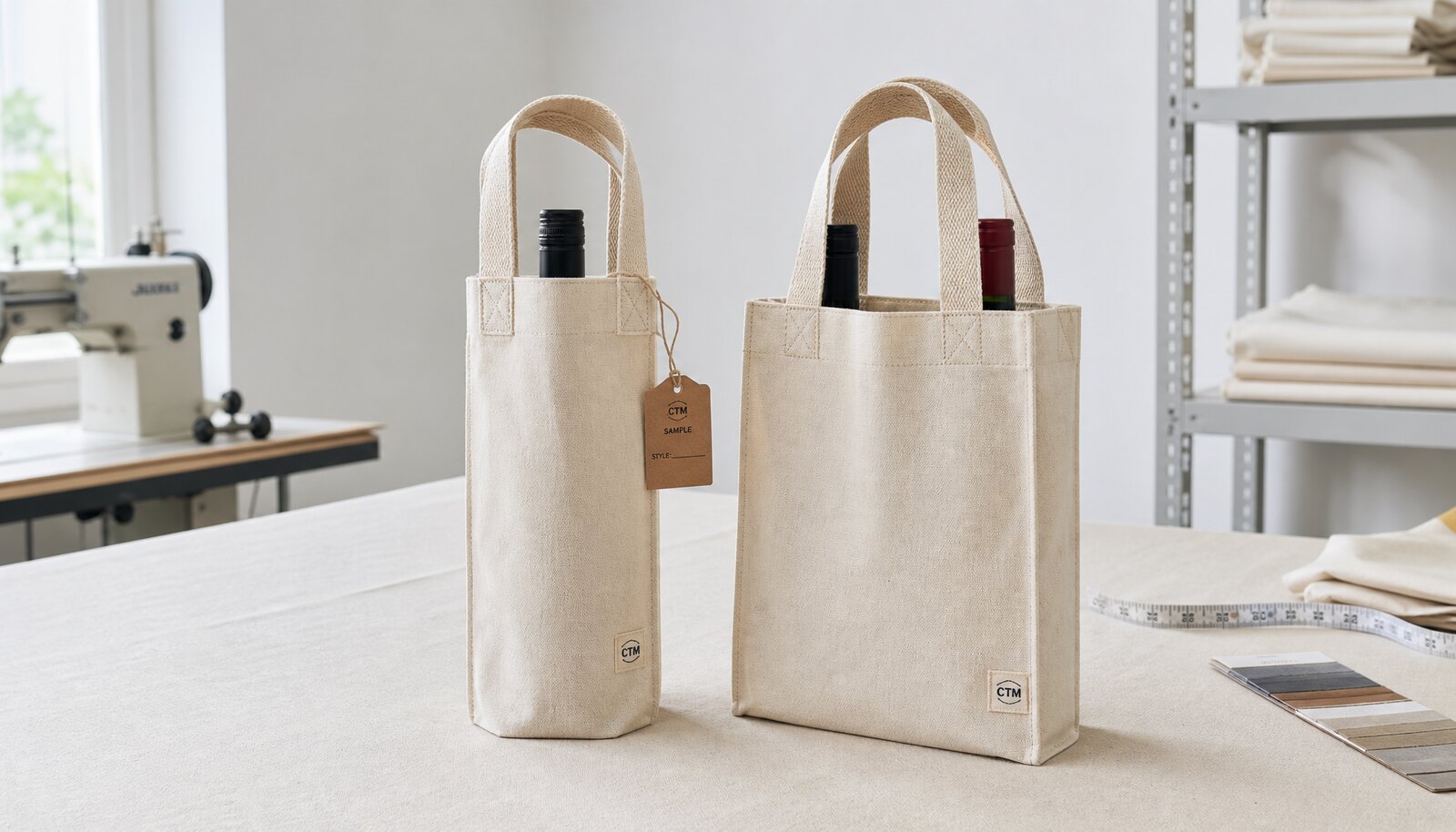
Start With the Gift-Shop Shelf, Not the Unit Price
The most useful way to buy wholesale canvas wine carriers for gift shops is to begin with the shelf environment, not with a target price. In a gift shop, the carrier is competing with candles, stationery, and other small-ticket add-ons, so the product has to look intentional at a glance. It also has to protect a bottle without becoming so bulky that the retail margin is swallowed by freight, packing, and handling. A good bulk pricing plan reflects how the item will be merchandised, stored, and reordered, not just what the factory can sew the cheapest.
That is why buyers should define the end use before they ask for quotes. A carrier sold as a low-cost souvenir accessory can tolerate simpler construction and a softer hand feel. A private-label gifting item usually needs a firmer body, cleaner logo presentation, and better shelf shape. If the product will ship with the bottle, the fit requirement matters more than decorative detail. If the product is sold as a standalone add-on, the display profile and perceived quality matter more than extra capacity.
The phrase 'canvas wine carrier' sounds simple, but the commercial choices behind it are not. One supplier may quote a flat pouch with a narrow handle. Another may assume a gusseted base, reinforced seams, and a retail insert. Those are not equivalent offers. The wrong comparison leads buyers to select the lowest number and then discover that the bag collapses in display, the logo sits too low on a filled bottle, or the carton cost is higher than expected because the bag is overbuilt.
A strong procurement brief starts with three decisions: what bottle the carrier must fit, what shelf position it must support, and what margin the buyer needs after landed cost. Once those three are fixed, the rest of the sourcing process becomes measurable instead of subjective. The result is a quote set that can actually be compared, negotiated, and repeated in a reorder plan.
For gift shops, this is especially important because assortment turns are often seasonal. The seller wants a product that can survive holiday demand spikes, gift wrap promotions, and counter display pressure without constant restocking problems. That means the buying file should already show the target finish level, the required retail presentation, and the price ceiling that still allows the shop to make margin after its normal markup.
- Decide the commercial role first: value add-on, mid-tier retail accessory, or premium gift item.
- Identify the bottle format before speaking to suppliers: standard 750 ml, larger-format bottle, or a gift set with divider.
- Use the same size and artwork basis across every supplier so the comparison is meaningful.
- Treat shelf stability as a cost driver because a soft bag may need extra packing or inserts to look right in store.
Choose the Construction Around Bottle Fit and Retail Presentation
Canvas wine carriers vary more than many buyers expect. A one-bottle carrier can be a simple flat design, but most gift-shop buyers are better served by a gusseted base that stands upright on the shelf. The standing feature changes the economics because it improves display value, but it also changes the cut size, seam layout, and carton packing efficiency. If the bag is too short, it looks unfinished. If it is too tall, it uses more fabric without adding real selling value.
The next decision is fabric weight. For many retail programs, a light-to-medium canvas is enough if the print and construction are clean. Once the buyer wants a firmer shelf feel, stronger handle resistance, or a more premium tactile impression, the fabric weight should move up. A practical sourcing range is usually around 8-10 oz for entry-level, 10-12 oz for standard retail, and 12-14 oz for a sturdier premium line. These are not universal rules, but they are useful starting points because the best weight depends on the bag size, the handle style, and whether the carrier needs to stand on its own.
Construction should be matched to the bottle and the use case. A single-bottle carrier for a standard bottle may only need a narrow gusset, but a two-bottle carrier needs more body structure and stronger load transfer at the handle. If the bag is sold as a set with the bottle, buyers should ask the factory to test the exact bottle model, not just a generic catalog dimension. Standard bottle shape variations can affect shoulder clearance, neck position, and the way the bag hangs when loaded.
Decoration also changes the buying outcome. A simple one-color screen print often gives the best economics for bulk ordering because setup is straightforward and the fabric itself carries most of the perceived value. Woven labels, embroidery, or a stitched patch can increase shelf appeal, but they add labor and may increase the MOQ. Buyers should choose the decoration method based on the retail price point, not simply on what looks attractive in a sample room.
Handle construction deserves more attention than it usually gets. The handle may seem like a small detail, but it determines whether the carrier feels dependable in hand. Ask for the handle width, the stitch pattern, the reinforcement method, and the handle drop. If the carrier is intended to be handed to a customer with a bottle inside, the handle should feel confident under repeated lifting, not merely acceptable on a bench test. A cheap-looking handle can make an otherwise good bag feel untrustworthy.
A useful rule is to define the carrier as a system: body fabric, base shape, handle build, decoration, and packing. The best supplier is not necessarily the one with the lowest fabric cost; it is the one who can balance all five elements so the final product matches the retailer’s margin and presentation needs.
- Use gusseted or structured bases when shelf standing is important.
- Match fabric weight to the selling price and the amount of structural support needed.
- Check handle width, stitch pattern, and handle drop as part of the design approval.
- Always test with the actual bottle shape, not a generic dimension sheet alone.
Understand Supplier Routes Before You Compare Prices
The supplier route can change both price and risk. A direct factory usually gives the cleanest unit-cost structure and the best control over cut, sew, print, and packing. It is typically the best path when the buyer wants a repeatable private-label program and can support a defined MOQ. The tradeoff is that the buyer has to be more disciplined: a factory quote only becomes reliable if the spec is specific, the sample is approved carefully, and the purchase order is clear about line items and tolerances.
Trading companies and sourcing agents are useful when the buyer needs one contact point for several components or multiple SKUs. They can simplify communication and sometimes solve packaging or consolidation problems that a small factory cannot handle elegantly. But the buyer must know whether the offer is a true factory basis or a bundle with markups, service fees, or rework risk hidden inside it. If the quote is not transparent, the apparent convenience can become expensive at reorder time.
Stock importers and domestic wholesalers are worth considering for first tests, urgent replenishment, or seasonal demand spikes. They reduce lead-time risk because the goods already exist, but the buyer gives up control over exact dimensions, logo placement, and repeat color matching. If a gift shop wants an exact private-label item for next season, a stock route should be treated as a market test, not the final long-term solution.
A two-step sourcing model can work well for premium programs. In that case, one supplier manages fabric or component sourcing while another handles sewing and finishing. This can be effective if the buyer needs precise material control or special branding elements, but it also introduces more handoffs, more lead-time coordination, and more opportunities for blame-shifting if something goes wrong. It should only be used when the buyer can control the spec and the timeline tightly.
The right route depends on order size, complexity, and how often the style will repeat. For gift shops, the biggest mistake is choosing the shortest route to a first shipment and then discovering that the product cannot be repeated profitably or consistently. Procurement should be organized around the reorder, not only the opening order.
- Direct factory: strongest control, best for repeat programs, needs clearer documentation.
- Trading company: easier for mixed shipments, but verify who is responsible for quality failures.
- Stock importer: fast and low-risk for tests, weak for exact branding consistency.
- Two-step sourcing: useful for premium lines only if lead time and responsibility are clearly divided.
Write an RFQ That Prevents Apples-to-Oranges Quotes
A useful RFQ is the fastest way to eliminate vague pricing. If the request simply says 'canvas wine bag with logo,' the market will return quotes built on different assumptions about fabric weight, handle quality, stitch count, packing, and testing. The result is not a comparison; it is a pile of different products with similar names. Procurement buyers should write the RFQ as if they are drafting a mini specification sheet, because that is exactly what the factory needs to quote accurately.
The RFQ should describe the product in measurable terms: bottle size, carrier format, fabric weight, finished dimensions, decoration method, handle details, and packing method. Ask the supplier to confirm whether the bag is made in-house or whether any steps are subcontracted. This matters because some suppliers are strong at sourcing but weak at quality control, while others can sew consistently but cannot manage complicated retail packing. The buyer needs to know where responsibility actually sits.
It also helps to ask for line-item pricing. A quote that shows only one lump sum hides the cost structure and makes it hard to judge whether one supplier is truly cheaper. Ask for the price of the body, handles, stitching, printing or labeling, packing, cartons, and sample charges. Once the quote is broken down, you can see where a supplier is saving money and decide whether that saving is acceptable. If one supplier is cheaper because it uses lighter fabric or simpler stitching, that should be visible, not discovered later.
For comparison purposes, all suppliers should quote the same Incoterm. Comparing one ex-factory price to another supplier’s delivered price is a common source of error. Freight, cartons, and duty assumptions can make a bad offer look good or a good offer look expensive. The RFQ should force a shared basis so that price differences reflect product and execution rather than quote structure.
A strong RFQ also protects the reorder. Include the color code, artwork file format, packing count, expected lead time, and whether future orders must match the first run exactly. That helps prevent subtle changes in fabric shade, logo placement, or folding style that could otherwise make a re-order inconsistent with the first shipment.
If the buyer is managing more than one SKU, the RFQ can include options. For example, ask suppliers to quote both 10 oz and 12 oz versions, or both screen print and woven label options. That lets the buyer see the price delta for each upgrade and decide where the margin can support a better finish.
- Ask for quotes on the same Incoterm and same packing basis.
- Separate fabric, handles, stitching, decoration, packing, carton, and sample charges.
- Request confirmation of in-house versus subcontracted steps.
- Include reorder requirements so the second run can match the first.
Build a Bulk Pricing Plan Around Volume Tiers
A real bulk pricing plan is more useful than a generic discount promise. For wholesale canvas wine carriers, price should be tied to volume tiers, fabric weight, and the complexity of the build. Buyers need to know what happens to the unit price when the order moves from a pilot quantity to a repeat order. Without that structure, it is impossible to forecast margin or evaluate whether a quote is commercially viable.
The simplest model is to define a base spec and then attach tiered pricing by quantity. For example, a one-color natural canvas carrier with standard packing may sit in a higher price band at 300-500 units, then fall at 1,000 units, and improve again at 3,000-5,000 units once setup and cutting waste are diluted. Heavier fabric, dyed material, extra print colors, and premium packing all shift the curve upward. The buyer should treat the tier table as a planning tool, not as a promise, because the exact numbers vary by region, factory efficiency, and shipping season.
The same logic applies to price deltas. When a supplier quotes two versions, ask how much the upgrade adds. What does 12 oz cost versus 10 oz? What does one additional print color add? What is the cost per piece for a woven label instead of a screen print? These deltas are more actionable than a single finished price because they show where the biggest margin tradeoffs sit. In gift shop programs, a small feature upgrade can be worth it if it materially improves shelf appeal, but only if the retail markup can absorb it.
Below is a practical example of how a buying team can structure a bulk pricing plan for planning purposes. The numbers are illustrative planning bands, not universal market quotes. They are meant to help buyers ask smarter questions and spot quotes that are either implausibly low or too padded to be competitive.
When reviewing a supplier's offer, make sure the quote is anchored to ex-factory first. Then add freight, carton cost, customs-related costs, and any domestic delivery charge. This is the only way to see true landed cost. A low unit price on a heavy or bulky carrier can lose its advantage if the carton cube grows too much, because freight often rises faster than the sewing cost falls.
Use Fabric Weight, Decoration, and Packing as Controlled Cost Levers
The most useful pricing levers are the ones buyers can actually control. For canvas wine carriers, fabric weight is usually the biggest lever because it affects material cost, handle feel, display stiffness, and carton cube. Decoration is the second major lever because the difference between one-color screen print and a more complex label or embroidery can be significant at lower volumes. Packing is the third lever because retail-ready packing improves presentation but can add labor, materials, and volume inside the carton.
A buyer should decide which element carries the value. If the brand wants the product to look clean and simple, a good natural canvas with a restrained logo may be enough. If the product must stand out as a gift item, the buyer may choose heavier fabric and a premium label rather than adding more print colors. That can be a better commercial decision because it improves perceived quality without making the artwork process more fragile.
MOQ often rises when the design becomes more complex. Dyed canvas, multiple colors, special lining, metal hardware, or multiple bottle sizes increase changeover risk and scrap exposure, so the factory will usually price those runs differently. Buyers sometimes ask for a low MOQ on a highly customized carrier, but the factory can only lower the MOQ by charging more per piece or by reducing quality concessions. The question is not simply 'Can you do it?' but 'What does the lower MOQ cost in unit price and consistency?'
Natural canvas can vary in shade and texture from batch to batch, so if color consistency matters, the buyer should ask how the factory handles lot matching. If the carrier will be sold next to other branded goods, shade variation can matter more than it would for a rustic or casual gift item. It is better to know that early than to discover it after a full run has shipped.
For procurement planning, it is helpful to think in increments. One more ounce of fabric, one more print color, one more packing step, or one more quality checkpoint all add up. A good bulk pricing plan makes those increments visible so the buyer can choose the best tradeoff between shelf value and landed cost.
- 10 oz natural canvas is a practical baseline for value-oriented gift shops.
- 12 oz to 14 oz creates a firmer, more premium hand feel.
- Screen print is usually the most economical decoration for simple logos.
- Embroidery, woven labels, or patches improve perceived value but should be justified by the retail price point.
Approve the Sample as if It Were a Production Shipment
Sample approval should test the same details the production run will need to pass. Buyers should not approve from a flat-lay photo or from a sample that has never been filled with the actual bottle. A wine carrier can look tidy when empty and still fail when the bottle is inside, because the base depth, handle position, or seam angle was never tested under load. The sample stage is the chance to catch that problem before it becomes a container issue.
A good sample review starts with measurement. Check the finished length, width, gusset, handle drop, and any divider spacing. Compare those numbers to the spec sheet and record the approved result. Then assess fit using the actual bottle or a validated dummy weight. The bottle should sit properly in the bag without forcing the seams apart or causing the neck to sit awkwardly below the top edge. If the carrier is supposed to stand upright, confirm that it actually does so on a retail shelf surface.
The visual check matters too, but it should be specific. Look at logo placement on both the flat sample and the filled sample because the image changes when the bag is loaded. Inspect the print edge, the color density, and whether the branding is centered relative to the visible front panel. A small shift can make a gift item look sloppy even if the sewing is technically fine.
Surface quality should also be checked carefully. Natural canvas often has visible fiber variation, which is normal, but it should not carry oil marks, loose lint, dirt, or odors that suggest poor storage or finishing. If the bag has a coating or printed area, rub and flex the fabric near the fold to see whether cracking begins early. That is especially relevant if the carrier will be folded and unfolded repeatedly in a gift shop.
The most important sample discipline is to approve the exact build, not a loose interpretation. If the factory plans to switch thread type, change the handle webbing, or alter the carton packing after approval, those differences should trigger a new sign-off. Otherwise, the sample becomes a suggestion rather than a control document.
- Use the actual bottle or a validated dummy during sample review.
- Check logo placement on a filled bag, not only on the flat sample.
- Measure and record the approved dimensions and keep them as the reorder reference.
- Do not release bulk until the supplier confirms the same material lot or an approved equivalent.
Set QC Acceptance Criteria That a Factory Can Actually Inspect
Quality control for canvas wine carriers should focus on functional failure points first. The major risks are weak handles, open seams, poor fit, crooked print, crushed packing, and uncontrolled color variation. Cosmetic variation matters too, but a buyer should separate preferences from rejectable defects. The best QC plans are operational: they define what to measure, how to test it, and what counts as pass or fail.
A practical QC plan begins with dimensional tolerances. The factory should inspect finished size against the approved spec with a clear tolerance band. For many standard canvas carriers, a tolerance in the low millimeters is reasonable, but the exact threshold should reflect the bag’s softness and the approved sample. Too-tight tolerances can create false rejects on natural canvas, while too-loose tolerances can result in inconsistent shelf presentation. The goal is consistency, not impossible perfection.
Handle testing deserves a defined method. Ask the factory to perform a practical load test using a filled bottle or equivalent weight. The carrier should be lifted repeatedly and inspected for seam opening, handle slip, stitch distortion, or bottom tear. For two-bottle carriers, the divider and the load transfer into the handle area become critical. A bag that survives one lift is not necessarily fit for store use; repeated handling is the better proxy.
Print inspection should include both placement and durability. Buyers should define acceptable deviation for logo position and require that screen print not smear, crack prematurely, or misregister beyond the agreed allowance. If the carrier uses embroidery or a woven label, the thread tension and attachment should be checked for puckering and loose edges. These details may sound small, but they are the difference between a retail-ready product and a product that looks inconsistent on the shelf.
Carton QC is part of product QC. The count, barcode, label, and outer mark must match the PO exactly. A shipment can have acceptable bags and still fail operationally if the carton label is wrong or the master count is inconsistent. For gift-shop buyers, that means the inspection plan should include not only the bag, but the whole packing unit.
The most operational QC programs also specify what happens when defects are found. If the factory sees a run of loose stitches or misprinted logos, the buyer should know whether rework is allowed, whether the lot is sorted, and who pays for repackaging. That makes the quality plan enforceable rather than advisory.
- Define dimensional tolerances in writing before production starts.
- Use a practical load test with the actual bottle or a validated weight.
- Separate cosmetic issues from functional defects in the acceptance criteria.
- Inspect carton labels, SKU codes, and pack counts as part of final QC.
Treat Packing as Part of the Merchandise, Not Just the Shipment
For gift shops, packing is not merely shipping protection. It affects how the product looks on the shelf, how easily staff can replenish it, and whether the buyer can sell it as an add-on without opening the unit. A clean fold, a simple insert card, or a visible hangtag can make the carrier feel like a retail product rather than a generic pouch. Because of that, packing decisions should be made during quoting, not after the price has already been negotiated.
There are two packing questions to answer. First, what does the shop need the customer to see? Second, what does the warehouse need to move efficiently? Those are not always the same answer. A retail-ready pack may require an insert, barcode, and careful fold orientation. A warehouse-friendly pack may prioritize compact carton cube and quick picking. If the buyer does not define both, the factory will optimize for its own convenience and the end result may not work in store.
For bulk orders, nested or flat-packed cartons are common, but buyers should check the crease effect. Canvas can hold fold lines if it is compressed too hard. That is fine for transport if the product can recover quickly, but not if the carrier will be hung or displayed immediately at retail. Moisture protection also matters on long-distance shipments; a simple liner or protective bag can reduce transit risk where humidity is a concern.
Retail packing should match channel behavior. If the carrier is being sold beside wine accessories, the product may need a hangtag or belly band so the logo is visible on the shelf. If it is sold as part of a gift basket, a simple protective pack may be enough. Asking for the wrong retail presentation is a common way to spend money without improving sell-through.
The buyer should make the carton spec part of the purchase order: units per carton, carton dimensions, carton gross weight target, and outer label format. That gives logistics and warehouse teams a stable basis to plan space and receiving. The best packing spec is the one that protects the product while also making the downstream operation easier.
- Define whether the product is shelf-facing, hangable, or purely ship-safe.
- Ask for the carton cube before approving the final unit price.
- Use barcode labels and clear style codes if the product will enter retail inventory systems.
- Avoid over-compressing canvas if the bag needs to look crisp at first unpacking.
Compare Ex-Factory, FOB, and Delivered Cost the Right Way
A lower unit price is not always a better buy. Procurement teams should compare canvas wine carrier quotes on the same basis, then convert them to landed cost using consistent assumptions. Ex-factory pricing shows the production cost at the factory gate. FOB adds the cost of loading and export handling to the port. Delivered pricing includes more of the logistics burden and can look attractive, but it only helps if the shipping assumptions are realistic and transparent. Mixing these terms in one spreadsheet creates false winners.
A good comparison uses line-item thinking. Suppose one supplier quotes a lower ex-factory price but the bags are packed in a way that creates a larger carton cube. Freight may rise enough to erase the advantage. Or suppose another supplier includes retail-ready packing in the unit price while a second supplier charges it separately. The second quote may look cheaper until the buyer adds the packing labor back in. This is why the full landed-cost view is more useful than a headline number.
Below is a simple example of how a buyer might structure comparison. The values are illustrative, not a market guarantee, but they show the right logic. If the factory quote is $0.95 ex-factory, cartons add $0.06, packing labor adds $0.08, inland export handling adds $0.04, and ocean freight plus destination handling adds $0.22, the landed cost is $1.35 before duty and domestic delivery. Another quote at $1.05 ex-factory could still be the better deal if it packs more efficiently or reduces rework. The point is that the cheapest sewing price does not always create the cheapest shipment.
Comparing terms also helps when suppliers are not equally transparent. A factory may say it can offer 'low prices,' but if it will not separate fabric, print, and packing, the buyer cannot tell whether the low price is sustainable or whether it depends on hidden compromises. Buyers should insist on a basis they can audit. The more visible the price structure, the easier it is to protect margin and manage reorders.
For buyers sourcing wholesale canvas wine carriers for gift shops, this is where a bulk pricing plan becomes practical. The plan should show the price at each quantity tier, the term basis for each quote, and the expected landed cost after freight and handling. That turns sourcing into a repeatable procurement process instead of a one-off negotiation.
- Compare all suppliers on the same Incoterm before making a decision.
- Add cartons, packing labor, freight, and handling to the sewing price to get landed cost.
- Use a simple landed-cost worksheet so the cheapest quote does not win by mistake.
- Ask the supplier to show line-item pricing if the quote looks unusually low or unusually bundled.
Specification comparison for buyers
| Buying route | Best use case | Typical spec control | Indicative price position | What to verify before quoting |
|---|---|---|---|---|
| Direct canvas factory | Repeat programs with fixed artwork and stable volume | Highest: fabric weight, stitch layout, handle build, packing | Lowest unit cost after setup; best at higher MOQs | Confirm in-house cutting and sewing, QC ownership, and whether any steps are subcontracted |
| Trading company or sourcing agent | Multi-SKU programs or buyers needing one contact for several components | Medium: can coordinate, but not always manufacture | Usually 5-15% above factory basis, sometimes more if the bundle includes hidden rework | Ask for the factory name, factory invoice basis, and a line-item breakdown |
| Stock importer or domestic wholesaler | Fast replenishment, seasonal tests, and small initial buys | Low to medium: limited color and size options | Higher unit price, lower startup risk | Check exact dimensions, logo method, carton count, and reorder availability |
| Low-MOQ decorator | Pilot private-label runs and design tests | Medium: good for simple print, weaker on custom construction | Higher unit price on small quantities | Validate print durability, fabric weight, and whether the decorator is reselling blank goods |
| Regional factory near destination market | Short transit and simpler after-sales support | Medium to high depending on factory specialization | Often higher labor cost, lower freight and risk | Verify material consistency, local compliance, and whether there is true cut-and-sew capability |
| Two-step sourcing model | Premium lines needing fabric control and separate finishing | Highest if managed well, but slower | Can be efficient at scale, but setup cost is split | Check component MOQs, responsibility split, and lead-time alignment |
| Direct offshore factory with packing line | Retail-ready gift shop programs needing inserts, labels, and barcodes | High if the factory has retail packing experience | Competitive at scale, especially when packing is included | Audit packing workflow, label control, and carton marking accuracy |
| Mixed-SKU giftware distributor | Assortment buys where speed matters more than exact construction | Low to medium | Convenient but not usually the cheapest | Ask whether the carrier is retail-ready or only transit-packed |
| Custom workshop or artisanal maker | Small-batch premium gifting or local-brand collaborations | High on decoration, variable on repeatability | Highest per unit, but flexible on appearance | Confirm repeat consistency, seam standards, and batch-to-batch color control |
Buyer checklist before sampling
- Bottle format is fixed: single-bottle or two-bottle, actual bottle height, shoulder width, and whether the neck should sit above the top edge.
- Canvas weight is stated in both oz and GSM, with a tolerance agreed in writing; for example, 8-10 oz for entry programs, 10-12 oz for standard retail, and 12-14 oz for firmer premium presentation.
- Construction is defined: seam type, seam allowance, base style, divider if any, handle width, and reinforcement method at the load points.
- Decoration method is chosen by order size and shelf goal: one-color screen print for bulk economy, woven label or embroidery for premium branding, or heat transfer only if durability is acceptable and the artwork is suitable.
- Packing spec is written down: single polybag, insert card, barcode label, fold orientation, master carton count, and whether the carrier must display well on a gift-shop shelf.
- Sampling approval includes physical measurement of the actual bottle fit, logo location on a filled carrier, odor check, seam finish, and carton fit before mass production starts.
- Lead time is split into sample time, material booking, production, and transit so the delivery promise is realistic and traceable.
- Quote comparison is normalized to the same basis: ex-factory, FOB, or delivered cost, with freight, cartons, artwork, and sampling listed separately.
- For repeat programs, the buyer keeps a master specification sheet and a photo-approved reference sample so the second order does not drift from the first.
- Acceptance criteria are set before order release, including dimensional tolerance, print registration, and practical load performance for the handle and bottom seam.
Factory quote questions to send
- Please quote the same style on an ex-factory, FOB, and delivered basis so we can compare freight and packing separately.
- What exact fabric weight in oz and GSM will you use, and what tolerance do you allow on incoming and finished fabric?
- Is the carrier made fully in your own facility, or are cutting, printing, embroidery, or packing subcontracted?
- What is the MOQ by color, by print method, and by carton configuration, and how does unit pricing change at 300, 500, 1,000, 3,000, and 5,000 pieces?
- Please break the quote into fabric, handles, stitching, decoration, packing, cartons, and sample charges.
- What is your standard seam allowance, handle attachment method, and reinforcement pattern at the load point?
- What size tolerance do you hold on finished length, width, gusset, and handle drop?
- How do you control print placement, print registration, and curing so the artwork does not crack or smear after folding?
- Can you share a pre-production sample photo set with measurements before bulk release?
- What is your lead time after sample approval, and what events usually extend it: fabric sourcing, print bottlenecks, peak season, or packing changes?
Quality-control points to confirm
- Finished size matches the approved sample within the agreed tolerance. A practical control point for most canvas wine carriers is ±3 mm on width and height for standard sizes, with a slightly wider tolerance only if the bag is intentionally soft-constructed.
- Bottle fit is checked with the actual bottle or a validated dummy load. The bottle should slide in without forcing the seams open, and the neck position should match the approved display height.
- Canvas weight is verified against the order spec in oz or GSM. Small natural variation is normal, but the shipment should not fall below the agreed minimum fabric weight band.
- Seam quality is even and continuous, with no skipped stitches, loose thread clusters, frayed edges, open side seams, or weak turn points at the bottom corners.
- Handle attachment is inspected at the load-transfer point. Bar-tacks or equivalent reinforcement should be present where the handle joins the body, with no visible distortion after a practical lift test.
- A simple load check is performed with a filled bottle or equivalent weight. For single-bottle carriers, the bag should be lifted repeatedly without tearing, handle slip, or seam opening; for two-bottle carriers, the divider and base must not shift under weight.
- Print registration, edge sharpness, and color density are checked against the approved artwork. The logo should not be noticeably off-center, blurred, washed out, or mismatched to the reference sample.
- If embroidery or woven labels are used, the stitching should be tight, the label should sit flat, and there should be no puckering, loose threads, or distorted fabric around the appliqué.
- There should be no visible odor, oil stain, mildew, needle damage, dirty marks, or uneven dye shade on packed units.
- If the product is retail-ready, the fold orientation, polybag size, insert card, barcode label, and hangtag position should match the packing sheet exactly.