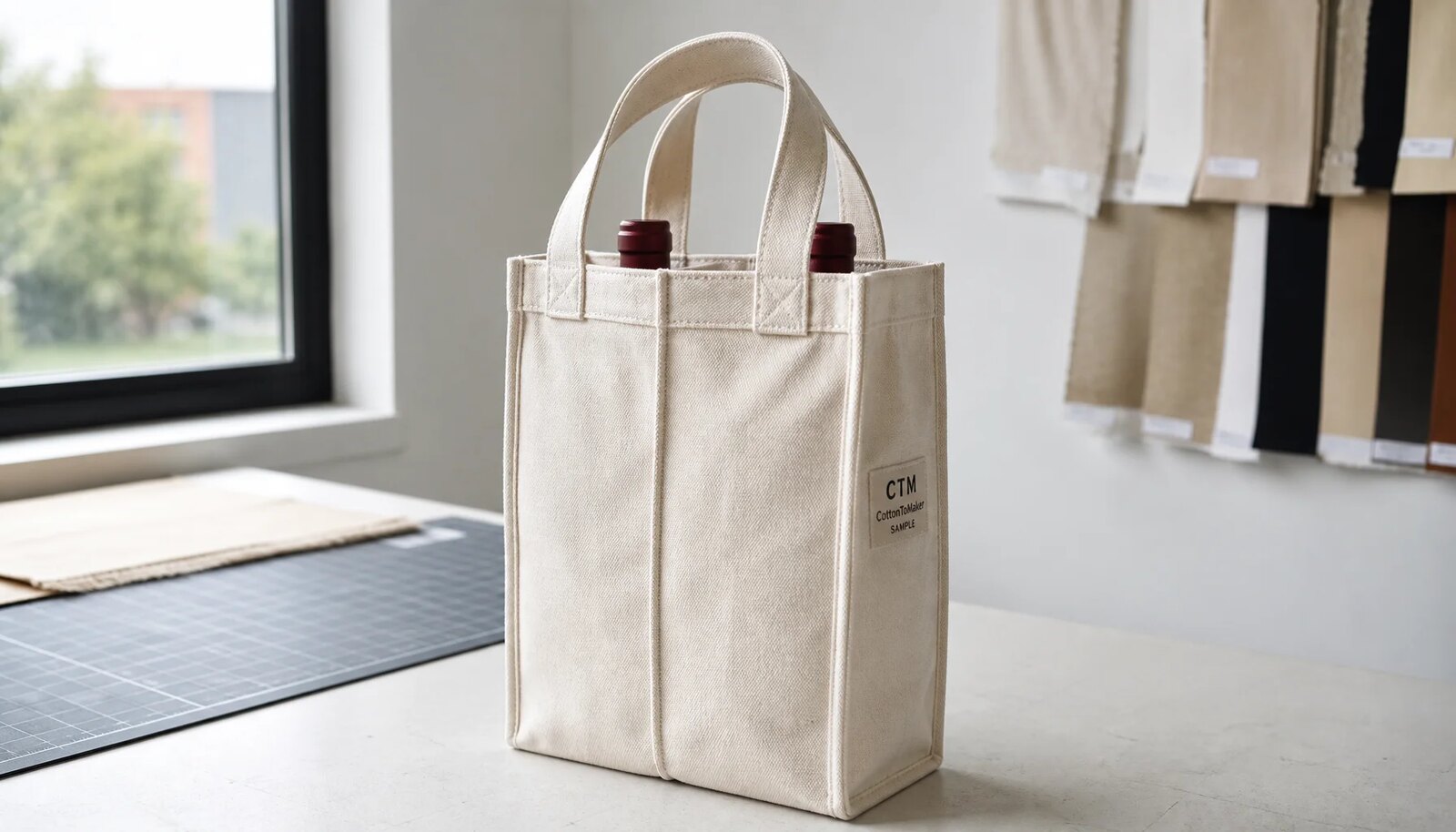
Start With the Sales Moment, Not the Bag
For wholesale canvas wine carriers for farmers market vendors, the sourcing logic starts with how the product will be sold, not how it will be sewn. At a market stall, the carrier is usually an add-on purchase, a gift solution, or a practical carry item paired with a bottle. That means the bag has to do several jobs at once. It has to look clean on a table, feel sturdy in the hand, and survive a short trip from stall to car. If the buyer defines the item only as a textile product, the order usually misses the real use case.
The first question is bottle format. A one-bottle carrier, a two-bottle carrier, and a multi-use gift carrier are different sourcing problems. Bottle diameter, shoulder shape, and height change the interior geometry, handle balance, and amount of reinforcement needed at the base. If the carrier is meant for standard wine bottles, say that plainly. If it must fit Burgundy or sparkling bottles, include that too. A supplier can only quote accurately when the bottle profile is defined up front, and the quote becomes much easier to defend later if the spec is specific from the start.
Farmers market vendors also sell in a visual environment that is busy, casual, and highly exposed. The carrier sits next to produce, flowers, baked goods, and other local products, so the finish has to feel intentional rather than generic. That affects color choice, decoration size, and whether the bag should stand upright or ship flat. When the product is built around shelf presence and impulse purchase behavior, the right spec is usually cleaner and easier to reorder than a highly customized novelty version.
- State the exact bottle type you expect most often: Bordeaux, Burgundy, sparkling, or mixed.
- Define the sales channel: farmers market stall, winery tasting room, gift shop, or event merch.
- Decide whether the carrier is a one-bottle SKU, a two-bottle SKU, or a mixed assortment program.
- Clarify whether the buyer cares more about retail display, bottle protection, or low-cost bundled packaging.
Translate the Use Case Into a Quoteable Spec
If you want useful quotes, turn the selling scenario into a simple tech pack. A factory can price faster when the request includes finished dimensions, fabric weight, lining status, divider details, handle construction, and decoration method. Without those details, the supplier will either guess or quote against its own assumptions. That makes negotiation harder later because every price difference becomes a debate about what was or was not included. Procurement works better when the facts are visible at the beginning.
Canvas weight is one of the clearest levers. A 12 oz, or roughly 400 GSM, canvas is often the practical midpoint for a retail wine carrier because it gives enough body without making freight and handling inefficient. A 16 oz, or roughly 500-540 GSM, canvas is better when the buyer wants a firmer silhouette, a more premium feel, or better resistance to distortion after repeated handling. If the order is a low-priced promotional item, a lighter fabric may work, but the buyer should accept the tradeoff in structure and print performance.
Construction details matter almost as much as fabric weight. Lining, divider inserts, contrast binding, reinforcement patches, and internal seams all increase labor or trim complexity. If the buyer is trying to reduce MOQ, simplify the build first. Keeping one fabric color, one print color, and one packing format is usually a more effective negotiation move than asking the factory to ignore a complex spec. The cleaner the tech pack, the easier it is to compare suppliers on equal terms and the less likely it is that a sample passes while the bulk lot drifts.
- Write finished dimensions, not only cut size.
- State whether the carrier is lined or unlined.
- Call out reinforcement at handle anchors and bottom seams.
- Specify the acceptable print area and whether the logo sits on one or both sides.
- Note whether the carrier must ship flat, folded, or pre-shaped.
Choose the Supplier Route Before You Negotiate MOQ
The route you choose changes the MOQ conversation. A direct factory that actually cuts and sews canvas bags is usually the best route for repeat programs because it controls the details that matter most: fabric purchase, stitch quality, packing, and production timing. The tradeoff is that direct factories tend to hold firmer on MOQ because setup costs are real and they need to protect sewing line efficiency. If the buyer expects a long-running program, that is usually the right partner. If the buyer only wants a first-season test, it may be too rigid unless the spec is simple.
A bag specialist or trading company can help when the buyer wants one managed quote process across multiple product types, or when internal sourcing time is limited. That route can be useful, but only if the buyer verifies who actually owns the fabric, who runs decoration, and who handles defects. If those responsibilities are unclear, the quote may look competitive while the risk sits with the buyer after approval. Ask for the actual maker, the decoration partner, and the inspection handoff point. Those are not administrative details. They are the difference between a clean order and a messy one.
Stock blank carriers with local decoration are the fastest path for a small launch, but they only work when the underlying blank is stable across replenishment. A blank carrier can be attractive for seasonal testing, but the buyer should confirm that future stock will match the sample in canvas weight, shade, and stitching. For a retail buyer who cares about repeatability, that stability check is not optional. A quick launch is only useful if the next order can be reproduced without redesigning the product.
- Direct factory: best for custom construction and repeat orders.
- Trading company: useful for simpler purchasing, but verify the real producer and QC owner.
- Stock blank plus local decoration: good for testing demand, but confirm replenishment stability.
- Ask who buys the canvas, who sews the bag, and who approves final packing.
Build the RFQ So Quotes Are Actually Comparable
A strong RFQ should force suppliers to answer the same questions in the same format. Ask for a separate unit price for the blank carrier, the decoration, the label, and any retail packaging. If the supplier quotes everything as one line, you cannot tell whether the difference comes from fabric weight, print setup, trim cost, or packing method. The goal is not to make the quote longer for its own sake. The goal is to make pricing interpretable so the buyer can negotiate the parts that matter. A flat price with unclear content is hard to manage and harder to audit later.
The RFQ should also expose the order structure. List the total quantity, MOQ by color, MOQ by print color, and whether mixed SKUs are allowed in the same carton plan. If you want a blank version and a branded version, ask for both on one sheet. If the supplier offers multiple canvas weights, ask for each one separately. That lets procurement compare unit cost against structure and appearance rather than getting trapped in a single number that hides material differences. The buyer should be able to see exactly what moves the price and what simply changes the look.
For farmers market buyers, it helps to include the intended sales price or target margin range. Suppliers do not need your internal margin model, but they do need to understand whether the carrier is a premium add-on, a mid-tier retail item, or a low-cost bundled accessory. That context often changes the way they suggest fabric weight, label format, or packing density. Better RFQs create better recommendations because they communicate the commercial target, not just the physical object.
- Ask for blank cost and decorated cost separately.
- Require carton count, carton size, and gross weight on the quote.
- Ask for MOQ by style, color, print color, and total order value.
- Include your target sales channel so the supplier can recommend the right construction level.
- Request a second quote for a simplified version if the first version is too expensive.
Use Samples to Prove Fit, Not Just Appearance
A sample is not approved just because the logo looks correct. The first approval has to prove bottle fit, carry balance, and construction quality. Test the actual bottle shapes you expect to sell, not a generic empty bag. A carrier that works for a standard Bordeaux bottle may pinch wider bottles or tip when loaded. Check whether the base sits flat, whether the top opening closes without stress, and whether the handle drop allows the bag to hang naturally in hand. If it is a two-bottle design, confirm that the bottles do not collide during movement. The sample should behave like a product, not just look like one.
Then inspect the sewing and trim. Look at seam allowance consistency, handle anchors, divider joins, and the top hem. A good sample should survive repeated flexing without seam pull, loose thread tails, or twisting. If there is a label or woven tag, inspect its placement relative to the seam line. Decorative elements that look neat in a photo can become weak points if they are sewn too close to stress areas. That is a common cause of first-lot defects in canvas bags, and it is easier to catch in the sample stage than in a warehouse.
Finally, test the visual finish in normal retail lighting. Compare print sharpness, shade consistency, and label alignment when the bag is sitting next to other market products. If the product is meant to be an impulse buy, visual clarity matters as much as strength. The buyer should reject samples that are mechanically acceptable but visually messy, because farmers market retail is highly visible and first impressions drive attachment rate.
- Test with full bottles, not empty bags.
- Check fit, balance, and base stability before looking at decoration.
- Inspect seam quality, handle anchors, and divider joins under load.
- Review the sample under normal store or market lighting, not only in a sample room.
- Ask for a pre-production sample if the bulk order will use a different fabric lot or print run.
Decoration Choices Affect MOQ, Reorder Speed, and Brand Flexibility
Screen print is usually the most efficient branding method for a canvas wine carrier when the logo is simple and the order needs to be repeatable. One-color or two-color prints are easy to compare across suppliers and generally hold up well when the cure is correct. The risk is not a complex design concept. It is poor registration, weak ink adhesion, or a print placed too close to a seam or fold line. If the carrier is meant to be washed or heavily handled, the buyer should ask for rub resistance and flex behavior during sample review.
A woven label or side label is often the better choice when the brand presentation should be quieter and more boutique. It preserves the texture of the canvas while still giving the product identity. That said, labels can introduce their own MOQ and attachment complexity. The buyer should confirm whether the label is sewn in-house, purchased separately, or attached by a subcontractor. If the label is custom made, it may become the actual MOQ bottleneck rather than the bag itself. That is why the branding decision should be made with the supplier's production flow in mind, not just from a packaging mockup.
For a buyer with a long-term product line, keep the brand mark reusable across different bag formats. A simple side label, small logo, or neutral hang tag is easier to carry forward into future canvas accessories than a large print that only fits one SKU. That matters in wholesale because the best brand systems are the ones you can repeat without redesigning the whole production flow every season.
- Use screen print for clear, repeatable branding.
- Use woven or side labels for a quieter premium look.
- Keep decoration away from seams, folds, and stress points.
- Confirm print cure quality and label attachment method before bulk approval.
- Ask whether the label MOQ is separate from the bag MOQ.
Packing and Carton Specs Can Make or Break Receiving
Packing is a procurement issue, not an afterthought. If the carrier is to be sold through farmers market vendors, the receiving team usually wants flat, clean, countable units that are easy to move from carton to shelf. The factory should specify whether the bags are flat-packed, lightly folded, or pre-shaped. The right answer depends on construction. A soft unlined carrier can usually be packed flat without problems. A reinforced or structured version may need a packing method that protects shape without taking too much volume. The wrong packing method can turn a good product into a difficult one before it reaches the buyer.
Carton specs need to be agreed in writing. Ask for units per master carton, carton dimensions, gross weight, and whether there are inner packs or polybags. If the product is distributed to multiple vendors, clear carton markings and stable counts reduce receiving mistakes. If the order is for a warehouse or distributor, carton efficiency matters because wasted volume drives freight cost. A cheap unit price can disappear quickly if the packing format is inefficient or inconsistent, especially on products that are not perfectly compact.
Also check for odor, moisture, dust, and compression marks when the cartons are opened. Canvas can pick up warehouse smell or creasing if the packing method is poor. This is especially important for retail-facing goods because the first person to open the carton is often not a QC specialist. They are a store associate, vendor, or distributor who expects the bag to look ready for sale. The order should arrive in a condition that supports immediate merchandising, not more cleaning or rework.
- Confirm flat-packed versus pre-shaped shipping.
- Require units per carton and carton size on every quote.
- Decide whether polybags are needed or whether the canvas can ship loose in a clean carton.
- Check carton markings and item codes for easy warehouse receiving.
- Ask for a packing photo before bulk shipment if the program is time-sensitive.
Negotiate MOQ on the Variable That Is Actually Expensive
The best MOQ negotiation starts by identifying what drives the factory's setup cost. Often it is not the bag body itself. It is the custom fabric order, the print setup, the label purchase, or the sewing line changeover. If the buyer wants a lower MOQ, the right move is to simplify the expensive variables first. One canvas color, one print color, and one packing format are easier for the factory to approve than a broad request for a smaller order on a complex spec. This is where procurement discipline pays off: the buyer gets more leverage by reducing complexity than by pushing on price alone.
A good negotiation conversation makes tradeoffs explicit. If the buyer can accept a standard canvas weight and a simple logo, the factory may be willing to lower the minimum or split the order across two shipments. If the buyer needs a custom color or specialty label, then the MOQ may need to stay higher. That is not a negotiation failure. It is a production reality. The buyer should decide which variables are strategic and which are just nice to have. A clear priority list helps suppliers understand where they can help without absorbing hidden cost.
When asking for flexibility, show the supplier the reorder logic. A factory is more likely to help on the first run if it sees a clear repeat path, even if that repeat path is not guaranteed. Be specific about expected timing, the seasonal window, and whether the carrier is part of a broader bag line. Suppliers usually respond better to a credible program than to a vague promise of volume. The cleaner the commercial story, the easier it is to get a practical MOQ compromise.
- Trade custom colors for a lower starting quantity if necessary.
- Keep decoration to one color if MOQ is tight.
- Ask whether the MOQ is based on style, color, print setup, or material purchase.
- Offer a simple reorder path rather than pushing for every option at once.
- Ask if the supplier can quote a trial run with reduced complexity and a clear follow-up order.
Quality Control for Bulk Production and First Reorder
The first bulk lot should be checked against the same critical points that were approved in the sample, but with a wider focus on consistency. Measure body size, handle drop, and bottle compartment width from multiple cartons. If the batch is supposed to be uniform, there should not be significant variation across the first shipment. A bag that passes one sample test can still fail if the bulk lot uses a different fabric batch, thread, or trim source. That is why the buyer should not treat the sample as a final guarantee. It is only the standard the bulk lot has to meet.
Run a simple use test with actual filled bottles. Lift the carrier by the handles, tilt it, and set it down repeatedly. This catches weak anchor points and poor base balance quickly. If the carrier includes dividers, test whether they stay upright after handling. If the print is prominent, rub test it with a dry cloth and check whether the ink transfers. These are basic checks, but they prevent expensive retail complaints later. If the item is going into a market channel where the customer handles it before buying, that friction test matters more than it does in a sealed warehouse product.
The first reorder deserves its own review as well. Reorders are where many suppliers quietly drift on fabric shade, trim substitution, or packing density. Keep the approved sample, photos, and spec sheet archived so the second order can be compared against the first. Buyers who only manage the initial production often lose consistency on reorder. A disciplined approval record is what keeps a wholesale program stable.
- Check dimensions across several cartons, not just one sample.
- Perform a handle load test with filled bottles.
- Confirm print rub resistance and label attachment durability.
- Compare first bulk lot against the approved sample photo and tech pack.
- Treat the reorder as a separate QC event, not a formality.
Know When a Quote Is Too Thin to Trust
A quote is not good just because the unit price is low. If the supplier cannot state the real MOQ logic, cannot identify the production source, or keeps changing what is included, the apparent savings are usually fragile. The same is true if the sample is visually good but the construction is inconsistent, or if the carton plan is vague enough to create receiving problems later. In procurement terms, opacity is a cost. If you cannot compare the quote cleanly, you cannot defend the purchase cleanly.
The right exit criteria are simple. Walk away if the supplier will not confirm fabric weight, cannot provide a measured sample, refuses to separate blank and decorated pricing, or shows no control over packing and defect handling. Those are not minor gaps. They are signs that the order will become harder after purchase order placement, not easier. For a wholesale farmers market program, predictability matters more than squeezing the last cent out of unit price. A slightly higher quote with clear control is usually the better operating decision.
If the supplier is close but not quite there, use the gaps to narrow the ask. Simplify the spec, reduce the print complexity, or move to a standard canvas color. Sometimes the right decision is not to force the original design through a reluctant factory. It is to redesign the product so the supply chain can support it cleanly.
- Walk away from quotes that hide fabric weight or packing details.
- Do not accept MOQ claims that are not tied to a specific setup cost.
- Reject samples that look good but fail fit or construction tests.
- Prefer a simpler spec over a fragile complex one when the launch window is fixed.
Specification comparison for buyers
| Spec decision | Recommended option | When it fits | Buyer risk to check |
|---|---|---|---|
| Sourcing route | Direct factory with in-house bag sewing | Best for repeat programs, custom dimensions, and tighter control over fabric, stitching, and packing | Confirm the supplier actually cuts and sews the carrier, not only decoration or trading |
| Sourcing route | Bag specialist or trading company with fixed factory partners | Useful when you need multiple product lines, one managed quote process, or lower sourcing overhead | Verify who owns QC, who buys the fabric, and where defects are resolved |
| Sourcing route | Stock blank carriers with local decoration | Works for fast tests, smaller launch quantities, or seasonal market drops | Check that blank stock lots are stable across replenishment and that decoration does not distort the bag |
| Fabric weight | 12 oz / about 400 GSM canvas | Balanced for everyday resale, a cleaner hand feel, and lower freight weight | Watch for thin weave, weak side walls, and visible print strike-through |
| Fabric weight | 16 oz / about 500-540 GSM canvas | Better for premium retail positioning, firmer structure, and heavier bottle support | Higher cost and cube can raise freight expense and reduce carton efficiency |
| Construction | Unlined canvas with reinforced base and handle anchors | Good for a straightforward retail carrier with tighter MOQ and simpler sampling | Check whether the base can stay flat after loading and whether the handles twist under weight |
| Construction | Light lining or insert panel | Useful when you need better shape retention, bottle separation, or a cleaner interior finish | Confirm whether lining changes the MOQ or adds a separate trim source |
| Decoration method | 1-color or 2-color screen print | Best for simple logos, price-sensitive orders, and stable repeat production | Confirm print size, cure quality, rub resistance, and registration tolerance before bulk approval |
| Decoration method | Woven label or side label branding | Good for understated branding, boutique resale, and longer visual life through handling | Check label size, attachment method, and whether the label MOQ forces a larger order |
Buyer checklist before sampling
- Lock the bottle count, bottle diameter, shoulder width, and bottle height before asking for MOQ.
- Choose the canvas weight in GSM or oz and state whether you want lined or unlined construction.
- Specify logo size, placement, and print method, or ask the supplier to quote two decoration options side by side.
- Request a measured sample with seam, handle, base, and divider details before bulk approval.
- Ask for carton count, inner packing, and whether the carrier ships flat, folded, or pre-shaped.
- Confirm the MOQ rule by style, color, print color, size, and total order value.
- Set an acceptable overrun or shortage tolerance in writing.
- Ask for production lead time separately from sample lead time and freight transit time.
- Ask whether the supplier has made bottle carriers before, not just generic tote bags.
- Require a photo or physical pre-production sample built from the final fabric and final decoration method.
Factory quote questions to send
- What is your MOQ by style, color, fabric weight, and print method for this wine carrier?
- What exact canvas GSM or ounce weight are you quoting, and is the fabric pre-shrunk, washed, or raw?
- Does the quote include handles, dividers, lining, reinforcement patches, and the side label or woven label?
- What are the sample fees, sample lead time, and the approval point before bulk cutting starts?
- How do you pack the carriers for shipment, and how many units go into one master carton?
- What are your normal overrun or shortage tolerances, and how do you handle defects found in pre-production samples?
- Can you quote a blank version and a branded version on the same spec sheet so we can compare landed cost?
- Is your quoted MOQ per style, per color, per print color, or per total order value?
- Which factory process actually makes the bag, and which process is outsourced?
- If we remove lining, simplify the label, or switch to one print color, how does that change MOQ and unit price?
Quality-control points to confirm
- Measure finished body size, handle drop, and bottle compartment width against the agreed tech pack. For a first bulk lot, many buyers use a target tolerance of plus or minus 5 mm on the overall body and plus or minus 3 mm on print placement, unless the style is very small or unusually structured.
- Check stitch quality at the handle anchors, bottom seam, divider joins, and top edge. Ask the factory to state stitches per inch or equivalent process control; for stress seams, 8-10 SPI is a common target when the sewing setup supports it.
- Test fit with the actual bottle shape you will sell. A carrier that fits a standard Bordeaux bottle may fail on wider Burgundy, Riesling, or sparkling bottles.
- Inspect print registration, ink curing, and rub resistance. The print should not crack on first flexing and should not transfer color to the hand or adjacent fabric.
- Review the side label, woven label, or hang tag attachment. The label should be centered, secure, and not create a weak point in the seam.
- Open one carton from the bulk sample lot and check for odor, moisture, compression marks, and random shade variation across units.
- Run a simple load test with fully filled bottles and handle carry. The carrier should not deform sharply, tear at the top edge, or twist when lifted.
- Check that divider panels, if present, stay upright and do not collapse into the bottle space after the first load test.
- Verify the top edge binding or hem for evenness, because uneven finishing is often a sign of poor line control.
- Inspect carton labels, item codes, and pack counts on every test carton to avoid receiving errors.