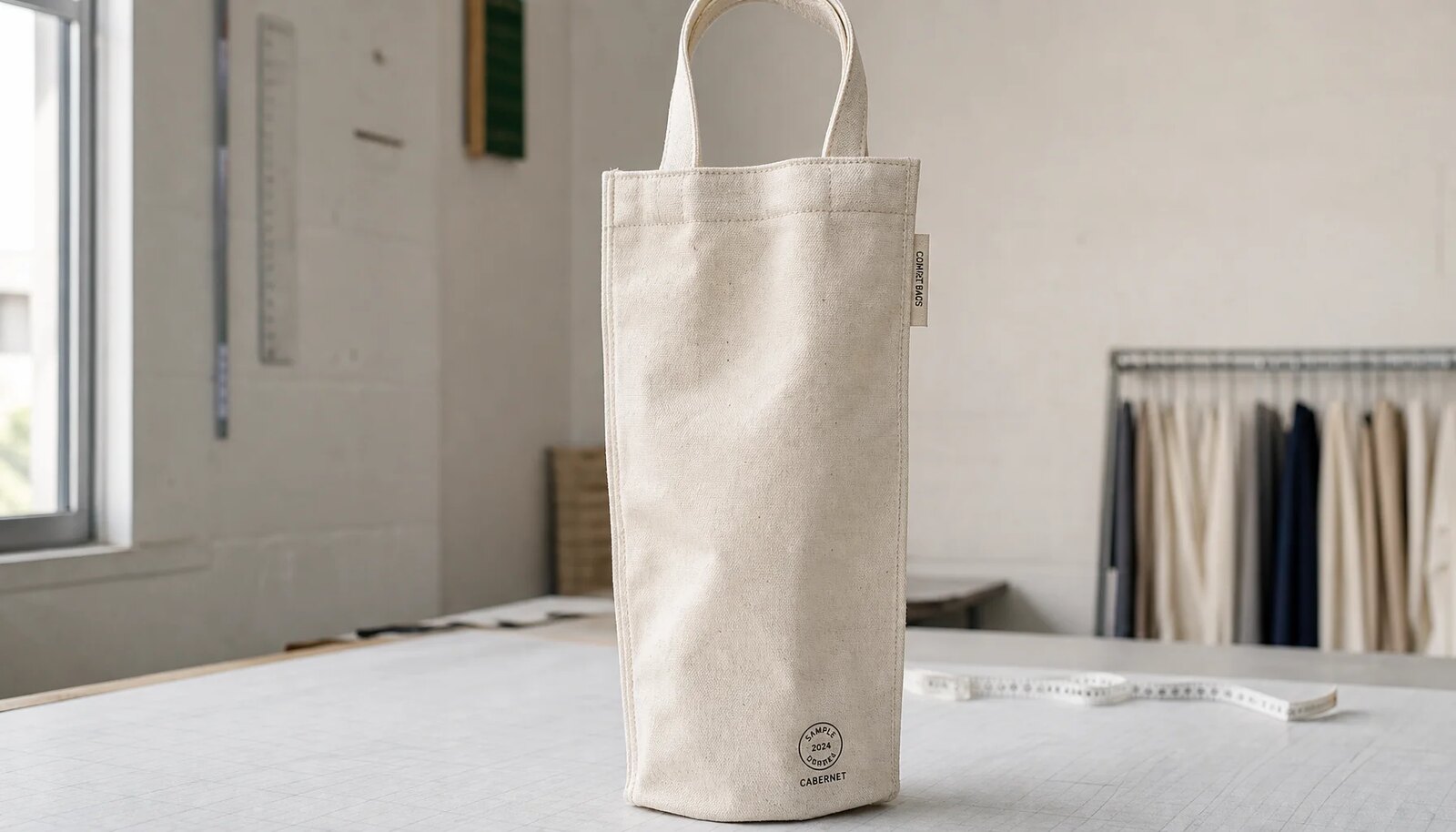
Why proofing fails on wine carriers
For farmers market vendors, a wine carrier is not just a branding item. It has to fit a 750 ml bottle, survive handling, and still show the logo cleanly after sewing, folding, and packing. Most failures start before the first sample is made: the buyer approves artwork before the body spec is frozen. If the pocket shifts, the gusset depth changes, or a seam lands inside the print field, the design that looked fine on screen becomes a production reject.
Treat proofing as a production rehearsal, not a design presentation. The approved sample needs to reflect the actual fabric weight, thread color, decoration method, and packing method. If the quote says 12 oz canvas but the sample arrives in a different weight or weave, the proof tells you very little about the bulk run. The goal is repeatability, not just a good-looking one-off.
- Lock the bottle size, pocket style, and handle length before artwork approval.
- Require the proof on the same fabric and decoration method named in the quote.
- Reject any sample where the logo is interrupted by seams, binding, or bar tacks.
Lock the carrier spec before artwork
Most single-bottle canvas carriers start at 10 oz to 14 oz canvas, with 12 oz often landing around 340 to 400 gsm depending on weave and finish. Lighter fabric lowers cost, but it can buckle once the bottle is inserted and may distort the print around the gusset. Heavier 14 oz canvas, often around 475 gsm, gives a cleaner print face and a more premium hand, but it adds sewing load and carton weight. For the spec sheet, define bottle diameter, whether the neck sits open or enclosed, and whether there is a divider or reinforced base.
The proof needs more than a front image. Specify print area in millimeters, edge distance from the top seam, and whether the logo must sit centered on the visible panel or aligned to a pocket. If a seam runs through the print field, fix the file before approval instead of asking the line to rescue it later. Handle tape color, thread color, and any side label should also be fixed now because they change the finished retail look more than buyers expect.
- State fabric weight in gsm or oz and note whether you want a natural, bleached, or dyed canvas.
- Provide finished size, not just bottle capacity.
- Define the bottle format the carrier must hold, including any sleeve or gift insert.
Pick the print method by artwork and volume
Screen printing is usually the best fit for simple logos, one to two colors, and solid coverage on natural canvas. It gives strong opacity and a straightforward proof, but it needs proper mesh selection, squeegee pressure, and color control. If the artwork has fine text, halftones, or more than two colors, the factory may push transfer or digital decoration. That can work, but only if the supplier can show wash and rub performance on the same canvas weight you are buying.
For farmers market programs, a common mistake is approving a beautiful proof that cannot survive production speed. Metallic inks, puff effects, and heavy ink piles can crack on fold lines or make stacked carriers stick together in packing. If the line uses water-based ink, ask how the factory controls bleeding on unbleached canvas and whether they pre-test a small patch after shrinkage. Embroidery usually belongs on a side label or a small patch, not across the main panel of a small carrier.
- Use screen print for bold logos and cleaner unit economics.
- Use transfer only if the artwork needs detail the screen cannot hold.
- Keep decoration away from fold lines, snap areas, and strap stress points.
Compare sourcing routes before you quote
The quote looks different depending on who owns the decoration step. A direct factory quote usually gives the cleanest visibility on fabric, sewing, print, and packing cost, but only if the factory truly does the decoration in-house. A trading company can simplify communication and sample coordination, but you need to know who is actually making the carrier and who is printing it. Domestic decorators are useful when speed matters more than unit cost, especially for local events, but they often lose margin if the blank bag is not standardized.
For a repeat buyer, the real question is not which supplier sounds easiest. It is which route gives the fewest hidden variables. If the blank carrier is sourced from one place and the print is done elsewhere, the approval sample has to cover both interfaces: fabric shrinkage, logo registration, and final pack quality. Use the comparison table to map the route to your order size, timing, and tolerance for variance.
- Compare the sourcing route, not just the unit price.
- Separate blank bag cost from decoration cost in the quote.
- Ask who signs off the first article and who owns rework if the print shifts.
What a usable proof should show
A proper proof is not just an artwork image. It should show the carrier from front, back, and side, with logo size, print position, and any seam or handle interference clearly marked. If there is a woven label, paper swing tag, or embossing on a faux leather patch, those elements belong on the proof as separate callouts. The best proof includes actual dimensions, a color reference such as Pantone or a physical swatch, and a note on what is excluded from printing.
For multi-color logos, insist on registration marks or at least a clear method for aligning the colors. On canvas, the weave can make fine lines look heavier than expected, so the proof should show minimum stroke widths and the smallest readable text. If the brand uses a dark logo on natural canvas, ask the factory to show one sample with the exact ink mix that will be used in bulk. Do not approve a proof based on a screen render that is brighter or cleaner than the fabric can actually hold.
- Request a flat dieline with measurements, not only a JPEG.
- Ask for Pantone references or a physical color chip for each ink.
- Make the factory mark any area where seams may disturb the print.
Sample approval and acceptance criteria
The first physical sample should be treated as a technical sample, not a display piece. Measure body width, gusset depth, handle length, and bottle pocket fit against the spec sheet. Check that the carrier stands upright with the intended bottle and that the print still reads cleanly after the bottle is inserted. If the carrier is lined, quilted, or padded, verify that the print area did not warp during sewing or pressing.
Acceptance criteria need numbers. A buyer can allow a small center shift, but that tolerance should be written down. The same goes for print opacity, color deviation, stitch density, and seam strength around the handle attachment. If the supplier proposes a pre-production sample after approval, that sample should match the bulk run in fabric, ink, thread, and packing, not just in design.
- Measure the sample against a written spec sheet, not memory.
- Test the carrier with the intended bottle size and closure type.
- Record any allowed deviation before bulk production starts.
MOQ and quote structure that changes unit cost
MOQ logic on canvas wine carriers is tied to fabric cutting efficiency, print setup, and carton packing. A small order can still be viable if the artwork is simple and the blank body is shared across several SKUs, but extra colors, custom labels, or special inserts can move the economic minimum quickly. The buyer should separate one-time charges from recurring unit cost so that a 3,000-piece quote can be compared fairly with a 10,000-piece quote.
A useful quote breaks out blank carrier price, print setup per color, sample charge, packaging cost, carton count, and any special finishing such as a bottle divider or laminated insert. Ask the factory to show the cost at two or three quantity breaks, for example 1,000, 3,000, and 5,000 pieces. That reveals whether the supplier is pricing for a real production run or padding the first lot to recover setup. When the unit price falls sharply at the next break, you need to know whether the extra volume also reduces waste or only lowers the headline number.
- Separate fixed setup charges from recurring per-piece charges.
- Compare the same spec at multiple quantity breaks.
- Include overrun and underrun tolerance in the quote math.
Packing, cartons, and retail readiness
Packing affects print quality more than many buyers expect. If printed carriers are folded face-to-face without tissue or a separator, fresh ink can offset onto the opposite panel, especially on dark logos or heavy coverage. For market vendors, a carrier may be sold as a gift item, so the inner pack should still look clean when opened. Polybagging, belly bands, hang tags, and barcode stickers should be confirmed before sample approval because each one changes labor and carton density.
Carton planning should reflect not just cube but crush risk. A too-tight carton can leave fold marks across the print, while a loose carton can let handles snag and distort the stack. Ask for carton dimensions, net weight, gross weight, and carton count per SKU. If the carrier includes a rigid insert or bottle divider, the packing test should show how many pieces fit without deforming the print field. For retail programs, a master carton mark with style, color, and quantity reduces receiving errors later.
- Require packing photos of the approved sample.
- Confirm whether printed surfaces need tissue or interleaf.
- Match carton count to the retailer's shelf and replenishment plan.
Lead time and schedule risk
Lead time is usually stretched by three steps: fabric sourcing, decoration approval, and packing changes. If the factory has to source a specific canvas weight or ink color, the sample may pass but the bulk lot still waits for material. A buyer should ask whether the carrier body, print, and packing are all controlled in one facility or split across vendors. More handoffs mean more calendar risk, especially before market season or holiday gifting windows.
Build the schedule backward from the first sell date, not from the purchase order date. Leave time for an initial proof, one correction round, a pre-production sample, and freight booking. If the order needs custom woven labels or special hang tags, those often have a longer approval path than the bag itself. A realistic plan includes a buffer for color matching, because a natural canvas lot can vary enough to make one ink formula look too warm or too gray.
- Get a dated sample calendar, not just a production lead-time claim.
- Treat artwork revisions as schedule events.
- Reserve buffer time for material variation and freight booking.
Final QC gate before release
Before shipment, the buyer or agent should inspect a random carton set for print alignment, fabric defects, color consistency, and packing integrity. A wine carrier is small, which makes defects easy to overlook and hard to recover later. Look for skipped stitches at the handle, ink pinholes on solid fills, broken weave lines, and bottle-pocket dimensions that drift from the sample. If the carrier is meant to be gift-ready, cosmetic consistency matters as much as structural strength.
The final release note should say what passes and what fails. If the acceptable window for print placement is too loose, the supplier can ship bags that look uneven in a retail display. If the tolerance is too tight without a realistic process plan, you create avoidable rework. The goal is a balanced control point: strict enough to protect the brand, practical enough that the factory can hit it at scale.
- Inspect print placement, stitch quality, and packing on the same random sample.
- Reject mixed ink shades in the same carton unless pre-approved.
- Hold shipment if the bulk sample does not match the approved first article.
Specification comparison for buyers
| Spec decision | Recommended option | When it fits | Buyer risk to check |
|---|---|---|---|
| Direct factory with in-house screen printing | Best for simple logo programs on 12 oz to 14 oz canvas with repeat orders | Use when you want the cleanest control over fabric, sewing, and print alignment | Confirm the print line is truly in-house and not subcontracted after sample approval |
| Direct factory with outsourced decoration | Acceptable when the bag factory is strong on sewing but weak on decoration | Fits buyers who need a custom body but can tolerate one extra handoff | Require proof of who controls screen setup, ink mixing, and rework if the print shifts |
| Trading company managing multiple mills | Useful for buyers who need coordination across fabric, labels, carton, and freight | Fits larger programs with internal sourcing teams that want one contact | Watch for margin stacking and make sure the quote still separates blank cost from decoration cost |
| Domestic decorator using imported blank carriers | Practical for fast-turn local events or short reorders | Works when lead time matters more than the lowest unit price | Check blank consistency, shrinkage, and whether the imported body matches the approval sample |
| Stock blank carrier with local print | Good for low-complexity branding and smaller MOQ | Fits market vendors testing a design before committing to a full custom run | Limited size control, limited fabric choice, and higher risk of a generic look |
| Fully custom cut-and-sew factory | Best when the carrier needs custom size, divider, lining, or premium finishing | Use for retail programs that need a distinct product and repeatable QC | MOQ and tooling are higher, so get exact setup charges and revision limits |
| Factory blank with domestic final packing and labeling | Good for buyers who want sourcing efficiency plus local compliance labels | Fits mixed programs where the body is made offshore but retail prep is done at home | Confirm carton count, label application, and who owns any packaging damage during transfer |
| Dual-source backup for repeat programs | Best for buyers who cannot stop a seasonal or retail replenishment program | Use when farmers market season or gifting windows make supply interruption expensive | Make sure both suppliers use the same measurement sheet, print spec, and carton plan |
Buyer checklist before sampling
- Final bottle size, bottle type, and whether the carrier must fit a standard 750 ml bottle, a chilled bottle sleeve, or a larger format bottle.
- Target fabric weight in gsm and the acceptable range, with the expected hand feel and whether the canvas must be natural, bleached, or dyed.
- Artwork file, logo size, print position in millimeters, and the number of colors or Pantone references for each ink.
- Preferred print method, such as screen print, transfer, woven label, embroidery patch, or a hybrid finish.
- Finished dimensions, gusset depth, handle length, and whether the carrier needs a divider, lining, or reinforced base.
- Sample type required, including artwork proof, strike-off, pre-production sample, and final golden sample.
- MOQ by color and by design, plus the quantity breaks that change unit price or setup charges.
- Packing method, polybag or tissue requirement, carton count, and master carton labeling instructions.
- Lead time, approval window, and freight term, including whether the quote is ex-works, FOB, or delivered to a warehouse.
- QC tolerance for print placement, color variation, stitching, and any acceptable rework or replacement terms.
Factory quote questions to send
- Is the carrier body, printing, and final packing handled in one facility or across multiple suppliers?
- What exact fabric weight, weave, and finish will you use for the approved sample and the bulk run?
- What is the MOQ for the body, the print, and any custom label or divider component?
- Please separate blank bag cost, print setup per color, sample cost, packing cost, and carton cost in the quote.
- What are the price breaks at 1,000, 3,000, and 5,000 pieces, and which charges are one-time versus recurring?
- What tolerance do you hold for print placement, color match, and stitch quality on this carrier?
- Can you supply a pre-production sample on the exact fabric, ink, thread, and packing method that will be used in bulk?
- What is the realistic production lead time after sample approval, and how much buffer do you need for material sourcing or rework?
Quality-control points to confirm
- Fabric weight matches the approved gsm or oz spec within the agreed tolerance.
- Carrier width, height, and gusset depth match the measurement sheet for the approved bottle size.
- Print placement is centered and does not drift into the seam, handle bar tack, or fold line.
- Ink opacity is consistent and does not show weave-through on solid fills unless that effect was approved.
- Color match is within the approved Pantone or physical swatch standard.
- Stitching is even, with no skipped stitches, loose threads, or weak handle attachments.
- Bottle fit is correct with the intended bottle inserted and the carrier still sits upright.
- Folded or packed carriers do not show ink transfer, offset, or crushing across the printed area.
- Carton labels, count, and style marks match the purchase order and packing list.
- No mixed lot of approved and unapproved print shades is packed into the same carton.