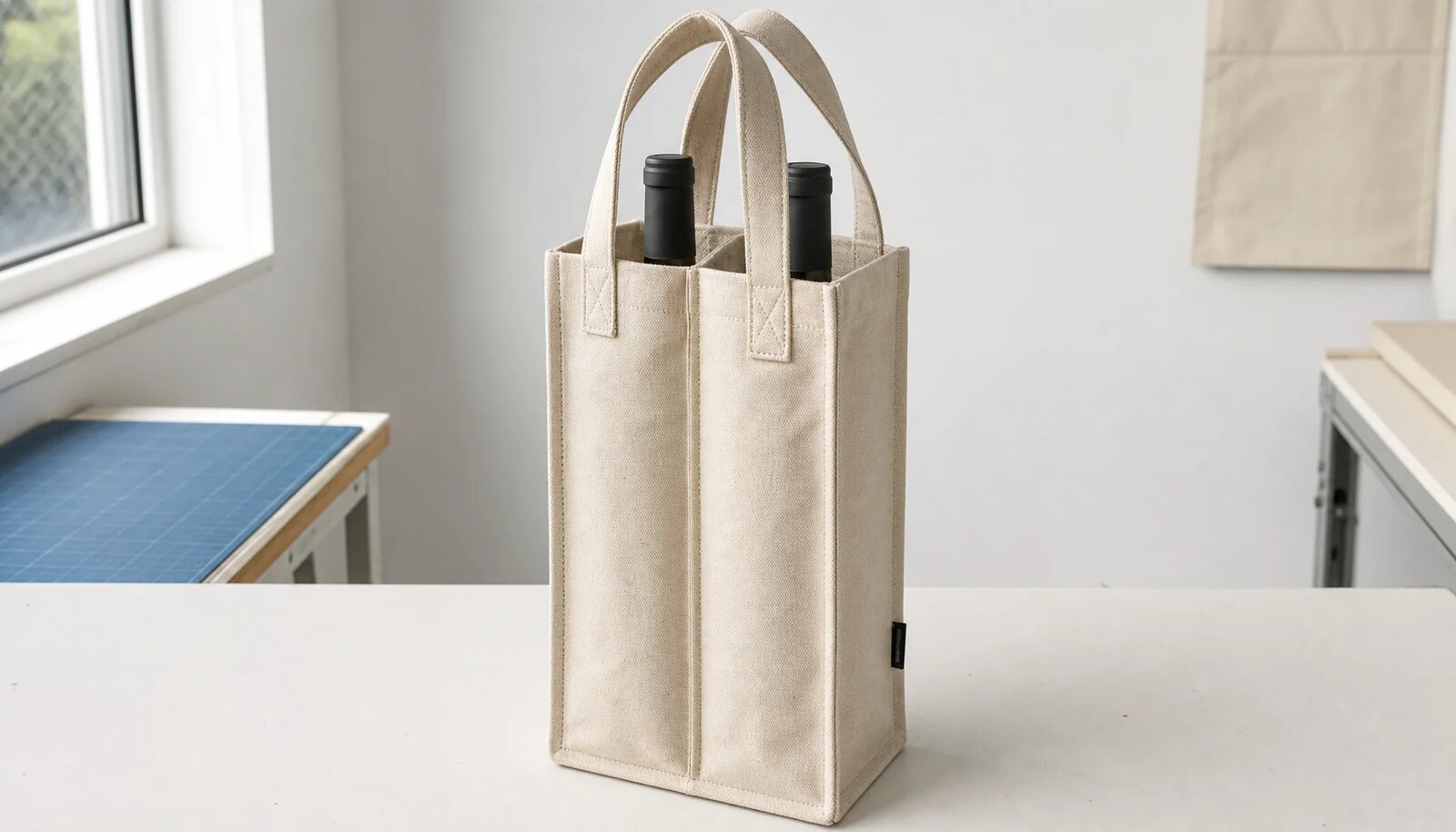
Start With The Event Job, Not The Bag Photo
A canvas wine carrier is rarely just a bag in an event program. It may be a sponsor giveaway, a donor thank-you, a hotel welcome item, a tasting kit, retail merchandise, or a practical way to move bottles from back-of-house storage to guest pickup. Each job asks something different from the material. A sample can look pleasant in a photo and still fail the real handoff if it collapses on the registration table, rubs a wine label, creases through a sponsor mark, or slows staff during setup.
Before asking for a quote, describe the job in plain operational terms. Is the guest carrying one bottle from a gala table to a car, or are staff preloading two bottles and staging hundreds of carriers by table number? Does the carrier need to stand upright for several hours? Will it sit in a hotel room, hang in a venue shop, or move through a fulfillment center with SKU labels and carton scans? These details decide whether you need a flat sleeve, boxed base, center divider, closure, hangtag, retail barcode, or upgraded reinforcement.
Think about the handler after the factory as well. Warehouse teams often prefer flat bulk packing and clear carton marks. Fulfillment teams may need inner packs, barcode labels, and predictable fold direction. Venue crews may need lighter cartons, quick-open packing, and bags that do not require steaming before use. When those requirements are missing from the RFQ, they usually return later as rush emails, added labor, or an event-day presentation problem.
- Write a one-sentence use case before quoting, such as two-bottle donor gift for seated gala pickup or one-bottle hotel welcome gift packed by room block.
- Confirm whether the carrier is mainly for presentation, guest carrying, retail resale, or internal event transport.
- Identify the final handler: factory, forwarder, warehouse, fulfillment center, hotel staff, event crew, retail team, or guest.
- Separate design preferences from requirements that affect fit, safety, setup speed, and brand presentation.
Specify Canvas By Finished GSM And Finish
Canvas weight is the headline material decision, but ounce language by itself is too loose for controlled sourcing. One supplier's 10 oz canvas may not behave like another supplier's 10 oz canvas because yarn, weave density, finishing, moisture content, and measurement practice can differ. For B2B procurement, ask for finished GSM as well as ounce terminology. A useful reference is about 270 gsm for 8 oz canvas, about 340 gsm for 10 oz canvas, and about 410 gsm for 12 oz canvas. The physical swatch and approved pre-production sample should still be the control standard.
For many one-bottle wholesale canvas wine carriers for event planners, 10 oz canvas around 340 gsm is a practical starting point. It usually balances structure, print surface, hand feel, cost, and carton weight. An 8 oz canvas can work for short-carry giveaways and low-cost presentation packaging, but it may sag more around a filled bottle and show print waviness. A 12 oz canvas is stronger for two-bottle carriers, premium gifts, and upright display, but it changes needle wear, folding behavior, freight volume, and landed cost.
Finish changes the story. Raw natural cotton canvas gives a relaxed, straightforward look and usually keeps processing simple, but buyers should expect seed flecks, slubs, and shade movement. Washed canvas feels softer and can look more finished, yet washing may shift dimensions and change print behavior. Dyed canvas can support venue colors, sponsor palettes, or retail merchandise, but it needs lab dip approval, bulk shade tolerance, and opacity testing for the decoration. Pre-shrunk canvas can reduce movement; it does not remove the need to measure finished bags.
- Request finished GSM, not only ounce weight, and state the acceptable GSM tolerance if your program requires it.
- Approve a physical swatch for raw natural shade, dyed color, hand feel, weave texture, and visible fleck level.
- Ask whether the quoted fabric is raw, washed, dyed, pre-shrunk, recycled blend, organic cotton, or another blend.
- Confirm whether decoration testing uses the same fabric finish planned for production.
- Compare landed cost after carton dimensions and gross weight are known, because heavier canvas changes freight and handling.
Fit The Largest Real Bottle
Bottle fit is a technical requirement, not a styling note. Standard 750 ml wine bottles are common, but event programs often include sparkling wine, champagne-style bottles, wide-shoulder reds, spirits, olive oil, or mixed tasting sets. Those shapes can need a wider top opening, deeper base, different divider placement, or stronger side seams. If the supplier patterns around an assumed bottle, the buyer may discover too late that the actual product scrapes its label, leans, or barely passes through the opening.
List the bottle height, maximum diameter, shoulder shape if relevant, and filled bottle weight in the RFQ. For mixed programs, design around the widest and tallest bottle that must fit, not the average bottle in the set. A one-bottle carrier needs enough clearance for easy loading and enough base support to prevent twisting. A two-bottle carrier needs a divider that does more than look neat. It should reduce bottle contact during normal walking movement and help the loaded bag hold shape.
Handle drop deserves an actual test. A short handle can look tidy on a table but feel awkward when a guest is also carrying a coat, phone, program, or gift envelope. A longer handle may improve comfort, but it can increase swing and make the bottle hang lower than expected. Ask for loaded sample photos from the front, side, and top. Better yet, test the sample with the intended bottle or a dummy that matches the maximum diameter, height, and weight.
- Test the pattern with the actual bottle or a dummy bottle matching the maximum diameter, height, and filled weight.
- Specify finished dimensions for height, width, base depth, top opening, divider placement, handle width, and handle drop.
- For two-bottle carriers, require a divider that reduces bottle impact during normal walking movement.
- Check that bottle labels do not rub against raw seam allowances, divider edges, or rough internal trim.
- Photograph the loaded sample from the front, side, and top before approval.
Choose Construction For The Load Path
Most canvas wine carrier problems are predictable. Handles pull. Side seams open. Bases twist. Top edges stretch. Dividers shift. These issues usually come from under-specified construction, not from canvas weight alone. A buyer may request 10 oz canvas and a logo while leaving seam type, handle reinforcement, and bottom finishing to the supplier. That can produce a basic item, but it is risky when the carrier holds glass bottles and represents a sponsor, venue, winery, or corporate brand.
Handle attachment carries the highest stress. For a light one-bottle carrier, a clean double row may be enough. For heavier bottles, two-bottle formats, preloaded staging, or reusable gifts, the specification should call out bartacks, X-stitches, reinforcement patches, wider handle tape, or another approved method. Put the reinforcement in the quote, not only in a sample comment. If one supplier includes bartacks and another quotes plain stitching, their prices are not comparable.
Base construction should follow the display requirement. A sleeve-style flat carrier packs efficiently and can suit a simple one-bottle giveaway. It usually will not stand or stage like a boxed-base carrier. A boxed base improves presentation and stability, but it adds sewing time, carton volume, and inspection points. Top-edge finishing also matters. Folded and stitched edges add structure; binding protects edges; lining can lift the look but increases cost and weight. The goal is not to add every feature. It is to reinforce the points where the loaded bottle transfers force into the carrier.
- Define handle material, width, drop, stitch pattern, and reinforcement method in the RFQ.
- State whether bartacks, X-stitches, double rows, reinforcement patches, or binding are required and included in the quote.
- Specify whether the top edge is folded, bound, lined, or finished another approved way.
- For boxed bases, confirm bottom seam strength, corner shape, base depth, and loaded upright stability.
- Inspect internal finishing for loose threads, sharp trim, skipped stitches, and rough seam allowances.
Set Tolerances Before Sampling
Tolerances turn a nice concept into an inspectable product. Sewn canvas will not behave like rigid packaging. Fabric stretches, shrinks, relaxes, and shifts through cutting, printing, sewing, pressing, and packing. The practical move is to define tolerances that protect function and brand presentation. A small change in overall height may be acceptable. The same movement in top opening, divider position, or handle drop may affect loading, stability, or guest comfort.
Common control points include finished height, width, base depth, top opening, divider position, handle drop, handle width, and logo placement. Buyers should also define appearance tolerance for natural flecks, slubs, shade movement, and print registration. Natural cotton canvas should not be judged like coated synthetic fabric; small seed specks may be normal if they are part of the approved swatch. Oil stains, water marks, mildew odor, broken yarns, and severe shade mismatch are different. Those should be treated as defects.
Logo placement tolerance is easy to overlook until the bags are lined up on a table. A mark that is 5 mm off-center may pass for a casual giveaway, but the same shift can look careless on a premium donor gift or retail item. Ask the supplier what tolerance they can hold for the chosen decoration method and panel shape. Textile tolerances are often wider than paper print tolerances. Decide what is acceptable before bulk production, while changes are still inexpensive.
- Define finished-size tolerances for all dimensions that affect bottle fit and loaded appearance.
- Set a print or label placement tolerance and approve it on the pre-production sample.
- Use the approved swatch to define acceptable natural flecks, shade range, and weave texture.
- Classify wrong artwork, wrong size, handle failure, open seams, and mildew odor as critical defects.
- Avoid vague requirements such as good stitching or clean print without measurable checkpoints.
Match Decoration To Artwork And Canvas
Decoration is where many event wine carrier projects either gain polish or quietly lose it. Screen printing is often a strong option for simple one- or two-color logos, sponsor marks, and event names at larger quantities. It can look sharp on canvas when the artwork is bold and the print panel is stable. Buyers still need to approve ink opacity, edge definition, cure quality, registration, rub resistance, and placement. A low unit price is not useful if the logo cracks, ghosts, bleeds into the weave, or lands crooked on the guest-facing panel.
For premium programs, woven labels, patches, embroidery, and sewn badges can feel more durable and more integrated than a large event print. These methods suit gifts intended for reuse, retail merchandise, or programs where the carrier should remain useful after the event date. The tradeoffs are real: placement variation, needle holes, puckering, stitch density, border finish, and added labor. Embroidery can distort a panel if the stitch count is too dense. A patch can look unfinished if the edge frays or the attachment stitch wanders.
Transfers or digital decoration may help with complex artwork and smaller runs, but test them on the actual canvas finish. Some transfers create a plastic hand feel that fights the natural fabric. Small sponsor logos, fine rules, QR codes, and light ink can lose clarity on textured or dyed canvas. Procurement teams can often improve the result by simplifying artwork, increasing line weight, or moving the logo away from seams and folds. A digital mockup is not enough; request a strike-off or production proof on the final fabric whenever possible.
- Use screen print for simple, low-color artwork at quantities where setup cost spreads efficiently.
- Use woven labels, patches, or embroidery for premium gifts, resale merchandise, and durable brand presentation.
- Keep logos away from deep folds, bottom corners, heavy seam intersections, and high-rub zones.
- Confirm Pantone targets, underbase requirements, print size, print placement tolerance, and side count.
- Test QR codes, small text, thin rules, and sponsor lockups on the actual canvas before bulk approval.
Build An RFQ Suppliers Can Price
A strong RFQ makes wholesale canvas wine carriers comparable across suppliers. Include bottle count, bottle dimensions, finished size, finished GSM, fabric finish, construction, reinforcement, decoration, artwork placement, label requirements, packing format, carton requirements, inspection expectations, destination, and incoterm. Without these details, suppliers will fill in the blanks differently. One quote may include reinforced handles and individual polybags; another may assume basic handles and bulk packing. The unit prices may look close while the products are not.
Ask suppliers to price the same specification at practical order levels such as 500, 1,000, and 3,000 pieces. The point is not always to push the order higher. It is to expose how setup charges, fabric purchasing, printing, labels, packing labor, and carton configuration scale. If the price barely improves after 1,000 pieces, extra inventory may not make sense. If the price drops sharply at a fabric, label, or print MOQ threshold, procurement can decide whether that larger buy is justified.
Separate optional costs. Individual polybags, insert cards, hangtags, barcode labels, desiccants, palletization, third-party inspection, upgraded cartons, and air freight readiness can all change the quote. Ask for carton dimensions, gross weight, net weight, units per carton, and estimated CBM before issuing the PO. A cheaper ex-works unit price can become more expensive landed if cartons are oversized, too heavy for venue handling, or packed in a way that slows fulfillment.
- Attach artwork files with logo size, color count, Pantone references, and placement notes.
- Ask every supplier to quote the same fabric, construction, decoration, packing, carton standard, and trade term.
- Request clear line items for sample fees, screen fees, label tooling, packing upgrades, and carton changes.
- Require carton quantity, dimensions, gross weight, net weight, and estimated CBM for freight planning.
- Ask suppliers to list exclusions so the low quote does not hide costs that appear after approval.
Check Supplier Route, MOQ, And Control
The sourcing route affects accountability. A direct cut-and-sew factory is often a strong fit for custom canvas wine carriers because fabric, cutting, sewing, decoration coordination, and packing can be aligned around one approved specification. This is useful when the order includes custom dimensions, a divider, special reinforcement, private labels, strict packing, or inspection requirements. Still, ask which processes are handled in-house and which are subcontracted. Screen printing, embroidery, woven labels, washing, dyeing, and export packing may sit with different partners.
A trading company or merchandiser can be useful when an event kit includes several product categories and the buyer wants one commercial contact. The risk is that technical details can get softened between buyer, merchandiser, and factory. If that route is used, responsibility must be explicit. Who approves samples? Who controls carton specs? Who checks bulk production? Who pays for rework? Who communicates production changes? Convenience helps only when technical accountability stays visible.
MOQ should be broken down by decision point. Natural stock canvas may have a lower MOQ than custom dyed canvas. Woven labels may have a separate label MOQ. Screen print, embroidery, patches, dividers, trims, hangtags, and individual packing can each carry a minimum or setup charge. Ask for MOQ by fabric color, artwork, decoration method, label, divider, trim, packing, and delivery batch. This prevents the common surprise of approving a 500-piece carrier only to learn that the dyed fabric, label, or insert card needs a larger run.
- Use direct factory sourcing when custom construction, material control, and QC visibility are priorities.
- Use a merchandiser when multi-category event consolidation is more valuable than direct technical communication.
- Ask which production steps are in-house and which are subcontracted before approving the supplier route.
- Separate MOQ by fabric, color, artwork, decoration, label, divider, trim, packing, and delivery batch.
- Confirm quote validity, payment terms, incoterm, production lead time trigger, and rework responsibility in writing.
Approve Samples With Loaded Checks
Sample approval should prove the carrier works in the real event flow. An empty bag can look fine and still fail once loaded with glass. Check fabric hand feel, finished dimensions, bottle insertion, handle comfort, divider behavior, upright stability, decoration placement, and packing result. If the carrier will ship flat, review the sample after folding and unpacking. If it will be individually packed, inspect the polybag, insert, barcode, hangtag, and fold direction as part of the presentation.
The final pre-production sample should use the same material, thread, construction, decoration, trim, and packing planned for bulk. Development samples are useful while details are changing, but they should not become the final approval reference by accident. A blank construction sample plus a separate print strike-off is not the same as one finished approved sample. Both buyer and factory should keep an approved sample, with photos and measurements recorded for inspection.
Functional testing does not have to be complicated. Load the carrier with the intended bottle or a dummy weight. Lift it several times, walk with it, set it down, pick it up again, and then inspect the handles, base, seams, divider, and logo. Look for seam pull, twisting, bottle rub, handle distortion, print cracking, and permanent creases across the logo panel. For time-sensitive event programs, this is the cheapest moment to find problems.
- Approve a final pre-production sample only after bottle fit, loaded carry, decoration, and packing have all been checked.
- Measure the sample against the written specification and record results for inspection reference.
- Use the heaviest and widest bottle combination expected in the event program.
- Check loaded appearance from the guest-facing side, including logo position, bag tilt, and handle shape.
- Keep one approved sample with the buyer and one with the factory as the bulk reference.
Write QC Criteria Before Bulk
Quality control works best when acceptance criteria are agreed before cutting begins. Vague instructions such as high quality, good stitching, or clean logo leave too much room for interpretation. The PO or inspection brief should define measurable points: finished dimensions, print placement tolerance, accepted shade range, stitch quality, reinforcement method, carton count, label position, and packing format. The carrier does not need unnecessary luxury standards. It does need to be consistent, functional, and presentable at normal viewing distance.
Inspection should cover both appearance and function. Visual checks include fabric stains, oil marks, water marks, broken yarns, shade mismatch, crooked labels, print smears, pinholes, edge blur, loose threads, and poor trimming. Functional checks include bottle fit, handle strength, seam integrity, divider stability, base shape, and whether the carrier can be unpacked without permanent deformation. Carton checks matter too. A bag can pass inspection and still create problems if inner packs, carton marks, barcodes, or assortment ratios are wrong.
Defect categories should be practical. Critical defects include handle failure, open seams, wrong artwork, wrong size that prevents bottle fit, mildew odor, and contamination. Major defects may include visible stains, crooked labels, obvious shade mismatch, poor print opacity, skipped stitches, distorted base shape, and loose reinforcement. Minor defects may include small thread tails or natural cotton flecks within the approved range. If a third-party inspection is required, book it early and share the checklist with the supplier before production starts.
- Set dimensional, decoration, fabric, construction, and packing criteria before bulk cutting starts.
- Require first-bulk photos or video at cutting, decoration, sewing, and packing stages for custom or time-sensitive orders.
- Classify defects as critical, major, and minor so rework decisions are not improvised under deadline pressure.
- Check loaded function during inspection, not only appearance on an empty flat bag.
- Do not release shipment approval until carton count, packing, decoration, and functional checks match the specification.
Specification comparison for buyers
| Spec decision | Recommended option | When it fits | Buyer risk to check |
|---|---|---|---|
| Fabric weight | 8 oz canvas, typically about 270 gsm finished | Light one-bottle giveaways, short guest carry distances, presentation packaging, and cost-sensitive event programs | May feel soft, collapse when empty, distort around the bottle, show more print waviness, or sag under heavier bottles; approve loaded appearance before bulk |
| Fabric weight | 10 oz canvas, typically about 340 gsm finished | Most one-bottle wholesale canvas wine carriers for event planners, corporate gifting, hotel welcome programs, tasting kits, and repeat branded events | Finished GSM, yarn count, weave density, washing, and shrinkage vary by mill; require a fabric swatch and final pre-production sample |
| Fabric weight | 12 oz canvas, typically about 410 gsm finished | Two-bottle carriers, heavier bottles, premium donor gifts, retail-facing bundles, and displays that must stand upright | Higher unit cost, carton weight, freight volume, needle wear, and fold memory; check logo-panel creasing and landed cost |
| Fabric finish | Raw natural cotton canvas | Rustic event presentation, neutral brand programs, lower processing cost, and buyers who accept cotton seed flecks and shade variation | Do not expect optical white consistency; approve a natural shade range, slub level, and visible fleck tolerance |
| Fabric finish | Washed or pre-shrunk canvas | Reusable carriers, softer hand feel, tighter repeat-order sizing, and programs where premium touch matters | Washing can change shade, shrinkage, dimensions, and print behavior; approve decoration after the same finishing process planned for bulk |
| Fabric finish | Dyed canvas with Pantone target | Brand-color programs, sponsor colors, hotel or venue palettes, and retail merchandise | Dyed lots can vary; confirm lab dip, bulk shade tolerance, colorfastness expectation, and print opacity on the final shade |
| Construction | Boxed base with reinforced handle points | Carriers that must stand upright, carry two bottles, or be staged loaded on registration, table, or hotel-room surfaces | Base depth, seam allowance, and handle attachment must match bottle diameter and loaded weight; check lean, bottle rub, and seam pull |
| Construction | Sleeve-style flat carrier | Lower-cost one-bottle programs, compact storage, easy bulk packing, and handoff where upright display is not important | Less structure and weaker presentation when empty or loaded; confirm it does not twist or scrape the bottle label |
| Decoration method | 1 to 2 color screen print on a clean logo panel | Large runs with simple artwork, sponsor marks, event names, and repeat orders using stable brand files | Check ink cure, opacity, edge sharpness, registration, rub resistance, and placement tolerance before approval |
Buyer checklist before sampling
- Define the event use case in operational terms: sponsor giveaway, donor gift, hotel welcome item, tasting kit, retail merchandise, seated-table pickup, or transport packaging for bottles already staged on-site.
- List the bottle count, bottle height, maximum diameter, shoulder shape, filled bottle weight, and whether the carrier must fit standard 750 ml wine only or also sparkling, champagne, spirits, olive oil, or mixed bottle formats.
- Specify finished fabric weight in GSM as well as ounce terminology, and state whether the canvas is raw, washed, pre-shrunk, dyed, recycled cotton blend, organic cotton, or undyed natural cotton.
- Set target finished dimensions and tolerances for height, width, gusset or base depth, top opening, divider width and position, handle drop, handle width, and any closure detail.
- Define reinforcement at handle joins, top edge, side seams, bottom seam, divider anchor, and stress points; state whether bartacks, X-stitches, double rows, binding, or reinforcement patches are required.
- Choose the decoration method early: screen print, transfer, embroidery, woven label, patch, sewn label, hangtag, or a combination; include logo size, placement, color count, Pantone targets, and whether one or both sides are decorated.
- Confirm whether the artwork can tolerate natural canvas flecks, weave texture, shade variation, seam interruptions, and slight placement movement, especially for small sponsor logos, QR codes, thin lines, or light ink.
- Set packing requirements before quoting: flat bulk, inner pack count, individual polybag, tissue, insert card, barcode, hangtag, carton marks, fold direction, pallet requirements, and maximum carton gross weight.
- Request the same quote scope at practical order levels such as 500, 1,000, and 3,000 pieces so setup charges, fabric MOQ, print MOQ, label MOQ, and packing labor are visible.
- Ask for sample photos or video using the intended bottle size and loaded weight, plus a fabric swatch or cut piece from the quoted material lot whenever possible.
Factory quote questions to send
- What is the finished fabric weight in GSM, and is the quoted canvas raw, washed, dyed, pre-shrunk, recycled blend, organic cotton, or another construction?
- What yarn, weave, or fabric description is being quoted, and can the finished GSM vary by more than the tolerance stated in the approved sample?
- Can you share an approved fabric swatch, mill lot reference, lab dip, or fabric cut for the quoted material, and will bulk production use the same material source?
- What is the finished size tolerance for height, width, base depth, top opening, divider position, and handle drop after sewing, pressing, and packing?
- Which reinforcement is included at the handles, top edge, base, and divider, and are bartacks, X-stitches, double stitching, binding, or reinforcement patches included in the quoted unit price?
- What bottle dimensions and loaded weight did you use when checking the pattern, and can you test our actual bottle or a dummy bottle matching our maximum diameter and height?
- Which decoration method do you recommend for this artwork, how many colors are included, what setup charges apply, and what are the print or label placement tolerances?
- For screen print, what ink type, cure process, opacity control, underbase requirement, and rub or wash expectation should we approve for this canvas finish?
- If the canvas is natural or dyed, how will you control shade variation across production and cartons, and what appearance range should we approve before cutting?
- What is the MOQ by fabric color, artwork, decoration method, woven label, divider construction, trim, packing format, and carton mark requirement?
Quality-control points to confirm
- Approved sample uses the same fabric weight, fabric finish, thread color, stitch count, handle construction, divider, decoration, trim, and packing method planned for bulk production.
- Finished dimensions stay within the agreed tolerance for height, width, base depth, top opening, divider position, and handle drop after sewing, pressing, and packing.
- Bag fit passes with the intended bottle size and weight; bottles insert smoothly, stand upright where required, and do not rub labels against seams, dividers, or rough inside edges.
- Handle attachment is secure with clean bartacks, X-stitches, double rows, or approved reinforcement, and the handle area shows no seam pull, skipped stitches, tearing, or distortion after a loaded carry test.
- Base and side seams support the load without twisting, leaning, or forcing bottles outward; two-bottle carriers keep bottles separated and stable during normal walking movement.
- Print placement stays within the agreed tolerance, with no smearing, pinholes, ghosting, cracking, poor opacity, edge blur, strike-through, or obvious misregistration at normal viewing distance.
- Decoration components such as woven labels, patches, embroidery, hangtags, or badges are straight, securely attached, cleanly trimmed, and consistent in color and placement across cartons.
- Canvas has even weave and acceptable color consistency against the approved swatch, with no oil stains, water marks, broken yarns, severe slubs, mildew odor, or shade variation outside the approved range.
- All seams, binding, edges, and internal finishing are clean, with no loose threads, skipped stitches, needle damage, sharp trim, open seams, or excess thread tails inside the carrier.
- Packing matches the PO exactly, including fold direction, inner pack count, individual bagging, barcode or label position, carton marks, assortment ratio, and any insert or hangtag requirement.