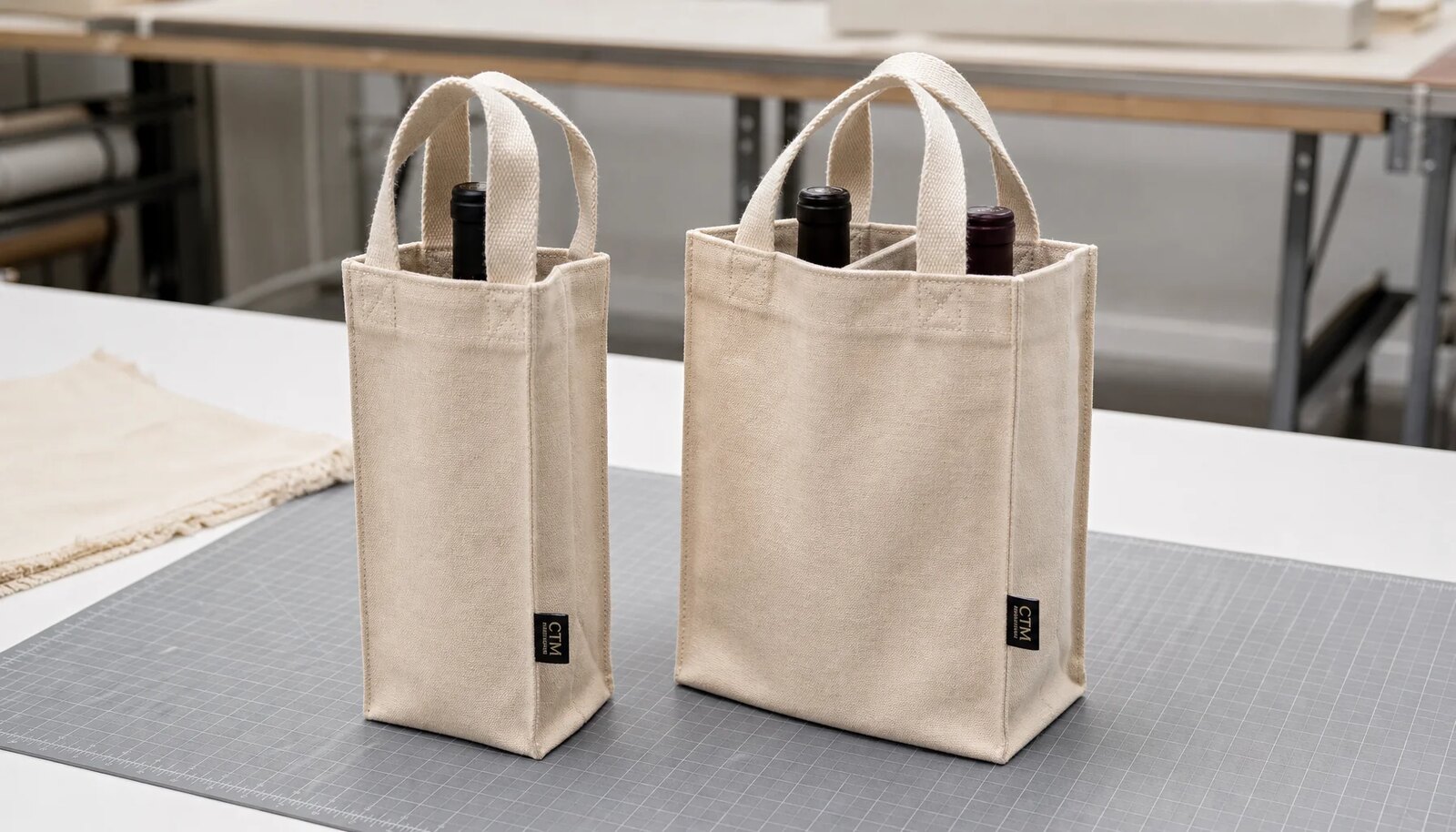
Start with fabric weight, then price
For wholesale canvas wine carriers, fabric weight is one of the first specifications to lock because it affects more than hand feel. It changes structure, print behavior, sewing difficulty, carton cube, freight exposure, and how the bag looks when loaded with glass. Event teams may begin with the logo or the event date, but procurement should make the material spec measurable before comparing prices.
A useful default range for many event planner programs is 10 oz to 12 oz canvas, which is about 339 to 407 GSM when the ounce term means ounces per square yard. This range usually gives enough body for one-bottle gifts and many two-bottle carriers without making cartons unnecessarily bulky. Lighter canvas can work for simple giveaways, but it should be tested loaded. Heavier canvas can look better upright, but it can also increase cost and packing volume.
Premium client gifts, wine club packaging, resale programs, and two-bottle carriers often move to 12 oz to 14 oz canvas, about 407 to 475 GSM. That is a starting point, not a guarantee. A heavier fabric will still fail if the handle attachment, divider, or bottom construction is weak. Ask suppliers to quote GSM, oz/yd2, and production tolerance on the same line so every offer is based on the same weight basis.
- 8 oz to 10 oz, about 271 to 339 GSM: use carefully for lightweight one-bottle handouts; test for limp body and handle strain.
- 10 oz to 12 oz, about 339 to 407 GSM: the most practical starting range for many event gifts and sponsor bags.
- 12 oz to 14 oz, about 407 to 475 GSM: better for premium feel, upright presentation, and many two-bottle applications.
- Above 14 oz, above about 475 GSM: use selectively because cost, folding bulk, needle stress, and carton volume can rise quickly.
Specify the canvas surface
The weight number does not fully describe the fabric. Natural cotton canvas, bleached canvas, dyed canvas, washed canvas, softened canvas, and coated canvas can behave differently even at the same GSM. Natural canvas may have visible slubs, seed flecks, and small shade variation. That look can suit winery, hospitality, and farm-to-table programs, but it should be approved as a controlled natural range rather than left to chance.
Dyed or bleached canvas gives more color control, yet it adds approval steps. Dyed fabric may need lab dips or strike-offs before bulk fabric is purchased. Bleached fabric can show handling marks more readily. Washed canvas feels softer, but it may lose some of the crisp body buyers expect from a structured carrier. If the supplier changes the finish to solve price or lead time, the approved sample may no longer represent production.
Fiber content should also be explicit. If the order requires 100% cotton, say so in the RFQ and purchase order. If a cotton-poly blend is acceptable, list it as an approved alternative. For organic, recycled, or other sustainability language, request documentation before those claims appear on event materials, sponsor presentations, hangtags, or resale packaging.
- State fiber content and whether substitutes are allowed.
- Define fabric state: natural, bleached, dyed, washed, softened, coated, or untreated.
- For natural canvas, approve acceptable slub level, shade range, and dark specks.
- For dyed canvas, approve lab dip or strike-off and confirm bulk shade control across rolls.
Fit the carrier to the real bottle
A wine carrier is approved empty but judged loaded. Standard 750 ml bottles are not all the same shape. Bordeaux, Burgundy, tall slim, sparkling, spirits, and olive oil bottles can differ enough to change the correct width, gusset, divider height, and handle clearance. When the event gift uses a known bottle, provide measurements or send a physical bottle before pattern approval.
Ask for finished internal dimensions, not only outside dimensions. Thick canvas, seam allowance, binding, lining, and divider bulk reduce usable space. A bag can match the outside drawing and still load slowly because the bottle scrapes the label or catches at the shoulder. For events, that matters because staff may need to fill hundreds or thousands of carriers before a dinner, tasting, conference, or hotel drop.
Fit approval should include handle clearance and loaded shape. If necks sit too close to the handle seam, carrying feels awkward and bottle tops may press into the handles. If the carrier is too loose, the bottle leans and the front logo can distort. Test the sample loaded, lifted, carried, and set down, then inspect the silhouette rather than approving only a flat photo.
- Provide bottle diameter, height, shoulder height, base shape, filled weight, and bottle type.
- Specify internal width, height, gusset depth, divider height, and handle drop with tolerances.
- Check label abrasion during insertion and removal.
- Approve the loaded silhouette: no severe pinching, sagging, glass contact, neck collision, or unstable tilt.
Make construction measurable
Canvas weight does not guarantee strength. A 12 oz carrier with weak handle attachment can perform worse than a 10 oz carrier with disciplined sewing. The RFQ should make the hidden construction details visible: handle webbing, stitch pattern, seam allowance, thread, base design, divider attachment, and reinforcement at stress points.
Handle specifications should be clear enough that another qualified factory could build the same sample. Define webbing width, fiber content, drop length, attachment location, stitch pattern, and whether bartacks or reinforcement patches are required. A narrow handle may reduce cost and still look fine in a photo, but it can feel poor when a guest carries two bottles across a venue.
Base and divider construction deserve the same attention. A simple boxed base may work for one-bottle giveaways. A two-bottle gift may need a double-layer base, heavier bottom panel, or insert to stay upright. Dividers should usually be anchored at the base and sides so bottles do not touch during normal carrying. Lining and binding can improve finish, but they also change cost and internal fit.
- Specify seam allowance, stitch density range, thread color, and reinforcement at stress points.
- Define handle webbing width, handle drop, placement, stitching, and bartack or patch requirements.
- Identify base construction: single layer, double layer, boxed gusset, sewn-in stiffener, removable insert, or no insert.
- For dividers, state material, height, side attachment, bottom attachment, and required bottle separation.
Match decoration to canvas texture
Canvas is a useful branding surface, but it is not a smooth coated sheet. The weave can soften small type, break fine lines, and change ink edges. A digital mockup is helpful for approval routing, but it does not prove readability. Sponsor-heavy artwork, QR codes, legal lines, and fine typography should be sampled on production fabric or a close production-material sample.
Screen printing is often the most practical default for event canvas wine bags because it works well for bold one-color or two-color marks and keeps repeat costs controlled. Ask about ink type, color reference, registration tolerance, curing, and coverage on the selected canvas. Large solid areas may need testing for hand feel and even coverage, especially on natural canvas.
Woven labels are useful for a restrained reusable look and can reduce print-surface risk. The quote should include label MOQ, setup, placement, sewing method, and lead time. Embroidery can look premium, but it is best for simple logos at adequate size; small letters and dense fill can pucker coarse canvas. Transfers can support detailed artwork, but they should be tested for fold marks, edge lift, cracking, and abrasion.
- Screen print: best for bold event logos and controlled repeat cost.
- Woven label: best for subtle private-label branding and reusable carriers.
- Embroidery: best for simple marks; sample carefully for puckering and small text.
- Heat transfer: test fold resistance, adhesion, abrasion, and edge lift before approval.
Use MOQ and price as signals
MOQ is shaped by fabric purchasing, cutting yield, dyeing, decoration setup, label production, labor scheduling, packing format, and carton labeling. A stock natural canvas body with one-color print may support a lower MOQ. Custom dye, unusual GSM, lining, several sizes, multiple sponsor logos, or destination-specific packing can create separate minimums.
Ask what the MOQ applies to: fabric color, body size, logo version, label design, packing format, or shipment destination. This is especially important when an event has sponsor tiers, multiple venues, or regional drops. A supplier may accept the total order quantity while still requiring a minimum for each version.
Price reductions can come from real efficiency, such as better cutting yield, repeat production, consolidated decoration, or simpler packing. They can also come from specification reductions: lighter canvas, narrower handles, fewer reinforcement stitches, unanchored divider, weaker cartons, or looser inspection. Those changes may be acceptable for a simple handout, but they should be visible before approval.
- Ask MOQ by fabric color, body size, logo version, label version, and packing format.
- Separate one-time charges for screens, embroidery tape, woven labels, lab dips, and revised samples.
- Confirm whether price breaks come from efficiency or specification changes.
- Compare landed cost, including carton cube, freight, inspection, receiving labor, and rework risk.
Approve samples like production goods
Not all samples answer the same question. A reference sample shows general workmanship. A design sample confirms proportion. A showroom sample shows what a supplier has made before. A pre-production sample should use production canvas, handles, thread, decoration, label, and intended fold method. For a fixed-date event order, that sample becomes the working approval standard.
Test the sample with the intended load. Insert the actual bottle or closest available match, lift the carrier repeatedly, carry it a short distance, set it down, and inspect the handle joins, bottom seam, divider, and base. For two-bottle carriers, check whether bottles touch during normal movement. These simple tests reveal problems that flat photos miss.
Also test packing behavior. Fold the carrier the way the factory plans to pack it, reopen it, and inspect the logo, handle orientation, base shape, and presentation. If the decoration is printed, check for weak coverage, cracking, or abrasion. Record approval with measurements and photos, then keep a signed sample or approved reference for production and receiving checks.
- Do not approve bulk from a substitute-fabric sample when GSM, color, hand feel, or print behavior matters.
- Measure the sample empty and loaded, including internal fit, gusset, handle drop, divider height, and logo position.
- Keep one approved reference for the factory and one for buyer-side receiving checks when possible.
- Document tolerances for fabric weight, dimensions, shade, logo placement, fold method, and carton quantity.
Set QC standards before shipment
Quality control works best when tolerances are written before production starts. Sewn textile goods have normal variation, so the goal is not impossible precision. The goal is to define the details that affect function and presentation: fabric weight, shade, finished dimensions, handle drop, divider height, logo placement, carton quantity, and acceptable natural canvas variation.
Defect classification should be practical. Critical defects include issues that create safety or severe use risk, such as handle failure under normal loaded carrying. Major defects include wrong fabric weight outside tolerance, wrong logo color, crooked logo beyond tolerance, unattached divider, severe stains, broken stitches at stress points, or carton quantity errors. Minor defects may include small loose threads or slub variation within the approved standard.
Inspection should not wait until cartons are sealed. Incoming fabric should be checked for GSM, shade, and flaws before cutting. Sewing checks should focus on handle joins, seam allowance, divider attachment, stitch density, and base shape. Decoration checks should happen after print, embroidery, transfer, or label application. Final inspection should include measurements, loaded testing, appearance, packing, carton marks, and rework records.
- Agree tolerances for fabric weight, width, height, gusset, handle drop, divider height, and logo placement.
- Classify critical, major, and minor defects before shipment inspection.
- Use loaded bottle testing on production samples, especially for two-bottle carriers.
- Require inspection records for GSM, workmanship, decoration, packing, carton marks, and rework.
Control packing for event receiving
Packing is part of the product specification. Canvas wine carriers are often flat-packed to reduce freight cube, but the fold method should be approved. A hard fold through the front logo can damage presentation. Twisted handles can slow venue teams. Inconsistent carton counts can create receiving errors when staff are working against an event schedule.
Inner packing should match the downstream workflow. Individual poly bags can protect against dust and scuffing for resale, premium gifting, or kitting, but they add cost, unpacking time, and waste for simple handouts. Bundled inner packs, paper bands, or direct master-carton packing may be more efficient for event distribution.
Master carton details should be confirmed before the purchase order is final. Ask for units per carton, carton dimensions, gross weight, carton marks, and whether cartons contain one SKU, one logo version, and one destination. For multi-location programs, destination labels and carton numbering reduce the risk of the right carrier arriving in the wrong room.
- Define fold method, acceptable crease locations, handle orientation, and whether logos may be folded.
- Choose inner packing by use case: individual bag for resale or dust control, bundled packs for fast event distribution.
- Require consistent units per master carton and avoid mixed SKU cartons unless specified.
- Include carton marks for SKU, fabric color, logo version, event name, destination, quantity, PO number, and carton number.
Write an RFQ suppliers can price cleanly
A strong RFQ turns a vague request into a comparable sourcing exercise. Instead of asking for a canvas wine carrier with logo, state the use case, bottle type, bottle count, target GSM, fiber content, fabric state, finished internal dimensions, construction, decoration, label, packing, inspection standard, sample path, and delivery window.
Name the problems the product must avoid. The carrier must not sag sharply when loaded. Handles must not feel narrow under bottle weight. The divider must prevent glass contact. The logo must stay readable on textured canvas. Cartons must be easy to count at receiving. These performance targets help suppliers recommend useful adjustments instead of guessing what can be changed.
Final quote comparison should be spec-normalized. Put each quote on the same sheet: GSM, oz/yd2, fiber content, finish, internal size, handle width, handle drop, reinforcement, divider, base, print method, logo size, label, inner pack, carton count, carton size, setup fees, sample fees, lead time, inspection responsibility, and freight exposure. The best quote is the one with the fewest unresolved assumptions, not only the lowest first number.
- Include numeric fabric, measurement, decoration, packing, and inspection specs in the first RFQ.
- Ask suppliers to list exclusions and assumptions for setup charges, labels, inserts, packing, and revised samples.
- Confirm lead time by stage: material, sampling, revision, production, inspection, packing, and shipment handoff.
- Compare quotes only after normalizing specification, QC responsibility, carton data, and delivery assumptions.
Specification comparison for buyers
| Spec decision | Practical starting point | Use when | QC risk to control |
|---|---|---|---|
| Fabric weight | 10 oz to 12 oz canvas, about 339 to 407 GSM, quoted with tolerance. | Most one-bottle event gifts, venue welcome drops, tasting handouts, and standard sponsor programs. | Lighter fabric may slump; heavier fabric may add cost, carton cube, and sewing stress. Confirm GSM, oz/yd2, and tolerance. |
| Premium weight | 12 oz to 14 oz canvas, about 407 to 475 GSM, with reinforced handles and stable base construction. | Two-bottle gifts, retail resale, wine clubs, hospitality programs, and higher-touch client gifting. | Heavy canvas cannot compensate for weak handle stitching, loose dividers, or poor base design. |
| Bottle fit | Develop from actual bottle measurements or supplied bottles. | Burgundy, sparkling, spirits, olive oil, mixed gift sets, and sponsor-provided bottles. | A generic 750 ml pattern can scrape labels, pinch shoulders, or let bottles shift. |
| Two-bottle construction | Anchored divider, adequate gusset, supported base, and defined handle drop. | Client gifts, pairing kits, wine club sets, hotel amenities, and premium event distribution. | Loose dividers allow glass contact and can collapse after loading. |
| Handle spec | Define webbing width, fiber content, drop length, stitch pattern, placement, and reinforcement. | Any order where guests carry loaded bags through venues, parking, hotels, or registration areas. | Narrow handles cut into the hand; long handles increase swing; vague reinforcement invites downgraded sewing. |
| Decoration | Screen print for bold marks, woven label for subtle branding, embroidery only for simple logos at suitable size. | Event logos, sponsor marks, venue branding, private-label gifts, and reusable programs. | Fine type can fill on textured canvas. Test artwork on production fabric, not only on a digital mockup. |
| Packing | Define fold method, inner pack, carton quantity, carton marks, and destination labeling. | Multi-venue events, kitting, retail resale, sponsor tiers, and warehouse receiving. | Creased logos, twisted handles, mixed cartons, and inconsistent carton counts slow event operations. |
| Sample approval | Approve a pre-production sample using production fabric, trim, thread, decoration, label, and fold method. | Fixed-date events, repeat orders, retail programs, and sponsor approvals. | A showroom sample may look right while missing bulk-production risks. |
| Quote comparison | Normalize fabric, dimensions, construction, decoration, packing, inspection, sample terms, and lead time. | Procurement teams collecting several supplier quotes. | A low price may exclude setup, labels, reinforcements, inserts, carton marks, or inspection responsibility. |
Buyer checklist before sampling
- Define the use case: one-bottle giveaway, two-bottle client gift, retail resale item, sponsor kit, hotel welcome drop, wine club insert, or kitting component.
- State fabric weight in both GSM and oz/yd2, plus the allowed tolerance and whether weight is checked before cutting.
- Identify fabric state: natural cotton canvas, bleached, dyed, washed, softened, coated, organic cotton with documentation, recycled blend, or approved cotton-poly blend.
- Provide bottle measurements: diameter, total height, shoulder height, base shape, filled weight, and whether bottles are standard wine, Burgundy, sparkling, spirits, olive oil, or mixed size.
- Specify finished internal dimensions, gusset depth, divider height, handle drop, and measurement tolerances.
- Define handle material, webbing width, handle drop, attachment position, stitch pattern, bartack or reinforcement patch, and comfort expectation under full load.
- State base construction: single layer, double layer, boxed gusset, sewn-in stiffener, removable insert, or no insert.
- For two-bottle carriers, specify divider material, height, seam allowance, bottom attachment, side attachment, and whether bottle-to-bottle contact is acceptable.
- Define decoration method, artwork size, color reference, placement tolerance, setup charges, label position, and readability requirements for small sponsor text.
- Request a pre-production sample made with production fabric, trim, thread, decoration, label, and intended fold method before bulk cutting.
Factory quote questions to send
- What exact GSM and oz/yd2 canvas weight are you quoting, and what production tolerance applies?
- Is the canvas natural, bleached, dyed, washed, softened, coated, or otherwise finished in a way that affects shade, shrinkage, hand feel, or print performance?
- Will fabric weight be checked before cutting, and can inspection records include GSM readings from multiple rolls or roll positions?
- Are the finished dimensions based on a standard bottle, our supplied measurements, or physical bottles we provide?
- What tolerances do you allow for height, internal width, gusset depth, divider height, handle drop, logo placement, and carton quantity?
- Does the price include divider, base reinforcement, handle reinforcement, woven label, hangtag, inner packing, master carton, and carton marks?
- What handle webbing width, fiber content, drop length, stitch pattern, and reinforcement method are included?
- For two-bottle carriers, how is the divider attached at the base and sides, and how is glass contact prevented during normal carrying?
- What stitch density range, seam allowance, thread type, and needle size do you use for the quoted canvas weight?
- What decoration method, color count, artwork size, setup charge, and placement tolerance are included in the quote?
Quality-control points to confirm
- Check canvas GSM before cutting on multiple rolls or roll positions and compare results with the approved tolerance.
- Confirm shade, weave texture, slub level, and hand feel against the signed sample so cartons do not look like mixed production lots.
- Cut panels on consistent grain direction so loaded carriers do not twist, skew, or collapse unevenly.
- Measure finished height, internal width, gusset depth, divider height, handle drop, and logo placement on a defined inspection sample size.
- Check seam allowance and stitch density at handle joins, side seams, bottom seams, divider seams, boxed corners, and stress points.
- Confirm handle webbing is centered, symmetrical, untwisted, cleanly finished, and aligned to the approved handle-drop tolerance.
- Run a loaded lift and carry test using the intended bottle count, with no popped stitches, seam tearing, thread fray, or visible stress at handle joins.
- For two-bottle carriers, verify divider height and attachment prevent bottle-to-bottle contact during normal carrying.
- Check base construction for upright presentation without sharp sagging, unstable tilt, or immediate deformation.
- Inspect logo placement, edge clarity, color, cure or adhesion, and distortion caused by seam pull or uneven fabric tension.