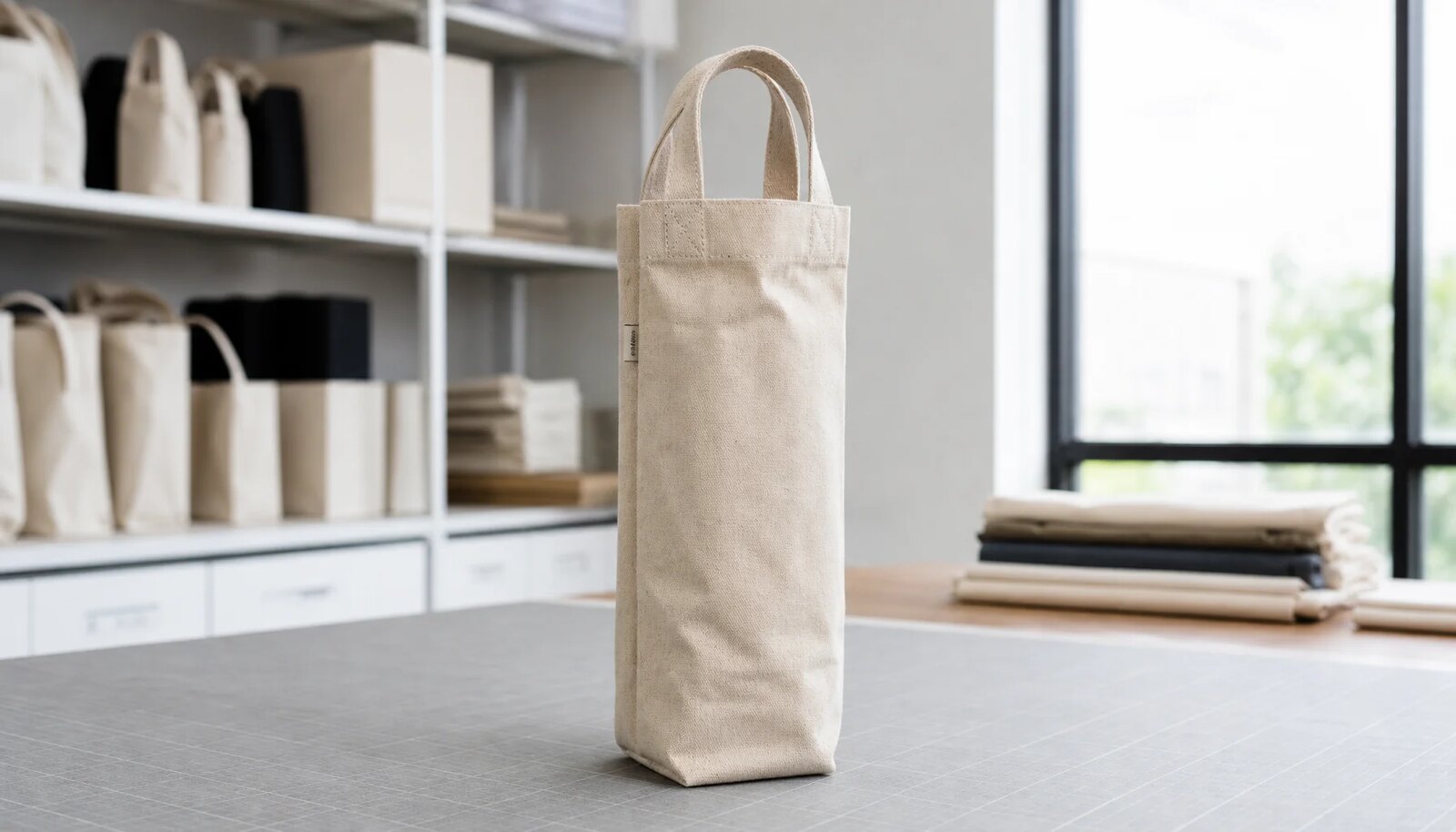
Lead time is lost in the spec sheet, not the sewing line
Wholesale canvas wine carriers look simple until the order gets close to the event date. The bag itself may only need a few panels and a pair of handles, but the schedule is usually consumed by unclear bottle dimensions, vague branding instructions, and last-minute packing changes. A carrier that must hold a standard 750 ml bottle, support the neck, and still look good in a gift set is not the same as a generic tote with a logo on it.
The fastest orders are the ones that arrive with a complete brief. A factory can quote quickly when it knows the bottle size, carrier style, fabric weight, print method, packing method, and delivery window. If any of those items are left open, you end up comparing guesses instead of real offers. That is where the delay starts: not in cutting canvas, but in revising the sample because the bottle sits too low, the handle feels too short, or the logo ends up too close to the seam.
- Start with the exact bottle size, including height and widest diameter.
- State whether the carrier is for gifting, retail resale, or event handout.
- Include artwork, print position, and packing preference in the first RFQ.
- Tell the supplier the date that matters: event date, ship date, or warehouse receipt date.
Choose the build before you ask for price
For most event programs, 12 oz to 14 oz canvas is the practical range. That is roughly 340 to 475 GSM, depending on the mill and finish. At the lower end, the carrier is easier to sew and cheaper to ship, but it may lose shape when the bottle is heavy or the bag is handled repeatedly. At the higher end, the body stands up better and looks more premium, but sewing speed drops and freight weight rises. If the carrier will be used for premium gifting or more frequent handling, heavier canvas is usually the safer choice.
The rest of the build matters just as much as the fabric. Decide whether the carrier needs a base board, a divider, a lining, or a closure before the supplier quotes. A single-bottle carrier with a reinforced bottom and bar-tacked handles is the cleanest structure for most events. If you want a wrapped gift presentation, add a top flap or closure detail, but know that it will add labor and more sample time. Ask for the finished dimensions, not a vague fit claim, because a carrier that is too narrow at the base or too short at the handle will pass a visual review and still fail in use.
- 12 oz to 13 oz canvas suits standard event gifts and simple branding.
- 14 oz canvas is better when the bottle is heavy or the bag must hold its shape.
- Specify bar-tacks, seam allowance, and base reinforcement in the quote request.
- Ask for measured dimensions and handle drop, not just a marketing description.
Compare sourcing routes before comparing unit price
The lowest unit price is not always the lowest-risk source. A direct factory quote usually gives better control over fabric, sewing, and sample turnaround, especially when the order includes custom print, a new size, or a repeat program that will be reordered later. A trading company can be useful when you need mixed product sourcing or one contact across multiple factories, but you should still confirm who owns the actual production schedule and who is accountable if the print shifts or the shipment slips. A stock supplier is fastest, but it gives up a lot of control on size, fabric weight, and branding.
Buyers should also ask for proof that the supplier can repeat the job, not just quote it once. Useful evidence includes current production photos, sample room images, carton packing photos, and a brief note on the production process. If the supplier cannot show a similar wine carrier body, or if they keep changing the spec during the quote stage, that is a warning sign. For event planning, the better supplier is not the one with the shortest headline promise. It is the one that can hold the same fabric, same print position, and same carton count from sample to shipment.
- Direct factory: best for custom specs, repeat orders, and clearer responsibility.
- Trading company: useful for mixed orders, but confirm the real factory and control point.
- Stock supplier: best for short deadlines, but limited on structure and branding.
- Ask for factory photos, sample images, and carton pack photos before placing the order.
Use a branding method that survives handling and packing
For canvas wine carriers, one-color screen print is usually the most stable choice when the artwork is simple and the schedule is tight. It keeps setup manageable and usually gives a clean result on natural canvas. Woven side labels are another practical option when you want subtle branding and shorter decoration time on the body itself. Embroidery can look good on heavier canvas, but small logos may pucker or distort if the panel is narrow. Heat transfer can work on short runs, but it needs careful curing and rub testing because event bags are handled, stacked, and repacked more than people expect.
The art file should be treated as a production document, not a design file. The supplier needs the exact logo size, placement from the seam or hem, color target, and whether the back side needs branding as well. A digital proof is useful for placement, but the real approval should be based on a physical sample or strike-off on the actual canvas. That is the only way to see if the ink sits cleanly on the weave, whether the logo looks too light on natural fabric, and whether the print lands too close to a stress point. If the artwork is being handled by a retail brand team, insist on a single approved master so that the production team is not working from multiple versions.
- Choose one-color screen print for simple logos and faster setup.
- Use a woven side label when you want subtle branding and cleaner repeatability.
- Keep the logo away from handle stress points and seam intersections.
- Require a physical proof if brand color, opacity, or placement matters.
Approve the sample against fit, load, and finish
A pre-production sample should match the final canvas weight, thread color, handle construction, label, and packing spec. Do not approve a carrier just because it looks tidy on the table. Put the actual bottle in it, close it the way the end user will close it, and lift it by the handle. That reveals handle balance, base support, and whether the bottle leans inside the body. If there is a divider or insert, test that as well. Many sample issues only show up once the bottle is inside, not when the carrier is empty.
The approval standard should be written before mass production starts. Critical dimensions should stay within the tolerance agreed in the tech pack, and the print position should be measured from a fixed reference point. For a sewn product, small tolerances matter because a 5 mm drift on the body can look fine in a factory photo and still make the logo sit too close to the seam on arrival. Give the supplier a clear rule for what must be remade and what can be accepted. That prevents disputes later and reduces the chance that the production lot is released on a weak sample.
- Test the carrier with the actual target bottle, not a placeholder bottle.
- Measure the sample before approving, especially handle length and base width.
- Check for twisted handles, loose threads, uneven seams, and print shift.
- Write the rejection criteria before production starts, not after the first batch arrives.
Packing decisions change both cost and schedule
For event orders, flat bulk packing is usually the most efficient route. It reduces carton volume, lowers handling time, and makes it easier to distribute the carriers after they arrive. Individual polybags are useful when the bags will be stored, resold, or packaged into premium gift kits later, but they add labor and cube. If the event team is going to sort by color or artwork onsite, tell the factory to separate cartons clearly so the receiving team does not spend hours rechecking mixed boxes.
Carton design is not a minor detail. Ask for carton size, units per carton, gross weight, and the palletization method if the shipment is moving by sea. A weak outer carton can crush the corners and deform the canvas even if the bags themselves are sewn correctly. Moisture protection is worth specifying on longer routes, especially for natural canvas. At minimum, the packing list and carton marks should show SKU, color, quantity, and purchase order number on two sides so warehouse staff can receive the shipment without opening every box.
- Choose flat bulk pack when speed, cube, and receiving labor matter most.
- Use individual polybags only when retail presentation or storage requires it.
- Confirm carton count, carton size, and gross weight before production starts.
- Require a clear carton mark and final carton count photo before dispatch.
Plan backward from the event date, not from the order date
The cleanest schedule starts from the event and works backward. A realistic timeline includes RFQ, quote review, sample, sample approval, purchase order, material reservation, production, quality inspection, packing, and transit. The longest delay is often not sewing. It is waiting for artwork confirmation, sample comments, or a late change to the bottle size. Once those items move, every downstream date moves with them. If the supplier gave a short promise without naming the approval gate, the order has not really been scheduled.
Event buyers should always ask for two dates: the factory-ready date and the ship-ready date. Those are not the same. The first tells you when the goods can be packed and inspected. The second tells you when they can leave the factory or port after packing is complete. Add buffer for holiday shutdowns, fabric reservation, and transit time. If the program is tied to one event only, a split shipment or backup stock body may be worth more than chasing the absolute lowest unit price.
- Add more buffer if the artwork has multiple colors, metallic effects, or special finishing.
- Treat custom cartons, inserts, and hangtags as schedule items, not afterthoughts.
- Keep a final week buffer for customs, inland delivery, or last-mile delays.
- If the event date is fixed, ask for the earliest safe ship date, not the fastest guess.
Read the quote as landed cost, not just ex-works price
A low quote can be misleading if it leaves out screens, labels, packaging, or inspection. To compare suppliers properly, the spec has to be identical across every quote. That means the same canvas weight, same carrier size, same logo size, same print method, same carton count, and same incoterm. Once that is fixed, ask the supplier to break the price into fabric, cutting, sewing, printing, packaging, and any one-time setup charges. This makes it easier to see whether the apparent savings are real or just pushed into another line item.
For recurring event programs, ask for a reorder price as well as the first-order price. If screens are already made and the packaging is approved, the second order may be more efficient even if the first order looked expensive. For importers and distributors, landed cost should include freight, duty, inland transport, and receiving labor. A slightly higher unit price can still be the better commercial choice if the supplier controls packing better, ships on time, and avoids rework at destination. That is the comparison that matters when the bags are tied to an event calendar instead of a warehouse shelf.
- Normalize every quote to the same fabric, size, branding, and packing spec.
- Separate one-time setup charges from repeat production costs.
- Compare EXW, FOB, and delivered terms using the same carton count.
- Include duty, inland haulage, and receiving labor in the landed-cost view.
Use a tight RFQ package so the supplier quotes one real option
A good RFQ for wholesale canvas wine carriers is short but complete. It should state the target bottle size, carrier dimensions, canvas weight, print method, logo file, packing method, delivery window, and incoterm. If the buyer wants strict control, the RFQ should also state whether substitutions are allowed. That keeps the supplier from quietly changing the fabric, the carton, or the print method just to keep the unit price attractive. If the order is for an event program, the supplier should know that lead time is part of the buying decision, not an afterthought.
The best RFQs also ask for proof that the supplier can repeat the order cleanly. Request a sample image, a carton photo, a simple line drawing, and a short process note if the order has any risk points. That may sound like extra work, but it saves more time than it costs. You are not buying a concept sketch. You are buying a repeatable, packed, and labeled product that arrives before the event and matches the approved sample. Once the brief is tight, the supplier can quote once, the buyer can compare properly, and the production team can move without unnecessary revision cycles.
- State whether substitutions are allowed and who must approve them.
- Ask for separate pricing for the first order and the reorder.
- Request a written lead time from sample approval to ex-factory completion.
- Require defect handling terms for overages, shortages, and print errors.
Specification comparison for buyers
| Spec decision | Recommended option | When it fits | Buyer risk to check |
|---|---|---|---|
| Sourcing route | Direct factory with a sample room and in-house QC | Custom size, repeat runs, or orders where lead time and responsibility must be clear | A broker-only quote can hide the real factory, create slow approvals, and blur accountability |
| Fabric weight | 12 oz to 14 oz canvas, roughly 340 to 475 GSM | Standard event gifts, branded giveaways, and carriers that need structure without becoming too heavy | Light fabric can sag with a full bottle; very heavy fabric can slow sewing and raise freight cost |
| Branding method | One-color screen print or sewn woven side label | Natural canvas, clean brand presentation, and orders where setup time matters | Multi-color art adds screen setup, registration risk, and more curing time |
| Carrier structure | Single-bottle body with reinforced base and bar-tacked handles | Most event programs and gift sets where the bottle must sit stable and travel safely | Weak base panels or short handle reinforcement can cause leaning, tearing, or bottle movement |
| MOQ strategy | Stock body with custom print for smaller runs; full custom only when volume justifies it | Pilot launches, event handouts, and orders with uncertain demand | MOQ may still apply per artwork or per color, and mixed SKUs can trigger extra setup charges |
| Packing route | Flat bulk pack with clear carton labels and inner count control | Event distribution, warehouse fulfillment, and shipments that will be re-sorted at destination | Loose packing can create count disputes, scuffing, and higher receiving labor |
| Sample path | Pre-production physical sample based on the final art, fabric, and packing spec | Any order with new size, new print, or a tight event date | Digital proofs do not expose fit problems, handle balance, or fabric handfeel |
| Lead-time control | Written factory-ready date plus ship-ready date with a buffer for approval | Orders tied to a fixed event date or seasonal promotion | Holiday shutdowns, artwork revisions, and fabric reservation delays can wipe out a thin schedule |
Buyer checklist before sampling
- Bottle dimensions, bottle weight, and whether the carrier must fit one bottle or a set
- Final carrier size, gusset depth, handle length, and whether a divider or base board is needed
- Canvas weight in GSM or ounces, fabric color, and whether the body should be dyed or natural
- Logo file, print method, print size, print position, and approved Pantone target if color matters
- MOQ by artwork, by color, and by carrier structure, not just a single headline number
- Sample approval method, including whether a physical pre-production sample is required
- Packing requirement, including polybag, flat bulk, carton count, and carton marking format
- Target event date, required ship date, incoterm, and whether the order can be split if needed
- QC tolerance for dimensions, stitching, print placement, and bottle fit
- What the quote includes and what is billed separately, such as screens, cartons, inserts, or labels
Factory quote questions to send
- What is the exact canvas weight, composition, and finish you will use for the quoted price?
- Is the MOQ per design, per color, per size, or for the total order volume?
- Which print method do you recommend for this artwork, and what setup charges apply?
- Can you quote the first order and the reorder price separately?
- What is the sample lead time, and can you provide a physical pre-production sample before mass production?
- What are the finished dimensions, handle length, stitching specification, and reinforcement points?
- What packing method is included in the unit price, and what carton size and carton count will you use?
- What are the factory-ready date, ship-ready date, and the main risks that could move either date?
Quality-control points to confirm
- Canvas GSM matches the approved sample and the supplier does not switch fabric without written approval
- Finished dimensions, handle length, and gusset depth stay within the agreed tolerance on the approved tech pack
- Handle ends and load points have secure bar-tacks or equivalent reinforcement with no loose stitches
- Print placement, opacity, and registration stay within the approved reference sample for the chosen method
- No skipped stitches, broken thread, uneven seam allowance, or puckering at stress points
- The target bottle fits without forcing, and the carrier holds shape when lifted and set down
- Carton count, SKU labels, and packing configuration match the purchase order and packing list
- Outer cartons arrive clean, dry, and free of crush damage or weak corners after packing and loading