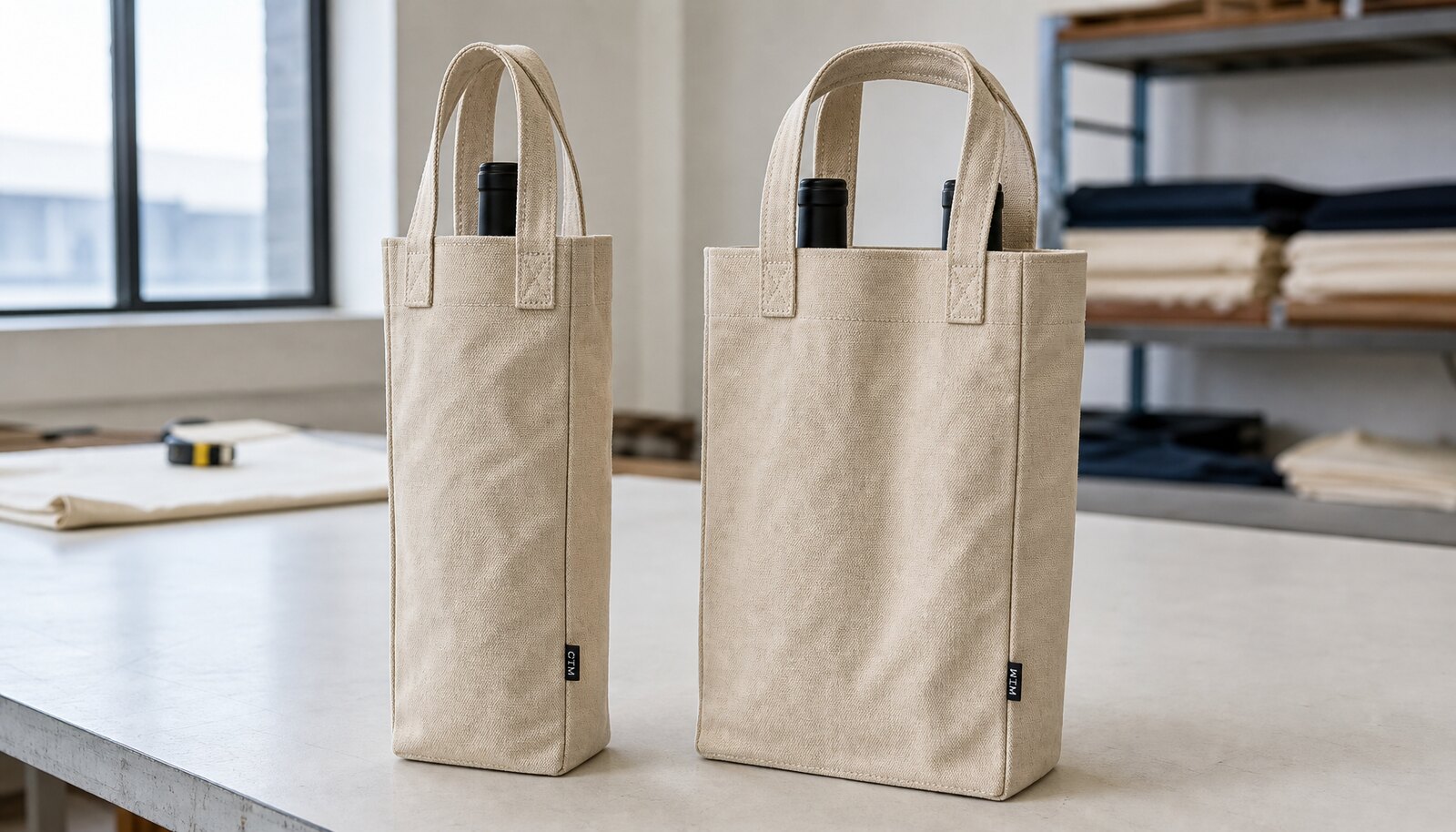
Start With Program Risk, Not the Cheapest Unit Price
Wholesale canvas wine carriers for corporate gifting look straightforward at first glance. They are small textile bags, often with a logo on the front and one or two bottles inside. In a procurement setting, though, they are tied to a fixed recipient list, a brand standard, an event date, and usually more than one internal stakeholder. Marketing cares about presentation. Sales cares about timing. Operations may need cartons sorted by office, region, client, or event location. Procurement has to keep the budget under control without creating a fulfillment problem later.
MOQ negotiation only works when those needs are translated into a production-ready specification. A supplier can lower a unit price in many quiet ways: lighter canvas, narrower handles, fewer reinforcement stitches, looser logo placement, no individual packing, or an assumption that the bottle is smaller than the one you will actually use. None of that may be obvious in a one-line quote. It becomes obvious when the preproduction sample does not fit, the printed logo looks soft on the fabric, or the warehouse receives cartons that are not labeled for the intended destinations.
A stronger approach is to define the risk first. Start with bottle fit, load-bearing strength, decoration quality, color consistency, packing integrity, schedule reliability, and landed cost. Once those are visible, MOQ becomes a practical trade rather than a fight over a number. The buyer can ask for a lower minimum by simplifying the order: one natural canvas color, one logo, one print position, one carrier size, and standard carton packing. That gives the factory a real reason to reduce setup risk instead of simply cutting margin.
- Treat MOQ as a function of material commitment, decoration setup, labor changeovers, inspection effort, and packing complexity.
- Compare quotes only after bottle dimensions, canvas GSM, handle construction, logo method, packing, Incoterm, and inspection standard are aligned.
- Separate the award decision into unit price, quality risk, delivery risk, supplier accountability, and total landed cost.
- Use the full sourcing phrase naturally in the RFQ: wholesale canvas wine carriers for corporate gifting require an MOQ negotiation guide because volume alone does not define factory cost.
Why Wine Carrier MOQ Differs From Simple Tote Bag MOQ
A basic canvas tote can be a little oversized, soft, or casually folded and still do its job. A wine carrier has less tolerance for guesswork. It needs to hold a heavy cylindrical bottle upright, keep the brand-facing panel presentable, and carry weight through the handles without twisting. A few millimeters of pattern drift can make the bottle hard to insert or too loose to feel premium. A weak base may sag. Handles sewn slightly off center can make the carrier lean when lifted.
The construction is also more specialized than a simple tote. A one-bottle carrier may use a sleeve-like pattern with a gusseted base. A two-bottle carrier needs a divider that can resist strain when two filled bottles move independently. Premium versions may add lining, base boards, padded dividers, closure tabs, webbing handles, leatherette patches, woven labels, or tissue wrapping. Every added component can introduce another MOQ, tooling charge, sewing operation, purchasing minimum, or inspection point.
Corporate gifting raises the cosmetic standard. The carrier may be placed on a reception table, inside a welcome kit, or in an executive gift set. Crooked logos, stains, odor, mismatched labels, crushed folds, or inconsistent fabric shades create brand risk even when the bag technically holds the bottle. That is why suppliers are usually most flexible when the program is easy to repeat, simple to inspect, and efficient to set up.
- Confirm whether the target bottle is standard 750 ml wine, champagne, tall wine, wide Burgundy-style, or a mixed bottle format.
- Do not combine one-bottle and two-bottle carriers into one MOQ unless the supplier agrees in writing that shared fabric or shared trims allow it.
- Standardize handle width, handle drop, reinforcement, thread color, and base construction wherever possible.
- Avoid unnecessary packing splits; different inner packs, carton labels, and destination allocations can create almost as much disruption as different product styles.
Define a Factory-Ready Specification Before Asking for MOQ Relief
A supplier can quote accurately only when the buyer describes the carrier as a manufactured textile product, not as a generic promotional item. Begin with the bottle. Provide height, maximum diameter, shoulder profile, neck height, and filled weight in millimeters and grams. State who will insert the bottles: the factory, a fulfillment partner, the buyer’s team, or the recipient. A tight tailored fit may look excellent in a boardroom, but it can slow a packing line if thousands of bottles must be inserted quickly.
Canvas weight should be stated in GSM or ounces and connected to the intended presentation. A 280-340 gsm canvas can work for soft, cost-conscious programs, light folding, and simple screen printing. A 360-420 gsm canvas usually gives better body and is often more suitable for two-bottle carriers or higher-touch corporate gifts. Canvas above 450 gsm can add structure, but it can also increase sewing difficulty, needle wear, seam bulk, packing volume, and freight cost. If the order calls for recycled content, unbleached natural color, a dyed brand shade, or a washed texture, include that before pricing starts.
The construction specification should include finished height, opening width, gusset, base width, divider width, handle length, handle drop, handle width, top hem, seam allowance, stitch type, reinforcement pattern, label position, and closure details. A dimensioned sketch is better than a long paragraph. For sewn textile bags, a general finished-size tolerance of +/-5 mm is common, but bottle fit may require tighter control on opening width, gusset, and divider spacing. Decoration placement tolerance should be handled separately because printing near seams or on textured canvas has different limits than panel cutting.
- Attach a drawing with dimensions, not only a reference photo.
- Specify canvas GSM, fiber composition, finish, color standard, and whether substitution is allowed.
- Define handle drop from the top edge to the top of the handle opening, not just total handle length.
- State tolerances before sample approval so the factory and inspector measure the same way.
Select Decoration by Brand Requirement and Production Risk
Decoration often drives MOQ because it affects setup, rejection risk, and production flow. Screen printing is usually efficient for clear one-color or two-color corporate logos on flat canvas panels. It is easier to inspect than many complex methods, but canvas weave can soften edges and reduce fine-detail sharpness. Thin lines, small text, large solid ink blocks, and tight Pantone targets should be tested on the final canvas, not on a substitute fabric that happens to be available during sampling.
Heat transfer can reproduce detailed artwork, gradients, or multi-color graphics, but it needs testing for adhesion, edge lifting, gloss level, and handfeel on the exact canvas finish. Embroidery gives a tactile premium effect, yet it can pucker lighter canvas and may not reproduce small lettering cleanly. Woven labels, sewn patches, and leatherette patches can lift perceived value, but they add tooling, separate MOQ, placement tolerance, and sometimes extra lead time. Hangtags are flexible and quick, although they do not feel as permanent as a sewn brand element.
For MOQ negotiation, ask the supplier which simplification would create the biggest operational benefit. A one-color screen print on stock natural canvas is easier to schedule than a dyed carrier with embroidery plus a custom woven patch. If brand rules require precise color, approve a print strike-off, thread card, label sample, or patch sample before final carrier approval. Also ask when decoration happens. Printing before sewing can improve flatness and efficiency, but panel movement during sewing affects final placement. Decorating after sewing may limit the print area near seams, gussets, and handles.
- Use screen print for clean logos, practical unit economics, and repeatable inspection on flat panels.
- Use embroidery, woven labels, or patches when tactile presentation matters more than the lowest MOQ.
- Test decoration on the final canvas finish, especially dyed, washed, coated, or recycled-content canvas.
- Ask whether each artwork version, logo color, print position, or regional mark creates a separate setup or MOQ.
Read the Supplier Quote Like a Costed Manufacturing Document
A useful quote explains the unit price instead of hiding it. Ask for separate lines for the blank carrier, decoration, sample cost, screen or plate charges, embroidery digitizing, woven-label or patch tooling, inner packing, master carton, carton labels, inspection support, and freight assumptions. When everything is blended into one number, procurement cannot see whether the supplier has reduced the bag price but recovered cost through setup fees, sample revisions, label tooling, or carton handling.
Quantity tiers matter. Ask for the same specification at 300, 500, 1,000, 2,000, 3,000, and 5,000 pieces if those volumes fit your forecast. The price curve shows where the real efficiency begins. Sometimes the drop from 300 to 500 pieces is meaningful because fixed setup is spread across more units. Sometimes the larger improvement appears after 1,000 or 2,000 pieces because fabric purchasing, cutting, or printing becomes more efficient. With that information, procurement can decide whether to simplify the product, accept a higher pilot price, or consolidate demand across departments.
The quote must also state how MOQ is counted. A buyer may think the order is 1,000 pieces, while the factory sees four 250-piece lots because there are two carrier sizes and two artwork versions. MOQ may apply per style, color, artwork, print position, label type, packing format, or shipping destination. The quote should also state Incoterm, currency, payment terms, sample lead time, production lead time after approval, inspection timing, allowed overrun or shortage, and whether rework is included if defects exceed the agreed standard.
- Require itemized pricing to expose setup, packaging, and decoration costs.
- Compare only quotes using the same Incoterm, carton count, inspection requirement, and delivery assumption.
- Ask suppliers to identify which cost changes if MOQ is reduced: fabric waste, setup, labor, decoration, or packing.
- State in the PO whether overruns or shortages are allowed and how they will be invoiced.
Negotiate MOQ by Removing Variables, Not by Pressuring Blindly
The best MOQ negotiation is a trade. Procurement reduces the factory’s risk, and the factory offers a lower starting quantity or a more realistic pilot price. Use stock natural canvas instead of custom-dyed canvas. Keep one artwork version. Reduce logo colors. Use the supplier’s standard handle webbing if it passes strength and appearance requirements. Avoid special inner packing unless the gifting experience truly needs it. These choices reduce material commitments, setup time, changeovers, and defect opportunities.
A pilot order can be structured differently from the full gifting program. The pilot may use a standard one-color print and bulk carton packing to validate bottle fit, recipient response, and internal demand. The repeat order can then add premium details such as a sewn patch, tissue wrap, or custom carton labels once volume is confirmed. That is more credible than promising a large future order without internal approval. Factories respond better when the forecast is realistic, the specification is frozen, and the buyer shows a repeatable path.
Shared material planning is another useful lever. If one-bottle and two-bottle carriers use the same canvas, handle webbing, thread, label, and carton family, the supplier may have more flexibility even when the sewing styles remain separate. Push regional differences to hangtags, insert cards, or carton labels where possible instead of changing the carrier itself. The goal is not to make the gift generic. The goal is to protect the brand outcome while removing production fragmentation.
- Offer one fabric, one color, one artwork, and one packing method when requesting reduced MOQ.
- Ask whether stock canvas, stock thread, stock webbing, or existing patterns can lower the supplier’s setup burden.
- Use a higher pilot unit price if necessary, but lock the repeat-order specification and tier pricing in advance.
- Keep department, region, or client variations outside the bag construction whenever possible.
Use Sampling to Prove Fit, Finish, Strength, and Repeatability
A canvas wine carrier sample is not just a visual mockup. It should prove that the bottle fits, the handle carries the weight, the logo presents correctly, and the construction can be repeated. Separate the sample stages when needed. A fit sample may use substitute fabric only to confirm dimensions. A decoration strike-off tests ink, transfer, thread, label, or patch quality. A preproduction sample should represent final fabric, construction, decoration, label placement, and packing. Only the preproduction sample should release mass production.
Fit testing should use the actual bottle or a buyer-approved dimensional equivalent. Check insertion speed, side-seam strain, base stability, handle comfort, front-panel distortion, and whether the carrier leans on a flat surface. For two-bottle carriers, test two filled bottles at the same time because divider seams, base stress, and handle pull change under real load. If the carrier will ship inside a gift box, corrugated shipper, or fulfillment kit, test the packed configuration as well. A carrier that looks good alone may crease, rub the logo, or bulge when packed with other components.
Document approval with measurements, photos, and physical samples. Keep one signed gold sample with the buyer, QA team, or third-party inspector and one identical signed sample at the factory. Record canvas GSM, color reference, handle drop, logo size, logo coordinates from top and side edges, label placement, stitch reinforcement, folding method, inner pack, pieces per carton, and carton marks. Any change after approval should be treated as a revision, even if it seems minor, because small construction changes can affect bottle fit and load performance.
- Label each sample stage clearly: fit sample, decoration strike-off, preproduction sample, and approved gold sample.
- Test with filled bottle weight, not only an empty bottle.
- Approve final decoration and final packing before cutting bulk fabric whenever possible.
- Create a photo approval sheet with rulers, close-ups of seams, logo placement, handle reinforcement, and packed carton views.
Set QC Standards Before Fabric Cutting Starts
Quality control should be agreed before production because the factory cannot inspect against assumptions. Define defect classes in plain language. Critical defects include broken handles, open seams that risk bottle drop, unsafe sharp components, severe odor, mildew, contamination, or bottle fit failure. Major defects include wrong canvas GSM, wrong color, obvious logo misplacement, weak stitching, visible stains on the face panel, incorrect divider construction, incorrect packing, or dimensions outside tolerance that affect use. Minor defects may include small loose threads, light wrinkles, or slight trim irregularities within agreed limits.
Functional inspection matters as much as appearance. Set a simple load test using the filled bottle weight plus a sensible handling margin agreed with the supplier. Keep the method repeatable: load the carrier, hold or suspend it for a defined time, inspect handle attachments, seams, divider, and base, then record pass or fail. Two-bottle carriers need separate testing because the load is higher and bottles can shift in opposite directions. For premium corporate gifting, raise the cosmetic standard on the front panel, logo area, and label area because those surfaces carry the brand impression.
Use inspection timing based on risk. For a new supplier, new pattern, or high-value event, an in-line inspection after first production is valuable. It can catch wrong seam allowance, weak reinforcement, print placement drift, or fabric shade issues before the full order is completed. Final random inspection should compare units to the gold sample, measure key dimensions, perform bottle-fit checks, review decoration, check odor and stains, verify carton count, and confirm carton labels. If using AQL, state the inspection level and critical, major, and minor acceptable limits in the PO or quality agreement.
- Define critical, major, and minor defects before production starts.
- Measure dimensions from the same reference points used on the approved sample.
- Include bottle-fit, load, decoration, odor, stain, packing, and carton-label checks.
- Require corrective-action photos and re-inspection if repeated defects appear during in-line review.
Control Packing, Cartons, and Landed Cost Early
Packing is part of the product experience, especially for corporate gifting. Canvas can crease, absorb odor, collect dust, show scuffs, or pick up color transfer if it is packed carelessly. Decide whether carriers ship folded flat, lightly shaped, individually polybagged, wrapped in tissue, grouped in inner cartons, or bulk packed. The right option depends on decoration method, canvas color, fulfillment process, and sustainability requirements. Embroidery, patches, and raised labels usually need more protection from pressure and abrasion than plain printed canvas.
Carton planning affects landed cost. Ask for pieces per carton, carton dimensions, gross weight, net weight, and estimated CBM. Freight may be charged by volume rather than actual weight, so bulky packing can erase the savings from a lower unit price. Overpacked cartons can crush the product; underfilled cartons increase freight and warehouse handling. If cartons go to a fulfillment center, keep carton weight manageable and the count per carton easy to verify. A clean carton plan reduces receiving errors.
Corporate gifting often requires carton marks, SKU labels, PO numbers, client labels, destination labels, barcodes, or region-specific allocation. These details should be included before quote finalization, not added after production. Manual relabeling after goods are packed can delay shipment and create sorting mistakes. If goods must be split by office, country, sales team, or event location, provide an allocation table with quantities and label requirements before packing materials are ordered.
- Define inner packing, folding method, and product protection before comparing freight cost.
- Request carton dimensions, carton quantity, gross weight, net weight, and CBM with every quote.
- Protect printed logos, embroidery, patches, and labels from scuffing and pressure marks.
- Include PO, SKU, barcode, destination, and client-specific carton marks in the written packing specification.
Manage Lead Time as Milestones, Not a Single Promise
A single production lead time hides too much. Break the schedule into artwork confirmation, technical spec approval, fit sample, decoration strike-off, sample revision, material booking, preproduction approval, cutting, decoration, sewing, trimming, packing, final inspection, shipment booking, and dispatch. Each milestone has an owner. Artwork delays often sit with the buyer. Fabric booking sits with the factory. Inspection booking may sit with procurement or a third party. A milestone schedule prevents late discovery that a dependent task never started.
Custom components need early decisions. Dyed canvas, custom woven labels, leatherette patches, embroidery thread matching, insert cards, special carton marks, and tissue wrapping can each have separate approval and production cycles. Even if the carrier body is simple, these components can delay shipment. For fixed event dates, ask which materials must be booked before final sample approval and what risk that creates if the sample changes. In some programs, the buyer may approve stock fabric first while holding final decoration approval until the strike-off is correct.
A fallback route is sensible when the delivery date cannot move. That does not always mean placing duplicate orders. It may mean identifying a stock canvas wine carrier and domestic decoration option that can be activated if the custom route becomes unsafe. The fallback should be close enough in size, color, and branding style to support the campaign without a full redesign. Keep artwork files, Pantone references, logo coordinates, packing instructions, and label data organized so a backup supplier can move quickly if needed.
- Build a milestone schedule with owners and approval deadlines.
- Confirm when fabric, labels, screens, patches, packaging, and cartons are booked.
- Do not release mass production until sample, artwork, tolerances, and packing are frozen in writing.
- Prepare a realistic fallback option for event, holiday, or conference programs with immovable dates.
Specification comparison for buyers
| Sourcing route | Best-fit program | MOQ and cost logic | Procurement checks before award |
|---|---|---|---|
| Direct cut-and-sew factory with in-house printing | Repeat corporate gifting program using one base fabric, one or two carrier styles, and controlled brand presentation | More flexible when the buyer standardizes canvas color, handle material, logo method, and packing; lower total risk at 500-5,000 pcs if the factory controls sewing and decoration | Verify which processes are in-house; request sewing line photos or capability list; confirm who pays for rework if print, stitch, or packing defects occur |
| Factory with outsourced decoration partner | Useful when sewing capacity is strong but screen print, embroidery, patch, or label work is subcontracted | MOQ may be driven by both bag sewing and decoration setup; artwork changes can create separate minimums even when the carrier body is identical | Ask for decoration subcontractor responsibility, strike-off approval flow, defect claim process, and whether printed panels are inspected before sewing |
| Trading company coordinating several suppliers | Multi-item gift sets that include wine bags, boxes, cards, tissue, ribbons, and fulfillment accessories | May consolidate communication but can hide the real production MOQ; price may include coordination margin and less direct factory visibility | Clarify who owns the technical specification, gold sample, inspection booking, replacement goods, and schedule recovery if a factory changes |
| Local decorator using imported blank wine carriers | Urgent domestic programs, small event runs, or late artwork approvals where speed is more important than full customization | Often easier below factory MOQ, but blank quality, dimensions, and canvas weight are fixed; unit price is usually higher than a planned factory run | Measure blank stock; test actual bottle fit; confirm available inventory by lot; check decoration adhesion and whether defective blanks can be replaced quickly |
| Large contract factory with formal material and QC controls | Annual gifting, multi-region brand programs, or retail-adjacent presentation where consistency matters | Higher starting MOQ may be offset by stable fabric purchasing, documented AQL inspection, repeatable carton labeling, and controlled production records | Confirm fabric lot control, color tolerance, preproduction sample process, AQL level, allowed overrun or shortage, and repeat-order material availability |
| Small workshop or boutique cut-and-sew supplier | Pilot runs, premium handmade look, or design development where flexibility matters more than maximum output | Can be flexible on sample changes but may have higher labor cost, slower output, and wider operator-to-operator variation | Set written seam allowance, stitch density, trim, and packing expectations; request first-article approval before continuing production |
| Stock carrier plus custom woven label, sewn patch, or hangtag | Fast corporate gifting when full custom pattern, custom dyed fabric, or complex printing is unnecessary | MOQ may be set by the label, patch, or tag rather than the bag; good for deadline-driven programs if stock is stable | Confirm whether the brand element is sewn, heat-applied, adhesive-backed, or only attached as a tag; check perceived value and durability |
| Mixed one-bottle and two-bottle program using one canvas base | Coordinated gift family for different recipient tiers or bottle combinations | MOQ may combine at the fabric level but usually remains separate by style because cutting, divider sewing, and packing differ | Ask whether MOQ is per style, per size, per color, per artwork, per print position, or combined fabric consumption |
| Premium structured carrier with divider, lining, base board, or closure | Executive gift sets where presentation, stiffness, and bottle separation are more important than the lowest price | Added components can trigger separate material MOQ, tooling, die-cutting, or handwork charges; packing volume and freight usually increase | Test divider load, handle pull, carton compression, base-board fit, odor, scuffing, and whether inserts shift during transit |
Buyer checklist before sampling
- Define the bottle format before quoting: standard 750 ml wine, tall Riesling-style bottle, Burgundy-style bottle, champagne or sparkling bottle, spirits bottle, or mixed-format program.
- Provide actual bottle dimensions in millimeters: bottle height, maximum diameter, shoulder profile, neck height, and filled weight. Do not rely on volume alone.
- State whether the carrier must hold one bottle, two bottles, or both as separate SKUs. Treat one-bottle and two-bottle carriers as separate styles unless the supplier confirms combined MOQ rules in writing.
- Select canvas weight early. Common procurement ranges are 280-340 gsm for soft, cost-conscious carriers; 360-420 gsm for better body; and 450 gsm or heavier only when structure is required and higher sewing cost, needle wear, and freight volume are acceptable.
- Specify fiber and finish: cotton canvas, cotton-poly canvas, recycled cotton blend, raw natural, bleached, dyed, washed, enzyme-washed, coated, laminated, or uncoated. Each affects price, odor, shrinkage, print adhesion, and color variation.
- Define critical dimensions with tolerances: overall height, opening width, gusset depth, base width, divider width, handle width, handle drop, and logo placement. Use +/-5 mm for general sewn dimensions unless bottle fit requires tighter control.
- Specify construction details: seam type, seam allowance, stitch density target, top hem width, handle reinforcement pattern, divider attachment, base construction, label position, and whether raw edges are enclosed.
- Limit artwork versions, decoration positions, and print colors during MOQ negotiation. Every logo version, Pantone match, screen, embroidery file, woven label, or patch variation may create separate setup cost.
- Request quote lines for blank carrier, decoration, sample, screens or digitizing, woven-label tooling, patch tooling, inner packing, master carton, carton labels, inspection support, and freight assumptions.
- Require all suppliers to quote the same Incoterm, currency, payment terms, carton quantity, inner packing, and inspection standard so unit prices are comparable.
Factory quote questions to send
- What is the MOQ per style, per size, per canvas color, per artwork version, per decoration method, and per packing version?
- Can the MOQ be reduced if we use your stock natural canvas, stock handle webbing, one-color screen print, and standard bulk carton packing?
- What exact fabric is included in the quote: GSM, fiber composition, weave, finish, dyed or undyed status, and whether the fabric is pre-shrunk or washed?
- What is the expected GSM tolerance and fabric shade tolerance for production compared with the approved swatch or gold sample?
- Is the canvas raw, bleached, dyed, washed, coated, laminated, recycled-content, or treated with any finish that could affect odor, shrinkage, ink adhesion, or handfeel?
- What bottle dimensions and filled weight did you assume when calculating the pattern, gusset, seam allowance, handle reinforcement, and divider design?
- What are the finished dimensions of the carrier and the proposed tolerances for height, width, gusset, base, divider, handle drop, and logo placement?
- Which decoration method is quoted: screen print, heat transfer, embroidery, woven label, sewn patch, leatherette patch, debossed patch, hangtag, or a combination?
- Does the decoration occur before sewing, after sewing, or on a separate panel? What print-area limits apply near seams, gussets, handles, and curved surfaces?
- How many artwork colors, logo positions, logo sizes, and Pantone matches are included before additional screens, setup charges, or minimums apply?
Quality-control points to confirm
- Finished height, width, gusset, base width, divider width, handle width, and handle drop match the approved specification. Use a stated tolerance such as +/-5 mm for general dimensions and tighter tolerance where bottle fit requires it.
- The actual target bottle inserts and removes without excessive force, side-seam strain, base deformation, handle imbalance, or visible distortion on the front logo panel.
- A loaded single-bottle carrier stands upright on a flat surface and does not twist because of uneven side panels, off-center handles, asymmetric gussets, or a warped base.
- A loaded two-bottle carrier keeps bottles separated; the divider seam does not tear, pull, or expose raw edges, and the base does not sag enough for bottles to collide.
- Handle attachment points have even reinforcement stitching, no broken stitches, no skipped stitches in high-stress zones, and no loose thread longer than the agreed limit, commonly 3 mm after trimming.
- Stitch density is consistent with the approved sample, especially at handles, divider seams, base seams, and top hems. Any change in stitch type or thread thickness requires approval.
- Side seams, base seams, divider seams, and top hems show consistent seam allowance, no open seams, no needle damage, no severe puckering, and no externally visible raw edges unless intentionally designed.
- Canvas face panels are free from obvious stains, oil marks, dirt, mildew spots, unacceptable slubs, color transfer, severe creases, and odor that would affect gifting presentation.
- Decoration is positioned within the approved placement tolerance. For flat printed panels, +/-2 mm to +/-3 mm may be practical; near seams or curved panels, the agreed tolerance should reflect construction limits.
- Print color, logo size, ink coverage, embroidery thread, woven label, patch material, or hangtag matches the approved artwork and preproduction sample under normal daylight-equivalent viewing conditions.