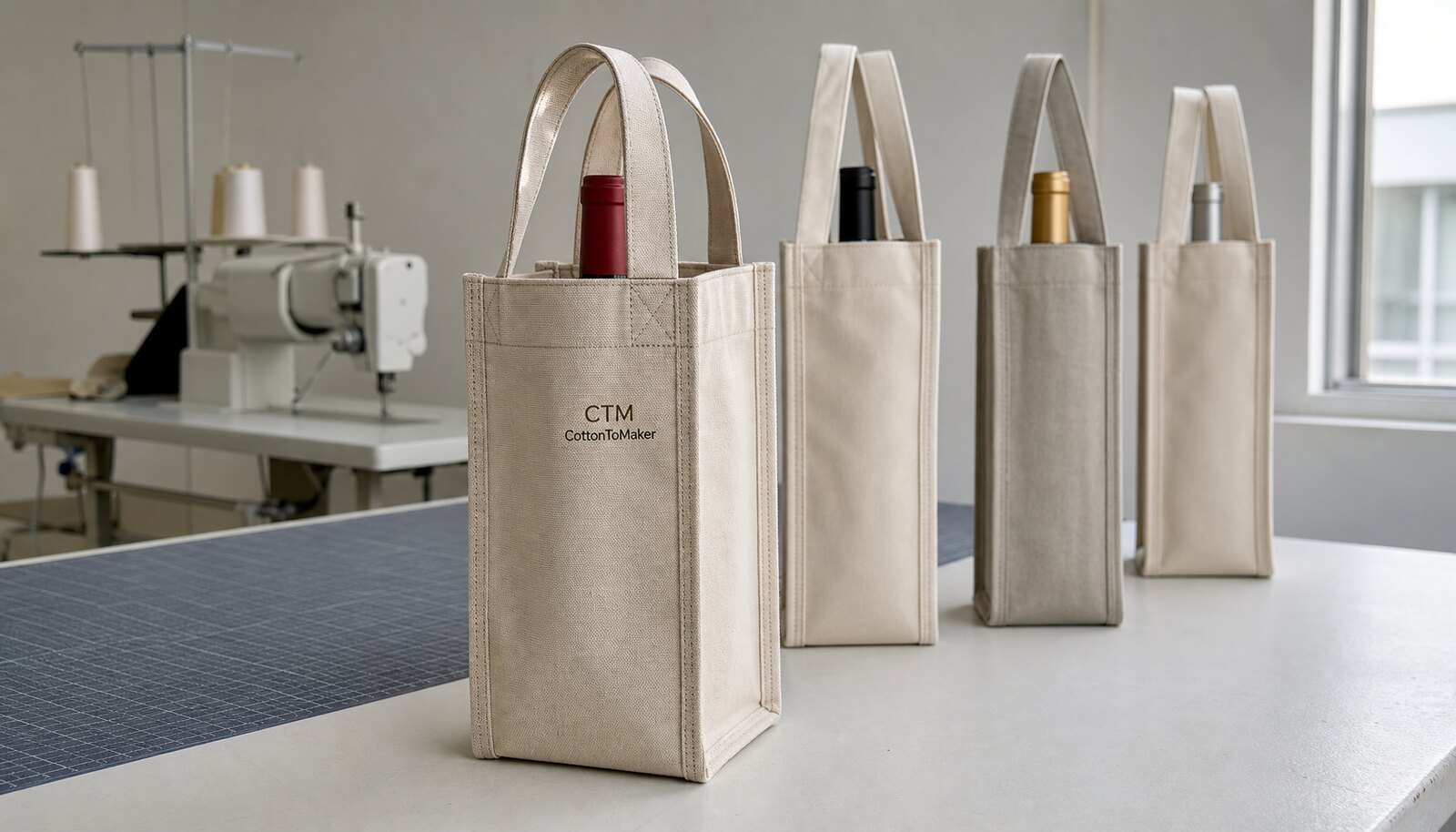
Why fabric weight matters more than most wine-bag RFQs admit
For wholesale canvas wine carriers for gift shops, fabric weight is not just a comfort spec. It affects how the bag stands on shelf, how clearly the logo prints, how much the seams stretch under a bottle, and how much freight you pay to move each carton. A supplier can make a sample look premium with tight pressing and careful hand-finishing, but if the production cloth is lighter than the sample, the bulk order can arrive soft, wrinkled, and visibly less commercial.
Gift shop buyers usually need two things at once: a carrier that feels gift-worthy and a unit cost that still works in wholesale margins. That is why the best choice is often a middle-weight canvas, not the heaviest cloth available. For a single-bottle wine carrier, most bulk programs land in the 10 oz to 14 oz finished canvas range, with 12 oz as the most common starting point for retail gift assortments.
The procurement issue is that vendors do not always quote the same basis. One factory may state ounce weight before washing, another may quote finished weight after pre-shrinking, and a third may use GSM without saying whether the cloth is coated. Those differences can make two '12 oz' quotes behave very differently in sewing, printing, and shipping. A buyer who does not pin down the basis can end up comparing apples to oranges.
- 10 oz finished canvas: lighter, less expensive, and workable for promo or seasonal gifting, but less stable and more prone to wrinkling.
- 12 oz finished canvas: the best all-round option for most gift shops; balances structure, print clarity, and cost.
- 14 oz finished canvas: better body and a more premium handfeel, but higher material cost, heavier cartons, and slower sewing.
- If the carrier has a gusset, divider, or board insert, the overall stiffness may matter more than the nominal cloth weight alone.
- Ask suppliers whether the quoted weight is finished cloth weight, not raw greige cloth weight.
How to read GSM and oz without overpaying for unnecessary structure
Many buyers receive both GSM and oz in the quote, but the conversion is only useful if the supplier uses the same basis every time. In canvas sourcing, finishing changes more than appearance. Pre-shrinking can reduce size drift. Washing can soften handfeel. Coating can improve wipe-clean performance but also alter print adhesion and foldability. A quote that says '12 oz canvas' without stating the finish is incomplete for procurement.
A practical way to compare fabric is to ask for three things together: finished weight, weave density, and finish type. For example, a natural canvas at about 340-360 GSM is often roughly in the 10 oz-12 oz working range, while a more substantial 390-450 GSM cloth is closer to the 12 oz-14 oz range depending on construction and treatment. These are working ranges, not universal rules, so the supplier should confirm the exact cloth on the sample card and production lot.
If your gift shop program needs shelf presence but also easy storage, avoid overspecifying stiffness. Very heavy cloth can make the carrier feel premium, but it can also make the bag bulky to pack, awkward to fold, and more expensive to sew. The right answer is usually to balance fabric weight with seam reinforcement and handle construction rather than simply buying the heaviest canvas available.
- Use 10 oz-12 oz finished canvas when the order is price-sensitive but still needs retail appeal.
- Use 12 oz-14 oz finished canvas when the bag must stand up better and feel more reusable.
- Ask for the fabric finish in writing: untreated, pre-shrunk, enzyme-washed, coated, or brushed.
- Request a fabric swatch with measured weight, not just a generic photo.
- If the supplier only gives GSM, ask for the equivalent oz figure and the measurement method used.
Fabric finish comparison: natural, washed, coated, and dyed canvas
Fabric finish can change the buyer experience as much as the weight itself. Two carriers made from the same base cloth can feel and perform differently once one is washed, one is coated, and one is left raw. Gift shops care about this because the product has to look good on a shelf, survive handling by staff and customers, and still align with the price point of the gift basket or bottle it accompanies.
Natural untreated canvas is common for rustic or handmade-looking programs. It is cost-effective and prints well with simple graphics, but it can show slubs, flecks, and shade variation more clearly. Pre-shrunk or enzyme-washed canvas feels softer and is usually easier to sell as a premium reusable gift item, though the supplier should account for shrinkage in cut size. Coated canvas or a light water-repellent finish can improve wipe-clean performance, but buyers should test whether the print remains sharp and whether the finish causes cracking at fold points.
For custom retail programs, dyed canvas introduces another layer of control risk. Color matching can be strong, but the buyer should define acceptable shade range and batch variation. A sample from lab-dyed cloth may not match bulk dye lots exactly unless the supplier controls the same mill, the same recipe, and the same finishing process. This is especially important when the carrier is part of a seasonal gift set and must match other packaging components.
- Natural canvas: lower cost, rustic look, but higher visible variation.
- Pre-shrunk canvas: better size stability after washing or humid transport.
- Enzyme-washed canvas: softer handfeel and more premium retail perception.
- Coated canvas: wipeable surface, but test print adhesion and crease resistance.
- Dyed canvas: stronger branding alignment, but define acceptable color tolerance before production.
Print method drives both quote price and brand perception
For wine carriers, the print method often determines whether the product looks like a proper retail item or a rushed promotional giveaway. A simple one-color logo with enough clear space around it is typically best suited to screen printing. Screen printing usually keeps setup cost reasonable at scale and gives a clean, matte retail appearance if the art is not overloaded with very fine detail.
If the artwork has gradients, multiple tones, tiny text, or photo-like detail, a supplier may suggest heat transfer or DTF. Those methods can work well for small runs and seasonal designs, but the buyer needs to inspect rub resistance, edge feel, and how the film looks under store lighting. A decoration method that looks vivid on a bench sample can still disappoint if the surface feels plasticky or lifts at the corners after folding.
Embroidery can create a premium cue on heavier canvas, but it is not automatically the best answer. Dense embroidery on lighter cloth may pucker the panel or distort the weave. Sewn labels or woven patches can be a better choice if the brand wants a textured cue without the cost and distortion risk of large stitch fills.
- Screen print: best for simple logos, repeat orders, and lower setup cost.
- Heat transfer or DTF: useful for multi-color graphics, but confirm rub resistance and edge finish.
- Embroidery: premium look, but watch for puckering and slow production.
- Woven label or sewn patch: useful when the buyer wants branding without heavy ink coverage.
- If the logo has fine text, ask the factory to simplify the art rather than shrinking the print size.
Stitching, reinforcement, and load performance buyers should specify
A wine carrier can fail even when the cloth weight is correct if the sewing is weak. Handle joins, bottom corners, gusset transitions, and side seams take the most stress. That means procurement needs to include construction details, not only fabric details. A quote that does not mention stitch type, stitch density, or reinforcement method is incomplete for a reusable retail carrier.
For standard canvas assembly, buyers often see about 6-8 stitches per inch on general seams, with reinforcement at the handle and load points. The exact number matters less than consistency and whether the same construction appears on every production unit. Bar-tacks or dense reinforcement stitches should be placed where the handle meets the body and where the bottle weight pulls on the bottom panel. If the factory uses a self-fabric handle, the join should be doubled or taped so the handle does not twist over time.
The best QC question is practical: if a filled bottle is lifted and set down repeatedly, does the seam stay flat and the handle stay aligned? Buyers should ask the factory to show that the same construction will be used in bulk, not a hand-finished sample with extra labor that cannot be repeated at scale.
- Specify stitch type and expected stitch density, not only 'strong sewing.'
- Ask for reinforcement at handle joins, bottom corners, and gusset transitions.
- Require the approved sample to match the production sewing method.
- If the design uses self-fabric handles, confirm whether the handle is doubled, taped, or lined.
- Check that the handle drop is long enough for the intended bottle shape and retail use.
A real supplier comparison framework for gift shop buyers
A useful comparison is not 'which vendor looks nicest' but which sourcing route fits your order structure and risk tolerance. For wholesale canvas wine carriers, buyers usually compare direct factory, trading company, and domestic stock or import reseller. Each route can be correct, but each one puts pressure on a different part of the buying process.
Direct factory sourcing is strongest when the spec is clear and the buyer wants cost control. The factory can quote the actual cloth, printing, sewing, and packing, which makes landed-cost analysis cleaner. The tradeoff is that the buyer must be more precise and should verify that the factory really owns the production line, not just the sample room. Trading companies can be useful when the order mixes multiple gift items or when the buyer needs help coordinating design and timing. Domestic stock distributors work best when replenishment speed matters more than custom control.
The important procurement question is whether the quote is transparent enough to compare like with like. A quote that seems cheaper may include fewer bar-tacks, thinner fabric, smaller carton counts, or a more expensive print method hidden in the decoration line. Ask every supplier to quote the same size, same artwork, same packing, same QC expectation, and same sample terms.
- Direct factory: strongest for control, traceability, and price discipline.
- Trading company: useful for mixed programs and communication support.
- Domestic stock route: useful for speed, but limited on customization and exact spec control.
- Never compare price without matching fabric weight, print method, carton count, and packing style.
- Ask who signs off the sample and who owns the production responsibility if there is a defect.
MOQ logic: what actually changes the minimum order
MOQ is not a fixed number; it is the outcome of fabric availability, dyeing, printing setup, and sewing efficiency. A supplier may offer a lower MOQ for stock natural canvas with one-color print, then move the minimum much higher once you request custom dye, multiple logo placements, or a special trim. Gift shop buyers should separate the MOQ for the body fabric, the decoration, and the packaging so they know which element is driving cost.
A common mistake is asking only, 'What is your MOQ?' That answer is too vague to protect the buyer. Instead, ask for MOQ by fabric color, by artwork version, and by packaging format. If the factory is allowing mixed colors in one order, ask whether those colors can be packed together or whether the MOQ applies to each color and each SKU. For seasonal gift programs, it is often better to keep the bag body constant and vary only the label or print, because that keeps the MOQ lower and the production schedule simpler.
If the order includes a custom-dyed canvas or special closure, the MOQ can rise quickly because the mill or trim supplier may require minimum dye or hardware runs. Buyers who need flexibility should favor stock cloth and a simple decoration method, then create variety through packaging, hangtags, or limited-edition graphics rather than changing the base construction every time.
- Ask for MOQ by body fabric, color, print version, and packaging type.
- Stock canvas usually supports lower MOQ than custom-dyed cloth.
- Simple one-color branding usually supports lower setup cost than multi-color decoration.
- Mixed-color packing can reduce inventory risk if the factory allows it.
- Any hardware, board insert, or special closure can change MOQ significantly.
Sample approval: what to verify before bulk production starts
A sample is only useful if it represents the real production method. If the factory uses a hand-made sample with extra stitching or a better fabric roll than the bulk order, the approval loses value. For canvas wine carriers, the pre-production sample should match the intended cloth weight, finish, handle construction, print method, and packing method. Otherwise the buyer is approving a product that may not be repeatable at scale.
The most practical sample checks are tactile and measurable. Insert the intended bottle type, lift the carrier repeatedly, lay it flat, fold it, and inspect the seams under normal retail lighting. The logo should sit where the spec says it will sit. The fabric should feel close to the approved swatch. If the carrier is meant to be a shelf gift item, it should also look neat when hanging or standing in a store fixture. A sample that only looks good in a photo is not enough.
Buyers should keep a sign-off sheet with version control. That sheet should note fabric type, weight, color reference, print size, handle drop, stitching detail, packing style, and any acceptable variations. When a bulk dispute happens, the approved sample is only useful if it is tied to the exact version the factory promised to reproduce.
- Approve the same fabric roll or matching lot, not a random substitute if possible.
- Confirm logo size and placement with measurements, not only visual approval.
- Inspect inner seams, outer seams, and reinforcement points.
- Test the carrier with the real bottle profile the gift shop will sell.
- Keep the sample sign-off tied to a dated spec sheet and artwork file version.
Packing, carton loading, and how they affect landed cost
Packing is one of the easiest places for a supplier to give a quote that looks good but is incomplete. A heavier cloth, a webbing handle, or a rigid insert may reduce the number of pieces per carton and change the freight picture materially. If the factory cannot provide carton dimensions and gross weight, you do not yet have a usable procurement quote.
For retail gift programs, the buyer should also think about presentation damage. Printed canvas can scuff if units rub together in transit, especially when the surface is coated or when the design includes dense ink. Individual polybags reduce that risk, but they add plastic, labor, and volume. Bulk inner packs are cheaper, but they require the factory to control abrasion and dust more carefully. The right answer depends on channel and shelf expectation, not on habit.
A practical landed-cost comparison should include carton count, cubic measurement, and estimated load quantity. Even a small change in unit thickness can alter how many bags fit into a carton and how many cartons fit in a container. That is why procurement should request a carton loading example, not just a product price.
- Request pieces per carton, carton dimensions, gross weight, and if possible pallet pattern.
- Ask whether the quote assumes individual polybags, bulk inner packs, or retail-ready labeling.
- Compare landed cost, not just unit price, especially when fabric weight changes carton density.
- Define outer carton marks and barcode labels before production starts.
- If printed surfaces are delicate, require anti-scuff packing or a separation method inside the carton.
Lead time, region risk, and what can actually delay shipment
A 30-45 day bulk lead time after sample approval is a reasonable working estimate for many standard programs, but it is not a guarantee. The schedule can slip if artwork arrives late, fabric must be dyed, or the sewing line is already committed to larger orders. For seasonal gift shop programs, the real lead time includes sample transit, sample revision, bulk production, quality inspection, carton booking, and export handling.
Region matters because it changes the risk profile. If the factory is sourcing from a region with frequent port congestion, weather interruptions, or textile mill lead constraints, the buyer should build extra cushion into the calendar. Likewise, if the order uses a custom dyed cloth or a coated finish, supply chain lead time can be longer than the sewing lead time. The factory may quote the sewing days clearly but leave out the mill delay, which is where many schedules get lost.
Buyers can reduce risk by freezing the spec before the purchase order is issued. Changes after cutting starts are expensive and slow. Even a small shift in fabric weight, logo placement, or packing style can force a new sample approval cycle. For holiday and gift-season assortments, the safest plan is to lock the spec early and leave time for inspection and freight booking.
- Ask what the quoted lead time starts from: deposit, artwork approval, or sample sign-off.
- Build in time for courier transit of samples and revision rounds.
- Avoid changing fabric, print, or packing after the PO unless you can absorb the delay.
- For seasonal programs, keep a schedule buffer for inspection and export booking.
- If the cloth must be dyed or coated, treat mill lead time as part of the project timeline.
Specification comparison for buyers
| Spec decision | Recommended option | When it fits | Buyer risk to check |
|---|---|---|---|
| Fabric weight | 12 oz finished canvas for standard retail gifting | Best for most gift shops that need a balanced look, stable print, and manageable freight | Ask whether the quote is finished fabric weight, pre-wash weight, or greige weight; the same oz number can behave differently |
| Fabric weight | 14 oz finished canvas for premium reusable programs | Works when the carrier must feel substantial, stand upright better, or support heavier bottle shapes | Heavier cloth increases sewing time, carton weight, and defect risk if the factory underprices labor |
| Fabric weight | 10 oz finished canvas for promotional or seasonal programs | Useful for price-sensitive programs with simpler branding and lighter handling expectations | Light fabric can wrinkle, distort print edges, and look less premium under store lighting |
| Fabric finish | Pre-shrunk or enzyme-washed canvas | Best when your retail buyer wants steadier size and softer handfeel | Check whether shrinkage is measured after wash and whether the factory compensates in cut size |
| Fabric finish | Natural untreated canvas | Good for lower cost and a rustic gift-shop look | Color variation, slub content, and odor acceptance need to be defined in writing |
| Fabric finish | PU-coated or water-repellent canvas | Useful when the carrier may be exposed to condensation or repeated handling | Coatings can change print adhesion, foldability, and handfeel; confirm decoration compatibility |
| Handle style | Self-fabric handle with reinforcement tape or doubled fabric | Suitable for clean retail appearance and moderate load use | Short handle drop or weak reinforcement can cause twisting and returns |
| Handle style | Webbing handle with bar-tacks at stress points | Better if the carrier needs higher load confidence and repeat use | Check webbing color consistency and stitch density; mismatched trims can create a downgrade look |
| Decoration method | One-color screen print on flat panel | Best for simple logos, repeat orders, and lower setup cost at scale | Small text, thin lines, and halftones may blur if artwork is not simplified |
Buyer checklist before sampling
- Confirm final bag size, gusset depth, handle drop, and usable load target in kilograms and pounds.
- State fabric type, finished weight in oz and GSM, color standard, and acceptable shade tolerance.
- Specify whether the canvas is pre-shrunk, washed, coated, or untreated, because finish changes handfeel and size stability.
- Send vector artwork, logo placement drawing, print size, and Pantone references where color matching matters.
- Ask for a physical pre-production sample made with the same fabric, same print process, and same reinforcement method planned for bulk.
- Request carton pack data: pieces per carton, carton dimensions, gross weight, inner pack style, and pallet pattern if needed.
- Define inspection checkpoints for stitch count, seam strength, print adhesion, odor, stains, and quantity count.
- Agree in writing on barcode placement, care label, hangtag, and country-of-origin marking before the PO is issued.
Factory quote questions to send
- What exact fabric weight are you quoting, and is it finished fabric weight, washed finished weight, or greige cloth before finishing?
- Can you state the GSM and oz conversion you are using, and what tolerance do you allow on production fabric?
- Does your price include printing, woven label, side label, embroidery, or packaging, or are those separate line items?
- What is your MOQ by color, by artwork version, and by fabric finish? If we use stock canvas, does MOQ change?
- What is the handle construction: self-fabric, webbing, reinforced tape, or double-layer fabric, and how many bar-tacks are included?
- What is the seam allowance, stitch type, and stitch density on the production sample?
- Can you confirm the packed carton quantity, carton dimension, gross weight, and estimated loading quantity per 20ft or 40ft container?
- How long does sample production take, and when does bulk lead time start: deposit, sample approval, or final artwork approval?
- What QC standard do you use for print tolerance, size deviation, stain allowance, loose threads, odor, and needle damage?
- If the bulk result differs from the approved sample, what is the remake or claim process?
Quality-control points to confirm
- Fabric weight should be checked against the approved spec with an agreed tolerance band, not just a name like 'heavy canvas.' For most gift-shop programs, a practical tolerance is about ±5% on finished weight unless the buyer and supplier agree otherwise.
- Fabric width and cut size should be checked before sewing because a small width loss can change panel size and side-gusset symmetry.
- Stitching at handle joins, side seams, gusset corners, and bottom corners should be even, with no skipped stitches, broken needle holes, or loose thread bundles.
- A useful production check is at least 6-8 stitches per inch on standard canvas assembly, unless the approved sample uses a different standard; whatever is approved should be repeatable in bulk.
- Bar-tacks or reinforcement stitches at stress points should be present on every unit, with placement matching the sample and no obvious misalignment.
- Print registration should match the approved artwork, with no major blur, shade shift, pinholes, or edge bleeding visible at normal retail viewing distance.
- For one-color screen print, buyers should define acceptable misregistration in millimeters; if the logo has fine text, keep the allowance tight.
- A bottle-load test should hold the intended bottle size without seam creep, handle twist, or bottom sagging after repeated lifts.
- Random carton opening should confirm no oil stain, mildew smell, moisture, or metal debris, especially when the goods ship from humid regions.
- Finished units should be counted against the packing list by carton and by outer case total, because shortages are often hidden by mixed packing.