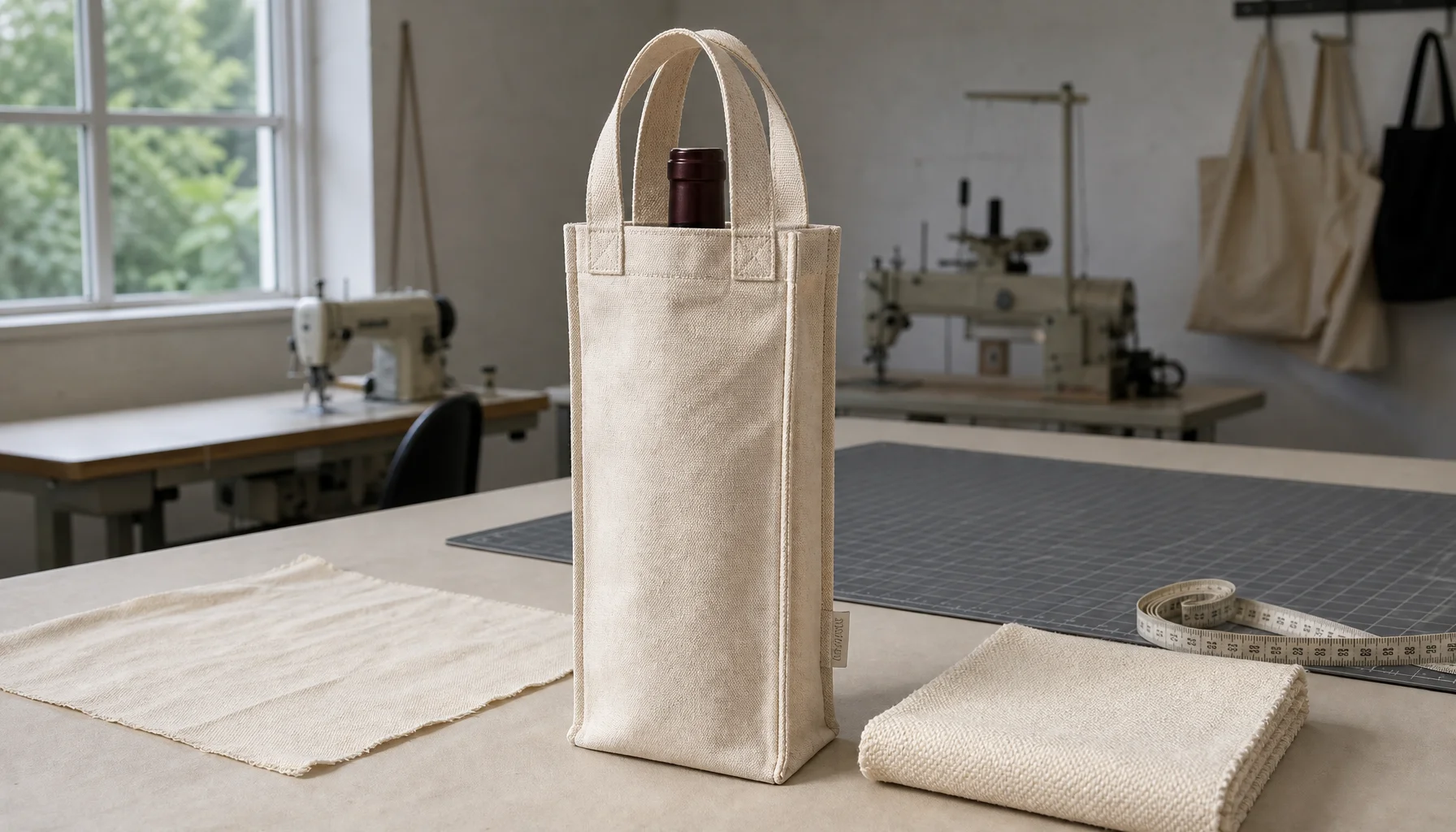
1. Start with fabric weight, but do not stop there
For wholesale canvas wine carriers, fabric weight is one of the first specifications to lock. It affects how the bag hangs, how the base holds a bottle, how cleanly the logo prints, how fast the sewing line can run, how many pieces fit into a carton, and what the landed cost looks like after freight. Two factories may both quote a “natural cotton canvas wine bag,” yet one may be pricing a soft 10oz fabric while another is using a structured 14oz canvas. Those quotes are not comparable.
This is where eco apparel brands can get caught. Wine carriers often enter the line as a lifestyle add-on: a holiday gift bag, tasting-room accessory, club pack, event giveaway, or retail bundle. Buyers who are used to cotton totes may assume the same construction rules apply. They do not. A wine bottle is dense, narrow, and rigid. It pulls hard at the handle points, presses into the base corners, and swings when carried. The carrier also has to look good with a cylindrical bottle inside, not twisted or puckered around the front logo.
The right question is not simply, “What is the heaviest canvas available?” A 16oz carrier can feel premium, but it may increase carton weight, reduce pack-out, and slow production. A 10oz carrier can be acceptable for a controlled single-bottle promotion if the handle and seams are engineered properly. Most B2B programs sit between those extremes. Specify fabric weight together with bottle format, handle design, seam allowance, print method, packing, and QC checks.
- 10oz canvas: lighter and easier to fold; best for controlled single-bottle programs where low bulk matters and reinforcement is defined
- 12oz canvas: common middle ground for single 750ml wholesale programs, balancing structure, printability, and export packing
- 14oz canvas: stronger presentation and better stability for premium single-bottle carriers or many two-bottle styles
- 16oz canvas: substantial and stiff, but should be justified by retail positioning because freight, sewing, and packing bulk increase
- Below about 8oz: generally better treated as a light sleeve or promotional wrap, not as a repeat-use bottle carrier unless the load and use case are very limited
2. Translate oz into GSM and write the tolerance into the RFQ
Canvas is often sold by ounces, while many international mills, factories, and procurement teams also use GSM. GSM means grams per square meter. In practical sourcing conversations, 10oz canvas is often around 340 GSM, 12oz around 405 GSM, 14oz around 475 GSM, and 16oz around 540 GSM. Treat these as buying references rather than fixed scientific conversions across every mill.
Why use both units? Because it keeps suppliers from hiding behind vague descriptions. One supplier may quote greige fabric weight before finishing. Another may quote finished fabric. A third may use a local convention that creates a slightly different number. Washing, dyeing, coating, calendaring, and other finishing steps can change the weight, hand feel, shrinkage, and surface behavior. A tightly woven 12oz canvas may feel more stable than a loose 12oz canvas with a rougher structure. GSM is not the whole story, but it gives the buyer a measurable anchor.
A clear RFQ might say: “12oz cotton canvas, approximately 405 GSM finished weight, natural undyed, acceptable GSM tolerance plus or minus 5% subject to bulk roll verification, suitable for one-color screen print.” If the factory cannot hold plus or minus 5%, ask what the mill can support and decide whether that tolerance fits your channel. Avoid words like “medium weight,” “heavy canvas,” or “eco canvas” unless they are supported by numeric specs.
- Ask whether GSM refers to greige, finished, washed, dyed, or coated fabric
- Use both oz and GSM in the purchase specification, not only one unit
- Agree bulk tolerance in writing; plus or minus 5% is a common target but not automatic
- Request a bulk fabric cutting or swatch from the production lot and seal it with the approved sample
- Compare weave tightness, surface smoothness, stiffness, and shade variation alongside numeric weight
- For repeat orders, record the approved roll reference or mill lot where available
3. Choose weight by bottle format, not by habit
A strong wine carrier specification begins with the bottle. A standard 750ml Bordeaux bottle, wider Burgundy bottle, Champagne-style sparkling bottle, magnum, and boxed gift bottle each need different allowances. The height, base diameter, shoulder width, and filled weight all change how the bag carries. If the assortment includes mixed bottles, decide early whether one universal carrier will fit the largest bottle or whether separate fitted SKUs are needed.
For many single 750ml bare-bottle programs, 12oz canvas at about 405 GSM is a sensible first sample. It usually gives enough body for a clean loaded presentation while still folding well for export. If the carrier is positioned as a premium retail gift item, or if the brand wants a sharper upright look on shelf, 14oz can be worth testing. For low-cost events with a known bottle and limited reuse expectations, 10oz may be considered, but only after a real loaded sample is reviewed.
Two-bottle carriers need more caution. They are not just wider single-bottle bags. They carry roughly twice the load, the handle angle changes, and the bottles can hit each other if the divider is weak. For many two-bottle retail styles, a 14oz body is a safer starting point. Still, GSM alone will not protect the product. The divider must be attached properly, the handle joins must be reinforced, and the loaded bag should be checked for twisting.
- Provide bottle height, base diameter, widest diameter, and filled weight if available
- Single 750ml Bordeaux everyday carrier: evaluate 12oz / about 405 GSM first
- Premium single-bottle gift carrier: evaluate 14oz / about 475 GSM for better structure
- Sparkling bottles: review wider base, heavier load, and handle swing before approving 10oz
- Two-bottle carrier: evaluate 14oz body, secured divider, reinforced handle joins, and loaded twisting
- Boxed bottle: build dimensions from the box outer size plus insertion allowance
- Mixed bottle program: decide between one universal carrier and multiple fitted SKUs before requesting price
4. Size it like packaging, not only like a fabric bag
“Fits one bottle” is not a production specification. A usable drawing should show finished height, front width, side gusset, base depth, top opening, handle drop, handle width, and printable area. If the carrier has a divider, add divider height, divider width, attachment points, and whether the divider reaches the base. If the bottle is already inside a paperboard gift box, use the outer box dimensions, not the bottle dimensions.
Insertion allowance is easy to overlook. A carrier may technically fit the bottle but still be too tight for warehouse teams, store staff, or event crews to load quickly. Tight openings stress the upper side seams and can scrape printed gift boxes. Too much room creates a different problem: the bottle leans, the front panel loses shape, and the bag swings more during carrying. The sample should be tested by inserting and removing the actual bottle several times, not only by checking flat measurements.
Use realistic tolerances for sewn goods. Depending on size and construction, plus or minus 0.5cm to 1.0cm may be more workable than hard-goods tolerances. For a narrow front panel, logo placement may need a tighter visual standard than the body dimension. Confirm measurement tolerances before the supplier prices bulk production and before any inspector uses them as pass/fail criteria.
- Define finished dimensions in centimeters, including body height, front width, gusset, base depth, and top opening
- State handle drop measured from the top edge to the inside top of the handle loop
- For gift boxes, test loading speed and corner protection, not only static fit
- For narrow bags, confirm that the logo remains visually centered after sewing and loading
- Use realistic sewn-goods tolerances and write them into the approved specification sheet
- Photograph the approved loaded sample from front, side, base, and top opening for inspection reference
5. Logo quality depends on the canvas surface
Canvas wine carriers leave less room for print error than large totes. The front panel is narrow, seams sit close to the artwork, and the bottle behind the panel can exaggerate distortion. A smoother 12oz to 14oz canvas normally gives cleaner screen print edges than a loose, open weave. A rustic surface can look right for an eco apparel brand, but it may also bring pinholes, feathered edges, uneven opacity, and more visible shade variation.
One-color screen printing on natural canvas is often a practical wholesale choice. It is simple, restrained, and scalable. Water-based ink can give a softer hand feel, but it still needs to be checked for opacity, cure, and rub performance on the actual fabric. Heat transfer may help with fine detail or smaller runs, although the film edge and hand feel should be reviewed carefully on textured canvas. Woven labels are a good option for small, consistent branding. Embroidered patches can feel premium, but they add cost, bulk, needle marks, and extra sewing steps.
Print placement should be specified from fixed points: top edge, side seam, and center line. If panels are printed before sewing, cutting and sewing can shift the final visual center. If the finished bag is printed after sewing, seams and gussets may limit the flat print area. On dyed canvas, test light ink opacity and crocking before approval. A digital mockup is useful for alignment, but it does not prove real canvas print behavior.
- Screen print: efficient for simple logos and medium to large wholesale runs
- Water-based ink: good hand feel, but test cure, opacity, and rub on the actual fabric
- Heat transfer: useful for fine detail or smaller runs; review edge film and adhesion
- Woven label: reliable for small brand marks and repeat-order consistency
- Embroidery patch: premium option, but confirm bulk, needle marks, and sewing cost
- Dark fabric: check crocking, lint visibility, light-ink opacity, and strike-through
- Large solid logos: require strike-off approval and inspect for pinholes and uneven coverage
6. Reinforcement beats vague promises of “heavy duty”
Heavier canvas helps, but it does not rescue weak construction. Load performance depends on how the bottle’s weight travels through the base, side seams, handle joins, and top edge. A poorly reinforced 14oz carrier can fail sooner than a well-built 12oz carrier. That is why the RFQ should describe reinforcement, not simply request a “strong wine bag.”
Handle construction needs precise language. Self-fabric handles look integrated and suit many apparel-brand aesthetics, but they must be folded evenly, stitched securely, and reinforced where they meet the body. Cotton webbing handles can be stable and durable when width, thickness, color, and texture are controlled. Rope handles give a gift-bag look, but they change the attachment method and often reduce flat-packing efficiency. Padded handles may improve comfort, yet they add bulk and cost.
The base deserves the same attention. A glass bottle has a hard bottom that concentrates pressure into a small area. For repeat-use programs, check base seam allowance, corner reinforcement, and whether an internal support panel is needed. Rigid inserts can improve shape, but they may complicate eco positioning, packing, and recycling claims. Use them only when the performance benefit is clear.
- Define load-bearing seam allowance, commonly around 1cm or more if the construction allows
- Require X-box stitching, bar-tacks, or approved reinforcement patches at handle joins
- State handle width and drop; excessive drop can increase swing, while too short can feel awkward
- Review stitch density, thread tension, skipped stitches, and raw edge control
- Inspect base corners after the sample remains loaded for several hours or overnight
- For two-bottle carriers, confirm divider attachment at side and/or bottom points, not only top appearance
- Do not assume 16oz fabric solves poor handle design
7. Keep sustainability claims narrow, documented, and safe to print
Eco apparel brands often want canvas wine carriers to support a broader sustainability message. Natural cotton canvas, reusable gifting, restrained branding, and reduced disposable packaging can all fit that direction. The risk is overclaiming. Suppliers may describe a fabric as organic, recycled, eco, natural, or sustainable, but the documents may apply only to fiber, yarn, fabric, a facility, or a specific transaction. Finished-goods claim support is not automatic.
Before artwork approval, decide exactly what the product must claim. If the bag, label, hangtag, or website copy will say “organic cotton,” “made with recycled cotton,” or reference a certification, request scope documents and transaction documents early. If the paperwork does not support a finished-product claim, adjust the language before printing. A plain material-content statement is often safer than a broad environmental promise that cannot be verified for the exact order.
Packing is part of the sustainability decision too. Removing individual polybags can reduce plastic use, but printed canvas still needs protection from dirt, moisture, abrasion, and ink offset. Bulk packing with tissue interleaving, carton liners, or paper bands may work for some channels. The best option is the one that protects sellable goods without adding unnecessary material. Damaged reusable carriers that require sorting, rework, or disposal do not improve the outcome.
- Clarify material content: conventional cotton, organic cotton, recycled cotton blend, or other blend
- Request claim documents before approving artwork, hangtags, labels, or website copy
- Confirm whether documents cover fiber, fabric, facility, transaction, or finished goods
- Avoid broad claims that cannot be verified for the exact order
- Decide whether natural shade variation is acceptable for the brand’s visual standard
- Balance no-polybag packing with protection against dirt, moisture, creasing, and print transfer
- If using recycled content, confirm fiber composition, hand feel, strength, and color consistency on sample
8. Compare MOQ and price by the real cost drivers
Wine carrier pricing is shaped by more than canvas weight. A low quote may assume stock natural canvas, a standard body, one-color logo, no divider, no hangtag, and bulk flat packing. A higher quote may include custom-dyed canvas, a secured center divider, premium handle trim, barcode labeling, individual packing, and stricter QC. If those assumptions are not visible, procurement may choose the cheaper supplier for the wrong reason.
Break MOQ into the parts that actually drive production: fabric color, print color count, artwork version, size, construction, and packing method. A 3,000-piece order in one natural canvas color with one logo is not the same as 3,000 pieces split across six fabric colors, four logos, and two bottle sizes. Each split affects fabric sourcing, cutting efficiency, print setup, trim purchasing, inspection, carton labeling, and reorder control.
For a market test, a stock natural 12oz single-bottle carrier with one-color screen print or a sewn label is usually cleaner than a complex custom seasonal design. Ask for tier pricing at pilot quantity, first reorder quantity, and annual forecast quantity. That structure helps you see which features scale well and which ones add complexity without enough commercial value.
- Separate MOQ by fabric color, print color count, artwork version, size, and construction
- Ask whether stock fabric is from one lot or multiple available lots
- Request itemized adders for dividers, linings, base boards, hangtags, labels, and special packing
- Compare EXW and FOB pricing clearly; do not mix quote bases
- Ask for carton data with the quote so CBM and gross weight can be included in landed cost
- Use tier pricing to see whether a design is viable for repeat orders
- Confirm reorder matching expectations for fabric shade, GSM, print color, and trim
9. Approve samples by testing fit, load, print, and packing
Do not approve a canvas wine carrier sample only because it looks good on a table. The sample must prove that the intended bottle fits, the loaded bag hangs correctly, the print works on the real canvas, and the packed item will arrive without avoidable damage. A development sample made from substitute fabric can be useful for shape review, but it does not remove risk if production fabric changes in GSM, weave, shrinkage, texture, or shade.
A practical sequence is development sample, pre-production sample, and sealed production reference. The development sample confirms general size, handle style, and construction direction. The pre-production sample should use production fabric, production trim, the real print method, and intended packing where possible. The sealed reference should include the finished bag, fabric swatch, print strike-off, measurement sheet, approved artwork placement, and photos of critical construction points.
Test the sample like the product will actually be used. Insert the bottle or box several times. Carry it by the handle. Let it hang. Set it upright. Leave it loaded overnight and inspect handle joins, base corners, side seams, and logo distortion. For two-bottle carriers, load both bottles and check whether they collide, twist, or pull the divider off center. These checks are simple, but they catch problems before bulk cutting.
- Use the exact bottle, filled bottle, or gift box format intended for the program
- Carry the sample by hand to evaluate comfort, drop, swing, twisting, and handle pressure
- Leave the carrier loaded overnight to inspect stress points and base distortion
- Measure body dimensions and handle drop against agreed tolerance
- Measure logo placement from top edge, side seam, and center line
- Check print rub, opacity, edge definition, and ink transfer after packing simulation
- Photograph approved construction: front, back, side, base, inside seams, divider, and handles
- Seal the sample, swatch, strike-off, and measurement sheet for factory and inspection reference
10. Put packing, QC, and lead time in the first RFQ
Packing choices affect both sustainability and landed cost. Individual polybags, tissue, hangtags, barcode labels, inserts, and retail-ready folding may be required for some channels, but they add labor, material, carton volume, and unpacking work. Bulk flat packing is often more efficient for wholesale, distributor, event, or replenishment orders. Decide the packing method before pricing rather than adding it after production begins.
Fabric weight changes carton data. A 14oz or 16oz carrier may present better, but it can reduce pieces per carton and increase gross weight. Thick handles, rope trim, padded wraps, dividers, and base inserts can keep the bag from lying flat. Request pieces per carton, carton dimensions, net weight, gross weight, and estimated CBM at quote stage. If the numbers are estimates, confirm them after the pre-production packing trial.
Lead time risk often appears before sewing starts. Fabric booking, dyeing, lab dips, certification checks, artwork approval, print strike-offs, sample courier time, and carton label approval can consume the schedule. Ask for a lead time breakdown instead of one total number. A 35-day quote using stock fabric has a different risk profile from a 35-day quote that depends on custom dyeing and document review. Repeat orders are only faster when the specifications, samples, artwork, and packing standards are already documented.
- Define packing method: no unit polybag, individual polybag, tissue interleaving, paper band, carton liner, or retail pack
- Set carton gross weight limits according to destination warehouse handling rules
- Request pieces per carton, carton size, net weight, gross weight, and CBM before supplier selection
- Confirm ink cure time before printed panels are packed face-to-face
- Approve barcode, shipping mark, carton label, and inner-pack instructions before packing
- Use AQL inspection with clear critical, major, and minor defect definitions for bottle bags
- Request lead time split for fabric, dyeing, strike-off, sample approval, cutting, printing, sewing, inspection, packing, and FOB handover
- Keep approved samples, artwork files, carton specs, and packing photos to reduce repeat-order ambiguity
Specification comparison for buyers
| Spec decision | Recommended option | When it fits | Buyer risk to check |
|---|---|---|---|
| Single 750ml everyday retail carrier | 12oz canvas, approximately 405 GSM finished weight, with plus or minus 5% GSM tolerance if agreed; cotton webbing or folded canvas handle 2.5cm to 3cm wide | Good balance for eco apparel retail, winery gift shops, event gifting, club packs, and wholesale programs that need structure without excessive carton weight | Below 10oz may stretch at side seams, wrinkle around the logo, or distort at base corners. Require loaded sample review and defined handle reinforcement before accepting a lighter quote |
| Premium single-bottle gift carrier | 14oz to 16oz canvas, approximately 475 to 540 GSM, reinforced base seam, clean top edge, and measured logo placement | Best when the bag must stand upright more cleanly, feel substantial in hand, and support premium gift positioning | Higher GSM increases sewing difficulty, carton gross weight, and CBM per piece. Compare carton dimensions, pieces per carton, and gross weight, not only unit price |
| Two-bottle carrier with center divider | 14oz canvas body minimum for most retail applications, internal divider panel secured at side and/or bottom points, X-box or bar-tack handle joins | Suitable for holiday bundles, tasting sets, distributor gifts, and club-member packs where bottle-to-bottle impact must be reduced | A floating divider or weak top-only stitch can let bottles collide. Inspect divider height, attachment points, seam allowance, and loaded twisting |
| Organic cotton or recycled cotton story | 10oz to 12oz certified or documented cotton canvas where available from an approved mill lot; simple print and low-plastic packing | Fits eco apparel brands extending into lifestyle gifting while keeping the material story restrained and supportable | Certification scope may cover fiber, yarn, fabric, facility, or finished goods differently. Do not print claims until documents support the exact wording |
| Large front logo with solid ink coverage | 12oz to 14oz smoother-weave canvas, screen print or transfer tested on actual production fabric; defined print area and placement tolerance | Works when branding visibility matters and the front panel must show clean logo edges on a narrow bag | Open-weave canvas can cause pinholes, feathering, uneven opacity, and shade variation. Require strike-off approval, rub check, and placement measurement |
| Small-run market test | Stock natural canvas, standard single-bottle shape, one-color screen print or sewn label, bulk flat packing | Useful for trial launches, seasonal drops, distributor sampling, and eco apparel brands testing wine and gifting accessories before committing to custom fabric | Low MOQ orders may use available stock lots. Confirm allowed shade variance, finished GSM tolerance, handle width, trim color, and whether reorders can match |
| Export order optimized for flat packing | Single-piece or low-bulk body construction with controlled handle thickness, no rigid insert unless needed, flat-packed in export cartons | Best for importers trying to reduce CBM, airfreight exposure, warehouse handling time, and replenishment cost | Padded handles, thick divider seams, rigid base boards, or very stiff 16oz canvas can reduce flatness and lower carton pack-out efficiency |
| Higher-abuse repeat-use program | 12oz to 14oz canvas with X-box or bar-tack handle reinforcement, load-bearing seam allowance around 1cm or more, secured base corners, and suitable thread/stitch density | Recommended for supermarkets, bottle shops, tasting rooms, club-member gifting, and reusable bag programs | Factories may say “reinforced” without defining stitch pattern, thread, reinforcement patch size, or test method. Put these details in the RFQ |
| Boxed bottle or gift set | 12oz to 14oz canvas sized from box outer dimensions, with insertion allowance at top opening and base depth | Needed when the bottle is already in a paperboard gift box, sleeve, or accessory set before bagging | Using bottle dimensions instead of box dimensions causes tight loading, crushed box corners, distorted side seams, and inaccurate carton pack-out |
Buyer checklist before sampling
- State bottle format precisely: 750ml Bordeaux, wider Burgundy, sparkling, magnum, boxed bottle, or mixed-size program. Include bottle height, base diameter, widest shoulder diameter, and filled bottle weight if available.
- Specify canvas weight by both oz and GSM, such as 12oz / about 405 GSM, and state whether it is finished fabric weight. Agree tolerance in writing, commonly around plus or minus 5% for finished canvas if the mill can support it.
- Define the required appearance: must stand upright when empty, stand only when loaded, hold a premium gift shape, or fold flat for economical export shipping.
- Provide target finished bag dimensions in centimeters or ask the supplier to recommend dimensions from the bottle data. Confirm top opening, body width, base depth, side gusset, and insertion allowance.
- List handle construction: self-fabric, cotton webbing, rope, padded wrap, contrast trim, or die-cut handle. Include handle width, handle drop, attachment area, and reinforcement method.
- State whether the product is a single-bottle carrier, two-bottle carrier, divider style, boxed-bottle bag, gift set with pocket, or reusable retail carrier with hangtag and barcode.
- Define logo method and artwork coverage: one-color screen print, water-based ink, plastisol if allowed, heat transfer, woven label, embroidered patch, sewn side label, or hangtag only.
- Include reinforcement requirements: X-box stitching, bar-tack count, reinforcement patch dimensions, doubled fabric at handle joins, base seam construction, and divider attachment points.
- Set measurement tolerances for finished dimensions, for example plus or minus 0.5cm on body width and handle drop for standard sewn goods unless your supplier confirms another workable tolerance.
- Set print tolerances: placement from top edge, side seam, and center line; color reference; acceptable ink hand feel; maximum skew; and whether minor canvas slub variation is acceptable.
Factory quote questions to send
- What exact fabric construction are you quoting: cotton content, weave type, yarn or density description if available, finished GSM, GSM tolerance, shrinkage expectation, and whether weight is measured before or after finishing?
- Is the canvas natural, bleached, dyed, washed, coated, or treated? If dyed, what lab dip process, bulk shade tolerance, and colorfastness expectations are included?
- What bottle size are you assuming in the quote? Please state recommended finished bag dimensions, top opening, base depth, side gusset, and insertion allowance for our bottle or box.
- What is the maximum loaded weight you recommend for this construction, and what internal load or handle test do you normally perform for wine carriers?
- What handle are you quoting: self-fabric, cotton webbing, rope, or another trim? Please provide width, thickness if applicable, handle drop, attachment method, stitch pattern, and reinforcement patch size.
- Does the unit price include base reinforcement, center divider, lining, binding, piping, hangtag loop, barcode label, inner pocket, or bottom insert, or are those separate cost adders?
- If quoting a two-bottle carrier, how is the divider attached: top only, side seams, bottom seam, full-height panel, or removable divider? What prevents bottle-to-bottle contact during carrying?
- Which print method are you quoting, and what artwork limitations apply for fine lines, large solids, gradients, light ink on dark fabric, and print area near seams or gussets?
- Will the strike-off be made on the actual production fabric lot? If not, what difference should we expect in shade, texture, ink absorption, and print edge definition?
- What is your MOQ by fabric color, print color count, artwork version, construction type, and packing method, not just by total purchase quantity?
Quality-control points to confirm
- Agree fabric weight tolerance in writing before bulk. A practical commercial tolerance for finished canvas is often around plus or minus 5%, but it must match the mill’s capability and the buyer’s application.
- Verify fabric weight from bulk rolls, not only from a sales swatch. Record the test method, sample size, roll number, and whether the fabric is finished, washed, dyed, or coated.
- Check fabric defects before cutting: holes, oil marks, slubs beyond approved standard, dye streaks, shade bands, mildew odor, and excessive lint. Natural canvas may have character, but limits should be agreed.
- Measure finished dimensions on both unloaded and loaded bags: front width, height, base depth, side gusset, top opening, handle drop, divider height, and logo position.
- Use agreed sewn-goods tolerances. For many simple fabric bags, plus or minus 0.5cm to 1.0cm may be realistic depending on dimension and construction; tighter tolerances should be confirmed with the factory before pricing.
- Inspect seam allowance consistency at side seams, base joins, top hem, divider seams, and handle joins. Narrow or uneven margins are a common source of bottle-carry failure.
- Require handle reinforcement verification with visible X-box stitching, defined bar-tack count, reinforcement patch, or approved stitch pattern at every stress point. Do not accept the word “reinforced” without visual standard.
- Check stitch quality: skipped stitches, loose tension, broken threads, raw edge exposure, backstitch security, and uneven topstitching on visible panels.
- Perform a loaded carry review using the intended bottle or box, not only a sandbag. Glass shoulder shape, base diameter, and bottle height create different pressure points.
- For internal tests, many buyers request a loaded hang or static load check above normal use weight; define the load, duration, and pass/fail criteria with the supplier instead of relying on vague “strong enough” wording.