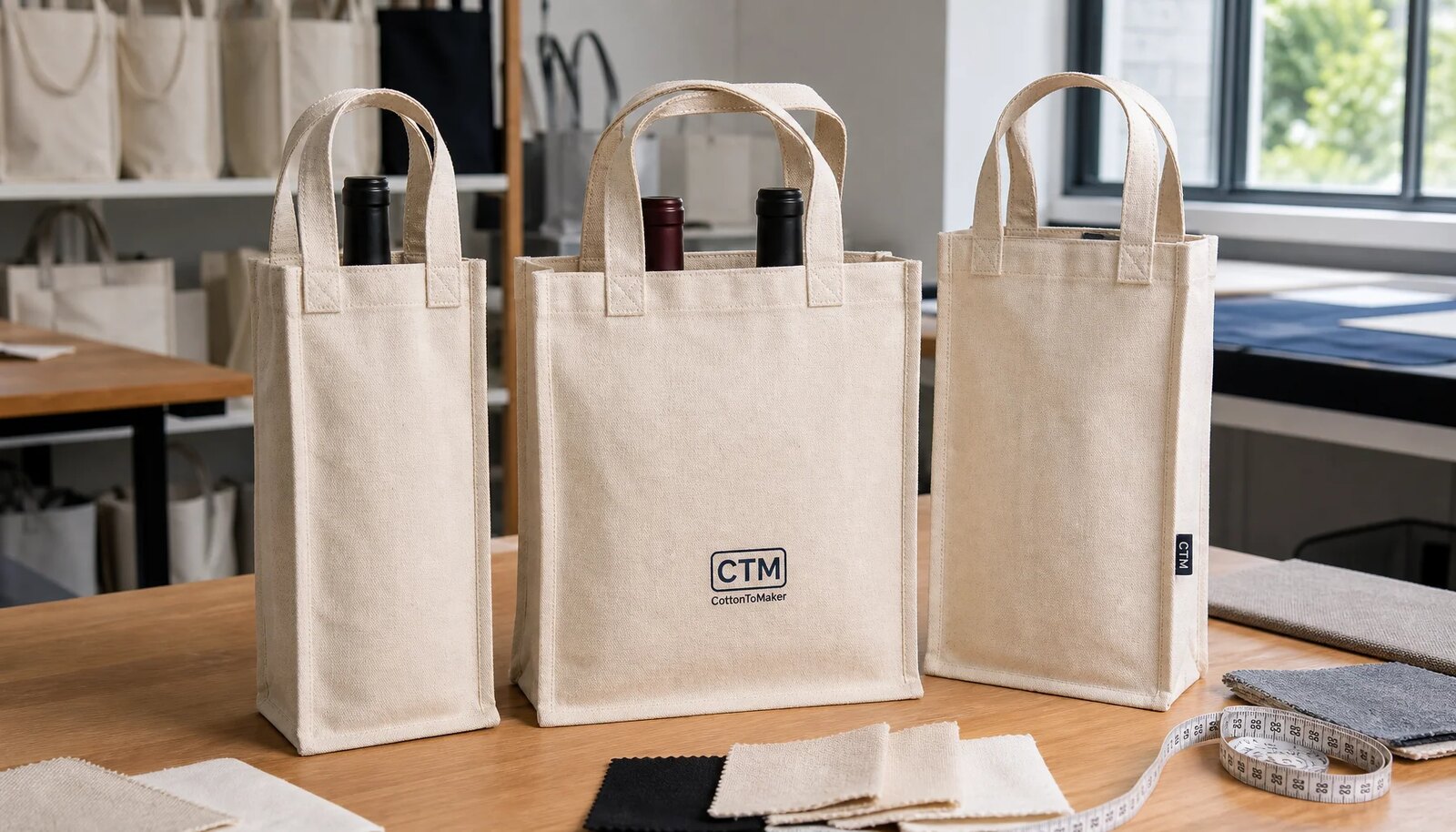
Start With the Real Craft Fair Use Case
A canvas wine carrier for a craft fair is not only a gift bag. It is handled at the booth, loaded with glass, carried through crowds, placed on the ground, packed into cars, and often reused by the buyer. The construction has to tolerate short but rough use. For procurement teams, the main buying problem is avoiding a bag that looks acceptable in a photo but fails when a customer walks away with a bottle inside.
Before comparing quotes, define the use case in physical terms. A standard 750 ml wine bottle usually weighs around 1.2 kg to 1.5 kg with glass, depending on bottle type. Sparkling wine and champagne bottles can be heavier and wider. Two-bottle carriers may carry 2.5 kg to 3.2 kg before adding tissue, tags, or inserts. That load changes the fabric, handle, bottom, and carton packing requirements.
- For tasting room giveaways, prioritize low unit cost, clean print, and acceptable single-bottle strength.
- For paid retail merchandise, prioritize canvas hand-feel, standing shape, seam neatness, and reusable quality.
- For gift sets, prioritize divider stability, boxed bottom strength, and carton packing that protects presentation.
- For outdoor craft fairs, consider darker canvas, stronger print adhesion, and less delicate folding.
Choose Canvas Weight by Strength and Presentation
Most wholesale canvas wine carriers sit between 8 oz and 12 oz fabric. An 8 oz canvas can work for simple single-bottle promotional bags if the handle attachment is strong and the buyer accepts a softer body. For craft fair retail, 10 oz to 12 oz is usually safer because the bag holds shape better, feels more substantial, and gives the print a stronger base. In GSM terms, buyers often see roughly 240 GSM to 340 GSM, but the conversion depends on fabric construction.
Do not approve fabric only from a spreadsheet. Two fabrics with the same GSM can behave differently if one has a loose weave and the other has a tighter weave. A loose weave may feel thick but stretch near the handle seam. A tight weave may print cleaner and resist distortion better. Ask for a cut swatch, a finished sample, and the supplier's tolerance range. If the final order can move plus or minus 5 percent from the approved GSM, write that into the purchase specification.
- 8 oz canvas: suitable for lower-cost single-bottle promotions with moderate handling.
- 10 oz canvas: balanced option for craft fair sales, winery merchandise, and repeat use.
- 12 oz canvas: better body and perceived value, but higher fabric cost and thicker folding.
- Dyed canvas: stronger shelf impact, but requires color approval and possible higher MOQ.
- Natural canvas: common, cost-efficient, but may show slubs, seed marks, and shade variation.
Handle Strength Is the Main Failure Point
When a canvas wine carrier fails, it usually fails at the handle, handle seam, side seam intersection, or bottom corner. The fabric may be strong enough, but the load concentrates at a small stitched area. For craft fairs, this matters because shoppers often swing the bag while walking. A static weight test alone is useful, but it does not show all movement risk.
The RFQ should describe handle material, handle length, attachment location, and reinforcement. Self-fabric handles look consistent with the bag body, while cotton webbing handles can increase strength and reduce sewing bulk. For a more reliable construction, the handle should be inserted deep enough into the body or hem and reinforced with box-X stitching, bar tack, or a long rectangular stitch pattern. A short straight stitch at the top edge is not enough for a loaded glass bottle.
- Single-bottle carrier: set a practical static hanging test around 5 kg for an agreed hold time.
- Two-bottle carrier: set a higher test around 8 kg because load and swing stress increase.
- Handle length: define hand carry or wrist carry; long handles may increase swinging force.
- Stitch density: avoid very long loose stitches that can open under repeated load.
- Inspection focus: review handle corners, skipped stitches, broken thread, and seam slippage.
Bottom and Divider Construction Decide Real Durability
A wine carrier looks simple until the bottle pushes against the base. Flat envelope bottoms are cheaper and pack compactly, but they may not stand well and can crease under a heavy bottle. A boxed bottom or added base panel gives better structure, especially for two-bottle carriers or retail gift packaging. The tradeoff is slightly more sewing time, more fabric consumption, and sometimes larger carton volume.
For two-bottle carriers, the divider is not decorative. It prevents glass contact and helps the bag keep shape. The divider should be fixed securely to the bottom or side panels, not only caught loosely at the top. If the divider floats too much, bottles knock together and the carrier feels unstable. Buyers ordering for craft fairs should test with the actual bottle types, because wider burgundy bottles and sparkling bottles can change the required internal dimensions.
- Flat bottom: lower cost, compact packing, acceptable for simple single-bottle use.
- Boxed bottom: better standing shape and more professional retail presentation.
- Added base panel: useful for premium two-bottle bags but adds material and labor.
- Fixed divider: preferred for glass protection and a more stable carry experience.
- Removable insert: flexible for mixed products but easier to lose and harder to pack consistently.
Print Method Must Match Canvas Texture
Canvas has texture, so the print method must be chosen for the fabric surface rather than only the artwork. Screen printing is usually the most practical method for solid logos, text, and simple brand graphics. It handles bulk production well and keeps unit cost controlled when the artwork has one to three colors. However, heavy ink on coarse canvas can crack or feel stiff if the supplier does not balance ink deposit and curing.
Heat transfer can reproduce gradients and full-color artwork, but it needs careful testing on canvas wine carriers because edges may lift under bending and friction. Embroidery can look premium but may pucker thinner canvas and is rarely the cheapest choice for large flat logos. Woven labels or side labels are useful when the buyer wants a cleaner retail finish with less print risk. The approval sample should use the real production print method, not a digital placeholder.
- Screen print: best for solid logos, repeat bulk orders, and controlled cost.
- Heat transfer: useful for full-color graphics, but test edge adhesion and cracking.
- Embroidery: premium appearance, but check puckering and back-thread neatness.
- Woven label: good for subtle branding and repeat styles across several bag colors.
- Print tolerance: specify position allowance, such as plus or minus 3 mm to 5 mm if acceptable.
Build the RFQ Around Comparable Quote Data
Many quote gaps come from suppliers pricing different products under the same short description. One factory may quote 8 oz natural canvas with simple top stitching, while another quotes 12 oz canvas with reinforced handles and boxed bottom. The lower quote is not necessarily better; it may be a different construction. A useful RFQ forces every supplier to price the same assumptions.
For wholesale canvas wine carriers, the quote should separate fabric, construction, print, packing, sample, and logistics data. Buyers do not need every factory cost line, but they do need enough information to compare landed cost and risk. If a supplier cannot state GSM, carton dimensions, print setup, MOQ by artwork, and sample lead time, the buyer will struggle to control the order after deposit.
- Bag size: include width, height, gusset, bottom type, and target bottle dimensions.
- Fabric: state oz, GSM, color, dye requirement, and accepted tolerance.
- Construction: define handle material, handle length, reinforcement, divider, and bottom.
- Branding: provide artwork size, number of colors, print position, and label requirements.
- Packing: request units per carton, carton size, gross weight, folding method, and inner packing.
- Commercial terms: request MOQ, sample fee, sample lead time, bulk lead time, payment terms, and validity.
Sample Approval Should Test Use, Not Just Appearance
A nice-looking sample is only the starting point. For this product, sample approval should include loaded testing, bottle fit, print rubbing, seam review, and packing review. A procurement team should keep one signed approval sample and record key measurements, fabric weight, print color, and stitching method. That approved sample becomes the reference for production and inspection.
The sample should be made with the actual fabric weight and actual print method whenever possible. If the factory uses substitute fabric for a quick prototype, label it clearly as a construction sample only. Do not approve bulk production from a prototype that has a different GSM, different handle webbing, or different print process. Those changes can affect both cost and durability.
- Load test the sample with the actual bottle weight plus a safety margin.
- Insert and remove the target bottle several times to detect tight openings or seam stress.
- Rub the print with dry white cotton fabric to look for ink transfer or dusting.
- Fold the bag as it will be packed and inspect whether the print cracks or creases badly.
- Measure the sample after loading to see whether the fabric stretches or distorts.
- Photograph handle reinforcement and bottom seams for the inspection file.
MOQ Logic and Cost Drivers Buyers Should Expect
MOQ is not only a factory policy. It is connected to fabric purchasing, dyeing, cutting efficiency, print setup, and line changeover. A natural canvas wine carrier in a common size can often support a lower MOQ than a custom-dyed bag with multiple artwork versions. If the buyer wants three bag colors, two handle colors, and four printed logos, the factory may need to treat these as separate production lots.
Cost drivers are usually fabric weight, bag size, bottom construction, handle method, divider, print colors, packing labor, and inspection requirements. A two-bottle carrier in 12 oz dyed canvas with reinforced divider and two-color screen print will not price like a single-bottle natural canvas promo bag. Buyers can control cost by standardizing fabric and construction while allowing artwork variation only where the MOQ supports it.
- Lower cost path: natural 10 oz canvas, single-bottle format, one-color screen print, flat packing.
- Mid-range path: 10 oz to 12 oz canvas, boxed bottom, reinforced handles, one or two print colors.
- Premium path: dyed canvas, fixed divider, base panel, woven label, individual retail packing.
- MOQ reducer: keep one fabric color and one construction across several brand artworks.
- MOQ increaser: custom dyeing, contrast handles, multiple small artwork splits, and special labels.
Packing Plan Affects Both Freight and Retail Condition
Canvas wine carriers are usually shipped flat, but the fold method matters. If the print is folded sharply through the logo, the bag may arrive with a permanent crease across the brand mark. If the boxed bottom is crushed too tightly, the carrier may not stand properly at the booth. For craft fair orders, the buyer often needs bags ready to unpack quickly, so carton organization is part of the product experience.
Request carton specifications before confirming the order, not after production. Carton quantity affects freight volume, warehouse handling, and final landed cost. A quote with a low unit price but oversized cartons may lose its advantage in shipping. For natural canvas, buyers should also define whether each bag needs an individual polybag, paper band, hangtag, or bulk inner packing. Retail buyers may prefer cleaner presentation, while sustainability-focused brands may reduce plastic.
- Flat bulk pack: efficient for wholesale distribution and lower packing cost.
- Individual polybag: protects against moisture and dirt but adds plastic and labor.
- Paper banding: better retail presentation for some brands but less moisture protection.
- Hangtag packing: useful for paid retail resale, but confirm tag placement and string strength.
- Carton marking: include SKU, artwork version, quantity, gross weight, and purchase order number.
Lead Time and Schedule Risk for Craft Fair Orders
Craft fair orders often have fixed event dates, so schedule risk is more serious than in normal replenishment. The buyer should work backward from the booth setup date, not the production finish date. Time is needed for sample development, artwork approval, bulk fabric preparation, printing, sewing, inspection, packing, export documents, inland transport, international freight, customs, and final distribution.
A realistic RFQ should ask the factory for separate sample lead time and bulk lead time after approval. Do not accept a lead time that starts before artwork, fabric color, and deposit are complete. For seasonal craft fairs, add buffer for re-sampling if the first print color is wrong or the handle construction needs improvement. The cheapest quote can become expensive if it misses the event window.
- Sampling risk: fabric substitution, artwork file problems, print color adjustment, and bottle fit changes.
- Production risk: fabric shortage, dye lot variation, print curing delays, and sewing line capacity.
- Inspection risk: failed load test, poor print placement, carton count mismatch, and repacking delays.
- Logistics risk: carton volume changes, vessel delay, customs hold, and final warehouse congestion.
- Buyer buffer: keep approval deadlines written into the purchase order and track them weekly.
Specification comparison for buyers
| Spec decision | Recommended option | When it fits | Buyer risk to check |
|---|---|---|---|
| Main fabric weight | 10 oz to 12 oz cotton canvas, roughly 270 to 340 GSM depending on weave | Most craft fair wine gifting, bottle shop promotions, and brand merchandise where the bag must stand up better than light cotton | Do not compare GSM only; a loose weave 340 GSM fabric may feel softer but stretch more than a tighter 300 GSM canvas |
| Single or double bottle format | Single bottle for premium gifting; two-bottle carrier with divider for higher retail value | Single bottle works for wineries and tasting room add-ons; two-bottle works for gift sets and holiday craft fair bundles | Two-bottle styles need divider strength and bottom load testing, not only handle testing |
| Handle construction | Self-fabric handles with box-X reinforcement or cotton webbing stitched into side seams | Best for buyers expecting shoppers to carry bottles around a fair for several hours | Short stitch lines or handles sewn only into the hem can tear when the bottle swings |
| Bottom reinforcement | Folded boxed bottom or added canvas base panel for two-bottle carriers | Useful when bottles are glass, heavier than 1.2 kg each, or sold as packaged gift sets | Flat envelope bottoms can crease and push stress into side seams during transport |
| Print method | Screen print for solid logos; heat transfer only for short runs or full-color artwork after wash and rub testing | Screen print is usually the safer bulk choice for craft fair handling and repeated friction | Thick ink layers may crack on coarse canvas; approve ink hand-feel and bend test before bulk |
| MOQ structure | Use one shared fabric color with artwork splits by SKU where possible | Keeps MOQ and dye risk lower when brands need several logo versions for different fair locations | Separate fabric colors, handle colors, and print setups can each trigger their own MOQ |
| Packing method | Flat pack in export cartons with inner polybag or paper banding based on buyer requirement | Flat packing controls freight volume and keeps natural canvas from heavy creasing | Over-compressed cartons can distort boxed bottoms and make bags look tired at retail setup |
| Supplier route | Direct canvas bag factory for repeat bulk orders; trading company only when consolidating mixed gift items | Direct factory gives better control over fabric, seam method, sampling, and QC records | A consolidator may quote fast but must still provide fabric GSM, seam photos, and pre-shipment inspection access |
Buyer checklist before sampling
- Define bottle type and loaded weight: 750 ml wine bottle, champagne bottle, olive oil bottle, or mixed bottle sizes.
- Specify fabric by ounce and GSM, then request a fabric swatch because weave density changes stiffness and strength.
- Choose single-bottle, two-bottle, or divider style before requesting price so factories quote the same construction.
- State handle length, handle material, and reinforcement method, including box-X, bar tack, or extended seam insertion.
- Set a minimum load test, such as 5 kg static hanging for single-bottle bags and 8 kg for two-bottle bags.
- Require seam inspection on handle attachment, bottom corners, divider joins, and side seam intersections.
- Confirm print method, ink type, print position tolerance, and rub resistance expectation before sampling.
- Approve one physical pre-production sample with the real fabric, real handle, real print, and real packing method.
- Request carton dimensions, units per carton, gross weight, and packing photos before comparing landed cost.
- Hold bulk approval until the factory provides inline inspection photos or a final AQL inspection option.
Factory quote questions to send
- What fabric weight in oz and GSM are you quoting, and is it greige, dyed, bleached, or natural canvas?
- Is the canvas pre-shrunk or washed, and what shrinkage range should we expect after light washing?
- How is the handle attached, and can you provide close-up photos of the stitch pattern and reinforcement?
- What loaded weight has this construction passed in your internal test, and for how long was the test held?
- For two-bottle carriers, how is the divider fixed to the bottom and side walls?
- Which print method are you quoting, how many colors are included, and what artwork size affects the print setup cost?
- What is your MOQ for this fabric, this bag size, and each artwork version?
- How many pieces fit per export carton, and what are the estimated carton dimensions and gross weight?
- What sample lead time and bulk lead time apply after artwork approval and deposit?
- Can you support pre-shipment inspection with carton opening, load testing, print rub testing, and photo records?
Quality-control points to confirm
- Fabric GSM tolerance should normally be controlled within an agreed range, such as plus or minus 5 percent from approved sample.
- Loaded handle test should be performed on production pieces, not only on an early development sample.
- Handle stitch length should be consistent, with no skipped stitches, loose thread loops, or broken reinforcement corners.
- Bottom corners should not show seam slippage after loaded hanging, short carry simulation, and carton compression review.
- Print should pass dry rub testing without obvious ink dusting, cracking, or transfer onto adjacent fabric.
- Bag opening should allow the target bottle to insert and remove smoothly without forcing the seam.
- Carton packing should match the approved fold method so the buyer receives the same presentation seen in the sample.
- Final inspection should include random measurement, loaded test, visual defect grading, print placement, and carton count verification.