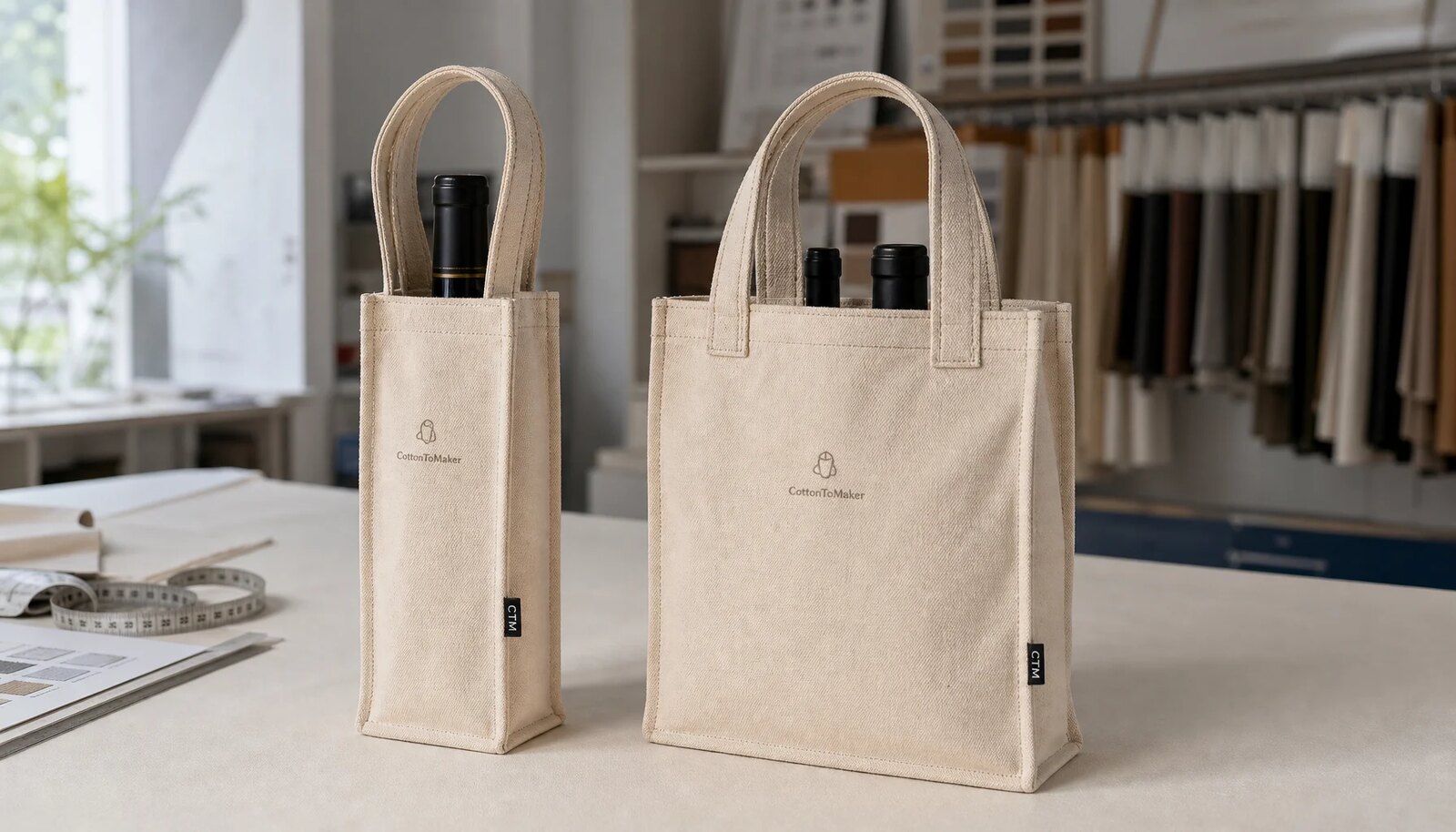
Find the MOQ Constraint Before You Negotiate
MOQ negotiation for wholesale canvas wine carriers for craft fairs is rarely a straight debate over total units. The factory may be willing to sew 500 or 1,000 carriers, yet the price changes quickly when the same order is broken into multiple fabric colors, sizes, print designs, labels, barcodes, and destinations. Procurement teams get better answers when they first identify which part of the order is creating the minimum: fabric purchasing, dyeing, cutting, printing, sewing, packing, or export handling.
Factories prefer production blocks that are easy to repeat. Fabric is bought by roll or batch. Cutting is faster when one pattern runs without interruption. Screen printing needs setup for each screen and each artwork version. Sewing output drops when operators switch from a single-bottle carrier to a two-bottle carrier with a divider. Packing slows again when cartons must be separated by craft fair, tasting room, distributor, store, or barcode. When too many variables arrive at once, the supplier may raise the MOQ simply to protect the hidden handling time.
A strong RFQ shows the whole program, then separates the variables. For example, 1,200 pieces in one natural 12 oz canvas, one approved single-bottle pattern, one handle construction, and six one-color logos of 200 pieces each is not the same as six unrelated 200-piece custom orders. The buyer still needs to pay for extra screens, artwork handling, and carton control, but fabric, cutting, sewing, and final inspection can be planned as one batch.
Avoid opening with only, what is your minimum order? That question gives the supplier room to answer with a safe number. Ask sharper questions: What is the MOQ if we keep one fabric color and one size but split six prints? What changes if we add a two-bottle version? What setup charge would allow 150 pieces per design? Good MOQ negotiation turns a vague refusal into a cost map.
- Separate total MOQ from MOQ per fabric color, carrier size, construction, print design, label version, and destination.
- Keep one base pattern for the first order when possible, then vary only artwork or carton allocation.
- Use stock natural canvas when low MOQ and speed matter more than custom color matching.
- Ask for setup charges as separate line items instead of forcing the supplier to bury them in unit price.
- Limit the first order to fewer SKU splits if launch speed and reliable QC matter more than assortment depth.
- Share reorder timing only when it is based on a real selling season, purchase plan, or buyer forecast.
Specify Canvas in Factory Terms
Canvas is a category, not a specification. A usable quote for canvas wine carriers should state fabric weight, composition, fabric width, color, finishing, shrinkage, and whether the material is stock or made to order. For many craft fair and winery resale programs, 10 oz to 12 oz cotton canvas, roughly 270 to 340 GSM, is a practical starting point. It has enough body to feel giftable while still folding reasonably flat for export cartons.
Lighter fabric can work, but the use case needs to justify it. A 6 oz to 8 oz cotton canvas may be acceptable for a low-cost giveaway sleeve or short-life promotional handout. It may also collapse around the bottle, wrinkle more heavily, and feel too thin for a paid retail add-on. A 10 oz fabric is often a stronger entry point for craft fair sales. A 12 oz fabric usually gives better handfeel for tasting rooms, winery checkout counters, and holiday bundles. Heavier 14 oz to 16 oz canvas can look premium, but it increases material cost, sewing resistance, folded thickness, and freight volume.
Because ounce weight can be quoted differently by market and fabric width, ask for GSM too. The supplier should confirm whether the stated weight is before washing, after finishing, or based on mill nominal data. If the carrier is washed during production, shrinkage must be built into the pattern. If it is not washed, avoid making end-user washability claims unless the finished carrier has been tested.
Natural cotton canvas usually includes seed flecks and small slubs. That can be attractive for craft fairs because it supports a handmade, natural look. Still, acceptance standards need boundaries. Small flecks on side panels may be acceptable. Oil stains, mildew odor, holes, dark slubs across the logo area, and obvious shade mismatch on front panels should not be treated as normal character. Dyed canvas needs a color standard, dye-lot control, and more lead time; custom dyeing can also raise MOQ.
- Request both oz and GSM, plus composition such as 100 percent cotton or cotton-poly blend if applicable.
- Confirm whether fabric is stock, greige, bleached, natural, dyed-to-order, or washed after sewing.
- Use 10 oz to 12 oz for most craft fair resale and winery checkout programs.
- Use 12 oz to 14 oz for premium two-bottle gifts only after checking folding and freight impact.
- Define natural flecks, small slubs, shade variation, stains, holes, and odor before production.
- Include fabric standard, shrinkage range, and approved swatch reference in the purchase order.
Approve Bottle Fit Before Artwork
The carrier has to fit the bottle, not the catalog photo. A standard 750 ml Bordeaux bottle, a wider Burgundy bottle, a champagne bottle, a slim bottle, and a tall olive oil bottle can all create different problems. Bottle diameter controls the bottom gusset and body width. Bottle height affects neck exposure and handle clearance. Filled weight drives seam and handle stress. If the buyer does not name the bottle, the factory may test the pattern with whichever sample happens to be available.
For a single-bottle carrier, the commercial requirements are simple but important. The bottle should slide in without forcing the seams. The bottom should sit reasonably flat on a table. The bag should not twist badly when lifted. The handles should feel comfortable with a filled bottle inside. If the bottle neck should remain visible for retail display or gift presentation, say that in the RFQ. Also state maximum bottle diameter, not just 750 ml capacity, because bottle shapes vary within the same volume.
Two-bottle carriers need more discipline. If the product is sold as a giftable or reusable carrier, the divider is part of the value, not a decorative extra. Without a divider, bottles can knock against each other during normal handling. The divider may be a canvas panel, reinforced panel, or lightly padded separator, but it must be attached well enough to stay in position. A loose hanging divider that folds aside during use defeats the purpose.
Ask for finished dimensions, not cut dimensions. A complete RFQ includes body width, body height, bottom gusset, side gusset if any, handle width, handle drop, divider height, and the seam allowance expectation. For small sewn bags, plus or minus 5 mm on key measurements is often a practical starting point, but it must be agreed with the factory. Canvas thickness, sewing tension, folding, and shrinkage can all change the finished size.
- State maximum bottle diameter, bottle height, shoulder shape, and filled test weight.
- Confirm whether the product is for Bordeaux, Burgundy, champagne, mixed wine bottles, or non-wine bottles.
- Use finished dimensions with tolerances, not only a photo or rough reference size.
- Require fit photos showing the bottle inserted, carrier standing, and handles lifted.
- Define divider material, divider height, attachment points, and padding before quoting two-bottle designs.
- Treat poor bottle fit, seam strain, and unstable standing as major defects when display presentation matters.
Build Handles for Real Weight
A heavier canvas does not automatically make a strong wine carrier. Most failures happen at the handles, side seams, bottom seam, or divider attachment points. A filled 750 ml wine bottle commonly weighs around 1.2 kg to 1.5 kg, depending on glass weight and closure. Two bottles can put roughly 2.5 kg to 3 kg or more into the carrier before any gift packaging is added. The construction must be designed for a customer carrying actual bottles through a fair, tasting room, parking lot, or checkout line.
Handle width matters for both comfort and durability. Narrow handles may reduce material cost, but they concentrate stress at the stitch points and can dig into the hand. Many buyers prefer handles around 25 mm to 38 mm wide for filled bottle carriers, depending on the style and price point. Self-fabric handles give a clean matching look. Cotton webbing can be more consistent and practical for heavier two-bottle designs or repeat-use programs.
Reinforcement should be easy to see and easy to inspect. Box-x stitching, bartacks, and dense rectangular reinforcement are common options at handle attachment points. The chosen method should be shown in the quotation and repeated in the pre-production sample. A single line of stitching may be enough for a lightweight promotional sleeve, but it is usually a weak standard for a reusable carrier sold at craft fairs or winery counters.
Seam allowance and stitch quality need the same attention. Very shallow seam capture can pull out under load, especially on loosely woven canvas. Procurement teams do not always need to dictate thread brand or exact stitches per inch, but they should reject skipped stitches, broken thread, loose tension, open seams, and missing back-tacking in load-bearing areas. For higher-value programs, ask the factory what internal pull or load check they use and write the agreed method into the approval record.
- Ask for handle material, width, handle drop, reinforcement type, and seam capture depth in the quote.
- Use webbing or reinforced self-fabric handles for two-bottle carriers and repeat-use programs.
- Reject skipped stitches, open seams, broken thread, and weak handle attachment as major defects.
- Request a practical load check using the intended filled bottle weight or an agreed weight simulation.
- Check bottom seam and divider attachment, not only the handle area.
- Approve construction from a physical sample before authorizing bulk cutting.
Match Print Method to MOQ
For wholesale canvas wine carriers, screen printing is usually the most efficient option for simple craft fair logos, winery marks, seasonal graphics, and short text. One-color screen print is the easiest to negotiate because it uses fewer screens, has less registration risk, moves faster through approval, and is simpler to inspect. Two-color screen printing can also work well, provided the artwork is realistic for textured fabric.
Print complexity can raise MOQ even when the blank carrier does not change. Every artwork version may need a separate screen, setup time, strike-off, drying space, sorting step, and carton label. If the program includes several craft fair names or winery logos, keep the logo size and print position the same across all versions. A consistent template helps the printer, sewing team, packing team, and inspector avoid mistakes.
Heat transfer can be useful for detailed artwork or smaller splits, but it needs a closer look on canvas. Check edge feel, adhesion, cracking after folding, dry rub behavior, and appearance on natural fabric. Digital printing may reproduce gradients, yet color on unbleached canvas can look muted, and larger panels may need different curing or handling. Embroidery can feel premium for a small emblem, but dense embroidery may pucker lighter canvas and is not a good fit for large front-panel graphics.
Print tolerance should be agreed before bulk production. For small front-panel logos, buyers often use a placement tolerance such as plus or minus 3 mm to 5 mm if the factory accepts that standard. Multi-color registration tolerance depends on artwork, ink, screen setup, and fabric texture. The approval sample should show final fabric, final print method, final logo size, final placement, and final curing behavior. A print on smooth white sample cloth is only a reference, not proof of how the artwork will look on natural 12 oz canvas.
- Use one-color screen print for the lowest-friction MOQ negotiation and easiest inspection.
- Keep logo size and print position consistent across all event or winery versions.
- Avoid tiny reverse text, thin lines, gradients, and metallic effects unless proven by strike-off.
- Approve print color and opacity on the same fabric weight and color as bulk production.
- Define logo placement tolerance, registration tolerance, and acceptable ink coverage before production.
- Check dry rub, folding marks, cracking, and ink transfer after packing simulation.
Lower MOQ by Removing Complexity
The best MOQ negotiation does not ask the factory to absorb losses. It removes the details that make a small order inefficient. Buyers can often improve MOQ by choosing stock natural canvas, using one base size, limiting the first order to one handle construction, keeping one print position, and separating setup charges from unit price. That gives the supplier a cleaner run while still letting the buyer test the market.
Ask the supplier to name the MOQ driver. Fabric may be limited by roll length or mill purchase minimum. Custom dyeing may require a dye-vat minimum and lab dip approval. Printing may require minimum setup time for each screen. Sewing may need enough pieces to justify line setup. Packing may be the bottleneck if the order is split across many events, stores, or distributor destinations. Once the driver is visible, negotiation becomes more practical.
A useful structure is a common blank carrier with split prints inside one production batch. Another option is a higher total quantity with lower per-design quantities if fabric, construction, print size, and packing remain unchanged. For example, a supplier may resist 150 pieces of a fully custom carrier but consider 900 pieces total across six one-color prints using the same blank and carton format. The numbers will vary by supplier, but the logic is consistent.
Be careful with vague future-volume promises. Suppliers hear them often. A more credible statement is specific: initial order for spring craft fair season, sell-through review after the event, possible holiday reorder using the same pattern. If repeat pricing is discussed, document what must remain unchanged for that price to hold: fabric weight, fabric color, artwork size, print method, packing method, Incoterm, and material cost validity.
- Negotiate shared fabric, cutting, and sewing first; negotiate print splits second.
- Ask whether separate setup charges can reduce MOQ per design.
- Use stock fabric and standard thread when timing and MOQ matter.
- Avoid adding custom labels, hangtags, and retail packing to the first test order unless required.
- Reduce destination splits when the supplier is already accepting small print runs.
- Document repeat-price assumptions and quote validity instead of relying on verbal comments.
Ask for Quotes You Can Compare
A low unit price is not helpful if the missing costs appear after approval. A professional quote for canvas wine carriers should separate fabric, sewing, printing, sampling, packing, logistics data, and commercial terms. That structure allows procurement buyers to compare suppliers on the same basis and prevents late surprises such as screen charges, barcode labeling, paper interleaf, mixed-carton fees, or revised carton dimensions.
Fabric pricing should identify GSM, ounce weight, composition, color, stock status, and shrinkage allowance. Sewing pricing should reflect carrier size, gusset, handle type, reinforcement, divider, lining, padding, and seam finishing. Print pricing should state method, number of colors, print area, artwork versions, screens, Pantone matching, strike-off, and any special curing or handling. Packing pricing should state bulk pack, individual bag, paper interleaf, hangtag, barcode, master carton, and carton marks.
Carton data belongs in the quote stage, not only after production. Ask for estimated pieces per carton, carton size, gross weight, net weight, and total carton count. A padded two-bottle carrier may look only slightly more expensive on the unit line but can increase dimensional weight and warehouse space. A flat-packed unlined carrier may produce a lower landed cost even when the sewing price is not the very cheapest.
Commercial terms need the same clarity. Confirm sample cost and refund policy, payment terms, quote validity, production start trigger, Incoterm, inspection responsibility, rework responsibility, and whether the supplier will hold approved samples. Clarify when lead time starts: after deposit, artwork approval, fabric arrival, pre-production sample approval, or packing approval. Seasonal craft fair deadlines leave little room for assumptions.
- Break out fabric, sewing, print, sample, packing, logistics, and commercial terms.
- Quote setup items separately: screens, artwork handling, strike-off, labels, barcodes, and mixed cartons.
- Request carton dimensions, gross weight, net weight, and pieces per carton before supplier comparison.
- Confirm Incoterm, delivery point, quote validity, payment terms, and production start trigger.
- Ask who pays for rework, replacement, or re-inspection if defects exceed the agreed limit.
- Compare landed cost and operational risk, not only first quoted unit price.
Use Samples to Freeze the Standard
Sampling should prevent production arguments, not just produce a polished approval photo. For a new canvas wine carrier program, start with a blank structural sample. Use it to check bottle fit, finished dimensions, handle comfort, gusset shape, divider position, and standing performance. Do not jump directly to printed bulk production if the bottle format or two-bottle divider has not been tested.
Once the structure is approved, request a printed strike-off or pre-production sample using the same fabric weight, fabric color, print method, logo size, and print position intended for bulk. If the supplier prints on a different fabric only to show ink color, treat that sample as a reference. Canvas texture, absorbency, natural flecks, and base shade all affect the final appearance.
The pre-production sample should include final sewing, final handle reinforcement, final divider if any, final label, final print, and proposed packing fold. If the order includes hangtags, barcodes, belly bands, individual polybags, paper interleaf, or retail labels, approve those before mass packing starts. Packing can damage the product if carriers are over-compressed, folded sharply through the logo, or stacked face-to-face before the ink has cured adequately.
Version control matters. The purchase order should identify the approved sample version, approval date, fabric standard, artwork file name, print colors, dimensions, and tolerance notes. Both buyer and supplier should keep a sealed sample or a documented approval record with measurements and photos. If anything changes after approval, treat it as a revision. Informal adjustments are how small problems become bulk disputes.
- Use a blank structural sample to approve fit, dimensions, gusset, handle, divider, and standing behavior.
- Use a print strike-off to approve color, opacity, edge quality, curing, rub behavior, and placement.
- Use a pre-production sample to approve final materials, final sewing, final print, label, and packing.
- Mark sample version, date, artwork file, fabric standard, and approved tolerances.
- Do not authorize bulk cutting until the controlling sample is identified in writing.
- Keep one sealed sample for inspection comparison whenever practical.
Control Packing and SKU Allocation
Packing is part of procurement, not a warehouse afterthought. Canvas wine carriers are often flat packed because it reduces freight volume and storage space. Flat packing works well for craft fair programs, but only when folding direction, carton compression, print protection, and carton labeling are controlled. A sharp fold through a large logo can leave a visible crease. Face-to-face printed panels can scuff or transfer if curing and protection are poor.
The RFQ should state whether the order needs bulk packing, individual polybags, paper interleaf, hangtags, barcodes, or retail-ready packaging. Bulk packing is often enough when wineries, distributors, or event teams unpack goods before selling. Individual polybags improve cleanliness and SKU control but add labor, material, and sometimes volume. Paper interleaf can be a practical middle option when the main concern is protecting printed panels.
Multi-design orders need a packing matrix. The matrix should list SKU, artwork, fabric color, size, quantity per carton, carton count, destination, and any mixed-carton instructions. Mixed cartons can be useful for event kits, but they must be deliberate. Random mixing creates receiving errors, relabeling work, and possible chargebacks. When several craft fair logos look similar, inner bundle labels and carton marks are not optional details.
Ask for carton strength and dimensions early. Confirm pieces per carton, net weight, gross weight, and carton size. Air, express, and some parcel services are sensitive to dimensional weight. Sea freight still depends on cubic meters, stacking strength, and pallet planning. The quote with the lowest unit price may cost more once carton volume, destination sorting, and warehouse handling are included.
- Define folding method, print protection, maximum compression, and carton quantity before production packing.
- Use paper interleaf for large printed areas if abrasion or ink transfer is a risk.
- Use individual polybags only when cleanliness, retail presentation, or barcode control justifies the cost.
- Mark cartons by PO, SKU, artwork, fabric color, size, quantity, and destination.
- Approve mixed-carton rules with a written packing matrix, not verbal instructions.
- Verify carton count, carton marks, and SKU allocation during final inspection.
Plan Lead Time Around Event Dates
Craft fairs, winery pop-ups, and holiday markets have fixed selling windows. If the carriers arrive after the event, the savings from a lower MOQ disappear. Lead time should be counted from the real production start point, not from the first quote email. Artwork correction, sample development, fabric confirmation, deposit payment, printed strike-off approval, and packing approval can all happen before mass production begins.
A realistic schedule separates sample development, material preparation, printing, sewing, packing, inspection, and freight. A supplier may say production takes 20 to 30 days, but buyers should ask what starts that clock. For new designs, include time for at least one sample correction. For repeat orders using the same fabric, construction, and artwork position, development can be shorter, but fabric availability and the print queue still matter.
Material choices affect timing. Stock natural canvas is generally faster than custom dyed canvas because it avoids lab dip approval and dye batch scheduling. One-color screen print is usually faster than multi-color or multi-version artwork. One destination is faster than many event allocations. If the order includes several logos, retail labels, or shipment splits, packing and inspection time need to be included in the plan.
Inspection and freight buffers are part of the schedule. If final inspection finds open seams, wrong artwork, stains, weak handles, or carton mix-ups, the supplier needs time for trimming, replacement, reprinting, or repacking. If the schedule depends on emergency air freight, the added cost may erase the savings gained during MOQ negotiation. Seasonal procurement should protect the event date first, then optimize price.
- Count lead time from deposit, artwork approval, fabric confirmation, sample approval, and packing approval.
- Use stock fabric and simple print when the event date is tight.
- Reserve time for one sample correction and one printed strike-off review on new programs.
- Book inspection early enough to allow rework and re-inspection if needed.
- Avoid year-specific or event-specific print unless freight and inspection buffers are realistic.
- Compare unit price against the cost of missed event sales or emergency air freight.
Specification comparison for buyers
| Spec decision | Recommended option | When it fits | Buyer risk to check |
|---|---|---|---|
| Canvas weight | 10 oz to 12 oz cotton canvas, typically about 270 to 340 GSM, with composition, fabric width, shrinkage, and color lot confirmed | Most paid craft fair add-ons, winery tasting-room carriers, holiday gift bundles, and distributor retail programs | Quotes that say only cotton canvas may hide 6 oz to 8 oz fabric; require GSM, ounce basis, fabric width, composition, shrinkage range, and approved swatch or sample |
| Bottle capacity | Single 750 ml carrier for first launches; two-bottle carrier only after divider, gusset, and load test are approved | Single bottle fits low MOQ event sales and checkout add-ons; two-bottle fits gift packs, club pickup, and corporate bundles | Champagne, Burgundy, Bordeaux, and olive oil bottles differ in diameter and shoulder shape; test with the real bottle or maximum diameter |
| Finished dimensions | Set body width, height, bottom gusset, handle drop, and tolerance before sampling; common tolerance is about plus or minus 5 mm for small sewn panels | Useful when several factories quote the same technical standard and the carrier must fit display shelves or gift cartons | If dimensions are quoted as cut size instead of finished size, shrinkage and seam allowance may reduce usable bottle space |
| Handle construction | Cotton webbing or self-fabric handles with box-x, bartack, or dense rectangular reinforcement at load points | Needed for filled 750 ml bottles, two-bottle formats, and repeated handling at events | Low quotes may use single-line stitching, narrow handles under 25 mm, shallow seam capture, or weak thread; request handle width, stitch type, seam allowance, and pull/load target |
| Print method | One-color or two-color screen print for most MOQ negotiations; digital or heat transfer only when artwork complexity requires it | Best for simple winery logos, craft fair names, seasonal graphics, and repeat programs using one print position | Tiny reverse text, gradients, metallic inks, distressed effects, and wraparound prints need a strike-off on the same canvas used for bulk |
| MOQ structure | Negotiate total batch quantity first, then MOQ per fabric color, size, print design, label version, and destination | Works when one buyer needs several event logos or winery versions using the same blank carrier | Too many splits increase screen charges, sewing changeovers, carton sorting errors, and inspection complexity |
| Divider and lining | Unlined for cost-efficient flat-packed carriers; center divider or light padding only when bottle separation is part of the product value | Unlined carriers suit craft fair resale and low freight volume; divider versions suit two-bottle gift sets | Padding changes folded thickness, carton volume, bottle fit, drying time after print, and landed cost |
| Packing method | Flat packed in export cartons with SKU, artwork, fabric color, bottle capacity, quantity, and destination on carton marks | Best for importers, wineries, distributors, and retailers shipping to multiple fairs or store locations | Over-compression can crease print panels; random mixed cartons create warehouse relabeling and allocation costs |
| Inspection standard | Use AQL-based final inspection or an agreed percentage check with defined critical, major, and minor defects | Appropriate for multi-design orders where wrong artwork, weak seams, or carton mix-ups have high commercial cost | Without defect definitions, factories and buyers may disagree on stains, slubs, print shade, size tolerance, and loose threads |
Buyer checklist before sampling
- Confirm the bottle before negotiating price: standard 750 ml Bordeaux, Burgundy, champagne, slim bottle, olive oil bottle, or mixed assortment; include maximum diameter, total height, shoulder shape, and filled weight for testing.
- Specify canvas by measurable fabric data, not just the word canvas: ounce weight, GSM, fiber composition, weave or yarn description if available, fabric width, stock or custom color, shrinkage range, and approved color standard.
- List finished carrier measurements with tolerance: body width, body height, bottom gusset, side gusset if any, divider height, handle width, handle drop, print position, and distance from logo to seams or bottom fold.
- Separate MOQ by total order, fabric color, size, construction, print design, print color count, woven label version, hangtag or barcode version, and shipping destination.
- Ask the supplier to quote setup charges separately: screens, artwork cleanup, Pantone matching, strike-off, custom label, carton label, mixed carton packing, barcode application, and inspection support.
- Request one blank structural sample for bottle fit and one printed pre-production sample using the same bulk canvas, print method, handle construction, divider, label, and packing fold.
- Set practical tolerances before production: plus or minus 5 mm on key small-bag dimensions, plus or minus 3 mm to 5 mm on logo placement, and an agreed fabric GSM tolerance such as plus or minus 5 percent if the supplier can support it.
- Define seam and handle expectations: reinforced load points, no open seams, no skipped stitches in load-bearing areas, adequate seam allowance, back-tacking at seam ends, and clean thread trimming.
- Confirm print acceptance: approved Pantone or color reference, opacity on natural canvas, edge sharpness, registration tolerance for multi-color artwork, dry rub behavior, and no cracking or transfer after normal folding.
- Require packing data in the quote: pieces per inner bundle or carton, carton size, gross weight, net weight, carton material, inner protection, folding method, polybag or paper interleaf use, barcode label position, and carton mark template.
Factory quote questions to send
- What exact fabric is included in the price: ounce weight, GSM, composition, fabric width, weave description if available, yarn count if available, shrinkage range, color method, and whether the material is stock or made to order?
- Is the quoted fabric weight measured before or after washing/finishing, and what tolerance can you guarantee against the approved sample or fabric test report?
- What is the MOQ for the total order, each fabric color, each carrier size, each construction, each print design, each print color count, each label version, and each shipment destination?
- Can multiple logos share one fabric purchase, one cutting batch, and one sewing batch if the base carrier is identical, and what per-design setup, screen, sorting, and carton-labeling charges apply?
- Which bottle did you use to test the pattern, and can you confirm maximum bottle diameter, maximum bottle height, shoulder shape, and safe filled weight for the quoted construction?
- What are the finished dimensions and tolerances for body width, body height, bottom gusset, divider position, handle width, handle drop, and print placement?
- What handle reinforcement is quoted: handle material, handle width, stitch pattern, bartack or box-x size, thread type if available, seam allowance, and any internal pull or load test method?
- Which print method and ink are included, how many colors are priced, what is the maximum print area, and what are your limitations for small text, halftones, gradients, metallic ink, distressed artwork, and wraparound placement?
- Can you provide a printed strike-off on the same canvas weight and color as bulk production, and will the strike-off show final logo size, print position, opacity, curing, and dry rub behavior?
- What sample stages are included: fabric swatch, blank structural sample, print strike-off, pre-production sample, sealed production sample, and packing sample?
Quality-control points to confirm
- Fabric weight should match the approved standard within the agreed tolerance, commonly around plus or minus 5 percent when the mill can support it; visible panels should be free from oil stains, mildew odor, holes, major weaving faults, and unacceptable shade lot mismatch.
- Finished dimensions should be checked on a statistically meaningful sample or agreed inspection quantity, with critical points including body width, height, bottom gusset, handle drop, handle width, divider position, and bottle clearance.
- Bottle fit should be tested with the intended bottle or maximum specified dummy, including insertion, upright standing, normal carrying, and removal without seam strain or excessive twisting.
- Handle attachment should show consistent reinforcement, adequate seam capture, no skipped stitches, no broken thread, no loose tension, and no tearing or distortion after agreed load simulation.
- Side seams, bottom seams, and divider attachment points should be checked for seam allowance, back-tacking, open seams, needle damage, puckering, and alignment against the sealed sample.
- Print position should match the approved artwork layout within the agreed tolerance, such as plus or minus 3 mm to 5 mm for small front-panel logos if the factory accepts that standard.
- Print quality should be judged on actual bulk canvas for color consistency, opacity, registration, edge sharpness, ink coverage, curing, dry rub behavior, cracking after folding, and transfer marks from packing.
- Divider panels should be centered, straight, and securely attached so two filled bottles remain separated during normal handling.
- Loose threads, untrimmed seams, heavy creases, fabric holes, stains, wrong labels, wrong artwork, and wrong quantities should be classified before inspection as critical, major, or minor defects.
- Carton labels should match SKU, artwork version, fabric color, carrier size, bottle capacity, quantity, purchase order, and destination; mixed cartons should follow a written packing matrix.