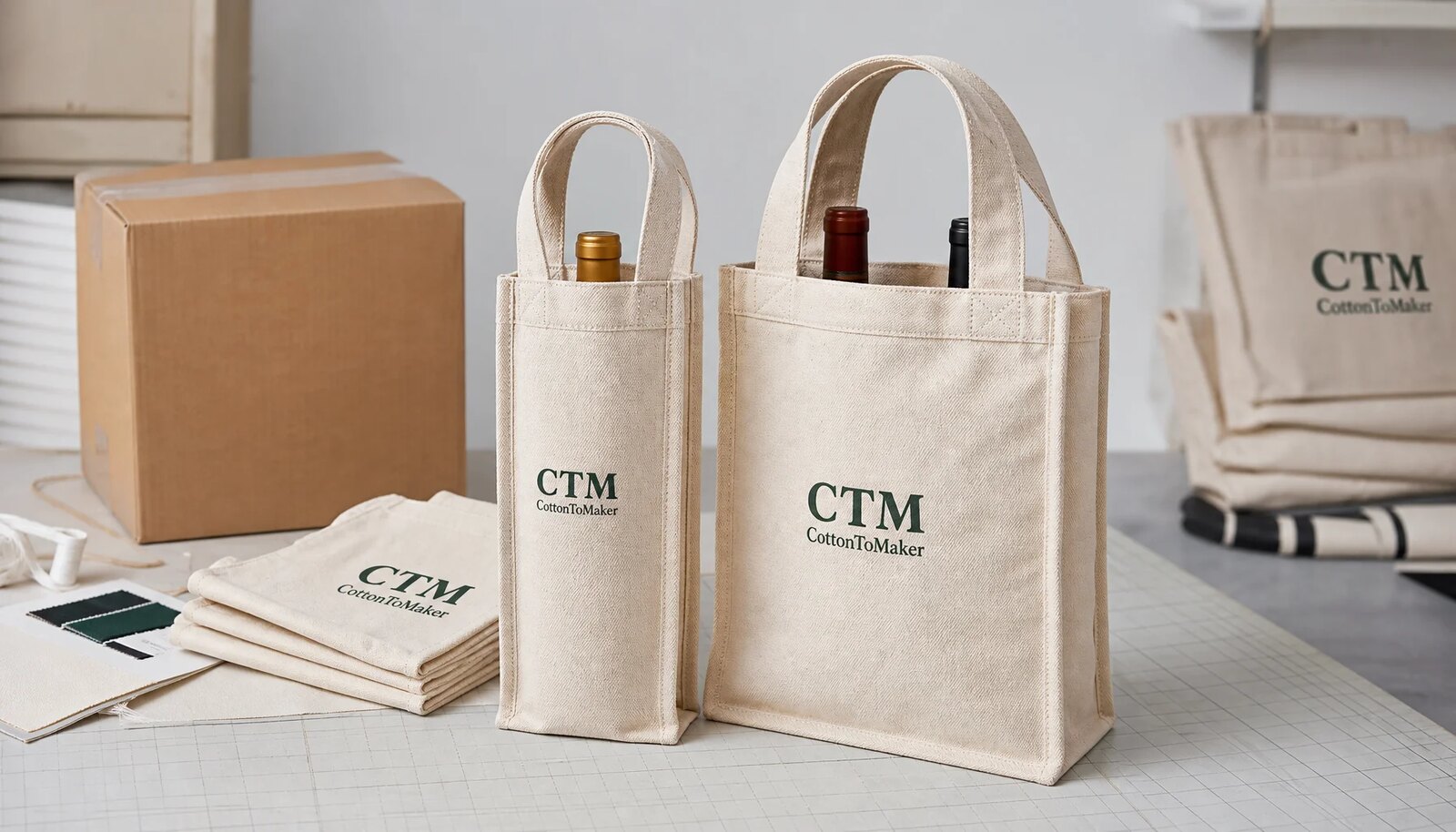
The Buying Problem: Nice Bags That Still Arrive Event-Ready
Wholesale canvas wine carriers for craft fairs look simple until the order has to work in three places: the factory line, the export carton, and the craft fair booth. A carrier that photographs well can still fail if the handle reinforcement is light, the bottle base does not sit flat, or the carton packing crushes the printed front panel. For procurement teams, the real buying problem is not only the unit price. It is getting a repeatable specification that arrives clean, fits the bottles, displays well, and can be unpacked quickly by event staff.
Craft fair distribution adds pressure that normal retail replenishment does not always have. Cartons may be split across venues, handled by temporary staff, opened on folding tables, and repacked after the event. If the bags are over-folded, dirty, mislabeled, or packed in awkward quantities, the buyer pays for the mistake in labor and lost presentation. A proper carton packing plan should be written into the RFQ at the same time as fabric, printing, and MOQ.
- Treat the wine carrier as a loaded product, not a flat promotional bag.
- Specify how bags must arrive: clean, flat, bundled, counted, and easy to allocate by booth.
- Use carton data to compare quotes, because freight cube can cancel a small unit-price saving.
- Approve packing together with the pre-production sample, not after bulk goods are sewn.
Choose Canvas Weight by Load, Shape, and Freight
For canvas wine carriers, fabric weight should be written in both ounces and GSM. Common options are around 8 oz, 10 oz, 12 oz, and 14 oz canvas. For craft fair wine bags, 10 oz to 12 oz is often the practical range. It gives enough body for a bag to stand better on a sales table and enough strength for a 750 ml bottle, without making cartons excessively heavy or creating deep fold marks during packing.
A lower weight such as 8 oz can work for short-run promotional giveaways, but it can feel soft around a glass bottle and may need stronger construction to compensate. A heavier 14 oz canvas gives a more premium handfeel, but it increases fabric cost, needle resistance, sewing time, carton gross weight, and freight cost. If the artwork needs a crisp screen print, a smoother, tighter canvas surface is usually more important than simply choosing the heaviest fabric.
- 8 oz canvas: useful for budget programs, but weaker body and less premium shelf presence.
- 10 oz canvas: common commercial balance for single-bottle carriers and moderate branding.
- 12 oz canvas: stronger feel for retail sale or gift packaging, with higher fabric and freight cost.
- 14 oz canvas: premium and stiff, but carton compression and sewing consistency need more control.
- Natural canvas may show cotton seed flecks; dyed canvas improves color control but adds dye lot risk.
Build the Spec Around the Actual Bottle
Do not let the supplier size the carrier from a generic bottle drawing unless your program truly uses standard Bordeaux-style bottles only. Wine bottle height, shoulder shape, diameter, punt depth, and label position vary. A carrier that fits a slim bottle may be tight around a sparkling bottle. A two-bottle carrier with a shallow divider may allow bottles to knock together during shopper movement.
A practical RFQ should include the largest bottle height and diameter expected, plus the desired visible neck height. For most 750 ml wine carriers, buyers should define the bag body height, bottom width, side gusset, handle length, and divider height if applicable. If the bag will be sold or gifted with the bottle already inserted, the bottom must support the load without sagging into a narrow point.
- Provide bottle diameter, full height, shoulder width, and filled weight.
- State whether the bottle neck should remain visible above the bag opening.
- For two-bottle carriers, require a center divider that reaches high enough to reduce glass contact.
- For display tables, request a flat base or gusset that stands reasonably upright when loaded.
- For premium retail use, consider seam alignment and label-facing orientation, not only dimensions.
Handle and Seam Construction Decide Real Usability
The handle is the failure point buyers notice first because the product carries glass. A wine carrier may pass a visual inspection but fail when a shopper carries it across a crowded fair. Self-fabric handles are common, but they need enough width, folded edge strength, and reinforcement at the connection point. Box-cross stitching or reinforced bar tacks are safer than a short straight stitch at the top edge.
Side seams and bottom seams also matter because the bottle weight sits low and concentrates stress. A single-bottle bag can use a simple gusseted construction if the bottom shape is stable. A two-bottle version needs a stronger divider seam and bottom support because two filled bottles can push the bag out of shape. If a supplier quote is much lower, one of the hidden reductions is often fewer stitches, narrower seam allowance, or less handle reinforcement.
- Handle width should be comfortable enough for loaded carrying, not only decorative.
- Handle insertion should not sit too close to the bag mouth edge.
- Stitch density should be consistent, with no skipped stitches around load points.
- Bottom corners should be secure because bottles shift toward the lowest point.
- Two-bottle dividers should be sewn firmly into the base or side seam, not loosely floating.
Printing Choices for Canvas Wine Carriers
Screen printing is usually the safest choice for simple craft fair branding, winery logos, and event graphics with one to three solid colors. It is economical at wholesale quantity, holds well on canvas when cured correctly, and gives clear quote inputs: artwork size, number of colors, print position, and ink type. The buyer should define whether the print is on one side or both sides because second-side printing affects handling time and drying space.
Heat transfer can be useful for small full-color artwork, but buyers should be careful with textured canvas. If the weave is coarse or the carrier has seam height variation near the print area, transfer adhesion may be inconsistent. Embroidery gives a premium look but is usually less efficient for larger artwork and can distort lighter canvas. For wine carriers that will be folded flat in cartons, print curing and anti-set-off packing are essential.
- Best for simple logos: screen print, one to three spot colors.
- Best for full-color small graphics: heat transfer, only after adhesion testing on the chosen canvas.
- Best for premium small marks: woven side label or embroidery, with placement away from bottle stress points.
- Avoid placing thick ink across heavy fold lines or raised seams.
- Approve print placement with a bottle inserted so the logo does not sit too low or become distorted.
MOQ Logic: Where Small Changes Raise the Quote
MOQ for canvas wine carriers is driven by fabric purchasing, cutting efficiency, print setup, sewing line changeover, and packing labels. A buyer may think of one order as 2,000 pieces, but the factory sees multiple versions if there are two fabric colors, two bag sizes, and four artwork designs. That turns one production run into many smaller runs, each with setup time and higher error risk.
The cleanest wholesale RFQ groups specifications logically. For example, one natural canvas color, one single-bottle size, and two print artworks may be manageable if quantities per artwork are clear. Adding dyed canvas, two-bottle construction, mixed handle colors, and event-specific labels can push the order below efficient factory batch size. Procurement teams should ask for both the ideal MOQ and the surcharge structure for smaller artwork splits.
- MOQ per fabric color: controls fabric dyeing or fabric stock allocation.
- MOQ per print design: controls screen setup, ink mixing, and print line scheduling.
- MOQ per size: controls pattern cutting and sewing line adjustment.
- MOQ per packing style: controls labels, carton marks, and warehouse sorting.
- Best RFQ practice: separate base quantity from optional artwork splits so the supplier can quote both.
Carton Packing Plan for Craft Fair Distribution
A carton packing plan should define how many bags go into each carton, how they are folded, whether inner bundles are used, and how carton marks identify the contents. For canvas wine carriers, flat packing is usually preferred because it saves space and makes counting easier. However, aggressive compression can create hard creases, distort gussets, and transfer ink from one printed face to another if curing or paper separation is poor.
Craft fair buyers often need cartons that can be opened and distributed quickly. If one booth needs 100 bags, cartons of 50 or 100 pieces may be easier than cartons of 180 pieces. If shipping is by courier to multiple venues, carton gross weight may matter more than CBM. If shipping by sea freight to one distribution center, maximizing pieces per carton may be more important, as long as the bags are not crushed.
- Require inner bundles of fixed quantity, such as 10, 20, or 25 pieces, for faster event allocation.
- Use carton marks showing PO number, bag size, artwork code, quantity, carton number, and gross weight.
- Keep printed faces protected by folding direction, tissue, paper, or controlled stacking when needed.
- Avoid mixed artwork inside the same carton unless the packing list and carton marks are very clear.
- Set carton weight limits based on the buyer’s warehouse or courier rules, not only factory convenience.
Sample Approval Should Include Load and Packing
A flat photo sample is not enough for this product. The pre-production sample should be tested with the intended bottle size and weight. The buyer should review how the bottle sits inside the bag, whether the base remains stable, whether the handle length feels practical, and whether the print remains centered when the bag is loaded. For two-bottle carriers, the divider must be judged with two real bottles inserted.
Packing approval is equally important. Before bulk production, the factory should provide a sample carton packing method or at least clear photos showing fold style, bundle quantity, bag direction, printed surface protection, and estimated carton dimensions. If the buyer waits until final inspection to discuss carton loading, there may be no time to redesign folding, adjust carton size, or add protective paper without delaying shipment.
- Approve one sample empty and one sample loaded with the actual bottle type.
- Measure handle length while loaded, because the bag shape changes under weight.
- Rub test the print after curing to catch weak ink adhesion before bulk printing.
- Review folded sample after 24 hours to understand crease behavior.
- Approve carton packing photos before full carton sealing begins.
Lead Time and Schedule Risks Buyers Miss
Lead time is not only sewing time. A realistic schedule includes fabric sourcing, cutting, printing, curing, sewing, trimming, inspection, packing, and booking shipment. For natural stock canvas and simple screen print, sampling can be relatively quick. Dyed canvas, custom labels, multiple artworks, or two-bottle divider construction add steps that can extend the schedule. Event deadlines are unforgiving, so buyers should calculate backward from the booth setup date, not from the purchase order date.
The highest schedule risk usually appears after sample approval. If artwork files are incomplete, print colors are not referenced clearly, or packing rules are changed late, the production line may wait. Another common issue is carton data. Freight forwarders need carton quantity, dimensions, gross weight, and CBM. If this information is estimated too loosely at quote stage, the landed cost and delivery plan can change after goods are finished.
- Allow time for artwork correction before screen making.
- Do not approve bulk cutting until bottle dimensions and bag size are confirmed.
- Lock carton quantity early if event distribution depends on fixed booth allocations.
- Build buffer for print curing, especially with heavy ink coverage.
- Request updated carton data before shipment booking, not after goods reach the warehouse.
How to Compare Quotes Beyond Unit Price
A low unit price can be misleading if the quote uses lighter canvas, weaker handles, fewer cartons, or vague packing. Procurement teams should compare landed cost inputs together: unit price, setup charge, sample fee, MOQ split charge, carton CBM, gross weight, inland handling, and defect risk. For wine carriers, the freight difference between 10 oz and 14 oz canvas can be meaningful because fabric weight affects both product weight and carton compression behavior.
The most useful quote sheet includes assumptions. If a supplier quotes 12 oz canvas, one-color screen print, 100 pieces per carton, and 0.055 CBM per carton, that is a different commercial offer from 10 oz canvas, one-side transfer print, 150 pieces per carton, and unknown gross weight. Buyers should push each supplier to quote the same specification, then request optional pricing for upgrades such as heavier canvas, divider panels, woven labels, or individual polybags.
- Compare fabric weight and construction before comparing unit price.
- Calculate cost per usable delivered bag, not only factory price per piece.
- Include carton cube and gross weight in the quote comparison sheet.
- Separate mandatory spec items from optional retail upgrades.
- Treat missing carton data as a quote risk, not a harmless blank field.
Specification comparison for buyers
| Spec decision | Recommended option | When it fits | Buyer risk to check |
|---|---|---|---|
| Fabric weight | 10 oz to 12 oz cotton canvas, roughly 270-340 GSM | Good balance for craft fair handling, upright display, and reasonable carton weight | Very light canvas collapses around bottles; very heavy canvas increases freight and may wrinkle badly after folding |
| Bottle capacity | Single-bottle carrier for mixed wine sales; two-bottle carrier only when carton load is tested | Single-bottle bags are easier for retail add-on sales and table display | Two-bottle carriers need divider strength and higher handle pull testing because packed load is much heavier |
| Handle construction | Self-fabric handles with box-cross reinforcement or full side seam insertion | Suitable for buyers expecting shoppers to carry glass bottles around a fair venue | Short tack stitches or narrow handles can fail during loaded movement, especially with 750 ml bottles |
| Printing method | Screen print for 1-3 solid colors; heat transfer only for small photographic graphics | Screen print is stable for logos, fair branding, and reorder color matching | Thick ink over seam areas cracks; heat transfer can peel if the canvas surface is uneven |
| Internal protection | Canvas divider or stitched center panel for two-bottle versions | Needed when two glass bottles may knock together in transit or shopper use | Loose dividers shift during packing; weak divider seams create bottle-to-bottle impact risk |
| Carton packing | Flat packed in inner bundles, then export carton with side protection and clear orientation marks | Best for reducing carton volume while keeping print faces clean | Over-compression causes handle creases, ink set-off, and distorted bag bottoms |
| MOQ logic | One fabric color and one print design per MOQ batch | Keeps cutting, printing setup, and packing labels simple for fair programs | Mixing many artwork versions below MOQ raises setup cost and increases carton marking errors |
| Sample approval | Pre-production sample loaded with real bottle weight, then approved carton packing photo | Protects both product performance and final carton cube before bulk sewing starts | Approving only a flat photo sample misses handle strength, divider fit, and carton compression issues |
| Supplier route | Direct factory for custom canvas specs; trading supplier only when consolidating several fair items | Direct factory gives better control over GSM, packing count, and reorders | A consolidator may quote fast but lack control of fabric shrinkage, seam allowance, and final carton loading |
Buyer checklist before sampling
- Define whether the order is single-bottle, two-bottle, or mixed capacity before asking for carton dimensions.
- Specify fabric in oz and GSM, not only as canvas, because quote differences often hide in fabric weight.
- Provide bottle size range, including diameter and height, instead of assuming all 750 ml bottles fit the same carrier.
- State the required carry load test in kilograms and whether the bag must pass with one or two glass bottles.
- Lock artwork size, print position, ink color reference, and whether printing crosses folded or stitched areas.
- Approve one physical sample with a real bottle inserted before approving bulk production.
- Require a carton packing photo showing bundle quantity, bag direction, carton marks, and any polybag use.
- Compare supplier quotes by unit price, carton cube, pieces per carton, gross weight, and setup charges together.
- Set an acceptable defect limit for dirty marks, loose threads, print smears, weak handle stitching, and carton crushing.
- Confirm whether cartons must fit retail backroom handling, pallet limits, or courier weight restrictions for event distribution.
Factory quote questions to send
- What fabric weight in oz and GSM is included in the quoted price, and is it pre-shrunk or regular greige-finished canvas?
- What is the minimum order quantity per bag size, fabric color, and artwork version?
- What bottle dimensions did you use to calculate the carrier size and divider position?
- Which print method is quoted, how many colors are included, and what setup or screen charges apply?
- What handle reinforcement is included, and what loaded pull test standard can your factory perform?
- How many pieces are packed per export carton, and what are the estimated carton dimensions, gross weight, and CBM?
- Will bags be packed flat, folded once, or nested, and how will printed surfaces be protected from ink transfer?
- What is the sample lead time, bulk lead time after approval, and realistic cut-off date for craft fair delivery?
- Can you provide pre-production sample photos, inline inspection photos, and final carton packing photos before shipment?
- What quote data changes if we split the order across two artwork versions or add a two-bottle carrier?
Quality-control points to confirm
- Fabric weight must match the approved specification within the agreed tolerance, normally checked by GSM cutting test or supplier fabric report.
- Bag mouth, height, width, gusset, and divider position must hold the approved sample dimensions within practical sewing tolerance.
- Handles must pass the agreed loaded carry test with real bottle weight and no seam tearing, handle twisting, or broken tack stitches.
- Print color, size, placement, ink coverage, and curing must match the approved sample without smearing, cracking, or set-off.
- Seams around the bottom, side gusset, divider, and handle reinforcement must be secure, balanced, and free of skipped stitches.
- Finished bags must be clean enough for retail event use, with no oil stains, heavy chalk marks, loose threads, or strong odor.
- Carton quantity must match the packing list, with consistent inner bundles and carton marks for size, artwork, and purchase order.
- Cartons must survive normal export handling without over-compression, corner collapse, wet damage, or print transfer between packed bags.