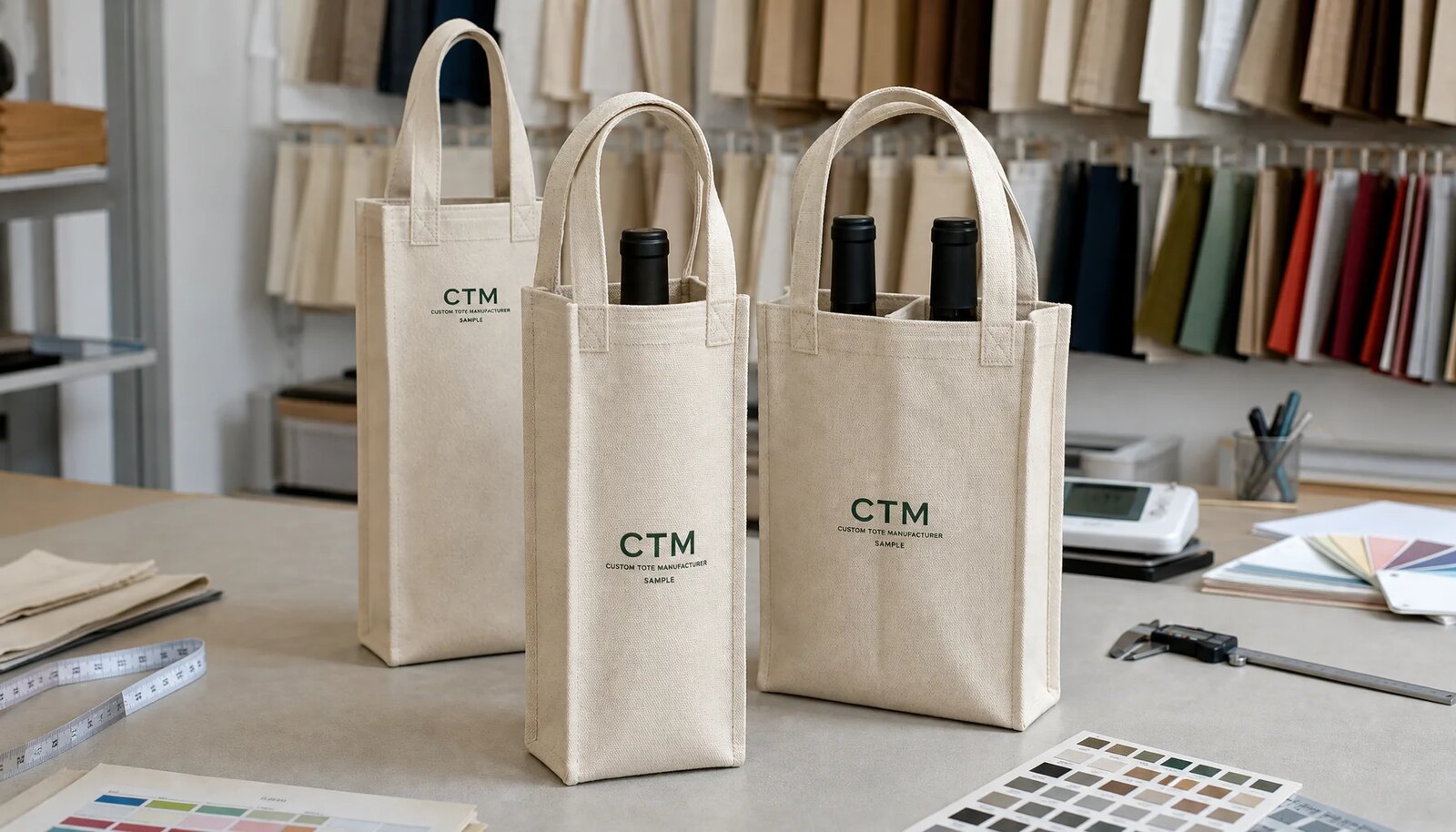
Start With the Event Calendar, Not the Factory Clock
Wholesale canvas wine carriers for craft fairs are deadline products. The order may look simple on paper, but it is usually tied to a fixed booth opening, winery weekend, distributor promotion, or seasonal retail launch. For procurement teams, the distinction that matters is not just production lead time. It is in-hand time, after approvals, packing, freight, customs, and any warehouse handling are finished.
A supplier saying “30 days production” is usually describing time after deposit, final specifications, approved fabric, approved artwork, confirmed packing instructions, and written sample approval. That number does not automatically include quote clarification, sample courier transit, buyer review, public holidays, export booking, customs clearance, or domestic distribution. If the bags are needed for a craft fair, the real deadline is the date they must be ready for use, not the date they leave the factory.
Work backward from the event. If the team needs goods one week before setup, that date becomes the true target. If a central warehouse must receive cartons, count them, relabel them, and forward product to several locations, add that internal handling time before setting the supplier ship date. A late wine carrier order can trigger expensive air freight, unbranded substitutes, rushed inspection, or missed booth merchandising support.
Assign approval owners before sampling starts. Delays often happen when the supplier has completed a step but the buyer has not: marketing has not approved print color, the bottle owner has not tested fit, logistics has not released carton marks, or finance has not processed the deposit. A workable B2B schedule should name who signs off on the blank fit sample, printed pre-production sample, bulk start, inline inspection, final inspection, packing list, and shipment handover.
The cleaner the handoff list, the fewer surprises later. For procurement buyers, that is the entire point: avoid spending the last two weeks solving a problem that should have been defined in the RFQ.
Use a milestone calendar rather than a single delivery promise. It is easier to control risk when each step is visible.
The supplier should know which milestone is allowed to move, and which one is not. Craft fair dates are usually the latter.
- Set the required in-hand date separately from the event date and supplier ex-factory date.
- Add internal time for warehouse receiving, carton counting, relabeling, store allocation, or regional forwarding.
- Treat artwork review, sample transit, buyer correction, and packing confirmation as real calendar days.
- Add more buffer for dyed fabric, multiple logos, two-bottle dividers, retail labels, or mixed cartons.
- Include milestone dates in the PO so both buyer and supplier share the same schedule assumptions.
- Escalate late approvals quickly because factories cannot recover buyer-side delays without cost, overtime, or quality risk.
Turn Bottle Data Into a Fit Specification
A strong RFQ starts with the bottle, not a generic “wine bag” description. Standard 750 ml Bordeaux bottles, Burgundy bottles, sparkling bottles, cider bottles, olive oil bottles, spirits bottles, and tall specialty sauce bottles can differ materially in height, maximum diameter, shoulder slope, base shape, and filled weight. If the program includes several bottle types, list each one and show which carrier style must fit it. For gift sets, identify whether both chambers carry the same bottle or a bottle plus accessory.
Fit controls booth speed and customer confidence. If the carrier is too tight, checkout staff lose time inserting bottles and may damage printed panels by forcing the bottle. If the carrier is too loose, the bottle shifts, the front logo wrinkles, and the bag looks less structured. In two-bottle carriers, excess movement can allow glass-to-glass contact; insufficient clearance can pull the side seams inward. The pattern should be judged by loaded use, not only by flat dimensions on a table.
Finished dimensions should be quoted and measured at specific points. Buyers should request top opening width, body height, bottom gusset width, divider width, divider height if relevant, handle width, and handle drop. The supplier should also confirm practical insertion clearance. A tolerance such as ±0.5 cm on key sewn dimensions is often realistic for simple canvas construction, but tolerances must be agreed around the bottle pattern and fit. The critical test is whether approved bottles insert, stand, and carry correctly.
The practical RFQ is specific enough that two suppliers would cut the same pattern, not merely quote the same category name. That level of definition saves time in sampling and keeps procurement conversations focused on variance that matters.
If your bottle mix includes different heights or shoulder shapes, say that early. The wrong assumption can make a sample technically correct and operationally useless.
Do not let a catalog-style bag description replace a fit spec. For this product, dimensions are the product.
- Provide bottle height, maximum diameter, base diameter, shoulder profile, filled weight, and photos with a ruler.
- State whether the neck should be exposed, partly covered, or fully contained after the bottle is inserted.
- Quote 1-bottle, 2-bottle, 4-bottle, and mixed gift-set carriers as separate SKUs.
- Define bottom construction as flat sleeve, boxed bottom, or gusseted bottom based on bottle diameter and stability need.
- For multi-bottle styles, specify sewn-in divider, padded divider, removable divider, or no divider.
- Ask the supplier to confirm fit assumptions in writing before sample making and bulk cutting.
Choose Canvas Weight With GSM and Tolerance
Canvas terminology can be imprecise unless the RFQ includes both ounce weight and GSM. For most reusable craft fair wine carriers, 10 oz to 12 oz cotton canvas, approximately 340-410 GSM, is a practical commercial range. A 10 oz canvas often balances structure, cost, printability, and carton efficiency for single-bottle carriers. A 12 oz canvas is more appropriate for two-bottle carriers, premium gift programs, or bags intended for repeated reuse. Very light 6 oz or 8 oz canvas may work for simple promotional sleeves, but it can feel weak around filled glass bottles and may collapse when displayed upright.
Heavier fabric is not automatically better. Canvas above 14 oz can create bulky folded seams, harder bottom corners, slower sewing, more needle wear, larger cartons, and higher freight weight. It can also make printing less clean if the weave is coarse or if seams prevent the print panel from lying flat. Procurement teams should ask suppliers to state the target GSM and tolerance, not only a fabric nickname. If the supplier cannot quote a controlled tolerance, the buyer should at least approve a bulk swatch before printed sample production.
Finishing status changes the behavior of the bag. Natural unwashed canvas, bleached canvas, dyed canvas, and washed canvas can print and shrink differently. Natural cotton may show seed specks and slubs; those are normal material characteristics if accepted in advance, but they become disputes if the buyer expected a perfectly clean surface. Dyed canvas adds shade approval and may add lead time. If brand color is strict, approve fabric shade before logo color because ink appearance changes against natural, bleached, or dyed grounds.
The point is not to over-specify the fabric. The point is to remove ambiguity. A clear weight, finish, and tolerance spec gives the supplier a target that can be measured and repeated.
For procurement, repeatability is worth more than a brochure description. Buyers need a lot they can buy again next season.
If the carrier is being sold at craft fairs alongside wine or food, the fabric should feel intentional in hand. The wrong weight or finish shows up fast at retail.
Ask for a swatch, not just a quote. Fabric is where a lot of hidden disagreement starts.
- Use 10 oz canvas for balanced cost and structure in many standard single-bottle programs.
- Use 12 oz canvas for stronger stand-up shape, two-bottle use, or premium reusable positioning.
- Request ounce weight, GSM, composition, weave, finishing status, and fabric tolerance in the quote.
- Approve bulk fabric swatches before locking print color, especially for natural or dyed canvas.
- Define whether seed specks, slubs, shade movement, or washing marks are acceptable.
- Set tolerance around fit-critical dimensions rather than demanding unrealistic cosmetic perfection.
Engineer Handles, Bottoms, and Dividers for Loaded Use
The most important failure point in a canvas wine carrier is usually not the center panel; it is the handle attachment, bottom corner, or divider seam. A filled 750 ml glass wine bottle commonly weighs roughly 1.2-1.6 kg depending on glass weight and contents. A two-bottle carrier can therefore carry around 2.4-3.2 kg before accessories, inserts, or shopper movement are considered. Buyers should not approve handle construction from photos alone. The RFQ should state handle material, width, drop, attachment position, reinforcement, and the load test method.
Self-fabric handles give a coordinated natural look, but they need folded layers and secure stitching to avoid stretching. Cotton webbing handles are often more consistent for heavier loads and can be more comfortable in hand. Common reinforcement methods include box-X stitching, bar-tacks, or extended stitch lines into reinforced panels. A practical handle width is often around 2.5-3.8 cm, but the exact choice depends on appearance, cost, and loaded comfort. Handle drop should allow easy carrying without making the bottle swing excessively. If the carrier is meant for long walks between booths or outdoor fairgrounds, that detail matters more than buyers often expect.
Divider and bottom engineering matter for two-bottle and four-bottle styles. A sewn-in canvas divider keeps bottles separated, but it must be wide enough for insertion and strong enough not to tear under side pressure. A padded divider may reduce contact risk for higher-value bottles, but it adds cost, bulk, sewing minutes, and carton volume. Boxed or gusseted bottoms help the carrier stand upright, but the bottom must match the maximum bottle diameter rather than a generic flat measurement. If the carrier tips on a display table, that is not a minor cosmetic issue; it is a merchandising problem.
The RFQ should also say what is not acceptable. If glass-to-glass contact is forbidden, write that down. If the bottom must stand when loaded, say so. If the handle must survive a given weight for a given duration, define that test. QC becomes much easier when the engineering target is plain.
A bag that looks fine empty can fail the moment it is loaded. The wrong seam placement, weak thread, or narrow divider shows up under stress, not on a sample shelf.
This is why procurement has to care about construction, not just appearance. The structure is part of the product.
Ask the factory to describe the load path in simple terms. If they cannot explain how weight moves through the handles, seams, and bottom, they probably have not controlled it tightly enough.
- Specify handle material, width, drop, attachment location, stitch pattern, and reinforcement method.
- Require loaded testing with the expected bottle weight plus an agreed safety margin.
- Inspect box-X or bar-tack placement at every handle attachment point during QC.
- Define divider material, height, width, attachment points, and chamber clearance for each bottle count.
- Check that divider tension does not twist the logo panel or narrow the opening.
- Classify failed handle attachment, failed bottom seam, and failed divider seam as critical defects.
Select the Logo Method by Artwork, Quantity, and Risk
Most wholesale canvas wine carriers for craft fairs use screen printing because it handles bold winery marks, event logos, retailer names, and simple seasonal graphics well. One-color and two-color prints are usually the most efficient for cost and schedule. Three colors can still be practical, but every color adds screens, registration work, setup time, and inspection risk. Large solid ink areas should be tested for opacity, hand feel, and curing on the actual canvas texture before bulk production.
Heat transfer is useful when artwork includes small details, gradients, photographs, or many colors, but it must be tested on the selected fabric. Transfers can feel stiff on heavy cotton canvas, and edges may lift if adhesion is weak or if the bag is folded tightly in cartons. The fold path should not run through a thick transfer edge. If the carrier is expected to be reused, the buyer should ask for rub checks and handling tests rather than judging only a fresh sample photo. The sample should be handled as a real product, not a display piece.
Embroidery and woven labels are options for premium or multi-logo programs. Embroidery can look high value, but dense stitches may pucker lighter canvas and may require backing that affects the inside appearance. Woven labels can simplify programs with many winery logos sharing one carrier body, but label development has its own MOQ, sampling, and lead time. Logo placement should avoid heavy seams, bottom folds, boxed corners, and handle reinforcement areas because uneven surfaces distort decoration. The best print area is usually the flattest, least stressed panel, not the largest available space.
When comparing suppliers, ask them to show the exact commercial assumption behind the decoration. That means print size, number of colors, setup costs, and whether the first sample includes correction rounds. A cheap quote that does not cover the actual artwork method is not cheap; it is incomplete.
For craft fair buyers, the right method depends on what will happen after purchase. If the bags will be carried, folded, refolded, and reused, decoration durability matters as much as the first impression.
Choose the method that matches the use case. A method that looks right in a photo but fails in the field is the wrong method.
If the logo is the thing that sells the bag, treat that part of the spec like a controlled process, not a design afterthought.
- Use screen print for 1-3 solid colors, simple logos, short text, and cost-sensitive event programs.
- Use heat transfer only after checking adhesion, edge lift, stiffness, folding, and rub resistance on actual canvas.
- Use embroidery for premium positioning after reviewing stitch density, backing, and puckering.
- Use woven labels when many logo versions share the same blank carrier body.
- Provide vector artwork, Pantone references, print size, position, orientation, and version code.
- Confirm setup costs and revised sample costs before comparing suppliers.
Understand MOQ, Price Breaks, and Hidden Cost Drivers
MOQ is not only a total number of pieces. For canvas wine carriers, factory efficiency depends on style, fabric color, canvas weight, cutting pattern, handle type, divider design, logo method, artwork version, print color count, and packing method. A 3,000-piece order may be efficient as one natural canvas, one-bottle style with one screen print. The same 3,000 pieces can become a fragmented order if split across three carrier styles, five wineries, four fabric colors, and several packing rules.
Cost comparison should normalize inclusions and exclusions. Canvas upgrade, dyed fabric, reinforced handles, sewn dividers, padded dividers, second-side print, large print area, heat transfers, embroidery, woven labels, individual polybags, hangtags, barcodes, mixed cartons, and palletization all affect pricing. A low unit price may exclude screen charges, digitizing, revised samples, sample courier, export cartons, carton marks, barcode labels, or final inspection support. Buyers should ask for line-item clarity before negotiating.
Price breaks should reflect real demand. Asking for 20,000-piece pricing when the confirmed craft fair need is 1,200 pieces can create an unrealistic benchmark and slow decision-making. Better RFQs request realistic breaks such as 500, 1,000, 2,000, and 5,000 pieces by style and artwork. If wineries or regional sales teams are consolidating orders, show the exact split and ask whether using one blank body with different one-color prints or woven labels improves efficiency.
This is where procurement discipline pays off. The cheapest quote is not the one with the lowest sticker price; it is the one that avoids surprise add-ons after approval.
When suppliers quote different assumptions, they are not truly competing on the same job. Align the spec first, then compare prices.
The goal is not to over-negotiate every line. The goal is to know what the line means before you sign it.
If the supplier cannot explain the cost drivers, the quote is not ready for a PO.
- Ask whether MOQ applies by total order, style, fabric color, artwork, print color, label, or packing setup.
- Request price breaks at realistic quantities by SKU, such as 500, 1,000, 2,000, and 5,000 pieces.
- List every artwork version and ask how it changes setup charge, MOQ, and sample cost.
- Separate costs for canvas weight, dyed fabric, handles, dividers, labels, print positions, and packing.
- Request carton size and gross weight because freight can materially change landed cost.
- Confirm quote validity, payment terms, excluded charges, and production start conditions.
Use a Two-Step Sampling Path Before Bulk Cutting
A blank fit sample should come before the printed pre-production sample when the order includes a new pattern, divider, bottom construction, custom handle, or nonstandard bottle. The blank sample proves the body dimensions, insertion clearance, bottom stability, handle drop, and loaded balance without mixing those decisions with artwork debates. Test it with the buyer’s actual bottle whenever possible. If the bottle cannot be sent, approve a dummy bottle with matching height, maximum diameter, and filled weight.
The printed pre-production sample then confirms the commercial standard. It should use approved bulk or representative fabric, final handle construction, final divider, approved logo method, correct artwork version, logo size, print position, print color, and packing fold. A digital mockup cannot prove how ink sits on cotton texture, whether a transfer edge survives folding, whether embroidery puckers the panel, or whether the print looks centered after a bottle is inserted.
Sample approval should be documented like a specification, not handled as a casual email. The approval file should record measurements, fabric weight, artwork version, Pantone reference, print method, stitch details, divider details, and approved deviations. Photos should show front, back, side, bottom, inside divider, handle attachment, loaded bottle view, and close-up decoration. Keep one golden sample with the factory and one with the buyer or third-party inspector so final QC is based on a shared physical standard.
This is where many late-stage disputes are prevented. Most disagreements about “fit” or “quality” are really disagreements about what was approved. Put the approval in writing, and make the sample traceable to the PO.
The sample process should feel a little slower than a rush buyer wants. That delay is cheaper than cutting the wrong bulk run.
If the sample cannot answer the question you will later inspect, it is not the right sample.
A good sample path reduces both quality risk and schedule risk at the same time.
- Approve blank fit before printed sample for new bottle sizes, dividers, boxed bottoms, or first supplier orders.
- Test the blank sample with actual bottles or approved dummy bottles matching height, diameter, and weight.
- Measure body height, top width, bottom gusset, divider width, handle width, handle drop, and print placement.
- Record artwork version, Pantone reference, fabric weight, sample date, and approved tolerance.
- Do not release bulk cutting until fit, fabric, handle, divider, and logo method are approved.
- Use matched golden samples for factory production control and buyer-side inspection.
Map Lead Time From RFQ to In-Hand Delivery
A realistic lead time plan includes every handoff, not only sewing days. RFQ clarification may take two to five business days when bottle dimensions, artwork, or packing rules need correction. Stock natural canvas may be sourced quickly, while dyed fabric, unusual GSM, washed finishing, or special webbing can add time. A blank fit sample for a new pattern commonly needs about five to ten days after specs are confirmed. A printed pre-production sample can add another five to ten days after final artwork because screens, ink matching, transfers, embroidery, or labels require setup.
Bulk production for wholesale canvas wine carriers often falls in the 20-40 day range, depending on quantity, style complexity, supplier capacity, fabric status, logo method, and packing. A simple one-color single-bottle carrier in stock natural canvas is very different from a dyed two-bottle carrier with sewn divider, multiple artwork versions, hangtags, and mixed cartons. The supplier should clearly state what event starts the clock: deposit received, material confirmed, printed sample approved, or PO released. Without that, “lead time” is just a vague estimate.
Delivery time is a separate planning line. Export booking, vessel schedule, courier cutoff, customs clearance, customs exams, destination trucking, warehouse receiving, and regional redistribution can all affect the in-hand date. For fixed craft fair programs, add a schedule buffer after the supplier’s production date. A 7-14 day protection buffer is often prudent for straightforward programs, while holiday periods, peak shipping seasons, custom dyeing, and multiple destinations may require more. That buffer is not padding; it is operational insurance.
The result is a schedule buyers can actually defend internally. It lets procurement answer the question that matters: when, exactly, will the product be ready for the event team to use?
If your timeline is tight, the smartest move is usually not to compress every stage. It is to reduce uncertainty early, before the order is in motion.
Production can be accelerated. Missing information cannot be conjured later.
Planning lead time well is often the difference between a controlled import and a panic purchase.
- Allow 2-5 business days for RFQ clarification and quote comparison when specifications are mostly complete.
- Allow 5-10 days for blank sampling when a new pattern, divider, or handle design is needed.
- Allow 5-10 days for printed pre-production sample approval after final artwork is supplied.
- Allow 20-40 days for bulk production depending on quantity, fabric, print complexity, and packing.
- Add buyer approval time, revised sample time, carton mark correction time, and holiday closures to the calendar.
- Plan freight, customs, warehouse receiving, and regional distribution separately from factory production.
Write Packing Rules for Craft Fair Distribution
Packing should match how the goods move after import, not only how the factory prefers to pack. A distributor may need one SKU and one artwork per carton so warehouse teams can pick quickly. A retailer may require barcodes, hangtags, warning labels, purchase order references, and carton marks. A winery group may request mixed cartons by event location, but mixed cartons increase mis-pick risk unless the packing list, carton labels, and inner bundles are very clear.
Flat packing saves carton volume, but the fold plan must be tested. A hard crease through a screen print or transfer edge can make the bag look damaged before it reaches the booth. Thick canvas, boxed bottoms, and sewn dividers can also distort if cartons are overpacked. Buyers should set maximum carton gross weight and practical carton dimensions so cartons remain manageable for warehouse and event staff. The supplier should provide estimated pieces per carton, carton dimensions, and gross weight before freight booking.
Individual polybags are a procurement decision, not an automatic requirement. They protect against moisture, dust, and carton rub, but they add plastic, cost, labor, and unpacking time at the event. If retail customers require polybags, barcode stickers, or hangtags, include them in the quote and lead time. If bulk packing is preferred for sustainability or booth speed, protect printed panels from abrasion and verify carton cleanliness.
Packing instructions should also define what not to mix. Mixed cartons are not inherently wrong, but they should be deliberate. If a warehouse team will break down cartons and repack them later, that process needs labeling discipline, or errors will surface at the worst time, often after the shipment is already distributed.
For event products, packing is not a back-office detail. It affects speed, damage, and whether the product actually reaches the booth in saleable condition.
The simplest packing plan is often the best. Complexity should be used only when it clearly reduces warehouse work or improves retail handling.
If a carton cannot be opened, counted, and moved without confusion, the packing spec is not finished.
- Pack one style and one artwork per carton unless mixed event cartons are specifically approved.
- Use carton marks with PO number, SKU, artwork code, style, quantity, carton number, gross weight, and destination.
- Set maximum carton gross weight and carton dimensions before freight planning.
- Confirm individual polybags, hangtags, barcodes, retail labels, warning labels, and palletization requirements.
- Avoid fold lines through printed logos, transfer edges, embroidery, or woven label corners.
- Verify carton count, SKU separation, mixed-carton accuracy, and label placement during final inspection.
Set QC Thresholds That Protect the Event
QC for canvas wine carriers should prioritize function first. Cosmetic issues matter, but the most serious event risks are failed handles, unusable bottle fit, wrong artwork, uncured print, incorrect carton labels, and shortage by SKU. Inspection criteria should classify defects by business impact. A loose thread may be minor if easily trimmed; a handle that opens during loaded testing should be critical. Wrong logo version, wrong carton mark, or a carrier that cannot accept the approved bottle should also be critical.
Measurement inspection should use random bulk units and a clear measurement method. Key dimensions include body height, top width, bottom gusset, divider width, handle width, handle drop, and print position. The approved tolerance should be practical for sewn cotton goods and tied to fit performance. If a bag is within a flat dimension tolerance but the actual bottle cannot be inserted smoothly or stand securely, it fails the intended use. Inspectors should load actual bottles or approved dummy bottles and check insertion, stability, divider separation, and carry comfort.
Decoration and packing QC should reference the approved golden sample. Natural cotton canvas may show seed specks, slubs, and minor shade variation, so the buyer should define acceptable fabric character before production. Print checks should cover color, opacity, registration, position, curing, dry rub, damp rub if relevant, and transfer edge adhesion where used. Packing checks should confirm carton quantity, carton marks, barcode placement, artwork code, gross weight, and whether folded bags protect the logo panel. If the bag is meant to be sold at a craft fair, it must arrive looking retail-ready, not merely factory-complete.
There is a practical benefit to using clear defect classes. It shortens inspection decisions and makes supplier conversations less circular. The team does not need to argue over every flaw if the critical failures are already defined.
For this product, QC is not only about rejecting defects. It is also about proving the shipment can perform at the event without extra handling, relabeling, or rework.
If the carrier fails the loaded test, the inspection should stop there. The rest of the report will not matter.
Quality control is the last chance to catch a manufacturing problem before it becomes a customer problem.
- Measure top width, body height, gusset, divider, handle width, handle drop, and print position on random units.
- Use actual bottles or approved dummy bottles for insertion, stability, divider, and loaded carry tests.
- Reject missed handle reinforcement, skipped stress-point stitches, opened seams, and unstable bottom construction.
- Check screen print or transfer curing with dry rub and, when relevant, damp rub or tape-pull checks.
- Classify wrong artwork, failed handle test, unusable bottle fit, major seam failure, and wrong carton label as critical defects.
- Reference golden sample, PO, artwork version, packing spec, defect classes, and AQL level in the inspection report.
Specification comparison for buyers
| Spec decision | Recommended B2B specification | When it fits | Buyer risk to control |
|---|---|---|---|
| Canvas weight | 10 oz to 12 oz cotton canvas, approximately 340-410 GSM, with a quoted tolerance such as ±5% if the supplier can support it | Most craft fair wine, cider, olive oil, sauce, and specialty bottle programs that need reusable structure without excessive carton weight | Below 8 oz often collapses around glass bottles; above 14 oz can create bulky seams, higher freight weight, slower sewing, and less even print results |
| Fabric status | Declare natural, bleached, dyed, washed, or unwashed canvas; approve a bulk swatch before printing | Brand-color programs, natural cotton positioning, retailer compliance, and repeat seasonal orders | Shrinkage, shade variation, cotton seed specks, dye lot movement, and print color shift can change approval results |
| Bottle format | Quote separate SKUs for 1-bottle, 2-bottle, 4-bottle, and mixed gift-set carriers | Wineries, distributors, gift packers, craft fair groups, and retailers combining several bottle sizes | One flat pattern rarely fits Bordeaux, Burgundy, sparkling, cider, and olive oil bottles equally well |
| Finished dimensions | State top width, body height, bottom gusset, divider width, handle width, handle drop, and tolerance on fit-critical dimensions | Orders where bottle insertion speed, neck exposure, and booth presentation matter | Loose tolerances can cause tight insertion, unstable standing, distorted logo panels, or glass-to-glass contact |
| Bottom construction | Boxed or gusseted bottom sized to bottle diameter, with reinforced bottom seams where filled bottles are carried | Reusable carriers that must stand upright on craft fair tables and hold filled bottles securely | A narrow gusset slows packing; weak bottom corners strain when loaded; oversize bottoms make the carrier look sloppy |
| Handle construction | Cotton webbing or folded self-fabric handles, typically 2.5-3.8 cm wide, with box-X, bar-tack, or equivalent reinforcement | Programs where shoppers carry filled bottles for several hours or across outdoor venues | Narrow handles, missed reinforcement, short seam allowance, skipped stitches, and weak thread can lead to handle failure |
| Divider design | Sewn-in canvas divider for two-bottle carriers; padded divider only when impact protection justifies added cost and bulk | Two-bottle wine, cider, olive oil, sauce, or gift-set carriers sold at booth checkout | Loose dividers allow bottle contact; tight dividers distort panels and slow insertion during busy selling periods |
| Logo method | Screen print for 1-3 solid colors; heat transfer for detail; embroidery or woven label for premium or multi-logo programs | Event marks, winery logos, retailer branding, seasonal graphics, and private-label programs | Ink curing, registration, transfer edge adhesion, embroidery puckering, and setup charges must be verified before PO |
| MOQ basis | MOQ split by style, fabric color, artwork, print color count, label type, and packing configuration | Importers consolidating demand across locations, wineries, or seasonal craft fair programs | A 3,000-piece order may price differently if split into 15 logos of 200 pieces each |
Buyer checklist before sampling
- Confirm event date, required in-hand date, receiving warehouse, destination country, shipment mode, and latest acceptable delivery date before asking for final pricing.
- Define bottle type, capacity, height, maximum diameter, shoulder shape, neck exposure, filled weight, and whether mixed bottle sizes share the same carrier.
- Specify finished dimensions for top width, body height, bottom gusset, divider width, handle width, handle drop, and acceptable tolerance on fit-critical dimensions.
- State canvas composition, target ounce weight, target GSM, acceptable GSM tolerance, color, dye or wash status, shrinkage concern, and whether natural cotton specks are acceptable.
- Separate quantities by carrier style, bottle count, fabric color, logo artwork, print color count, print position, label type, and packing method.
- Require handle material, handle width, handle drop, attachment position, reinforcement stitch type, seam allowance target, and loaded carry test method in the quote.
- Define divider design, divider attachment points, chamber clearance, bottom stability expectations, and whether glass-to-glass contact is unacceptable.
- Provide vector artwork, Pantone or brand color references, print size, print location, logo orientation, and acceptable print position tolerance before sampling.
- Request a blank fit sample before a printed pre-production sample when using dividers, boxed bottoms, premium handles, or nonstandard bottles.
- Confirm setup costs for screens, transfers, embroidery digitizing, woven labels, revised samples, sample courier, carton labels, hangtags, and barcodes.
Factory quote questions to send
- What canvas composition, ounce weight, GSM range, weave, finishing status, shrinkage expectation, and bulk fabric tolerance are included in this quotation?
- Is the MOQ calculated by total order, each style, each bottle count, each fabric color, each artwork, each print color count, or each packing configuration?
- What finished dimensions and tolerances are assumed for top width, body height, bottom gusset, divider width, handle width, and handle drop?
- Which bottle height, maximum diameter, shoulder type, neck exposure, and filled weight did you use when developing the pattern and handle reinforcement?
- What handle material, handle width, handle drop, attachment method, reinforcement stitch, seam allowance, and load test are included in the unit price?
- For two-bottle and four-bottle styles, what divider material, divider height, divider attachment, chamber clearance, and bottom construction are included?
- Which logo method is quoted, how many colors are included, what is the maximum print area, and what print position tolerance can you hold in bulk?
- Are screen charges, transfer tooling, embroidery digitizing, woven label sampling, revised samples, courier costs, carton marks, and retail labels included or separate?
- How many business days are required for blank sample, printed pre-production sample, buyer correction, bulk production, packing, and shipment handover after written approval?
- What is excluded from the quoted lead time, including artwork correction, fabric dyeing, sample courier, holidays, export booking, customs clearance, inland trucking, or buyer-side approval time?
Quality-control points to confirm
- Fabric weight verified by cutting and weighing a measured swatch, converting to GSM, and comparing with the approved bulk fabric tolerance.
- Fabric shade, natural cotton seed specks, weave slubs, dye lot consistency, washing effect, and shrinkage behavior checked against the approved swatch or golden sample.
- Finished dimensions measured flat at top width, body height, bottom gusset, divider width, handle width, handle drop, and print location, with tolerance stated in the inspection plan.
- Bottle fit checked with buyer-supplied bottles or approved dummy bottles, including insertion clearance, removal speed, bottom stability, neck exposure, and filled appearance.
- Loaded carry test performed with expected filled weight plus agreed safety margin, especially for two-bottle and four-bottle carriers.
- Handle reinforcement inspected for box-X placement, bar-tack length, stitch density, seam allowance, skipped stitches, thread breaks, and stress-point security.
- Side seams, bottom corners, divider seams, backstitching, stitch density, loose threads, panel twisting, and cut-edge fraying checked before packing.
- Screen print checked for color, opacity, registration, print size, print position, curing, dry rub resistance, edge sharpness, and ink bleed on canvas texture.
- Heat transfer or embroidery checked for puckering, cracking, edge lifting, stiffness, sharp backing, distorted panels, and fold-line damage.
- Cartons checked for correct SKU, artwork code, quantity, mixed-carton accuracy, carton marks, barcode placement, gross weight, and protection from print creasing.