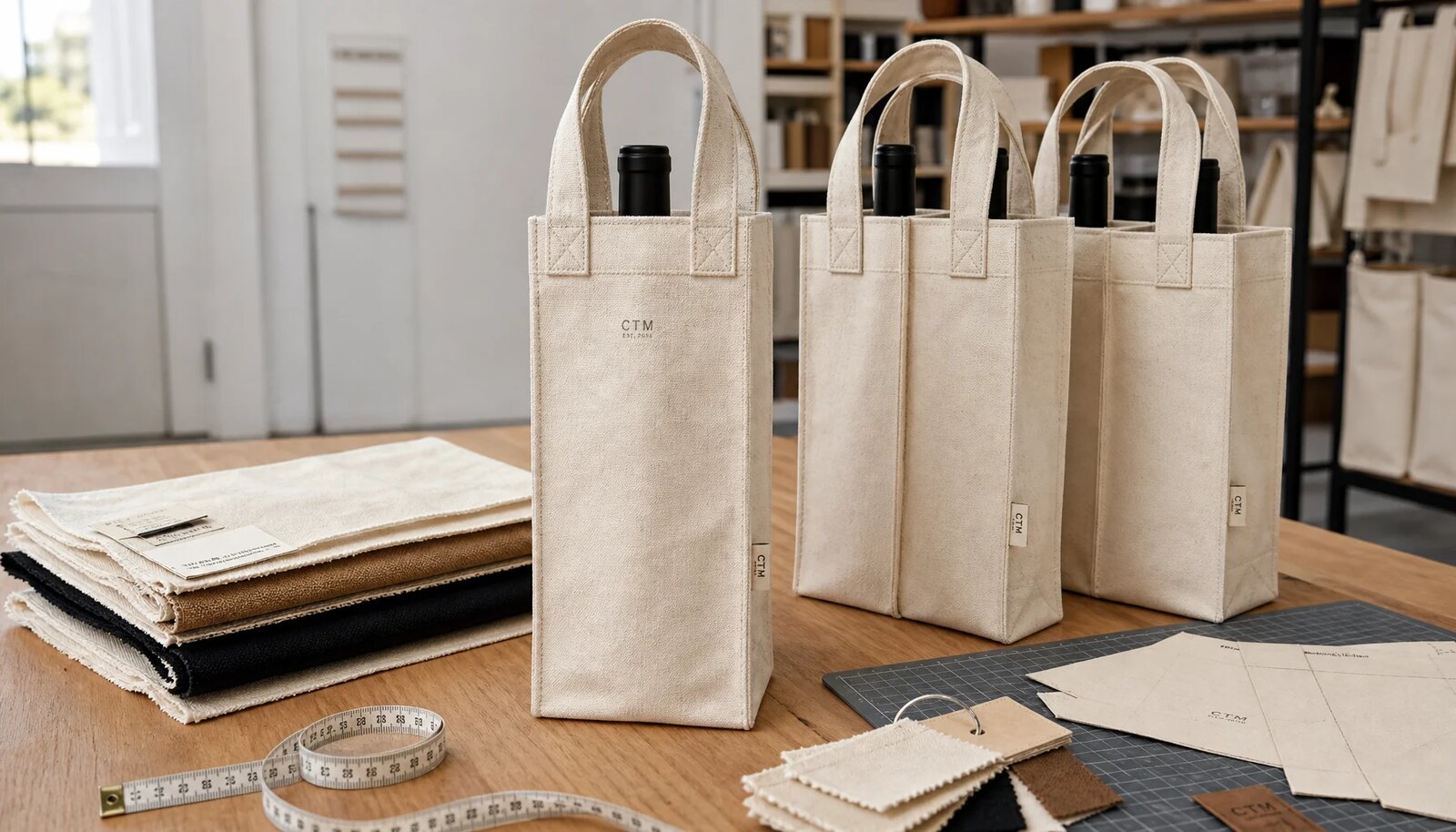
The Buying Problem Behind Fabric Weight
Canvas wine carriers for craft fairs sit in an awkward sourcing category. They are not simple lightweight giveaway bags, but they are also not luxury leather packaging. A buyer needs the bag to carry glass safely, print cleanly, look credible at a booth, and ship at a cost that still works for seasonal retail programs. Fabric weight is usually the first spec buyers mention, but it is only useful when connected to bottle weight, handle reinforcement, divider design, and packing volume.
For procurement teams, the mistake is treating “heavy canvas” as a complete RFQ. Two suppliers can both quote a 12 oz wine carrier and deliver very different products: one may use tightly woven finished canvas with good body, while another may use looser fabric that feels thin after finishing. Your RFQ should translate the commercial use case into measurable details so the factory can quote the correct construction instead of guessing.
- Use 10 oz to 12 oz canvas for most single-bottle craft fair carriers where price and presentation must balance.
- Use 12 oz to 16 oz canvas for two-bottle carriers, heavier bottles, premium gifting, or repeated-use programs.
- Do not rely on fabric weight alone; specify handle reinforcement, bottom gusset, bottle fit, and print method together.
- If the carrier must stand upright at a retail table, request a physical sample because stiffness varies by weave and finishing.
Recommended Weight Ranges by Bottle Use
The safest starting point for a standard 750 ml wine bottle is 10 oz natural cotton canvas if the bag is mainly a branded carrier for one purchase occasion. It gives more structure than light cotton, accepts screen print well, and keeps freight more reasonable than very heavy canvas. For buyers who want a more substantial hand feel, 12 oz canvas is often the better presentation choice, especially when the carrier will be sold as part of a gift set or reused by the shopper.
Two-bottle carriers need a different calculation. The total filled weight can rise quickly, and the divider creates extra seam stress. For these styles, 12 oz should be treated as the lower commercial range, while 14 oz or 16 oz may be justified if the brand positioning supports the extra cost. However, a heavier body without reinforced handles is false economy; the first failure point is usually stitching, not the flat fabric panel.
- 8 oz canvas: acceptable only for light promotional use where the bottle is inserted briefly and low price is the priority.
- 10 oz canvas: practical entry point for single-bottle wholesale programs with solid screen print.
- 12 oz canvas: strong all-round choice for craft fair wine carriers with better shelf presence and less collapsing.
- 14 oz to 16 oz canvas: useful for two-bottle styles, premium retail sets, or heavier glass bottles.
- Above 16 oz: check whether the improved feel is worth higher sewing difficulty, carton volume, and freight cost.
How GSM, Ounce Weight, and Finishing Affect Quotes
Many importers request fabric in ounces while factories may manage purchasing in GSM. As a rough working range, 10 oz canvas is often around 340 GSM, 12 oz around 400 GSM, and 16 oz around 540 GSM, but the exact number depends on fabric type and finishing. That is why a quote should state both the ounce weight and the target GSM tolerance. Without this, two quotes that appear equal may not be comparable.
Finishing also matters. Washing, dyeing, brushing, and shrinkage control can change hand feel, measurement, and cost. A natural undyed canvas wine carrier is usually simpler to control than a dyed canvas carrier in burgundy, navy, or black. Dyed canvas needs more attention to colorfastness, shade consistency, and shrinkage, especially if you require tight dimensions for bottle fit.
- State whether GSM is required on finished fabric, not only greige fabric before processing.
- Request GSM tolerance, for example plus or minus 5 percent, if the program requires consistency.
- For dyed canvas, request a lab dip or fabric swatch before bulk fabric cutting.
- For natural canvas, define whether small cotton seed flecks are acceptable or should be limited.
- Compare quotes using the same fabric color because dyed canvas can change cost and lead time.
Construction Details That Matter More Than Buyers Expect
A wine carrier is a load-bearing package. The body panel can look fine while the handle attachment is underbuilt. For craft fairs, shoppers may walk across an event venue, carry the bag by one handle, place it on rough tables, and reuse it later. Handle attachment should include reinforced stitching, clean bartacks, or a durable box stitch depending on style. The bottom gusset should allow the bottle to sit flat without forcing the side seams outward.
For two-bottle bags, the divider is a major quality point. A divider that is too low does not protect bottles from knocking, while a divider that is too tight makes insertion difficult. The divider seam must be straight because it affects both function and appearance. Buyers should send bottle dimensions or a target bottle list rather than assuming all 750 ml bottles fit the same carrier.
- Define bottle diameter, bottle height, and shoulder style for the intended product range.
- Specify bottom gusset width so the bottle base sits correctly instead of stretching the bag.
- Require bartacks or equivalent reinforcement where handles meet the body.
- For two-bottle carriers, set divider height high enough to separate bottle bodies during walking.
- Check the opening width with the actual bottle, especially for champagne, spirits, or olive oil bottles.
Print Method Selection for Craft Fair Branding
Screen printing is usually the most sensible method for wholesale canvas wine carriers. It works well for simple winery logos, farm market branding, distributor marks, and one- or two-color seasonal artwork. On heavier canvas, the print surface can be textured, so fine lines and small reversed text need review before mass production. Large solid blocks of ink may require careful curing to avoid tackiness, cracking, or carton transfer.
Heat transfer can handle gradients and complex multi-color artwork, but it may not match the natural feel many craft fair brands want. Embroidery can look premium, yet it adds cost, may pucker the panel, and is not ideal for very detailed small text. Woven labels or side labels are useful when the buyer wants a quieter brand mark or needs the same bag body for multiple private-label customers.
- Use screen print for bold logos, simple text, and practical bulk production.
- Use heat transfer only when artwork complexity justifies the different hand feel.
- Use embroidery for premium short runs, but test puckering on the selected fabric weight.
- Use woven or sewn labels when one neutral bag body serves several retail brands.
- Always approve print strike-off on the same canvas weight and color as bulk production.
MOQ Logic and Quote Comparability
MOQ is not only a factory rule; it comes from fabric purchasing, cutting efficiency, print setup, and packing separation. A simple natural canvas single-bottle carrier with one screen print can have a lower practical MOQ than a dyed two-bottle carrier with multiple artwork versions. If a distributor wants ten small craft fair accounts under one order, the factory needs to know whether the body fabric is shared and whether only the logo changes.
To compare supplier quotes properly, keep the first RFQ controlled. Ask for one base specification at three quantity breaks, such as 1,000, 3,000, and 5,000 pieces. Then request optional adders for heavier fabric, inside divider, retail hangtag, individual polybag, extra print color, or barcode sticker. This prevents suppliers from hiding setup or packing costs inside a single unit price that is hard to audit.
- Separate MOQ by fabric color, bag size, and print design in the RFQ.
- Request quantity breaks using the same specification, not different fabric weights at each quantity.
- Ask for setup charges separately from unit price when artwork versions vary.
- For distributor programs, confirm whether mixed logos can run under one fabric purchase.
- If the supplier quotes unusually low, verify fabric weight, print size, reinforcement, and carton quantity.
Sample Approval Before Bulk Production
A development sample is useful for confirming shape and approximate appearance, but it is not enough for final approval if substitute fabric or hand printing was used. A pre-production sample should use the actual fabric weight, actual construction, actual handle reinforcement, and actual print method. This is especially important for wine carriers because the product needs to perform with a filled glass bottle, not just look good in a photo.
Sample review should be documented with measurable comments. Instead of saying “make it stronger,” specify handle reinforcement type, stitch density, divider height, or fabric weight change. Instead of saying “logo looks small,” confirm print dimensions and placement from seam edges. A well-marked sample approval sheet reduces the chance that sales, sampling, and production teams interpret the change differently.
- Fit test with the buyer’s actual bottle or a factory bottle matching the same dimensions.
- Measure bag height, width, gusset, handle length, and divider position.
- Photograph logo placement with ruler reference before approving bulk production.
- Run a simple loaded carry test using the intended filled bottle weight.
- Approve fabric hand feel, shade, and stiffness before cutting bulk material.
Packing Choices That Affect Landed Cost
Packing is often treated as an afterthought, but it changes freight cost, receiving time, and product condition. Canvas wine carriers can be flat packed, folded, or bundled depending on fabric weight and handle style. Flat packing protects shape better but may increase carton size. Tight folding saves space but can leave fold marks across the print, especially on heavier canvas or dark dyed fabric.
For craft fair and retail distribution, carton organization matters. If each event, store, or customer logo requires separate allocation, cartons should be marked clearly by SKU, artwork, and quantity. Individual polybags are not always necessary and may conflict with sustainability goals, but they can protect printed surfaces and simplify retail handling. Buyers should decide this before quoting, not after production is complete.
- Request carton dimensions and gross weight for each quantity break used in freight estimates.
- Define whether bags are flat packed, folded once, bundled, or individually polybagged.
- Use inner bundles if multiple artwork versions ship in the same master order.
- Require carton marks showing item code, artwork version, quantity, and destination reference.
- Avoid over-compression when print panels face each other inside the carton.
Lead Time and Schedule Risk
A realistic schedule starts after final artwork, sample approval, and deposit or purchase order confirmation, not from the first RFQ date. Natural canvas in standard weights may be available faster if the factory keeps fabric stock. Dyed canvas, uncommon weights, custom labels, and multiple logo versions add more coordination. Craft fair season also creates demand peaks, so late artwork approval can become a real shipping problem.
Procurement teams should map the schedule into decision gates: quote comparison, sample making, sample transit, revision, bulk fabric preparation, cutting, printing, sewing, inspection, packing, and export. The highest-risk areas are usually artwork delays, fabric shade approval, print curing time, and carton relabeling for multiple destinations. A supplier that gives one short lead time without these dependencies may not be giving a usable production plan.
- Allow sample time before counting bulk production days.
- Confirm whether fabric is in stock or must be woven, dyed, or finished.
- Build extra time for print strike-off approval when Pantone matching is important.
- Do not schedule inspection before print curing and final packing are complete.
- For craft fair deadlines, keep a buffer for port congestion, customs exams, and domestic distribution.
Quote Data Needed for a Fair Supplier Comparison
A good supplier quote should be more than a unit price. It should identify fabric weight, GSM range, fabric color, dimensions, handle construction, print method, print size, packing method, carton quantity, sample charge, setup cost, payment term, trade term, and lead time. Without these fields, procurement teams may choose the lowest price and later discover that the quote excluded reinforcement, used lighter canvas, or packed in a way that increases freight.
For landed-cost comparison, request carton data early. A heavier 16 oz carrier may look only slightly more expensive at factory price but can take more carton volume and increase freight per piece. Conversely, an underbuilt 8 oz or 10 oz carrier may save money upfront but create claims if handles fail or the bag does not meet retail presentation standards. The best specification is the one that matches the bottle use, brand position, and delivery channel.
- Compare fabric weight, GSM tolerance, and weave description across all supplier quotes.
- Compare handle reinforcement and divider construction, not only the outside bag dimensions.
- Compare print setup, number of colors, print area, and strike-off cost separately.
- Compare carton quantity, carton size, gross weight, and packing method for freight planning.
- Compare lead time assumptions, especially whether they start before or after sample approval.
Specification comparison for buyers
| Spec decision | Recommended option | When it fits | Buyer risk to check |
|---|---|---|---|
| Fabric weight for single-bottle carrier | 10 oz to 12 oz cotton canvas, approximately 340 to 400 GSM after finishing | Works for craft fair wine, cider, olive oil, and gift bottle programs where the bag must stand better than a thin cotton tote | Below 10 oz may collapse around the bottle and show print distortion; above 12 oz may increase freight and make the mouth too stiff |
| Fabric weight for two-bottle carrier | 12 oz to 16 oz canvas, approximately 400 to 540 GSM, with center divider reinforcement | Suitable for higher perceived value gift sets, winery bundles, and retail counter merchandising | Divider seam and handle bartacks must be tested with filled bottles; fabric weight alone does not guarantee load strength |
| Handle construction | Self-fabric handles or cotton webbing with bartack reinforcement at stress points | Best for repeated carrying at craft fairs where shoppers may walk with glass bottles for several hours | Cheap flat lock stitching without bartacks can fail even when the canvas body is heavy |
| Print method | Screen print for solid logos; heat transfer only for complex small-color artwork; embroidery only for premium short runs | Screen print is the normal bulk choice for winery logos, farm brands, and seasonal craft fair graphics | Thick canvas absorbs ink differently; require strike-off approval for ink coverage, edge sharpness, and color shift |
| Inside divider | Stitched canvas divider for two-bottle bags; removable divider only if buyer needs flexible use | Stitched divider reduces bottle knocking and improves retail presentation | Divider height too low allows bottle necks to hit; divider seam must not create a crooked front panel |
| MOQ structure | One fabric color and one print design per MOQ; combine sizes only if supplier confirms shared cutting and production logic | Helps distributors offer controlled SKU options without creating excessive sampling and setup cost | Mixing many logo colors or bag sizes can push unit cost up more than expected due to print setup and packing separation |
| Packing method | Flat packed by size and artwork, 50 to 100 pieces per export carton depending on fabric weight and handle bulk | Best for importers and retail buyers who need clean receiving, carton labeling, and easy allocation to events | Over-compressed cartons can crease heavy canvas and damage printed panels if ink curing is not complete |
| Sample approval | Pre-production sample using actual fabric weight, actual handle method, and actual print technique | Required when the bag will hold glass bottles or when brand color accuracy matters | Photo-only approval is risky because stiffness, seam strength, and bottle fit cannot be judged reliably from images |
Buyer checklist before sampling
- Define bottle type before quoting: 750 ml wine bottle, champagne bottle, spirits bottle, olive oil bottle, or mixed use.
- Specify fabric weight in oz and GSM, and state whether the value is before or after washing or finishing.
- Confirm single-bottle or two-bottle format, bottom gusset width, divider height, and opening size.
- Require handle length, handle material, bartack location, and minimum load test target in the RFQ.
- Send logo artwork with Pantone references, print size, print position, and acceptable color tolerance.
- Request actual fabric swatch and print strike-off before approving bulk production.
- Define packing by SKU, carton quantity, carton marks, polybag requirements, and any retail hangtag or barcode needs.
- Ask for quote separation by bag cost, print setup, sample charge, packing material, inland freight, and export terms.
- Set inspection points for fabric GSM, seam strength, print adhesion, bottle fit, carton labeling, and final AQL.
- Build schedule buffer for artwork approval, sample courier time, fabric dyeing or greige stock availability, and peak-season shipping.
Factory quote questions to send
- What fabric weights are in regular stock for natural, black, and dyed canvas wine carriers, and what GSM tolerance do you control in production?
- Is the quoted fabric weight based on finished fabric or greige fabric before shrinkage and finishing?
- For the proposed fabric weight, what bottle weight and carry load have you tested on the handle and bottom seams?
- Can you quote the same design in 10 oz, 12 oz, and 16 oz canvas with the same print size so we can compare landed cost?
- What print method do you recommend for our artwork, and what are the setup cost, minimum print quantity, and color limitations?
- Will the sample use bulk fabric and bulk print method, or is it a handmade development sample with substitute materials?
- What is the MOQ per fabric color, per print design, and per size, and can cartons be separated by customer event or retail SKU?
- What carton dimensions and gross weight should we use for freight estimate at 1,000, 3,000, and 5,000 pieces?
- What inspection standard do you use for fabric stains, loose threads, print defects, seam slippage, and packing errors?
- What production lead time applies after final sample approval, and what schedule risks could change that timing?
Quality-control points to confirm
- Fabric GSM should be checked by cutting a measured sample from bulk fabric and weighing it, not estimated from supplier description.
- Finished bag dimensions should stay within agreed tolerance, commonly plus or minus 1 cm for body size and plus or minus 1.5 cm for handle length.
- Handle attachment should include reinforced stitching or bartacks with no skipped stitches, broken threads, or loose ends at stress points.
- A filled-bottle carry test should be performed using the heaviest intended bottle type for a defined time and movement pattern.
- Print adhesion should pass a dry rub and light scratch check after curing; ink should not crack heavily when the panel is flexed.
- Divider seams in two-bottle carriers should be centered, straight, and high enough to keep bottles separated during normal walking.
- Bags should stand or lie consistently depending on agreed construction; twisted handles and uneven gussets should be rejected above tolerance.
- Cartons should match SKU count, artwork version, carton mark, and gross weight stated in the packing list.