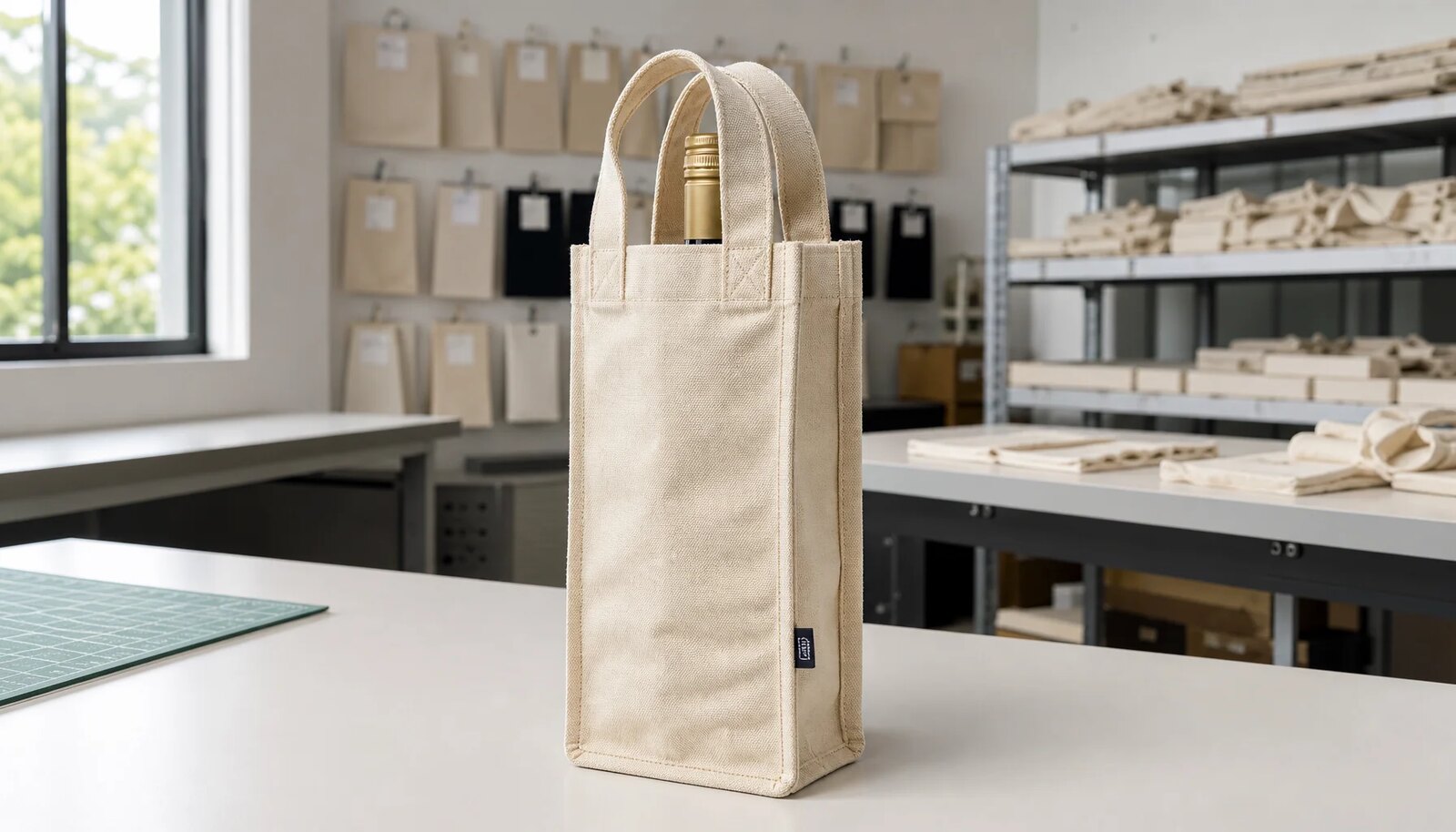
Define the Gift Use Before the Bag Spec
Wholesale canvas wine carriers sit between packaging, branded merchandise, and light-duty transport. A holiday executive gift may need quiet branding and a crisp standing shape. A sponsor gift may need a larger front logo that reads well on an event table. A hotel amenity may need fast room assembly, clear carton marks, and understated labels. The same carrier will not serve every program equally well.
Procurement teams get cleaner quotes when the RFQ describes the business use, not only the product name. If the request says only "canvas wine bag with logo," suppliers may quote different fabric weights, handle types, bottom constructions, decoration methods, and packing styles. Those prices may look comparable in a spreadsheet, but they are pricing different risk.
- Define the use case: executive gift, employee gift, distributor gift, hospitality amenity, event sponsor pack, or retail-style bottle presentation.
- State whether the carrier is the main branded item or secondary packaging for a bottle, card, and insert.
- Confirm whether goods ship empty, loaded with bottles, or assembled with other gift items after import.
- List receiving locations and any PO label, SKU label, barcode, country-of-origin, carton mark, or appointment delivery requirements.
Measure the Bottle Before Approving the Pattern
A 750 ml bottle is not one standard shape. Bordeaux bottles are usually straighter, Burgundy bottles are broader and rounder, sparkling bottles are often wider and heavier, and spirits bottles may have unusual shoulders or caps. A carrier that fits one bottle can feel tight, loose, unstable, or visually unbalanced with another.
The essential measurements are full bottle height, base diameter, shoulder height, neck diameter, and cap or cork finish height. Buyers should also define desired neck exposure above the opening. On a narrow one-bottle bag, a small diameter change can twist the front panel and make a centered logo appear off-center once the bottle is inserted.
- Provide full bottle height, base diameter, shoulder height, neck diameter, cap or cork finish height, and filled bottle weight if the carrier will be lifted loaded.
- Identify the bottle family: Bordeaux, Burgundy, sparkling, spirits, specialty bottle, or mixed assortment.
- Define preferred neck exposure and whether the bottle label should remain visible above the carrier.
- For two-bottle bags, specify divider material, divider height, divider stitching, and whether bottles may touch during movement.
- Approve sample photos with the actual bottle or approved dummy inserted, including front, side, top opening, bottom, and lifted-handle views.
Specify Canvas by More Than Weight
Canvas weight is commonly quoted in ounces or GSM, but weight alone does not define performance. A dense 12 oz canvas can feel more stable than a loosely woven heavier fabric. A washed finish may feel softer but less crisp. Natural unbleached cotton can vary by lot. Dyed fabric adds shade-control and rub-transfer questions. The RFQ should define fabric weight, finish, construction, and reinforcement together.
For many corporate gifting programs, 12 oz to 14 oz cotton canvas is a practical starting range. It gives more structure than light promotional fabric while remaining workable for cutting, sewing, printing, and carton packing. Lighter 8 oz to 10 oz canvas can work for cost-driven presentation sleeves. Heavier 16 oz canvas can suit premium programs, but buyers should check seam thickness, fold marks, needle holes, carton cube, and decoration limits before approving.
- Use 8 oz to 10 oz for light presentation sleeves or short-use event programs where structure is less important.
- Use 12 oz to 14 oz for most reusable corporate gifting carriers requiring a stable hand feel.
- Consider 16 oz or reinforced construction only after checking folding, sewing thickness, decoration performance, and packed carton volume.
- Specify boxed bottom, bottom insert, lining, binding, handle material, and bar-tack reinforcement as separate construction decisions.
- Approve natural or dyed canvas from a physical swatch and, when brand color matters, from a decorated strike-off.
Turn Logo Placement Into Measurements
Logo placement should be written as a production measurement, not a preference such as centered, tasteful, or lower front. The supplier needs artwork size, reference points, and a placement tolerance. On a narrow canvas wine carrier, a drift of only a few millimeters can look obvious because the front panel is small and the bottle creates a curved surface.
For front-center branding, define a decoration window using the top binding or opening edge, both side seams, the bottom seam or fold, and the vertical center line. Keep artwork clear of handle bar-tacks, binding, gusset folds, divider stitch lines, and areas that curve tightly around the bottle. As a practical starting point, many buyers leave at least 15-25 mm from seams, folds, and reinforcement points, then confirm the final window on the loaded sample.
- Define maximum logo width and height in millimeters or inches, including clear area around the artwork.
- Show measured distances from fixed points: top edge, side seam, bottom seam, center line, handle attachment, or label seam.
- Set a written placement tolerance; for flat-panel decoration before sewing, a tighter tolerance may be possible than for patches, embroidery, or post-sewing decoration.
- Inspect logo position with the bottle inserted if the finished gift will be presented loaded.
- Keep the approved physical sample and placement drawing as inspection references for bulk production.
Choose Decoration by Artwork and Risk
Screen printing is often the most efficient option for corporate gifting because it is clear, scalable, and suitable for bold logos. It works best with solid shapes, limited colors, and artwork that can tolerate canvas texture. Buyers should confirm ink type, color target, maximum print area, screen charges, and whether printing happens before or after sewing.
Embroidery, woven labels, and patches can look more premium, but each has production limits. Dense embroidery can pucker a narrow panel or make small lettering unreadable. Woven labels are useful for discreet branding but need fold allowance and seam placement approved. Patches add texture, yet thickness can affect folding, pressure marks, and carton count. No decoration method should be approved from a digital mockup alone.
- Use one-color screen print for bold corporate logos, event visibility, and repeat orders with stable artwork.
- Use woven labels for discreet retail-style branding when the front panel should remain mostly blank.
- Use embroidery for smaller simple marks on stable canvas, with stitch density and puckering checked on a stitched sample.
- Use sewn patches when texture matters, then confirm patch material, thickness, edge stitching, corner security, and packing impact.
- Ask the supplier to flag minimum line weight, minimum letter height, color limitations, and artwork simplification before sampling.
Control MOQ, Variants, and Lead Time
MOQ is usually driven by production economics rather than one fixed rule. Standard natural canvas, one logo, one print color, and simple bulk packing are easier to quote at lower quantities. Dyed fabric, custom lining, embroidery, woven labels, patches, dividers, gift-ready packing, and multiple regional logos can all raise MOQ or add setup costs.
Lead time should be broken into decision gates: artwork review, placement drawing, sample or strike-off, sample shipping, buyer approval, material booking, cutting, decoration, sewing, trimming, inspection, packing, carton marking, and handover to the forwarder. This matters because internal brand approval can consume more time than production. Variant management also needs discipline; different logos should be tracked by SKU or logo code from artwork approval through carton labeling.
- Ask for MOQ by exact fabric, color, logo method, color count, packing style, and number of variants.
- Request a timeline that separates sample lead time, buyer approval time, material booking, production, inspection, packing, and delivery to forwarder.
- Set last-change dates for artwork, fabric color, finished dimensions, packing, and carton marks.
- Confirm whether variants are packed by SKU, mixed by recipient kit, or separated by destination.
- Require carton labels that identify logo version, SKU, PO, quantity, and destination without opening the carton.
Approve Samples With Written Tolerances
A pre-production sample is the control reference for bulk production. It should use the same canvas, finish, trim, thread, handle construction, decoration method, logo size, placement, insert, folding method, and packing planned for the order. If the first sample uses substitute fabric or temporary decoration, identify it as a fit sample or visual sample instead of final approval.
Written tolerances make approval objective. Finished dimensions can be checked at body height, width, gusset, opening, handle drop, divider height, and bottom insert. Logo placement can be measured from the top edge, side seam, center line, or bottom seam. As a practical example, a buyer might set +/-5 mm on key sewn dimensions and +/-3-5 mm on logo placement where the method and construction can hold it, but the supplier should confirm what is realistic before bulk production.
- Label sample purpose clearly: fit sample, decoration strike-off, pre-production sample, packing sample, or final approved sample.
- Write tolerances for finished size, logo position, logo size, color, stitch alignment, patch placement, and carton packing.
- Test the sample loaded with the actual bottle or approved dummy, then lift it by the handle and check balance, twist, and standing shape.
- Fold and pack the sample as planned to check print cracking, patch pressure, embroidery dents, and permanent creases.
- Do not release bulk production until sample comments, artwork files, and placement drawings match.
Build QC Around Function, Appearance, and Packing
Quality control should cover materials, dimensions, function, decoration, sewing, cleanliness, packing, and carton labels. A final random inspection can work well for many B2B gift orders, but the buyer should define critical checks in advance. For example, a minor shade variation may be acceptable on natural canvas, while handle failure, wrong logo position, or mixed carton variants should be treated as serious defects.
Functional checks matter because a filled wine bottle is heavy for a small sewn product. Inspectors should load the carrier with the agreed bottle or equivalent weight, lift it, and look for seam opening, handle stretch, tearing, twisting, or bar-tack failure. Some buyers specify a short static lift check using the expected filled bottle weight plus a reasonable margin; the exact method should be agreed before inspection so results are not subjective.
- Check fabric weight, color, weave defects, stains, odor, and hand feel against the approved sample.
- Measure finished dimensions and logo position across randomly selected units, recording out-of-tolerance results.
- Perform bottle fit, standing stability, insertion, removal, and loaded handle-lift checks using the agreed bottle or controlled equivalent.
- Inspect screen print for bleed, pinholes, smearing, skipped ink, cracking, registration shift, and ink transfer.
- Inspect embroidery, labels, and patches for puckering, loose threads, crooked placement, lifted corners, fraying, and incorrect color.
- Verify folding method, inner protection, carton quantity, carton marks, variant separation, gross weight, and carton condition.
Specify Packing for Real Receiving Conditions
Packing affects unit cost, carton cube, scuff risk, warehouse labor, and the first impression when cartons are opened. A blank light carrier may only need bulk folding. A decorated executive gift carrier may need individual polybagging, tissue, interleaving, insert card placement, or protection around a patch. Each packing step should be quoted separately so stakeholders can decide which presentation details are worth the cost.
Carton density needs balance. Over-packed cartons can crush corners, crease canvas, flatten patches, and make decorated panels arrive tired. Under-packed cartons increase freight cost and allow units to shift. A carton plan should include units per inner pack if any, units per master carton, carton dimensions, gross weight range, carton board strength, carton marks, and pallet requirements if shipping to a 3PL, distributor, hotel group, or event warehouse.
- Define unit packing: bulk folded, individual polybag, tissue wrap, belly band, insert card, divider, or gift-set assembly.
- Confirm whether decorated panels need interleaving, face-out packing, or pressure protection.
- Specify master carton quantity, carton dimensions, gross weight range, carton strength, and carton marks.
- Use clear SKU or logo codes for multi-variant programs so receiving teams do not need to open cartons to identify goods.
- Ask for packed-carton photos before shipment when the order is time-sensitive or has multiple destinations.
Compare Quotes on Landed Cost
A low unit price can hide missing assumptions. For canvas wine carriers, quote differences often come from decoration, setup fees, packing, carton specification, sampling, inspection, freight, and responsibility for rework. A quote that excludes screen charges, digitizing, patch setup, individual packing, carton labels, or export handling is not cheaper in a useful way; it is incomplete.
Use one quote structure across suppliers. Every supplier should price the same finished size, canvas weight, fabric finish, construction, handle type, bottom support, decoration method, logo size, placement, color count, packing, carton quantity, and Incoterms. Then ask for optional upgrades as separate lines: heavier canvas, woven label, patch, lining, bottom insert, divider, tissue wrap, or individual polybag. This keeps marketing, procurement, and operations comparing real choices rather than unclear totals.
- Separate blank bag cost, decoration, setup, sample, packing, carton upgrade, inspection, freight, duty, and destination charges.
- Compare suppliers on the same dimensions, fabric, construction, logo method, placement, packing, and Incoterms.
- Include local handling, rejects, repacking, and schedule risk when comparing factory decoration with local branding.
- Confirm who pays for correction if bulk goods fail approved logo placement, color, stitching, construction, or packing requirements.
- For time-sensitive gifting, weigh delivery reliability alongside unit price because a missed event date can erase the saving.
Specification comparison for buyers
| Spec decision | Recommended option | When it fits | Buyer risk to check |
|---|---|---|---|
| Bottle format and pattern | Approve finished dimensions from the actual bottle or a dimensionally accurate dummy, including base diameter, shoulder height, full height, neck diameter, and desired neck exposure | Corporate wine gifts, distributor thank-you packs, hotel amenities, event gifts, and branded bottle presentations | A carrier fitted to a Bordeaux bottle may be tight on Burgundy, unstable with sparkling wine, or visually wrong for spirits; this can also shift a centered logo once loaded |
| Canvas weight and finish | Use 12 oz to 14 oz cotton canvas for most gifting, with natural, bleached, dyed, washed, or coated finish stated clearly | Reusable gifts where the bag needs structure without becoming bulky or difficult to pack | Low-weight canvas can sag and show print bleed; heavy or washed canvas can increase sewing difficulty, folding marks, carton cube, and shade variation |
| Construction reinforcement | Specify boxed or gusseted bottom, reinforced bottom seam, bottom insert if needed, bar-tacked handles, binding, divider, and handle material | Loaded one-bottle or two-bottle programs where recipients may carry the gift rather than only receive it on a table | A good-looking empty sample can fail under bottle weight if handle joins, bottom seam, divider stitching, or insert size are vague |
| Finished size tolerance | Write measurable tolerances after sample approval; for small sewn bags, many buyers use about +/-5 mm on key dimensions when the construction supports it | Orders where bottle exposure, standing shape, logo alignment, and carton count need to stay consistent | Loose tolerances can cause variable bottle fit, panel twisting, uneven opening width, or inconsistent logo presentation across cartons |
| Front-center logo window | Use a measured print window centered on the front panel, often leaving at least 15-25 mm from seams, binding, handle bar-tacks, bottom fold, and high-curve areas | High-visibility gifts, sponsor programs, event tables, and gifts likely to be photographed | Oversized art can wrap around the bottle curve, drift off center, or sit too close to stitching where print and embroidery quality are harder to control |
| Lower-front logo placement | Place small marks in the lower-middle or lower third only after checking the loaded bag and boxed-bottom shape | Premium programs where branding should be visible but restrained | If too low, the logo can distort over the base radius, disappear in a gift box, or look uneven when the bottle weight settles the bottom |
| Woven side label | Use a folded woven label or seam label with width, height, fold allowance, insertion depth, and distance from top or bottom defined | Executive gifts, hospitality programs, retail-style presentation, and brand guidelines that prefer quiet marking | Labels can sit crooked, fray, show the wrong fold, or migrate between lots if the label spec is approved separately from the sewing sample |
| One-color screen print | Use for bold logos, stable artwork, efficient repeat orders, and larger print windows on natural or dyed canvas | Medium and large corporate gifting runs with one primary brand color | Ink absorption, edge bleed, pinholes, shade shift on natural canvas, screen charges, and rub transfer should be confirmed on actual production fabric |
| Embroidery | Use for smaller simple marks on stable canvas; avoid dense filled logos on narrow panels unless a stitched sample proves the result | Premium programs where tactile branding matters more than large front-panel visibility | Puckering, needle marks, backing show-through, thread mismatch, stitch distortion, and unreadable small lettering can make embroidery riskier than expected |
Buyer checklist before sampling
- Confirm the exact bottle format before quoting: full height, base diameter, shoulder height, neck diameter, cap or cork finish height, filled bottle weight if relevant, and bottle family such as Bordeaux, Burgundy, sparkling, spirits, or mixed assortment.
- State whether the carrier ships empty, ships with a bottle inserted, or will be assembled into a larger gift set after import, because this changes bottom support, folding, carton strength, and scuff protection.
- Specify finished carrier dimensions: body height, body width, gusset or bottom depth, opening width, handle length or handle drop, divider height if any, bottom insert size if any, and acceptable finished-size tolerance.
- Define canvas in production language: ounce weight or GSM, cotton content if required, natural or bleached or dyed finish, lining, binding, bottom insert, handle webbing or self-fabric handle, and reinforcement method.
- Choose one primary decoration method before comparing quotes, then price optional alternatives separately so screen print, embroidery, woven label, and patch quotes do not hide different assumptions.
- Set a logo placement window by fixed reference points such as top binding, side seams, bottom seam, center line, handle bar-tack, or label seam, with maximum artwork size and written placement tolerance.
- State artwork requirements: file type, Pantone or physical color target, number of print colors or thread colors, minimum line weight, minimum letter height, and whether negative space must remain open.
- Ask whether decoration is completed before sewing, after sewing, or by a subcontracted decorator, because this affects placement accuracy, seam clearance, inspection timing, and responsibility for defects.
- Require a pre-production sample made with the same bulk fabric, trim, handle construction, decoration method, logo size, placement, insert, folding method, and packing method planned for production.
- Compare quotes on the same Incoterms, MOQ, sample cost, setup cost, unit packing, carton quantity, inspection allowance, carton marks, export handling, and freight assumptions.
Factory quote questions to send
- What exact canvas weight are you quoting in oz or GSM, and is the fabric natural, bleached, dyed, washed, coated, or otherwise finished in a way that may affect print color, shrinkage, or shade consistency?
- What are the finished dimensions after sewing, including body height, width, gusset or bottom depth, opening size, handle length or drop, divider height, and bottom insert size, and what tolerance will you commit to in writing?
- Which bottle shape was used to confirm fit, and can you test against our actual bottle dimensions or a dimensionally accurate dummy before pre-production approval?
- Is the quoted construction single-layer canvas, lined canvas, bound seams, boxed bottom, inserted bottom board, fabric divider, webbing handle, self-fabric handle, or another construction?
- Where exactly will the logo sit, and what are the measured distances from the top edge, side seams, bottom seam, handle attachment, and center line on the approved layout?
- What decoration method is included in the unit price, how many colors or thread shades are included, and which screen, digitizing, label, patch, plate, artwork, or setup charges are separate?
- What minimum line weight, minimum text height, maximum print area, embroidery stitch limit, label size, or patch thickness do you recommend for this artwork on the specified canvas?
- Is decoration completed before sewing, after sewing, or by a separate subcontractor, and who is responsible for correction if logo placement, color, or attachment is outside the approved tolerance?
- What is the MOQ for this exact fabric weight, color, logo method, logo size, color count, packing style, and number of logo or regional variants?
- What is the sample lead time and bulk lead time broken down by artwork approval, material booking, decoration, sewing, inspection, packing, and delivery to forwarder?
Quality-control points to confirm
- Fabric weight is checked against the approved oz or GSM target, and the inspector confirms that hand feel, weave density, color, and surface defects are consistent with the approved sample.
- Finished dimensions match the approved sample and written tolerance, including body height, width, gusset, bottom depth, opening size, handle drop, divider position, and bottom insert size if used.
- Actual bottle fit is tested with the agreed bottle format or dummy, including insertion, removal, standing stability, lifted-handle balance, neck exposure, and whether the body twists under load.
- Logo placement is measured from fixed seams, binding, bottom fold, or center line, and the result stays within the written tolerance across randomly selected units.
- Logo size is checked against the approved artwork, with attention to distortion caused by curved panels, fabric tension, seam pull, embroidery shrinkage, or patch stitching.
- Screen print edges are clean, with no visible bleed, smearing, cracking, skipped ink, excessive ink buildup, pinholes, registration shift, or ink transfer to adjacent bags.
- Embroidery, woven labels, or patches are straight, securely attached, correctly colored, and free from puckering, loose threads, lifted corners, frayed edges, or distorted artwork.
- Stitching is straight and secure at side seams, bottom seams, handle joins, binding, dividers, patch edges, and bar-tack reinforcement, with loose thread ends trimmed cleanly.
- Canvas color, trim color, print color, thread color, label color, and patch color are checked against the approved reference under consistent lighting, not only under factory floor lighting.
- Handle strength is checked by lifting with the agreed bottle weight or a controlled equivalent, looking for seam opening, handle stretch, bar-tack failure, tearing, or permanent distortion.