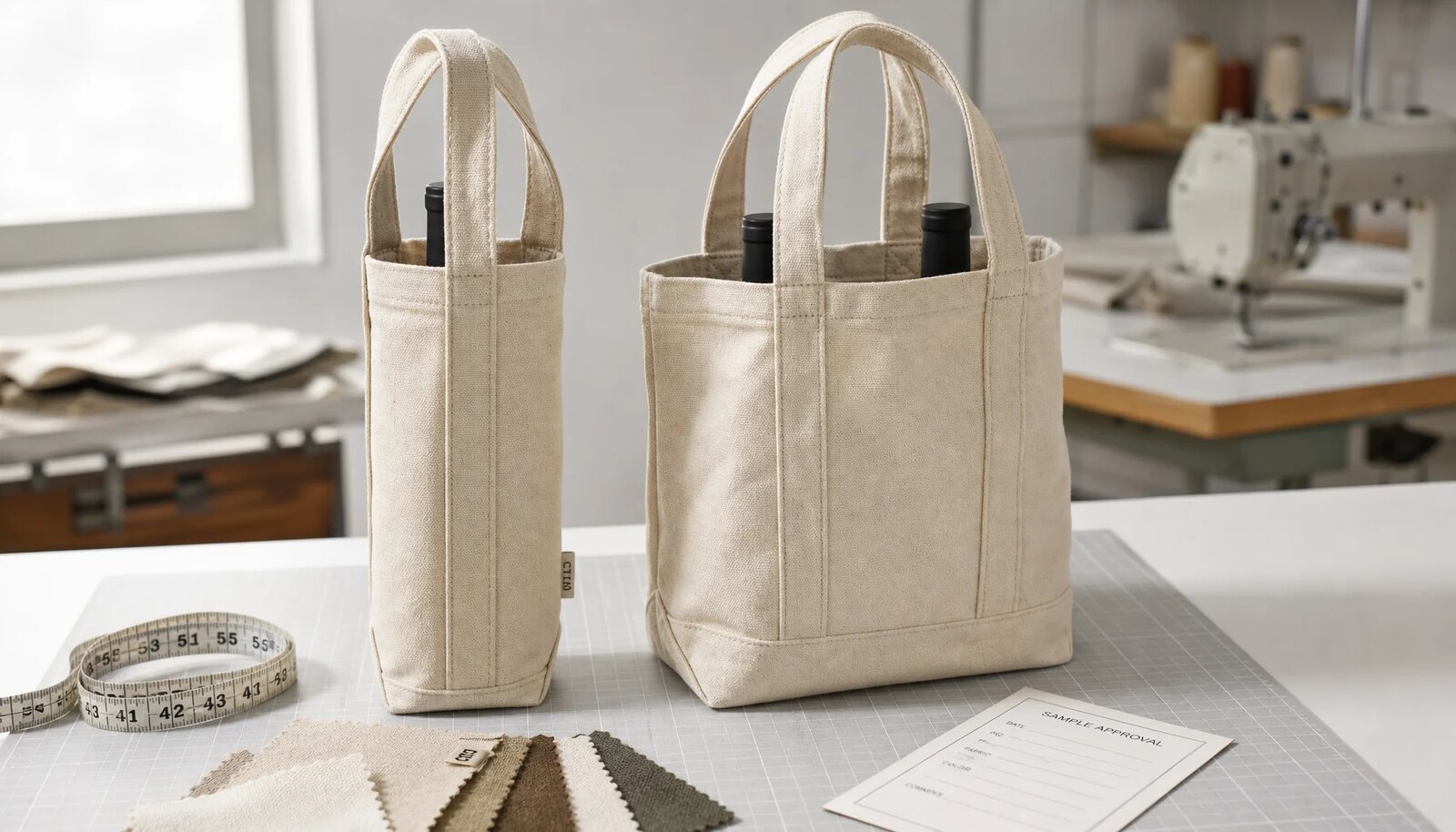
Start With the Gift Use Case
A useful brief for wholesale canvas wine carriers for corporate gifting starts with how the carrier will be used. The same product name can describe a soft bottle sleeve, a structured one-bottle carrier, a two-bottle carrier with a divider, or a retail-style gift bag with labels, inserts, and individual packing. Those versions may look similar in a supplier catalog, but they do not use the same fabric weight, base construction, handle reinforcement, logo process, carton plan, or inspection standard.
Define the gifting moment before asking for a unit price. A carrier handed out at an event table may only need to move one bottle from a venue to a car. A client gift placed on a boardroom table must stand upright, protect the bottle label, and look intentional when photographed. A winery bundle may need two bottles separated cleanly inside one carrier. A hospitality program may reorder the same item and need stable repeat production. The right canvas weight depends on that job, not on GSM alone.
Procurement also needs to align marketing, logistics, and fulfillment. Marketing may care about the logo scale and natural canvas texture. Logistics may care about carton cube, flat packing, and inner pack counts. Fulfillment may need inserts packed separately so the bags can be assembled with bottles and cards. Put those requirements into one short specification. When the brief is vague, suppliers fill the gaps differently, and quotes become hard to compare.
- Define the program type: event giveaway, executive gift, winery promotion, hospitality amenity, retail bundle, or repeat corporate program.
- State whether the carrier must stand upright, ship flat, fit inside a gift box, hold one bottle, hold two bottles, or include a card pocket.
- List non-negotiables before sampling: bottle fit, canvas weight range, logo method, handle strength, base construction, packing, QC, and delivery date.
Canvas Weight and GSM
Fabric weight is the headline variable, but it is not a complete quality grade. In this category, 8-10oz canvas, roughly 270-340 GSM depending on weave and finishing, is an economy range. It can work for short-use event carriers, simple single-bottle sleeves, or bags packed inside a rigid gift package. It becomes risky when the bottle is heavy, the base is narrow, the weave is loose, or the handle anchors are not reinforced.
Around 12oz, often about 380-430 GSM, is the practical starting point for many corporate gifting programs. It has enough body for a reusable feel while staying manageable for sewing, screen printing, folding, and carton packing. Heavier 14-16oz canvas, often about 470-550 GSM, gives a more structured feel and may suit two-bottle carriers or premium presentation. It also brings tradeoffs: stiffer fold marks, higher carton volume, more difficult sewing, and greater risk of print cracking if the logo sits across a fold.
Ask what the GSM number actually describes. Some suppliers quote greige fabric weight before dyeing or washing. Others quote finished fabric, coated fabric, or a product name from a stock range. A tight 12oz duck canvas may perform better than a looser fabric with a similar stated weight. Washed canvas may feel softer but vary more in dimensions. Coated or laminated canvas may add stiffness while affecting odor, fold whitening, and ink adhesion. The approved sample should lock the real fabric, not only the number in the quotation.
- Use 8-10oz only when the carrier is simple, cost-sensitive, and still reinforced at load points.
- Use 12oz as the default starting point for most reusable branded single-bottle carriers.
- Use 14-16oz for premium structure, two-bottle formats, or retail-style presentation after checking fold memory and carton cube.
- Require both oz and GSM, plus the measurement stage: raw, finished, dyed, washed, coated, or laminated.
Bottle Fit Is the Spec
The phrase 750ml bottle is not specific enough for production. Bordeaux bottles are generally straighter and narrower. Burgundy bottles are wider with sloped shoulders. Champagne and sparkling bottles can be heavier, wider, and harder on the base and handle. Tall slim bottles need height without much extra width. A carrier patterned around one bottle family can strain, lean, or fail to accept another.
Give the supplier the bottle height, base diameter, widest shoulder diameter, neck diameter if relevant, and filled weight. If the final bottle is known, send a physical bottle or a dimensioned drawing. If several bottle styles may be used, approve the carrier against the largest and heaviest realistic bottle. The bottle should slide in without forcing the side seams, and the loaded panel should not pull hard across the shoulder.
Separate external dimensions from internal usable dimensions. External width and height help with appearance and carton planning. Internal width, internal depth, gusset, top opening, and usable height determine whether the carrier works. Also define neck exposure. Some programs want the bottle label covered for a cleaner branded presentation. Others want the bottle label visible. That choice changes pattern height, logo placement, and perceived value.
Always inspect the carrier loaded. Many canvas carriers look square on the sample table until a filled bottle is inserted. Then the bottom may round out, the top opening may pull, the handle may twist, or the bottle may lean. These are not cosmetic details for a corporate gift; they affect how the recipient experiences the item.
- Specify bottle family and actual dimensions, especially for Burgundy, champagne, sparkling, and unusually tall bottles.
- Approve fit with the intended filled bottle, not an empty display bottle or generic cylinder.
- Set internal usable dimensions separately from external finished dimensions.
- Check loaded balance, shoulder tension, neck exposure, and whether the carrier stands upright.
Base, Divider, and Inserts
Base construction is one of the easiest places for quotes to diverge. A simple folded bottom may be acceptable for a lightweight sleeve or event carrier. A boxed base gives better standing stability and a more deliberate shape. An added bottom panel can improve structure but adds sewing time. A removable or fixed board insert can keep the base flatter under bottle weight, though it adds material cost, packing decisions, and sometimes assembly labor.
Match the base to how the gift will be presented. A carrier inside a rigid gift box may not need a board insert. A bottle delivered on its own may need a flatter base and better upright balance. If the bag ships flat, decide whether inserts are installed, packed loose inside each unit, bundled separately, or added by the fulfillment center. Each option affects carton volume, receiving checks, and assembly time.
Two-bottle carriers need more discipline than single-bottle bags. The divider should prevent bottle-to-bottle contact during normal handling and should not collapse below the bottle shoulders. The base needs enough support for the combined load, and the handle should remain comfortable with two filled bottles. A two-bottle carrier can look premium when empty and become awkward when loaded if divider height, base stiffness, and handle drop were not designed together.
Ask suppliers to describe the base in construction terms and provide sample photos from inside and outside the carrier. For board inserts, ask for material type, thickness, size, edge finish, and whether the insert is removable or fixed. Also confirm that inserts will not warp, stain the canvas, or create pressure marks against printed panels during storage.
- Use a folded base only when upright presentation is not critical.
- Use a boxed base or bottom panel when the loaded carrier must stand cleanly.
- Use board inserts when base flatness and presentation matter more than the lowest unit cost.
- For two-bottle carriers, approve divider height, base support, bottle separation, and handle comfort under full load.
Handles and Seam Strength
Canvas wine carriers usually fail at stress points, not in the middle of the fabric. Risk gathers at handle anchors, side seams, bottom corners, divider seams, and the top opening. One filled bottle often weighs around 1.2-1.6 kg depending on glass weight and closure. Two-bottle formats can exceed 3 kg before added packaging. That load is lifted, swung, set down, and lifted again through factory packing, fulfillment, event setup, gifting, and recipient handling.
Handle details need measurable language. Define handle width, length, drop, fabric layer count, attachment depth, and reinforcement method. Short hand-carry handles usually keep one bottle more stable. Longer handles may suit some retail styles, but they increase swing and can add stress at the anchors. Ask the factory to measure handle length end-to-end and handle drop from the bag top edge to the inside peak of the handle. Keep those numbers in the approved sample record.
Seams deserve the same treatment. Ask for seam allowance, stitch density, thread type, and whether handle anchors use bar-tacks, box stitches, cross stitches, or another reinforcement. On natural canvas, messy sewing is visible. Under load, weak sewing becomes functional risk. Inspection should catch skipped stitches, broken thread, loose thread tails, uneven seam allowance, distorted top hems, and weak backstitching.
For higher-risk programs, add a simple loaded carry check before approving bulk production. Load the carrier with the intended filled bottle weight, lift it repeatedly, carry it with normal motion, and review handle anchors, side seams, base corners, and top opening. The goal is to catch obvious weakness while it can still be corrected.
- Specify handle width, length, drop, layer count, attachment depth, and reinforcement stitch.
- Require reinforced handle ends for carriers intended to transport filled bottles.
- Record stitch density and seam allowance in the sample file or PO spec.
- Classify loose handle anchors, open seams, broken stitches, and failed loaded checks as critical or major defects.
Logo Method and Placement
Corporate gifting depends on clean brand presentation. Screen print is often the most practical decoration method for simple one-color or two-color logos because it scales well and keeps the carrier flexible. It still needs controls. Coarse canvas can soften fine lines. Heavy ink can crack at folds. Poor curing can create tackiness, rub marks, or transfer inside cartons. Ask how the supplier cures the ink and what checks are done before packing.
Heat transfer can support multi-color artwork or smaller runs, but adhesion must be tested on the final canvas finish. Embroidery can look premium on heavier canvas, though it may pucker lighter fabric or distort large logo areas. Woven labels, cotton labels, and sewn patches work well for understated executive branding, especially when the logo has fine detail that would not print cleanly. These options bring their own MOQ, lead time, placement tolerance, and stitching checks.
Placement should be specified in millimeters. Define logo size, centerline, distance from top edge, distance from side seam, and minimum safe zone from handle anchors, gusset folds, bottom folds, base panels, and packing fold lines. If the carrier ships folded, the fold should not run through the primary logo unless the buyer has approved that exact result. A placement tolerance of plus or minus 3-5 mm may be realistic for many sewn bags, but confirm it with the factory.
Keep artwork control simple. The PO should reference the final artwork version, Pantone or thread references, logo size, placement drawing, and approved decorated sample. Late artwork changes after screens, transfers, labels, or patches are in production can create delays and avoidable cost.
- Use screen print for simple corporate marks and repeat volume programs.
- Use woven labels, cotton labels, or sewn patches for restrained premium branding and fine logo detail.
- Test heat transfer, embroidery, and heavy ink on the final canvas before bulk approval.
- Set logo placement tolerance, safe zone, artwork version, and packing fold method in writing.
Supplier Route and MOQ
Supplier route changes the commercial shape of the order. A direct sewing factory can be a strong choice when the specification is stable and repeatability matters across fabric, cutting, sewing, samples, and bulk production. A trading company or sourcing agent can be useful when the gift set includes several SKUs, consolidated packing, or export coordination. A promotional products distributor may fit lower quantities, domestic artwork service, stock programs, and short event timelines. The right route depends on complexity, quantity, delivery pressure, and how much visibility procurement needs.
MOQ is rarely one clean number. It may be driven by fabric color, fabric width, custom dyeing, cutting efficiency, print setup, label production, insert sourcing, or carton configuration. A stock natural canvas carrier with one-color screen print may have a much lower MOQ than a custom dyed two-bottle carrier with a woven patch, board insert, and retail-style packing. Ask for MOQ by component so the real constraint is visible.
Normalize quotes before comparing unit prices. The RFQ should state canvas weight, finished dimensions, bottle fit, handle spec, base construction, logo method, logo size, label requirements, packing method, delivery term, and inspection requirement. Then ask suppliers to list setup fees and exclusions separately. A lower price may mean lighter canvas, no insert, bulk packing instead of individual packing, fewer print colors, looser tolerances, or no inspection support.
When suppliers offer alternatives, ask them to change one variable at a time. Compare 10oz versus 12oz with the same pattern and print. Compare screen print versus woven label on the same carrier. Compare bulk flat packing versus individual packing with carton cube shown for each. This keeps negotiation practical and protects the features that matter.
- Ask which production steps are in-house and which are outsourced.
- Request MOQ by fabric, color, decoration, label, insert, packing method, and repeat order.
- Compare quotes only after normalizing GSM, size, handle spec, logo method, packing, delivery term, and inspection scope.
- Separate sample fees, screen charges, label setup, insert costs, inspection support, and freight assumptions from the unit price.
Cost Drivers Worth Challenging
The main cost drivers are fabric, construction time, decoration, inserts, packing, and freight cube. Heavier canvas increases material cost, but it is not always the main reason a quote rises. Custom dyeing, a second print color, a sewn patch, individual tissue wrap, board inserts, or inefficient carton packing can create just as much pressure. Sewing cost rises with dividers, linings, pockets, shaped bases, multiple labels, narrow tolerances, and extra reinforcement steps.
Challenge features that do not support the gifting strategy. A lining may be valuable if the inside must look finished or if accessories could rub against the canvas, but many single-bottle carriers do not need one. A board insert helps when upright presentation matters, but it may be unnecessary for a sleeve packed inside a rigid box. A large multi-color print may not improve perceived value if it sits across folds or loses detail on coarse fabric. A smaller woven label may look cleaner and inspect more consistently.
Avoid savings that weaken the product. Removing handle reinforcement, reducing seam allowance, narrowing the gusset, or accepting vague bottle fit can create failures that are expensive to fix late. Better savings often come from simplifying variables while protecting load-bearing details. Stock natural canvas can reduce shade risk and lead time. One logo location makes printing and inspection easier. A standard carton count can simplify receiving and fulfillment.
Ask for good-better-best options, but require the changed variable to be explicit. Otherwise the comparison becomes a mix of different fabrics, dimensions, decoration, packing, and delivery terms. The objective is not the cheapest possible carrier. It is the simplest carrier that fits the bottle, carries safely, presents the brand well, and arrives on schedule.
- Do not remove handle reinforcement, seam allowance, base stability, or fit control as the first savings move.
- Challenge custom dyed fabric, multi-color decoration, full lining, and retail packing unless they clearly support the program.
- Request good-better-best options with the changed variable clearly identified.
- Review carton cube and gross weight because freight and fulfillment can erase ex-factory savings.
Sampling and Tolerances
Sampling should move through controlled stages. A proto sample proves pattern, bottle fit, handle comfort, and base concept. A revised sample corrects issues. A pre-production sample should use the final canvas, final color, final decoration, final label, final insert, and final packing method. That approved pre-production sample becomes the golden sample for bulk production. Photo approval alone is weak because photos cannot confirm GSM, stiffness, odor, print adhesion, loaded balance, or handle comfort.
The sample record should include finished width, height, gusset, base width, top opening, handle length, handle drop, logo placement, stitch density, thread color, fabric reference, artwork version, packing method, and carton plan. Typical dimensional tolerance for sewn canvas bags may be around plus or minus 5 mm on smaller dimensions and plus or minus 10 mm on larger panels, but the factory should confirm what it can hold. Logo placement may need tighter control, such as plus or minus 3-5 mm, when the mark is centered on a small front panel.
Tolerances need defect thresholds. A handle pulling loose, wrong fabric weight, wrong logo, unsafe odor, or carrier that cannot hold the intended bottle should be critical. Major defects may include obvious stains, severe shade mismatch, off-center logo beyond tolerance, skipped stitches at stress points, incorrect divider height, or wrong packing. Minor defects may include small thread tails or natural slub variation within the approved standard. Define these categories before inspection, while there is still time to align the supplier and inspector.
Keep one approved sample under buyer control and one with the factory. If third-party inspection is planned, the inspector should receive the golden sample, artwork file, measurement table, tolerances, defect list, and packing standard before the inspection date. That preparation makes final inspection faster and less subjective.
- Approve bulk production only from a pre-production sample made with final materials, construction, decoration, and packing.
- Record measurement tolerances and sample version details in the PO or approved specification sheet.
- Load-test samples with real filled bottle weight and normal carry motion.
- Define critical, major, and minor defects before bulk production starts.
Packing and Delivery Readiness
Packing is part of quality for a gift item. A carrier can leave sewing in good condition and arrive creased, dusty, rubbed, or misshapen if the packing method is wrong. Bulk flat packing is efficient for many wholesale orders, but the fold line must not damage the logo or leave a hard crease across the presentation panel. If the carrier uses a board insert, define whether it ships installed, loose in each unit, bundled separately, or added later during fulfillment.
Inspection should cover incoming material, in-line production, and final packed goods. Incoming checks confirm fabric shade, weight, odor, weave, coating, and visible defects. In-line checks catch print placement, seam allowance, handle reinforcement, divider height, and base construction before the entire order is finished. Final inspection checks measurements, decoration, loaded performance, loose threads, stains, packing, carton marks, and count accuracy. For repeat orders, compare new production against the previous approved standard, not only the latest factory sample.
Delivery planning should include carton dimensions, gross weight, net weight, CBM, pieces per carton, inner pack count, carton marks, barcode labels if required, and destination requirements. Canvas wine carriers are not usually heavy per unit, but structured bases, two-bottle formats, board inserts, and retail packing can increase volume quickly. The carton plan affects freight booking, warehouse receiving, and gift assembly labor.
Corporate gifting schedules leave little room for late repairs. Work backward from the event date, launch date, or holiday delivery window. Reserve time for sample approval, material purchase, printing, sewing, inspection, rework if needed, export handling, freight, customs, receiving, and final fulfillment. A clear timeline prevents rushed approvals that turn a workable product into a service problem.
- Approve the real fold and packing method, then inspect whether it affects logo appearance.
- Request carton dimensions, gross weight, net weight, pieces per carton, CBM, and inner pack details before freight booking.
- Share tolerances, defect classifications, golden sample, and artwork with the inspector before production finishes.
- Build schedule buffer for custom fabric, outside printing, label production, inspection, rework, freight booking, and holiday gifting peaks.
Specification comparison for buyers
| Buyer decision | Common options | Best-fit use | Quote and QC risk |
|---|---|---|---|
| Canvas weight | 8-10oz, 12oz, or 14-16oz canvas; ask for GSM and finishing stage. | Use 8-10oz for simple event carriers, 12oz for most reusable corporate gifts, and 14-16oz for premium or two-bottle formats. | Nominal weight can hide loose weave, shrinkage, coating, or washed-fabric variation. Confirm finished GSM against the approved sample. |
| Bottle format | Single bottle, tall slim bottle, Burgundy bottle, champagne bottle, or two-bottle carrier. | Match the pattern to the actual bottle family and filled weight, not only to the phrase 750ml. | Wrong assumptions create tight shoulders, unstable bases, poor neck exposure, or two-bottle contact. |
| Base construction | Folded base, boxed base, added bottom panel, removable board insert, or fixed insert. | Use a boxed base or insert when the carrier must stand upright and present cleanly. | Base details are often omitted from low quotes. Inspect loaded balance and base distortion. |
| Divider design | No divider, sewn canvas divider, padded divider, or divider plus board support. | Use dividers only when two bottles must travel together in one carrier. | Divider height and anchoring must prevent bottle contact under normal handling. |
| Handle reinforcement | Plain stitched handle, bar-tack, box stitch, cross stitch, or deeper attachment. | Require reinforced handles for any carrier expected to transport filled bottles. | Weak handle anchors are a functional defect, even if the fabric weight is high. |
| Decoration method | Screen print, heat transfer, embroidery, woven label, cotton label, or sewn patch. | Use screen print for simple logos; use labels or patches for restrained premium branding. | Test curing, adhesion, rub, fold marks, puckering, registration, and placement tolerance. |
| Supplier route | Direct sewing factory, trading company, sourcing agent, or promotional products distributor. | Choose based on quantity, customization, timeline, consolidation needs, and visibility into production. | The cheapest route may exclude sampling, setup, export packing, inspection support, or rework accountability. |
| MOQ driver | Fabric color, custom dyeing, decoration setup, label production, insert sourcing, or packing method. | Ask which component sets the MOQ instead of accepting one blended minimum. | A low bag MOQ may still require higher minimums for custom fabric, labels, or patches. |
| Packing method | Bulk flat pack, individual polybag, tissue wrap, nested packing, insert installed, or insert packed separately. | Approve the packing method when logo appearance, gift presentation, or fulfillment labor matters. | Fold lines, ink transfer, crushed bases, missing inserts, and carton cube can change the landed cost. |
Buyer checklist before sampling
- Specify the bottle family and dimensions: height, base diameter, widest shoulder diameter, neck diameter if relevant, and filled weight.
- State canvas weight in both oz and GSM, and ask whether the value is for greige, finished, dyed, washed, coated, or laminated fabric.
- Define the canvas type and finish: duck canvas or plain weave, natural or bleached cotton, dyed shade reference, washing, coating, lamination, and expected shrinkage behavior.
- Set finished external dimensions and internal usable dimensions, including width, height, gusset, base width, top opening, and usable bottle height.
- Choose the base construction: folded base, boxed base, added bottom panel, removable board insert, fixed insert, lining, divider, neck loop, or card pocket.
- Lock handle width, length, drop, fabric layer count, attachment depth, reinforcement stitch, thread type, and safe loaded-use expectation before sampling.
- Define decoration method, logo size, color references, artwork version, safe zone, placement tolerance, and distance from seams, folds, handle anchors, and top edge.
- Request a fit sample first, then a pre-production sample made with final fabric, final decoration, final labels, final inserts, and final packing.
- Ask for pieces per carton, carton dimensions, net weight, gross weight, CBM, inner pack method, carton marks, and whether bags ship flat, folded, nested, or with inserts installed.
- Write tolerances for body size, gusset, handle drop, logo placement, shade variation, stitch density, loose threads, stains, odor, slubs, and packing condition.
Factory quote questions to send
- What is the exact canvas weight in oz and GSM, and is it measured before or after dyeing, washing, coating, lamination, or other finishing?
- What canvas type, weave, fabric width, color reference, and finishing process are included in the quote?
- Is the fabric stock, made-to-order, or custom dyed, and what MOQ applies to the fabric alone?
- Which bottle dimensions did you use for the pattern, and what are the internal usable dimensions of the finished carrier?
- What finished tolerance do you hold for width, height, gusset, base width, top opening, handle length, handle drop, and logo placement?
- What seam allowance, stitch density, thread type, and reinforcement method do you use at the side seam, base, divider, and handle anchors?
- Is the base folded, boxed, made with an added bottom panel, supported by a removable board insert, supported by a fixed insert, or built another way?
- Can you quote the same carrier using one-color screen print, two-color screen print, heat transfer, embroidery, woven label, cotton label, and sewn patch options?
- What minimum artwork distance do you require from side seams, handle anchors, top hem, bottom fold, gusset edge, and any packing fold line?
- What print curing, adhesion, rub, fold, and transfer checks do you run on this specific canvas finish?
Quality-control points to confirm
- Verify canvas GSM against the approved material spec using fabric records or measured cut samples, not only the supplier's item name.
- Compare fabric shade, weave tightness, handfeel, odor, coating, surface slubs, stains, and finishing against the approved pre-production sample.
- Measure finished width, height, gusset, base width, top opening, handle length, and handle drop against the written tolerance and golden sample.
- Check internal usable space with the actual bottle shape, including base diameter, shoulder diameter, neck height, and filled weight.
- Inspect handle bar-tacks, box stitches, cross stitches, seam overlap, and end stitching for symmetry, secure anchoring, skipped stitches, loose thread tails, and broken thread.
- Check seam allowance and stitch density at side seams, top hem, divider seam, base corners, bottom panel, and handle attachment points.
- Load-test sample units with the intended filled bottle weight and normal carry motion to check twisting, tipping, handle strain, seam pulling, and base distortion.
- Confirm the carrier stands upright with the bottle inserted and does not collapse, lean sharply, expose a rounded base, or force the bottle against the top opening.
- Review logo placement, print sharpness, ink coverage, color consistency, label alignment, patch stitching, embroidery puckering, and artwork scale against the approved file.
- Fold and reopen printed units using the approved packing method, then check for cracking, transfer, rub marks, ink tackiness, ghosting, and visible crease damage.