Start with the bottle and channel, not the artwork file
For coffee roasters, a canvas wine carrier is rarely just a wine accessory. In procurement terms, it is a branded carrying pack, a gift presentation bag, and sometimes a retail display item at the same time. The same structure may be used for bottled cold brew, coffee concentrate, flavored syrup, a collaboration bottle, or a seasonal tasting set. That is why the first sourcing question should not be about the logo. It should be about the bottle, the channel, and the commercial job the carrier must do.
Before requesting a quote, lock the bottle dimensions and the actual use case. A standard 750 ml wine bottle, a shorter 500 ml cold brew bottle, and a taller 1 L bottle all stress the canvas differently. Shoulder shape matters as much as height. A short, wide bottle can push the lower print area outward and make the logo look stretched. A tall bottle can sit close to the top seam and interfere with the handle stitches. If the carrier is meant for gifting, the buyer should also decide whether a neck tag, insert card, tissue, or hangtag will be visible above the bottle. Those details change the logo’s visible space.
This matters even more when the carrier doubles as marketing. Many roasters want a bag that looks premium in a cafe, photographs well in e-commerce, and can still be packed in bulk without trouble. A logo that looks centered on a flat mockup may look low once the bottle is inside. The right approval process is physical: load the actual bottle into the sample, view it from the front and side, and confirm the artwork in the same posture the customer will see.
You should also decide whether the bag is intended for reuse. If customers will keep it, then handle comfort, stitch reinforcement, and fabric body matter more than if the bag is a one-time promo pack. If the carrier is going to distributor accounts, carton efficiency and stackability may matter more. Those use-case decisions should be written into the RFQ so the supplier can recommend the right construction, not just the cheapest fabric.
A concise brief for suppliers is usually better than a long brand story. Include bottle type, intended channel, retail or gifting purpose, expected fill weight, and whether the bag should feel premium or purely functional. Once those basics are fixed, logo placement and print method become easier to judge because the factory is working from real use, not guesswork.
- For 750 ml bottles, allow enough base depth so the carrier does not taper too tightly around the bottle bottom.
- For bottled cold brew, verify cap height and shoulder shape because many bottles are shorter and wider than standard wine bottles.
- For gift sets, decide whether tissue, tags, or inserts will sit inside the carrier because they affect visible logo height.
- For retail display, photograph the carrier with a real filled bottle before approving logo position.
- If the bag will be reused by consumers, ask the supplier for handle and seam reinforcement details in the quote.
Use a physical print zone, not a guess from the mockup
For most wholesale canvas wine carriers for coffee roasters, the safest front logo zone is centered on the main panel and placed away from the strongest bottle curve, the top seam, and the handle attachment. A common starting point is 70–90 mm below the top opening, but that number only works if it matches the actual pattern. On a single-bottle carrier, a practical logo often fits within roughly 80 x 80 mm to 120 x 120 mm. On a larger two-bottle carrier, the artwork can be wider, but the safe area still depends on the final cut, gusset, and seam layout.
Coffee roaster logos frequently include small typography, badge shapes, roast-level marks, bean icons, or distressed textures. Those details need room on woven canvas. A logo that prints cleanly on a coffee pouch or corrugated sleeve may not behave the same on textured 10 oz or 12 oz canvas. Thin borders, tiny reverse text, and hairline icons are the first things to blur or fill in during screen printing. Buyers should simplify the logo for fabric use where necessary rather than assuming the original vector file can be used unchanged.
The most reliable way to confirm the print zone is to ask the factory for the actual bag size, panel measurement, and a print-position diagram. Do not approve placement from a flat layout alone. A production-ready diagram should show distance from the top opening, side seams, bottom fold, handle stitch points, and divider stitching if the product is a two-bottle carrier. This matters because repeat orders need to look the same across stores and territories. A placement that works in one sample room may look off if the factory changes the cut or stitch path.
For procurement reviews, it helps to ask one simple question: where will the eye land when the bottle is inside the bag? If the answer is the upper third, the logo should sit high enough to be seen but not so high that the handle seam competes with it. If the answer is shelf display, then the logo needs to survive real-world loading and still read from about one meter away. That is a better test than print size alone.
- Keep key text at least 15–20 mm away from side seams and bottom folds.
- Avoid placing the logo directly under handle stitching because seam thickness can cause print pressure variation.
- Use a flat print-area measurement from the physical sample, not only the CAD drawing.
- For two-bottle carriers, test logo visibility with both bottles inserted because the divider changes front-panel tension.
- If the logo contains small text, request a strike-off at actual size before bulk printing.
Front print, side label, or both: what to specify in the PO
A front print gives the strongest retail impact, especially for coffee roasters selling gift sets, holiday packs, or collaboration bottles. A woven side label is more subtle, but it is useful when the brand wants a permanent identifier that survives seasonal artwork changes. Many buyers use both: a seasonal front graphic and a small woven brand label in the side seam or lower corner. That combination lets the carrier feel campaign-specific while still being clearly tied to the roaster’s brand.
These options are not equal from a sourcing perspective. Screen printing needs screens, ink matching, drying time, and registration control. Woven labels need separate ordering, label sewing, and seam planning so they do not interfere with bag construction. Embroidery may look premium, but it can stiffen narrow panels and is usually less efficient for detailed roaster marks, especially when the logo includes small text. Buyers should decide which element is the primary brand signal and which is secondary before asking for pricing.
A practical procurement rule works well here. Put what must be seen from the shelf on the front panel. Put what must remain consistent across seasons on the side seam or lower corner. If the roaster runs holiday versions, private-label versions, or cafe-specific artwork, the side label can stabilize the core identity while the front print changes with the campaign. That also makes reorders easier because the bag body stays the same and only the artwork changes.
For some programs, a small woven label can replace a very complex front print. That may reduce the risk of fine detail failing on textured canvas. It can also create a cleaner look when the brand wants the carrier to feel more reusable and less promotional. The right answer is not always the most visible one; it is the one that matches the channel, the bottle, and the brand tone.
- Use front screen print when shelf visibility and brand recognition are the priority.
- Use side woven labels when the bag should look reusable and less promotional.
- Use both when the buyer wants seasonal front artwork but consistent brand identity across repeat orders.
- Avoid embroidery on very narrow front panels unless the logo is simple and the stitch count is controlled.
- If the label is a permanent brand element, confirm label stock, fold type, and sewing position before issuing a PO.
Fabric weight changes structure, print readability, and freight
For wholesale canvas wine carriers, 10–12 oz cotton canvas, roughly 280–340 GSM, is a practical procurement range. It usually has enough body to hold a bottle upright, accepts screen print well, and avoids seams that become overly bulky. For premium gift programs, some buyers move toward 14 oz canvas, but that increases material cost, carton weight, and sometimes sewing difficulty. In high-volume programs, even a modest GSM increase can change freight cost and carton efficiency.
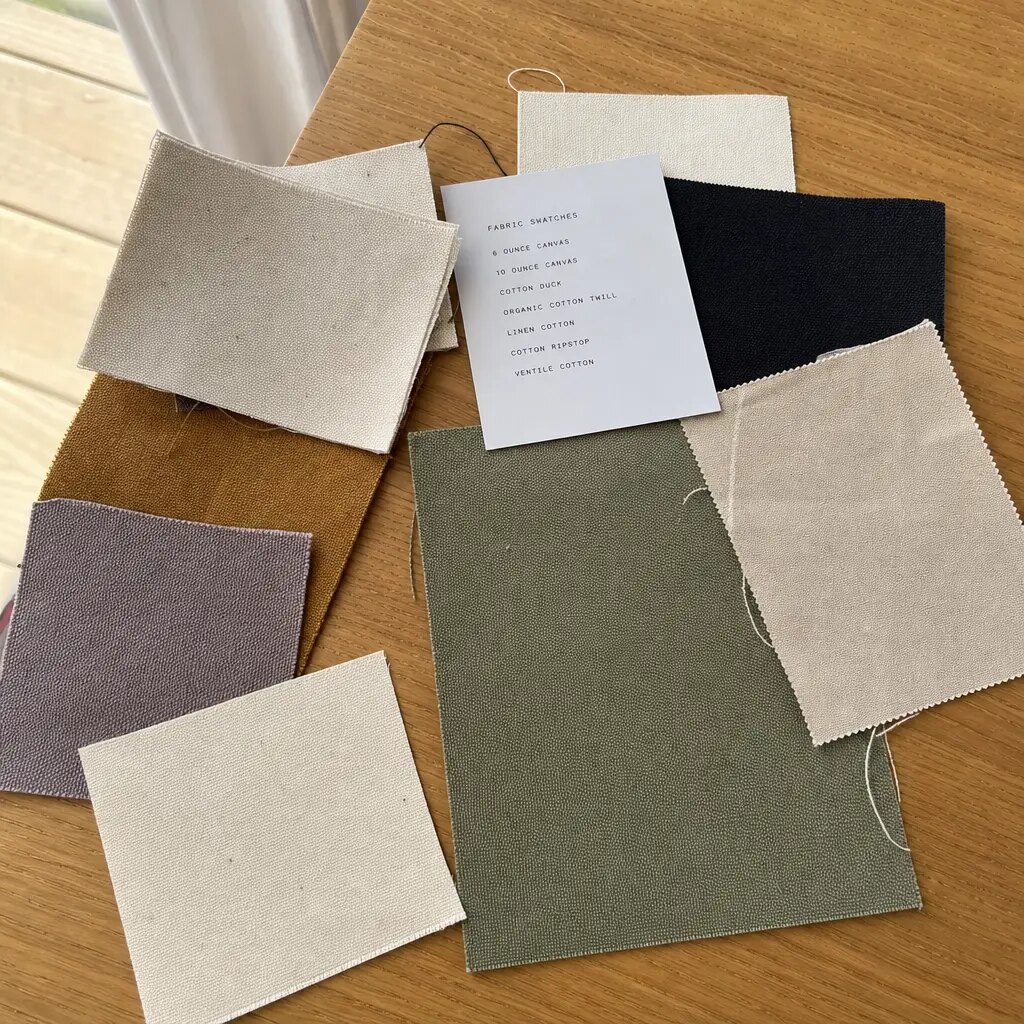
Lighter canvas can reduce the unit price, but it may look too thin when holding a glass bottle. It can also telegraph the bottle shape through the front panel, which affects how the logo reads in real use. Natural cotton canvas also has slubs and shade variation. That is not automatically a problem. It is part of the material. What matters is whether the buyer accepts that natural look or wants bleached, dyed, or tighter-weave canvas for a cleaner presentation. If exact repeat color matters across replenishment orders, say so early. Shade variation can be normal within an approved range, but the range should be defined.
Fabric weight influences print quality too. A thicker canvas can give a more stable print face, but if the weave is too coarse, fine details can break up. A lighter weave may print more crisply but lose structure under load. Buyers should therefore request both the material specification and a sample with actual printed artwork. The best decision is not always the heaviest cloth. It is the cloth that balances bottle support, print clarity, and freight efficiency for the intended use.
If the carrier is sold into retail, think about how it feels in hand and on the shelf. A slightly heavier bag may communicate value, but it also adds weight to the shipment and can complicate hanging or barcode display. For roasters planning seasonal promotions, the right fabric weight is often the one that keeps the bag stable, photographs cleanly, and stays within target shipping thresholds.
- 260 GSM and below: lower cost, softer feel, but weaker structure and more logo distortion when loaded.
- 280–340 GSM: balanced choice for most roaster gift carriers and retail bottle bags.
- 360–420 GSM: heavier handfeel, stronger structure, higher freight weight, and thicker seams.
- Dyed canvas: better brand color control but requires colorfastness review and longer material preparation.
- If the product will be retailed, ask for both bag weight and estimated packed carton weight in the quote.
Choose the print method around the artwork, not the other way around
Spot-color screen print is usually the most practical method for coffee roaster logos on canvas wine carriers. It handles black, white, cream, brown, and one-color Pantone marks efficiently at wholesale quantities. It also holds up reasonably well for reusable gifting when curing and rub resistance are controlled. On textured canvas, slightly bolder lines usually print more cleanly than hairline details, especially when the artwork includes small beans, circles, or thin outlines.
Heat transfer can reproduce gradients, small multicolor graphics, and photo-style artwork, but the finished handfeel may sit on top of the fabric rather than blending into it. That can be acceptable for short campaigns, launch packs, or highly detailed branding. The buyer should still test whether the transfer edge lifts when the carrier is folded or when the bag rubs inside a carton. Digital printing may suit short runs or sample development, but procurement should confirm color consistency and adhesion on the actual fabric, not only from a lab print.
Embroidery can look premium for a simple monogram or badge, but it is not always the best choice for narrow bottle carriers because it adds stiffness and may distort fine details. A woven label can be a better premium branding element than embroidery if the logo is detailed. Some buyers use a combination approach: a small front print, a woven side label, and a simple hangtag. That can achieve a premium look without overcomplicating the sewn panel.
When choosing the print method, ask about real limitations instead of asking what the factory can do in theory. Good questions include minimum line thickness, smallest readable text size, acceptable Pantone range, and whether the logo needs underbase on natural canvas. These practical constraints are where many brand files fail, and they are much easier to solve before production starts than after screens or transfer films are made.
- Screen print: best for 1–3 solid colors and repeat wholesale production.
- Heat transfer: useful for full-color graphics but needs adhesion and edge-lift review.
- Embroidery: premium texture, better for simple marks than fine text.
- Woven label: stable brand detail, good for side seam or lower-corner placement.
- Debossing is usually not practical on soft cotton canvas unless a special patch or composite material is added.
Single-bottle or two-bottle: structure affects pricing and risk
The structure decision should be made early because it changes material use, sewing time, and carton dimensions. A single-bottle carrier is usually the most efficient option for premium gifts, retail add-ons, and cafe counter sales. It is also the easiest format to print because the front panel is simpler and there is less internal stress on the artwork. A two-bottle carrier is better for pairings, bundles, and distributor promotions, but the divider, extra volume, and added reinforcement make it more sensitive to loading and fit.
For a two-bottle carrier, buyers should care about divider height, divider stitching, and bottle contact points. A divider that stops too low can let bottles bump during carrying. A divider that is too stiff or too close to the front panel can make insertion difficult and distort the logo area. Ask the supplier to show where the divider is anchored and whether the bottles are prevented from touching the base or the top section. That information is more useful than a generic note that the bag has a divider.
The choice also affects how the bag photographs and how customers perceive value. A single-bottle carrier can look clean and premium if the logo is well placed. A two-bottle carrier often needs more visual balance because the extra width can make the front panel feel empty if the artwork is too small. Buyers should ask for a filled sample photo before final approval, especially if the carrier will be sold online or used in retail displays.
If the roaster wants one bag family for multiple programs, it is usually better to standardize the construction and vary the print. That keeps tooling simple and helps with reorders. If the bag family needs both single- and two-bottle versions, ask whether the supplier can keep the same fabric and handle style across both so the brand looks consistent even when the structure changes.
- Single-bottle carriers are easier to load, print, and retail-store display.
- Two-bottle carriers need verified divider height and anchor points.
- Ask for filled photos because empty-bag proportions are misleading.
- Standardize fabric and handle style across sizes when possible.
- Check whether the two-bottle version changes carton fit, not just unit cost.
MOQ, artwork splits, and reorder logic for roasters with multiple locations
A common sourcing mistake is treating every artwork version as a separate tiny order. Factories do not calculate cost only from unit count. They also look at material booking, cutting efficiency, screen or transfer setup, sewing line planning, label preparation, and packing labor. If the buyer has one bag structure and fabric color but three cafe logos, the RFQ should show the total quantity and the split per artwork. That lets the factory judge whether the body can be combined through cutting and where the print setup must be split.
MOQ can be driven by different parts of the bag. Stock natural canvas may support a lower MOQ than custom-dyed canvas. A single-color print usually has a simpler setup than a multi-color transfer. Woven labels can also have their own MOQ, separate from the bag body. This matters for coffee roasters that run seasonal campaigns or multiple locations, because a low bag MOQ can still become expensive if each artwork needs its own label lot or its own screen set. Buyers should ask which cost elements scale with the bag body and which scale with each design version.
The cleanest procurement approach is to keep the structure constant and vary the artwork only when needed. If each distributor needs a different logo, plan print batches rather than changing the sewing specification. If the roaster expects repeat replenishment, ask whether the screens or label inventory can be retained, for how long, and at what storage or reactivation cost. Those details matter for true landed cost, not just first-order pricing.
It also helps to be explicit about what counts as one SKU. For example, if the bag size, canvas color, handle, and packing stay the same but the front logo changes, some factories treat that as one construction SKU with multiple print versions. Others price it as separate artworks. The RFQ should ask the supplier to state the rule, so procurement can compare offers on equal terms and avoid hidden setup charges later.
- State total order quantity, then list artwork split quantities.
- Keep the same bag size, fabric, handle, and packing across artwork versions to control cost.
- If each distributor needs a different logo, plan print batches instead of changing sewing construction.
- For repeat orders, ask whether unused woven labels or printed labels can be held and for how long.
- Do not compare supplier quotes unless MOQ assumptions and artwork split rules are the same.
Sampling should prove fit, print, and handling together
A useful sample is not just a nicely printed bag. For canvas wine carriers, the pre-production sample should be made with the intended fabric GSM, final handle material, final seam construction, final divider if any, and final print method. Buyers should insert the actual bottle and evaluate the carrier from the front, the side, and the shelf perspective. The sample must show whether the logo remains centered when loaded, whether the handle seam crowds the artwork, and whether the lower bottle bulge changes the appearance of the print.
For coffee roasters, sample approval should include both the brand team and the operations team. Brand teams check logo size, color, and message hierarchy. Operations teams notice whether the bottle is hard to insert, whether the handle feels secure, and whether packing staff can load units fast enough for the planned distribution window. A sample that slows fulfillment can create more cost than a slightly higher unit price. If the bag is meant for a retail launch, photograph it under the same lighting used for product listings or sell sheets.
The best practice is to approve sample details in writing. Include finished dimensions, print placement, stitch details, handle length, divider height, and packing method. If the sample is accepted only by verbal comments or one photo angle, the factory may interpret approval too loosely. A good pre-production sample becomes the production reference, so the buyer should keep one signed sample or a clearly labeled photo record for comparison during final inspection.
For repeat programs, ask the supplier to mark the approved sample clearly with the order number, date, and key construction notes. That sounds small, but it helps avoid confusion when a re-order comes months later and the previous bag version is still in storage. A dated sample is often the easiest way to settle disputes about logo position or handle height.
- Measure finished width, height, gusset, and handle length on the sample.
- Load the intended bottle weight and carry it for a short handling simulation.
- Take photos with the bottle inside before signing off print placement.
- Rub the printed logo lightly with a clean white cloth after curing to detect obvious transfer.
- Confirm that the approved sample is sealed or photographed clearly for factory reference.
Cost drivers should be visible in the quote, not hidden in the follow-up
A reliable quote for wholesale canvas wine carriers should show more than a unit price. Buyers need to see fabric specification, print method, number of print colors, logo size, screen or setup charge, sample charge, MOQ, lead time, packing, carton data, and payment terms. Without those details, two quotes that look different by only a few cents may not be comparable at all. Procurement teams should insist on line-item structure whenever possible, especially for branded programs that may be reordered later.
The main cost drivers are fabric weight, bag size, divider construction, handle type, print complexity, label use, order quantity, packing method, and inspection requirements. A two-bottle carrier with a full divider and reinforced handles uses more material and sewing time than a simple single-bottle sleeve. A larger front print can also increase setup handling, especially if there are multiple artwork versions or a color-matched brand tone. If the bag uses a woven side label or hangtag, the label cost may be separate from the bag cost and should be shown clearly.
Buyers should also ask whether the quote includes artwork correction, strike-off, or proofing. Sometimes the first quote omits these items and they appear later as add-ons. The procurement goal is not only the lowest price per unit. It is a clear landed-cost picture that includes what it takes to approve, produce, pack, and deliver the correct bag the first time.
A good supplier quote should also indicate which specifications are fixed and which are flexible. For example, if the supplier offers a standard natural canvas body but can change print position within a safe zone, that should be stated. If the handle stitch pattern or divider height is non-negotiable, that should also be stated. Clear boundaries prevent scope creep and reduce the chance of a late redesign.
- Fabric: GSM, weave, natural or dyed, stock or custom sourced.
- Construction: single-bottle, two-bottle, divider height, gusset, seam binding if used.
- Branding: print size, print colors, label type, label position, color-matching requirement.
- Packing: flat pack, individual polybag, retail hangtag, barcode, master carton quantity.
- Commercial terms: MOQ, sample fee, screen fee, lead time, Incoterm, payment schedule.
- Ask whether artwork corrections or extra strike-offs are billed separately.
Packing and export handling can damage a good logo
Canvas wine carriers are often packed flat, which is efficient for export freight and warehouse storage. The risk is that fresh ink can rub against another bag or crease if the carton is compressed too tightly. Large dark logos are the most vulnerable because abrasion is easy to see. If the front print is dense or covers a large area, the factory may need tissue interleaving or face-to-back stacking to reduce contact. For natural canvas, moisture control also matters because cartons can move through humid ports, transit warehouses, or retail backrooms before they are opened.
Retail buyers may require individual polybags, barcode stickers, hangtags, or inner cartons. Sustainability-focused buyers may request no individual polybag, but then the supplier must use another method to protect the print and maintain a clean retail presentation. This can include interleaving, carefully controlled carton fill, or placing printed surfaces in alternate directions. The packing method affects landed cost, warehouse handling speed, and retail compliance, so it should be decided before the quote is finalized rather than added later as a surprise.
For imported beverage gifting, carton marks should also be specified. Buyers should ask for carton size, gross weight, units per carton, and estimated CBM before confirming the order. If the carrier is heavy or a two-bottle version, carton limits become more important because handling and freight can change quickly. A good packing plan protects the logo, keeps the carton stack stable, and makes the receiving team’s job easier.
If the order will be split across multiple destinations, ask the supplier whether carton labeling can reflect those splits at source. That can save relabeling time at the warehouse and reduce mis-ships. It also makes receiving easier when the same carrier is going to stores, e-commerce fulfillment, and distributor accounts in different lanes.
- Define units per carton and maximum carton weight for warehouse handling.
- Request carton dimensions and CBM to estimate freight impact.
- Use interleaving when large printed areas face each other.
- Keep printed panels flat without over-compressing the carton.
- Specify carton marks, SKU labels, and barcode placement if the goods go to retail distribution.
Specification comparison for buyers
| Spec decision | Recommended option | When it fits | Buyer risk to check |
|---|---|---|---|
| Front logo placement | Centered on the main panel, usually 70–90 mm below the top opening, with a safe print zone sized to the actual bag pattern rather than the mockup | Best for coffee roaster logos, retail shelf display, and gift bundles where the carrier stands upright with a bottle inside | Bottle bulge can distort the artwork if the logo is too low; top seams and handle stitching can crowd the print if it is too high |
| Side label placement | Woven label in the right or left side seam, typically 25–35 mm wide, folded or end-folded | Useful when front graphics change seasonally but the brand wants a stable identifier | Thick labels can stiffen the seam; confirm label thickness, fold style, and seam allowance before cutting |
| Fabric weight | 10–12 oz cotton canvas, roughly 280–340 GSM | Balanced for bottled coffee, cold brew, wine bottles, retail gifting, and repeat use | Light canvas can sag and show bottle shape; heavy canvas increases freight weight, seam bulk, and carton cube |
| Print method | Spot-color screen print for 1–3 solid colors; transfer only when the artwork truly requires gradients or multi-color detail | Most coffee roaster logos use one to three brand colors that screen print handles efficiently | Fine distressed details can fill in on textured canvas; require a strike-off on the actual fabric, not paper |
| Carrier structure | Single-bottle carrier for premium gifts; two-bottle carrier with an internal divider for bundles and pairing sets | Single bottle suits retail gifting; two-bottle suits cold brew sets, wine-and-coffee pairings, and seasonal promotions | Divider height and anchor points must prevent bottle contact; low dividers reduce cost but raise knock and breakage risk |
| Handle construction | Cotton webbing handle stitched into side seams or reinforced front/back panels with box-X stitching | Needed when the filled carrier reaches about 1.5–3.5 kg depending on bottle type and count | Decorative handles without pull testing can fail; require sample testing and verify stitch density |
| MOQ logic | Combine same fabric and carrier structure across artwork versions; split logo colors only after base MOQ is met | Works for roasters with multiple cafes, seasonal labels, or distributor territories | Small artwork splits raise setup fees and packing complexity; the quote should separate base bag MOQ from print-version MOQ |
| Packing method | Flat pack in export carton with interleaving or face-to-back stacking when print rub risk exists | Suitable for importers shipping to warehouses, distributors, or retail DCs | Over-tight cartons can crease logos; underfilled cartons increase carton crush risk and freight cube inefficiency |
| Sample approval | Pre-production sample using bulk fabric, final logo size, final handle, and final divider construction | Required before retail launch quantities or distributor orders | A showroom sample may use cleaner fabric or different thread tension; approve only a sample made from production materials |
Buyer checklist before sampling
- Define the bottle type before requesting a quote: 750 ml wine bottle, 500 ml cold brew, 1 L bottle, or a mixed retail set.
- State whether the order is for single-bottle or two-bottle construction and whether the divider must run full height.
- Specify fabric weight in GSM or oz and confirm whether the canvas is natural, bleached, dyed, or organic cotton.
- Provide logo size, Pantone colors, print position, and whether artwork must remain visible when a bottle is inside.
- Request a print strike-off on the actual canvas, especially for small text, distressed logos, or fine coffee-bean icons.
- Separate total order quantity from artwork split quantities so the factory can calculate cutting, printing, and packing efficiently.
- Confirm handle length, handle material, and reinforcement method based on the expected filled weight.
- Set carton packing requirements, including units per carton, inner polybag policy, carton marks, and retail barcode needs.
- Include sample approval steps and who signs off on fabric, stitching, logo position, print color, and packing.
- Request quote data in a structured format: unit price, tooling or screen cost, sample cost, MOQ, lead time, carton size, gross weight, and payment terms.
Factory quote questions to send
- What GSM and oz canvas options do you recommend for a filled single-bottle and two-bottle carrier, and what is the estimated bag weight for each?
- Can you provide the safe print area for our selected carrier size, including distance from the top opening, side seams, bottom fold, and handle stitching?
- For our logo, do you recommend screen print, heat transfer, embroidery, woven label, or a combination, and why?
- What is the MOQ for the bag body, and what is the minimum quantity per artwork or print-color change?
- Will the pre-production sample be made with bulk fabric, bulk thread, final handles, final divider, and final print method?
- What print tolerance do you control in bulk production for logo position, color difference, and registration?
- How will printed bags be packed to prevent ink transfer, creasing, moisture, and carton deformation during export shipping?
- What are the estimated lead times for material booking, sample making, bulk cutting, printing, sewing, packing, and final inspection?
- What quote items are charged separately, such as screens, woven labels, sample freight, Pantone ink matching, barcode stickers, or inner cartons?
- Can you share carton dimensions, units per carton, gross weight, and estimated CBM before order confirmation?
Quality-control points to confirm
- Logo position tolerance should be defined before bulk production, commonly within plus or minus 5 mm for screen print on sewn canvas.
- Screen print color should be compared against the approved strike-off under consistent light, with acceptable variation agreed before production starts.
- Handle pull strength should be tested on filled-weight simulation, not only by visual inspection.
- Divider stitching in two-bottle carriers should be secure from top opening to lower anchor point so bottles do not collide during carrying.
- Seam allowance and stitch density should be consistent; loose thread, skipped stitches, and broken bar tacks are rejectable defects.
- Finished-size tolerance should be suitable for the bottle diameter and height; a beautiful bag that is too tight is a commercial failure.
- Natural canvas shade variation should be controlled within the approved range, especially if repeat orders will sit beside older stock in retail stores.
- Printed panels should not show heavy ink bleeding, pinholes beyond the approved standard, ghosting, or pressure marks from packing.
- Cartons should pass basic handling requirements with correct shipping marks, dry packaging, and no over-compression of printed faces.
- Final inspection should include filled-bottle fit testing on random cartons, not only flat-table measurement.