Start With the Bottle and the Carton
For coffee roasters, a canvas wine carrier is often used for more than wine. It may hold bottled cold brew, coffee concentrate, flavored syrup, barrel-aged releases, co-branded retail bottles, or holiday gift sets. That makes the sourcing question more operational than decorative. The carrier has to fit the bottle, protect the brand presentation, pack efficiently, and arrive in a carton your warehouse can receive without repacking.
The best wholesale canvas wine carriers for coffee roasters carton packing plan begins with the bottle and the master carton, not the lowest sewing price. A lower unit price can disappear quickly if the carrier folds poorly, ships with too much air, crushes the handle in transit, or requires your team to recount cartons by hand. Procurement should ask suppliers for product cost and carton data in the same quote.
Before approving a design, decide how the carrier moves through your business. A carrier shipped empty to a cafe chain has different requirements from a retail-ready two-bottle gift set. A distributor sample kit needs counting accuracy and clean carton marks. A direct-to-consumer gift may need a stiffer base, a cleaner presentation, or a closure that keeps bottles from shifting.
- Define the use case: cafe retail, wholesale buyer gift, holiday bundle, distributor kit, subscription insert, or DTC fulfillment.
- State whether units ship empty, flat-folded, retail-ready, or packed with bottles later.
- Request pieces per carton, carton dimensions, gross weight, net weight, and CBM with the first quotation.
- Ask whether the carrier will be palletized, floor-loaded, mixed with other SKUs, or stored for seasonal release.
- Check that the carton count supports warehouse receiving without manual repacking or recounting.
Build a Coffee-Roaster Specification
A practical RFQ should describe the exact bottle format. Coffee bottles vary widely: stubby cold brew bottles, tall syrup bottles, concentrate bottles with narrow necks, swing-top glass, aluminum closures, and private-label glass can all behave differently inside the same carrier. A wine-bottle pattern may look acceptable in photos and still fail when used with a broad-shouldered cold brew bottle.
Send the supplier a physical bottle when possible. If that is not practical, provide a drawing with base diameter, maximum body diameter, shoulder width, neck diameter, cap height, total height, label thickness, and filled weight. For two-bottle carriers, say whether both bottles are identical or whether the set combines coffee concentrate with syrup, tonic, bitters, or another retail product.
The carrier spec should use finished dimensions, not cutting dimensions. Sewing, washing, dyeing, coating, and folding can all change the final size. For procurement comparison, ask suppliers to confirm finished width, height, depth or gusset, handle drop, divider width, bottle cavity, closure position, and tolerance. This gives quality control something measurable to inspect.
- Use actual filled weight when setting handle and seam requirements.
- Include cap and closure clearance, especially for swing caps, wax seals, pump tops, or tall screw caps.
- Specify whether bottle labels can touch the fabric or need clearance to avoid scuffing.
- Set the finished bottle cavity tolerance before sample approval.
- Ask the factory to test bottle insertion and removal, not only static fit.
Choose Canvas Weight by Function
Canvas weight should be quoted as finished GSM or oz. Words such as thick, premium, heavy, or export grade are not precise enough for a purchase order. For many one-bottle or entry retail programs, 10 oz to 12 oz canvas can provide enough structure without inflating carton volume. For two-bottle gift carriers or heavier filled sets, 12 oz to 14 oz may be more appropriate.
Heavier fabric is not automatically better. A 14 oz canvas may hold shape more cleanly, but it can reduce pieces per carton, increase gross weight, and make folding bulkier around handles and dividers. A 10 oz canvas may pack efficiently but collapse around heavier bottles or show more print-through. The right choice depends on the bottle weight, divider design, base support, logo method, and packing route.
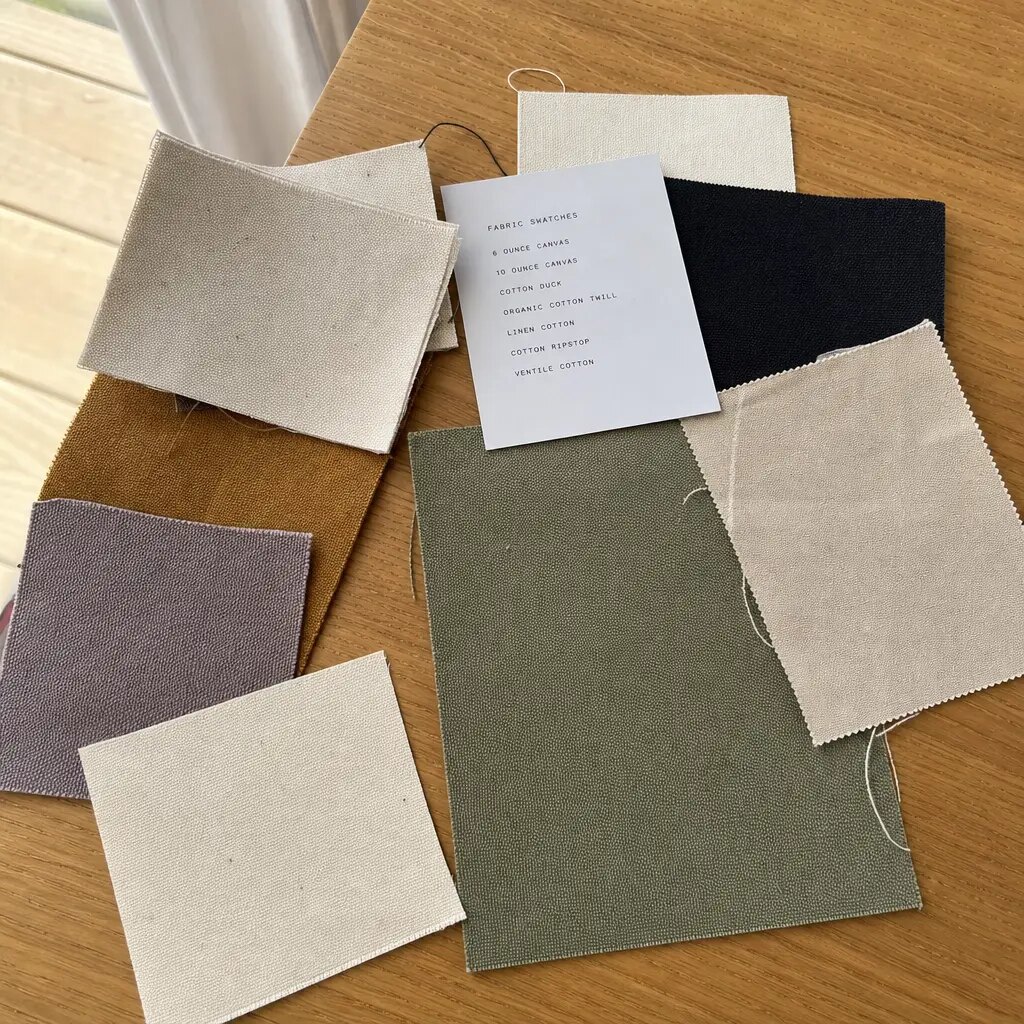
Finishing matters as much as nominal weight. Natural canvas can suit a roaster brand, but shade variation may be visible across panels. Dyed canvas can improve brand color control but may raise MOQ. Washed canvas feels softer but may shrink more. Coated canvas can resist marks but may change hand feel and print behavior. Ask suppliers to quote the finished material, not just raw greige fabric.
- Ask for finished GSM or oz, fabric composition, weave, finish, color reference, and shrinkage range.
- Compare 10 oz, 12 oz, and 14 oz samples using the same bottle and the same folding method.
- Check whether a fabric upgrade changes pieces per carton and CBM per 1,000 pieces.
- Approve color against a physical swatch when natural shade variation matters to the brand.
- Confirm whether the fabric is pre-shrunk, washed, dyed, coated, or calendered.
Design Construction Around Handling
Canvas bottle carriers fail most often at stress points: handle joins, divider seams, bottom corners, and closure areas. These are also the areas most affected by carton compression. A clean-looking sample is not enough if it has not been loaded, lifted, folded, packed, and unpacked in the way your warehouse will actually use it.
Specify handle construction clearly. A self-fabric handle may match the body visually, while webbing may improve durability and consistency. Define handle drop, reinforcement length, stitch pattern, bartack location, and whether the handle must clear the bottle cap when lifted. For heavier bottles, ask for a load test that reflects the filled carrier, not an empty bag.
For two-bottle carriers, the divider is a functional part, not a cosmetic seam. It should prevent bottle-to-bottle contact without making insertion slow or causing the bottles to lean. A bottom board can improve standing stability for retail presentation, but it adds cost, folding thickness, and sometimes extra packing labor. Treat each reinforcement as a decision with carton impact.
- Define handle type, handle drop, bartack count, box stitch size, and reinforcement length.
- Set divider height and width based on the actual bottle shoulder and body profile.
- Test whether the filled carrier stands upright if counter or shelf presentation matters.
- Ask whether the bottom board is sewn in, removable, or inserted during packing.
- Reject samples that twist, lean, or strain at seams after normal bottle loading.
Select Branding That Survives Packing
Brand decoration should be chosen with carton handling in mind. A large screen print may look strong on a flat sample but scuff when units are tightly folded, stacked, or rubbed against carton walls. A woven side label or small sewn patch may better fit a premium roaster gift set because the mark is controlled, subtle, and less exposed.
Screen print is usually efficient for simple one-color artwork and larger repeat runs. Ask for print area limits, screen fees, ink type, placement tolerance, and repeat charges. Multi-color print can work, but registration should be checked on the final canvas texture. Heat transfer can support detailed artwork, but buyers should ask for abrasion checks if cartons are packed tightly.
Embroidery can feel substantial, but it can pucker lighter canvas and reduce usable cavity space if placed on a tension panel. Woven labels, folded tabs, and sewn patches shift some risk away from fabric texture, but they add label MOQ, lead time, and placement inspection. The safest approval is always on a production-representative sample made from final fabric.
- Use screen print for simple logos, larger runs, and broad visibility.
- Use woven labels or sewn patches for subtle premium branding and lower scuff exposure.
- Set logo placement tolerance, commonly +/-3 mm to +/-5 mm depending on artwork size.
- Check rub resistance on final canvas after folding and carton contact.
- Approve decoration on a loaded sample because panel shape can change around the bottle.
Compare Supplier Routes Clearly
Supplier choice should be based on control, not only unit price. A direct sewing factory may be strongest for repeat custom programs because it can control pattern, bottle fit, handle reinforcement, and packed-carton count. A trading company may be useful if the roaster is buying several textile and packaging items together. A stock-bag supplier may be best for a fast test where exact fit and carton optimization are less critical.
The risk is hidden ownership. If sewing, printing, label production, carton sourcing, and final packing are spread across unnamed partners, revisions can slow down and accountability becomes unclear. Ask who owns each step and who signs off before goods are packed. A supplier that cannot explain the packing method early is not ready to quote landed cost reliably.
For procurement, the comparison should normalize the same bottle, same carrier style, same artwork, same order quantity, and same delivery route. Then compare what changes: sample cost, MOQ, lead time, carton count, CBM, inspection plan, and ability to repeat the same spec. That produces a decision, not just a price list.
- Use direct factory sourcing when custom fit, repeat orders, and carton control matter most.
- Use stock plus branding for quick cafe tests or low-risk promotional runs.
- Ask trading companies which steps are subcontracted and how inspection records are shared.
- Confirm who designs and approves master cartons before bulk packing.
- Require every supplier to quote carton dimensions and CBM so prices can be compared fairly.
Read the Quote Beyond Unit Price
A useful quote separates the cost drivers. Procurement should be able to see sewing, fabric upgrade, logo method, woven label or patch, divider, bottom board, individual wrap, hangtag, master carton, printed carton marks, sample fee, setup fee, and special packing labor. When these are buried in one unit price, supplier comparisons become unreliable.
For example, one supplier may quote a lower bag price but exclude individual wrapping, carton marks, and woven label cost. Another may include a higher unit price with a better carton plan and lower CBM. Without the line items, the cheaper quote may not be cheaper at landed cost. Ask each supplier to show CBM per 1,000 pieces and estimated cartons per order.
MOQ should also be unpacked. The bag MOQ may be low, while the custom fabric color, label, screen print, printed carton, or custom carton size has a higher MOQ. Coffee roasters testing a first seasonal bottle program should know which component creates the real inventory commitment before approving artwork or packaging.
- Ask for line-item pricing for sewing, decoration, label, divider, base support, wrap, carton, and packing labor.
- Request setup fees, screen charges, label MOQ, sample fees, and repeat-order charges separately.
- Compare total CBM, cartons per order, and gross weight, not only ex-factory unit price.
- Clarify whether barcode labels, carton marks, carton numbering, and PO labels are included.
- Ask what price or carton count changes if fabric weight or divider stiffness changes after sampling.
Use Carton Math Before PO Release
Carton planning protects margin because canvas carriers are bulky relative to their value. Small changes in folding thickness, handle height, divider construction, or individual packaging can change pieces per carton. For empty carriers, a density-focused plan may use flat folding and bundled packing. For retail-ready units, a protection-focused plan may use paper wrap, individual bags, inner cartons, or extra clearance around labels and handles.
Ask for two carton options when order value justifies the review. One option should optimize freight density, with higher pieces per carton and controlled folding. The other should optimize protection, with fewer pieces, less compression, and stronger board if needed. Compare carton outer dimensions, pieces per carton, gross weight, CBM per 1,000 pieces, and likely pallet pattern.
A simple carton calculation keeps everyone honest. If a carton holds 100 empty carriers and measures 50 x 40 x 35 cm, the carton CBM is 0.07. Ten cartons for 1,000 pieces equal 0.70 CBM. If a heavier divider drops the carton count to 70 pieces in the same carton, 1,000 pieces need about 14.3 cartons, or roughly 1.0 CBM. The unit sewing cost may look unchanged while freight volume rises by more than 40 percent.
Gross weight needs the same attention. A carton should be heavy enough to use space efficiently but not so heavy that warehouse teams struggle with receiving or retail distributors reject it. If carriers are packed with inserts, bottom boards, or retail tags, ask for final gross weight from a packed sample, not a theoretical estimate.
- Calculate CBM per carton as length x width x height in meters.
- Calculate CBM per 1,000 pieces so different carton counts can be compared directly.
- Check gross weight per carton against your warehouse handling limit.
- Inspect packed cartons for swelling, crushed handles, torn wraps, and product movement.
- Approve carton marks and barcode label position before bulk packing starts.
Set QC With Testable Thresholds
Quality control should be written so the factory and inspector can measure it. For canvas bottle carriers, the core checks are fabric, dimensions, stitching, handle strength, bottle fit, decoration, packing, and carton condition. A generic export-quality standard is not enough because the product can pass visually while failing in use.
Dimension checks should be made on finished goods after sewing and decoration. Key bottle-fit points often need tighter control than overall bag dimensions. Many buyers use +/-5 mm for cavity width, divider width, and handle drop, and +/-8 mm for less critical overall dimensions, but the correct tolerance should match the bottle and design. If the bottle is tight, reduce tolerance or adjust the pattern before bulk cutting.
Handle strength should use an agreed filled weight and hold time. A practical method is to load the carrier to the intended filled weight plus a safety margin, suspend or lift it for the agreed time, and check for seam tearing, bartack failure, elongation, or fabric damage. For two-bottle gift carriers, test the full intended load, not one empty sample.
Decoration checks should include position, color, edge clarity, registration, label stitching, and rub resistance. Packing checks should verify carton quantity, folding method, individual wrap, carton dimensions, gross weight, sealing, carton marks, and barcode placement. A good carrier in a poor carton can still arrive as a warehouse problem.
- Treat broken handles, open seams, wrong logo, wrong quantity, severe stains, and failed bottle fit as major defects.
- Treat small trimable threads, slight allowable slub, or minor placement drift within tolerance as minor defects.
- Use the approved bottle or gauge for fit checks, not a random factory bottle.
- Inspect loose units and packed cartons because compression defects may only appear after packing.
- Ask the supplier to record defect categories on repeat orders so quality drift is visible.
Protect the Schedule for Reorders
Lead time is often lost before sewing begins. Bottle drawings arrive late, artwork changes after sample approval, label proofs wait for brand review, or cartons are ordered before the packed sample is measured. Procurement can reduce delays by freezing the bottle, fabric, decoration, construction, and carton plan before bulk cutting.
A sensible approval path includes fabric swatch, artwork proof, pre-production sample, bottle-fit approval, packed-carton sample if needed, bulk material release, cutting, decoration, sewing, final inspection, and shipment booking. Some steps can overlap, but risky overlaps should be avoided. Printing panels before final artwork approval or cutting bulk fabric before bottle-fit approval can create expensive rework.
Repeat orders are easier when the buyer preserves the full approved spec. Keep the physical sample, fabric swatch, artwork file, label details, carton dimensions, carton marks, inspection notes, and any approved tolerance changes. Before reordering, ask whether the same fabric source, label lot, screen, carton board, and subcontracted decoration process are still available. If one component changed, request a targeted approval sample rather than assuming the repeat will match.
- Freeze bottle dimensions, artwork, carrier dimensions, fabric, logo method, and carton count before bulk cutting.
- Assign one approval owner so supplier comments do not bounce between marketing, sales, logistics, and procurement.
- Add time for custom-dyed canvas, woven labels, printed cartons, and holiday-season capacity pressure.
- For reorders, confirm fabric source, label stock, screen condition, carton size, and packing method before deposit.
- Do not book tight freight windows until packed-carton dimensions and gross weight are confirmed.
Specification comparison for buyers
| Decision point | Best-fit option | Choose it when | Trade-off to check |
|---|---|---|---|
| Fast market test | Stock canvas bottle bag with simple screen print or sewn label | You need 100 to 500 pieces for a cafe launch, subscription insert, or seasonal retail test | Bottle fit and carton density are fixed by the stock style; confirm cavity size before approving artwork |
| Repeat gift program | Custom sewn carrier with approved bottle gauge and fixed carton count | You plan repeat orders for holiday sets, cold brew bottles, syrup bottles, or wholesale customer gifts | Requires more approval work up front, but gives better control of fit, logo placement, and packing |
| Freight-density pack | Flat-folded carriers, bundled or individually wrapped, in a higher-count master carton | The carrier ships empty to your warehouse or distributor and presentation can be handled later | Handles and dividers can crease if packed too tightly; inspect a packed carton before bulk release |
| Protection-focused pack | Lower carton count with controlled folding, paper wrap, divider protection, or inner carton | The carrier is retail-ready, has a premium label, or will be handled by multiple warehouses | Higher CBM per 1,000 pieces and more packing labor; compare against damage and rework risk |
| One-bottle carrier | 10 oz to 12 oz canvas with reinforced handle and clear cavity tolerance | You sell single bottled cold brew, concentrate, syrup, or tasting-room add-ons | Too much fabric weight can reduce carton count without improving function |
| Two-bottle carrier | 12 oz to 14 oz canvas with stitched divider, base reinforcement if needed, and load test | You sell paired bottles, holiday bundles, cafe partner gifts, or premium retail sets | Divider bulk affects folding thickness; carton count may drop if the divider is stiff |
| Quiet brand finish | Small woven side label, folded tab, or sewn patch | Your roaster brand wants a reusable carrier that feels retail-clean without a large print area | Label MOQ and lead time may exceed the bag MOQ; confirm label inventory for reorders |
| Large visible logo | One-color screen print on approved finished canvas | You need strong shelf visibility, lower decoration cost, and repeatable artwork on larger runs | Canvas texture can break fine details; set print placement and rub-resistance requirements |
| Custom carton size | Master carton sized around the approved folded carrier and target gross weight | You import by volume, palletize, or need predictable receiving counts | Custom cartons may have MOQ, tooling, or longer lead time; do not order before packed-sample approval |
Buyer checklist before sampling
- List the exact bottle format: cold brew, concentrate, syrup, wine, collaboration bottle, or mixed set.
- Provide base diameter, maximum body diameter, shoulder width, neck diameter, cap height, total height, label thickness, and filled weight.
- State whether the carrier ships empty, flat-folded, retail-ready, loaded with bottles, or bundled with other coffee merchandise.
- Specify finished carrier dimensions with tolerances for width, height, gusset or depth, handle drop, divider width, and bottle cavity.
- Ask suppliers to quote finished canvas weight in GSM or oz, including finishing, dyeing, washing, coating, and expected shrinkage.
- Choose the logo method based on artwork size, order quantity, abrasion risk, and whether units are packed tightly in cartons.
- Require a pre-production sample made with final fabric, final handle, final divider, final closure, and final logo placement.
- Request a packed-carton layout with inner dimensions, outer dimensions, pieces per carton, net weight, gross weight, and CBM.
- Ask for CBM per 1,000 pieces so freight impact can be compared across suppliers and packing options.
- Separate costs for sewing, fabric upgrade, logo, label, divider, bottom board, wrap, master carton, special carton marks, and packing labor.
Factory quote questions to send
- Which finished canvas weight do you recommend for our bottle size and filled weight, and can you quote 10 oz, 12 oz, and 14 oz versions for comparison?
- Is the quoted fabric natural, bleached, dyed, washed, coated, or pre-shrunk, and what color and shrinkage tolerance will you guarantee?
- Can you make a bottle-fit sample using our physical bottle or a dimensioned bottle drawing with base, shoulder, neck, cap, height, and filled weight?
- What cavity tolerance do you recommend so the bottle inserts smoothly but does not swing or distort the carrier during handling?
- Which logo method is included in the quote, and what are the setup fees, artwork requirements, color limits, placement tolerance, and repeat-order costs?
- For a small coffee-roaster brand mark, would you recommend screen print, woven label, sewn patch, embroidery, or heat transfer, and why?
- Do you cut and sew in-house, and are printing, label sewing, carton sourcing, and final packing handled by your team or by named partners?
- Can you quote two packing plans: one freight-density option and one protection-focused option, each with carton size, pieces per carton, gross weight, and CBM?
- What is the MOQ for the bag, custom fabric color, print, woven label, printed carton, and custom carton size, and can those MOQs be separated?
- What inspection checks do you perform for dimensions, handle load, seam strength, divider alignment, print rub, label position, bottle fit, and carton quantity?
Quality-control points to confirm
- Finished width, height, gusset or depth, handle drop, divider width, and bottle cavity should be measured on finished sewn goods; typical tolerance should be agreed in advance, often +/-5 mm for key fit points and +/-8 mm for noncritical overall dimensions.
- Canvas weight should be checked against the approved finished fabric spec; a common acceptance band is +/-5% GSM unless a different tolerance is agreed with the mill or supplier.
- Color should match the approved swatch under consistent light; large panel-to-panel shade difference, obvious dye streaks, or mixed-lot appearance should be treated as a major defect for retail programs.
- Fabric should be free from stains, oil marks, holes, mildew odor, broken yarns, severe slubs outside the approved standard, and weak or fraying edges.
- Cut panels should follow the approved grain direction; loaded carriers should not twist, lean sharply, or show uneven side-panel tension after bottle insertion.
- Stitching should have consistent stitch density, no skipped stitches over 10 mm, no open seams, no broken bartacks, no needle cuts, and no loose thread clusters that cannot be trimmed cleanly.
- Handle attachment should match the approved reinforcement method and pass a load check using at least the intended filled weight multiplied by the agreed safety factor; no seam tearing, bartack failure, or visible handle separation should occur after the hold time.
- Bottle fit should be tested with the approved bottle or gauge; the bottle should insert by hand without forcing, remain upright, and avoid excessive side-to-side movement or contact between bottles in a two-bottle carrier.
- Divider, partition, neck loop, tie, snap, bottom board, or insert should stay aligned during bottle insertion, carton packing, and unpacking, with no abrasion against the bottle label area.
- Print position should stay within the approved placement window, commonly +/-3 mm to +/-5 mm depending on artwork size; wrong logo, wrong color, severe tilt, smearing, or poor registration should be treated as major defects.