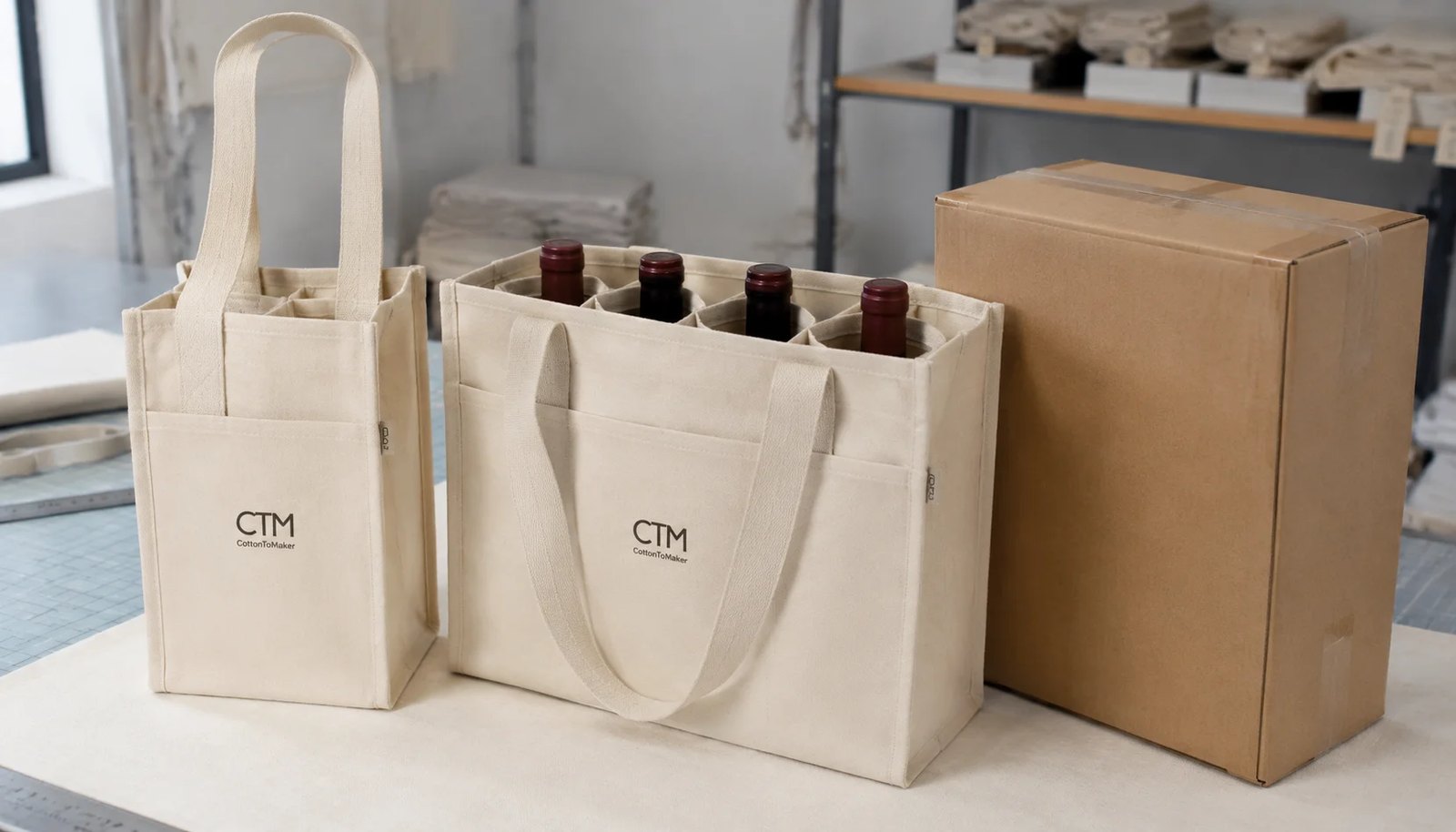
The Buying Problem
Wholesale canvas wine carriers look simple on a quote sheet, but they create problems when the RFQ only says “canvas wine bag with logo.” Liquor retailers and distributors are usually buying a functional carryout item, a branded reusable bag, and a warehouse-handled retail supply at the same time. The carton packing plan affects the cost almost as much as the fabric and print, because these carriers are bulky after sewing and can crush, crease, or distort when packed without a plan.
For a retail program, the useful RFQ starts with the bottle format and ends with the carton. A supplier needs to know whether the bag must carry one, two, four, or six bottles; whether the bottles are standard 750 ml wine, wider sparkling wine, spirits bottles, or mixed liquor assortments; and how the units should arrive at the distribution center. Without that information, quotes may look cheaper but will not be comparable.
- State bottle type and quantity per carrier before discussing artwork.
- Treat the divider layout as a structural part, not a decoration.
- Approve carton packing before mass production, not after goods are sewn.
- Compare quotes by delivered usable unit, not only by factory unit price.
Carrier Format
The most common retail wine carrier formats are 1-bottle, 2-bottle, 4-bottle, and 6-bottle. For liquor retailers, the 2-bottle and 4-bottle versions are often the better commercial balance: they feel substantial enough for gifting or loyalty programs, but they are still manageable for carton packing and customer carryout. A 6-bottle canvas carrier can be useful for wine clubs, but the loaded weight makes handle construction and carton compression more critical.
The bottle cells must be sized against the actual bottle mix. A standard 750 ml Bordeaux bottle does not behave like a Champagne bottle or a squat spirits bottle. If the divider is too tight, the customer struggles at checkout. If it is too loose, bottles knock together and the carrier feels cheap. For RFQ purposes, provide the bottle diameter range, bottle height range, and target maximum loaded weight.
- 1-bottle carrier: good for gift packaging and premium single bottle promotions, but lower perceived utility after purchase.
- 2-bottle carrier: common for retail checkout, tasting sets, and seasonal promotions; easier to pack flat than larger formats.
- 4-bottle carrier: useful for club orders and multi-buy promotions; needs stronger handles and divider anchoring.
- 6-bottle carrier: possible in canvas, but should be treated as a load-bearing bag with stricter testing.
Fabric Selection
For wholesale canvas wine carriers, 10 oz to 12 oz cotton canvas is usually the practical range. In GSM terms, that is roughly 340 to 410 GSM depending on yarn and weave. This weight gives a better print face, enough body for the bag to stand, and stronger stitch holding around handles and dividers. Lighter 8 oz canvas can reduce cost, but it often collapses when loaded and may look weak beside glass bottles.
Heavier 14 oz or 16 oz canvas can be specified for premium reuse programs, but buyers should understand the tradeoff. Heavy fabric increases unit cost, needle wear, sewing time, carton volume, and shipping weight. It also makes folding less clean, which may create carton pressure marks across printed panels. For most liquor retail programs, a well-sewn 12 oz canvas carrier performs better than an overbuilt bag with no carton plan.
- Specify fabric as “10 oz cotton canvas, approx. 340 GSM” or “12 oz cotton canvas, approx. 410 GSM” instead of only “heavy canvas.”
- Request a fabric swatch before artwork approval if color shade matters.
- Use natural canvas for lower risk and faster sourcing; dyed canvas needs shade tolerance and fabric lead time.
- Clarify whether the canvas is washed, unwashed, bleached, or natural greige, because shrinkage and color tone change the final look.
Construction Details
The divider is where many canvas wine carrier problems start. A divider that is only tacked at the top can shift during loading and allow bottles to hit each other. A stronger construction uses dividers sewn into the side seam and bottom seam, with enough height to separate the bottle bodies. For higher-end orders, a lightly padded divider or double-layer canvas divider can improve feel, but it adds thickness and affects carton count.
Handles need the same attention. A narrow handle may reduce fabric consumption, but it concentrates pressure on the hand and on the stitch point. For 2-bottle and 4-bottle formats, self-fabric canvas handles with box stitching or cross stitching are a safer default. Handle drop should be long enough for customer carryout but not so long that the loaded carrier swings too much.
- Use reinforced handle stitching at all four anchor points.
- Avoid placing print artwork directly under handle stress areas.
- Set divider height high enough to reduce bottle contact but low enough for easy insertion.
- For 4-bottle carriers, test lifting from the handle after loading with the heaviest likely bottle mix.
- Bottom gusset and side seams should be aligned so the carrier stands square when loaded.
Logo And Print
Screen printing is the usual choice for wholesale canvas wine carriers when the design is a solid store logo, brand mark, or simple campaign graphic. It is durable, cost-efficient at volume, and works well on natural cotton canvas. The RFQ should state print size, color count, Pantone reference if required, and exact placement from the top edge or side seam. A “front logo” instruction is not enough for repeatable production.
Heat transfer or digital transfer can fit detailed artwork, gradients, or small promotional runs, but it should be tested for flexing and rub resistance on canvas texture. Embroidery is possible for premium programs, but it adds cost and can pucker the fabric if the logo is large. For liquor retail, most buyers get the best balance from one-color or two-color screen print placed on the broad front panel away from folds and seams.
- Keep the logo at least a practical production margin away from stitched dividers and handle bases.
- Approve ink color on the actual canvas color, not only on a digital proof.
- Include acceptable print position tolerance, for example +/-5 mm or a supplier-agreed standard.
- For dark dyed canvas, confirm whether an underbase print is required for color opacity.
- Add a simple rub check to sample approval when bags will be stacked or compressed in cartons.
MOQ Logic
MOQ depends on how much of the order is standard and how much is custom. A standard natural canvas fabric, standard 2-bottle pattern, and one-color screen print can usually be quoted at a lower MOQ than a dyed canvas, custom divider structure, custom pocket, and multi-color artwork. Buyers should separate the MOQ for fabric, printing, sewing, and packing, because the limiting factor is not always the bag factory.
For a first retail test, a standard size with custom print is often the lower-risk route. For a chain rollout or distributor program, custom sizing may be justified if it improves bottle fit, carton cube, or shelf presentation. A lower MOQ quote is not automatically better if the supplier cannot hold the same construction for repeat orders.
- Stock fabric plus standard pattern: better for pilot orders and seasonal promotions.
- Custom dyed canvas: better for brand control, but requires shade approval and longer material lead time.
- Custom size: useful when bottle mix or carton packing efficiency is important.
- Custom divider or padded structure: valuable for premium programs, but sample testing becomes more important.
- Repeat orders should lock the pattern, fabric weight, print position, and carton plan under one approved spec.
Carton Packing Plan
The carton packing plan should be part of the quote, not an afterthought. Canvas wine carriers are not flat fabric panels; once handles, gussets, and dividers are sewn, the unit has uneven thickness. If too many units are forced into a carton, the printed face can crease, the handles can bend permanently, and the first cartons in the stack may arrive distorted. If too few units are packed, ocean freight and warehouse handling cost increase.
A practical plan defines unit fold method, inner packing, units per carton, carton ply, carton dimensions, gross weight, net weight, carton mark, and pallet pattern if needed. For export, a 5-ply carton is a common starting point for heavier canvas carriers. The carton should be strong enough for stacking but not so oversized that units shift during transport.
- Flat fold each carrier consistently so printed panels are not sharply compressed.
- Use bundle packing when individual polybags are not required; use individual polybags only when retail handling or humidity protection requires it.
- Keep carton gross weight practical for warehouse handling, commonly under a buyer-defined limit such as 15-20 kg.
- Request a packed carton photo before shipment showing count, fold method, and carton fill.
- For mixed SKUs, avoid mixed cartons unless the receiving warehouse has approved the marking and count method.
Sample Approval
A good sample approval process checks more than appearance. The pre-production sample should use the final fabric weight, final divider method, final handle stitching, and final print size. If the factory sends a sample made from substitute fabric just to show shape, it can be useful for early discussion but should not release bulk production. The approved sample becomes the control for QC and dispute handling.
The sample should be loaded with real bottles or equivalent weight blocks. Look for bottle fit, divider movement, handle comfort, seam strain, print cracking after folding, and whether the carrier stands square. Measure the sample against the RFQ and record the accepted tolerances. This prevents arguments later when bulk goods vary slightly from the drawing.
- Approve fabric swatch, printed panel, and full sewn sample separately when timing allows.
- Photograph the sample loaded and unloaded for the production file.
- Measure finished width, height, gusset, handle drop, divider width, and print placement.
- Fold the sample the same way planned for carton packing and inspect print crease risk.
- Do not approve mass production from a digital mockup alone.
Lead Time Risks
Lead time for wholesale canvas wine carriers is driven by material availability, sample approval speed, artwork clarity, sewing complexity, and packing requirements. Standard natural canvas with one-color print is usually simpler than dyed fabric or multi-color transfer printing. Custom dyed canvas adds fabric production and shade approval time. A revised sample can also reset the schedule if the bottle fit or print position changes.
Retail buyers should build the schedule backward from the in-store date or distribution center required date. Add time for sample courier, physical review, purchase order approval, bulk material booking, production, inspection, export packing, freight, customs, and inland delivery. If the cartons require special labeling, palletization, or retailer routing compliance, that work belongs in the timeline from the start.
- Freeze artwork before sample production to avoid repeated screen or transfer setup.
- Confirm fabric stock before issuing a purchase order for urgent orders.
- Allow extra time for dyed fabric, special handles, padded dividers, or nonstandard carton packing.
- Schedule inspection before final carton sealing when carton count and packing quality are critical.
- Put the latest acceptable ship date and required arrival date in the PO.
Quote Comparison
A factory quote for canvas wine carriers should be detailed enough to compare construction, not just price. Two suppliers may both quote a 2-bottle canvas carrier, but one may include 12 oz canvas, stitched dividers, reinforced handles, 5-ply cartons, and screen setup, while another may quote lighter fabric, simple tacks, and thin cartons. The cheaper quote can become more expensive after failures, repacking, or freight changes.
Build a comparison sheet using the same assumptions for every supplier. Include fabric weight, bag dimensions, divider method, handle specification, print method, MOQ, sample cost, production lead time, carton quantity, carton size, gross weight, and trade term. For landed cost, add ocean or air freight, duty, customs fees, destination handling, inland freight, inspection cost, and any retailer compliance charge.
- Do not compare EXW, FOB, CIF, and DDP prices without normalizing freight and responsibility.
- Separate one-time costs such as screens, sample courier, and artwork setup from repeat unit cost.
- Calculate carton cube per 1,000 units to see the freight effect of the packing plan.
- Review carton gross weight against warehouse handling limits before approving the lowest unit price.
- Keep a record of the approved sample and quote version used for the PO.
Specification comparison for buyers
| Spec decision | Recommended option | When it fits | Buyer risk to check |
|---|---|---|---|
| Fabric weight | 10 oz to 12 oz cotton canvas, about 340-410 GSM | Most 1-bottle, 2-bottle, and 4-bottle retail wine carriers where shape retention and print surface matter | Very light canvas may collapse around glass bottles; very heavy canvas raises freight cost and can make folding carton packing less efficient |
| Bottle capacity | 2-bottle or 4-bottle construction with stitched internal dividers | Liquor stores, wine clubs, tasting rooms, and gift sets that need stable separation during customer carryout | Loose dividers can shift in transit; divider height should cover the shoulder area enough to prevent bottle knock |
| Handle construction | Self-fabric canvas handles with cross-stitch or box-stitch reinforcement | Retail use where the carrier may hold heavy glass bottles and be reused by customers | Single line stitching or narrow handles can fail during loaded carry tests, especially with 4-bottle formats |
| Print method | Screen print for solid logos; heat transfer only for detailed multi-color artwork | Brand logos, store marks, seasonal wine programs, and distributor campaigns | Thick ink can crack on folded seams; print position must avoid divider stitch lines and handle attachment areas |
| Packing method | Flat packed by unit, then inner polybag or bundle, then 5-ply export carton | Bulk retail replenishment where warehouse counting and carton stability are important | Over-compressed cartons can crease printed panels; carton size must match pallet and container loading plan |
| MOQ route | Stock canvas and standard size for lower MOQ; custom size and dyed fabric for higher MOQ | Buyers balancing test orders against brand-specific packaging needs | A low MOQ quote may hide a stock-only limitation, while dyed fabric may require fabric mill MOQ and longer lead time |
| Supplier option | Direct bag factory for repeat bulk orders; trading company only when consolidating many item types | Liquor retail chains, distributors, and importers managing repeat PO programs | Factory quotes give better construction control; traders may be useful for consolidation but need clearer inspection ownership |
| Sample approval | Pre-production sample using final fabric weight, final divider layout, and final print size | Any custom logo order or new carton packing plan before mass production | A photo sample is not enough for loaded fit, odor, print rub, handle strength, and carton compression checks |
| Carton marking | Neutral export marks plus buyer SKU, color, size, quantity, gross weight, net weight, and carton dimensions | Retail distribution centers and import warehouses that need scan-ready receiving data | Missing SKU or mixed carton rules can create chargebacks, miscounts, and relabeling cost after arrival |
Buyer checklist before sampling
- Define bottle count per carrier, target bottle diameter, and maximum loaded weight before requesting quotes.
- Specify fabric as cotton canvas by oz and approximate GSM, not only as “canvas bag.”
- State whether internal dividers are stitched in, removable, padded, or made from the same canvas.
- Place logo artwork away from fold lines, divider stitching, handle anchors, and bottom stress areas.
- Require a loaded carry test using real glass bottles or weight blocks equal to the heaviest expected retail load.
- Approve carton dimensions, units per carton, gross weight, and pallet pattern before bulk packing begins.
- Confirm whether units are individually polybagged, bundled, paper wrapped, or packed loose by carton.
- Request pre-production sample photos plus physical sample approval for first custom orders.
- Include acceptable tolerance for fabric weight, finished size, print position, carton quantity, and carton weight.
- Separate tooling, sample, sea freight, duty, and inland delivery lines when comparing supplier quotes.
Factory quote questions to send
- What canvas weight in oz and GSM is included in this quote, and is it stock greige, bleached, dyed, or custom-woven fabric?
- What finished size tolerance do you apply to the wine carrier body, handle drop, divider width, and bottom gusset?
- How many real bottles or equivalent weight blocks will the sample and bulk goods be tested with before shipment?
- Which print method is quoted, how many colors are included, and what is the maximum print area on the selected carrier size?
- Are dividers stitched into the side seams and bottom seam, or are they inserted after sewing?
- What MOQ applies to standard canvas, dyed fabric, custom size, and custom printed order separately?
- How many units are packed per inner bundle and per export carton, and what are the estimated carton dimensions and gross weight?
- Can you provide a packing mockup photo showing unit fold, bundle method, carton fill, and carton mark before mass packing?
- What sample lead time, bulk production lead time, and packing time are included after artwork and sample approval?
- Which quote items are excluded, such as mold/tooling, print screen charges, sample courier, export carton upgrade, inspection, or freight?
Quality-control points to confirm
- Fabric weight should match the approved swatch within a practical production tolerance, usually about +/-5% unless a tighter standard is agreed.
- Finished carrier size, divider width, and handle drop should match the approved sample within written tolerances that still fit the target bottle.
- Handle stitching should show no skipped stitches, loose threads, broken needle damage, or weak back-tacking at stress points.
- Each loaded carrier should hold the agreed bottle weight without seam tearing, handle elongation, or divider failure during a short carry test.
- Print color, registration, position, and ink curing should match the approved sample; rub testing should not leave obvious transfer.
- Canvas should be free from strong chemical odor, mildew smell, visible oil marks, excessive slubs, and unacceptable shade variation.
- Carton packing should match the approved packing plan, with correct unit count, carton mark, gross weight, and no crushed printed panels.
- Random carton inspection should include both top and bottom cartons from packed stacks, not only cartons selected from the front of the line.