1. Start with the startup use case, not the bag
Wholesale canvas wine carriers are often treated as a simple promotional accessory. For a tech startup, they can sit in several different workflows: a founder-hosted investor dinner, a product launch reception, an enterprise client gift, a partner enablement kit, an employee milestone package, or a limited e-commerce bundle. Each use case changes the buying decision.
An event handout needs reliable timing, acceptable presentation, and efficient bulk packing. A client gift needs cleaner finishing, stronger handles, and more controlled branding. A retail or e-commerce SKU needs repeatable construction, barcode-ready pack-out, and defect standards that survive customer scrutiny. If one carrier must cover more than one program, state the priority before suppliers quote.
The simplest way to prevent drift is to write a one-page sourcing brief before discussing artwork. Include the channel, quantity range, bottle type, target ship date, delivery location, expected reorder potential, and whether the bag is meant to feel basic, practical, or premium. This keeps the conversation tied to use, not vague preferences.
For startups, speed often matters, but speed should not mean incomplete specifications. A fast decision with unclear dimensions, weak handle requirements, or unknown packing assumptions can cost more later than a slightly slower RFQ. The procurement goal is not to over-engineer the bag; it is to define the few details that make the order safe to approve.
- Identify the program owner and use case before requesting quotes.
- Separate event, gift, and retail needs instead of forcing one vague spec.
- Decide whether the first order is a pilot or a repeatable standard.
- Use a short written brief so suppliers quote the same product.
2. Lock bottle fit before artwork approval
Bottle fit is the first technical risk. A standard 750 ml wine bottle is not one fixed shape. Bordeaux, Burgundy, sparkling, and specialty bottles can vary in shoulder width, base diameter, height, and label thickness. A carrier that fits a slim bottle may bind on a wider one or lean when placed on a table.
Send the supplier the actual bottle dimensions in millimeters: total height, base diameter, widest body diameter, shoulder profile, and any unusually thick label or sleeve. If several bottle types may be used, size for the worst-case bottle now. Redesigning the pattern after artwork approval is slower and more expensive than confirming clearance at the start.
Ask for internal dimensions, not only finished outside size. Outside width can be misleading because canvas thickness, seams, dividers, and base construction reduce usable space. For most single-bottle canvas carriers, a practical starting point is 5–8 mm total clearance around the widest point, adjusted for bottle shape and fabric stiffness. The final tolerance should be confirmed by sample testing.
A physical bottle-fit test is worth more than a digital mockup. Insert and remove the bottle several times, stand the loaded carrier on a flat surface, and lightly shake it. The bottle should not jam, rattle heavily, distort the base seam, or tilt so much that the carrier looks unstable. Write that behavior into the approval notes.
- Measure the actual bottle, not a generic reference.
- Request internal width, usable height, and base depth.
- Use the widest likely bottle if future programs may vary.
- Approve bottle fit before final artwork and bulk production.
3. Choose canvas weight, base structure, and handle construction together
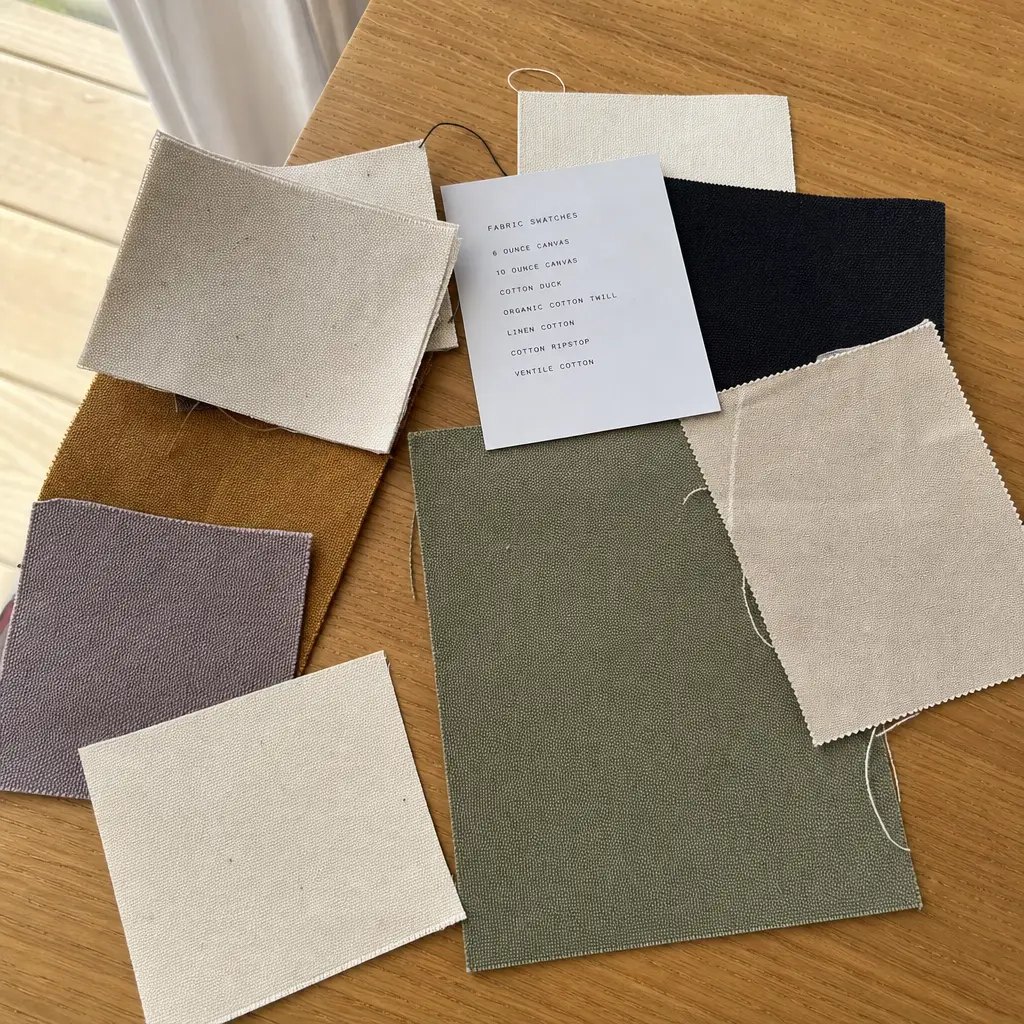
Canvas weight affects cost, hand feel, structure, sewing difficulty, and freight. For many B2B programs, 12–16 oz canvas is the practical comparison range. Lighter canvas can work for low-cost giveaways, but it may collapse around the bottle and show contours. Heavier canvas feels sturdier, but it increases material cost and may slow sewing.
Do not choose fabric weight in isolation. A 12 oz carrier with a reinforced base and good handle construction may outperform a heavier but poorly sewn option. The important question is whether the bag supports a loaded bottle without distortion, weak seams, or uncomfortable carrying. Base depth, seam allowance, thread quality, and handle attachment all matter.
Handle construction should be specified clearly. A double-layer handle with bar-tack or box-x reinforcement is a strong baseline for a wine carrier. Ask whether handles are sewn into a seam or attached to the body panel, what thread is used, and how the reinforcement is positioned. The handle root is a predictable failure point, so it deserves a measurable test.
For most programs, specify a handle load test before production: for example, 3 kg for 60 seconds with no stitch opening, fabric tear, or seam slippage. This does not replace full product safety testing where required, but it gives both buyer and factory a practical acceptance point for a loaded bottle carrier.
- Compare 12–16 oz canvas first unless the channel requires lighter or heavier material.
- Specify base construction, not just fabric weight.
- Require reinforced handles and close-up stitch photos.
- Use a written handle load test rather than a subjective pull check.
4. Match decoration method to tech branding realities
Tech startup branding often looks simple: a wordmark, app icon, small tagline, or one-color mark. That simplicity is useful. Screen print is usually the best starting point for clean logos and moderate-to-large wholesale runs because it is cost-efficient and repeatable. However, fine text, gradients, small icons, and multi-color marks may need a woven label, heat transfer, or simplified artwork.
The narrow front panel of a wine carrier leaves less branding space than a tote bag. Ask for the usable decoration area in millimeters and confirm the safe distance from side seams, bottom folds, and handle roots. A logo that looks balanced in a mockup may feel crowded on a tall narrow panel.
Use numeric decoration standards. A practical baseline is logo placement within ±3 mm from the approved location, color matched to the approved physical sample or a Pantone reference where applicable, and legibility at normal viewing distance, such as 60 cm. For screen print, check edge sharpness, ink opacity, and cure. For labels, check stitching, trimming, and lifting edges.
If the carrier will be folded in cartons, test decoration after folding. Some prints scuff, some labels crease, and embroidery can create pressure marks. Ask for a folded sample or packing photo before bulk. For client gifts and investor events, a slightly simpler mark that arrives clean is usually better than an ambitious decoration that varies in production.
- Use screen print for simple logos and cost-efficient bulk orders.
- Use woven labels or transfers when fine detail matters.
- Set print placement tolerance, such as ±3 mm.
- Approve decoration after checking folded and packed condition.
5. Treat MOQ and price breaks as a structure, not a headline
MOQ is more than the minimum quantity a factory will accept. It often reflects material purchasing, print setup, cutting efficiency, packing labor, and how the supplier manages small-batch work. A low MOQ can be helpful for a startup pilot, but it may hide higher setup fees, less favorable packing cost, or limited customization.
Ask for three quantity points: pilot, planned order, and reorder or volume tier. For example, request pricing at 250, 500, and 1,000 units if those quantities are realistic. This shows where the supplier becomes efficient and whether your program should start small or consolidate demand across teams.
Also clarify whether MOQ applies by total order, canvas color, logo version, or packing format. A startup may want separate logos for sales, recruiting, and partner teams. The supplier may treat those as separate production runs. If mixed designs are important, put that in the RFQ so the quote reflects real requirements.
When comparing suppliers, separate fixed charges from scalable charges. Screen setup, sampling, and artwork preparation may be fixed. Fabric, sewing, and packing usually scale with volume. This distinction helps finance understand why unit cost changes across tiers and why a pilot may cost more per piece than a repeat order.
- Request pilot, planned, and reorder quantity pricing.
- Ask whether MOQ is per style, per color, per logo, or total order.
- Separate setup fees from unit price.
- Use realistic quantity tiers instead of aspirational volume only.
6. Ask suppliers for evidence you can verify
Supplier vetting should be specific to the order. A general promise of quality is not enough. Ask who performs cutting, sewing, printing, label production, final inspection, and packing. If any step is subcontracted, request disclosure and ask who owns final quality responsibility. Subcontracting is not automatically a problem, but hidden handoffs are a risk.
Request evidence that matches the product: close-up photos of handle roots, seams, base construction, inside finishing, printed panels, folded samples, carton labels, and export cartons. Ask for the sample to be tagged with the date and your project name or version so you know the photos refer to your spec.
For a stronger procurement file, request material traceability and production-process evidence. This can include a canvas lot code, supplier material reference, factory audit summary scope, recent inspection report template, and references or examples from similar canvas bottle bag or small tote production. Do not ask for confidential customer details; ask for enough proof to confirm capability.
If the supplier claims audit or compliance status, ask what the audit covered: social compliance, quality systems, security, environmental process, or only a basic site visit. For many wine carrier programs, the practical question is whether the supplier can control material, sewing, decoration, packing, and inspection consistently. Evidence should support that answer.
- Ask what is in-house and what is subcontracted.
- Request dated photos of your actual sample and construction details.
- Ask for material lot traceability and inspection record examples.
- Clarify factory audit scope instead of accepting a vague certificate claim.
7. Approve samples with measurable limits
A pre-production sample should prove fit, construction, decoration, and packing behavior. It is not only a visual proof. If the sample is approved with comments like “looks good,” the factory has little guidance when production variables appear. Replace subjective approval with measurable acceptance points.
Use tolerances that match function. Fit-critical dimensions can be held to ±3 mm, while less critical overall dimensions may use ±5 mm if appropriate. Logo placement can often be held within ±3 mm from the approved edge or centerline. Handle strength should be tested with the agreed load and time. Stains, holes, strong odor, and broken stitches in visible or load-bearing areas should be defined as rejects.
The sample should be tested with the real bottle and the intended fold method. If the carrier is going to a 3PL, retail buyer, or office team, share the sample with the receiving or fulfillment stakeholder before bulk approval. They may catch issues such as awkward carton labeling, excessive fold creasing, or a handle that does not sit well when packed.
Keep one sealed golden sample after approval. Label it with the approval date, spec version, artwork file name, supplier name, and any agreed deviations. This sample becomes the reference for final inspection, receiving checks, and reorders. It also reduces disputes because everyone can compare the bulk goods against the same physical standard.
- Approve a physical sample before bulk production.
- Use numeric tolerances for size, logo placement, and handle strength.
- Test bottle fit and fold condition together.
- Keep a sealed golden sample for inspection and reorders.
8. Build QC around likely failure modes
Canvas wine carrier QC should focus on the defects that affect use, presentation, and receiving. The main risk areas are dimensions, bottle fit, handle strength, stitch quality, decoration placement, fabric defects, odor, and pack-out. A useful inspection plan is specific enough for pass/fail decisions but simple enough for factory staff or a third-party inspector to apply consistently.
Agree on a sampling plan before shipment. Many buyers use ANSI/ASQ Z1.4 or a similar AQL-based method. A common starting point is Critical 0, Major 2.5, Minor 4.0, but the exact plan should be written on the purchase order. Critical defects might include unsafe handle failure or contamination. Major defects might include wrong dimensions, broken stitches, stains in visible areas, or incorrect logo placement. Minor defects might include small thread ends or slight cosmetic variation within agreed limits.
Handle testing should not be improvised. Load the carrier to at least 3 kg for 60 seconds or use another agreed test appropriate to your bottle weight and safety expectations. Inspect both handle roots afterward. Reject any stitch opening, thread breakage, seam slippage, or fabric tearing. If the carrier is designed for heavier bottles or multiple bottles, raise the test load accordingly.
Decoration inspection should be measured, not guessed. Check logo position from the approved reference points, compare color to the golden sample, and verify opacity and edge quality. On natural canvas, minor texture interaction is normal, but smudging, severe fading, off-center placement beyond tolerance, or illegible text should be rejected.
Packing inspection matters because many defects happen after sewing. Open sampled cartons to confirm count, fold direction, carton labels, lot markings, and whether print or handle areas are crushed. Document defects by type and quantity. A simple defect log helps the supplier identify whether the problem is cutting, sewing, printing, handling, or packing.
- Use an agreed AQL or sampling plan before shipment.
- Classify defects as Critical, Major, and Minor.
- Test handles with a defined load and time.
- Measure logo placement and dimensions against the golden sample.
- Inspect carton count, labels, folding, and compression damage.
9. Plan packing, labels, and freight before the order is produced
Packing decisions affect cost, freight, and receiving. Bulk export packing is usually the most economical choice for event handouts, office gifting, and internal distribution. Retail-ready packing may be justified for e-commerce, store shelves, subscription boxes, or kitting operations, but it adds labor, materials, carton volume, and more QC points.
Ask for carton dimensions, units per carton, net weight, gross weight, fold direction, and carton label format before approving the final quote. A lower unit price can lose its advantage if cartons are oversized, too heavy for warehouse handling, or inefficient to palletize. If your 3PL has carton weight or size limits, send them to the supplier early.
Specify how the carrier is folded. The logo should not be sharply creased if the product is for client gifts or retail. Handles should not be crushed in a way that permanently distorts the carry shape. If individual polybags, hang tags, barcodes, or inserts are required, list them as separate quote lines so their cost and QC impact are visible.
Receiving labels should be practical. Include item name, SKU or project code, quantity per carton, carton number, gross weight, and lot or PO reference. If the shipment is being split across event sites or departments, ask whether cartons can be labeled by destination. Clear labels reduce warehouse questions and make shortage claims easier to investigate.
- Confirm carton dimensions and gross weight before freight booking.
- Document fold direction and logo protection requirements.
- Use retail-ready packing only when the channel needs it.
- Put receiving information on carton labels, not only on the packing list.
10. Compare landed cost with a simple scenario
Unit price is only one part of the decision. Landed cost includes the carrier, decoration setup, sample cost, packing materials, cartons, freight basis, duty or tax assumptions, inspection cost if used, and any receiving or repacking work. A supplier with a slightly higher unit price may be cheaper if the cartons are efficient, defects are lower, and the spec is repeatable.
Use a simple comparison model. Suppose Supplier A quotes 1,000 canvas wine carriers at $2.40 each, plus $120 setup, $80 sample cost, and estimated freight of $520. Before duties or local taxes, the working total is $3,120, or $3.12 per unit. Supplier B quotes $2.25 each, plus $180 setup, $100 sample cost, and estimated freight of $760 because cartons are bulkier. The working total is $3,290, or $3.29 per unit. The cheaper unit price is not the cheaper landed estimate.
Now add risk. If Supplier A also provides clear handle testing, carton labels, and inspection records, while Supplier B cannot document subcontracted printing or carton dimensions, the decision becomes even clearer. The point is not that higher quotes are always better. The point is that startup procurement teams should compare total delivered value, not the first number in the email.
When presenting options internally, show three lines: product cost, logistics/packing cost, and risk controls. Marketing can see brand and presentation impact. Finance can see total cost. Operations can see receiving and delivery risk. That structure keeps the purchase moving without repeating the same procurement discussion in every approval meeting.
- Build a landed-cost worksheet for every serious quote.
- Include setup, sample, packing, freight, and inspection assumptions.
- Compare carton volume and gross weight, not just unit cost.
- Show internal stakeholders cost, logistics, and risk controls together.
Specification comparison for buyers
| Buying decision | Recommended baseline | Quantified buyer check | Cost or risk impact |
|---|---|---|---|
| Bottle fit | Size from the actual bottle, not a catalog assumption; request internal width, usable height, and base depth | Target 5–8 mm total clearance around the widest bottle point; finished fit-critical dimensions within ±3 mm | Prevents jamming, leaning, rattling, and late pattern changes |
| Canvas weight | Compare 12–16 oz canvas for most gift, event, and partner programs | Confirm quoted weight in oz and GSM; reject substitutions beyond agreed weight range without approval | Heavier canvas improves structure but raises material, sewing, and freight cost |
| Handle construction | Use double-layer handles with bar-tack or box-x reinforcement at the attachment point | Handle should hold 3 kg static load for 60 seconds with no stitch opening, tearing, or visible seam slippage | Reduces breakage complaints and replacement risk for loaded bottles |
| Stitch quality | Specify even stitching, trimmed threads, secure back-tacks, and reinforced stress points | Check stitch density target, such as 7–9 stitches per inch where practical; no skipped stitches over 10 mm in visible/load zones | Catches weak sewing before shipment and improves perceived quality |
| Decoration method | Use screen print for simple tech logos; woven label or heat transfer for fine text; embroidery only for premium tier | Print placement tolerance within ±3 mm from approved position; logo readable at 60 cm; color matched to approved sample or Pantone target | Controls brand consistency across events, gifting, and reorders |
| Packing format | Bulk export carton unless retail, e-commerce, or kitting requires individual pack-out | Confirm units/carton, carton dimensions, gross weight, fold method, and carton label before freight quote | Poor carton planning can erase unit-price savings through volume, damage, or receiving labor |
| Supplier evidence | Prefer suppliers that disclose in-house vs subcontracted steps and can document material, sewing, print, and final inspection | Request factory audit summary scope, material traceability, subcontractor disclosure, recent similar production references, and inspection record sample | Reduces accountability gaps and improves reorder reliability |
| Sampling approval | Approve a physical pre-production sample after bottle-fit, decoration, and fold tests | Keep one sealed golden sample with date, version, artwork file, and spec sheet; bulk must match it within written tolerances | Prevents subjective disputes and protects against spec drift |
| QC plan | Use measurable acceptance rules, not only visual comments | For final inspection, use ANSI/ASQ Z1.4 or agreed AQL, for example Critical 0, Major 2.5, Minor 4.0, with defects logged by type | Makes pass/fail decisions clear before the goods leave the factory |
Buyer checklist before sampling
- Define the program: launch event, client gift, investor dinner, partner kit, employee milestone, or retail/e-commerce SKU.
- Record bottle height, base diameter, widest diameter, shoulder shape, and whether future bottle styles must fit the same carrier.
- Choose one baseline spec before quoting: canvas weight, handle construction, base structure, decoration method, and packing format.
- Send every supplier the same RFQ sheet and ask them to mark any deviation instead of silently substituting materials or construction.
- Request a physical pre-production sample and test it with the actual bottle, artwork, fold method, and carton concept.
- Set numeric tolerances: fit-critical dimensions ±3 mm, non-critical dimensions ±5 mm, logo placement ±3 mm unless otherwise agreed.
- Require a handle load test, such as 3 kg for 60 seconds, with no stitch opening, tearing, or seam slippage.
- Ask for AQL or sampling plan before final inspection, including separate Critical, Major, and Minor defect definitions.
- Request supplier evidence: material traceability, subcontractor disclosure, audit scope, recent similar production references, and sample inspection records.
- Compare landed cost with all add-ons: unit price, decoration setup, sample cost, packing labor, cartons, freight basis, duty/tax assumptions, and payment terms.
Factory quote questions to send
- What internal dimensions do you recommend for our bottle, and how much clearance are you allowing at the widest point?
- Which bottle profile did you use for sizing: our provided bottle, a standard 750 ml bottle, a Burgundy-style bottle, or another reference?
- What exact canvas weight is quoted in oz and GSM, and is it stock canvas, custom-dyed canvas, or a custom weave?
- Can you provide material traceability for the canvas lot, including supplier name or internal lot code?
- Which steps are done in-house and which are subcontracted: cutting, sewing, printing, label making, washing, final inspection, and packing?
- If subcontractors are used, who performs final inspection and who is responsible for replacing defects?
- Can you share the scope of your most recent factory audit or compliance review, without confidential commercial details?
- Can you provide photos or references from recent similar canvas bottle bag or small tote production?
- What handle reinforcement is included, and can you show close-up photos of the stitch pattern at the handle root?
- What handle load test do you perform, at what weight, and for how long?
Quality-control points to confirm
- Finished dimensions: measure width, height, opening, and base depth against the approved spec; use ±3 mm for fit-critical dimensions and ±5 mm for non-critical dimensions unless a tighter tolerance is agreed.
- Bottle fit: insert the actual bottle or approved worst-case bottle; it should slide in without force, stand upright on a flat surface, and not rattle noticeably during a light shake test.
- Handle load test: load the carrier to at least 3 kg for 60 seconds; reject if there is stitch opening, thread breakage, fabric tearing, handle elongation that changes carry feel, or seam slippage at the attachment point.
- Stitch inspection: check bar-tack or box-x reinforcement, back-tacks, skipped stitches, loose threads, uneven tension, and stitch density; no skipped stitch run over 10 mm in visible or load-bearing areas.
- Print or label placement: measure from the approved reference edge; hold logo placement within ±3 mm unless the artwork/spec requires tighter control; reject smudging, poor opacity, visible registration drift, or illegible fine text.
- Fabric inspection: reject holes, oil marks, mildew marks, broken yarns in visible zones, major shade inconsistency within the same lot, and weak spots near handle roots or base seams.
- Odor check: reject strong chemical, mildew, smoke, or storage odor that remains after normal airing and would be noticeable in a gift or office setting.
- AQL and sample size: agree to a recognized sampling plan such as ANSI/ASQ Z1.4; common starting points are Critical 0, Major 2.5, Minor 4.0, with final values confirmed on the PO.
- Pack-out check: open sampled cartons to verify unit count, fold direction, lot marking, carton label, barcode placement if used, and carton integrity.
- Compression check: confirm the fold and carton stacking do not crease the logo area, crush handle roots, or deform the base beyond normal recoverable folding.