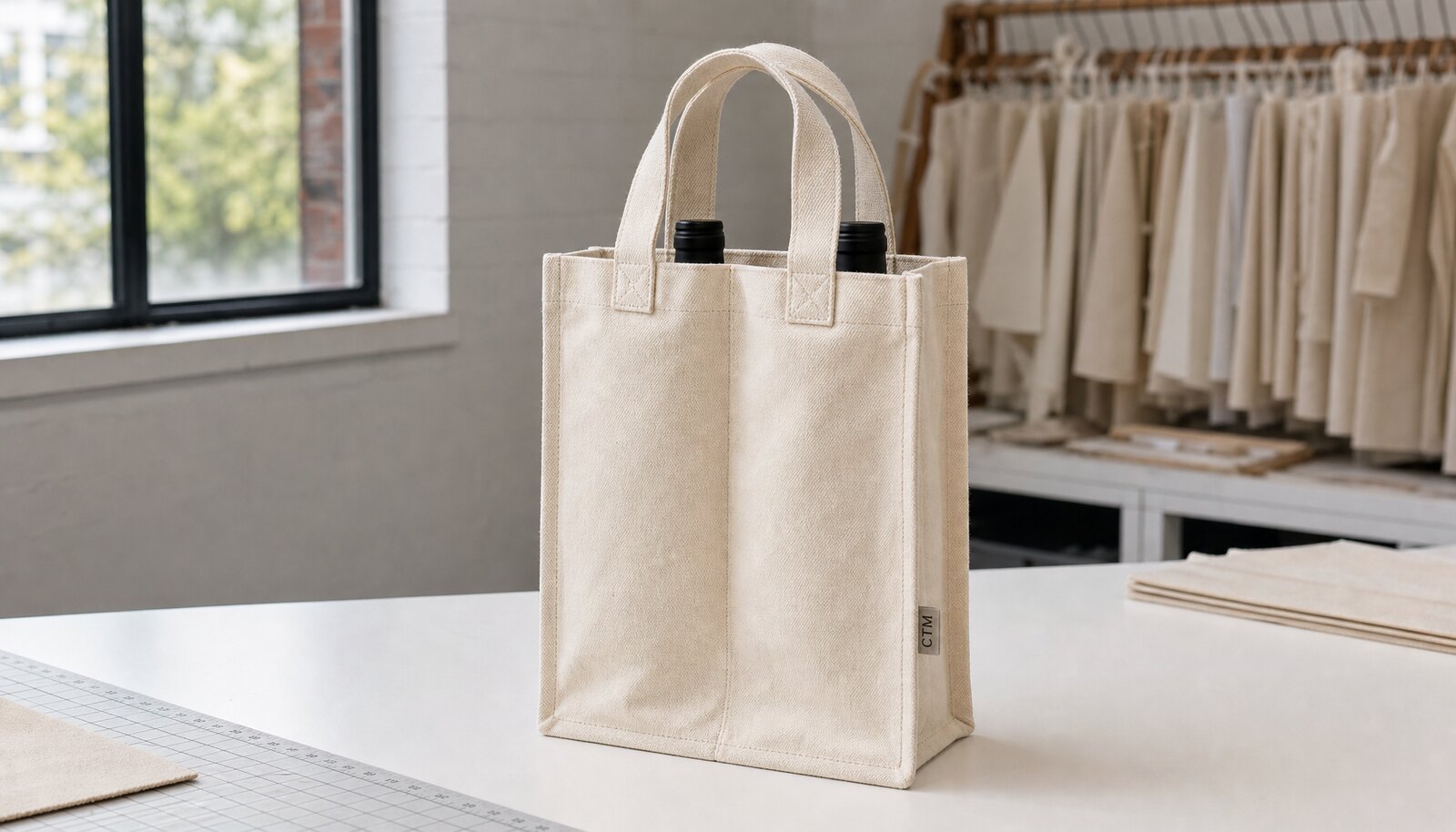
1. Start with the bottle line, then size the carrier
Wholesale canvas wine carriers for boutique wineries work best when the bottle drives the spec, not the other way around. A carrier built around a standard 750 ml Bordeaux bottle is a different product from one meant for Burgundy, sparkling bottles, or a mixed gift set. The widest diameter, shoulder shape, and neck exposure all affect the pattern, gusset depth, and handle position. If the buyer skips that step, the first quote may look attractive and still fail once the real bottle is loaded.
The safest way to structure the program is to list the exact bottle references first and then define the carrier around them. For a single-bottle program, measure the body diameter at the widest point, the shoulder width, and the full height of the bottle with closure. For a two-bottle program, measure the combined width, bottle-to-bottle spacing, and the clearance needed so the necks do not rub. If the winery plans to sell both tasting room retail and e-commerce packs, decide whether the carrier must stand upright, fold flat, or survive pre-kitting with bottles inside.
- Use an actual bottle sample or a dimensioned drawing before pattern approval.
- Define the maximum allowed neck exposure so the carrier looks intentional on shelf.
- Specify whether the bag should feel premium and rigid or soft and promotional.
2. Match fabric weight to the channel, not to habit
Canvas weight matters, but it is only one part of the commercial equation. A 10 oz canvas body can be fine for a light promotional carrier if the bottles are standard and the load is modest. A 12 oz body is a more balanced choice for most boutique winery programs because it usually gives better structure, cleaner seams, and less visible wrinkling on display. A 14 oz body, or heavier, is more appropriate when the carrier must look premium, hold a heavier bottle, or carry repeated customer handling without softening quickly.
Do not buy a nominal ounce number without checking the actual fabric behavior. Ask the supplier for the measured fabric weight, weave density, finishing method, and whether the canvas is pre-shrunk or washed. Two suppliers can both call their material '12 oz canvas' and still deliver different hand feel, different cut behavior, and different shrinkage after production. For a buyer comparing quotes, the correct comparison is not just price per unit. It is price per unit at the same fabric behavior, same bottle fit, and same decoration result.
- 10 oz: lower-cost, lighter feel, better for simple promo programs and low handling.
- 12 oz: the practical default for many boutique winery orders and repeat retail use.
- 14 oz+: better for premium presentation, stronger shelf presence, and higher perceived value.
3. Reinforcement and construction determine whether the bag feels cheap
Construction details are where most cost surprises hide. Handle width, handle fold, seam allowance, gusset depth, and the reinforcement method around the anchor points all change how the carrier behaves under load. A narrow handle may look neat in a sample room and still feel uncomfortable once a full bottle is inserted. A weak base seam can let the bottle tip, and a loose top edge can make the whole carrier look unfinished even if the print is perfect.
When you compare quotes, ask the supplier to name the stitch count, the thread type, and the reinforcement pattern. A simple topstitch is not the same as bar-tacking at the stress point, and a boxed-X at the handle anchor is usually more robust than a decorative seam alone. If the carrier uses a divider or insert, make the supplier tell you whether it is sewn in, removable, or just a loose board. That detail affects both assembly cost and failure risk in transit.
- Set a handle width that is comfortable for a full bottle load, not just visually neat.
- Require stress-point reinforcement before decoration is applied.
- Ask for the seam type and stitch count on the approval sample, not only in the quote.
4. Qualify the supplier route before you negotiate price
Not every quote deserves the same trust. A direct factory can be the best option when the order is repeatable, the spec is stable, and the buyer wants control over cutting, sewing, printing, and final packing. A trading company may be useful when your team wants faster quote collection across multiple factories, but you should expect an added margin layer and weaker visibility into where the product is actually made. A local converter can be fast for short-turn work, yet it is only a good answer if the base carrier already matches your required quality.
Before you compare numbers, qualify the vendor in a practical way. Ask whether the factory is cut-and-sew in-house or outsourcing sewing. Ask to see a photo of the inspection area, not just the product photo. Ask for the fabric source, the decoration method, and who owns a defect claim if the final lot fails. Procurement teams often lose time because they compare low numbers from unqualified vendors against tighter prices from real manufacturers. That is not a price comparison; it is a risk comparison disguised as a quote sheet.
- Check whether the supplier controls production or is only brokering the order.
- Verify who owns the sample, the screen, the pattern, and the approved spec.
- Ask for traceability on fabric lot, decoration setup, and final inspection.
5. Build the bulk pricing ladder before you ask for a final number
A useful bulk pricing plan is more than a single unit price. It should show how the price behaves as quantity rises and where the setup cost stops mattering. For canvas wine carriers, the first quantity band usually carries the highest apparent price because the supplier is absorbing pattern work, screen setup, label setup, and carton planning. The middle band is where the order starts to benefit from cutting efficiency and better labor absorption. The upper band is where the price should flatten if the spec stays frozen.
A practical example for planning, assuming one-color print and standard export packing, is this: 300 to 499 units usually sits at the highest tier because setup cost is spread across a small run; 500 to 999 units often drops the unit price enough to justify a second-order forecast; 1,000 to 2,999 units should usually produce another visible step down; 3,000 units and above should mainly improve through labor efficiency and material purchasing. If the supplier gives a quote that gets cheaper only by changing fabric weight, removing reinforcement, or reducing carton quality, the price break is not real.
- Compare price breaks only with the same fabric, same decoration, and same carton spec.
- Ask for the reorder price on the approved spec, not a new verbal description.
- Use the price ladder to decide whether to commit to a larger first order or hold safety stock.
6. Write the RFQ so the supplier cannot hide spec gaps
The best RFQ for wholesale canvas wine carriers is short, specific, and impossible to misread. Start with the bottle reference, carrier style, canvas weight, decoration method, and pack configuration. Then add the non-negotiables: handle reinforcement, print placement tolerance, carton count, and sample requirements. If the vendor returns a quote that leaves any of those items undefined, the quote is not complete enough for a procurement decision.
A strong quote should separate the base carrier from the added work. You want a line for the bag body, a line for print or embroidery, a line for labels, a line for packaging, and a line for sample or setup fees. That structure makes it possible to compare one supplier against another without guessing what was bundled into the price. It also makes negotiation easier because you can see whether the supplier is charging for real labor or hiding margin in an undefined package price.
- Put bottle dimensions, carrier dimensions, and fabric weight in the same RFQ.
- Require separate lines for decoration, labels, inner packing, and cartons.
- Ask for the lead time tied to sample approval, not only the estimated production lead time.
7. Choose the decoration method based on artwork, not preference
For most boutique winery programs, one-color screen printing is the cleanest commercial answer. It handles logos, names, and simple iconography well, and it usually keeps the unit cost under control at repeat volume. If the artwork has small type, multiple colors, gradients, or fine line detail, a transfer method may be more suitable. Embroidery can work for a premium tactile look, but it also adds labor, increases setup complexity, and can distort lighter canvas panels if the stitch density is too high.
The buyer should approve decoration with measurable limits. Keep artwork at least 20 mm away from stitched edges unless the pattern is intentionally designed otherwise. For simple logos, set a print registration tolerance of plus or minus 2 mm so the supplier understands the acceptable drift. Ask for the approved color reference, whether that is Pantone, a physical swatch, or a mastered sample, and make sure the factory uses the same reference on the production line. A good print can save the program; a slightly off logo can make an otherwise correct bag look like an afterthought.
- Use screen print for bold, repeatable winery branding.
- Use transfer when the design has small text or multiple color layers.
- Use embroidery only when the brand value supports the added labor and lead time.
8. Set QC acceptance numbers before production starts
Quality control needs numbers, not general expectations. Buyers often say they want 'good stitching' or 'nice print,' but those terms are not enforceable in inspection. A better approach is to set acceptance criteria in the PO or tech pack. Start with dimensions: a practical target is plus or minus 5 mm on the body size and plus or minus 3 mm on handle placement. For print, use plus or minus 2 mm on straightforward logos and reject any visible smearing, banding, or broken text on the approval sample and bulk lot.
Inspection should also cover seam integrity and load behavior. A useful starting point for a single-bottle carrier is a static hang test at 3 kg for 60 seconds without seam opening or handle slip. For a two-bottle carrier, use 5 kg for 60 seconds and add a 25-cycle lift-and-set test. If the carrier is sold into retail, set the lot acceptance standard at AQL 2.5 for major defects, AQL 4.0 for minor defects, and zero for critical defects. That gives procurement a clear language for rejection instead of a vague argument after the goods arrive.
- Reject open seams, skipped stitches on stress seams, and thread tails longer than 10 mm on finished goods.
- Check the lot under consistent light so shade drift and print variation are visible.
- Hold one sealed golden sample from approval so future reorders can be checked against it.
9. Pack-out and freight decisions should be treated as part of the product spec
Packing is not an afterthought for wine carriers. If the carrier ships flat, the supplier should optimize the fold line so the visible panel does not carry a permanent crease or damage the print. If it ships folded or kitted with inserts, the pack-out must protect the shape and prevent carton deformation. The buyer should also define the maximum carton weight in advance. Many teams use a manual-handling target somewhere around 12 to 15 kg per carton, but the real limit should follow your warehouse standard and freight mode.
Ask the supplier to state how many pieces go into each inner pack, how many inner packs go into each carton, and whether the cartons are export grade. Then decide whether a polybag is sufficient for dust control or whether you need additional board support, tissue, or dividers. If the carrier is part of a gift set, the packing method needs to survive kitting without crushing the gusset or bending the handles. Freight savings are irrelevant if the bag arrives with a shape problem that damages shelf presentation.
- Fix inner pack count and carton count before the purchase order is released.
- Set a maximum carton weight that your warehouse team can safely handle.
- Ask the supplier to confirm pallet pattern and carton stacking behavior for the selected route.
10. Control lead time and reorders with one approved master spec
Lead time risk usually comes from change management, not from the canvas itself. Artwork revisions, new label art, revised carton counts, and late sample changes can all reset the production schedule. To reduce that risk, freeze the artwork before mass cutting starts, archive one approved sample, and keep a single master specification sheet that includes dimensions, decoration, pack-out, and inspection rules. If the supplier needs to change anything to hit the schedule, the change should be documented and re-approved before production continues.
Reorders are where a good program starts to pay back. The first order creates the master spec, the approved sample, and the inspection standard. The second order should re-use those assets so the price becomes more predictable and the communication loop gets shorter. If the supplier cannot honor the same fabric weight, print method, or carton spec on reorder, the program is not stable enough for a real bulk pricing plan. In that case, it is better to reset the spec now than to carry an unresolved quality problem into the next season.
- Freeze artwork and carton rules before the PO is issued.
- Keep one approved sample and one archived spec sheet for every SKU.
- Treat any change after approval as a formal change order, not a casual revision.
Specification comparison for buyers
| Sourcing route | Typical MOQ band | Unit cost impact | Lead-time impact | Best fit |
|---|---|---|---|---|
| Direct factory sourcing | 500-3,000+ units, depending on color and decoration | Lowest at repeat volume once setup is amortized | Usually the most predictable after sample approval | Repeat programs with stable specs and a clear tech pack |
| Trading company | 100-1,000 units can be possible, but varies widely | Usually higher because of an added margin layer | Often faster to quote, not always faster to ship | Small teams that need one contact and broad factory access |
| Stock blank + local print | Low MOQ if the blank carrier is already in domestic stock | Can be economical on rush orders, but blank quality may limit positioning | Fastest route when inventory is available | Promotions, tastings, and short seasonal runs |
| Custom OEM program | Usually starts higher because of pattern, print, and packaging setup | Higher upfront, lower risk of mismatch when the spec is locked | Longer because sampling and approvals take more steps | Boutique winery gifting and retail programs with premium presentation |
| Local decorator or converter | Can be low if the blank is in hand | Decoration may be competitive, but the base product is not truly under control | Fast for final decoration, slower if the base bag must be sourced first | Rush replenishment or region-specific kits |
| Hybrid sourcing model | Core volume at factory MOQ, short-turn top-ups locally | Can reduce stock-out risk, but it adds process complexity | Best when managed with one approved master spec | Brands that want stable pricing plus emergency replenishment |
Buyer checklist before sampling
- Measure the actual bottle range, not only the label size: diameter, shoulder width, height, and neck exposure for each bottle type you plan to ship.
- Decide whether the carrier is for a single bottle, double bottle, or mixed gift set, then lock the loaded dimensions before quoting.
- Set a fabric target in gsm or ounce weight and ask for the measured fabric weight on a swatch, not only the nominal description.
- Define whether the canvas should be pre-shrunk, washed, or finished for stiffness so suppliers do not quote different hand feel under the same name.
- Specify the handle width, handle length, stitch type, and reinforcement method so the carrier does not distort under a full bottle load.
- Request a production-like sample with final fabric, final thread, final print method, and final carton spec before bulk approval.
- Set acceptable print placement tolerance and a visible logo margin from stitched edges so artwork does not drift into the seam line.
- Write a packaging rule for inner packs, carton count, maximum carton weight, and whether the carrier ships flat or folded.
- Ask each supplier to quote the same Incoterm and separate the base carrier, decoration, packaging, and freight assumptions.
- State the acceptable defect thresholds in the RFQ, including critical defects at zero and clear limits for major and minor defects.
Factory quote questions to send
- What is the actual measured fabric weight, weave density, and finish for the canvas body and handles?
- Is the canvas pre-shrunk or washed, and what shrinkage range should we expect after production handling?
- What exact bottle dimensions did you use to draft the pattern, and can you show the measurement points?
- What is the MOQ by color, artwork version, and carton configuration, not just the MOQ for the overall order?
- What is the setup fee for screen printing, woven labels, embroidery, heat transfer, or any other decoration method you propose?
- What are your sample lead time and bulk lead time, and which steps are fixed versus flexible?
- Who performs cutting, sewing, printing, and final inspection, and which of those steps are in-house?
- What defect standard do you inspect to, and what are your limits for critical, major, and minor defects?
- Can you quote the same spec at 500, 1,000, and 3,000 units so we can see the real price-break ladder?
- What packaging materials are included in the quote, what carton grade are you using, and what is the maximum carton weight you recommend?
Quality-control points to confirm
- Body dimensions: set a practical internal tolerance of plus or minus 5 mm on finished width and height, unless your tech pack requires a tighter limit.
- Handle placement: keep handle anchor points within plus or minus 3 mm of the approved sample so the bag carries evenly.
- Print placement: for simple logos, use plus or minus 2 mm as a working target from the approved artwork position.
- Stitch quality: reject open seams, skipped stitches on visible stress seams, and loose thread tails longer than 10 mm on finished goods.
- Load test: for a single 750 ml carrier, ask for a static hang test at 3 kg for 60 seconds; for a two-bottle carrier, use 5 kg for 60 seconds as a starting point and adjust for bottle weight.
- Cycle test: lift and set down the loaded carrier repeatedly for at least 25 cycles and check that handles, seams, and base shape remain intact.
- Inspection standard: start with AQL 2.5 for major defects, AQL 4.0 for minor defects, and zero tolerance for critical defects unless your compliance team sets a stricter rule.
- Material consistency: compare color, weave, and surface finish against the approved swatch under consistent light so one lot does not drift visibly from the sample.
- Carton integrity: confirm that cartons arrive square, uncrushed, and able to hold the approved pack count without handle deformation or panel creasing.
- Label and barcode placement: check that SKU labels, barcodes, and origin marks are readable and consistently placed across cartons and inner packs.