Start With the Display Problem, Not the Logo File
For artisan bakeries, a canvas wine carrier is rarely only a bottle bag. It may carry wine with sourdough, olive oil with crackers, cider with pastry, or a holiday gift bundle sold at the counter. Logo placement has to work when the carrier is full, standing on a shelf, handed across a retail counter, and photographed by the buyer’s own marketing team. A logo that looks balanced on a flat drawing can disappear once the bottle pushes the fabric outward or the handle folds forward.
Procurement teams should define the selling use before releasing the RFQ. A wholesale canvas wine carrier for a bakery gift program needs different logo rules than a promotional giveaway at a wine tasting. If the bag will sit in a bakery window, front-center placement usually matters most. If it will be tied with a tag or ribbon, the logo may need to sit lower so the decoration does not cover it. If distributors will sell the same carrier to several bakery accounts, a neutral logo zone and optional side label may be safer than a large front print.
- For counter display, keep the logo visible above the lower curve of the bottle and below any folded handle shadow.
- For gift bundles, leave clear space for ribbon, hang tag, or bakery product label so the print is not visually crowded.
- For distributor programs, consider a small woven side label plus optional front print to support multiple bakery buyers.
- For retail shelves, test the filled carrier from a normal customer viewing angle, not only flat on a table.
Choose Canvas Weight Around Structure and Freight
Most bakery buyers should start with 10 oz to 12 oz cotton canvas, roughly 280-340 GSM, for single and double wine carriers. This range gives enough body for the bag to stand reasonably well with a bottle inside, while still folding flat for export packing. Lighter canvas can reduce cost, but it may collapse around the bottle and show more wrinkles through the print area. Heavier 14 oz canvas can look premium, but the added material cost and carton weight are not always justified for seasonal retail packaging.
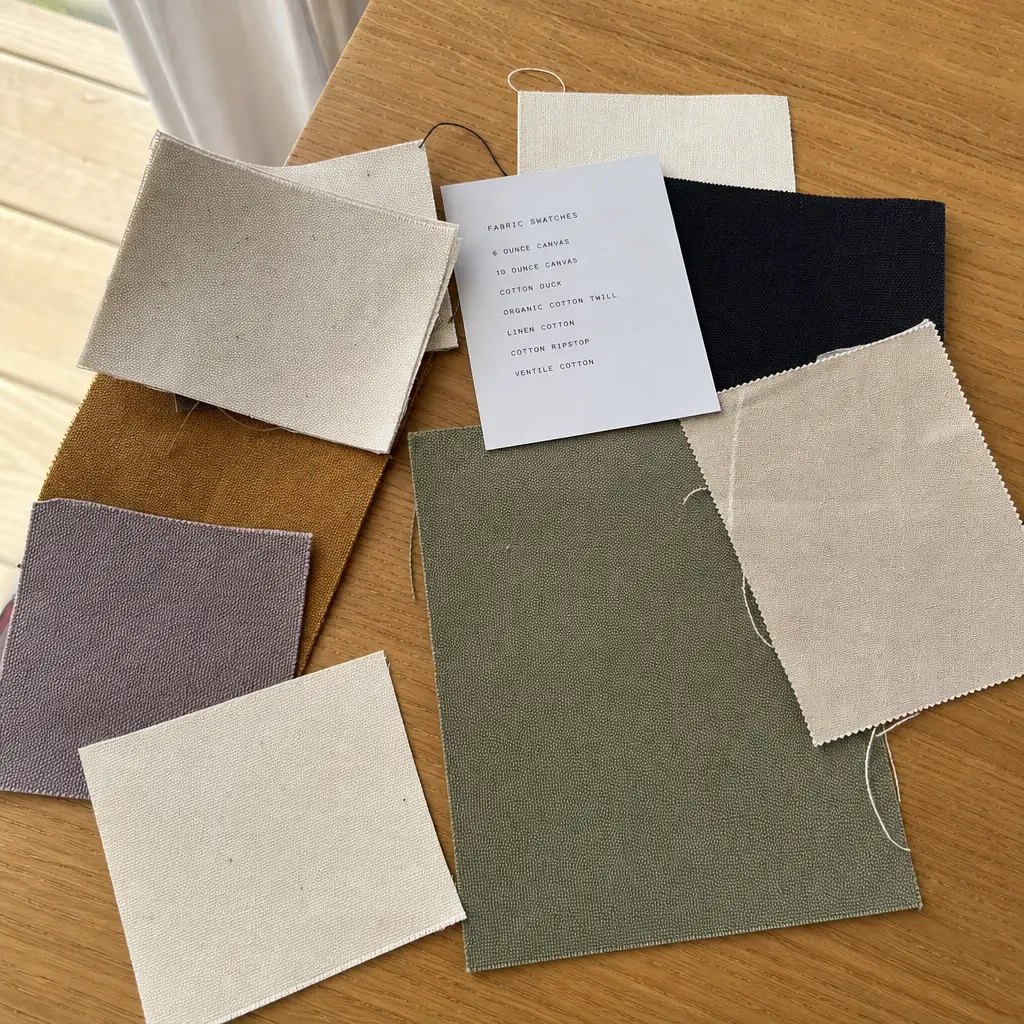
Fabric descriptions in supplier quotes can be misleading if the buyer only writes canvas. Some factories quote 8 oz cotton duck, some quote 12 oz canvas, and some quote a blended or recycled cotton fabric. Natural canvas also has seed flecks and shade variation, which can affect logo contrast. If a clean cream tone is required for a bakery brand identity, specify bleached or semi-bleached canvas and request a physical swatch. If the brand wants a rustic bakery look, natural unbleached canvas is usually acceptable, but the logo color should be tested on the actual fabric.
- 8 oz canvas: lower cost and lighter shipping, but less structure and weaker premium feel.
- 10 oz canvas: practical for standard single-bottle carriers and moderate-volume bakery promotions.
- 12 oz canvas: stronger shelf presence and better durability for two-bottle or gift-bundle use.
- 14 oz canvas: premium hand feel, but higher sewing difficulty, freight weight, and folding bulk.
Size the Carrier From Real Bottles
A common sourcing mistake is approving a wine carrier size from a supplier’s catalogue without testing the buyer’s actual bottle. Standard 750 ml wine bottles vary in shoulder shape, diameter, and height. Sparkling cider, champagne, olive oil, and specialty bakery beverage bottles may be wider or taller. A bag that fits a Bordeaux bottle may be tight around a champagne bottle, and tight fabric will distort the logo exactly where the buyer wants clean presentation.
For RFQ purposes, give the supplier the maximum bottle height, body diameter, and shoulder width. For two-bottle carriers, define whether a center divider is required and whether bottles should touch. A sewn divider improves protection and presentation, but it adds labor and material. If the carrier is meant for a wine bottle plus a baguette sleeve, jar, or boxed biscuit, the buyer should send a packing diagram or sample product dimensions rather than asking the factory to guess.
- Single bottle reference size: about 12 x 36 x 10 cm for many standard 750 ml bottles, subject to bottle confirmation.
- Two-bottle reference size: about 20 x 36 x 10 cm with a divider if bottle contact must be reduced.
- Logo zone should be tested after bottle insertion because the front panel curves outward under load.
- Bottom gusset depth should support standing display without forcing the logo panel to tilt sharply.
Set a Logo Placement Rule the Factory Can Measure
Logo placement should be specified from finished bag edges, not from artwork mockup proportions. The cleanest instruction is usually distance from the finished top edge to the top of the logo, and distance from the left finished side seam to the logo centerline. For many canvas wine carriers, a front-center logo placed 60-80 mm below the opening works well, but the exact position depends on bag height, handle drop, and whether the product will carry a hang tag.
Keep logos away from seams, bottom folds, and thick handle reinforcement areas. Screen printing over uneven seam allowances causes missing ink and rough edges. Printing too low can place the logo on the curved bottom area where it will crease during packing. Printing too high may be hidden by the handle or bottle neck. A practical placement tolerance for standard screen print on sewn canvas is often plus or minus 5 mm, but the factory must confirm this based on cutting, sewing, and printing sequence.
- Use a vector artwork file with final logo width stated in millimeters.
- State placement from finished edges after sewing, pressing, and final shaping.
- Avoid placing small text across fabric folds, side seams, gusset corners, or divider stitch lines.
- Approve a photo of the filled sample from front, side, and three-quarter retail viewing angles.
Match Print Method to Artwork and Order Size
Water-based screen printing is usually the best starting point for wholesale canvas wine carriers for artisan bakeries. It gives a soft hand feel, good durability, and reasonable setup cost when the logo uses one to three solid colors. It also suits natural canvas because the finish looks less plastic than a heavy transfer. For dark dyed canvas, pigment strength and underbase requirements need to be discussed early because light logos can look weak without extra ink layers.
Heat transfer can be useful for small pilot runs, detailed artwork, gradients, or many bakery branch logos, but it changes the hand feel and can look less integrated on rustic canvas. Embroidery is durable and premium, but it can pucker lighter canvas and may not suit detailed bakery illustrations. Woven labels are good when the logo needs consistent color across fabric batches, but they add label MOQ and sewing placement checks. The best print method is the one that matches the buyer’s volume, artwork complexity, and acceptable hand feel.
- Screen print: best for solid logos, repeat orders, and practical unit cost at wholesale quantities.
- Heat transfer: useful for detailed graphics or low-volume split logos, but test edge feel and wash resistance.
- Embroidery: premium for simple marks, but avoid tiny lettering and very lightweight canvas.
- Woven label: strong for multi-account distribution, but confirm label MOQ, sewing tolerance, and label edge finish.
Understand MOQ and Cost Drivers Before Comparing Quotes
MOQ is not only a supplier preference. It is linked to fabric sourcing, cutting efficiency, print setup, label production, and packing complexity. A plain natural canvas wine carrier with one-color front print may be practical at 300-500 pieces with many factories. Dyed canvas, custom labels, multi-color print, two-bottle dividers, individual retail packaging, or multiple store logos can push the practical MOQ higher. If the buyer forces a low MOQ across many variations, the factory may quote a high unit cost or quietly simplify the construction.
When comparing quotes, the buyer should separate base bag cost from print setup, sample cost, inner packing, carton marking, and inland freight if applicable. A cheaper quote may exclude reinforced handles or use lighter canvas. Another quote may include export cartons and better QC photos. Procurement teams should build a comparison sheet using the same size, GSM, print method, number of colors, packing quantity, and incoterm. Without that, the lowest price is often only the least complete quote.
- Major cost drivers include fabric weight, bag size, divider panel, handle reinforcement, print colors, label type, and packing method.
- Artwork changes after sampling can trigger new screens, new transfers, or new approval samples.
- SKU splits by bakery location, fabric color, or logo color reduce production efficiency and raise handling risk.
- Quotes should state whether sample fees, screen charges, carton marks, and inspection support are included or separate.
Build the Sample Approval Around Real Acceptance Criteria
A digital proof is useful for layout, but it cannot approve fabric texture, ink absorption, handle strength, or bottle fit. For logo placement-sensitive orders, the pre-production sample should use final canvas weight, final bag size, final print method, final logo dimensions, and final handle stitching. If timing is tight, a blank fit sample can be approved first, followed by a printed pre-production sample, but bulk cutting should not start until the buyer has signed off the production standard.
Sample review should be practical and measurable. Photograph the sample empty and filled. Measure logo position from the finished top edge and side seams. Insert the actual bottle and check whether the print stretches, wrinkles, or disappears under the curve. Pull the handle with the intended loaded weight. Review whether the carrier stands well enough for retail display. Any requested correction should be written as a measurable change, not as a general comment such as make logo more centered.
- Approve final sample only after checking finished size, logo width, placement, print color, seam quality, and bottle fit.
- Keep one signed sample with the buyer and one matching sample with the factory if possible.
- Use photos with a ruler or measuring tape when approving remotely.
- Record any approved deviation so QC does not reject production for a known and accepted sample feature.
Define QC Thresholds for Printing, Sewing, and Load
Canvas wine carriers need QC criteria that match how the product is used. The bag will carry a heavy glass bottle, so handle attachment and seam strength are not cosmetic details. A buyer should define the expected load based on the heaviest filled product combination, then require the factory to test sample units accordingly. For a two-bottle carrier, the stress points at the handle and divider are more important than the appearance of a flat empty sample.
Print QC should include placement tolerance, color standard, edge clarity, and rub resistance. Natural canvas has texture, so very small artwork details may not print as sharply as they do on coated paper. That is not necessarily a defect if it was visible in the approved sample. However, severe ink bleeding, missing strokes, crooked placement, and obvious color mismatch should be rejectable. Sewing QC should cover skipped stitches, loose threads, uneven bartacks, seam slippage, and handle alignment.
- Placement tolerance: commonly plus or minus 5 mm from approved sample unless a tighter range is agreed.
- Size tolerance: commonly plus or minus 5 mm for simple canvas wine carrier dimensions.
- Print defects: reject major smears, heavy bleeding, missing logo parts, and crooked prints visible at normal viewing distance.
- Load test: use filled-bottle weight plus repeated lifting cycles rather than only static hanging.
- Sewing defects: reject broken stitches, loose handle reinforcement, open seams, and divider misalignment that affects bottle fit.
Plan Packing So the Logo Arrives Clean
Packing affects logo appearance more than many buyers expect. Canvas carriers are often folded flat, but a fold line across the printed logo can leave a visible crease or pressure mark. For water-based screen print, the ink should be fully cured before packing. For transfer print, heat and pressure during carton compression can affect the surface. The packing plan should define folding direction, units per inner pack, carton quantity, carton dimensions, and maximum gross weight.
Bakery distributors and retail buyers also need carton information for warehouse receiving. Mixed logos, mixed sizes, or seasonal assortments should be packed with clear carton marks and packing lists. If the goods will go directly to stores or bakery locations, inner carton or bundle labels may be required. If the buyer wants plastic-free presentation, paper bands can replace individual polybags, but the supplier should confirm whether this increases scuffing risk during ocean or truck transport.
- Avoid folding directly through the printed logo when a premium retail presentation is required.
- Keep carton weight practical for manual handling and reduce compression on lower layers.
- Use carton marks that identify size, logo, color, quantity, PO number, and destination when needed.
- Confirm whether inner packing is individual polybag, bundle pack, paper band, or no inner packing.
- Request packing photos before shipment when multiple bakery logos or distributor SKUs are included.
Control Lead Time Risk Around Artwork and Seasonal Launches
Canvas wine carriers for bakeries are often tied to holidays, wine pairing events, harvest promotions, or gift basket seasons. The lead time risk usually comes less from sewing and more from slow artwork approval, fabric confirmation, sample revisions, and late packing instructions. A realistic schedule should separate artwork proof, fabric swatch approval, blank sample, printed sample, bulk production, QC inspection, packing, and export handover. Combining these steps into one vague delivery date makes delay responsibility hard to manage.
For standard natural canvas with one-color screen print, sampling can often move faster than dyed or custom-labeled programs, but buyers should still leave time for correction. Dyed canvas may need lab dips. Woven labels may require separate label production. Multi-location bakery logos need more artwork control and carton segregation. The purchase order should state which approval starts production lead time. Otherwise, one supplier may count from deposit, while another counts from final sample approval, making quoted lead times impossible to compare.
- Separate sample lead time from bulk production lead time in the RFQ and purchase order.
- Freeze artwork before screens, transfers, labels, or embroidery files are produced.
- Add buffer for holiday programs because rework time is limited once retail launch dates are fixed.
- State whether partial shipment is acceptable if one logo or SKU is delayed.
- Align final inspection date with packing completion, not with the first day of finished sewing.
Specification comparison for buyers
| Spec decision | Recommended option | When it fits | Buyer risk to check |
|---|---|---|---|
| Canvas body fabric | 10 oz to 12 oz cotton canvas, approximately 280-340 GSM, pre-shrunk when tight logo registration is required | Good balance for bakery wine gifts, deli pairings, and retail takeaway without making freight weight excessive | Very loose weave or unshrunk fabric can distort logos after ironing, washing tests, or humid storage |
| Logo position | Front center panel, 60-80 mm below the bag opening, kept clear of seams and bottom fold radius | Best for shelf visibility when the carrier sits beside bread, cheese, preserves, or wine displays | Artwork too close to the side seam may warp during sewing and look off-center after bottles are inserted |
| Print method | Water-based screen print for one to three solid colors; heat transfer only for detailed small runs | Screen print suits wholesale bakery programs where repeat color and hand feel matter | Fine reversed text below 1.2 mm stroke may fill in on textured canvas, especially with water-based ink |
| Handle construction | Self-fabric canvas handle with box-X reinforcement or bartack at stress points | Required for one or two filled wine bottles, bakery gift bundles, or heavier retail kits | Decorative narrow handles may pass visual sampling but fail load testing after repeated lifting |
| Bag size | Single bottle around 12 x 36 x 10 cm or two-bottle around 20 x 36 x 10 cm, adjusted to bottle diameter | Works for standard 750 ml wine, olive oil, sparkling cider, and bakery gift bottle formats | A size copied from a photo may not fit champagne shoulders, wax-sealed bottles, or boxed add-ons |
| MOQ logic | 300-500 pcs for standard canvas and one-color print; 1,000 pcs or more for dyed fabric, woven labels, or multi-SKU packing | Keeps setup cost practical while allowing bakery chains and distributors to test seasonal demand | Splitting many colors or store logos below MOQ raises unit cost and increases picking mistakes |
| Packing method | Flat packed in export carton with inner polybag or paper band by buyer preference; carton weight kept under practical handling limits | Best for importers and retailers needing clean warehouse receiving and low damage risk | Over-compression can crease printed areas; mixed SKUs without clear carton marks slow DC receiving |
| Approval sample | Pre-production sample using final fabric, final logo size, final print color, and final handle reinforcement | Necessary before bulk cutting when logo placement is the main buying risk | Approving only a digital proof does not verify ink absorption, seam alignment, or real bottle fit |
Buyer checklist before sampling
- Define whether the carrier is for one bottle, two bottles, or a bottle plus bakery product bundle before requesting size quotes.
- State canvas weight in oz and GSM, not only the word canvas, because mills and suppliers use different naming habits.
- Provide logo artwork as vector file with Pantone or approved color reference and minimum print size.
- Mark the logo placement from finished bag edges, not from cut panel edges, to avoid sewing tolerance confusion.
- Confirm whether the logo must face outward on shelf display, gift handover, or table presentation.
- Request a pre-production sample made with final fabric, final ink, final handle construction, and filled-bottle fit testing.
- Set acceptable placement tolerance, such as plus or minus 5 mm from approved position for standard screen printing.
- Confirm carton quantity, carton dimensions, gross weight, barcode label needs, and mixed-SKU rules before mass packing.
- Require photos of first bulk pieces before full production continues, especially for seasonal bakery gift campaigns.
- Compare quotes using the same fabric, size, print method, packing, and incoterm before selecting supplier.
Factory quote questions to send
- What canvas weight in oz and GSM are you quoting, and is the fabric greige, bleached, dyed, or washed?
- Is the quoted size the finished bag size after sewing, and what bottle diameter and height does it fit?
- What print method is included, how many colors are included, and what is the maximum print area in the quoted price?
- What logo placement tolerance can your factory hold on this bag shape after sewing and pressing?
- Does the quote include reinforced handle stitching, bartack, divider panel for two bottles, or only basic sewing?
- What is the MOQ per size, per logo, per fabric color, and per packing method?
- What sample options are available: blank fit sample, printed sample, or full pre-production sample, and how long does each take?
- What carton packing quantity, carton size, gross weight, and export marks are included in the quote?
- What production lead time starts after which approval: deposit, artwork approval, fabric approval, or PP sample approval?
- Which quote data are fixed and which may change after final artwork, fabric testing, or packing confirmation?
Quality-control points to confirm
- Finished size tolerance should be agreed before production, commonly plus or minus 5 mm for width and height on simple canvas carriers.
- Logo placement should be measured from finished top edge and side seams, not from the cut panel before sewing.
- Print color should be checked against approved swatch under consistent lighting, allowing realistic variation on natural canvas.
- Ink adhesion should pass a dry rub and light wet rub check suitable for normal retail handling.
- Handle attachment should be load tested with the intended filled bottle weight and repeated lift cycles.
- Seams should be inspected for skipped stitches, loose threads, uneven bartacks, and seam allowance catching errors.
- Bottle fit should be checked with the real bottle type or a dimension-matched dummy, including cork, cap, or wax seal height.
- Cartons should be checked for quantity accuracy, clean packing, correct labels, and no heavy compression marks on printed panels.